check engine PEUGEOT BOXER 2015 User Guide
[x] Cancel search | Manufacturer: PEUGEOT, Model Year: 2015, Model line: BOXER, Model: PEUGEOT BOXER 2015Pages: 276, PDF Size: 8.99 MB
Page 34 of 276
32
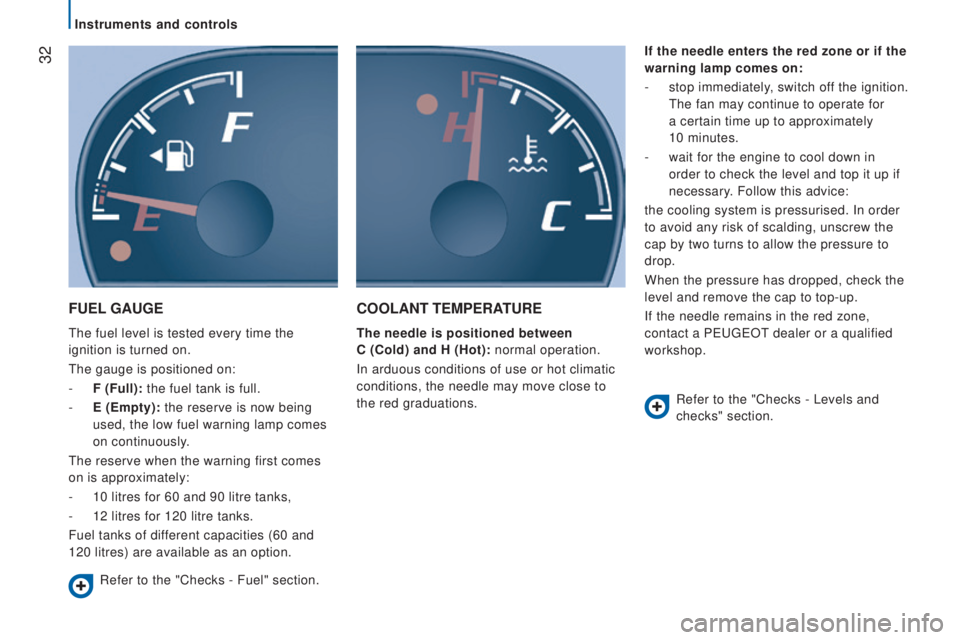
FuEL GAuGE
the fuel level is tested every time the
ignition is turned on.
the gauge is positioned on:
-
F (Full): the fuel tank is full.
-
E (Empty): the reserve is now being
used, the low fuel warning lamp comes
on continuously.
the reserve when the warning first comes
on is approximately:
-
10 litres for 60 and 90 litre tanks,
-
12 litres for 120 litre tanks.
Fuel tanks of different capacities (60 and
120 litres) are available as an option.
cooLAnt tEMPErAturE
the needle is positioned between
c (cold) and H (Hot):
normal operation.
In arduous conditions of use or hot climatic
conditions, the needle may move close to
the red graduations. If the needle enters the red zone or if the
warning lamp comes on:
-
stop immediately, switch of
f the ignition.
the fan may continue to operate for
a certain time up to approximately
10
minutes.
-
wait for the engine to cool down in
order to check the level and top it up if
necessary. Follow this advice:
the cooling system is pressurised. In order
to avoid any risk of scalding, unscrew the
cap by two turns to allow the pressure to
drop.
When the pressure has dropped, check the
level and remove the cap to top-up.
If the needle remains in the red zone,
contact a PeugeOt dealer or a qualified
workshop.
Refer to the "Checks - Fuel" section. Refer to the "Checks - Levels and
checks" section.
Instruments and controls
Page 37 of 276
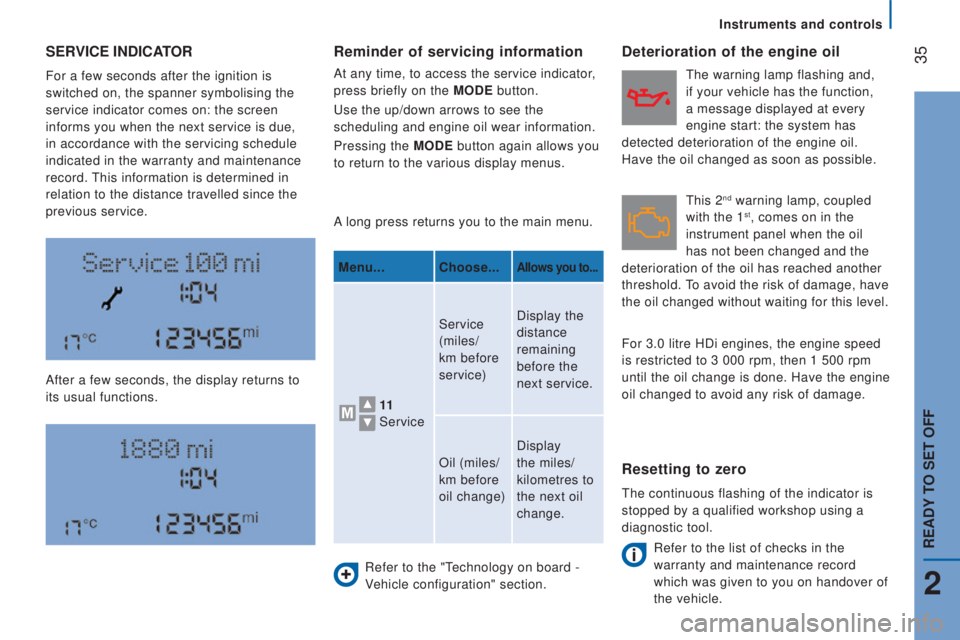
35SErVIcE IndIcAtor
For a few seconds after the ignition is
switched on, the spanner symbolising the
service indicator comes on: the screen
informs you when the next service is due,
in accordance with the servicing schedule
indicated in the warranty and maintenance
record.
this information is determined in
relation to the distance travelled since the
previous service.
After a few seconds, the display returns to
its usual functions. A long press returns you to the main menu.
Refer to the "
technology on board -
V
ehicle configuration" section.
deterioration of the engine oil
Refer to the list of checks in the
warranty and maintenance record
which was given to you on handover of
the vehicle.
reminder of servicing information
At any time, to access the service indicator,
press briefly on the M
odE
button.
use the up/down arrows to see the
scheduling and engine oil wear information.
Pressing the M
odE
button again allows you
to return to the various display menus.
Menu...
choose...Allows you to...
11
Service Service
(miles/
km before
service)
Display the
distance
remaining
before the
next service.
Oil (miles/
km before
oil change) Display
the miles/
kilometres to
the next oil
change.
resetting to zero
the continuous flashing of the indicator is
stopped by a qualified workshop using a
diagnostic tool.
this 2nd warning lamp, coupled
with the 1st, comes on in the
instrument panel when the oil
has not been changed and the
deterioration of the oil has reached another
threshold.
to avoid the risk of damage, have
the oil changed without waiting for this level.
the warning lamp flashing and,
if your vehicle has the function,
a message displayed at every
engine start: the system has
detected deterioration of the engine oil.
Have the oil changed as soon as possible.
For 3.0 litre HDi engines, the engine speed
is restricted to 3 000 rpm, then 1 500 rpm
until the oil change is done. Have the engine
oil changed to avoid any risk of damage.
2
rEAdY to SEt oFF
Instruments and controls
Page 40 of 276
38
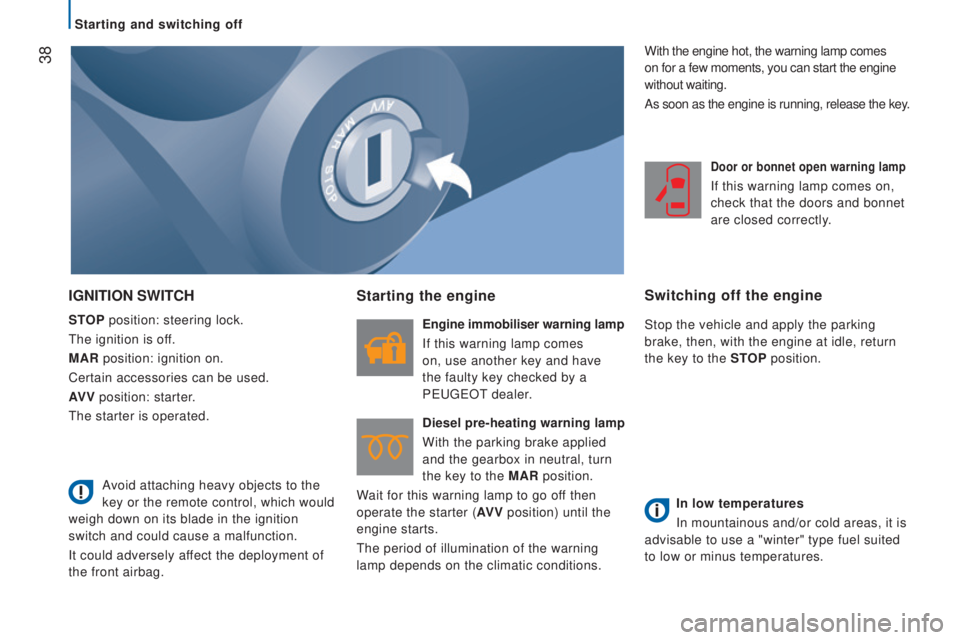
IGnItIon SWItcH
StoP position: steering lock.
the ignition is of
f.
MA
r position: ignition on.
Certain accessories can be used.
AV
V position: starter.
the starter is operated.
Starting the engine
Engine immobiliser warning lamp
If this warning lamp comes
on, use another key and have
the faulty key checked by a
P
eugeOt dealer.
diesel pre-heating warning lamp
With the parking brake applied
and the gearbox in neutral, turn
the key to the MA
r position.
W
ait for this warning lamp to go off then
operate the starter (AV V position) until the
engine starts.
the period of illumination of the warning
lamp depends on the climatic conditions.
door or bonnet open warning lamp
If this warning lamp comes on,
check that the doors and bonnet
are closed correctly.
Switching off the engine
Stop the vehicle and apply the parking
brake, then, with the engine at idle, return
the key to the S
t
o
P
position.
In low temperatures
In mountainous and/or cold areas, it is
advisable to use a "winter" type fuel suited
to low or minus temperatures.
Avoid attaching heavy objects to the
key or the remote control, which would
weigh down on its blade in the ignition
switch and could cause a malfunction.
It could adversely affect the deployment of
the front airbag. With the engine hot, the warning lamp comes
on for a few moments, you can start the engine
without waiting.
As soon as the engine is running, release the key.
Starting and switching off
Page 41 of 276
39
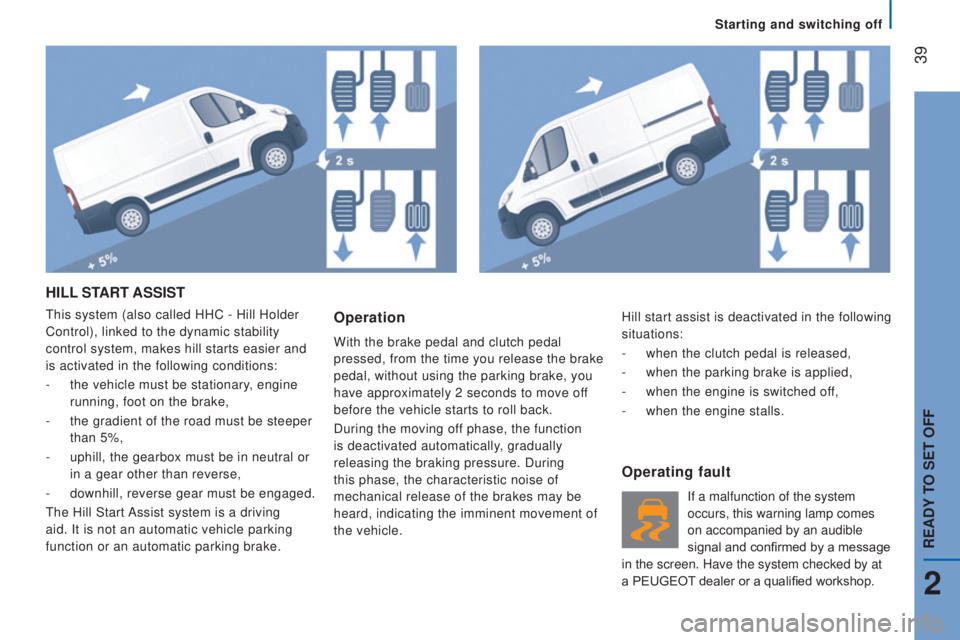
HILL StArt ASSISt
this system (also called HHC - Hill Holder
Control), linked to the dynamic stability
control system, makes hill starts easier and
is activated in the following conditions:
-
the vehicle must be stationary, engine
running, foot on the brake,
-
the gradient of the road must be steeper
than 5%,
-
uphill, the gearbox must be in neutral or
in a gear other than reverse,
-
downhill, reverse gear must be engaged.
the Hill Start
Assist system is a driving
aid. It is not an automatic vehicle parking
function or an automatic parking brake.operation
With the brake pedal and clutch pedal
pressed, from the time you release the brake
pedal, without using the parking brake, you
have approximately 2 seconds to move off
before the vehicle starts to roll back.
During the moving off phase, the function
is deactivated automatically, gradually
releasing the braking pressure. During
this phase, the characteristic noise of
mechanical release of the brakes may be
heard, indicating the imminent movement of
the vehicle.
operating fault
If a malfunction of the system
occurs, this warning lamp comes
on accompanied by an audible
signal and confirmed by a message
in the screen. Have the system checked by at
a PEUGEOT dealer or a qualified workshop. Hill start assist is deactivated in the following
situations:
-
when the clutch pedal is released,
-
when the parking brake is applied,
-
when the engine is switched off,
-
when the engine stalls.
2
rEAdY to SEt oFF
Starting and switching off
Page 44 of 276
42
deactivation
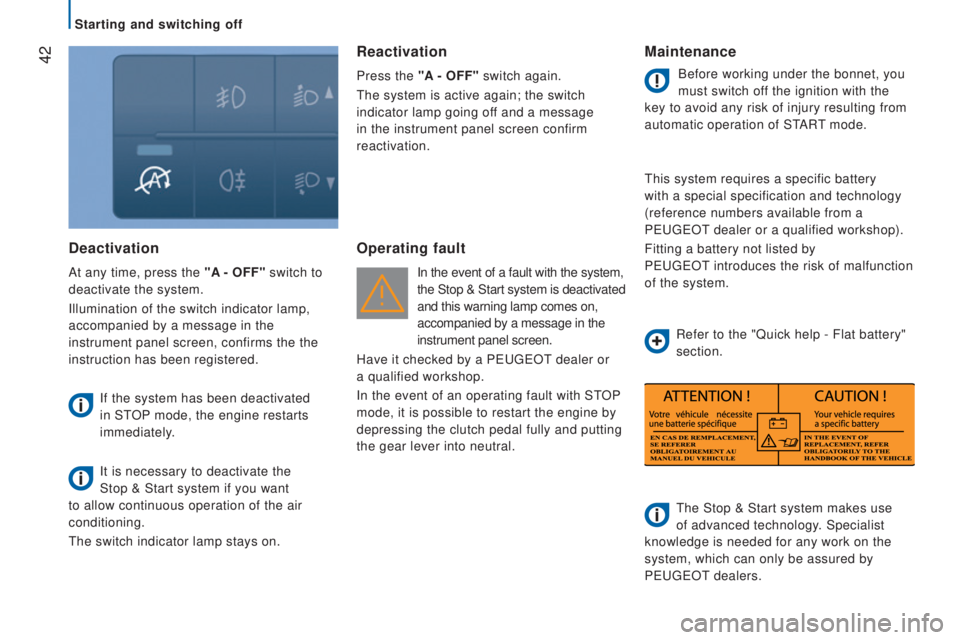
At any time, press the "A - oFF" switch to
deactivate the system.
Illumination of the switch indicator lamp,
accompanied by a message in the
instrument panel screen, confirms the the
instruction has been registered.
If the system has been deactivated
in S
tOP mode, the engine restarts
immediately.
It is necessary to deactivate the
Stop
& Start system if you want
to allow continuous operation of the air
conditioning.
the switch indicator lamp stays on.
reactivation
Press the "A - oFF" switch again.
the system is active again; the switch
indicator lamp going off and a message
in the instrument panel screen confirm
reactivation.
operating fault
In the event of a fault with the system,
the Stop & Start system is deactivated
and this warning lamp comes on,
accompanied by a message in the
instrument panel screen.
Have it checked by a P
eugeOt dealer or
a
qualified workshop.
In the event of an operating fault with S
tOP
mode, it is possible to restart the engine by
depressing the clutch pedal fully and putting
the gear lever into neutral.
Maintenance
Before working under the bonnet, you
must switch off the ignition with the
key to avoid any risk of injury resulting from
automatic operation of S
tARt mode.
this system requires a specific battery
with a special specification and technology
(reference numbers available from a
P
eugeOt dealer or a qualified workshop).
Fitting a battery not listed by
P
eugeOt
introduces the risk of malfunction
of the system.
the Stop & Start system makes use
of advanced technology. Specialist
knowledge is needed for any work on the
system, which can only be assured by
P
eugeOt dealers.
Refer to the "Quick help - Flat battery"
section.
Starting and switching off
Page 45 of 276
43drIVInG rEcoMMEndAtIonS
Observe the driving regulations and remain
vigilant whatever the traffic conditions.
Pay close attention to the traffic and keep
your hands on the wheel so that you are
ready to react at any time to any eventuality.
On a long journey, a break every two hours
is strongly recommended.
In difficult weather, drive smoothly, anticipate
the need to brake and increase the distance
from other vehicles.
driving on flooded roads
We strongly advise against driving on
flooded roads, as this could cause serious
damage to the engine or gearbox, as well as
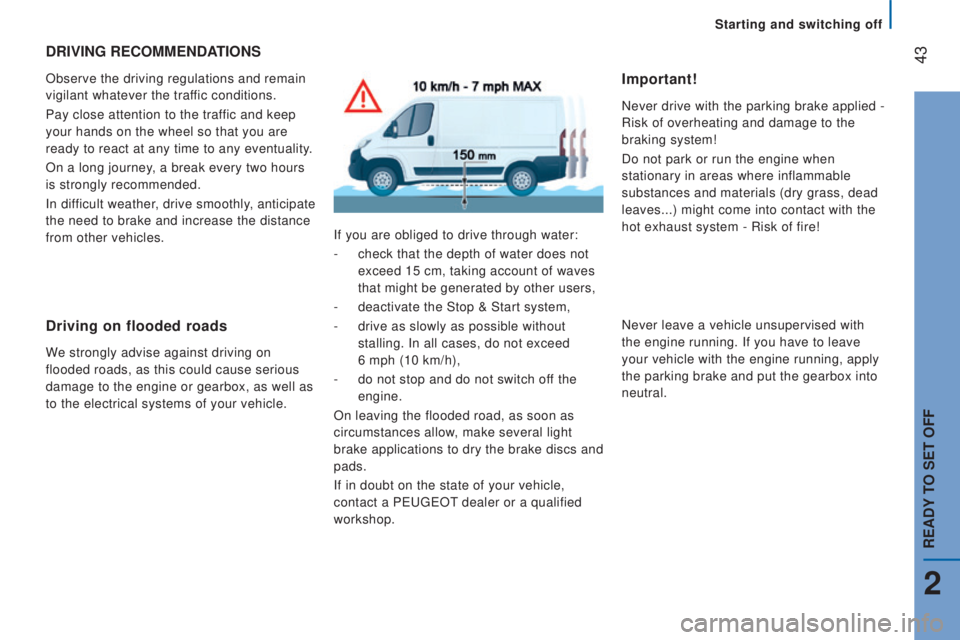
to the electrical systems of your vehicle.If you are obliged to drive through water:
-
check that the depth of water does not
exceed 15 cm, taking account of waves
that might be generated by other users,
-
deactivate the Stop & Start system,
-
drive as slowly as possible without
stalling. In all cases, do not exceed
6 mph (10 km/h),
-
do not stop and do not switch off the
engine.
On leaving the flooded road, as soon as
circumstances allow, make several light
brake applications to dry the brake discs and
pads.
If in doubt on the state of your vehicle,
contact a P
eugeOt dealer or a qualified
workshop.
Important!
Never drive with the parking brake applied -
Risk of overheating and damage to the
braking system!
Do not park or run the engine when
stationary in areas where inflammable
substances and materials (dry grass, dead
leaves...) might come into contact with the
hot exhaust system - Risk of fire!
Never leave a vehicle unsupervised with
the engine running. If you have to leave
your vehicle with the engine running, apply
the parking brake and put the gearbox into
neutral.
2
rEAdY to SEt oFF
Starting and switching off
Page 71 of 276
69
Have the additional heating checked at
least once a year at the beginning of
winter. Maintenance and repairs should only
be carried out by a P
eugeOt dealer or a
qualified workshop.
use only genuine replacement parts.
Switching off the heating
In the case of deferred operation, the
heating stops at the end of the programmed
period.
Good practice
to avoid any risk of poisoning or
asphyxiation, the additional heating must
not be used, even for short periods, in
an enclosed space such as a garage or
workshop which is not fitted with an exhaust
gas extraction system.
the additional heating switches of
f when the
battery voltage is low, so as to allow engine
starting.
the additional heating is supplied by the
vehicle's fuel tank.
ensure that the low fuel
warning lamp is not on.
Always switch off the additional heating
when filling with fuel to avoid any risk of fire
or explosion.
the temperature near the heater must not
exceed 120
°C.
A temperature higher than
this (for example in the case of painting in
an oven) could damage the components of
the electronic circuits.
the additional heating is fitted with
a temperature limiter which cuts off
the combustion in the event of engine
overheating due to a lack of coolant. Check
the level and if necessary top-up following
the advice given in the "Checks - Levels"
section.
then press the programme
selection button before switching the heating
on again.
Setting the operating period
the period of operation can be set to
between 10 and 60 minutes.
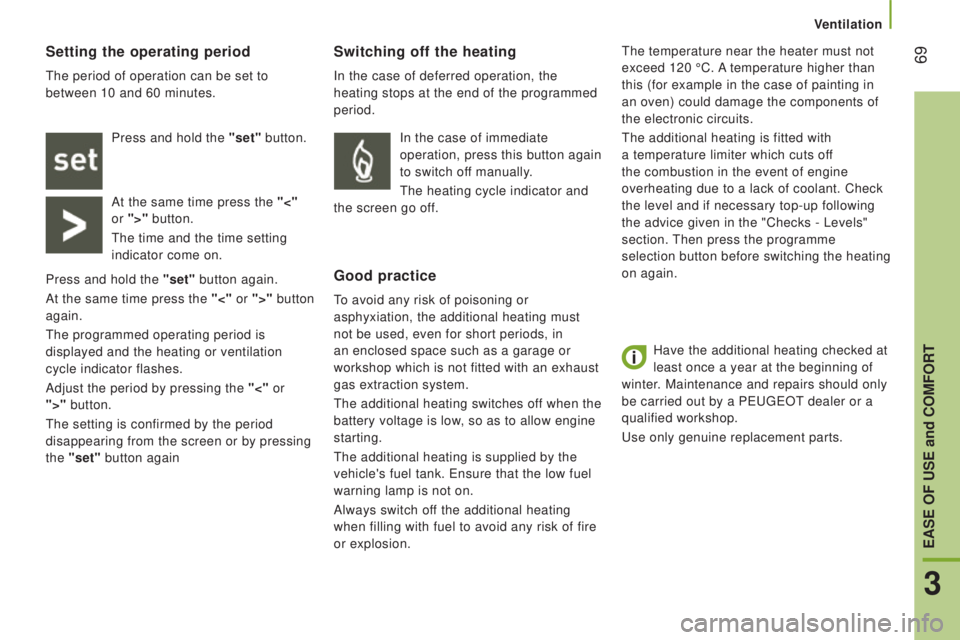
Press and hold the "set"
button.
At the same time press the "<"
or ">" button.
the time and the time setting
indicator come on.
Press and hold the "set" button again.
At the same time press the "<" or ">" button
again.
the programmed operating period is
displayed and the heating or ventilation
cycle indicator flashes.
Adjust the period by pressing the "<" or
">" button.
the setting is confirmed by the period
disappearing from the screen or by pressing
the "set" button again In the case of immediate
operation, press this button again
to switch off manually.
the heating cycle indicator and
the screen go off.
3
EASE oF uSE and coMFort
Ventilation
Page 103 of 276
101
trAjEctorY controL SYStEMS
Switching off
this system cannot be deactivated by the
driver.
dynamic stability control
(dSc)
the electronic stability programme acts on
the brake of one or more wheels and on the
engine to keep the vehicle on the trajectory
required by the driver, within the limits of the
laws of physics.
With the DSC system, maintain course
without trying to countersteer.
operation
the DSC system is activated automatically
each time the vehicle is started.
operating fault
Illumination of this warning lamp,
accompanied by an audible signal
and confirmed by a message
in the instrument panel screen,
indicates a fault with the DSC system.
Have it checked by a P
eugeOt dealer or a
qualified workshop.
operation
this system is activated automatically every
time the vehicle is started.
In the event of a problem of adhesion or
trajectory, this system comes into play.
Switching off
In exceptional conditions (starting a vehicle
which is bogged down, stuck in snow,
on soft ground...), it may be advisable to
deactivate the ASR system, so that the
wheels can spin freely and regain grip.
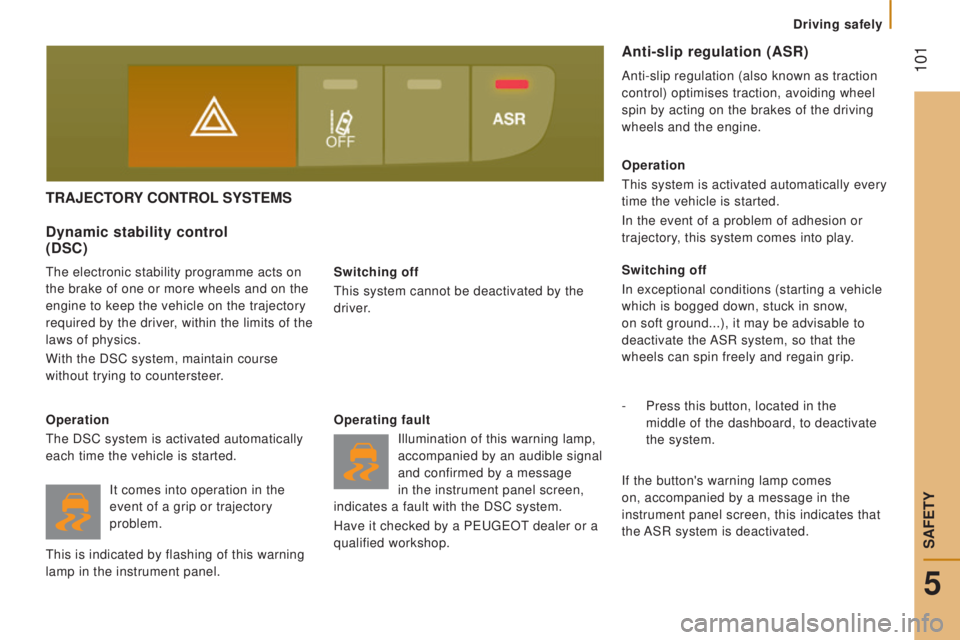
-
Press this button, located in the
middle of the dashboard, to deactivate
the
system.
Anti-slip regulation (ASr)
Anti-slip regulation (also known as traction
control) optimises traction, avoiding wheel
spin by acting on the brakes of the driving
wheels and the engine.
If the button's warning lamp comes
on, accompanied by a message in the
instrument panel screen, this indicates that
the ASR system is deactivated.
It comes into operation in the
event of a grip or trajectory
problem.
this is indicated by flashing of this warning
lamp in the instrument panel.
5
Driving safely
SAFetY
Page 106 of 276
104
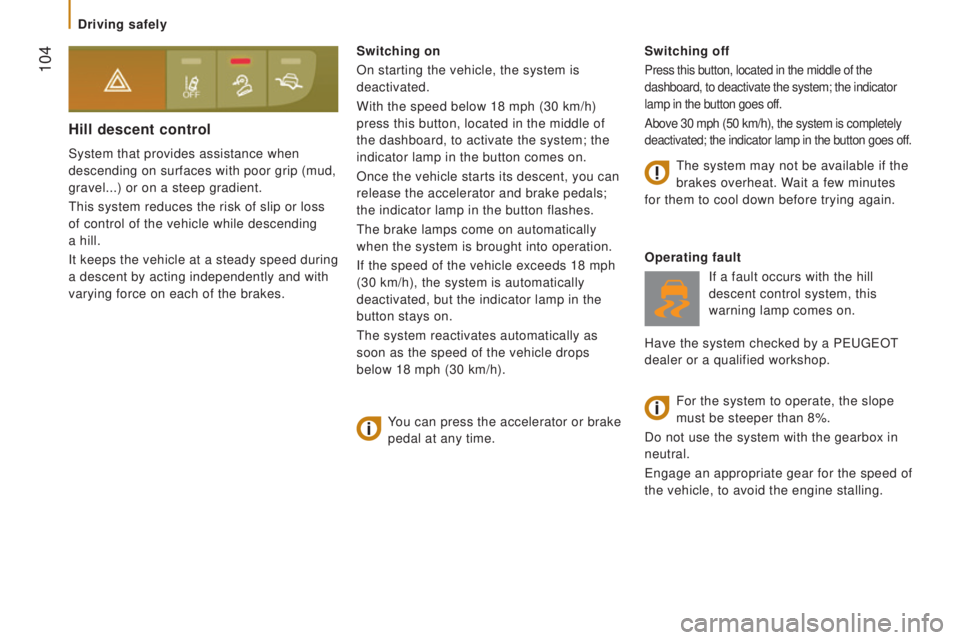
Hill descent control
System that provides assistance when
descending on surfaces with poor grip (mud,
gravel...) or on a steep gradient.
this system reduces the risk of slip or loss
of control of the vehicle while descending
a hill.
It keeps the vehicle at a steady speed during
a descent by acting independently and with
varying force on each of the brakes. Switching off
Press this button, located in the middle of the
dashboard, to deactivate the system; the indicator
lamp in the button goes off.
Above 30 mph (50 km/h), the system is completely
deactivated; the indicator lamp in the button goes off.
operating fault
If a fault occurs with the hill
descent control system, this
warning lamp comes on.
Have the system checked by a P
eugeOt
dealer or a qualified workshop.
Switching on
On starting the vehicle, the system is
deactivated.
With the speed below 18 mph (30 km/h)
press this button, located in the middle of
the dashboard, to activate the system; the
indicator lamp in the button comes on.
Once the vehicle starts its descent, you can
release the accelerator and brake pedals;
the indicator lamp in the button flashes.
the brake lamps come on automatically
when the system is brought into operation.
If the speed of the vehicle exceeds 18 mph
(30 km/h), the system is automatically
deactivated, but the indicator lamp in the
button stays on.
the system reactivates automatically as
soon as the speed of the vehicle drops
below 18 mph (30 km/h).
For the system to operate, the slope
must be steeper than 8%.
Do not use the system with the gearbox in
neutral.
engage an appropriate gear for the speed of
the vehicle, to avoid the engine stalling.
You can press the accelerator or brake
pedal at any time.
the system may not be available if the
brakes overheat. Wait a few minutes
for them to cool down before trying again.
Driving safely
Page 108 of 276
106
cAB SEAt BELtS
If you install a front bench seat as
an accessory, it it must be fitted with
approved seat belts.
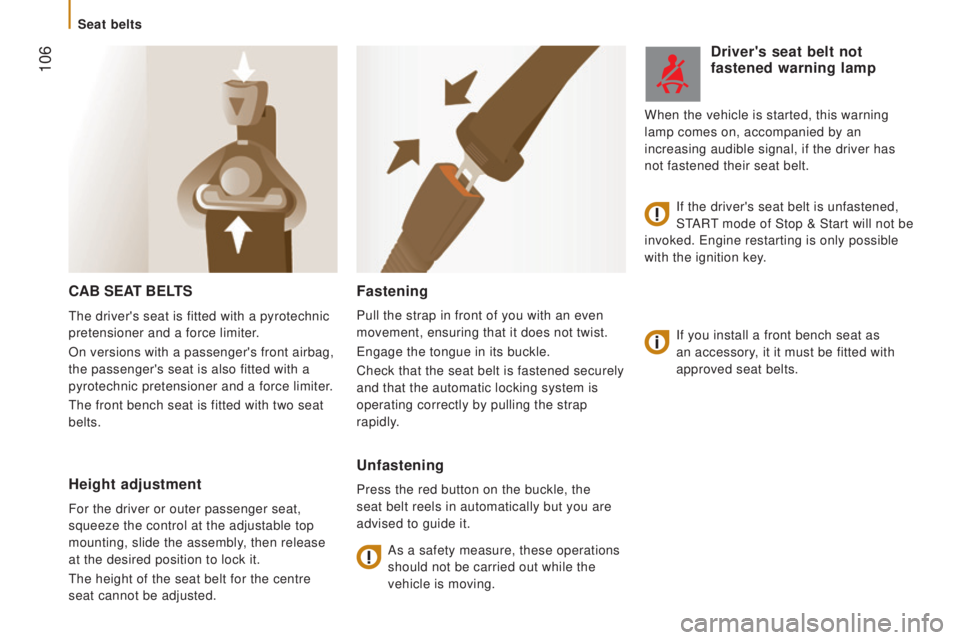
Fastening
Pull the strap in front of you with an even
movement, ensuring that it does not twist.
engage the tongue in its buckle.
Check that the seat belt is fastened securely
and that the automatic locking system is
operating correctly by pulling the strap
rapidly.
unfastening
Press the red button on the buckle, the
seat belt reels in automatically but you are
advised to guide it.
As a safety measure, these operations
should not be carried out while the
vehicle is moving.
driver's seat belt not
fastened warning lamp
If the driver's seat belt is unfastened,
S
tARt mode of Stop & Start will not be
invoked.
engine restarting is only possible
with the ignition key. When the vehicle is started, this warning
lamp comes on, accompanied by an
increasing audible signal, if the driver has
not fastened their seat belt.
the driver's seat is fitted with a pyrotechnic
pretensioner and a force limiter.
On versions with a passenger's front airbag,
the passenger's seat is also fitted with a
pyrotechnic pretensioner and a force limiter.
the front bench seat is fitted with two seat
belts.
Height adjustment
For the driver or outer passenger seat,
squeeze the control at the adjustable top
mounting, slide the assembly, then release
at the desired position to lock it.
the height of the seat belt for the centre
seat cannot be adjusted.
Seat belts