lock PEUGEOT BOXER 2015 Owner's Guide
[x] Cancel search | Manufacturer: PEUGEOT, Model Year: 2015, Model line: BOXER, Model: PEUGEOT BOXER 2015Pages: 276, PDF Size: 8.99 MB
Page 122 of 276
120
Good practice
children at the front
the legislation on carrying a child on the
front passenger seat is specific to each
country. Refer to the legislation in force in
your country.
Deactivate the passenger's airbag when a
rearward facing child seat is installed on the
front seat.
Otherwise, the child would risk being
seriously injured or killed if the airbag were
deployed. As a safety precaution, never leave:
-
one or more children alone and
unsupervised in a vehicle,
-
a child or an animal in a vehicle which
is exposed to the sun, with the windows
closed,
-
the keys within reach of children inside
the vehicle.
to prevent accidental opening of the doors,
use the "Child Lock".
take care not to open the rear windows by
more than one third.
to protect young children from the rays of
the sun, fit side blinds to the rear windows. Installing a booster seat
the chest part of the seat belt must be
positioned on the child's shoulder without
touching the neck.
ensure that the lap part of the seat belt
passes correctly over the child's thighs.
P
eugeOt recommends the use of a
booster seat which has a back, fitted with a
seat belt guide at shoulder level.
For the optimum installation of a forward
facing child seat, ensure that the back of
the child seat is as close as possible to the
backrest of the vehicle's seat, or in contact
if possible.
the head restraint must be removed before
installing a child seat with a backrest on the
passenger seat.
ensure that the head restraint is stowed or
attached securely so that it is not thrown
around the vehicle in the event of sharp
braking.
Refit the head restraint as soon as the child
seat is removed.
At the rear, always leave sufficient space
between the front seat and:
-
a rearward facing child seat,
-
the feet of a child seated in a forward
facing child seat.
For this, move the front seat forward and, if
necessary, straighten its backrest as well.
the incorrect installation of a child seat in a
vehicle compromises the child's protection in
the event of an accident.
Check that there is no seat belt or seat belt
buckle under the child seat, as this could
destabilise the seat.
Remember to fasten the seat belts or the
child seat harnesses keeping the slack
relative to the child's body to a minimum,
even for short journeys.
For the installation of a child seat using
the seat belt, ensure that the seat belt is
well tensioned on the child seat and that
it is holding the child seat firmly against
the vehicle's seat. If the passenger seat is
adjustable, move it forward if necessary.
Child safety
Page 126 of 276
124
otHEr AccESSorIES
these accessories and parts, having been
tested and approved for reliability and
safety
, are all adapted to your vehicle. A
wide range of recommended and genuine
parts is available.
"comfort":
Air deflectors, insulated module, scented air
fresheners, reading lamp, cigarette lighter,
portable ashtray, non-slip seat cushions
,rear parking sensors...
"Protection":
Mats, mudflaps, vehicle protective cover,
seat covers, security grills for rear door
windows, twin rear security doors with
security locks, paint touch-up...
"Security":
Anti-intrusion alarm, vehicle tracking system,
snow chains, non-slip covers, child seats,
first aid kit, warning triangle, high visibility
vest, fire extinguisher, pet safety belt, seat
belt cutter / glass hammer...
"Style":
Alloy wheels...
"Multimedia":
CD player, Wi-Fi on Board, semi-integral
satellite navigation system, hands-free kits,
driving aids, rear multimedia support, DVD
player, navigation mapping update, portable
satellite navigation systems, telephone
carrier, aftermarket digital radio, audio
systems...
"transport solutions":
towbars, towbar wiring harness with
7/13
connector
, 7/7 connector, 13 connector,
interior protection kits, non-slip floor, wheel
arch protector, cab dividers, transverse roof
bars, roof racks, ladder for roof rack, roof
loading runners, loading plate for roof rack... Installation of radiocommunication
transmitters
You are advised to contact a P
eugeOt
dealer before installing accessory
radiocommunication transmitters with
external aerial on your vehicle.
P
eugeOt dealers can advise you on
the specifications (frequency waveband,
maximum output power, aerial position,
specific installation conditions) of the
transmitters which can be fitted, in
accordance with the Vehicle
electromagnetic
Compatibility Directive (2004/104/
eC).
the fitting of electrical equipment or
accessories which are not listed by
P
eugeOt may result in the failure of your
vehicle's electronic system.
W
e request that you take note of this point
and recommend that you contact a dealer
to be shown the range of recommended
equipment and accessories.
Depending on the country in which the
vehicle is sold or operated, it may be
compulsory to have a high visibility vest,
warning triangle, replacement bulbs and
breathalyzer in the vehicle.
to prevent the mat from becoming
caught under the pedals:
-
ensure that the mat and its fixings are
positioned correctly
,
-
never fit one mat on top of another.
equipment
Page 135 of 276
133
operating fault
If this alert persists, do not ignore the
warning; it indicates that a fault has occurred
in the exhaust / particle filter system.
Have the whole system checked by a
P
eugeOt dealer or a qualified workshop.
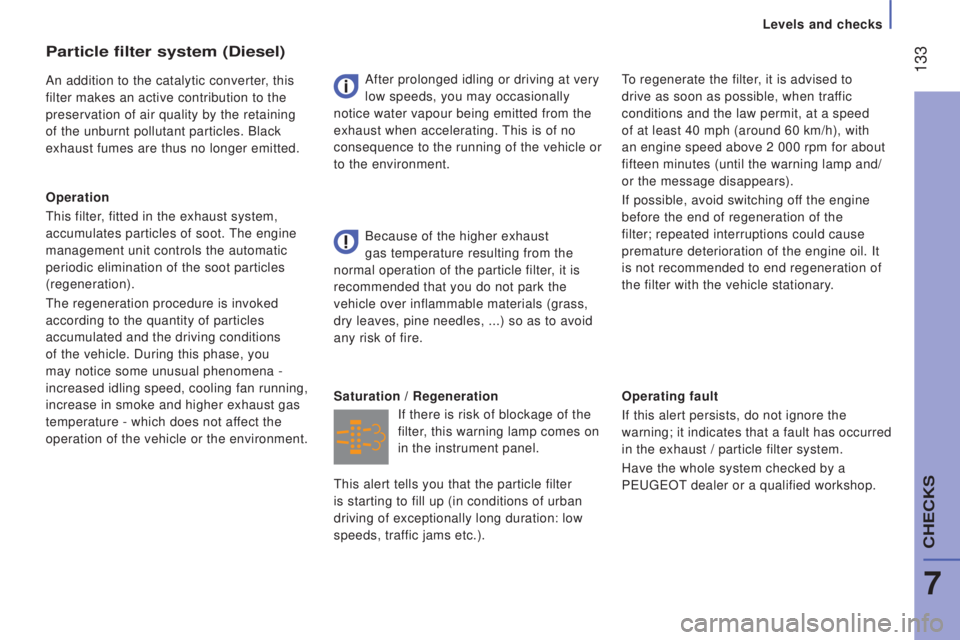
If there is risk of blockage of the
filter
, this warning lamp comes on
in the instrument panel.
Saturation / regeneration
Because of the higher exhaust
gas temperature resulting from the
normal operation of the particle filter, it is
recommended that you do not park the
vehicle over inflammable materials (grass,
dry leaves, pine needles,
...) so as to avoid
any risk of fire.
Particle filter system (diesel)
An addition to the catalytic converter, this
filter makes an active contribution to the
preservation of air quality by the retaining
of the unburnt pollutant particles. Black
exhaust fumes are thus no longer emitted.
operation
this filter
, fitted in the exhaust system,
accumulates particles of soot.
the engine
management unit controls the automatic
periodic elimination of the soot particles
(regeneration).
the regeneration procedure is invoked
according to the quantity of particles
accumulated and the driving conditions
of the vehicle. During this phase, you
may notice some unusual phenomena
-
increased idling speed, cooling fan running,
increase in smoke and higher exhaust gas
temperature
- which does not af
fect the
operation of the vehicle or the environment. After prolonged idling or driving at very
low speeds, you may occasionally
notice water vapour being emitted from the
exhaust when accelerating.
this is of no
consequence to the running of the vehicle or
to the environment.to regenerate the filter, it is advised to
drive as soon as possible, when traffic
conditions and the law permit, at a speed
of at least 40
mph (around 60 km/h), with
an engine speed above 2 000 rpm for about
fifteen
minutes (until the warning lamp and/
or the message disappears).
If possible, avoid switching of
f the engine
before the end of regeneration of the
filter; repeated interruptions could cause
premature deterioration of the engine oil. It
is not recommended to end regeneration of
the filter with the vehicle stationary.
this alert tells you that the particle filter
is starting to fill up (in conditions of urban
driving of exceptionally long duration: low
speeds, traffic jams etc.).
7
CHeCKS
Levels and checks
Page 136 of 276
134
Low fuel level
rEFuELLInG
In low temperatures
In mountainous and/or cold areas, it is
advisable to use a "winter" type fuel suited
to low or minus temperatures.With Stop & Start, never refuel with
the system in S
tOP mode; you must
switch off the ignition with the key. When the fuel tank level E
(
empty) is reached, this warning
lamp comes on.
You then have around 10 to
12 litres in the reserve, depending on the
capacity of the tank, the engine type, the
driving conditions and the profile of the road.
Refuel without delay to avoid running out of
fuel.
the capacity of the fuel tank is
approximately 90 litres.
Fuel tanks of different capacities, 60
and
120 litres, may be fitted.
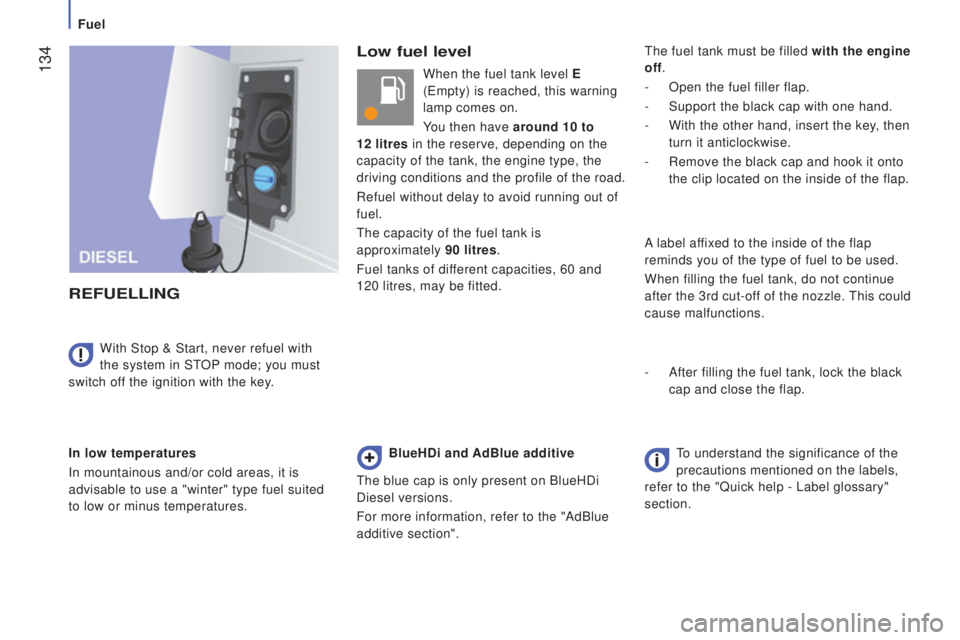
the fuel tank must be filled
with the engine
off.
-
Open the fuel filler flap.
-
Support the black cap with one hand.
-
With the other hand, insert the key, then
turn it anticlockwise.
-
Remove the black cap and hook it onto
the clip located on the inside of the flap.
A
label affixed to the inside of the flap
reminds you of the type of fuel to be used.
When filling the fuel tank, do not continue
after the 3rd cut-off of the nozzle.
this could
cause malfunctions.
-
After filling the fuel tank, lock the black
cap and close the flap.
BlueH
di and AdBlue additive
the blue cap is only present on BlueHDi
Diesel versions.
For more information, refer to the "AdBlue
additive section".to understand the significance of the
precautions mentioned on the labels,
refer to the "Quick help - Label glossary"
section.
Fuel
Page 137 of 276
135
FuEL SYStEM cut-oFF
After the collision and before restore
these supplies, check that there is no
fuel leak or sparks, to avoid the risk of fire. In the event of a collision, a device
automatically cuts off the fuel supply
from the engine and cuts off the vehicle's
electrical supply.
It triggers operation of the hazard warning
lamps and courtesy lamps, and unlocking of
the doors.
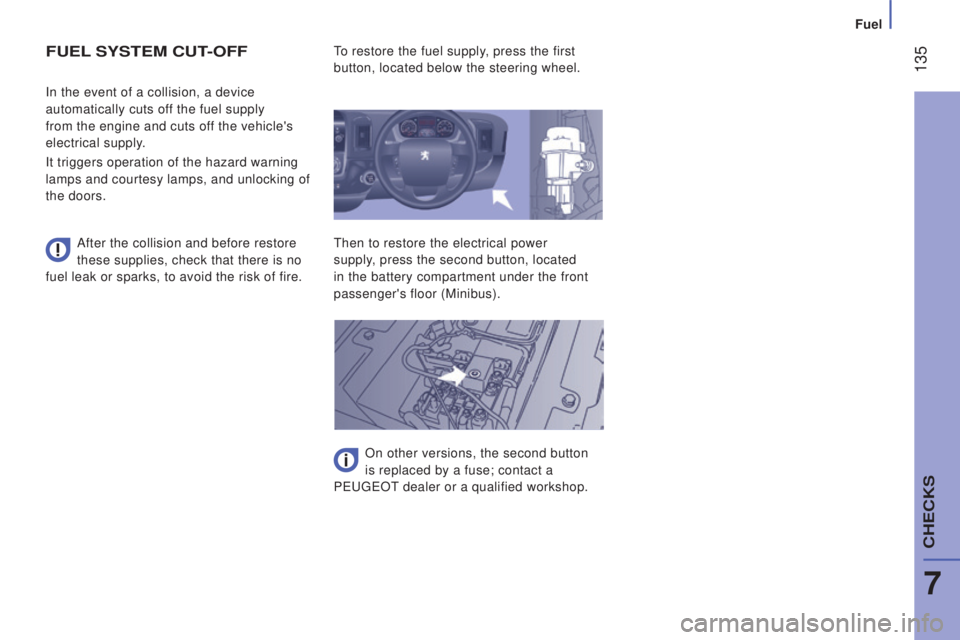
to restore the fuel supply, press the first
button, located below the steering wheel.then to restore the electrical power
supply, press the second button, located
in the battery compartment under the front
passenger's floor (Minibus).
On other versions, the second button
is replaced by a fuse; contact a
P
eugeOt dealer or a qualified workshop.
7
CHeCKS
Fuel
Page 142 of 276
140
refilling / topping-up the
AdBlue® additive
Precautions to take
use
only AdBlue® additive that meets the
ISO 22241 standard.
the AdBlue® additive is an urea-based
solution.
this liquid is non-flammable, colourless and
odourless.
to be kept in a cool area.
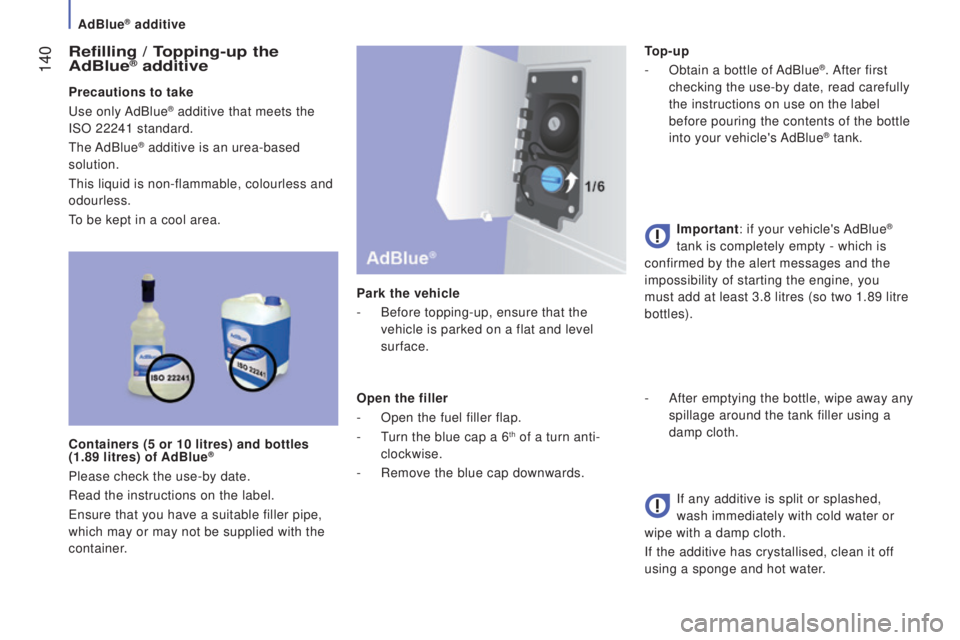
containers (5 or 10 litres) and bottles
(1.89 litres) of AdBlue
®
Please check the use-by date.
Read the instructions on the label.
ensure that you have a suitable filler pipe,
which may or may not be supplied with the
container. Park the vehicle
-
Before topping-up, ensure that the
vehicle is parked on a flat and level
surface.
open the filler
-
Open the fuel filler flap.
-
t
urn the blue cap a 6th of a turn anti-
clockwise.
-
Remove the blue cap downwards.
top-up
-
Obtain a bottle of AdBlue®. After first
checking the use-by date, read carefully
the instructions on use on the label
before pouring the contents of the bottle
into your vehicle's AdBlue
® tank.
Important: if your vehicle's AdBlue
®
tank is completely empty - which is
confirmed by the alert messages and the
impossibility of starting the engine, you
must add at least 3.8 litres (so two 1.89 litre
bottles).
-
After emptying the bottle, wipe away any
spillage around the tank filler using a
damp cloth.
If any additive is split or splashed,
wash immediately with cold water or
wipe with a damp cloth.
If the additive has crystallised, clean it off
using a sponge and hot water.
AdBlue® additive
Page 143 of 276
141
refit the filler cap
-
Refit the blue cap to the tank and turn it
a 6th of a turn clockwise, to its stop.
-
Close the filler flap.
Never dispose of AdBlue
® additive
bottles in the household waste. Place
them in a special container provided this
purpose or take them to your dealer.
Keep AdBlue
® out of the reach of
children, in its original container.
Never transfer AdBlue
® to another container:
it would loose its purity.
Never dilute the additive with water.
Never pour the additive into the Diesel fuel
tank.
recommendations on storage
Never store containers or bottles of
AdBlue® in your vehicle. Freezing of the AdBlue
® additive
AdBlue® freezes at about -11°C (12.2° F)
and deteriorates above 25°C (77°F).
It is recommended that containers and
bottles be stored in a cool area and
protected from direct sunlight.
under these conditions, the additive can be
kept for at least a year.
Additive that has been frozen can be used
once it has thawed out in ambient air.
the SCR system includes an
AdBlue
®
tank heater that ensures operation of
the vehicle in normal conditions.
In exceptional situations, such as when the
vehicle is kept at temperatures below -15°C
(5°F) for a long period, there may be an
emission fault alert related to freezing of the
AdBlue
® additive.
Park the vehicle in an area at a more
moderate temperature for a few hours until
the additive becomes a liquid again.
the emissions warning lamp does not go of
f
immediately, but does so after a few miles
of driving.
AdBlue® additive
7
CHeCKS
Page 146 of 276
144
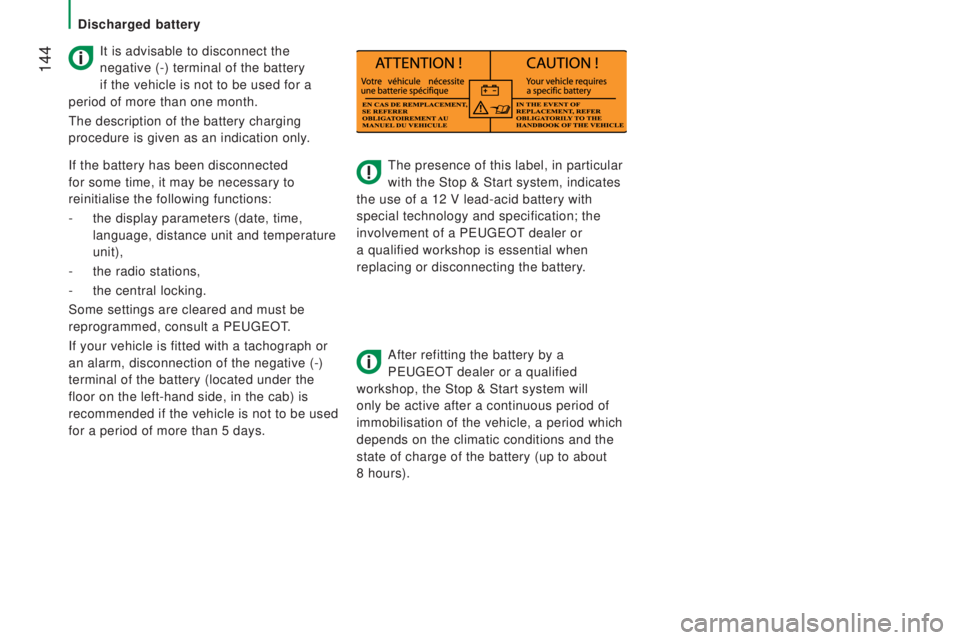
the presence of this label, in particular
with the Stop & Start system, indicates
the use of a 12 V lead-acid battery with
special technology and specification; the
involvement of a P
eugeOt dealer or
a qualified workshop is essential when
replacing or disconnecting the battery.
After refitting the battery by a
P
eugeOt dealer or a qualified
workshop, the Stop & Start system will
only be active after a continuous period of
immobilisation of the vehicle, a period which
depends on the climatic conditions and the
state of charge of the battery (up to about
8 hours).
It is advisable to disconnect the
negative (-) terminal of the battery
if the vehicle is not to be used for a
period of more than one month.
the description of the battery charging
procedure is given as an indication only.
If the battery has been disconnected
for some time, it may be necessary to
reinitialise the following functions:
-
the display parameters (date, time,
language, distance unit and temperature
unit),
-
the radio stations,
-
the central locking.
Some settings are cleared and must be
reprogrammed, consult a P
eugeOt.
If your vehicle is fitted with a tachograph or
an alarm, disconnection of the negative (-)
terminal of the battery (located under the
floor on the left-hand side, in the cab) is
recommended if the vehicle is not to be used
for a period of more than 5 days.
Discharged battery
Page 148 of 276
 Allocation
12 7.5Right-hand dipped headlamp
13 7.5Left-hand dipped headlamp
31 5
engine compartment control unit relay - Dashboard control unit relay (ig\
nition switch +)
32 7.5Cabi")
146FusesA (amps) Allocation
12 7.5Right-hand dipped headlamp
13 7.5Left-hand dipped headlamp
31 5
engine compartment control unit relay - Dashboard control unit relay (ig\
nition switch +)
32 7.5Cabin lighting (battery +)
33 7.5Battery check sensor on Stop & Start version (battery +)
34 7.5Minibus interior lighting - Hazard warning lamps
36 10Audio system -
Air conditioning controls - Alarm -
tachograph - Battery cut-off control unit -
Additional heating programmer (battery +)
37 7.5Brake lamp switch -
third brake lamp Instrument panel (ignition +)
38 20Central door locking (battery +)
42 5ABS control unit and sensor -
ASR sensor - DSC sensor - Brake lamp switch
43 20Windscreen wiper motor (ignition switch +)
47 20Driver's electric window motor
48 20Passenger's electric window motor
49 5Parking sensors control unit - Audio system - Steering mounted controls - Centre and side switch panels\
-
Auxiliary switch panel - Battery cut-off control unit (ignition switch +)
50 7.5Airbags and pre-tensioners control unit
51 5
tachograph - Power steering control unit - Air conditioning - Reversing lamps - W
ater in Diesel sensor -
Air flow sensor (ignition switch +)
53 7.5Instrument panel (battery +)
89 -Not used
90 7.5Left-hand main beam
91 7.5Right-hand main beam
92 7.5Left-hand front foglamp
93 7.5Right-hand front foglamp
Failed fuse
Page 151 of 276
149When using a high pressure washer
on stubborn dirt, do not persist on
the headlamps, the lamps and their edges
to avoid damaging their lacquer finish and
seals.
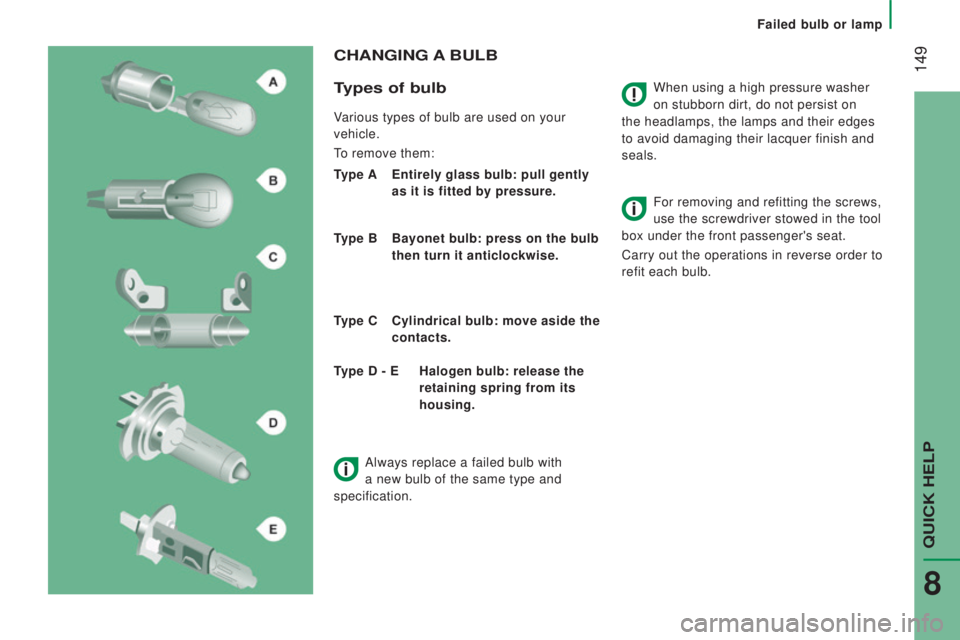
cHAnGInG A BuLB
t
ypes of bulb
Various types of bulb are used on your
vehicle.
to remove them:
type A Entirely glass bulb: pull gently
as it is fitted by pressure.
type B
Bayonet bulb: press on the bulb
then turn it anticlockwise.
type c
c
ylindrical bulb: move aside the
contacts. For removing and refitting the screws,
use the screwdriver stowed in the tool
box under the front passenger's seat.
Carry out the operations in reverse order to
refit each bulb.
type d - E
Halogen bulb: release the
retaining spring from its
housing.
Always replace a failed bulb with
a new bulb of the same type and
specification.
QuICK HeLP
8
Failed bulb or lamp