Fuel Peugeot Boxer 2018 Owner's Guide
[x] Cancel search | Manufacturer: PEUGEOT, Model Year: 2018, Model line: Boxer, Model: Peugeot Boxer 2018Pages: 232, PDF Size: 9.09 MB
Page 120 of 232
118
Compatibility of fuels
Fuel used for Diesel
engines
The Diesel engines are compatible with
biofuels that conform to current and future
European standards and which can be
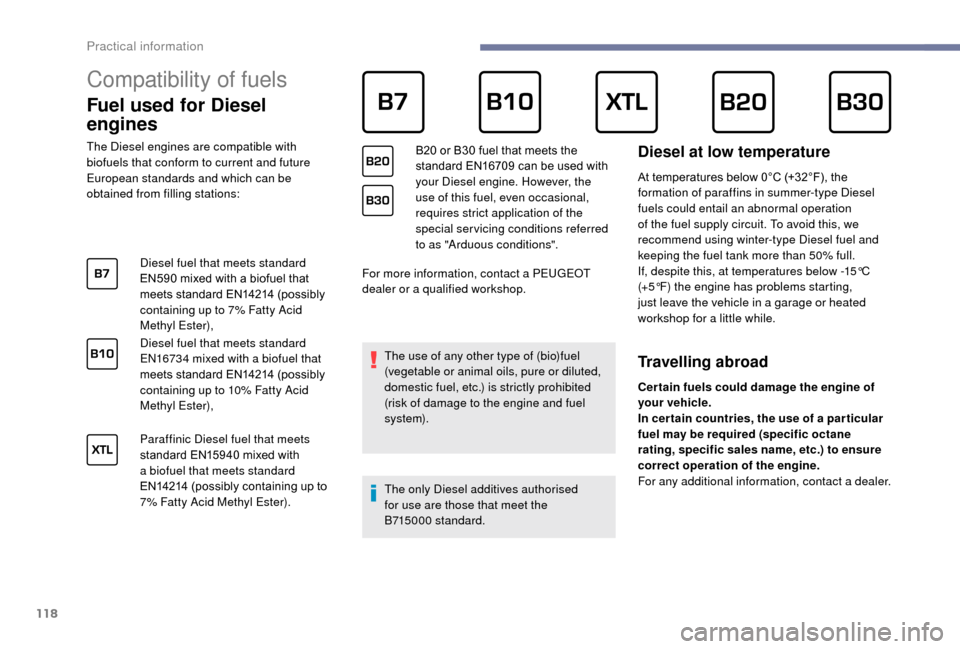
obtained from filling stations:Diesel fuel that meets standard
EN590
mixed with a biofuel that
meets standard EN14214 (possibly
containing up to 7% Fatty Acid
Methyl Ester),
Diesel fuel that meets standard
EN16734
mixed with a biofuel that
meets standard EN14214 (possibly
containing up to 10% Fatty Acid
Methyl Ester),
Paraffinic Diesel fuel that meets
standard EN15940
mixed with
a
biofuel that meets standard
EN14214 (possibly containing up to
7% Fatty Acid Methyl Ester). For more information, contact a
PEUGEOT
dealer or a
qualified workshop.
The use of any other type of (bio)fuel
(vegetable or animal oils, pure or diluted,
domestic fuel, etc.) is strictly prohibited
(risk of damage to the engine and fuel
syste m).
The only Diesel additives authorised
for use are those that meet the
B715000
standard.Diesel at low temperature
At temperatures below 0°C (+32°F), the
formation of paraffins in summer-type Diesel
fuels could entail an abnormal operation
of the fuel supply circuit. To avoid this, we
recommend using winter-type Diesel fuel and
keeping the fuel tank more than 50% full.
If, despite this, at temperatures below -15°C
(+5°F) the engine has problems starting,
just leave the vehicle in a garage or heated
workshop for a
little while.
B20
or B30
fuel that meets the
standard EN16709
can be used with
your Diesel engine. However, the
use of this fuel, even occasional,
requires strict application of the
special servicing conditions referred
to as "Arduous conditions".
Travelling abroad
Cer tain fuels could damage the engine of
your vehicle.
In cer tain countries, the use of a
par ticular
fuel may be required (specific octane
rating, specific sales name, etc.) to ensure
correct operation of the engine.
For any additional information, contact a dealer.
Practical information
Page 128 of 232
126
Diesel engines
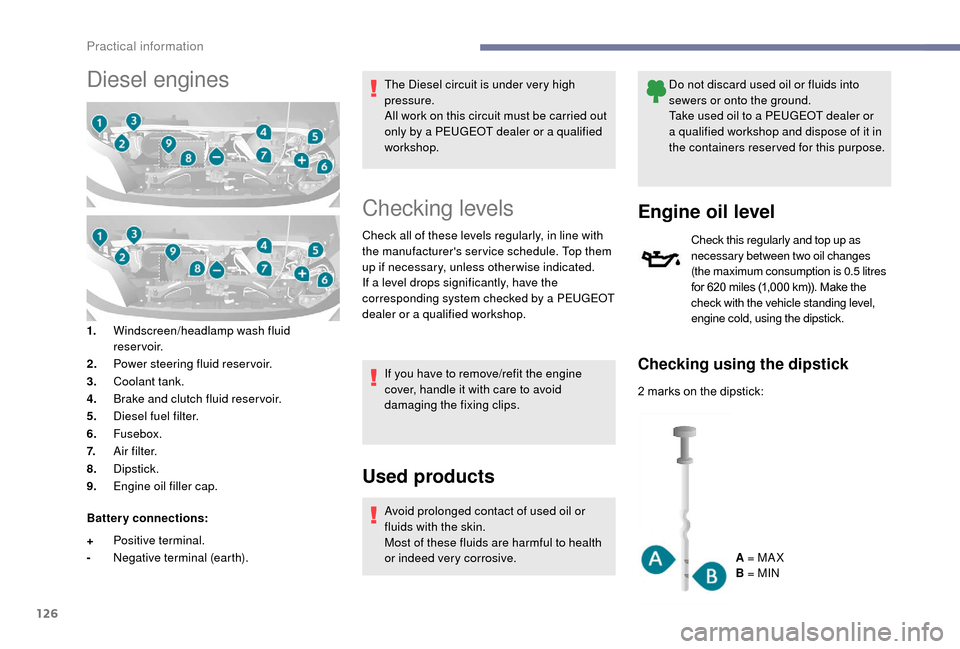
1.Windscreen/headlamp wash fluid
reservoir.
2. Power steering fluid reservoir.
3. Coolant tank.
4. Brake and clutch fluid reser voir.
5. Diesel fuel filter.
6. Fusebox.
7. A i r f i l t e r.
8. Dipstick.
9. Engine oil filler cap.
Battery connections:
+ Positive terminal.
- Negative terminal (earth). The Diesel circuit is under very high
pressure.
All work on this circuit must be carried out
only by a
PEUGEOT dealer or a qualified
workshop.
Checking levels
Check all of these levels regularly, in line with
the manufacturer's service schedule. Top them
up if necessary, unless other wise indicated.
If a
level drops significantly, have the
corresponding system checked by a
PEUGEOT
dealer or a
qualified workshop.
If you have to remove/refit the engine
cover, handle it with care to avoid
damaging the fixing clips.
Used products
Avoid prolonged contact of used oil or
fluids with the skin.
Most of these fluids are harmful to health
or indeed very corrosive. Do not discard used oil or fluids into
sewers or onto the ground.
Take used oil to a
PEUGEOT dealer or
a qualified workshop and dispose of it in
the containers reser ved for this purpose.
Engine oil level
Check this regularly and top up as
necessary between two oil changes
(the maximum consumption is 0.5
litres
for 620
miles (1,000 km)). Make the
check with the vehicle standing level,
engine cold, using the dipstick.
Checking using the dipstick
2 marks on the dipstick:
A = MA X
B = MIN
Practical information
Page 133 of 232
131
Brake disc wear
For information on checking brake
disc wear, contact a PEUGEOT
dealer or a
qualified workshop.
Parking brake
If excessive travel or a loss of
e ffectiveness of this system is
noticed, the parking brake must
be checked, even between two
services.
This system must be checked by a
PEUGEOT
dealer or a
qualified workshop.
Diesel fuel filter
The Diesel fuel filter is located under the
bonnet, close to the brake fluid reser voir. If this warning lamp comes on, the
filter must be purged to remove
water.
You can also purge the fuel filter
regularly, every time the engine oil
is changed.
Purging water from the filterThe HDi engines use advanced technology.
All work must be done by personnel that
have had special training, which can be
ensured by going to a
PEUGEOT dealer or
a
qualified workshop.
Only use products recommended by
PEUGEOT or products of equivalent
quality and specification.
In order to optimise the operation of
components as important as those in the
braking system, PEUGEOT selects and
offers very specific products.
After washing the vehicle, dampness, or
in wintry conditions, ice can form on the
brake discs and pads: braking efficiency
may be reduced. Make light brake
applications to dry and defrost the brakes.
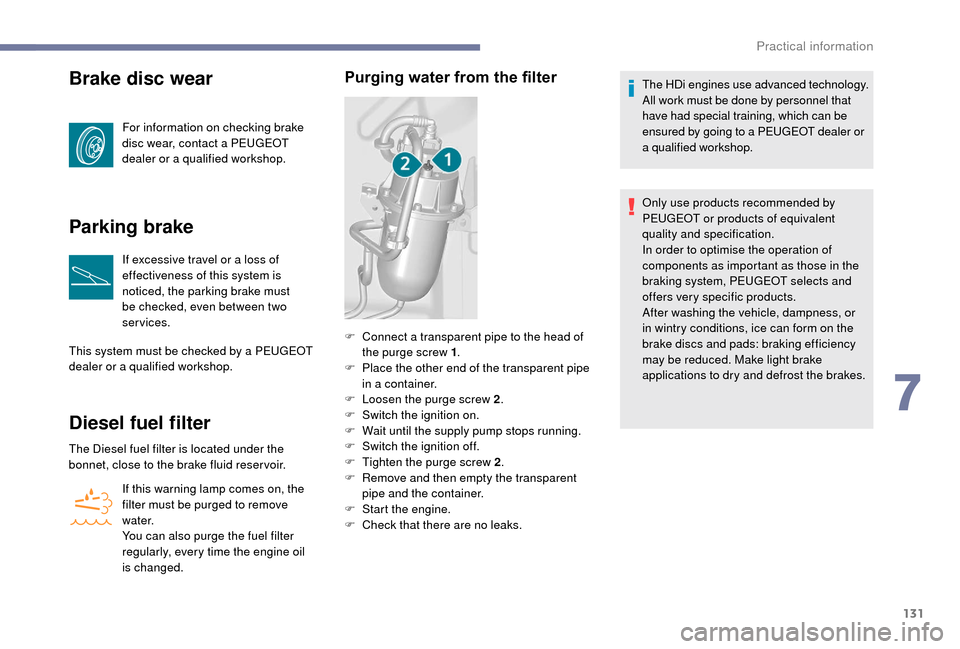
F
C
onnect a
transparent pipe to the head of
the purge screw 1 .
F
P
lace the other end of the transparent pipe
in a
container.
F
L
oosen the purge screw 2 .
F
S
witch the ignition on.
F
W
ait until the supply pump stops running.
F
S
witch the ignition off.
F
T
ighten the purge screw 2 .
F
R
emove and then empty the transparent
pipe and the container.
F
S
tart the engine.
F
C
heck that there are no leaks.
7
Practical information
Page 134 of 232
132
Freezing of the AdBlue®
AdBlue® freezes at temperatures below
around -11°C.
The SCR system includes a
heater for the
AdBlue
® tank, allowing you to continue
driving in very cold conditions.
Topping up with AdBlue®
Before topping up, please read the
following warnings carefully.
Precautions for use
AdBlue® is a urea-based solution. This fluid
is
non-flammable, colourless and odourless
(stored in a
cool place).
In the event of contact with the skin, wash the
affected area with soap and running water. In
the event of contact with the eyes, immediately
rinse the eyes with large amounts of water
or with an eye wash solution for at least
15
minutes. If a burning sensation or irritation
persists, get medical attention.
If swallowed, immediately wash out the mouth
with clean water and then drink plenty of water.
In certain conditions (high exterior temperature,
for example), the risk of ammonia being
released cannot be excluded: do not inhale
the vapours. Ammonia has an irritant effect on
mucous membranes (eyes, nose and throat).
AdBlue® (BlueHDi engines)
To respect the environment and ensure
compliance with the Euro 6 standard, without
adversely affecting the per formance or fuel
consumption of Diesel engines, PEUGEOT
has taken the decision to equip its vehicles
with a
system that associates SCR (Selective
Catalytic Reduction) with a
Diesel particle filter
(DPF) for the treatment of exhaust gases.
SCR system
Using a liquid called AdBlue® containing urea, a
catalytic converter turns up to 85% of nitrogen
oxides (NOx) into nitrogen and water, which are
harmless to health and the environment.
The AdBlue
® is contained in a special tank with
a
capacity of approximately 14 litres.
It has an exterior filler located behind the fuel
filler flap below the fuel filler cap and closed
with a
blue filler cap .
An alarm system is triggered once the
remaining range is 1,500
miles (2,400 km), in
other words once the reser ve level is reached. Once the AdBlue
® tank is empty, a
regulatory device prevents the engine
from being restarted.
If the SCR system is faulty, the level of
emissions from your vehicle no longer
meet the Euro 6
regulations: your vehicle
becomes polluting.
In the event of a
confirmed fault with the
SCR system, you must go to a
PEUGEOT
dealer or a
qualified workshop as soon
as possible: having travelled 250 miles
(400 km), a device will be triggered
automatically to prevent the engine from
starting.
Practical information
Page 135 of 232
133
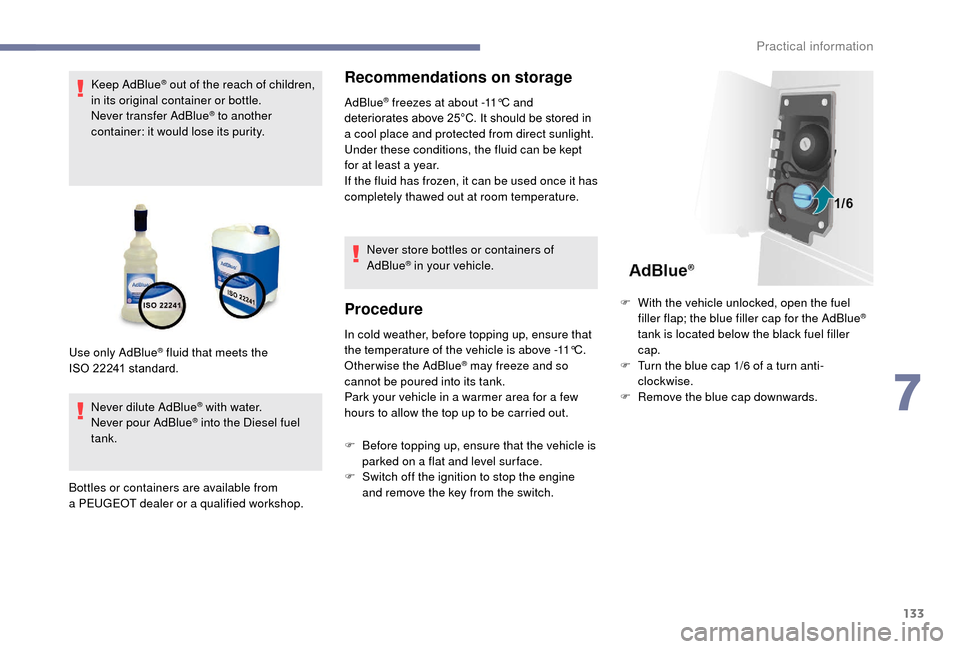
Keep AdBlue® out of the reach of children,
in its original container or bottle.
Never transfer AdBlue
® to another
container: it would lose its purity.
Never dilute AdBlue
® with water.
Never pour AdBlue® into the Diesel fuel
tank.
Bottles or containers are available from
a
PEUGEOT dealer or a
qualified workshop.
Recommendations on storage
AdBlue® freezes at about -11°C and
deteriorates above 25°C. It should be stored in
a
cool place and protected from direct sunlight.
Under these conditions, the fluid can be kept
for at least a
year.
If the fluid has frozen, it can be used once it has
completely thawed out at room temperature.
Never store bottles or containers of
AdBlue
® in your vehicle.
Procedure
In cold weather, before topping up, ensure that
the temperature of the vehicle is above -11°C.
Otherwise the AdBlue
® may freeze and so
cannot be poured into its tank.
Park your vehicle in a
warmer area for a few
hours to allow the top up to be carried out.
Use only AdBlue
® fluid that meets the
ISO
22241
standard.
F
B
efore topping up, ensure that the vehicle is
parked on a
flat and level sur face.
F
S
witch off the ignition to stop the engine
and remove the key from the switch. F
W
ith the vehicle unlocked, open the fuel
filler flap; the blue filler cap for the AdBlue
®
tank is located below the black fuel filler
cap.
F
T
urn the blue cap 1/6 of a turn anti-
clockwise.
F
R
emove the blue cap downwards.
7
Practical information
Page 136 of 232
134
Refilling
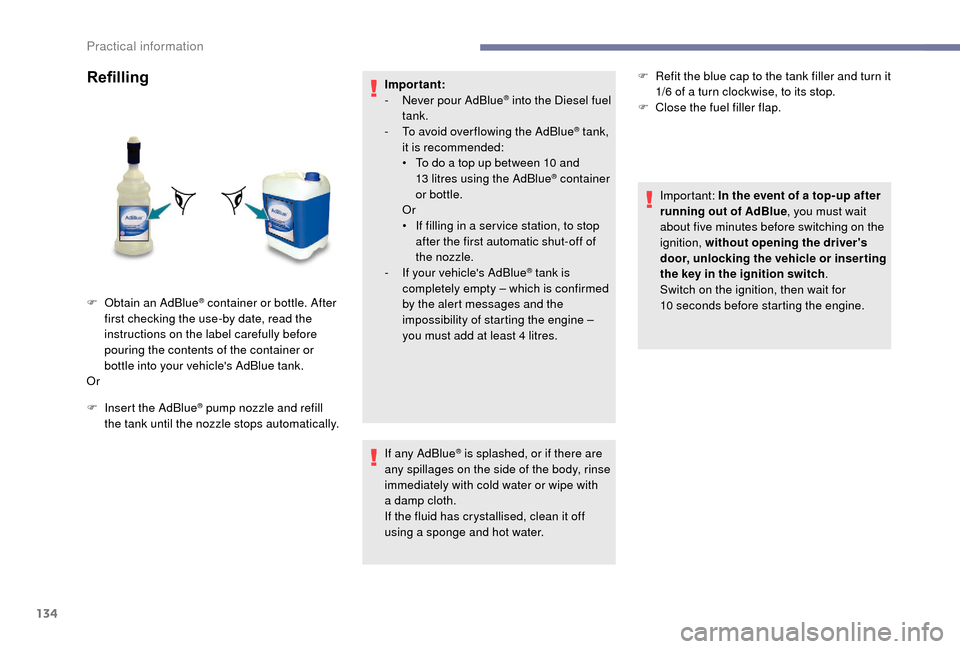
F Insert the AdBlue® pump nozzle and refill
the tank until the nozzle stops automatically. Important:
-
N
ever pour AdBlue
® into the Diesel fuel
tank.
-
T
o avoid over flowing the AdBlue
® tank,
it is recommended:
•
T
o do a
top up between 10
and
13
litres using the AdBlue
® container
or bottle.
Or
•
I
f filling in a
ser vice station, to stop
after the first automatic shut-off of
the nozzle.
-
I
f your vehicle's AdBlue
® tank is
completely empty – which is confirmed
by the alert messages and the
impossibility of starting the engine –
you must add at least 4
litres.
If any AdBlue
® is splashed, or if there are
any spillages on the side of the body, rinse
immediately with cold water or wipe with
a
damp cloth.
If the fluid has crystallised, clean it off
using a
sponge and hot water.
F
O
btain an
AdBlue
® container or bottle. After
first checking the use-by date, read the
instructions on the label carefully before
pouring the contents of the container or
bottle into your vehicle's AdBlue tank.
Or F
R
efit the blue cap to the tank filler and turn it
1/6 of a turn clockwise, to its stop.
F
C
lose the fuel filler flap.
Important: In the event of a top-up after
running out of AdBlue , you must wait
about five minutes before switching on the
ignition, without opening the driver's
door, unlocking the vehicle or inser ting
the key in the ignition switch .
Switch on the ignition, then wait for
10 seconds before starting the engine.
Practical information
Page 154 of 232
152
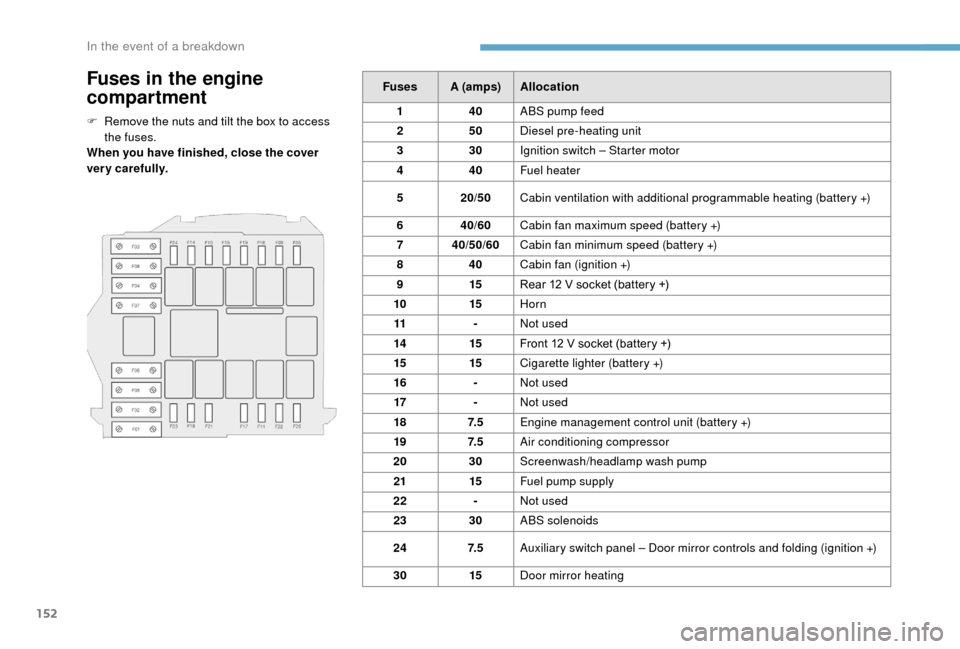
Fuses in the engine
compartment
F Remove the nuts and tilt the box to access the fuses.
When you have finished, close the cover
very carefully. Fuses A (amps)
Allocation
1 40ABS pump feed
2 50Diesel pre-heating unit
3 30Ignition switch – Starter motor
4 40Fuel heater
5 20/50Cabin ventilation with additional programmable heating (battery +)
6 40/60Cabin fan maximum speed (battery +)
7 40/50/60 Cabin fan minimum speed (battery +)
8 40Cabin fan (ignition +)
9 15Rear 12
V socket (battery +)
10 15Horn
11 -Not used
14 15Front 12
V socket (battery +)
15 15Cigarette lighter (battery +)
16 -Not used
17 -Not used
18 7. 5Engine management control unit (battery +)
19 7. 5Air conditioning compressor
20 30Screenwash/headlamp wash pump
21 15Fuel pump supply
22 -Not used
23 30ABS solenoids
24 7. 5Auxiliary switch panel – Door mirror controls and folding (ignition +)
30 15Door mirror heating
In the event of a breakdown
Page 160 of 232
158
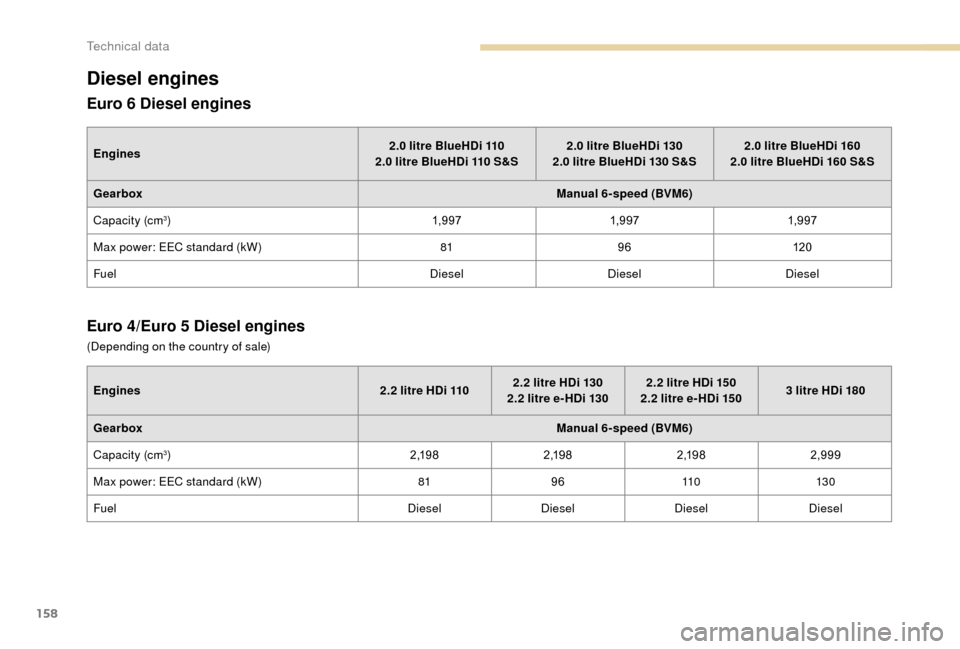
Diesel engines
Euro 6 Diesel engines
Engines 2.0 litre BlueHDi 110
2.0 litre BlueHDi 110 S&S2.0
litre BlueHDi 130
2.0 litre BlueHDi 130 S&S2.0
litre BlueHDi 160
2.0 litre BlueHDi 160 S&S
Gearbox Manual 6-speed (BVM6)
Capacity (cm
3) 1,9 971,9 971,9 97
Max power: EEC standard (kW) 8196120
Fuel DieselDieselDiesel
Euro 4/Euro 5 Diesel engines
Engines 2.2 litre HDi 1102.2 litre HDi 130
2.2 litre e- HDi 1302.2
litre HDi 150
2.2 litre e- HDi 1503
litre HDi 180
Gearbox Manual 6-speed (BVM6)
Capacity (cm
3) 2 ,1 9 82 ,1 9 82 ,1 9 8 2,999
Max power: EEC standard (kW) 819611 0 13 0
Fuel DieselDieselDiesel Diesel
(Depending on the country of sale)
Technical data
Page 172 of 232
170
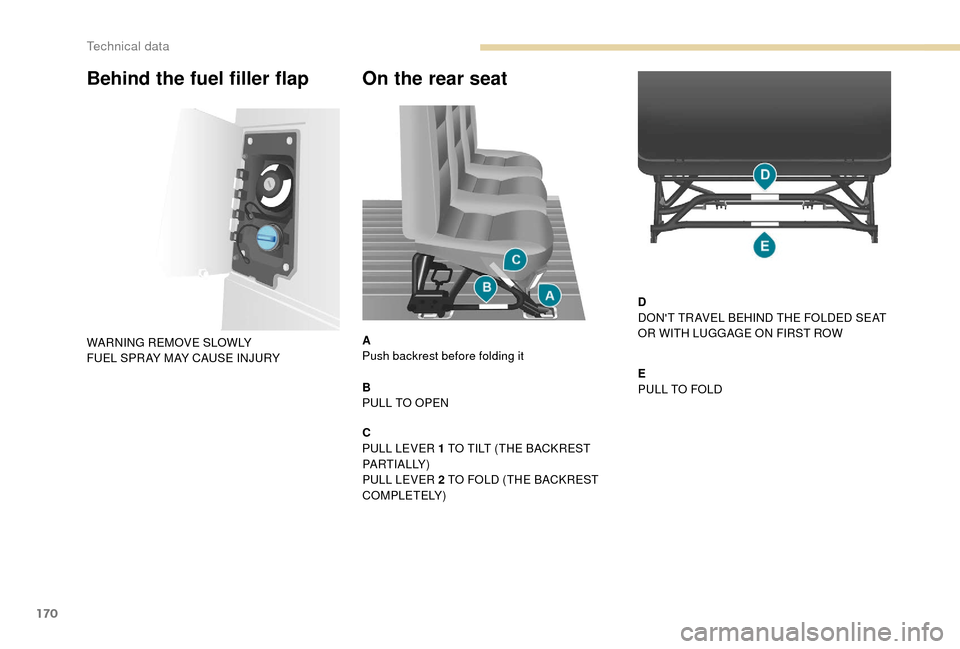
On the rear seat
A
Push backrest before folding it
B
PULL TO OPEN
C
PULL LEVER 1 TO TILT (THE BACKREST
PA R T I A L LY )
PULL LEVER 2
TO FOLD (THE BACKREST
COMPLETELY) D
DON'T TR AVEL BEHIND THE FOLDED SEAT
OR WITH LUGGAGE ON FIRST ROW
E
PULL TO FOLD
Behind the fuel filler flap
WARNING REMOVE SLOWLY
FUEL SPR AY MAY CAUSE INJURY
Technical data
Page 184 of 232
182
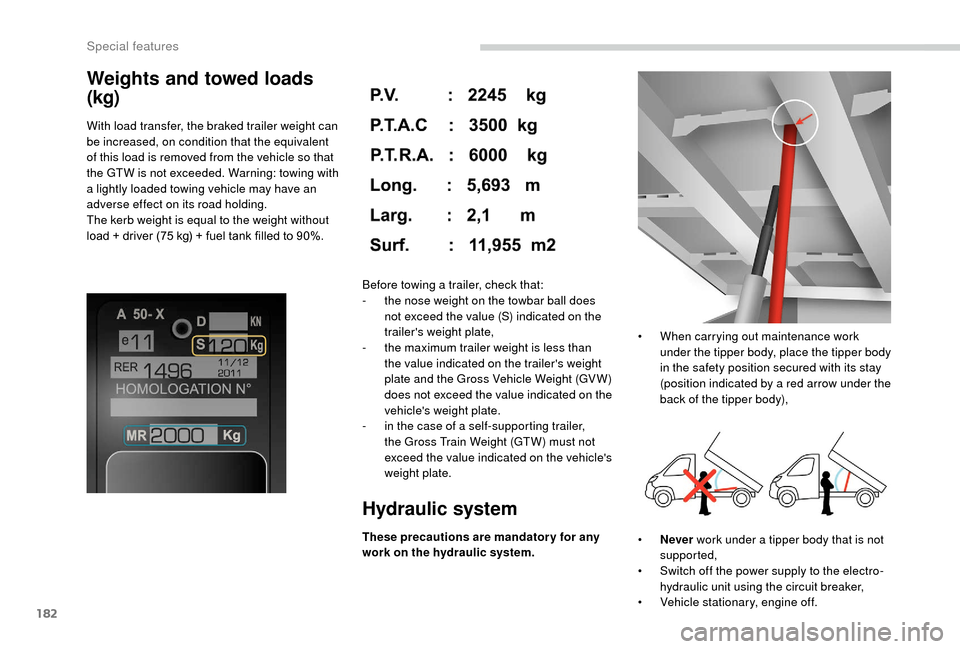
Weights and towed loads
(kg)
With load transfer, the braked trailer weight can
be increased, on condition that the equivalent
of this load is removed from the vehicle so that
the GTW is not exceeded. Warning: towing with
a lightly loaded towing vehicle may have an
adverse effect on its road holding.
The kerb weight is equal to the weight without
load + driver (75
kg) + fuel tank filled to 90%.
Hydraulic system
These precautions are mandator y for any
work on the hydraulic system. Before towing a trailer, check that:
-
t
he nose weight on the towbar ball does
not exceed the value (S) indicated on the
trailer's weight plate,
-
t
he maximum trailer weight is less than
the value indicated on the trailer's weight
plate and the Gross Vehicle Weight (GV W)
does not exceed the value indicated on the
vehicle's weight plate.
-
i
n the case of a self-supporting trailer,
the Gross Train Weight (GTW) must not
exceed the value indicated on the vehicle's
weight plate.
• N ever work under a tipper body that is not
supported,
•
S
witch off the power supply to the electro-
hydraulic unit using the circuit breaker,
•
V
ehicle stationary, engine off.
•
W
hen carrying out maintenance work
under the tipper body, place the tipper body
in the safety position secured with its stay
(position indicated by a red arrow under the
back of the tipper body),
Special features