load Peugeot Boxer 2018 Owner's Guide
[x] Cancel search | Manufacturer: PEUGEOT, Model Year: 2018, Model line: Boxer, Model: Peugeot Boxer 2018Pages: 232, PDF Size: 9.09 MB
Page 105 of 232
103
Malfunction
In the event of a fault, the system is
s witched off and the indicator goes
out.
Have it checked by a
PEUGEOT dealer or by
a
qualified workshop. Use the cruise control only when traffic
conditions allow you to travel at a
constant
speed for a
certain period of time whilst
keeping a
sufficiently safe distance from
other vehicles.
Do not activate the cruise control in urban
areas, in heavy traffic, on winding or steep
roads, on slippery or flooded roads, or in
conditions of poor visibility (heavy rain,
fog, falling snow, etc.).
In some circumstances, it may not
be possible to maintain or reach the
programmed speed: towing, vehicle
heavily loaded, steep climb, etc. The use of mats not approved by
PEUGEOT may impair the operation of the
cruise control.
To avoid any risk of jamming of the pedals:
-
e
nsure that the mat is positioned
c o r r e c t l y,
-
d
o not fit one mat on top of another.
Cruise control (3 litre HDi
e ngine)
System which automatically
maintains the cruising speed of the
vehicle at a
setting programmed by
the driver, without any action on the
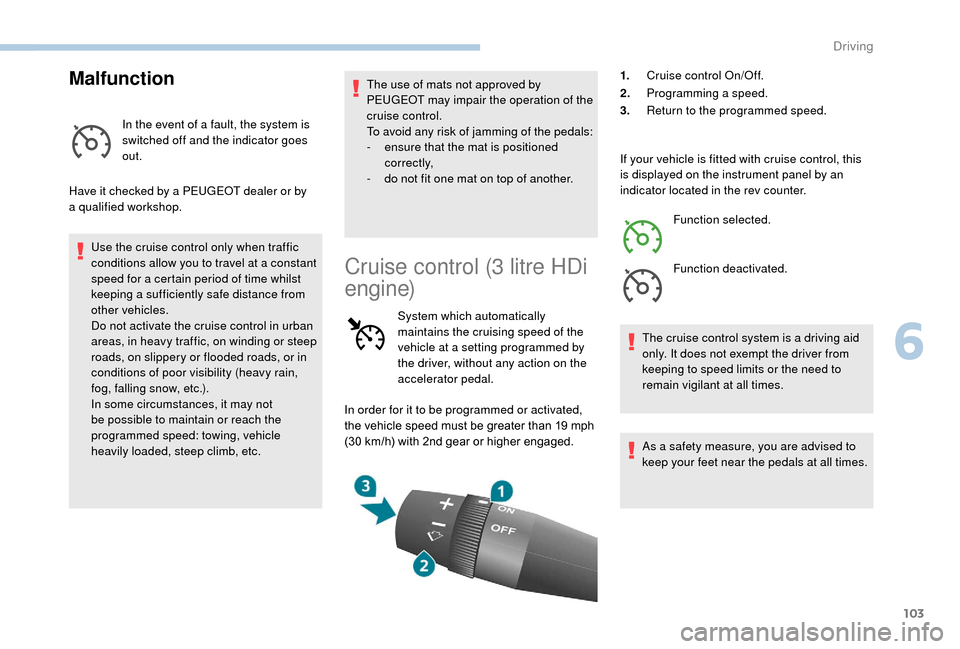
accelerator pedal. 1.
Cruise control On/Off.
2. Programming a
speed.
3. Return to the programmed speed.
If your vehicle is fitted with cruise control, this
is displayed on the instrument panel by an
indicator located in the rev counter. Function selected.
Function deactivated.
The cruise control system is a driving aid
only. It does not exempt the driver from
keeping to speed limits or the need to
remain vigilant at all times.
In order for it to be programmed or activated,
the vehicle speed must be greater than 19
mph
(30
km/h) with 2nd gear or higher engaged. As a
safety measure, you are advised to
keep your feet near the pedals at all times.
6
Driving
Page 107 of 232
105
Restore – RES
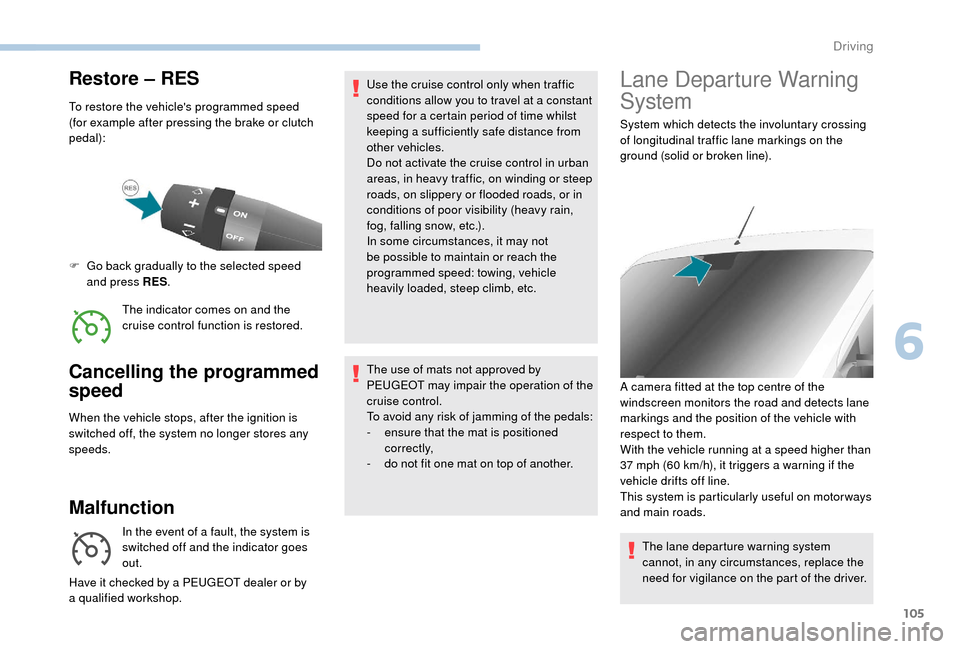
To restore the vehicle's programmed speed
(for example after pressing the brake or clutch
pedal):The indicator comes on and the
cruise control function is restored.
F
G
o back gradually to the selected speed
and press RES .
Cancelling the programmed
speed
When the vehicle stops, after the ignition is
switched off, the system no longer stores any
speeds.
Malfunction
In the event of a fault, the system is
s witched off and the indicator goes
out.
Have it checked by a
PEUGEOT dealer or by
a
qualified workshop. Use the cruise control only when traffic
conditions allow you to travel at a
constant
speed for a certain period of time whilst
keeping a sufficiently safe distance from
other vehicles.
Do not activate the cruise control in urban
areas, in heavy traffic, on winding or steep
roads, on slippery or flooded roads, or in
conditions of poor visibility (heavy rain,
fog, falling snow, etc.).
In some circumstances, it may not
be possible to maintain or reach the
programmed speed: towing, vehicle
heavily loaded, steep climb, etc.
The use of mats not approved by
PEUGEOT may impair the operation of the
cruise control.
To avoid any risk of jamming of the pedals:
-
e
nsure that the mat is positioned
c o r r e c t l y,
-
d
o not fit one mat on top of another.
Lane Departure Warning
System
System which detects the involuntary crossing
of longitudinal traffic lane markings on the
ground (solid or broken line).
The lane departure warning system
cannot, in any circumstances, replace the
need for vigilance on the part of the driver.
A camera fitted at the top centre of the
windscreen monitors the road and detects lane
markings and the position of the vehicle with
respect to them.
With the vehicle running at a
speed higher than
37
mph (60 km/h), it triggers a warning if the
vehicle drifts off line.
This system is particularly useful on motor ways
and main roads.
6
Driving
Page 109 of 232
107
The system is automatically deactivated
if the Stop & Start system is active.
The system will restart and check the
operating conditions again when the
vehicle moves off. Detection may be impeded:
-
i
f the markings on the road are worn,
-
i
f there is little contrast between the
markings on the road and the road
sur face.
The system may suffer inter ference or not
work correctly:
-
w
hen the vehicle is carrying a very
heavy load (even more so if the load is
not evenly spread),
-
w
hen the conditions of visibility are
poor (rain, fog, snow, etc.),
-
w
hen the lighting conditions are poor
(dazzling sun, shade, etc.),
-
i
f the windscreen is dirty or damaged
near the camera,
-
i
f any of the ABS, DSC, ASR or
Intelligent Traction Control systems are
out of service.
Malfunction
If a malfunction occurs, this warning
l amp comes on, accompanied by
an audible signal and confirmed by
a
message in the screen.
Have the system checked by a
PEUGEOT
dealer or a
qualified workshop.
6
Driving
Page 112 of 232
110
Under-inflation detection
The tyre under-inflation detection system
is a driving aid which does not replace the
need for vigilance on the part of the driver.This system does not relieve you of
the monthly check of the tyre inflation
pressures (including the spare) and before
a
long journey.
Driving with under-inflated tyres impairs
handling, extends braking distances and
causes premature tyre wear, particularly
in adverse conditions (heavy loads, high
speeds, long journeys).
Driving with under-inflated tyres
increases fuel consumption. The tyre pressure measurement unit can be
configured with the MODE
button: in the "Tyre
pressure measurement" menu, select "psi/bar/
k Pa".
For more information on Vehicle
configuration , refer to the corresponding
section.
Under-inflation warning
This warning is indicated by
continuous illumination of this lamp,
an audible signal and, depending on
the equipment installed, a message
displayed on the screen.
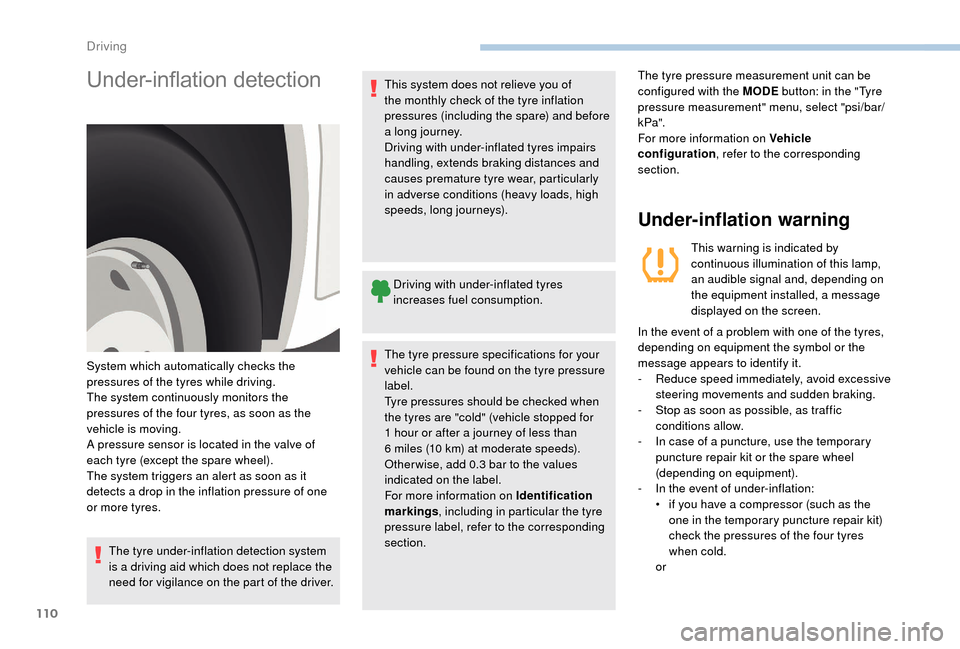
System which automatically checks the
pressures of the tyres while driving.
The system continuously monitors the
pressures of the four tyres, as soon as the
vehicle is moving.
A pressure sensor is located in the valve of
each tyre (except the spare wheel).
The system triggers an alert as soon as it
detects a
drop in the inflation pressure of one
or more tyres. In the event of a
problem with one of the tyres,
depending on equipment the symbol or the
message appears to identify it.
-
R
educe speed immediately, avoid excessive
steering movements and sudden braking.
-
S
top as soon as possible, as traffic
conditions allow.
-
I
n case of a puncture, use the temporary
puncture repair kit or the spare wheel
(depending on equipment).
-
I
n the event of under-inflation:
•
i
f you have a compressor (such as the
one in the temporary puncture repair kit)
check the pressures of the four tyres
when cold.
or
The tyre pressure specifications for your
vehicle can be found on the tyre pressure
label.
Tyre pressures should be checked when
the tyres are "cold" (vehicle stopped for
1
hour or after a
journey of less than
6
miles (10
km) at moderate speeds).
Other wise, add 0.3
bar to the values
indicated on the label.
For more information on Identification
markings , including in particular the tyre
pressure label, refer to the corresponding
section.
Driving
Page 114 of 232
112
Switching off
F Move from reverse gear into neutral.
Malfunction
If this warning lamp comes on in the
instrument panel accompanied by
a message in the screen, contact
a
PEUGEOT dealer or a qualified
workshop.
Reversing camera
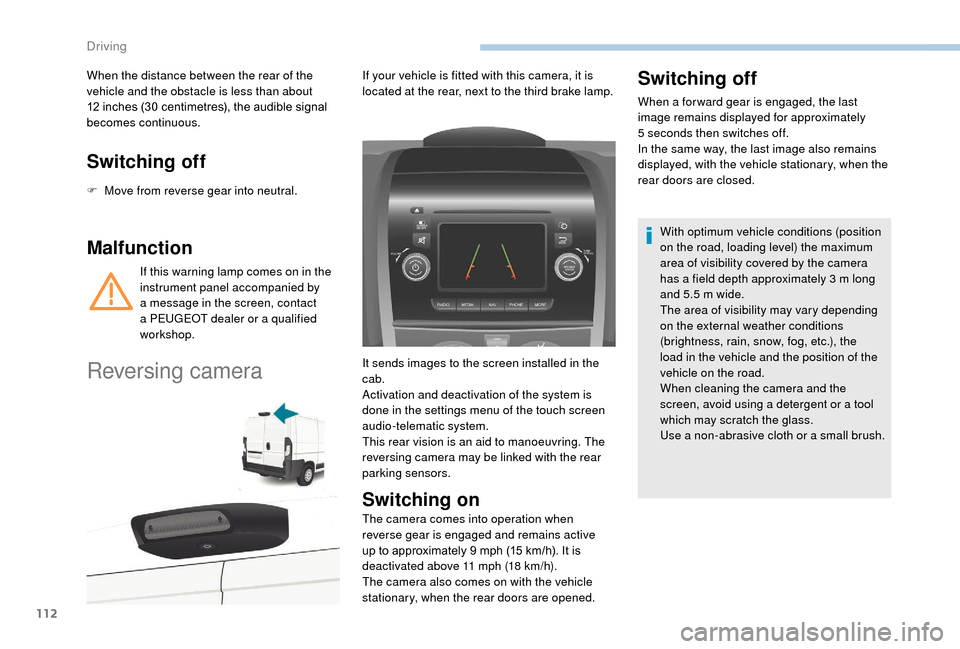
If your vehicle is fitted with this camera, it is
located at the rear, next to the third brake lamp.
Switching on
The camera comes into operation when
reverse gear is engaged and remains active
up to approximately 9
mph (15 km/h). It is
deactivated above 11
mph (18 km/h).
The camera also comes on with the vehicle
stationary, when the rear doors are opened.
Switching off
When a for ward gear is engaged, the last
im age remains displayed for approximately
5
seconds then switches off.
In the same way, the last image also remains
displayed, with the vehicle stationary, when the
rear doors are closed.
With optimum vehicle conditions (position
on the road, loading level) the maximum
area of visibility covered by the camera
has a
field depth approximately 3 m long
and 5.5
m wide.
The area of visibility may vary depending
on the external weather conditions
(brightness, rain, snow, fog, etc.), the
load in the vehicle and the position of the
vehicle on the road.
When cleaning the camera and the
screen, avoid using a
detergent or a tool
which may scratch the glass.
Use a
non-abrasive cloth or a small brush.
It sends images to the screen installed in the
cab.
Activation and deactivation of the system is
done in the settings menu of the touch screen
audio-telematic system.
This rear vision is an aid to manoeuvring. The
reversing camera may be linked with the rear
parking sensors.
When the distance between the rear of the
vehicle and the obstacle is less than about
12 inches (30 centimetres), the audible signal
becomes continuous.
Driving
Page 115 of 232
113
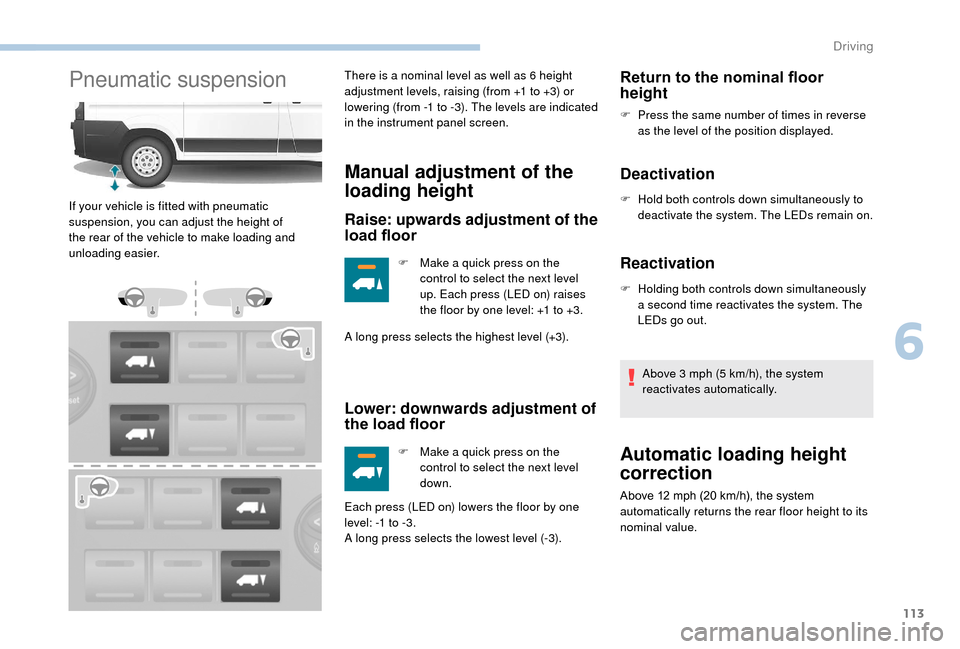
Pneumatic suspensionThere is a nominal level as well as 6 height
a djustment levels, raising (from +1 to +3) or
lowering (from -1
t
o -3). The levels are indicated
in the instrument panel screen.
Manual adjustment of the
loading height
Raise: upwards adjustment of the
load floor
F Make a quick press on the
control to select the next level
up. Each press (LED on) raises
the floor by one level: +1
to +3.
A long press selects the highest level (+3).
Lower: downwards adjustment of
the load floor
F Make a quick press on the
control to select the next level
down.
If your vehicle is fitted with pneumatic
suspension, you can adjust the height of
the rear of the vehicle to make loading and
unloading easier.
Each press (LED on) lowers the floor by one
level: -1
to -3.
A long press selects the lowest level (-3).
Return to the nominal floor
height
F Press the same number of times in reverse as the level of the position displayed.
Deactivation
F Hold both controls down simultaneously to deactivate the system. The LEDs remain on.
Reactivation
F Holding both controls down simultaneously a second time reactivates the system. The
LEDs go out.
Above 3
mph (5 km/h), the system
reactivates automatically.
Automatic loading height
correction
Above 12 mph (20 km/h), the system
a utomatically returns the rear floor height to its
nominal value.
6
Driving
Page 116 of 232
114
Operating fault
If a fault occurs with the system, this
w arning lamp comes on.
Have the system checked by a
PEUGEOT
dealer or a
qualified workshop.
Driving with the suspension set too high
or too low poses a risk of damaging
components under the body.
The height may be adjusted automatically
to take account of changes in temperature
or loading.
You must avoid using this control in the
following circumstances:
-
w
hen working underneath the vehicle,
-
w
hen changing a
wheel,
-
w
hen the vehicle is being transported
by lorry, train, ferry, boat, etc.
To avoid damaging the vehicle or injuring
anyone, check that there is no object or
person that might be close to or come into
contact with the vehicle, before raising or
lowering the suspension.
Driving
Page 122 of 232
120
For more information on the Technical
data of the vehicle and particularly on
weights and towable loads, refer to the
corresponding section.
You will then have information on your vehicle's
ability to tow a
trailer, a caravan, a boat, etc.
We recommend the use of genuine
PEUGEOT towbars and their harnesses
that have been tested and approved from
the design stage of your vehicle, and
that the fitting of the towbar is entrusted
to a
member of the PEUGEOT dealer
network.
These genuine towbars are compatible
with the operation of the rear parking
sensors and the reversing camera, if your
vehicle is so equipped.
If the towbar is not fitted by a
PEUGEOT
dealer, it must still be fitted in accordance
with the vehicle manufacturer's
instructions.Towbar with quickly
detachable towball
Presentation
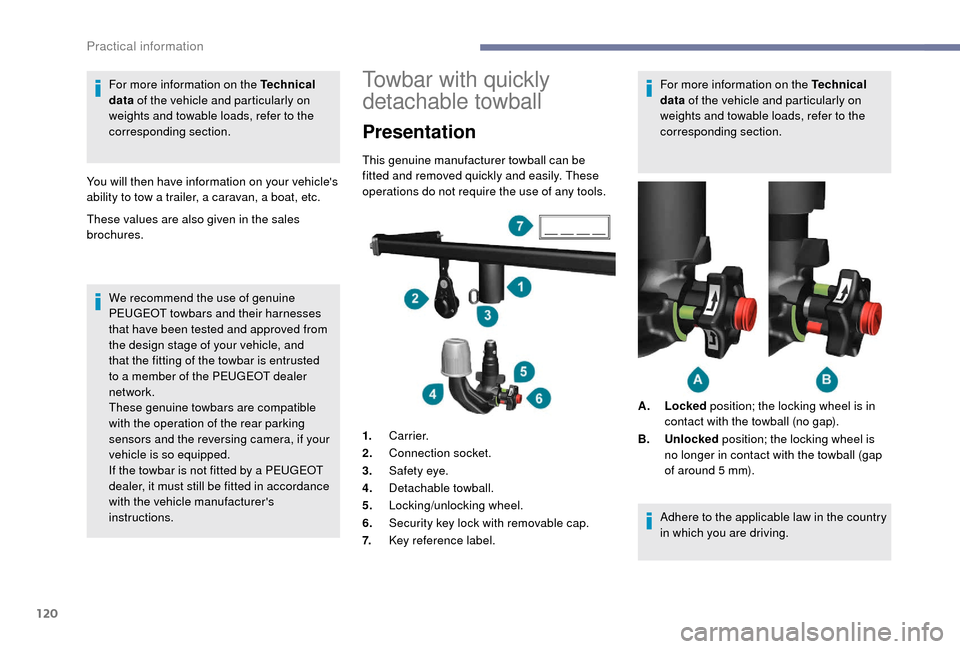
This genuine manufacturer towball can be
fitted and removed quickly and easily. These
operations do not require the use of any tools.
1. Carrier.
2. Connection socket.
3. Safety eye.
4. Detachable towball.
5. Locking/unlocking wheel.
6. Security key lock with removable cap.
7. Key reference label. For more information on the Technical
data
of the vehicle and particularly on
weights and towable loads, refer to the
corresponding section.
A. Locked position; the locking wheel is in
contact with the towball (no gap).
B. Unlocked position; the locking wheel is
no longer in contact with the towball (gap
of around 5
mm).
Adhere to the applicable law in the country
in which you are driving.
These values are also given in the sales
brochures.
Practical information
Page 123 of 232
121
Before each use
Check that the towball is correctly locked by
verifying the following points:
- the green mark on the locking wheel is in line with the green mark on the towball,
- the locking wheel is in contact with the towball,- the security lock is locked and the key removed; the locking wheel can no longer be
operated,
- the towball must not be able to move in its carrier; test by trying to shake it with your hand.
During use
Never release the locking system with
a trailer or load carrier on the towball.
Never exceed the maximum authorised
weight for the vehicle (the Gross Vehicle
Weight – GV W), the trailer, or the sum of
the two (the Gross Train Weight – GTW).
Following use
When travelling without a trailer or load on
a towbar-mounted carrier, the towball must be
removed and the protective plug inserted in
the carrier. This measure applies particularly
where the towball might obscure visibility of the
number plate or its lighting.
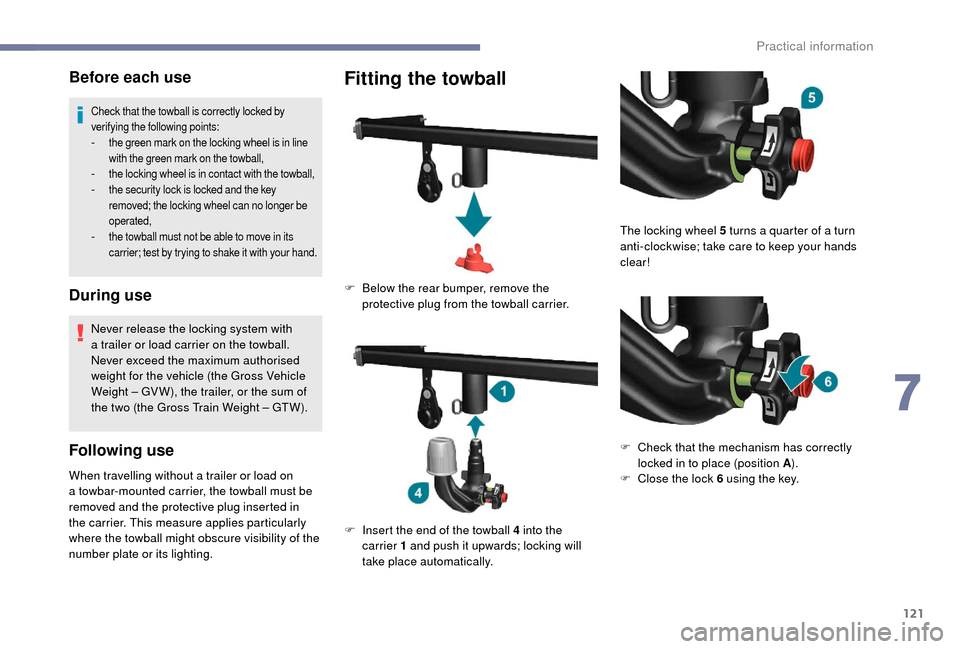
Fitting the towball
F Below the rear bumper, remove the protective plug from the towball carrier.
F
I
nsert the end of the towball 4 into the
carrier 1
and push it upwards; locking will
take place automatically. The locking wheel 5
turns a quarter of a turn
anti-clockwise; take care to keep your hands
clear!
F
C
heck that the mechanism has correctly
locked in to place (position A ).
F
C
lose the lock 6 using the key.
7
Practical information
Page 126 of 232
124
Maximum load on the roof, evenly
distributed: 150 kg, for all models, within
the vehicle's weight limit (Gross Vehicle
Weight).
On all H3
height models, the roof cannot
be fitted with a
carrying system.
Fully comply with the legal requirements
for carrying oversized loads.
For more information on the Technical
data of your vehicle and particularly the
dimensions, refer to the corresponding
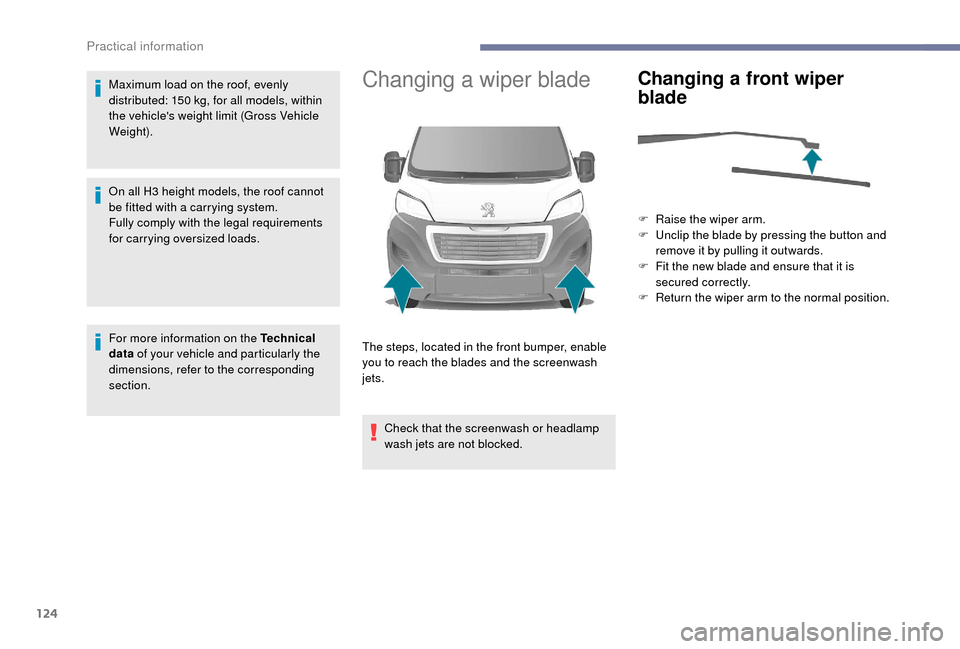
section.Changing a wiper blade
Check that the screenwash or headlamp
wash jets are not blocked.
Changing a front wiper
blade
F Raise the wiper arm.
F
U nclip the blade by pressing the button and
remove it by pulling it outwards.
F
F
it the new blade and ensure that it is
secured correctly.
F
R
eturn the wiper arm to the normal position.
The steps, located in the front bumper, enable
you to reach the blades and the screenwash
jets.
Practical information