load Peugeot Boxer 2018 User Guide
[x] Cancel search | Manufacturer: PEUGEOT, Model Year: 2018, Model line: Boxer, Model: Peugeot Boxer 2018Pages: 232, PDF Size: 9.09 MB
Page 59 of 232
57
Rear fittings
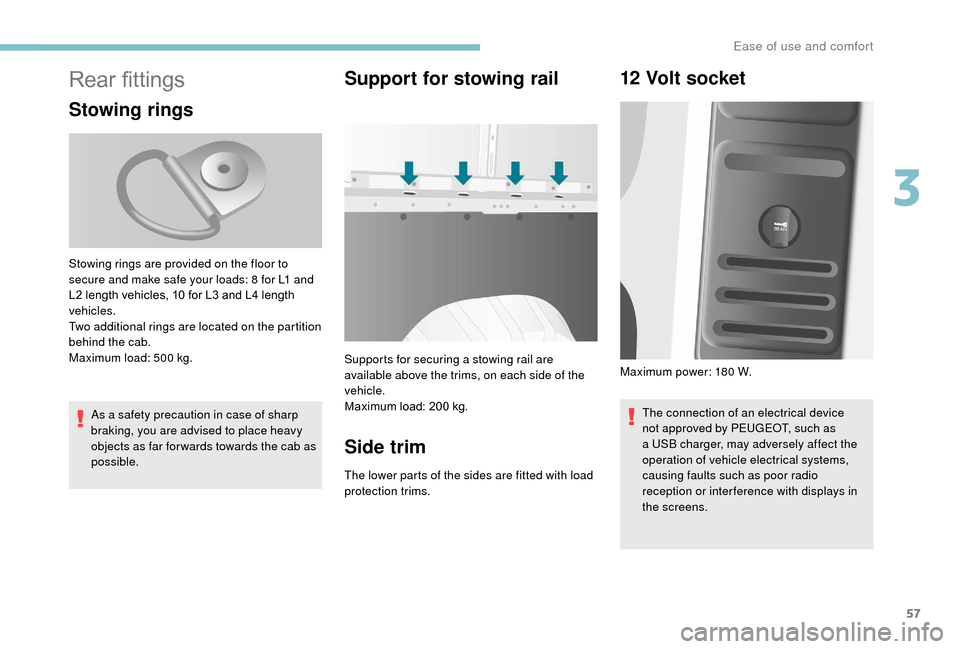
Stowing rings
As a safety precaution in case of sharp
b raking, you are advised to place heavy
objects as far for wards towards the cab as
possible.
Support for stowing rail
Supports for securing a stowing rail are
a vailable above the trims, on each side of the
vehicle.
Maximum load: 200
kg.
Side trim
The lower parts of the sides are fitted with load
protection trims.
Stowing rings are provided on the floor to
secure and make safe your loads: 8
for L1
and
L2
length vehicles, 10
for L3
and L4
length
vehicles.
Two additional rings are located on the partition
behind the cab.
Maximum load: 500
kg.
12 Volt socket
The connection of an electrical device
not approved by PEUGEOT, such as
a
USB charger, may adversely affect the
operation of vehicle electrical systems,
causing faults such as poor radio
reception or inter ference with displays in
the screens.
Maximum power: 180
W.
3
Ease of use and comfort
Page 60 of 232
58
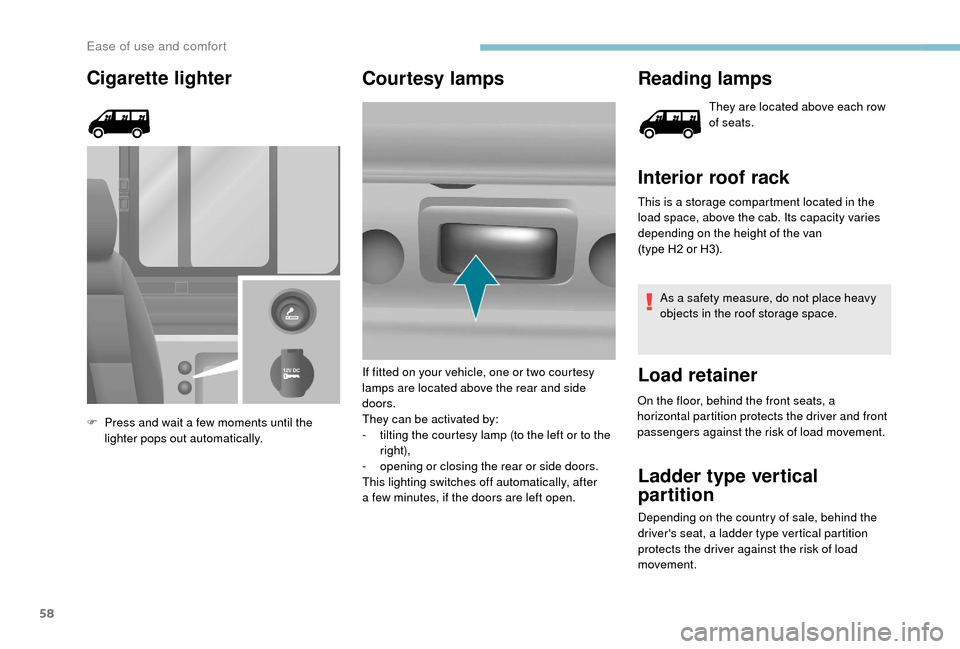
Cigarette lighter
F Press and wait a few moments until the
lighter pops out automatically.
Courtesy lamps Reading lamps
They are located above each row
of seats.
Interior roof rack
This is a storage compartment located in the
l oad space, above the cab. Its capacity varies
depending on the height of the van
(type H2
or H3).
As a
safety measure, do not place heavy
objects in the roof storage space.
Load retainerIf fitted on your vehicle, one or two courtesy
lamps are located above the rear and side
doors.
They can be activated by:
-
t
ilting the courtesy lamp (to the left or to the
right),
-
o
pening or closing the rear or side doors.
This lighting switches off automatically, after
a
few minutes, if the doors are left open. On the floor, behind the front seats, a
horizontal partition protects the driver and front
passengers against the risk of load movement.
Ladder type vertical
partition
Depending on the country of sale, behind the
driver's seat, a ladder type vertical partition
protects the driver against the risk of load
movement.
Ease of use and comfort
Page 61 of 232
59
Glazed partition
Depending on the country of sale, a glazed
partition separates the cabin from the load
space.
However, you can use the control to open/close
its sliding window.
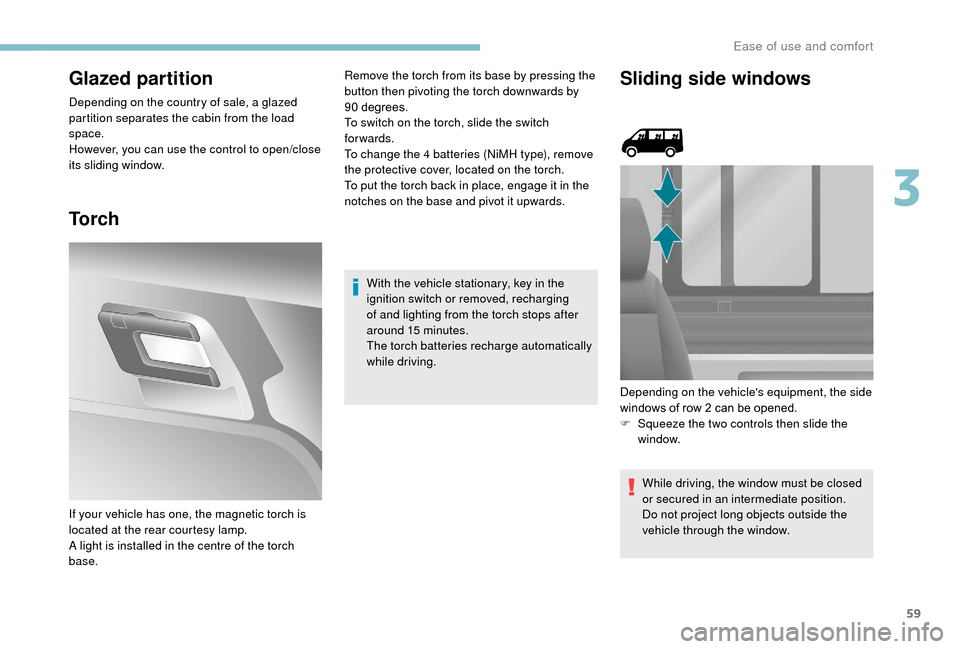
To r c h
Remove the torch from its base by pressing the
button then pivoting the torch downwards by
90
de
grees.
To switch on the torch, slide the switch
forwards.
To change the 4
batteries (NiMH type), remove
the protective cover, located on the torch.
To put the torch back in place, engage it in the
notches on the base and pivot it upwards.
If your vehicle has one, the magnetic torch is
located at the rear courtesy lamp.
A light is installed in the centre of the torch
base. With the vehicle stationary, key in the
ignition switch or removed, recharging
of and lighting from the torch stops after
around 15
minutes.
The torch batteries recharge automatically
while driving.Sliding side windows
While driving, the window must be closed
or secured in an intermediate position.
Do not project long objects outside the
vehicle through the window.
Depending on the vehicle's equipment, the side
windows of row 2
can be opened.
F
S
queeze the two controls then slide the
window.
3
Ease of use and comfort
Page 67 of 232
65
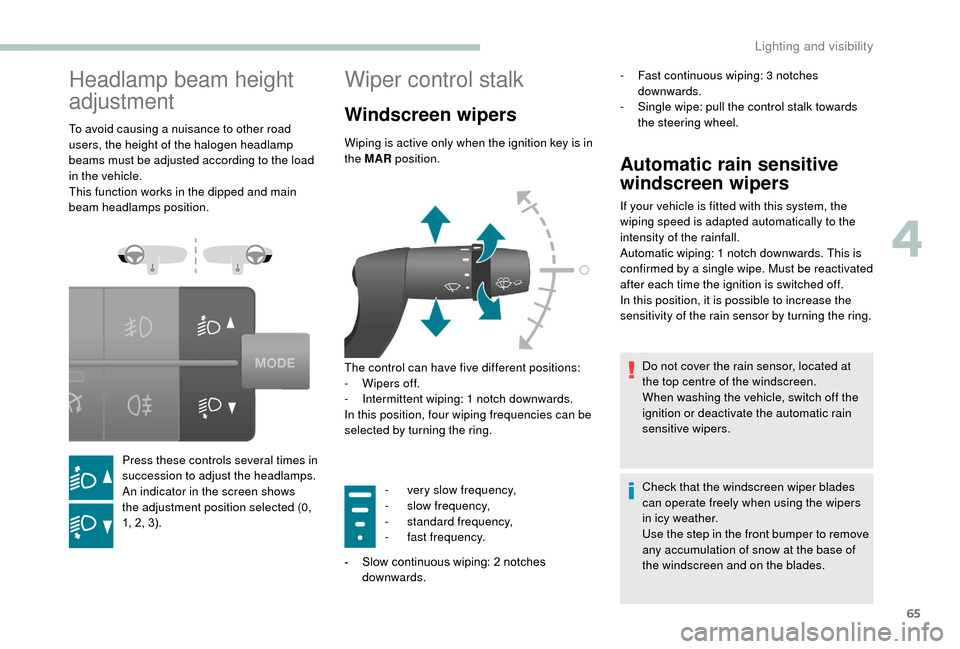
Headlamp beam height
adjustment
To avoid causing a nuisance to other road
u sers, the height of the halogen headlamp
beams must be adjusted according to the load
in the vehicle.
This function works in the dipped and main
beam headlamps position.
Press these controls several times in
succession to adjust the headlamps.
An indicator in the screen shows
the adjustment position selected (0,
1, 2, 3).
Wiper control stalk
Windscreen wipers
Wiping is active only when the ignition key is in
the MAR position.
The control can have five different positions:
-
W
ipers off.
-
I
ntermittent wiping: 1 notch downwards.
In this position, four wiping frequencies can be
selected by turning the ring.
Automatic rain sensitive
windscreen wipers
If your vehicle is fitted with this system, the
wiping speed is adapted automatically to the
intensity of the rainfall.
Automatic wiping: 1
notch downwards. This is
confirmed by a
single wipe. Must be reactivated
after each time the ignition is switched off.
In this position, it is possible to increase the
sensitivity of the rain sensor by turning the ring.
Do not cover the rain sensor, located at
the top centre of the windscreen.
When washing the vehicle, switch off the
ignition or deactivate the automatic rain
sensitive wipers.
Check that the windscreen wiper blades
can operate freely when using the wipers
in icy weather.
Use the step in the front bumper to remove
any accumulation of snow at the base of
the windscreen and on the blades.
-
v
ery slow frequency,
-
sl
ow frequency,
-
s
tandard frequency,
-
f
ast frequency.
-
S
low continuous wiping: 2
notches
downwards. -
F
ast continuous wiping: 3 notches
downwards.
-
S
ingle wipe: pull the control stalk towards
the steering wheel.
4
Lighting and visibility
Page 73 of 232
71
Intelligent Traction Control
System to improve traction on slippery sur faces
(snow, ice, mud, etc.)
This system checks for situations of difficult
sur face grip that could make it difficult to move
off or make progress.
In these situations, Intelligent Traction
Control takes over from the ASR system, by
transferring drive to the wheel with the best grip
on the ground to provide the best traction and
trajectory control.
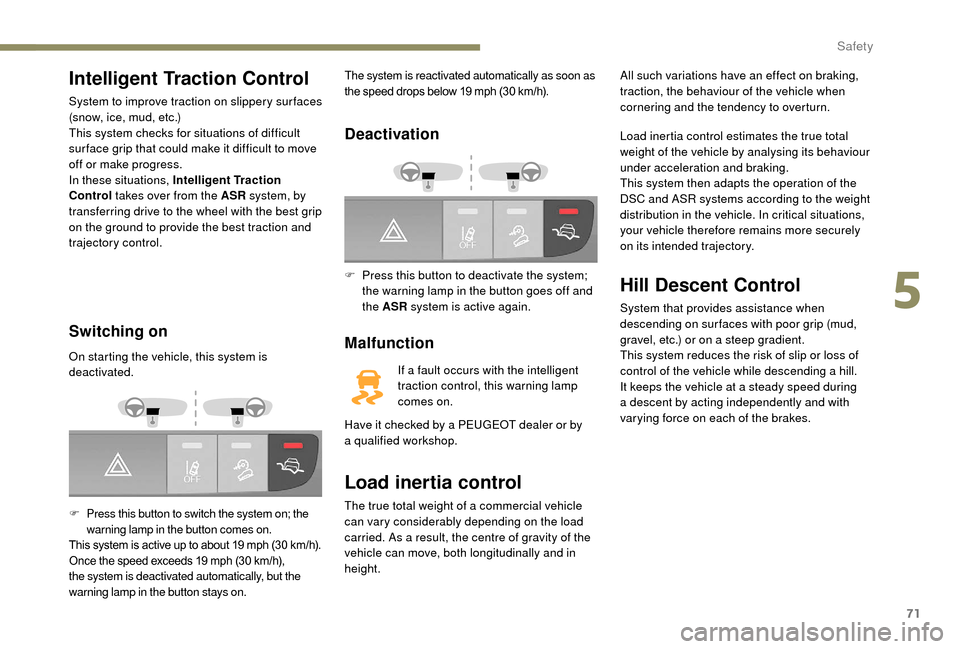
Switching on
On starting the vehicle, this system is
deactivated.
F
Press this button to switch the system on; the warning lamp in the button comes on.
This system is active up to about 19
mph (30 km/h).
Once the speed exceeds 19
mph (30 km/h),
the system is deactivated automatically, but the
warning lamp in the button stays on. The system is reactivated automatically as soon as
the speed drops below 19
mph (30 km/h).
Deactivation
F Press this button to deactivate the system;
the warning lamp in the button goes off and
the ASR system is active again.
Malfunction
If a fault occurs with the intelligent
t raction control, this warning lamp
comes on.
Have it checked by a
PEUGEOT dealer or by
a
qualified workshop.
Load inertia control
All such variations have an effect on braking,
traction, the behaviour of the vehicle when
cornering and the tendency to overturn.
The true total weight of a
commercial vehicle
can vary considerably depending on the load
carried. As a
result, the centre of gravity of the
vehicle can move, both longitudinally and in
height. Load inertia control estimates the true total
weight of the vehicle by analysing its behaviour
under acceleration and braking.
This system then adapts the operation of the
DSC and ASR systems according to the weight
distribution in the vehicle. In critical situations,
your vehicle therefore remains more securely
on its intended trajectory.
Hill Descent Control
System that provides assistance when
descending on sur faces with poor grip (mud,
gravel, etc.) or on a
steep gradient.
This system reduces the risk of slip or loss of
control of the vehicle while descending a
hill.
It keeps the vehicle at a
steady speed during
a
descent by acting independently and with
varying force on each of the brakes.
5
5
Safety
Page 90 of 232
88
Manoeuvre cautiously, at low
speed
The dimensions of your vehicle differ from
those of a light vehicle, in width, in height, as
well as in length, and some obstacles will be
more difficult to notice.
Manoeuvre slowly.
Before turning, check that there are no
obstacles at mid-height along the sides.
Before reversing, check that there are no
obstacles, particularly at high level behind the
vehicle.
Be aware of the external dimensions, if ladders
are fitted.
Load the vehicle correctly
With a load, the vehicle must remain within the
m aximum authorised weight, the Gross Vehicle
Weight.
To avoid upsetting the balance of the vehicle,
the load should be centred and the heaviest
part placed on the floor in front of the rear
wheels.
It is inadvisable to place heavy loads on a
roof
rack.
Loading also implies adherence to the
maximum load of the roof bar anchor points.
Adhere to the maximum permissible weight,
according to PEUGEOT dealer specifications.
Loads must be securely lashed down.
A load that is not properly secured inside the
vehicle may affect vehicle handling and create
a
risk of accident.
Drive the vehicle in a prudent
a nd efficient way
Take corners gently.
Anticipate the need to brake as the stopping
distance is increased, particularly on wet or icy
roads.
Be aware of the effect of side winds on the
vehicle.
Effective eco-driving saves fuel; accelerate
progressively, anticipate the need to slow down
and adapt your speed to suit the situation.
Indicate changes of direction well in advance
so that you are seen by other road users.
Take care
The tyres must be inflated to at least the
pressures indicated on the label, even over-
inflated by 0.2
to 0.3 bar for long journeys.
In case of towing
Driving with a trailer places greater
d emands on the towing vehicle and
requires extra care from the driver.
Distribution of loads
F Distribute the load in the trailer so that the heaviest items are as close as possible to
the axle and the nose weight approaches
the maximum permitted without exceeding
it.
Air density decreases with altitude, thus
reducing engine performance. The maximum
towed load must be reduced by 10% for every
1,000
metres of altitude.
For more information on the Technical
data of your vehicle and particularly on
towable loads, refer to the corresponding
section.
Side wind
F Take into account the increased sensitivity to wind.
If your vehicle is fitted with a
drop-side back,
the height and width of the load must remain
within the overall dimensions of the vehicle.
Driving
Page 91 of 232
89
Cooling
Towing a trailer on a slope increases the
t emperature of the coolant.
As the fan is electrically controlled, its cooling
capacity is not dependent on the engine speed.
F
T
o lower the engine speed, reduce your
speed.
The maximum towable load on an incline
depends on the gradient and the exterior
temperature.
In all cases, keep a
check on the coolant
temperature.
F
I
f this warning lamp and the
STOP warning lamp come on,
stop the vehicle and switch off
the engine as soon as possible.
New vehicle
Do not pull a
trailer before having driven at
least 620
miles (1,000 kilometres).
Braking
Towing a trailer increases the braking distance.
T o avoid overheating of the brakes, the use of
engine braking is recommended.
Ty r e s
F Check the tyre pressures of the towing vehicle and of the trailer, observing the
recommended pressures.
Lighting
F Check the electrical lighting and signalling on the trailer and the headlamp beam height
of your vehicle.
For more information on Headlamp
beam height adjustment , refer to the
corresponding section.
The rear parking sensors will be
deactivated automatically to avoid the
audible signal if a
genuine PEUGEOT
towbar is used.
Anti-theft protection
Electronic immobiliser
The keys contain an electronic immobiliser
device.
This device locks the engine supply system.
It activates automatically when the key is
removed from the ignition.
This warning lamp goes off after the
key has been recognised, the ignition is
switched on and the engine can be started.
If the key is not recognised, the engine
cannot be started. Use another key
and have the faulty key checked by
a
PEUGEOT dealer.
Note the number of the keys carefully;
in case of loss, inter vention by the
PEUGEOT dealer will be more efficient
and quicker if you present this number and
the confidential card.
When the ignition switch is turned on, a
dialogue is set up between the key and the
electronic immobiliser.
Do not make any modifications to the
electronic immobiliser system.
Operating the remote control, even when it
is in your pocket, may result in involuntary
unlocking of the doors.
The simultaneous use of other high
frequency equipment (mobile telephones,
domestic alarms, etc.), may inter fere
with the operation of the remote control
temporarily.
The remote control does not operate
while the key is in the ignition, even if the
ignition is off, except for reinitialisation.
6
Driving
Page 93 of 232
91
In low temperatures
In mountainous and/or cold areas, it is
advisable to use a "winter" type fuel suited
to low or minus temperatures.
Battery standby system
If the vehicle is not to be used for a prolonged
p eriod, such as for winter storage, for example,
it is strongly recommended that the battery
be placed on standby in order to protect it and
optimise its ser vice life.
When the battery is on standby, access to
the vehicle is only possible by unlocking
the vehicle using the key in the lock barrel
in the driver's door.
After the battery is switched off, the
information (time, date, radio stations,
etc.) is stored.
To take the battery out of standby:
F
T
urn the key to the MAR position.
F
S
tart the engine normally (AV V position).
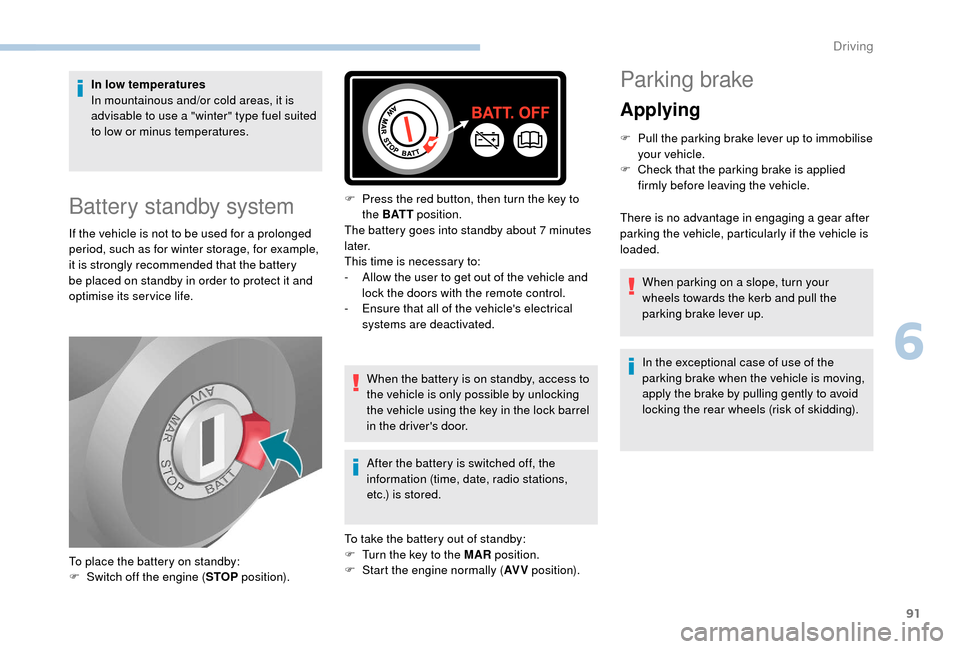
To place the battery on standby:
F
S
witch off the engine ( STOP position). F
P
ress the red button, then turn the key to
the B AT T position.
The battery goes into standby about 7 minutes
later.
This time is necessary to:
-
A
llow the user to get out of the vehicle and
lock the doors with the remote control.
-
E
nsure that all of the vehicle's electrical
systems are deactivated.
Parking brake
Applying
F Pull the parking brake lever up to immobilise your vehicle.
F
C
heck that the parking brake is applied
firmly before leaving the vehicle.
There is no advantage in engaging a
gear after
parking the vehicle, particularly if the vehicle is
loaded.
When parking on a
slope, turn your
wheels towards the kerb and pull the
parking brake lever up.
In the exceptional case of use of the
parking brake when the vehicle is moving,
apply the brake by pulling gently to avoid
locking the rear wheels (risk of skidding).
6
Driving
Page 94 of 232
92
Releasing
When the vehicle is being driven,
this warning lamp coming on
indicates that the parking brake is
still applied or has not been fully
released.
Manual gearbox
To change gear easily, always depress the
clutch pedal fully.
To prevent the mat from becoming caught
under the pedal:
-
e
nsure that the mat is positioned
correctly,
-
n
ever fit one mat on top of another.
Avoid leaving your hand on the gear knob as
the force exerted, even if slight, may wear the
internal components of the gearbox over time.
Engaging reverse gear
Never engage reverse gear before the
vehicle is completely stationary.
If your vehicle is fitted with parking
sensors, the system comes into operation
when reverse gear is engaged; an audible
signal is heard.
For more information on Rear parking
sensors , refer to the corresponding
section.
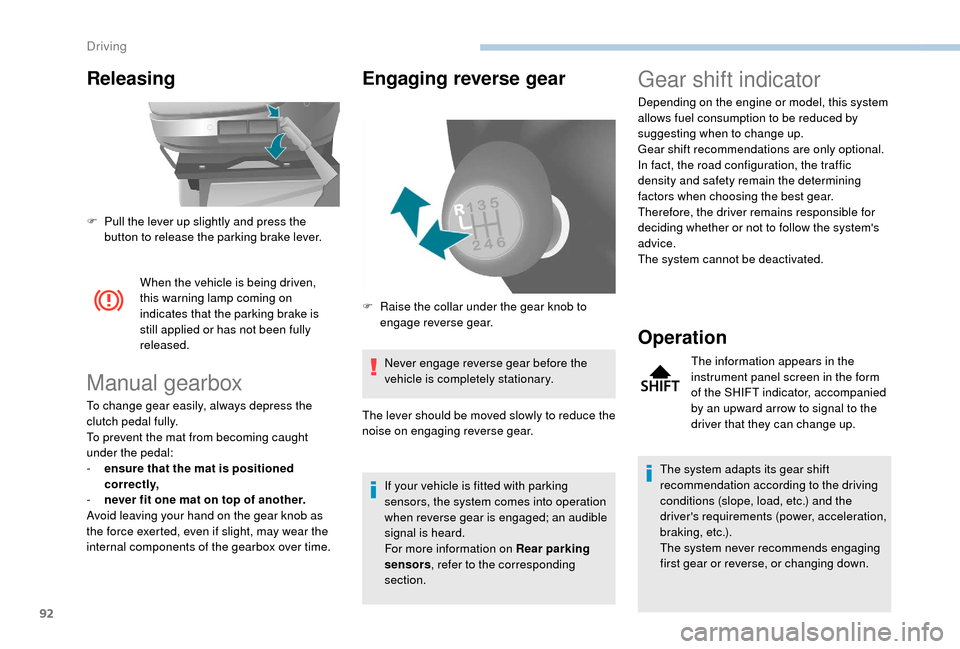
F
P
ull the lever up slightly and press the
button to release the parking brake lever.
Gear shift indicator
Depending on the engine or model, this system
allows fuel consumption to be reduced by
suggesting when to change up.
Gear shift recommendations are only optional.
In fact, the road configuration, the traffic
density and safety remain the determining
factors when choosing the best gear.
Therefore, the driver remains responsible for
deciding whether or not to follow the system's
advice.
The system cannot be deactivated.
Operation
The information appears in the
instrument panel screen in the form
of the SHIFT indicator, accompanied
by an upward arrow to signal to the
driver that they can change up.
The system adapts its gear shift
recommendation according to the driving
conditions (slope, load, etc.) and the
driver's requirements (power, acceleration,
b r a k i n g , e t c .) .
The system never recommends engaging
first gear or reverse, or changing down.
F
R
aise the collar under the gear knob to
engage reverse gear.
The lever should be moved slowly to reduce the
noise on engaging reverse gear.
Driving
Page 100 of 232
98
Additional traffic signs are filtered as follows:
- S igns related to snow or ice are displayed
only if the exterior temperature is below
3°C.
-
S
igns related to snow, rain or fog are
displayed only if the wipers are on and the
exterior temperature is below 3°C.
-
S
igns related to heavy goods vehicles are
only displayed if they apply to vehicles
weighing less than 4
tonnes.
-
S
igns related to farm vehicles are not
displayed.
Signs such as the no overtaking sign disappear
after about 40
seconds in the instrument panel.
Activation/Deactivation
The function is set with the MODE button; in
the "Traffic Sign" menu, select "ON" or "OFF".
For more information on Vehicle
configuration , refer to the corresponding
section.
Operating limits
The legislation on speed limits is specific to
each country.
The system does not take account of reduced
speed limits in the following cases:
-
p
oor weather (rain, snow),
-
a
tmospheric pollution,
-
t
railer, caravan,
-
d
riving with snow chains fitted,
-
d
riving with a non-genuine suspension kit,
-
p
uncture repair using the temporary repair
kit,
-
y
oung drivers. The following situations may interfere with
the operation of the system or prevent it
from working:
-
p
oor visibility (dazzling sun, inadequate
street lighting, falling snow, heavy rain,
dense fog, vehicle too far from the
traffic sign),
-
l
ow temperatures and particularly
severe climatic conditions,
-
w
indscreen area in front of the camera
being: dirty, misted up, frost-covered,
snow-covered, damaged or covered by
a
s t i c ke r,
-
f
ault with the camera,
-
o
bsolete or incorrect mapping,
-
o
bstructed road signs (by other
vehicles, vegetation, snow),
-
t
raffic signs that do not conform to the
standard, are damaged or distorted,
-
r
oad inclination causing the sign to be
out of the camera view (for example, to
one side).
-
v
ariation of load causing the camera
to be significantly inclined (the system
may not work for a
moment while the
camera recalibrates itself).
Driving