Dis Peugeot Boxer 2018 Repair Manual
[x] Cancel search | Manufacturer: PEUGEOT, Model Year: 2018, Model line: Boxer, Model: Peugeot Boxer 2018Pages: 232, PDF Size: 9.09 MB
Page 114 of 232
112
Switching off
F Move from reverse gear into neutral.
Malfunction
If this warning lamp comes on in the
instrument panel accompanied by
a message in the screen, contact
a
PEUGEOT dealer or a qualified
workshop.
Reversing camera
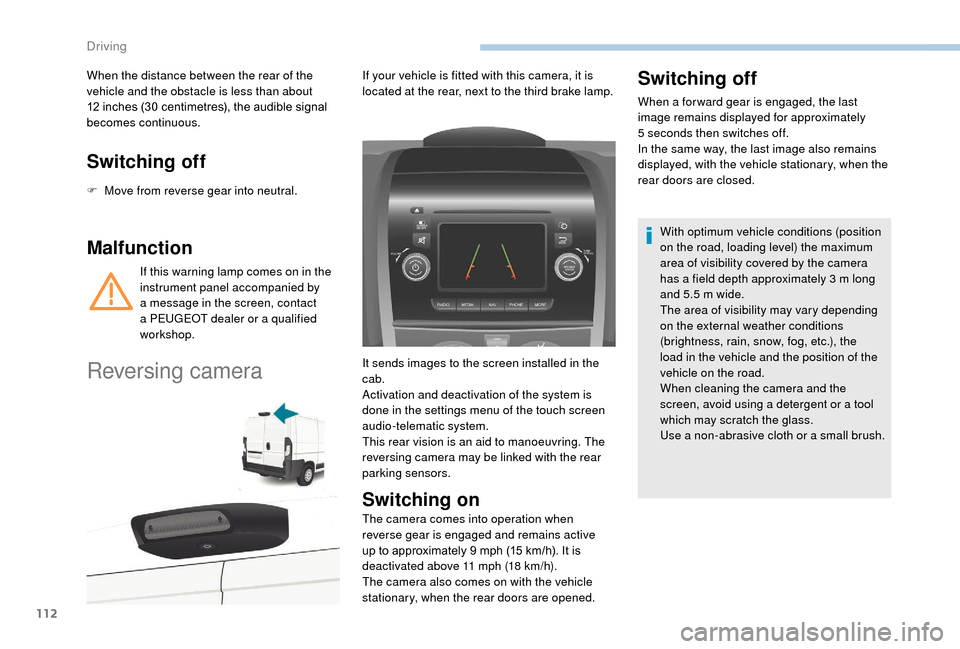
If your vehicle is fitted with this camera, it is
located at the rear, next to the third brake lamp.
Switching on
The camera comes into operation when
reverse gear is engaged and remains active
up to approximately 9
mph (15 km/h). It is
deactivated above 11
mph (18 km/h).
The camera also comes on with the vehicle
stationary, when the rear doors are opened.
Switching off
When a for ward gear is engaged, the last
im age remains displayed for approximately
5
seconds then switches off.
In the same way, the last image also remains
displayed, with the vehicle stationary, when the
rear doors are closed.
With optimum vehicle conditions (position
on the road, loading level) the maximum
area of visibility covered by the camera
has a
field depth approximately 3 m long
and 5.5
m wide.
The area of visibility may vary depending
on the external weather conditions
(brightness, rain, snow, fog, etc.), the
load in the vehicle and the position of the
vehicle on the road.
When cleaning the camera and the
screen, avoid using a
detergent or a tool
which may scratch the glass.
Use a
non-abrasive cloth or a small brush.
It sends images to the screen installed in the
cab.
Activation and deactivation of the system is
done in the settings menu of the touch screen
audio-telematic system.
This rear vision is an aid to manoeuvring. The
reversing camera may be linked with the rear
parking sensors.
When the distance between the rear of the
vehicle and the obstacle is less than about
12 inches (30 centimetres), the audible signal
becomes continuous.
Driving
Page 115 of 232
113
Pneumatic suspensionThere is a nominal level as well as 6 height
a djustment levels, raising (from +1 to +3) or
lowering (from -1
t
o -3). The levels are indicated
in the instrument panel screen.
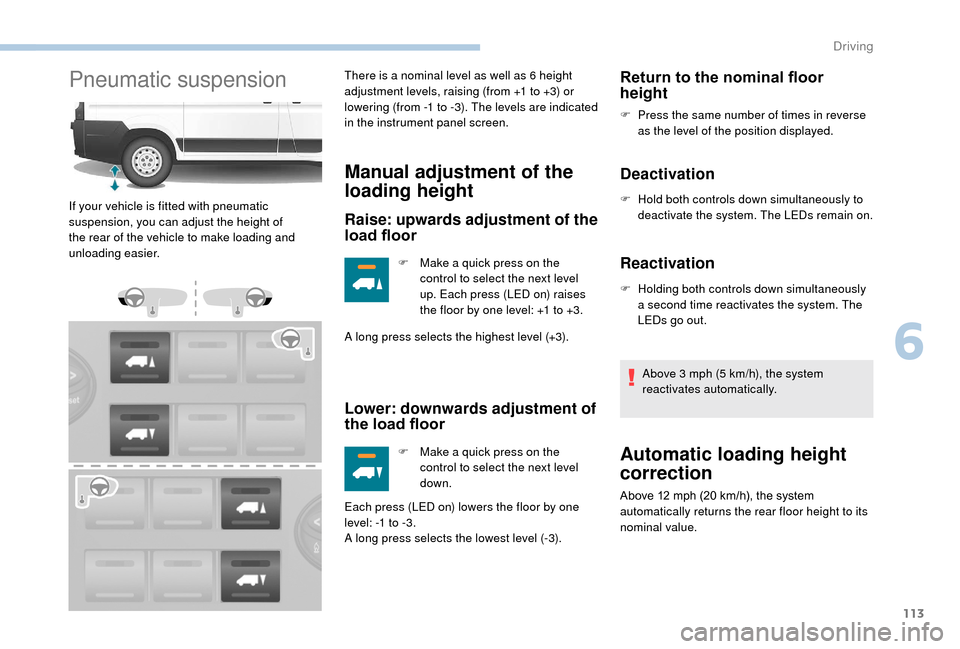
Manual adjustment of the
loading height
Raise: upwards adjustment of the
load floor
F Make a quick press on the
control to select the next level
up. Each press (LED on) raises
the floor by one level: +1
to +3.
A long press selects the highest level (+3).
Lower: downwards adjustment of
the load floor
F Make a quick press on the
control to select the next level
down.
If your vehicle is fitted with pneumatic
suspension, you can adjust the height of
the rear of the vehicle to make loading and
unloading easier.
Each press (LED on) lowers the floor by one
level: -1
to -3.
A long press selects the lowest level (-3).
Return to the nominal floor
height
F Press the same number of times in reverse as the level of the position displayed.
Deactivation
F Hold both controls down simultaneously to deactivate the system. The LEDs remain on.
Reactivation
F Holding both controls down simultaneously a second time reactivates the system. The
LEDs go out.
Above 3
mph (5 km/h), the system
reactivates automatically.
Automatic loading height
correction
Above 12 mph (20 km/h), the system
a utomatically returns the rear floor height to its
nominal value.
6
Driving
Page 126 of 232
124
Maximum load on the roof, evenly
distributed: 150 kg, for all models, within
the vehicle's weight limit (Gross Vehicle
Weight).
On all H3
height models, the roof cannot
be fitted with a
carrying system.
Fully comply with the legal requirements
for carrying oversized loads.
For more information on the Technical
data of your vehicle and particularly the
dimensions, refer to the corresponding
section.Changing a wiper blade
Check that the screenwash or headlamp
wash jets are not blocked.
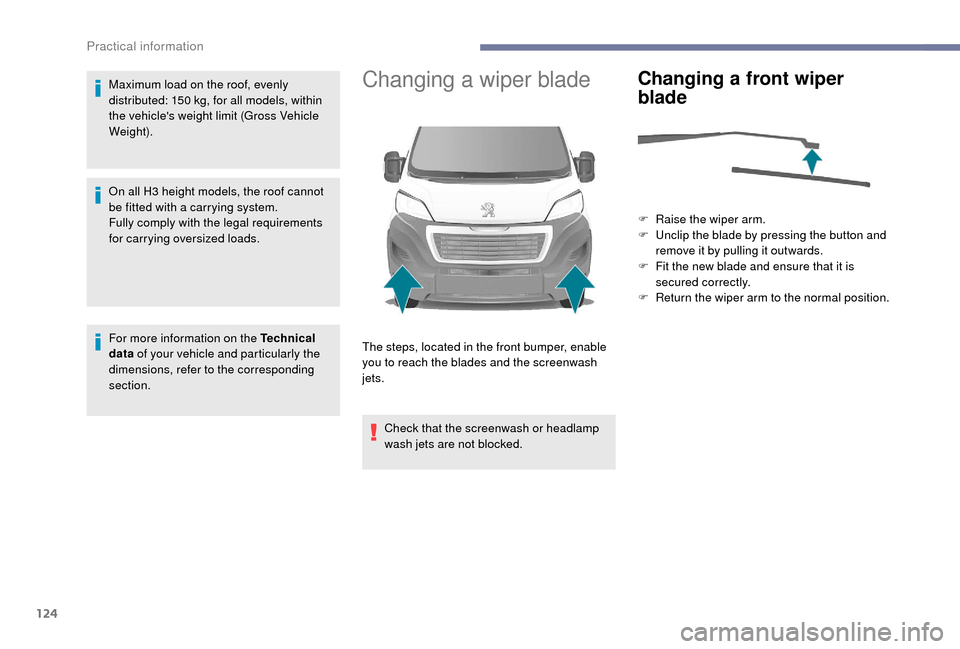
Changing a front wiper
blade
F Raise the wiper arm.
F
U nclip the blade by pressing the button and
remove it by pulling it outwards.
F
F
it the new blade and ensure that it is
secured correctly.
F
R
eturn the wiper arm to the normal position.
The steps, located in the front bumper, enable
you to reach the blades and the screenwash
jets.
Practical information
Page 128 of 232
126
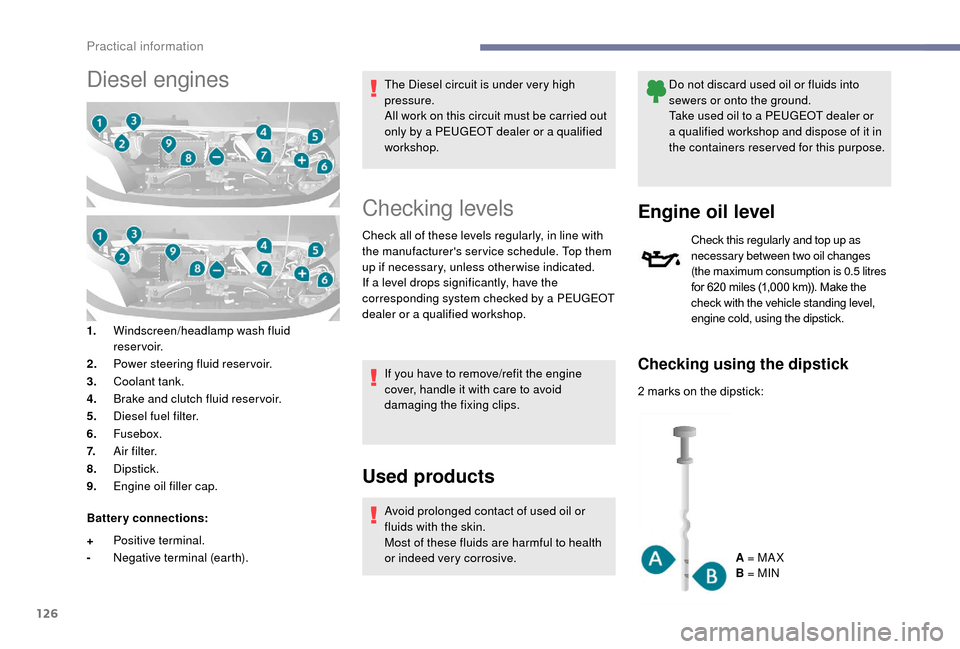
Diesel engines
1.Windscreen/headlamp wash fluid
reservoir.
2. Power steering fluid reservoir.
3. Coolant tank.
4. Brake and clutch fluid reser voir.
5. Diesel fuel filter.
6. Fusebox.
7. A i r f i l t e r.
8. Dipstick.
9. Engine oil filler cap.
Battery connections:
+ Positive terminal.
- Negative terminal (earth). The Diesel circuit is under very high
pressure.
All work on this circuit must be carried out
only by a
PEUGEOT dealer or a qualified
workshop.
Checking levels
Check all of these levels regularly, in line with
the manufacturer's service schedule. Top them
up if necessary, unless other wise indicated.
If a
level drops significantly, have the
corresponding system checked by a
PEUGEOT
dealer or a
qualified workshop.
If you have to remove/refit the engine
cover, handle it with care to avoid
damaging the fixing clips.
Used products
Avoid prolonged contact of used oil or
fluids with the skin.
Most of these fluids are harmful to health
or indeed very corrosive. Do not discard used oil or fluids into
sewers or onto the ground.
Take used oil to a
PEUGEOT dealer or
a qualified workshop and dispose of it in
the containers reser ved for this purpose.
Engine oil level
Check this regularly and top up as
necessary between two oil changes
(the maximum consumption is 0.5
litres
for 620
miles (1,000 km)). Make the
check with the vehicle standing level,
engine cold, using the dipstick.
Checking using the dipstick
2 marks on the dipstick:
A = MA X
B = MIN
Practical information
Page 132 of 232
130
Operation
This filter, fitted in the exhaust system,
accumulates particles of soot. The engine
management unit controls the automatic
periodic elimination of the soot particles
(regeneration).
The regeneration procedure is triggered
depending on the amount of particles
accumulated and the vehicle use conditions.
During this phase, you may notice some
unusual phenomena – increased idling speed,
cooling fan running, increase in smoke and
higher exhaust gas temperature – which does
not affect the operation of the vehicle or the
environment.After prolonged idling or driving at very
low speeds, you may occasionally notice
water vapour being emitted from the
exhaust when accelerating. This is of no
consequence to the running of the vehicle
or to the environment. Because of the higher exhaust gas
temperature resulting from the normal
operation of the particle filter, it is
recommended that you do not park the
vehicle over inflammable materials (grass,
dry leaves, pine needles, etc.) so as to
avoid any risk of fire.
Saturation/Regeneration
If there is risk of blockage of the
filter, this warning lamp comes on in
the instrument panel.
This alert tells you that the particle filter is
starting to saturate (in conditions of urban
driving of exceptionally long duration: low
speeds, traffic jams, etc.).
To regenerate the filter, it is advised to drive
as soon as possible, when traffic conditions
and the law permit, at a
speed of at least
37
mph (60 km/h), with an engine speed above
2,000
rpm for about fifteen minutes (until the
warning lamp and/or the message disappears).
If possible, avoid switching off the engine
before the end of the filter regeneration;
repeated interruptions could cause premature
deterioration of the engine oil. It is not
recommended to end regeneration of the filter
with the vehicle stationary.
Malfunction
If this alert persists, do not ignore the warning;
it indicates that a fault has occurred in the
exhaust system/particle filter assembly.
Have the whole system checked by
a
PEUGEOT dealer or a qualified workshop.
Manual gearbox
The gearbox does not require any
maintenance (no oil change).
Brake pads
Brake wear depends on the style
of driving, particularly in the case
of vehicles used in town, over short
distances. It may be necessary to
have the condition of the brakes
checked, even between vehicle
services.
If this warning lamp comes on, have
the brake pad wear checked by
a
PEUGEOT dealer or a qualified
workshop.
Practical information
Page 133 of 232
131
Brake disc wear
For information on checking brake
disc wear, contact a PEUGEOT
dealer or a
qualified workshop.
Parking brake
If excessive travel or a loss of
e ffectiveness of this system is
noticed, the parking brake must
be checked, even between two
services.
This system must be checked by a
PEUGEOT
dealer or a
qualified workshop.
Diesel fuel filter
The Diesel fuel filter is located under the
bonnet, close to the brake fluid reser voir. If this warning lamp comes on, the
filter must be purged to remove
water.
You can also purge the fuel filter
regularly, every time the engine oil
is changed.
Purging water from the filterThe HDi engines use advanced technology.
All work must be done by personnel that
have had special training, which can be
ensured by going to a
PEUGEOT dealer or
a
qualified workshop.
Only use products recommended by
PEUGEOT or products of equivalent
quality and specification.
In order to optimise the operation of
components as important as those in the
braking system, PEUGEOT selects and
offers very specific products.
After washing the vehicle, dampness, or
in wintry conditions, ice can form on the
brake discs and pads: braking efficiency
may be reduced. Make light brake
applications to dry and defrost the brakes.
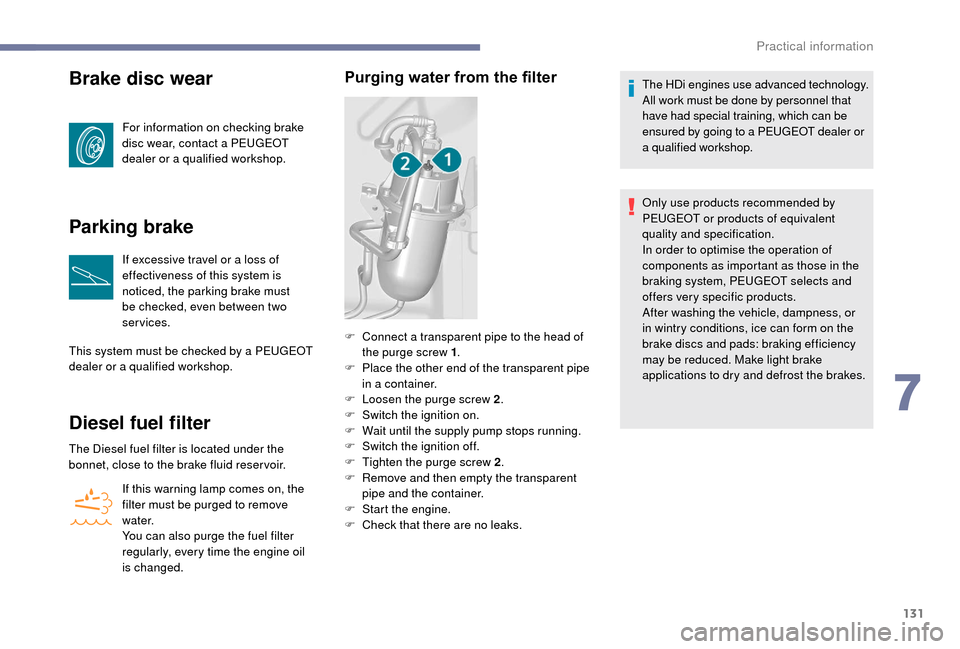
F
C
onnect a
transparent pipe to the head of
the purge screw 1 .
F
P
lace the other end of the transparent pipe
in a
container.
F
L
oosen the purge screw 2 .
F
S
witch the ignition on.
F
W
ait until the supply pump stops running.
F
S
witch the ignition off.
F
T
ighten the purge screw 2 .
F
R
emove and then empty the transparent
pipe and the container.
F
S
tart the engine.
F
C
heck that there are no leaks.
7
Practical information
Page 138 of 232
136
F If a pressure of at least 3 bar is not
reached within 5 minutes, disconnect the
compressor from the valve and the power
socket, then move the vehicle for ward by
approximately 10
metres to distribute the
sealant fluid inside the tyre.
F
T
hen repeat the inflation operation:
•
i
f a pressure of at least 3 bar is not
reached within 10
minutes, switch off your
vehicle: the tyre has suffered too much
damage and it could not be repaired.
Contact a
PEUGEOT dealer or a qualified
workshop.
•
i
f the tyre has been inflated to a pressure
of 5
bar, set off again immediately.
F
A
fter driving for approximately 10 minutes,
stop and check the pressure of the tyre
again.
F
A
djust the pressure to the value given on
the label on the driver's door pillar, and
contact a
PEUGEOT dealer or a qualified
workshop as soon as possible.
This puncture repair kit and replacement
cartridges are available from PEUGEOT
dealers.Checking and adjusting the
pressure
The compressor can only be used to check and
adjust the pressure.
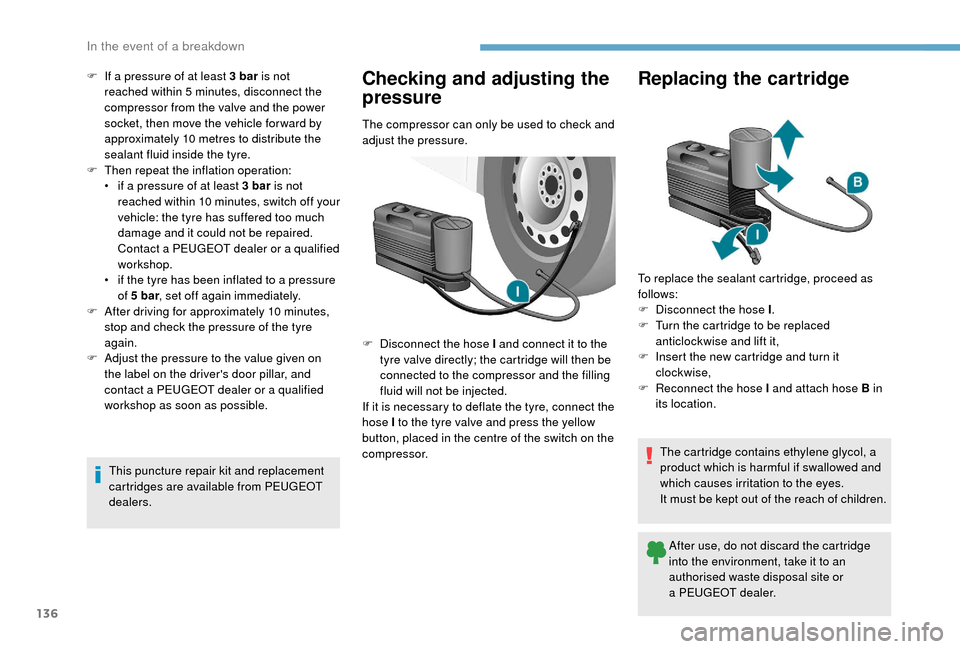
F
D
isconnect the hose I and connect it to the
tyre valve directly; the cartridge will then be
connected to the compressor and the filling
fluid will not be injected.
If it is necessary to deflate the tyre, connect the
hose I to the tyre valve and press the yellow
button, placed in the centre of the switch on the
compressor.
Replacing the cartridge
To replace the sealant cartridge, proceed as
follows:
F
D
isconnect the hose I .
F
T
urn the cartridge to be replaced
anticlockwise and lift it,
F
I
nsert the new cartridge and turn it
clockwise,
F
R
econnect the hose I and attach hose B in
its location.
The cartridge contains ethylene glycol, a
product which is harmful if swallowed and
which causes irritation to the eyes.
It must be kept out of the reach of children. After use, do not discard the cartridge
into the environment, take it to an
authorised waste disposal site or
a
PEUGEOT dealer.
In the event of a breakdown
Page 146 of 232
144
In some weather conditions (e.g. low
temperature or humidity), the presence
of misting on the internal sur face of the
glass of the headlamps and rear lamps is
normal; it disappears after the lamps have
been on for a few minutes.
Types of bulb
Various types of bulb are fitted to your vehicle.
To remove them:
Ty p e A
Ty p e B
All glass bulb: pull gently as it is fitted by
pressure.
Ty p e C
Ty p e D
Bayonet bulb: press on the bulb then turn it
anti-clockwise. Cylindrical bulb: move the contacts apart.
Halogen bulb: release the retaining spring from
its housing.
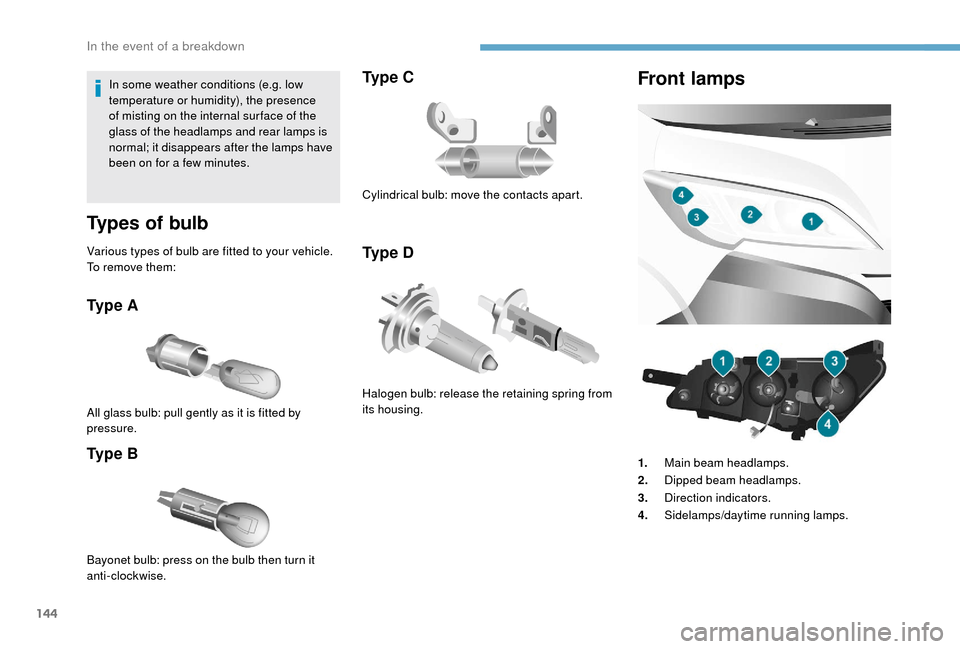
Front lamps
1.
Main beam headlamps.
2. Dipped beam headlamps.
3. Direction indicators.
4. Sidelamps/daytime running lamps.
In the event of a breakdown
Page 148 of 232
146
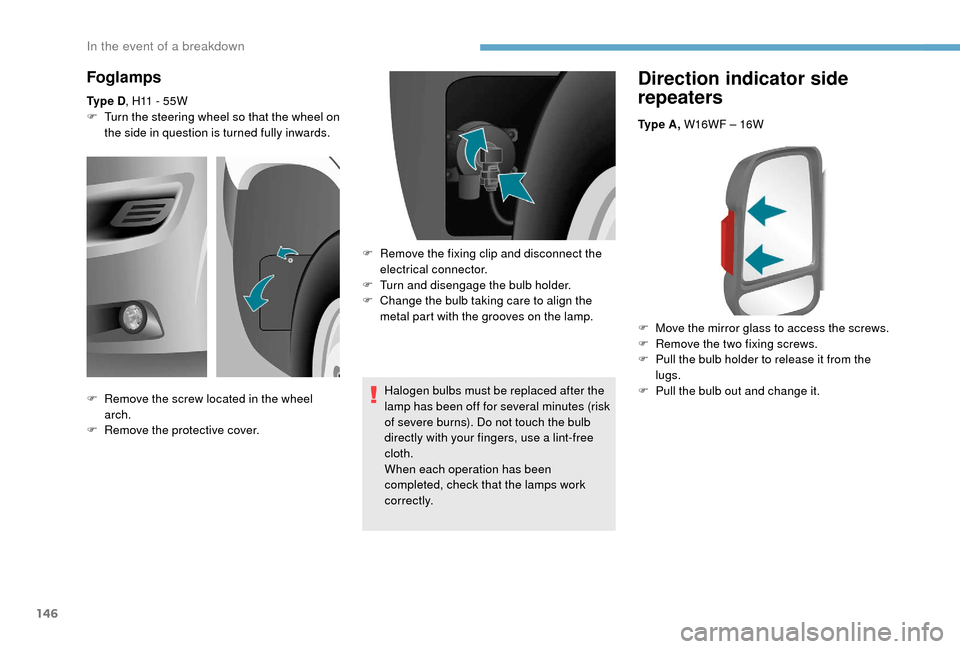
Direction indicator side
repeaters
Ty p e A , W16WF – 16W
F
M
ove the mirror glass to access the screws.
F
R
emove the two fixing screws.
F
P
ull the bulb holder to release it from the
lugs.
F
P
ull the bulb out and change it.
Foglamps
Ty p e D , H11 - 55W
F T urn the steering wheel so that the wheel on
the side in question is turned fully inwards.
Halogen bulbs must be replaced after the
lamp has been off for several minutes (risk
of severe burns). Do not touch the bulb
directly with your fingers, use a
lint-free
cloth.
When each operation has been
completed, check that the lamps work
c o r r e c t l y.
F
R
emove the screw located in the wheel
arch.
F
R
emove the protective cover. F
R
emove the fixing clip and disconnect the
electrical connector.
F
T
urn and disengage the bulb holder.
F
C
hange the bulb taking care to align the
metal part with the grooves on the lamp.
In the event of a breakdown
Page 155 of 232
153
Battery
Batteries contain harmful substances
such as sulphuric acid and lead.
They must be disposed of in accordance
with regulations and must not, in any
circumstances, be discarded with
household waste.
Take used remote control batteries and
vehicle batteries to a special collection
point.
Access to the battery
Procedure for starting the engine using another
battery or charging a discharged battery.
Lead-acid starter batteries
Protect your eyes and face before
handling the battery.
All operations on the battery must be
carried out in a
well ventilated area and
away from naked flames and sources of
sparks, so as to avoid the risk of explosion
or fire.
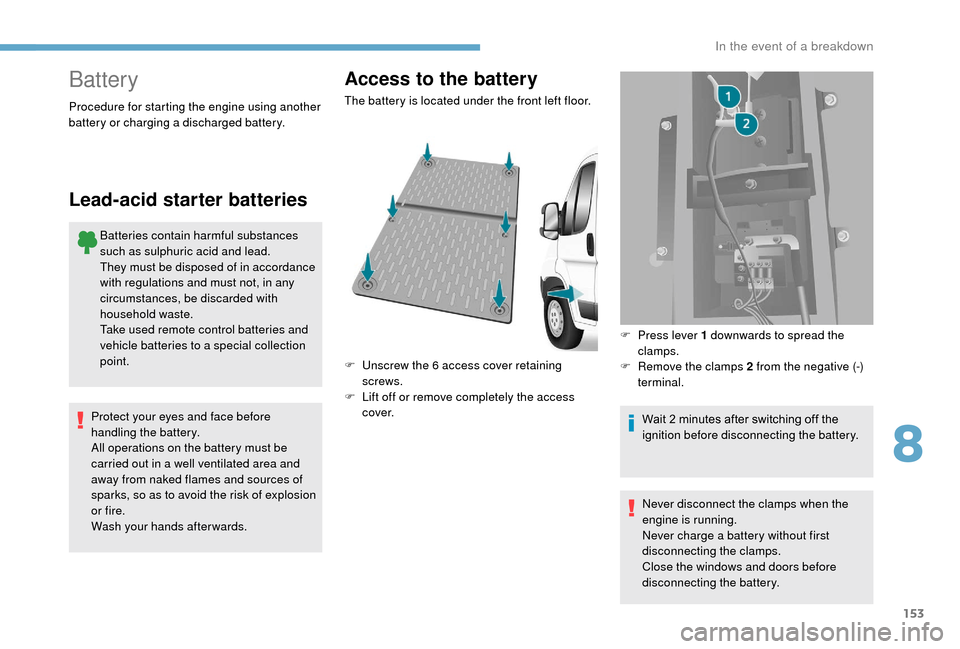
Wash your hands afterwards. The battery is located under the front left floor.
F
U
nscrew the 6 access cover retaining
screws.
F
L
ift off or remove completely the access
c ove r. F
P
ress lever 1 downwards to spread the
clamps.
F
R
emove the clamps 2 from the negative (-)
terminal.
Wait 2 minutes after switching off the
ignition before disconnecting the battery.
Never disconnect the clamps when the
engine is running.
Never charge a
battery without first
disconnecting the clamps.
Close the windows and doors before
disconnecting the battery.
8
In the event of a breakdown