Dis Peugeot Boxer 2018 Service Manual
[x] Cancel search | Manufacturer: PEUGEOT, Model Year: 2018, Model line: Boxer, Model: Peugeot Boxer 2018Pages: 232, PDF Size: 9.09 MB
Page 81 of 232
79
When OFF is selected, the front passenger airbag
will not be triggered in the event of an impact.Every time the engine is started, the
deactivation check is confirmed by
the illumination of this warning lamp,
accompanied by a
message in the
display screen.
Reactivating the front
passenger airbag
F As soon as the child seat is removed, select ON to reactivate the airbag and thus ensure
the safety of your front passengers in the
event of an impact.
5
5
Safety
Page 83 of 232
81
LTNIEK ADA neįrenkite vaiko prilaikymo priemonės su atgal atgręžtu vaiku ant sėdynės, kuri saugoma VEIKIANČIOS priekinės ORO
PAGALVĖS. Išsiskleidus oro pagalvei vaikas gali būti MIRTINAI arba SUNKIAI TR AUMUOTAS.
LV NEK AD NEuzstādiet uz aizmuguri vērstu bērnu sēdeklīti priekšējā pasažiera sēdvietā, kurā ir AKTIVIZĒTS priekšējais DROŠĪBAS GAISA
SPILVENS. Tas var izraisīt BĒRNA NĀVI vai radīt NOPIETNUS IEVAINOJUMUS.
MT Qatt m'ghandek thalli tifel/tifla marbut f'siggu dahru lejn l-Airbag attiva, ghaliex tista' tikkawza korriment serju jew anke mewt lit-tifel/tifla
NL Plaats NOOIT een kinderzitje met de rug in de rijrichting op een zitplaats waar van de AIRBAG is INGESCHAKELD. Bij het afgaan van de
airbag kan het KIND LEVENSGEVA ARLIJK GEWOND R AKEN
NO Installer ALDRI et barnesete med ryggen mot kjøreretningen i
et sete som er beskyttet med en frontal AKTIVERT KOLLISJONSPUTE,
BARNET risikerer å bli DREPT eller HARDT SK ADET.
PL NIGDY nie instalować fotelika dziecięcego w
pozycji "tyłem do kierunku jazdy" na siedzeniu wyposażonym w CZOŁOWĄ PODUSZKĘ
POWIETRZNĄ w
stanie AKT Y WNYM. Może to doprowadzić do ŚMIERCI DZIECK A lub spowodować u niego POWA ŻNE OBR A ŻENIA
CIAŁA.
PT NUNCA instale um sistema de retenção para crianças de costas para a
estrada num banco protegido por um AIRBAG frontal ACTIVADO.
Esta instalação poderá provocar FERIMENTOS GR AVES ou a
MORTE da CRIANÇA.
RO Nu instalati NICIODATA un sistem de retinere pentru copii, dispus cu spatele in directia de mers, pe un loc din vehicul protejat cu AIRBAG
frontal ACTIVAT. Aceasta ar putea provoca MOARTEA COPILULUI sau R ANIREA lui GR AVA.
RU ВО ВСЕХ СЛУЧА ЯХ ЗАПРЕЩАЕТСЯ использовать обращенное назад детское удерживающее устройство на сиденье,
защищенном ФУНКЦИОНИРУЮЩЕЙ ПОДУШКОЙ БЕЗОПАСНОСТИ, установленной перед этим сиденьем. Это может привести к
ГИБЕЛИ РЕБЕНК А или НАНЕСЕНИЮ ЕМУ СЕРЬЕЗНЫХ ТЕЛЕСНЫХ ПОВРЕЖ ДЕНИЙ
SK NIKDY neinštalujte detské zádržné zariadenie orientované smerom dozadu na sedadlo chránené AKTIVOVANÝM čelným AIRBAGOM.
Mohlo by dôjsť k
SMRTEĽNÉMU alebo VÁ ŽNEMU POR ANENIU DIEŤAŤA.
SL NIKOLI ne nameščajte otroškega sedeža s
hrbtom v smeri vožnje, če je VARNOSTNA BLA ZINA pred sprednjim sopotnikovim sedežem
AKTIVIR ANA. Takšna namestitev lahko povzroči SMRT OTROK A ali HUDE POŠKODBE.
SR NIK ADA ne koristite dečje sedište koje se okreće unazad na sedištu zaštićenim AKTIVNIM VA ZDUŠNIM JASTUKOM ispred njega, jer mogu
nastupiti SMRT ili OZBILJNA POVREDA DETETA.
SV Passagerarkrockkudden fram MÅSTE vara avaktiverad om en bakåtvänd bilbarnstol installeras på denna plats. Annars riskerar barnet att
DÖDAS eller SK ADAS ALLVARLIGT.
TR KESİNLKLE HAVA YASTIĞI AKTİF olan ön koltuğa yüzü arkaya dönük bir çocuk koltuğu yerleştirmeyiniz. Bu ÇOCUĞUN ÖLMESİNE veya
ÇOK AĞIR YAR ALANMASINA sebep olabilir.
5
5
Safety
Page 89 of 232
87
Driving recommendations
Observe the driving regulations and remain
vigilant whatever the traffic conditions.
Pay close attention to the traffic and keep your
hands on the wheel so that you are ready to
react at any time to any eventuality.
As a safety measure, the driver should only
carry out any operations that require close
attention when the vehicle is stationary.
On a
long journey, a break every two hours is
strongly recommended.
In difficult weather, drive smoothly, anticipate
the need to brake and increase the distance
from other vehicles.
Never leave the engine running in
an enclosed area without adequate
ventilation: internal combustion engines
emit toxic exhaust gases, such as carbon
monoxide. There is a
risk of poisoning and
death!
In very severe wintry conditions
(temperatures below -23°C), to guarantee
correct operation and the longevity of
the mechanical elements of your vehicle,
engine and gearbox, the engine must be
left running for 4
minutes before driving.
Driving on flooded roads
We strongly advise against driving on flooded
roads, as this could cause serious damage
to the engine or gearbox, as well as to the
electrical systems of your vehicle.
Important!
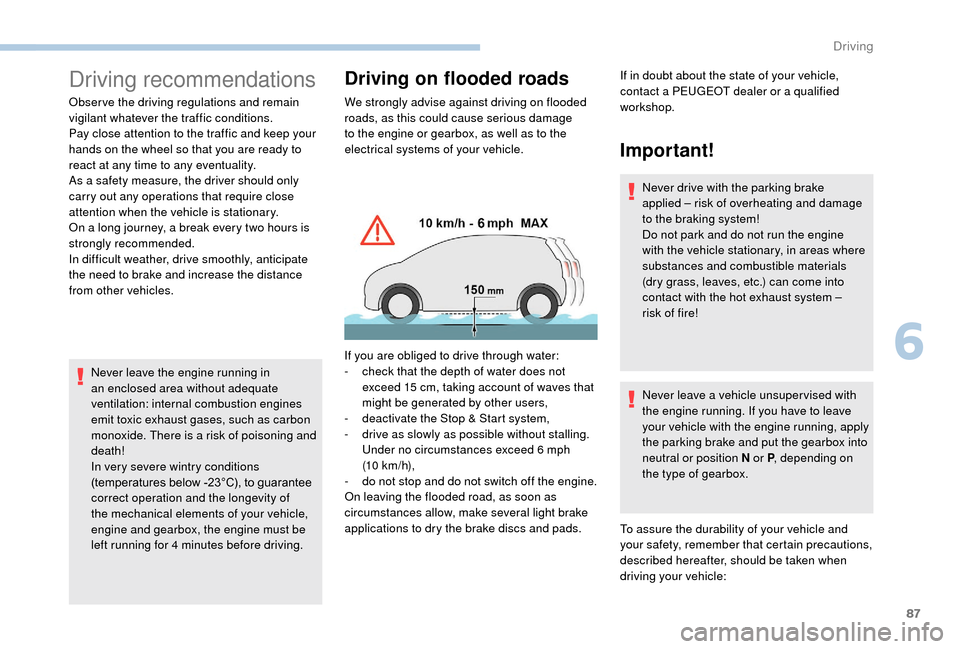
If you are obliged to drive through water:
- c heck that the depth of water does not
exceed 15
cm, taking account of waves that
might be generated by other users,
-
d
eactivate the Stop & Start system,
-
d
rive as slowly as possible without stalling.
Under no circumstances exceed 6
mph
(10
km/h),
-
d
o not stop and do not switch off the engine.
On leaving the flooded road, as soon as
circumstances allow, make several light brake
applications to dry the brake discs and pads. If in doubt about the state of your vehicle,
contact a
PEUGEOT dealer or a qualified
workshop.
Never drive with the parking brake
applied – risk of overheating and damage
to the braking system!
Do not park and do not run the engine
with the vehicle stationary, in areas where
substances and combustible materials
(dry grass, leaves, etc.) can come into
contact with the hot exhaust system –
risk of fire!
Never leave a vehicle unsuper vised with
the engine running. If you have to leave
your vehicle with the engine running, apply
the parking brake and put the gearbox into
neutral or position N or P , depending on
the type of gearbox.
To assure the durability of your vehicle and
your safety, remember that certain precautions,
described hereafter, should be taken when
driving your vehicle:
6
Driving
Page 90 of 232
88
Manoeuvre cautiously, at low
speed
The dimensions of your vehicle differ from
those of a light vehicle, in width, in height, as
well as in length, and some obstacles will be
more difficult to notice.
Manoeuvre slowly.
Before turning, check that there are no
obstacles at mid-height along the sides.
Before reversing, check that there are no
obstacles, particularly at high level behind the
vehicle.
Be aware of the external dimensions, if ladders
are fitted.
Load the vehicle correctly
With a load, the vehicle must remain within the
m aximum authorised weight, the Gross Vehicle
Weight.
To avoid upsetting the balance of the vehicle,
the load should be centred and the heaviest
part placed on the floor in front of the rear
wheels.
It is inadvisable to place heavy loads on a
roof
rack.
Loading also implies adherence to the
maximum load of the roof bar anchor points.
Adhere to the maximum permissible weight,
according to PEUGEOT dealer specifications.
Loads must be securely lashed down.
A load that is not properly secured inside the
vehicle may affect vehicle handling and create
a
risk of accident.
Drive the vehicle in a prudent
a nd efficient way
Take corners gently.
Anticipate the need to brake as the stopping
distance is increased, particularly on wet or icy
roads.
Be aware of the effect of side winds on the
vehicle.
Effective eco-driving saves fuel; accelerate
progressively, anticipate the need to slow down
and adapt your speed to suit the situation.
Indicate changes of direction well in advance
so that you are seen by other road users.
Take care
The tyres must be inflated to at least the
pressures indicated on the label, even over-
inflated by 0.2
to 0.3 bar for long journeys.
In case of towing
Driving with a trailer places greater
d emands on the towing vehicle and
requires extra care from the driver.
Distribution of loads
F Distribute the load in the trailer so that the heaviest items are as close as possible to
the axle and the nose weight approaches
the maximum permitted without exceeding
it.
Air density decreases with altitude, thus
reducing engine performance. The maximum
towed load must be reduced by 10% for every
1,000
metres of altitude.
For more information on the Technical
data of your vehicle and particularly on
towable loads, refer to the corresponding
section.
Side wind
F Take into account the increased sensitivity to wind.
If your vehicle is fitted with a
drop-side back,
the height and width of the load must remain
within the overall dimensions of the vehicle.
Driving
Page 91 of 232
89
Cooling
Towing a trailer on a slope increases the
t emperature of the coolant.
As the fan is electrically controlled, its cooling
capacity is not dependent on the engine speed.
F
T
o lower the engine speed, reduce your
speed.
The maximum towable load on an incline
depends on the gradient and the exterior
temperature.
In all cases, keep a
check on the coolant
temperature.
F
I
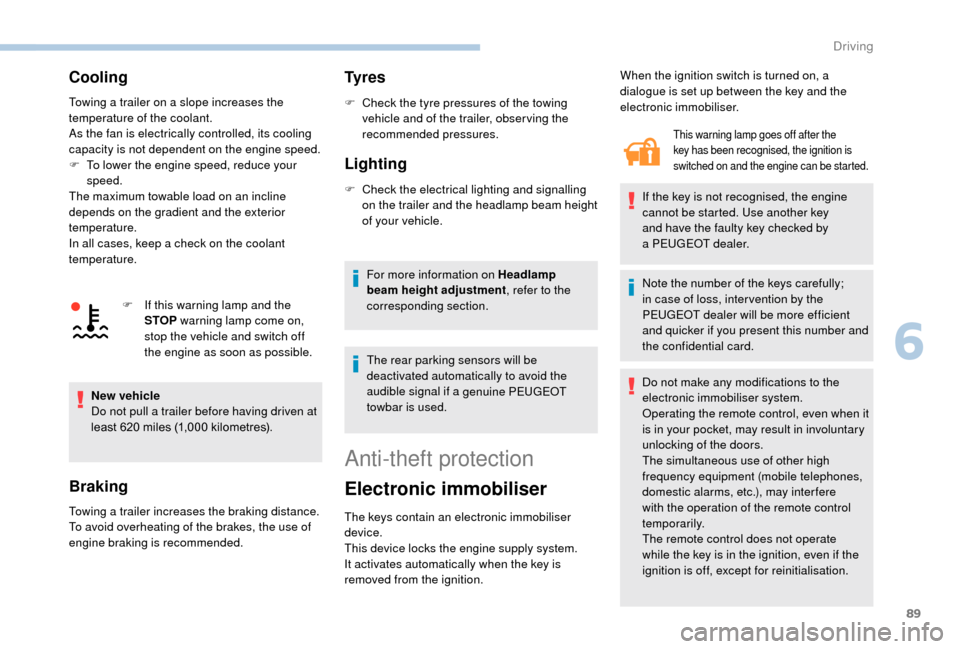
f this warning lamp and the
STOP warning lamp come on,
stop the vehicle and switch off
the engine as soon as possible.
New vehicle
Do not pull a
trailer before having driven at
least 620
miles (1,000 kilometres).
Braking
Towing a trailer increases the braking distance.
T o avoid overheating of the brakes, the use of
engine braking is recommended.
Ty r e s
F Check the tyre pressures of the towing vehicle and of the trailer, observing the
recommended pressures.
Lighting
F Check the electrical lighting and signalling on the trailer and the headlamp beam height
of your vehicle.
For more information on Headlamp
beam height adjustment , refer to the
corresponding section.
The rear parking sensors will be
deactivated automatically to avoid the
audible signal if a
genuine PEUGEOT
towbar is used.
Anti-theft protection
Electronic immobiliser
The keys contain an electronic immobiliser
device.
This device locks the engine supply system.
It activates automatically when the key is
removed from the ignition.
This warning lamp goes off after the
key has been recognised, the ignition is
switched on and the engine can be started.
If the key is not recognised, the engine
cannot be started. Use another key
and have the faulty key checked by
a
PEUGEOT dealer.
Note the number of the keys carefully;
in case of loss, inter vention by the
PEUGEOT dealer will be more efficient
and quicker if you present this number and
the confidential card.
When the ignition switch is turned on, a
dialogue is set up between the key and the
electronic immobiliser.
Do not make any modifications to the
electronic immobiliser system.
Operating the remote control, even when it
is in your pocket, may result in involuntary
unlocking of the doors.
The simultaneous use of other high
frequency equipment (mobile telephones,
domestic alarms, etc.), may inter fere
with the operation of the remote control
temporarily.
The remote control does not operate
while the key is in the ignition, even if the
ignition is off, except for reinitialisation.
6
Driving
Page 96 of 232
94
Special cases: START mode
activated automatically
The START mode may be triggered
automatically in the following circumstances:
-
t
he vehicle is free-wheeling on a gradient,
-
t
he windscreen wipers are on fast wipe,
-
t
he air conditioning is on,
-
t
he engine has been stopped for around
3
minutes with Stop & Start,
-
s
ome special conditions (battery charge,
engine temperature, braking assistance, air
conditioning setting, etc.) where the engine
is needed to control a
system or the vehicle.
In this case, a message appears
in the instrument panel screen,
accompanied by this indicator lamp,
which flashes for a
few seconds,
then goes off.
This operation is perfectly normal. While in STOP mode with a
manual
gearbox, if a gear is engaged without fully
depressing the clutch pedal, restarting
may not take place.
An indicator lamp and/or message is
displayed in the instrument panel asking
you to fully depress the clutch pedal to
allow restarting.
With the engine stopped in STOP
mode, if the driver unfastens their
seat belt and opens a
front door, the
engine can only be restarted using
the ignition key. There is an audible
signal, accompanied by flashing of
this indicator lamp, and the display
of a
message.
Deactivation
If the system has been deactivated
in STOP mode, the engine restarts
immediately.
It is necessary to deactivate the
Stop & Start system if you want to
allow continuous operation of the air
conditioning.
The button indicator lamp remains on.
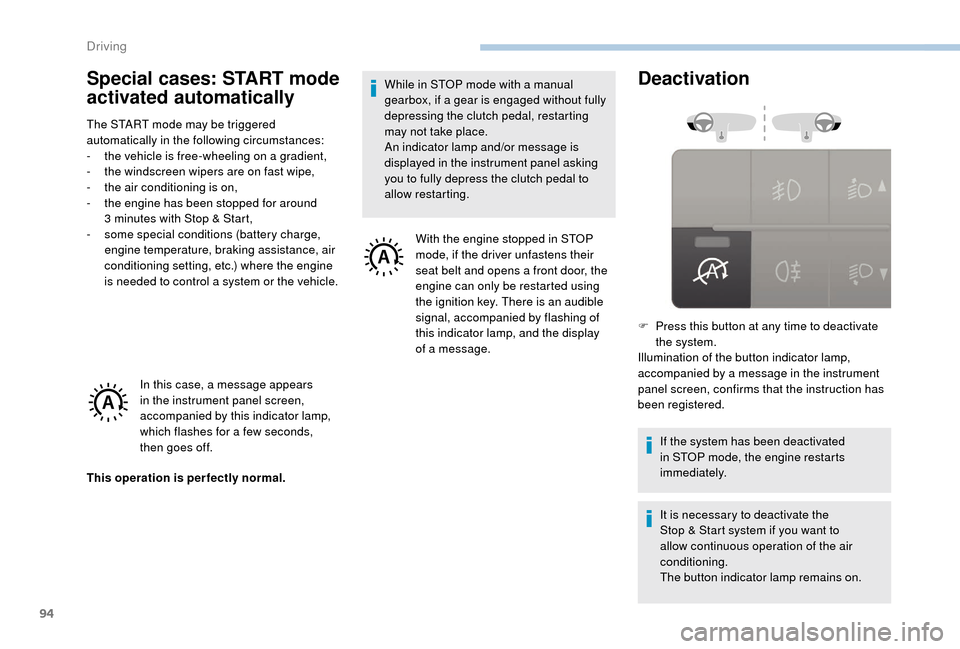
F
P
ress this button at any time to deactivate
the system.
Illumination of the button indicator lamp,
accompanied by a message in the instrument
panel screen, confirms that the instruction has
been registered.
Driving
Page 97 of 232
95
Reactivation
Malfunction
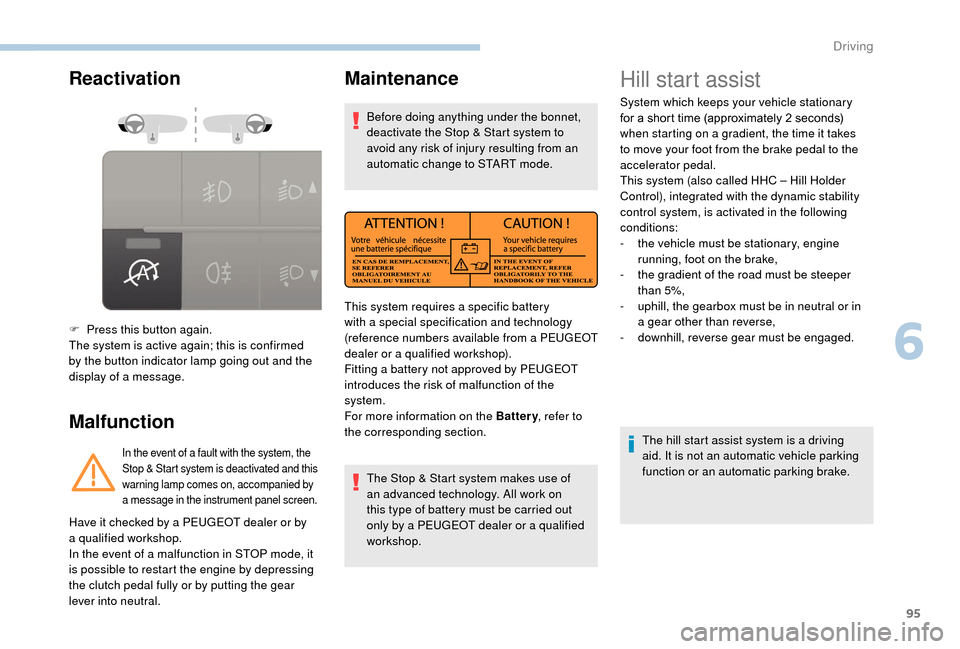
F Press this button again.
The system is active again; this is confirmed
by the button indicator lamp going out and the
display of a message.
In the event of a fault with the system, the
S top & Start system is deactivated and this
warning lamp comes on, accompanied by
a
message in the instrument panel screen.
Maintenance
Before doing anything under the bonnet,
deactivate the Stop & Start system to
avoid any risk of injury resulting from an
automatic change to START mode.
The Stop & Start system makes use of
an advanced technology. All work on
this type of battery must be carried out
only by a
PEUGEOT dealer or a qualified
workshop.
Have it checked by a
PEUGEOT dealer or by
a
qualified workshop.
In the event of a
malfunction in STOP mode, it
is possible to restart the engine by depressing
the clutch pedal fully or by putting the gear
lever into neutral. This system requires a
specific battery
with a
special specification and technology
(reference numbers available from a
PEUGEOT
dealer or a
qualified workshop).
Fitting a
battery not approved by PEUGEOT
introduces the risk of malfunction of the
system.
For more information on the Battery , refer to
the corresponding section.
Hill start assist
System which keeps your vehicle stationary
for a short time (approximately 2 seconds)
when starting on a
gradient, the time it takes
to move your foot from the brake pedal to the
accelerator pedal.
This system (also called HHC – Hill Holder
Control), integrated with the dynamic stability
control system, is activated in the following
conditions:
-
t
he vehicle must be stationary, engine
running, foot on the brake,
-
t
he gradient of the road must be steeper
than 5%,
-
u
phill, the gearbox must be in neutral or in
a
gear other than reverse,
-
do
wnhill, reverse gear must be engaged.
The hill start assist system is a
driving
aid. It is not an automatic vehicle parking
function or an automatic parking brake.
6
Driving
Page 98 of 232
96
Operation
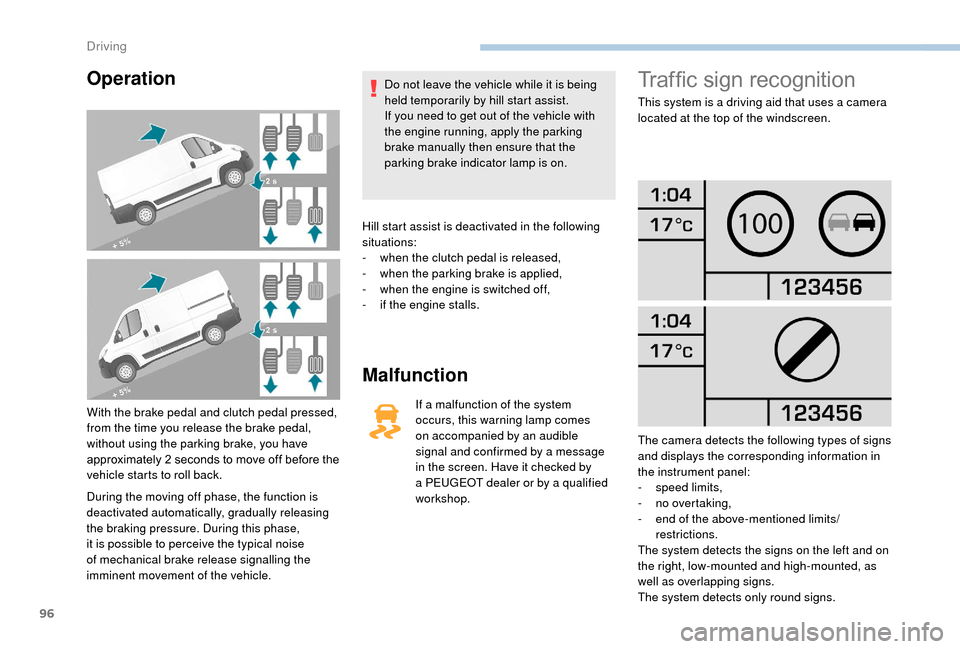
With the brake pedal and clutch pedal pressed,
from the time you release the brake pedal,
without using the parking brake, you have
approximately 2 seconds to move off before the
vehicle starts to roll back.
During the moving off phase, the function is
deactivated automatically, gradually releasing
the braking pressure. During this phase,
it is possible to perceive the typical noise
of mechanical brake release signalling the
imminent movement of the vehicle. Do not leave the vehicle while it is being
held temporarily by hill start assist.
If you need to get out of the vehicle with
the engine running, apply the parking
brake manually then ensure that the
parking brake indicator lamp is on.
Hill start assist is deactivated in the following
situations:
-
w
hen the clutch pedal is released,
-
w
hen the parking brake is applied,
-
w
hen the engine is switched off,
-
i
f the engine stalls.
Malfunction
If a malfunction of the system
o ccurs, this warning lamp comes
on accompanied by an audible
signal and confirmed by a
message
in the screen. Have it checked by
a
PEUGEOT dealer or by a qualified
workshop.
Traffic sign recognition
This system is a driving aid that uses a camera
l ocated at the top of the windscreen.
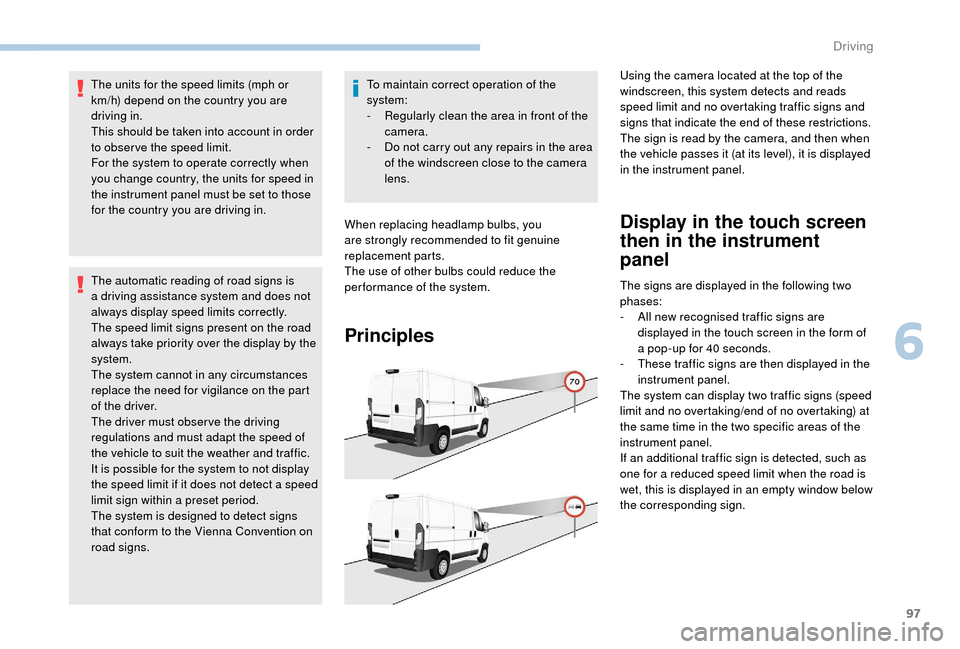
The camera detects the following types of signs
and displays the corresponding information in
the instrument panel:
-
sp
eed limits,
-
n
o overtaking,
-
e
nd of the above-mentioned limits/
restrictions.
The system detects the signs on the left and on
the right, low-mounted and high-mounted, as
well as overlapping signs.
The system detects only round signs.
Driving
Page 99 of 232
97
The units for the speed limits (mph or
km/h) depend on the country you are
driving in.
This should be taken into account in order
to obser ve the speed limit.
For the system to operate correctly when
you change country, the units for speed in
the instrument panel must be set to those
for the country you are driving in.
The automatic reading of road signs is
a driving assistance system and does not
always display speed limits correctly.
The speed limit signs present on the road
always take priority over the display by the
system.
The system cannot in any circumstances
replace the need for vigilance on the part
of the driver.
The driver must observe the driving
regulations and must adapt the speed of
the vehicle to suit the weather and traffic.
It is possible for the system to not display
the speed limit if it does not detect a
speed
limit sign within a
preset period.
The system is designed to detect signs
that conform to the Vienna Convention on
road signs. To maintain correct operation of the
system:
-
R
egularly clean the area in front of the
camera.
-
D
o not carry out any repairs in the area
of the windscreen close to the camera
lens.
When replacing headlamp bulbs, you
are strongly recommended to fit genuine
replacement parts.
The use of other bulbs could reduce the
per formance of the system.
Principles Display in the touch screen
then in the instrument
panel
The signs are displayed in the following two
phases:
-
A
ll new recognised traffic signs are
displayed in the touch screen in the form of
a
pop-up for 40 seconds.
-
T
hese traffic signs are then displayed in the
instrument panel.
The system can display two traffic signs (speed
limit and no overtaking/end of no overtaking) at
the same time in the two specific areas of the
instrument panel.
If an additional traffic sign is detected, such as
one for a
reduced speed limit when the road is
wet, this is displayed in an empty window below
the corresponding sign. Using the camera located at the top of the
windscreen, this system detects and reads
speed limit and no overtaking traffic signs and
signs that indicate the end of these restrictions.
The sign is read by the camera, and then when
the vehicle passes it (at its level), it is displayed
in the instrument panel.
6
Driving
Page 100 of 232
98
Additional traffic signs are filtered as follows:
- S igns related to snow or ice are displayed
only if the exterior temperature is below
3°C.
-
S
igns related to snow, rain or fog are
displayed only if the wipers are on and the
exterior temperature is below 3°C.
-
S
igns related to heavy goods vehicles are
only displayed if they apply to vehicles
weighing less than 4
tonnes.
-
S
igns related to farm vehicles are not
displayed.
Signs such as the no overtaking sign disappear
after about 40
seconds in the instrument panel.
Activation/Deactivation
The function is set with the MODE button; in
the "Traffic Sign" menu, select "ON" or "OFF".
For more information on Vehicle
configuration , refer to the corresponding
section.
Operating limits
The legislation on speed limits is specific to
each country.
The system does not take account of reduced
speed limits in the following cases:
-
p
oor weather (rain, snow),
-
a
tmospheric pollution,
-
t
railer, caravan,
-
d
riving with snow chains fitted,
-
d
riving with a non-genuine suspension kit,
-
p
uncture repair using the temporary repair
kit,
-
y
oung drivers. The following situations may interfere with
the operation of the system or prevent it
from working:
-
p
oor visibility (dazzling sun, inadequate
street lighting, falling snow, heavy rain,
dense fog, vehicle too far from the
traffic sign),
-
l
ow temperatures and particularly
severe climatic conditions,
-
w
indscreen area in front of the camera
being: dirty, misted up, frost-covered,
snow-covered, damaged or covered by
a
s t i c ke r,
-
f
ault with the camera,
-
o
bsolete or incorrect mapping,
-
o
bstructed road signs (by other
vehicles, vegetation, snow),
-
t
raffic signs that do not conform to the
standard, are damaged or distorted,
-
r
oad inclination causing the sign to be
out of the camera view (for example, to
one side).
-
v
ariation of load causing the camera
to be significantly inclined (the system
may not work for a
moment while the
camera recalibrates itself).
Driving