warning Peugeot Expert 2001.5 User Guide
[x] Cancel search | Manufacturer: PEUGEOT, Model Year: 2001.5, Model line: Expert, Model: Peugeot Expert 2001.5Pages: 127, PDF Size: 4.95 MB
Page 43 of 127
CHECKS*59IV-2
Beware:When working under the bonnet, the cooling fan could operate if
the engine is hot (even when switched off). The engine oil level should be checked frequently between services (as recommended by the manufacturer), as well as before long journeys.
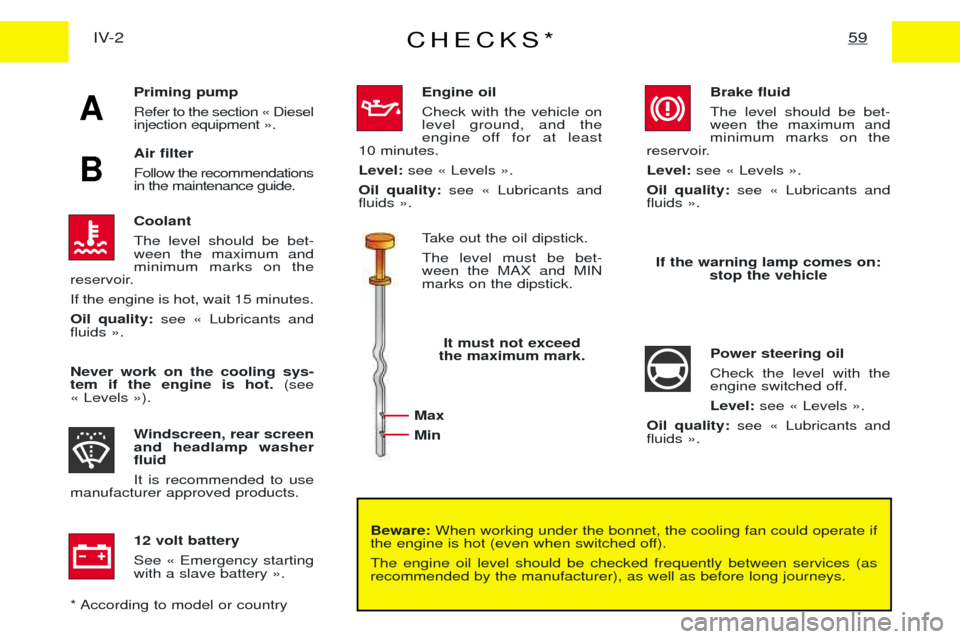
Priming pump Refer to the section
Ç Diesel
injection equipment È.
CoolantThe level should be bet- ween the maximum andminimum marks on the
reservoir. If the engine is hot, wait 15 minutes.Oil quality: see Ç Lubricants and
fluids È.
Never work on the cooling sys- tem if the engine is hot. (see
Ç Levels È).
Windscreen, rear screenand headlamp washerfluid It is recommended to use
manufacturer approved products.
12 volt batterySee Ç Emergency starting
with a slave battery È. Engine oilCheck with the vehicle on level ground, and the
engine off for at least
10 minutes. Level: see Ç Levels È.
Oil quality: see Ç Lubricants and
fluids È.
Take out the oil dipstick.The level must be bet- ween the MAX and MINmarks on the dipstick.
It must not exceed
the maximum mark. Brake fluid The level should be bet- ween the maximum andminimum marks on the
reservoir. Level: see Ç Levels È.
Oil quality: see Ç Lubricants and
fluids È.
If the warning lamp comes on: stop the vehicle
Power steering oilCheck the level with the
engine switched off. Level: see Ç Levels È.
Oil quality: see Ç Lubricants and
fluids È.
A
Air filter Follow the recommendations in the maintenance guide.
B
Max Min
* According to model or country
Page 45 of 127
CHECKS*61IV-2
Beware:When working under the bonnet, the cooling fan could operate if
the engine is hot (even when switched off). The engine oil level should be checked frequently between services (as recommended by the manufacturer), as well as before long journeys.
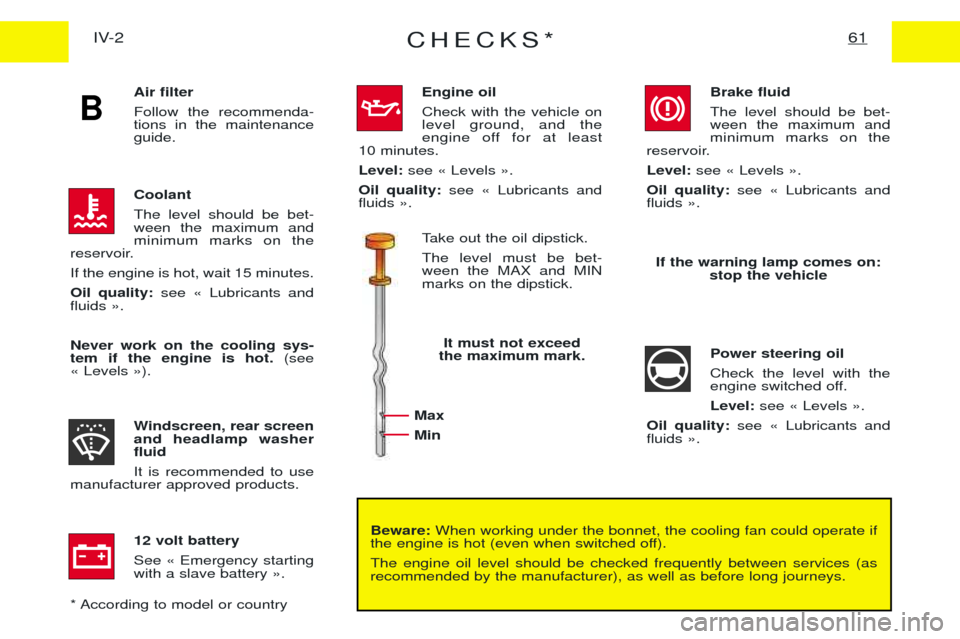
Air filter Follow the recommenda- tions in the maintenanceguide. Coolant The level should be bet- ween the maximum andminimum marks on the
reservoir. If the engine is hot, wait 15 minutes.Oil quality: see Ç Lubricants and
fluids È.
Never work on the cooling sys- tem if the engine is hot. (see
Ç Levels È).
Windscreen, rear screenand headlamp washerfluid It is recommended to use
manufacturer approved products.
12 volt batterySee Ç Emergency starting
with a slave battery È. Engine oilCheck with the vehicle on level ground, and the
engine off for at least
10 minutes. Level: see Ç Levels È.
Oil quality: see Ç Lubricants and
fluids È.
Take out the oil dipstick.The level must be bet- ween the MAX and MINmarks on the dipstick.
It must not exceed
the maximum mark. Brake fluid The level should be bet- ween the maximum andminimum marks on the
reservoir. Level: see Ç Levels È.
Oil quality: see Ç Lubricants and
fluids È.
If the warning lamp comes on: stop the vehicle
Power steering oilCheck the level with the
engine switched off. Level: see Ç Levels È.
Oil quality: see Ç Lubricants and
fluids È.
B
Max Min
* According to model or country
Page 50 of 127
LEVELSIV-5
66
Beware: When working under the bonnet, the cooling fan could operate if the engi-
ne is hot (even when switched off).
Windscreen, rear screen andheadlamp washer fluid
For best results and for your safety, use the products approved by the
manufacturer. Capacity:
see Ç Capacities È. Brake fluidThe synthetic fluid not only gives protection against corrosion but also ensures correct functioning of the braking system in all environmental conditions, the-refore you should only use the synthetic product recommended by the manu-
facturer. (this fluid must be replaced every two years). These important requirements are detailed in your vehicle's Maintenance Guide. Oil quality:
see Ç Lubricants and fluids È.
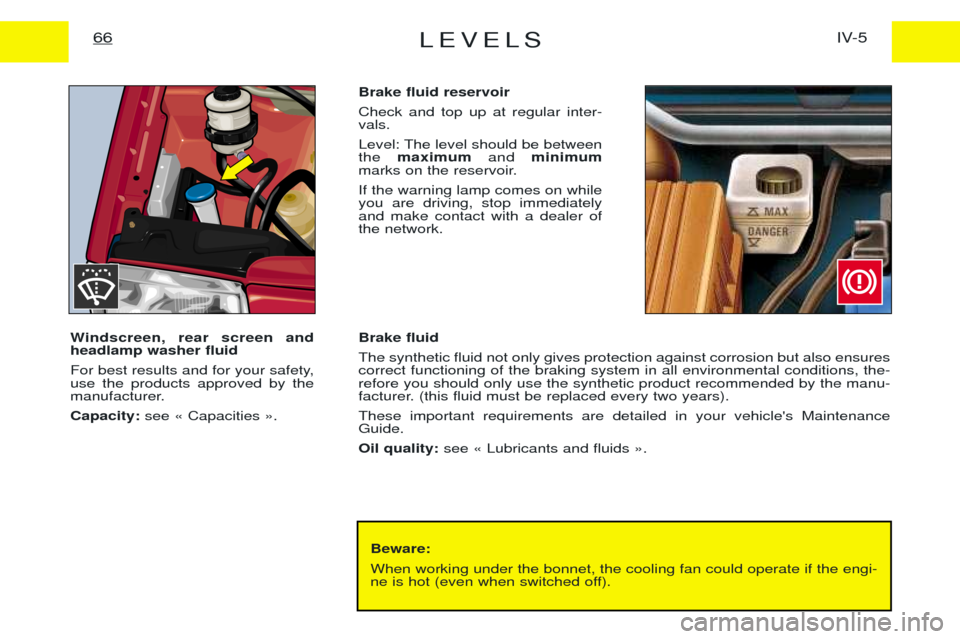
Brake fluid reservoirCheck and top up at regular inter- vals.
Level: The level should be between the
maximum and minimum
marks on the reservoir. If the warning lamp comes on while you are driving, stop immediatelyand make contact with a dealer ofthe network.
Page 52 of 127
STEERING LOCK - IGNITION - STARTERII-1
40
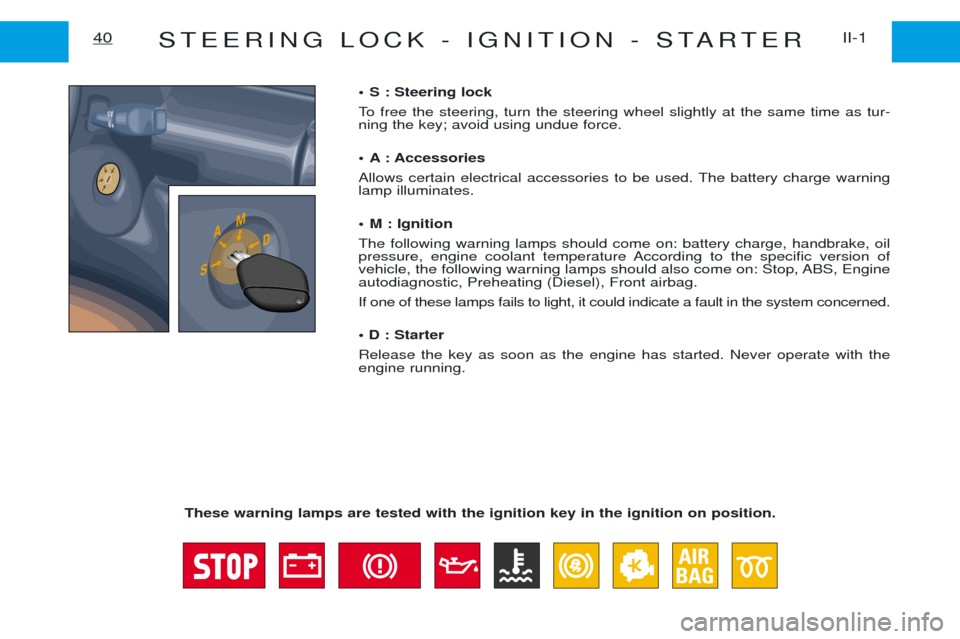
¥ S : Steering lock
To free the steering, turn the steering wheel slightly at the same time as tur- ning the key; avoid using undue force.
¥ A : Accessories
Allows certain electrical accessories to be used. The battery charge warning lamp illuminates.
¥ M : Ignition The following warning lamps should come on: battery charge, handbrake, oil
pressure, engine coolant temperature According to the specific version of
vehicle, the following warning lamps should also come on: Stop, ABS, Engineautodiagnostic, Preheating (Diesel), Front airbag. If one of these lamps fails to light, it could indicate a fault in the system concerned. ¥ D : Starter Release the key as soon as the engine has started. Never operate with the engine running.
These warning lamps are tested with the ignition key in the ignition on position.
Page 53 of 127
STEERING LOCK - IGNITION - STARTER41II-1
WARNING
NEVER REMOVE THE IGNITION KEY BEFORE THE VEHICLE IS COMPLETELY STATIONARY. NEVER ATTEMPT TO MOVE THE VEHICLE BEFORE STARTING
THE ENGINE AND WAITING FOR THE HYDRAULIC LOW PRESSURE WARNING
LAMP TO GO OUT. IF THE ENGINE IS NOT RUNNING, THE STEERING WILL NOT HAVE POWER ASSISTANCE AND THERE MAY BE NO RESERVE OF PRESSURE AVAILABLE TO OPERATE THE FOOTBRAKE. THERE IS ALSO A RISK OF THE
STEERING LOCK ENGAGING AND THE SAFETY FEATURES NOT OPERATING IF THE IGNITION IS NOT SWITCHED ON. ONLY IN AN EMERGENCY SITUATION
SHOULD YOU ATTEMPT TO MOVE A VEHICLE WITHOUT STARTING THE ENGINE.
TAKE ALL THE NECESSARY SAFETY PRECAUTIONS AND BE PREPARED TO USE THE PARKING BRAKE TO STOP THE VEHICLE.
When parking, remove the ignition key and turn the steering wheel until the steering column locking peg engages.
Steering lock
S With the key removed and the steering lock peg engaged, the steering column is locked; the lock peg will engage in
a number of positions of the steering wheel. The key can only be removed in position S.
A The steering is unlocked - to enable the key to be turned to position A, it may be necessary to turn the steering slightly.
M Running position.
D Starting position.
For starting and stopping the engine, see Ç Starting È.
Page 55 of 127
STARTING43II-2
WARNING
DO NOT RUN THE ENGINE IN AN ENCLOSED OR POORLY VENTILATED AREA
DIESEL Starting the engine
Turn the ignition key to the ignition position. Wait for the preheater lamp to go out, then operate the starter motor until the engine starts.
If the engine does not start, switch off the ignition and start again.At temperatures below 0¡C, depress the clutch pedal to ease starting. Release the pedal slowly when the engine has started. Note:
Do not depress the accelerator pedal while operating the starter.
Advice
Vehicles equipped with a Turbo:
Turbo equipped engines MUST be allowed to return to idle for several seconds before switching off the ignition. Failure to do so could cause serious damage to the turbo unit.
Flicking the throttle pedal as the ignition is turned off can lead to severe damage to the turbo unit.
Page 56 of 127
BRAKESII-3
44
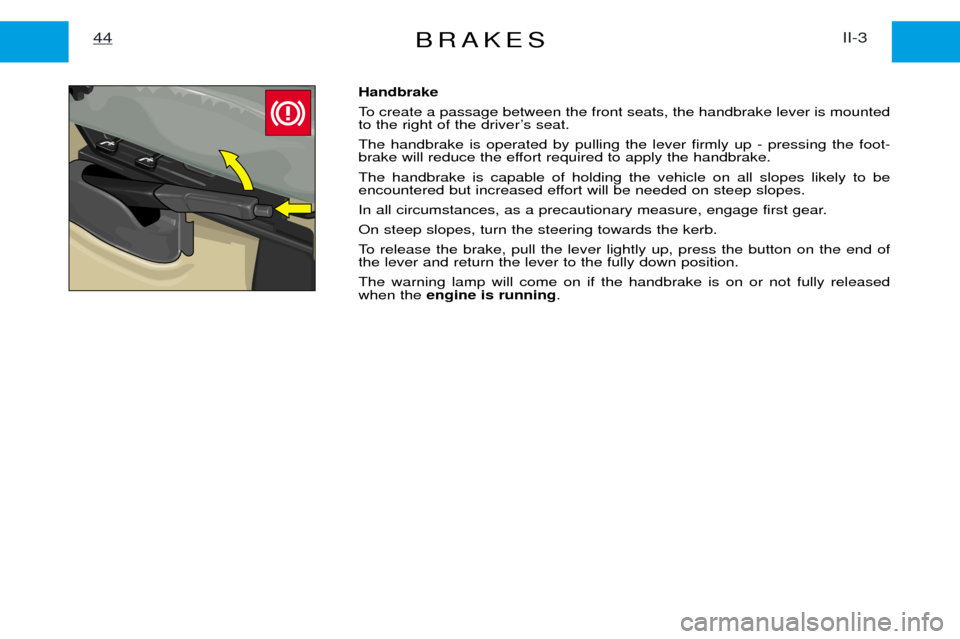
Handbrake
To create a passage between the front seats, the handbrake lever is mounted
to the right of the driverÕs seat. The handbrake is operated by pulling the lever firmly up - pressing the foot-
brake will reduce the effort required to apply the handbrake. The handbrake is capable of holding the vehicle on all slopes likely to be
encountered but increased effort will be needed on steep slopes.
In all circumstances, as a precautionary measure, engage first gear.On steep slopes, turn the steering towards the kerb.
To release the brake, pull the lever lightly up, press the button on the end of the lever and return the lever to the fully down position. The warning lamp will come on if the handbrake is on or not fully released when the engine is running .
Page 59 of 127
SEAT BELTS114
Replacing the pyrotechnic pretensioner systems
They must be replaced following deployment or within ten years after first
registration of the vehicle. This must be done by the dealer network. In accordance with the strict security regulations in force, any repairs or checks must be performed exclusively by the dealer network. Any repairs that have not been carried out in strict compliance with the regulations could prevent the systems from operating correctly or couldcause their premature deployment, with the risk of bodily injuries.
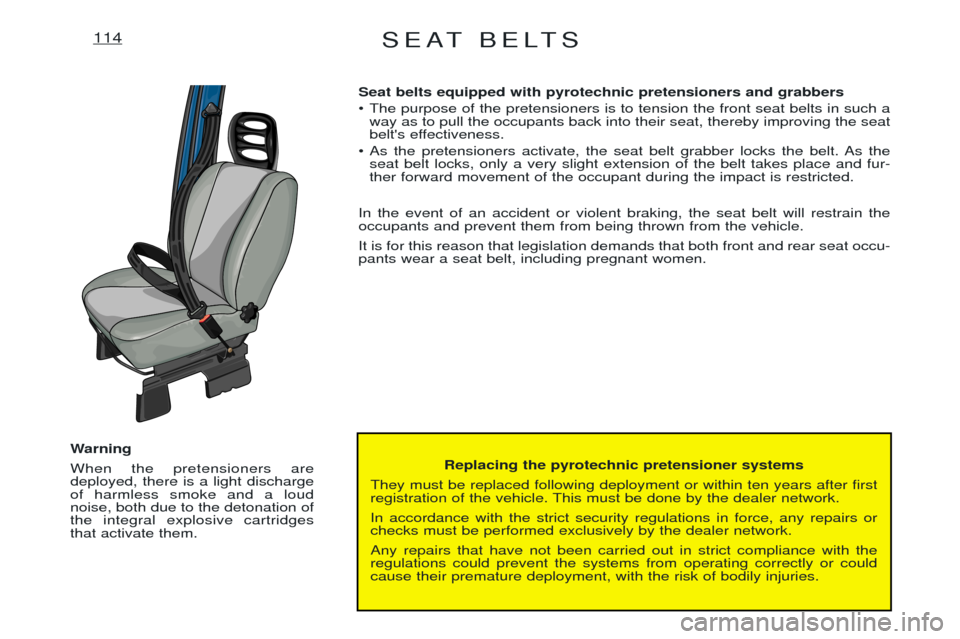
Warning When the pretensioners are deployed, there is a light dischargeof harmless smoke and a loudnoise, both due to the detonation ofthe integral explosive cartridgesthat activate them. Seat belts equipped with pyrotechnic pretensioners and grabbers
¥ The purpose of the pretensioners is to tension the front seat belts in such a
way as to pull the occupants back into their seat, thereby improving the seat
belt's effectiveness.
¥ As the pretensioners activate, the seat belt grabber locks the belt. As the seat belt locks, only a very slight extension of the belt takes place and fur-ther forward movement of the occupant during the impact is restricted.
In the event of an accident or violent braking, the seat belt will restrain theoccupants and prevent them from being thrown from the vehicle. It is for this reason that legislation demands that both front and rear seat occu- pants wear a seat belt, including pregnant women.
Page 63 of 127
AIR CONDITIONING*III-2
50
Air conditioning
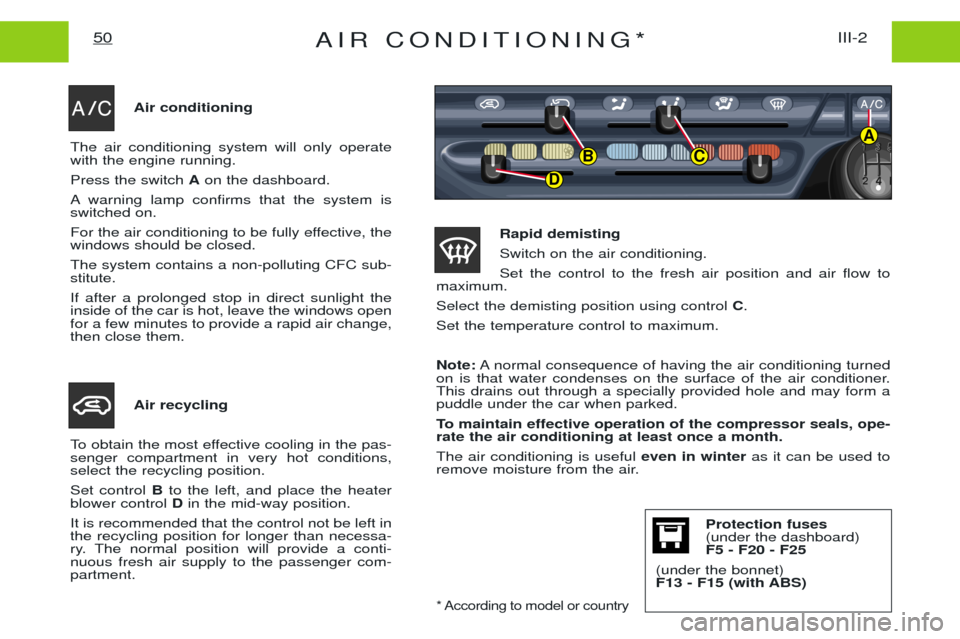
The air conditioning system will only operate with the engine running. Press the switch Aon the dashboard.
A warning lamp confirms that the system is switched on.
For the air conditioning to be fully effective, the windows should be closed. The system contains a non-polluting CFC sub- stitute. If after a prolonged stop in direct sunlight the inside of the car is hot, leave the windows openfor a few minutes to provide a rapid air change,then close them.
Air recycling
To obtain the most effective cooling in the pas-senger compartment in very hot conditions,select the recycling position. Set control Bto the left, and place the heater
blower control Din the mid-way position.
It is recommended that the control not be left in the recycling position for longer than necessa-
ry. The normal position will provide a conti-nuous fresh air supply to the passenger com-partment. Rapid demisting Switch on the air conditioning.Set the control to the fresh air position and air flow to
maximum.Select the demisting position using control C.
Set the temperature control to maximum. Note: A normal consequence of having the air conditioning turned
on is that water condenses on the surface of the air conditioner. This drains out through a specially provided hole and may form apuddle under the car when parked.
To maintain effective operation of the compressor seals, ope- rate the air conditioning at least once a month. The air conditioning is useful even in winteras it can be used to
remove moisture from the air.
* According to model or country
Protection fuses (under the dashboard)F5 - F20 - F25
(under the bonnet)
F13 - F15 (with ABS)
A
CB
D
Page 65 of 127
INTERIOR COMFORTIII-4
52
WARNING
As a safety measure,
the glovebox must remain shut when the vehicle is in motion.
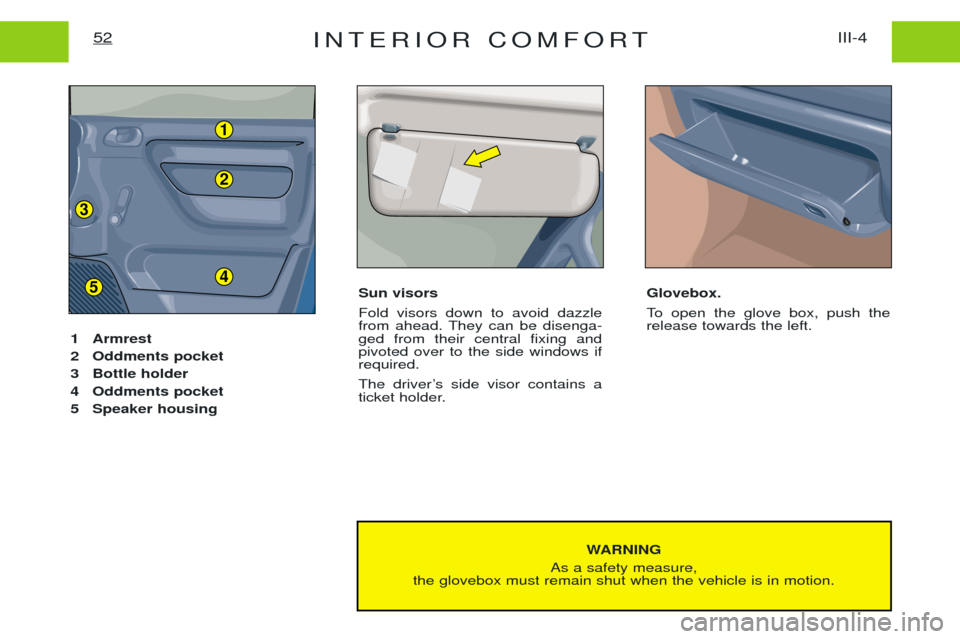
1 Armrest
2 Oddments pocket
3 Bottle holder
4 Oddments pocket
5 Speaker housing
Sun visors Fold visors down to avoid dazzle
from ahead. They can be disenga-ged from their central fixing andpivoted over to the side windows ifrequired.
The driverÕs side visor contains a
ticket holder.
Glovebox.
To open the glove box, push the release towards the left.
1
2
3
45