sliding Peugeot Expert 2019 User Guide
[x] Cancel search | Manufacturer: PEUGEOT, Model Year: 2019, Model line: Expert, Model: Peugeot Expert 2019Pages: 324, PDF Size: 13.07 MB
Page 45 of 324
43
Automatic
The loading area is always locked when
driving.
To deactivate the automatic locking
function, go to a PEUGEOT dealer or a
qualified workshop.
Manual
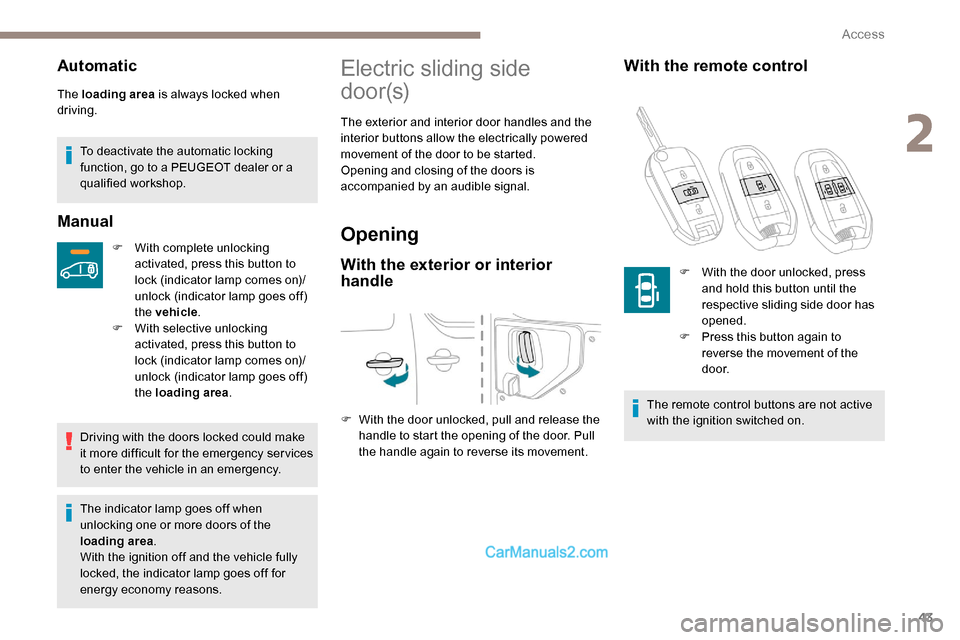
F With complete unlocking activated, press this button to
lock (indicator lamp comes on)/
unlock (indicator lamp goes off)
the vehicle .
F
W
ith selective unlocking
activated, press this button to
lock (indicator lamp comes on)/
unlock (indicator lamp goes off)
the loading area .
Electric sliding side
d o o r (s)
Opening
With the exterior or interior
handle
F With the door unlocked, pull and release the
handle to start the opening of the door. Pull
the handle again to reverse its movement.
Driving with the doors locked could make
it more difficult for the emergency ser vices
to enter the vehicle in an emergency.
The indicator lamp goes off when
unlocking one or more doors of the
loading area .
With the ignition off and the vehicle fully
locked, the indicator lamp goes off for
energy economy reasons. The exterior and interior door handles and the
interior buttons allow the electrically powered
movement of the door to be started.
Opening and closing of the doors is
accompanied by an audible signal.
With the remote control
F With the door unlocked, press
and hold this button until the
respective sliding side door has
opened.
F
P
ress this button again to
reverse the movement of the
d o o r.
The remote control buttons are not active
with the ignition switched on.
2
Access
Page 46 of 324
44
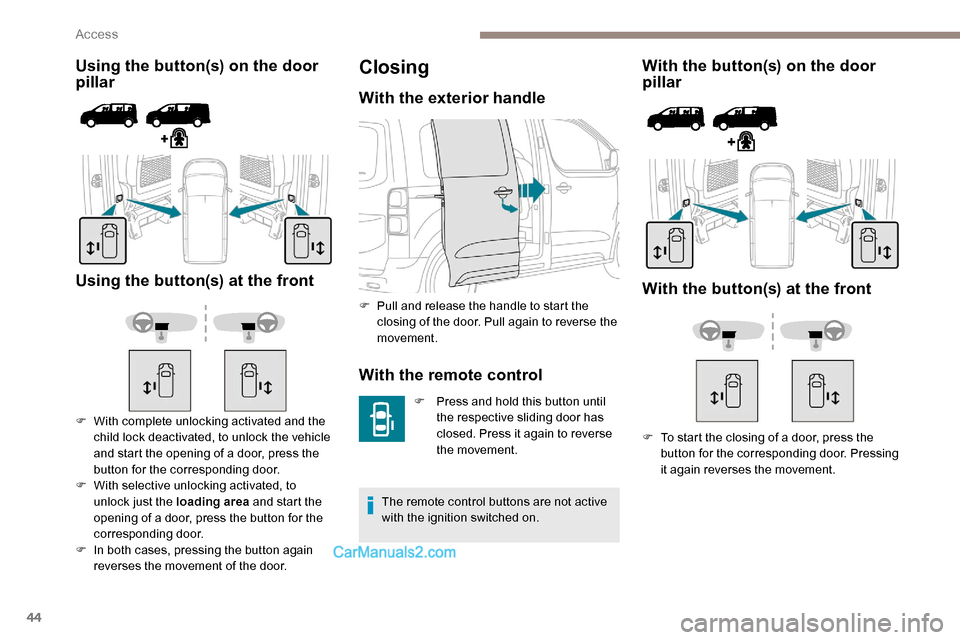
Using the button(s) on the door
pillar
Using the button(s) at the front
F With complete unlocking activated and the child lock deactivated, to unlock the vehicle
and start the opening of a door, press the
button for the corresponding door.
F
W
ith selective unlocking activated, to
unlock just the loading area and start the
opening of a door, press the button for the
corresponding door.
F
I
n both cases, pressing the button again
reverses the movement of the door.
Closing
With the exterior handle
With the remote control
F Press and hold this button until the respective sliding door has
closed. Press it again to reverse
the movement.
The remote control buttons are not active
with the ignition switched on.
With the button(s) on the door
pillar
With the button(s) at the front
F To start the closing of a door, press the button for the corresponding door. Pressing
it again reverses the movement.
F
P
ull and release the handle to start the
closing of the door. Pull again to reverse the
movement.
Access
Page 47 of 324
45
The button is not operational and pressing
it results in an audible signal, if the speed
of the vehicle is above 20 mph (30 km/h).
The button(s) at the front or on the door
pillar is not operational and pressing it
results in an audible signal, if:
-
t
he vehicle is moving,
-
t
he child lock is on (activated) (for the
buttons on the door pillars),
-
t
he vehicle has been locked or
deadlocked from outside (using
the key, remote control or Keyless
Entry and Starting, depending on
equipment).
The button for the left-hand door is not
operational and pressing it results in an
audible signal if the fuel filler flap is open.General
recommendations for the
sliding side doors
The doors must only be operated when
the vehicle is stationary.
For your safety and for that of your
passengers, as well as for correct
operation of the doors, you are strongly
advised not to drive with a door open.
Always check that it is safe to operate the
door and in particular, be sure not to leave
children or animals near the door controls
without supervision.
The audible warning, the illumination
of the "door open" warning lamp and
the message on the screen are there to
remind you. Contact a PEUGEOT dealer
or a qualified workshop to have this
warning deactivated.
Lock the vehicle when using an automatic
car wash. Before opening or closing or per forming
any movement of the doors, ensure that
no person, animal or object is in the
window frame or could block the desired
movement, inside or outside the vehicle.
If this advice is not followed, injuries or
damage may occur if a part of the body or
an object is trapped or caught.
The doors cannot be opened electrically
above 2 mph (3
km/h ):
-
H
owever, if the doors remained open
when starting, the speed must fall
below 19 mph (30
km/h) before they
can be closed.
-
A
ny attempt to open a door electrically
using the interior handle while driving
results in it only being possible to open
the door manually.
-
I
n this case, the audible warning will be
given, accompanied by the illumination
of the "door open" warning lamp and
the message on the screen. To release
the door and be able to operate it
again, it is necessary to stop the
vehicle.
2
Access
Page 48 of 324
46
Take care not to block the guide space
on the floor to allow the door to slide
c o r r e c t l y.
As a safety measure and for functional
reasons, do not drive with the sliding side
door open.
The electric controls are inhibited in the
event of an impact. Manual opening and
closing remain possible.
While starting the engine, the movement
of a door is interrupted and continues
once the engine is running.Depending on the engine, if the
door is closed and an attempt
is made to open it in Stop mode
of Stop & Start, the door opens
partially and stops. In Start mode,
when the engine restarts, the
door continues its movement.
To hold the sliding side door in the open
position, open the door fully to engage the
locking device (located at the bottom of
the door).Doors and their obstruction Safety/Obstacle detection
with electric door(s)
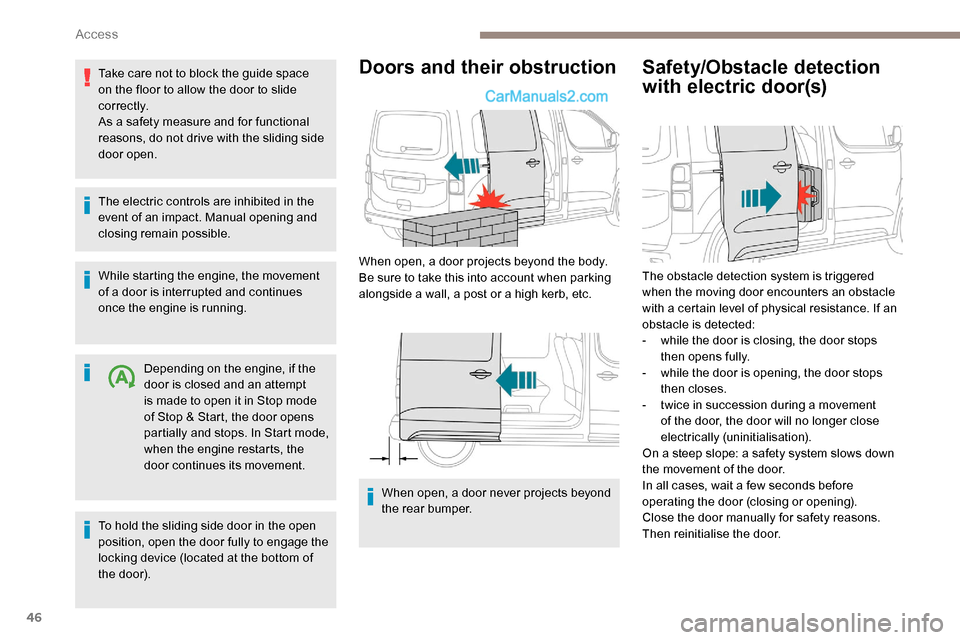
When open, a door projects beyond the body.
Be sure to take this into account when parking
alongside a wall, a post or a high kerb, etc.
When open, a door never projects beyond
the rear bumper. The obstacle detection system is triggered
when the moving door encounters an obstacle
with a certain level of physical resistance. If an
obstacle is detected:
-
w
hile the door is closing, the door stops
then opens fully.
-
w
hile the door is opening, the door stops
then closes.
-
t
wice in succession during a movement
of the door, the door will no longer close
electrically (uninitialisation).
On a steep slope: a safety system slows down
the movement of the door.
In all cases, wait a few seconds before
operating the door (closing or opening).
Close the door manually for safety reasons.
Then reinitialise the door.
Access
Page 49 of 324
47
Reinitialising electric doors
If electrical operations no longer work:
F
F
ully close the door(s) manually .
F
F
ully open the door(s) electrically .
F
C
lose the door(s) electrically .
On completion of this procedure, electric
operation of the doors is restored.
However, if a problem persists following this
procedure, contact a PEUGEOT dealer or a
qualified workshop.
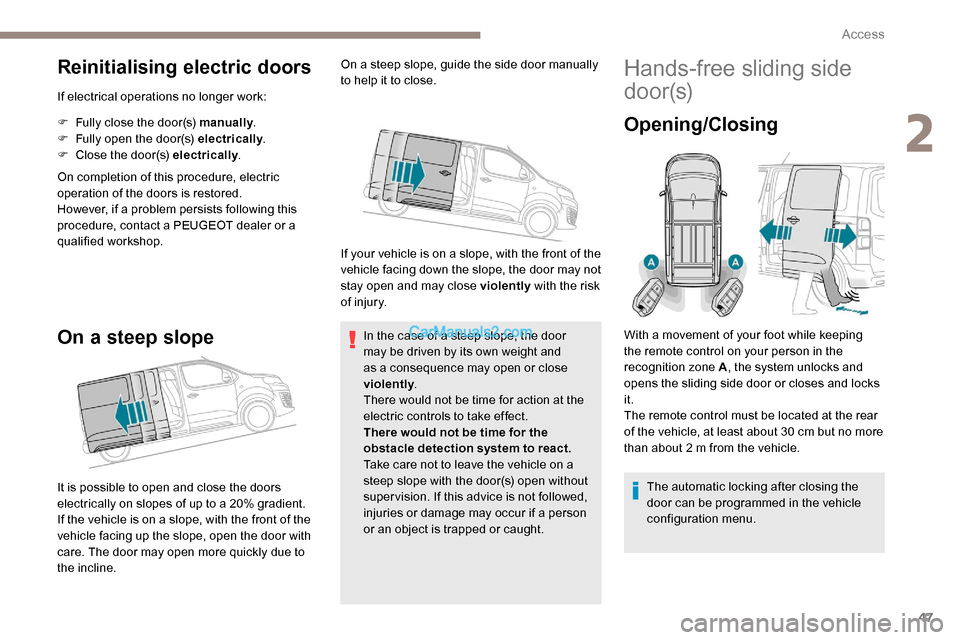
On a steep slope
It is possible to open and close the doors
electrically on slopes of up to a 20% gradient.
If the vehicle is on a slope, with the front of the
vehicle facing up the slope, open the door with
care. The door may open more quickly due to
the incline. On a steep slope, guide the side door manually
to help it to close.
If your vehicle is on a slope, with the front of the
vehicle facing down the slope, the door may not
stay open and may close violently
with the risk
of injury.
In the case of a steep slope, the door
may be driven by its own weight and
as a consequence may open or close
violently .
There would not be time for action at the
electric controls to take effect.
There would not be time for the
obstacle detection system to react.
Take care not to leave the vehicle on a
steep slope with the door(s) open without
supervision. If this advice is not followed,
injuries or damage may occur if a person
or an object is trapped or caught.
Hands-free sliding side
d o o r (s)
Opening/Closing
The automatic locking after closing the
door can be programmed in the vehicle
configuration menu.
With a movement of your foot while keeping
the remote control on your person in the
recognition zone A
, the system unlocks and
opens the sliding side door or closes and locks
it.
The remote control must be located at the rear
of the vehicle, at least about 30 cm but no more
than about 2 m from the vehicle.
2
Access
Page 50 of 324
48
Before making the movement with your
foot, ensure that you are steady and well
positioned, so that you do not lose your
balance (rain, snow, ice, mud, etc.).
Take care not to touch the exhaust tailpipe
when making the movement with your foot
- risk of burns.
Make the movement without interruption
and do not repeat it immediately
after wards or several times.
If the door does not open, wait about
2
seconds before trying again.
Do not keep the foot in the air.
Automatic locking
The vehicle locks itself following the hands-free
closing of the sliding door.
Activation/Deactivation
With audio system or touch
screen
By default, hands-free access is activated.
The "Hands-Free Tailgate Access"
function or automatic vehicle locking
when the sliding door is closed is
activated and deactivated via the
vehicle configuration menu.
Operating fault
An audible signal repeated three times
indicates a fault with the system.
Contact a PEUGEOT dealer or a qualified
workshop to have the system checked.
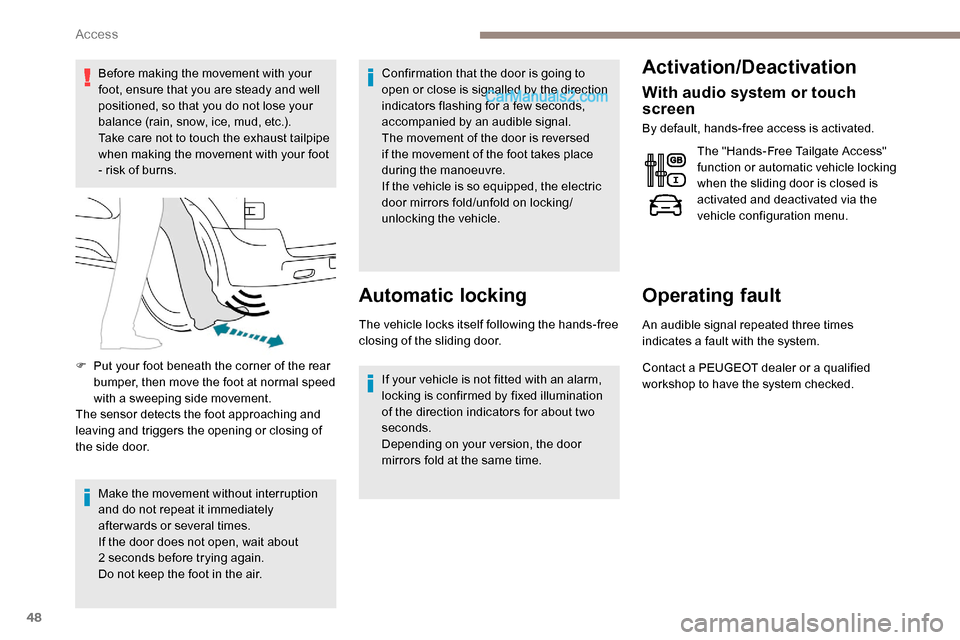
F
P
ut your foot beneath the corner of the rear
bumper, then move the foot at normal speed
with a sweeping side movement.
The sensor detects the foot approaching and
leaving and triggers the opening or closing of
the side door. Confirmation that the door is going to
open or close is signalled by the direction
indicators flashing for a few seconds,
accompanied by an audible signal.
The movement of the door is reversed
if the movement of the foot takes place
during the manoeuvre.
If the vehicle is so equipped, the electric
door mirrors fold/unfold on locking/
unlocking the vehicle.
If your vehicle is not fitted with an alarm,
locking is confirmed by fixed illumination
of the direction indicators for about two
seconds.
Depending on your version, the door
mirrors fold at the same time.
Access
Page 74 of 324
72
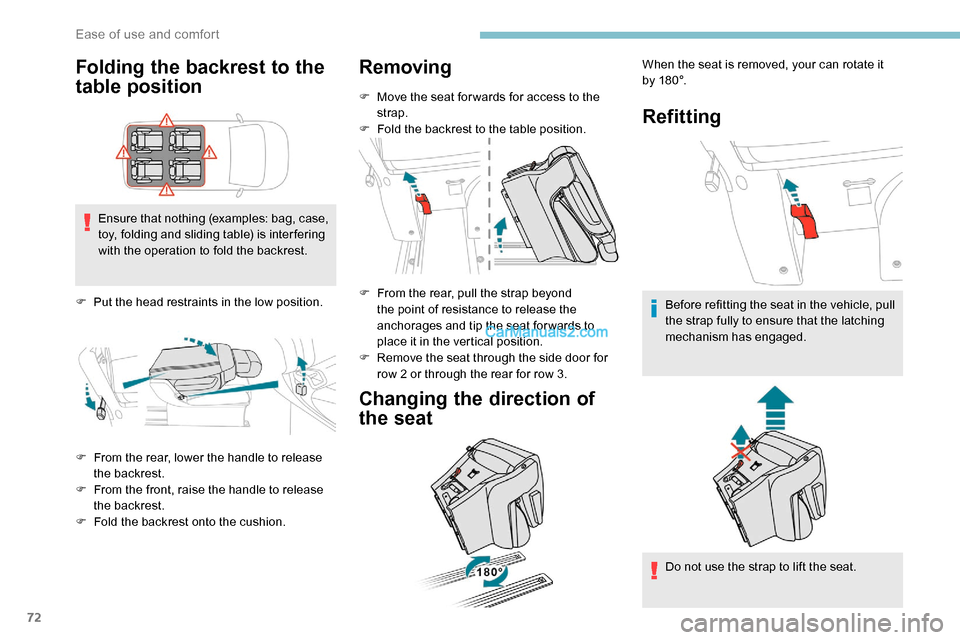
Folding the backrest to the
table position
Ensure that nothing (examples: bag, case,
toy, folding and sliding table) is inter fering
with the operation to fold the backrest.
F
P
ut the head restraints in the low position.
F
F
rom the rear, lower the handle to release
the backrest.
F
F
rom the front, raise the handle to release
the backrest.
F
F
old the backrest onto the cushion.
Removing
F Move the seat for wards for access to the strap.
F
F
old the backrest to the table position.
F
F
rom the rear, pull the strap beyond
the point of resistance to release the
anchorages and tip the seat for wards to
place it in the vertical position.
F
R
emove the seat through the side door for
row 2 or through the rear for row 3.
Changing the direction of
the seat Refitting
When the seat is removed, your can rotate it
by 18 0 °.
Before refitting the seat in the vehicle, pull
the strap fully to ensure that the latching
mechanism has engaged.
Do not use the strap to lift the seat.
Ease of use and comfort
Page 82 of 324
80
Recommendations on
loading
The weight of the load must comply with
the Gross Train Weight (GTW).
For more information on Engine
technical data and towed loads, refer to
the corresponding section.
If you are using a carrying system (roof
bars/roof rack), comply with the maximum
loads associated with this system.
For more information on Roof bars/Roof
rack , refer to the corresponding section.
Make sure that the size, shape and
volume of the loads carried are compatible
with the highway code and safety
regulations and do not impair the driver’s
field of vision.
Steel or glass partitions separate the loading
area from the cab.
The load must be evenly distributed in the
loading area so as not to inter fere with
driving the vehicle.
Place the load close to the side panels,
or even push it against the side panels
between the wheel arches.
However, it is recommended that heavy
objects are placed as close to the cab as
possible as a precaution in case of sharp
braking.
Firmly secure all parts of the load using
the stowing rings on the floor of the
loading area.
For more information on the Interior
fittings
and in particular on the stowing
rings, refer to the corresponding section. To avoid the risk of injury or accident, the
load must be made stable so that it cannot
slide, tip over, fall or be thrown. To do this,
use only retaining straps that conform to
current standards (DIN for example).
For more information on putting straps
in place, refer to the manufacturer’s user
guide.
There must not be any empty space
between the components of the load.
To prevent the load sliding, there must not
be any empty space between the load and
the panels of the vehicle.
As well as the straps, optimise the stability
of the load with stable handling equipment
(wedges, rigid blocks of wood or padding).
When washing your vehicle, never clean
the inside directly using a water jet.
Ease of use and comfort
Page 85 of 324
83
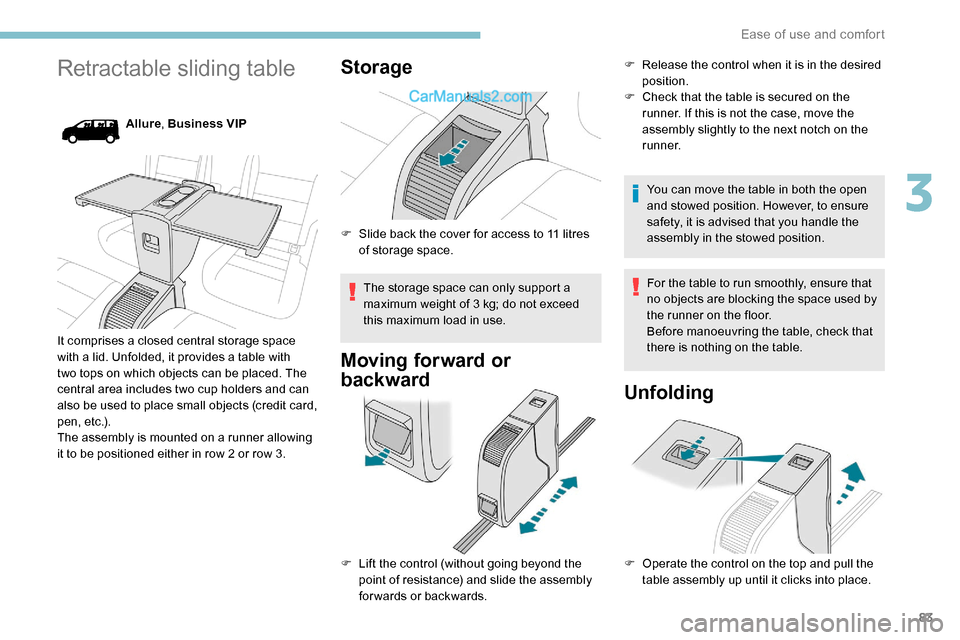
Retractable sliding table
Allure, Business VIP
It comprises a closed central storage space
with a lid. Unfolded, it provides a table with
two tops on which objects can be placed. The
central area includes two cup holders and can
also be used to place small objects (credit card,
pen, etc.).
The assembly is mounted on a runner allowing
it to be positioned either in row 2 or row 3.
Storage
F Slide back the cover for access to 11 litres of storage space.
The storage space can only support a
maximum weight of 3 kg; do not exceed
this maximum load in use.
Moving forward or
backward
F Lift the control (without going beyond the point of resistance) and slide the assembly
forwards or backwards. F
R
elease the control when it is in the desired
position.
F
C
heck that the table is secured on the
runner. If this is not the case, move the
assembly slightly to the next notch on the
r u n n e r.
You can move the table in both the open
and stowed position. However, to ensure
safety, it is advised that you handle the
assembly in the stowed position.
For the table to run smoothly, ensure that
no objects are blocking the space used by
the runner on the floor.
Before manoeuvring the table, check that
there is nothing on the table.
Unfolding
F Operate the control on the top and pull the table assembly up until it clicks into place.
3
Ease of use and comfort
Page 86 of 324
84
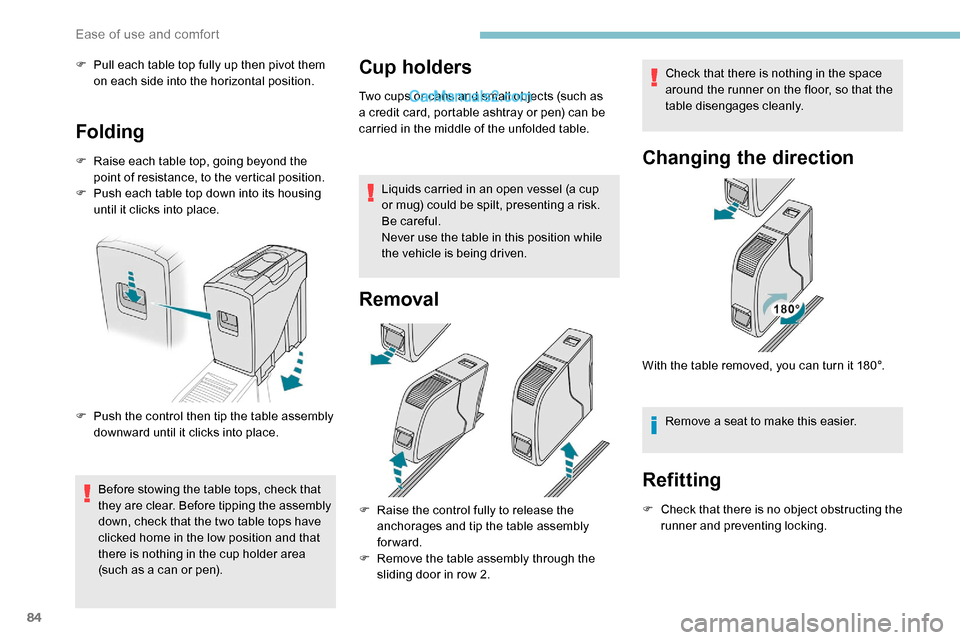
F Pull each table top fully up then pivot them on each side into the horizontal position.
Folding
F Raise each table top, going beyond the point of resistance, to the vertical position.
F
P
ush each table top down into its housing
until it clicks into place.
F
P
ush the control then tip the table assembly
downward until it clicks into place.
Before stowing the table tops, check that
they are clear. Before tipping the assembly
down, check that the two table tops have
clicked home in the low position and that
there is nothing in the cup holder area
(such as a can or pen).
Cup holders
Two cups or cans and small objects (such as
a credit card, portable ashtray or pen) can be
carried in the middle of the unfolded table.
Liquids carried in an open vessel (a cup
or mug) could be spilt, presenting a risk.
Be careful.
Never use the table in this position while
the vehicle is being driven.
Removal
F Raise the control fully to release the anchorages and tip the table assembly
forward.
F
R
emove the table assembly through the
sliding door in row 2.
Changing the direction
Remove a seat to make this easier.
Refitting
F Check that there is no object obstructing the runner and preventing locking.Check that there is nothing in the space
around the runner on the floor, so that the
table disengages cleanly.
With the table removed, you can turn it 180°.
Ease of use and comfort