Esc Peugeot Expert 2019 Owner's Guide
[x] Cancel search | Manufacturer: PEUGEOT, Model Year: 2019, Model line: Expert, Model: Peugeot Expert 2019Pages: 324, PDF Size: 13.07 MB
Page 172 of 324
170
For more information on the Head-up
display, refer to the corresponding
section.
Messages and alerts
The display of these messages or alerts is
not sequential.
Operating limits
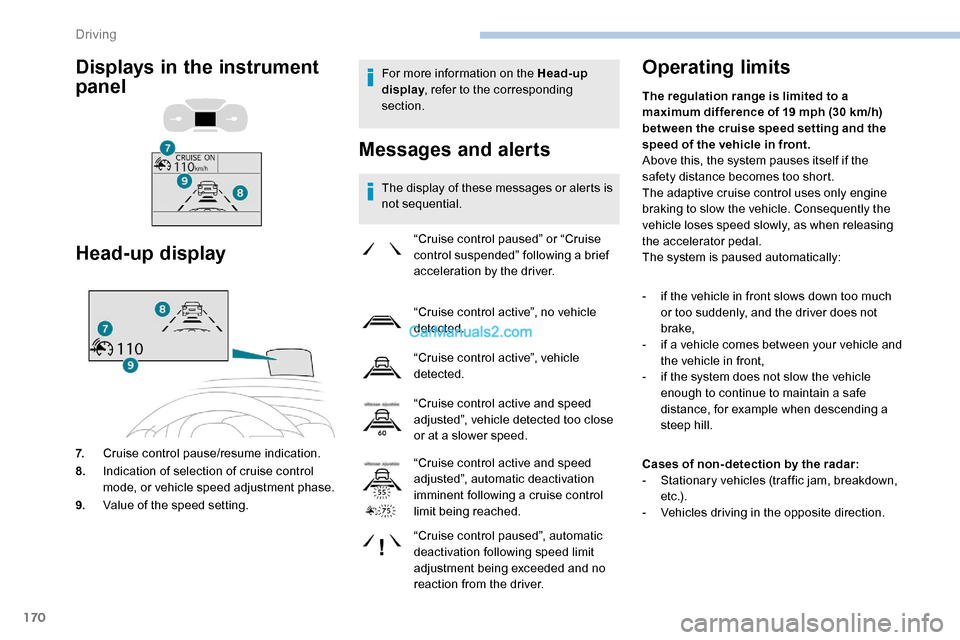
“Cruise control paused” or “Cruise
control suspended” following a brief
acceleration by the driver.
“Cruise control active”, no vehicle
detected.
“Cruise control active”, vehicle
detected.
“Cruise control active and speed
adjusted”, vehicle detected too close
or at a slower speed.
“Cruise control active and speed
adjusted”, automatic deactivation
imminent following a cruise control
limit being reached.
“Cruise control paused”, automatic
deactivation following speed limit
adjustment being exceeded and no
reaction from the driver. The regulation range is limited to a
maximum difference of 19 mph (30
km/h)
between the cruise speed setting and the
speed of the vehicle in front.
Above this, the system pauses itself if the
safety distance becomes too short.
The adaptive cruise control uses only engine
braking to slow the vehicle. Consequently the
vehicle loses speed slowly, as when releasing
the accelerator pedal.
The system is paused automatically:
-
i
f the vehicle in front slows down too much
or too suddenly, and the driver does not
brake,
-
i
f a vehicle comes between your vehicle and
the vehicle in front,
-
i
f the system does not slow the vehicle
enough to continue to maintain a safe
distance, for example when descending a
steep hill.
Cases of non- detection by the radar:
-
S
tationary vehicles (traffic jam, breakdown,
e t c .) .
-
V
ehicles driving in the opposite direction.
Head-up display
7.Cruise control pause/resume indication.
8. Indication of selection of cruise control
mode, or vehicle speed adjustment phase.
9. Value of the speed setting.
Displays in the instrument
panel
Driving
Page 174 of 324
172
- Active Safety Brake (automatic emergency b r ak ing).
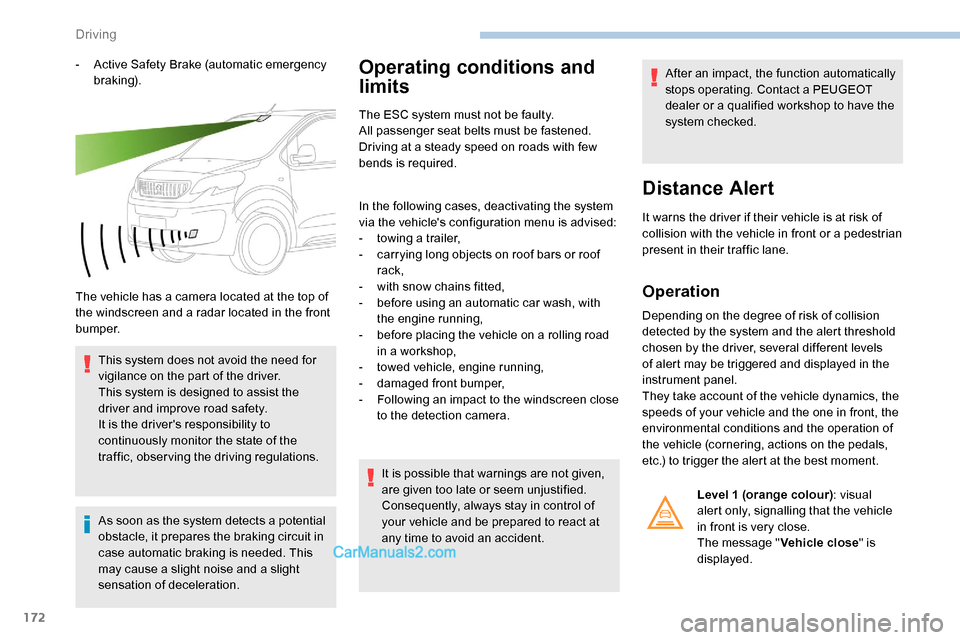
The vehicle has a camera located at the top of
the windscreen and a radar located in the front
b u m p e r. This system does not avoid the need for
vigilance on the part of the driver.
This system is designed to assist the
driver and improve road safety.
It is the driver's responsibility to
continuously monitor the state of the
traffic, observing the driving regulations.
As soon as the system detects a potential
obstacle, it prepares the braking circuit in
case automatic braking is needed. This
may cause a slight noise and a slight
sensation of deceleration.Operating conditions and
limits
The ESC system must not be faulty.
All passenger seat belts must be fastened.
Driving at a steady speed on roads with few
bends is required.
In the following cases, deactivating the system
via the vehicle's configuration menu is advised:
-
t
owing a trailer,
-
c
arrying long objects on roof bars or roof
rack,
-
w
ith snow chains fitted,
-
b
efore using an automatic car wash, with
the engine running,
-
b
efore placing the vehicle on a rolling road
in a workshop,
-
t
owed vehicle, engine running,
-
d
amaged front bumper,
-
F
ollowing an impact to the windscreen close
to the detection camera.
It is possible that warnings are not given,
are given too late or seem unjustified.
Consequently, always stay in control of
your vehicle and be prepared to react at
any time to avoid an accident. After an impact, the function automatically
stops operating. Contact a PEUGEOT
dealer or a qualified workshop to have the
system checked.
Distance Alert
It warns the driver if their vehicle is at risk of
collision with the vehicle in front or a pedestrian
present in their traffic lane.
Operation
Depending on the degree of risk of collision
detected by the system and the alert threshold
chosen by the driver, several different levels
of alert may be triggered and displayed in the
instrument panel.
They take account of the vehicle dynamics, the
speeds of your vehicle and the one in front, the
environmental conditions and the operation of
the vehicle (cornering, actions on the pedals,
etc.) to trigger the alert at the best moment.
Level
1 (orange colour) : visual
alert only, signalling that the vehicle
in front is very close.
The message " Vehicle close" is
displayed.
Driving
Page 198 of 324
196
Wheels and tyres
The pressure must be checked on
all tyres, including the spare wheel,
when the tyres are "cold".
The pressures indicated on the tyre pressure
label are valid for "cold" tyres. If you have
driven for more than 10 minutes or more
than 6
miles (10 kilometres) at over 31 mph
(50
km/h), add 0.3 bar (30 kPa) to the values
indicated on the label.
Driving with under-inflated tyres increases
fuel consumption. Non-compliant tyre
pressure causes premature wear on tyres
and has an adverse effect on the vehicle's
road holding - risk of an accident!
Driving with worn or damaged tyres reduces
the braking and road holding per formance of
the vehicle. It is recommended to regularly
check the condition of the tyres (tread and
sidewalls) and wheel rims as well as the
presence of the valves.
Using different size wheels and tyres from
those specified can affect the lifetime of
tyres, wheel rotation, ground clearance, the
speedometer reading and have an adverse
effect on road holding.
AdBlue® (BlueHDi)
To respect the environment and ensure
compliance with the Euro 6 standard, without
adversely affecting the per formance or fuel
consumption of its Diesel engines, PEUGEOT
has taken the decision to equip its vehicles
with a system that associates SCR (Selective
Catalytic Reduction) with a Diesel particle filter
(DPF) for the treatment of exhaust gases.
SCR system
Using a liquid called AdBlue® that contains
urea, a catalytic converter turns up to 85%
of nitrogen oxides (NOx) into nitrogen and
water, which are harmless to health and the
environment.
The AdBlue
® is contained in a
special tank holding about 20
litres. Its capacity allows a driving range of
approximately 4,300
miles (7,000 km)
( highly dependent on your driving style
and the vehicle). An alert system is triggered
automatically when the remaining range
reaches 1,500 miles (2,400 km), i.e. once the
reserve level has been reached.
Several alerts are triggered successively during
the remaining 1,500 miles (2,400 km) before
the tank is empty and the vehicle is disabled.
If the estimated distance travelled by the
vehicle between two ser vices is greater than
3,700 miles (6,000 km), it will be necessary to
top up the AdBlue.
For more information on the Warning
and indicator lamps and the associated
alerts, or the Indicators , refer to the
corresponding sections.
Fitting different tyres on the front and rear axles
can cause the ESC to mistime.
Practical information
Page 203 of 324
201
F Operate the starter motor to start the engine (if the engine does not start at the first
attempt, wait around 15 seconds before
trying again).
F
I
f the engine does not start after a few
attempts, operate the priming pump again,
then the starter motor.
F
P
ut the cover back in place and clip it in,
then close the bonnet.
2.0 HDi engines
F Open the bonnet and then, if necessary, unclip the cover to access the priming
pump.
F
L
oosen the degassing bolt. F
O
perate the priming pump until
fuel appears in the transparent
tube.
F
R
etighten the degassing bolt.
F
O
perate the starter motor until the engine
starts (if the engine does not start at the
first attempt, wait around 15
seconds before
trying again).
F
I
f the engine does not start after a few
attempts, operate the priming pump again,
then the starter motor.
F
P
ut the cover back in place and clip it in,
then close the bonnet.
Tool box
Access
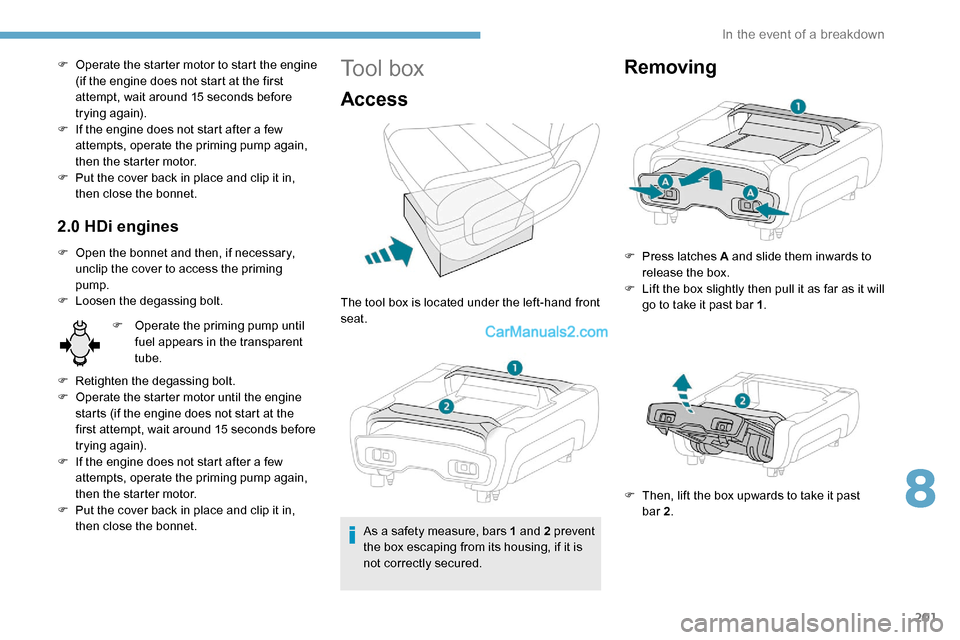
The tool box is located under the left-hand front
seat.
As a safety measure, bars 1 and 2 prevent
the box escaping from its housing, if it is
not correctly secured.
Removing
F Press latches A and slide them inwards to release the box.
F
L
ift the box slightly then pull it as far as it will
go to take it past bar 1 .
F
T
hen, lift the box upwards to take it past
bar
2.
8
In the event of a breakdown
Page 220 of 324
218
PEUGEOT accepts no responsibility for
the cost incurred in repairing your vehicle
or for rectifying malfunctions resulting
from the installation of accessories
not supplied and not recommended by
PEUGEOT and not installed in accordance
with specifications, in particular when the
combined power consumption of all of the
additional equipment connected exceeds
10 milliamperes.
For more information on installing a
towbar or equipment of the TA XI type,
contact a PEUGEOT dealer.
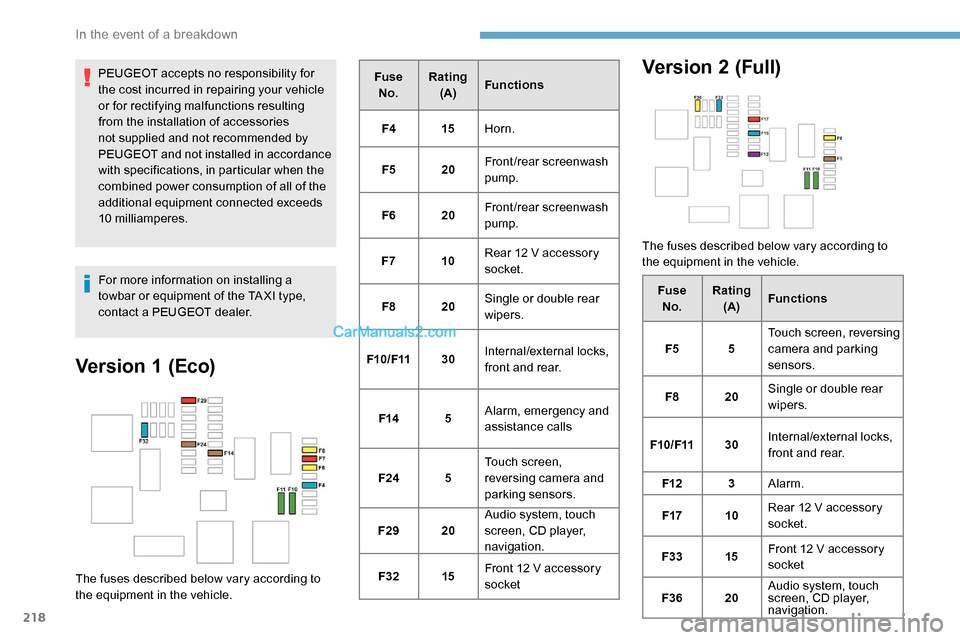
Version 1 (Eco)
The fuses described below vary according to
the equipment in the vehicle.Fuse
No. Rating
(A) Functions
F4 15Horn.
F5 20Front/rear screenwash
pump.
F6 20Front/rear screenwash
pump.
F7 10Rear 12 V accessory
socket.
F8 20Single or double rear
wipers.
F10/F11 30Internal/external locks,
front and rear.
F14 5Alarm, emergency and
assistance calls
F24 5Touch screen,
reversing camera and
parking sensors.
F29 20Audio system, touch
screen, CD player,
navigation.
F32 15Front 12 V accessory
socket
Version 2 (Full)
The fuses described below vary according to
the equipment in the vehicle.
FuseNo. Rating
(A) Functions
F5 5Touch screen, reversing
camera and parking
sensors.
F8 20Single or double rear
wipers.
F10/F11 30Internal/external locks,
front and rear.
F12 3Alarm.
F17 10Rear 12 V accessory
socket.
F33 15Front 12 V accessory
socket
F36 20Audio system, touch
screen, CD player,
navigation.
In the event of a breakdown
Page 221 of 324
219
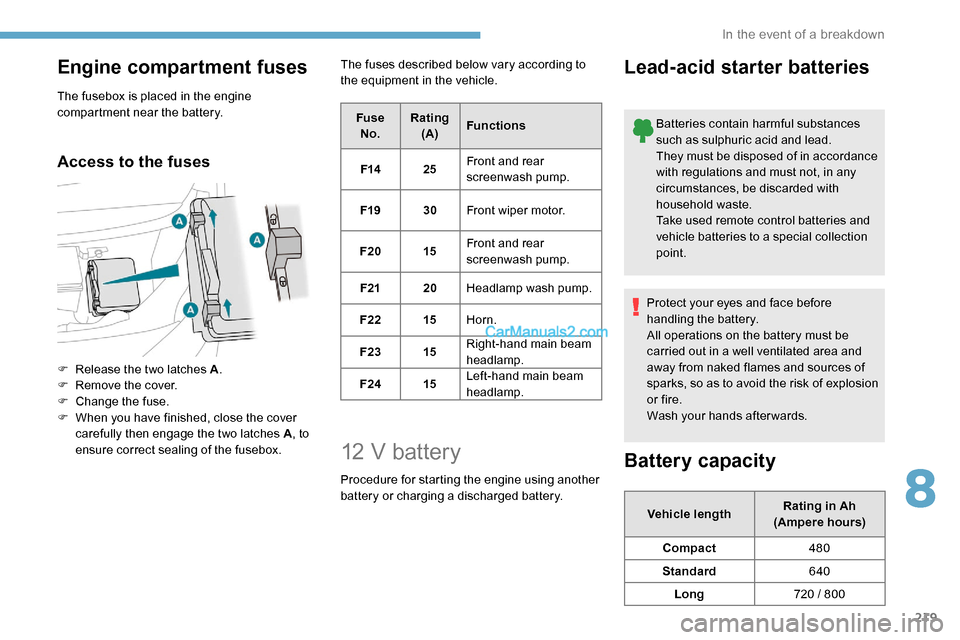
Engine compartment fuses
The fusebox is placed in the engine
compartment near the battery.
Access to the fuses
F Release the two latches A.
F R emove the cover.
F
C
hange the fuse.
F
W
hen you have finished, close the cover
carefully then engage the two latches A , to
ensure correct sealing of the fusebox. The fuses described below vary according to
the equipment in the vehicle.
FuseNo. Rating
(A) Functions
F14 25Front and rear
screenwash pump.
F19 30Front wiper motor.
F20 15Front and rear
screenwash pump.
F21 20Headlamp wash pump.
F22 15Horn.
F23 15Right-hand main beam
headlamp.
F24 15Left-hand main beam
headlamp.
12 V battery
Procedure for starting the engine using another
battery or charging a discharged battery.
Lead-acid starter batteries
Batteries contain harmful substances
such as sulphuric acid and lead.
They must be disposed of in accordance
with regulations and must not, in any
circumstances, be discarded with
household waste.
Take used remote control batteries and
vehicle batteries to a special collection
point.
Protect your eyes and face before
handling the battery.
All operations on the battery must be
carried out in a well ventilated area and
away from naked flames and sources of
sparks, so as to avoid the risk of explosion
or fire.
Wash your hands afterwards.
Battery capacity
Vehicle length Rating in Ah
(Ampere hours)
Compact 480
Standard 640
Long 720 / 800
8
In the event of a breakdown
Page 235 of 324
1
Bluetooth® audio system
Contents
First steps
2
S
teering mounted controls
2
M
enus
4
R
adio
4
D
AB radio (Digital Audio Broadcasting)
6
M
edia
7
T
elephone
1
0
Frequently asked questions
1
4 The different functions and settings
described vary according to the version
and configuration of your vehicle.
As a safety measure and because it
requires sustained attention by the
driver, the pairing of a Bluetooth mobile
telephone with the Bluetooth hands-free
system of your audio system must be
done with the vehicle stationary
and the
ignition on.
Your audio system is coded in such a way
that it will only operate in your vehicle.
All work on the system must be
carried out exclusively by a dealer or
qualified workshop, to avoid any risk of
electrocution, fire or mechanical faults.
To avoid discharging the battery, the audio
system may switch off after a few minutes
if the engine is not running.
.
Bluetooth® audio system
Page 253 of 324
1
PEUGEOT Connect
Radio
Multimedia audio system -
Applications - Bluetooth®
telephone
Contents
First steps
1
S
teering mounted controls
2
M
enus
3
A
pplications
5
R
adio
5
D
AB radio (Digital Audio Broadcasting)
7
M
edia
8
T
elephone
1
0
Settings
1
4
Frequently asked questions
1
6
The various functions and settings
described differ according to the version
and configuration of the vehicle. For safety reasons and because they
require continued attention on the part of
the driver, the following operations must
be carried out with the vehicle stationary
and the ignition on:
-
Us
ing a smartphone.
-
P
airing a Bluetooth mobile phone to
the hands-free Bluetooth system of the
car radio.
-
Sm
artphone connection operations for
CarPlay
®, MirrorLinkTM or Android Auto
(certain applications interrupt their
display when the vehicle starts to move
again).
-
T
he configuration of profiles.
The system is protected in such a way that
it will only operate in the vehicle.
The display of the message Energy
Economy Mode signals that a change to
standby is imminent.
The link below gives access to the OSS
(Open Source Software) code for the
system.
https://www.groupe-psa.com/fr/oss/
https://www.groupe-psa.com/en/oss/
First steps
With the engine running, a press
mutes the sound.
With the ignition off, a press turns
the system on.
Increase or decrease the volume using
the wheel or the "plus" or "minus" buttons
(depending on the equipment).
Use the buttons on either side of or below the
touch screen for access to the menus, then
press the virtual buttons in the touch screen.
Depending on the model, use the "Source" or
"Menu" buttons on the left of the touch screen
for access to the menus, then press the virtual
buttons in the touch screen.
At all times it is possible to display the rolling
menus by pressing the screen briefly with three
fingers.
All of the touch areas of the screen are white.
For pages with multiple tabs at the bottom of
the screen, it is possible to switch between
pages either by tapping the tab for the desired
page, or by using a finger, sliding the pages to
the left or to the right.
Press in the grey zone to go back up a level or
to confirm.
.
PEUGEOT Connect Radio
Page 273 of 324
1
PEUGEOT Connect Nav
GPS navigation -
Applications - Multimedia
audio system - Bluetooth
®
telephone
Contents
First steps
1
S
teering mounted controls
2
M
enus
3
V
oice commands
4
N
avigation
1
2
Connected navigation
1
4
Applications
1
7
Radio
2
0
DAB radio (Digital Audio Broadcasting)
2
2
Media
2
2
Telephone
2
4
Settings
2
8
Frequently asked questions
3
0The various functions and settings
described differ according to the version
and configuration of the vehicle.
For safety reasons and because they
require continued attention on the part of
the driver, the following operations must
be carried out with the vehicle stationary
and the ignition switched off:
-
Us
ing a smartphone.
-
P
airing a Bluetooth mobile phone to
the hands-free Bluetooth system of the
audio system.
-
Sm
artphone connection operations for
CarPlay
®, MirrorLinkTM or Android Auto
(certain applications interrupt their
display when the vehicle starts to move
again).
-
W
atching a video (the video stops
when the vehicle starts to move again).
-
T
he configuration of profiles.
The system is protected in such a way that
it will only operate in the vehicle.
The display of the message Energy
Economy Mode signals that a change to
standby is imminent. The link below gives access to the OSS
(Open Source Software) code for the
system.
https://www.groupe-psa.com/fr/oss/
https://www.groupe-psa.com/en/oss/
First steps
With the engine running, a press
mutes the sound.
With the ignition off, a press turns
the system on.
Increase or decrease the volume using
the wheel or the "plus" or "minus" buttons
(depending on the equipment).
Use the menu buttons on either side of or
below the touch screen for access to the
menus, then press the virtual buttons in the
touch screen.
Depending on the model, use the "Source" or
"Menu" buttons to access the rolling menus,
then press the virtual buttons in the touch
screen.
Display the rolling menus at any time by
pressing the screen briefly with three fingers.
All of the touch areas of the screen are white.
Press the back arrow to go back a level.
Press "OK" to confirm.
.
PEUGEOT Connect Nav
Page 310 of 324
234
G
H
Gauge, fuel............................................. 185 -187
Gearbox, automatic .......145 -15 0, 15 3 -15 4, 19 5
Gearbox, electronic
...............145, 15 0 -152, 19 5
Gearbox, manual
...........14 5 -14 6 , 15 3 -15 4, 19 5
Gear lever, automatic gearbox
..............147-15 0
Gear lever, electronic gearbox
.....................195
Gear lever, manual gearbox
..................145 -14 6
Gear shift indicator ~ Gear efficiency indicator
..................................... 14 6
Glove box
........................................................ 76
Hazard warning lamps
..........................108, 200
Hazard warning lamps, automatic operation
.................................... 10
8
Headlamp adjustment
...................................102
Headlamp adjustment
...................................102
Headlamp beam height
................................. 10
2
Headlamps, automatic dipping
.......20, 101, 174
Headlamps, automatic illumination
................99
Headlamps, dipped beam
..........20, 97, 211-213
Headlamps, halogen
..............................211-212
Headlamps, main beam
.......20, 22, 97, 211-213
Headlamps, Xenon
....................................... 213
EBFD
................
.............................................
11 0
Eco-driving (advice)
..........................................
7
Economy mode
............................................. 18
9
Electric windows
.............................................
53
Electronic brake force distribution (EBFD)
.............................. 10
9 -110
Emergency braking assistance (EBA)
...
109 -110
Emergency call
.....................................
108 -109
Emergency warning lamps
...................
108, 200
Emissions control system, SCR
.............
26, 19 6
Energy economy mode
................................. 18
9
Engine compartment
.................................... 19
1
Engine, Diesel
...........
13, 18, 185, 191, 200, 225
Engines
.........................................................
224
Engine self-diagnosis ..................................... 16
E
nvironment
.......................................... 7, 40, 94
ESC (electronic stability control)
.................. 10
9
E
F
Fatigue detection .......................................... 175
Filling the AdBlue® tank ........................ 19 4, 198
Filling the fuel tank ................................. 185 -187
Filter, air
........................................................ 19 4
Filter, Diesel fuel
........................................... 191
Filter, oil
................
......................................... 19 4
Filter, particle
........................................ 193, 195
Filter, passenger compartment
...............8 6, 19 4
Finisher
......................................................... 210
Fitting a wheel
....................................... 208 -210
Fitting roof bars
............................................. 189
Fittings, interior
.................................... 7
5 -76, 81
Fittings, rear
.................................................... 81
Fitting the mat
................................................. 75
Flap, fuel filler
......................................... 185 -187
Flap, removable
..............................
..........60-62
Flashing indicators
.......................................... 98
Floor cab
....................................................... 216
Fluid, brake
................................................... 193
D
Date (setting) ................................................... 30
Daytime running lamps ..............97, 99, 211-213
Deactivating the passenger airbag
.......11 8 , 12 2
Deactivation of DSC (ESC)
...........................111
Deadlocking
............................................... 37- 3 8
Defrosting
............................................ 60, 90 -91
Demisting
.................................................. 90 -91
Demisting, rear
................................................ 91
Demisting, rear screen
...................................91
Dimensions
..............................
.....................228
Dipstick
................
.............................. 24 -25, 192
Direction indicators
..................98, 211-214, 216
Display, head-up
...............................
.....15 8 -159
Door pockets
...............................
..............75 -76
Doors, rear
................................................ 49-50
Doors, side-hinged
......... 3
7-38, 49 - 50, 214 -215
Driver’s attention warning
.............................175
Driving
.................................................... 13 8 -13 9
Driving abroad ................................................. 97
Driving aids camera (warnings)
....................157
Driving aids (recommendations)
...................15 6
Driving economically ......................................... 7
Dynamic stability control (DSC)
.......17, 1 0 9 -11 3
Cruise control
..................
159, 161-162, 16 4 -167
Cruise control, adaptive .........
16 2 , 167, 170 -171
Cruise control by speed limit recognition
...............................
............
161-162
Cruise control, dynamic with Stop function
........................................
161-162
Cup holder .......................................................
75 Fluid, engine coolant
.....................................
193
Fluid, power steering
.................................... 19
3
Foglamp, rear
..................................
19, 214, 216
Foglamps, front
.........................
97-98, 100, 214
Foglamps, rear
........................................... 9
7- 9 8
Fuel ............................................................ 7, 1 8 5
Fuel consumption
........................................
7, 2 9
Fuel tank ........................................................ 185
Fusebox, engine compartment
.....................
219
Fuses
...................................................... 21
7-219
Alphabetical index