Anchor Peugeot Expert 2019 Owner's Manual
[x] Cancel search | Manufacturer: PEUGEOT, Model Year: 2019, Model line: Expert, Model: Peugeot Expert 2019Pages: 324, PDF Size: 13.07 MB
Page 64 of 324
62
When the side seat is up
and the flap is removed,
you must install the anti-
slip net.
Refer to the Anti-slip net
section.
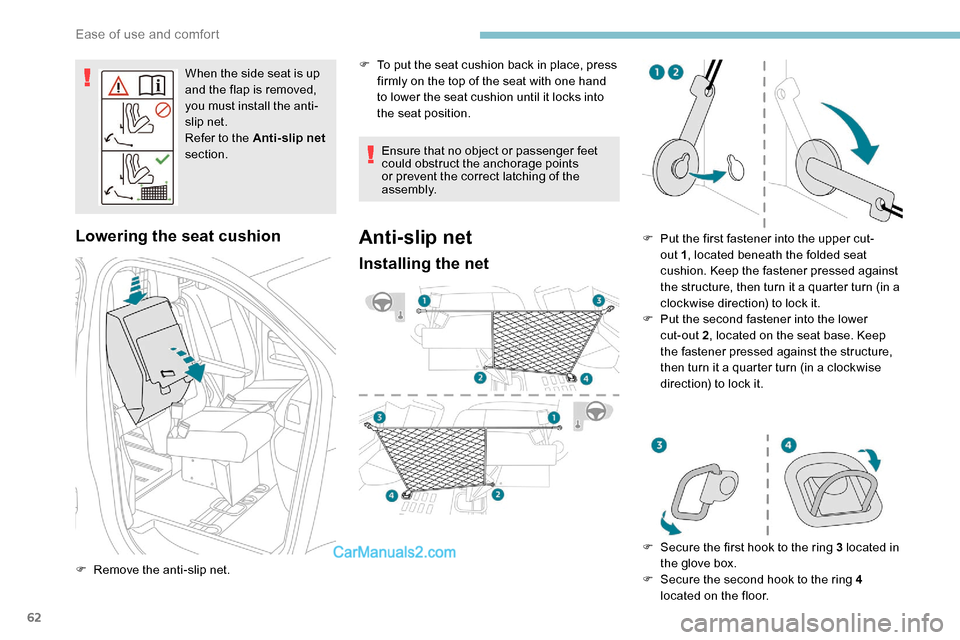
Lowering the seat cushion
F Remove the anti-slip net. Ensure that no object or passenger feet
could obstruct the anchorage points
or prevent the correct latching of the
assembly.
Anti-slip net
Installing the net
F Put the first fastener into the upper cut-
out 1, located beneath the folded seat
cushion. Keep the fastener pressed against
the structure, then turn it a quarter turn (in a
clockwise direction) to lock it.
F
P
ut the second fastener into the lower
cut-out 2 , located on the seat base. Keep
the fastener pressed against the structure,
then turn it a quarter turn (in a clockwise
direction) to lock it.
F
S
ecure the first hook to the ring 3 located in
the glove box.
F
S
ecure the second hook to the ring 4
located on the floor.
F
T
o put the seat cushion back in place, press
firmly on the top of the seat with one hand
to lower the seat cushion until it locks into
the seat position.
Ease of use and comfort
Page 65 of 324
63
Removing the net
F Release the hooks from the rings 4 and 3.
F R emove the lower fastener 2 then the upper
fastener 1 , turning them by a quarter turn
backwards to unlock them.
Make sure that the size, shape and
volume of the loads carried are compatible
with the highway code and safety
regulations and do not impair the driver’s
field of vision.
All loads must be appropriately secured
to prevent or minimise displacement and
prevent injury.
Install the anti-slip net (supplied with the
vehicle) every time that the seat is raised
and the partition flap removed.
Never use the net for any other purposes.
Regularly check the condition of the
anti-slip net. As soon as signs of wear or
tear appear, contact a PEUGEOT dealer
to have it replaced by an anti-slip net
that meets the specifications required by
PEUGEOT for the vehicle.
Always fit the removable flap back into
place when you are not carrying any long
loads.
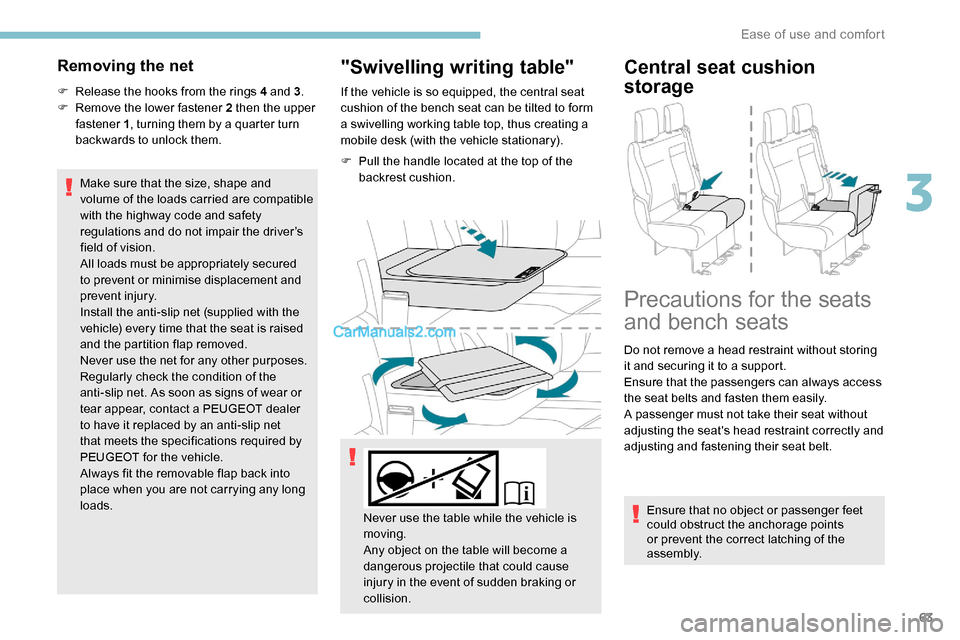
"Swivelling writing table"
If the vehicle is so equipped, the central seat
cushion of the bench seat can be tilted to form
a swivelling working table top, thus creating a
mobile desk (with the vehicle stationary).
F
P
ull the handle located at the top of the
backrest cushion.
Central seat cushion
storage
Never use the table while the vehicle is
moving.
Any object on the table will become a
dangerous projectile that could cause
injury in the event of sudden braking or
collision.
Precautions for the seats
and bench seats
Do not remove a head restraint without storing
it and securing it to a support.
Ensure that the passengers can always access
the seat belts and fasten them easily.
A passenger must not take their seat without
adjusting the seat's head restraint correctly and
adjusting and fastening their seat belt.
Ensure that no object or passenger feet
could obstruct the anchorage points
or prevent the correct latching of the
assembly.
3
Ease of use and comfort
Page 67 of 324
65
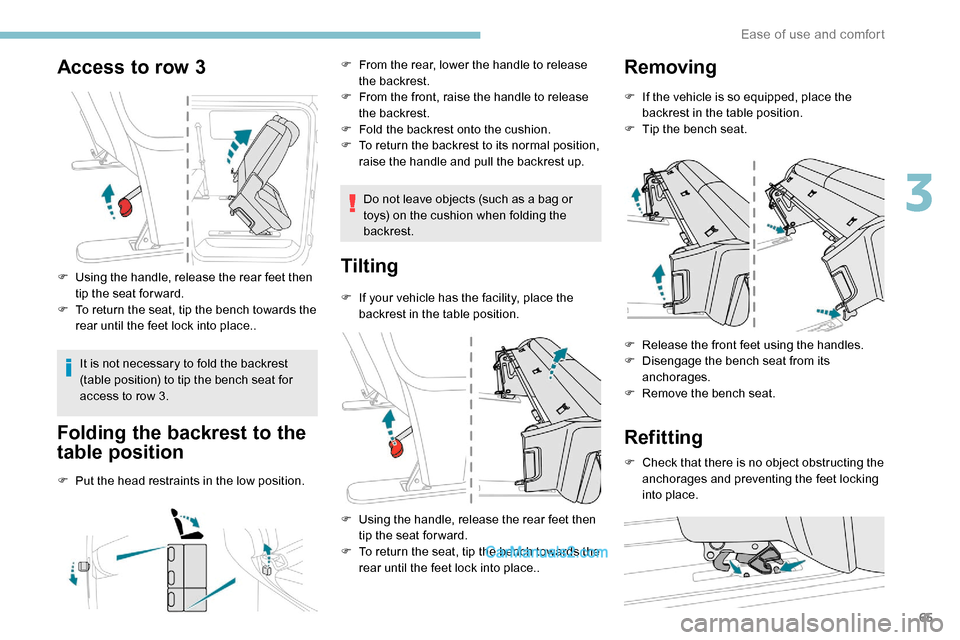
Access to row 3
F Using the handle, release the rear feet then tip the seat for ward.
F
T
o return the seat, tip the bench towards the
rear until the feet lock into place..
It is not necessary to fold the backrest
(table position) to tip the bench seat for
access to row 3.
Folding the backrest to the
table position
F Put the head restraints in the low position. F
F
rom the rear, lower the handle to release
the backrest.
F
F
rom the front, raise the handle to release
the backrest.
F
F
old the backrest onto the cushion.
F
T
o return the backrest to its normal position,
raise the handle and pull the backrest up.
Do not leave objects (such as a bag or
toys) on the cushion when folding the
backrest.
Tilting
F If your vehicle has the facility, place the backrest in the table position.
F
U
sing the handle, release the rear feet then
tip the seat for ward.
F
T
o return the seat, tip the bench towards the
rear until the feet lock into place..
Removing
F If the vehicle is so equipped, place the backrest in the table position.
F
T
ip the bench seat.
F
R
elease the front feet using the handles.
F
D
isengage the bench seat from its
anchorages.
F
R
emove the bench seat.
Refitting
F Check that there is no object obstructing the anchorages and preventing the feet locking
into place.
3
Ease of use and comfort
Page 68 of 324
66
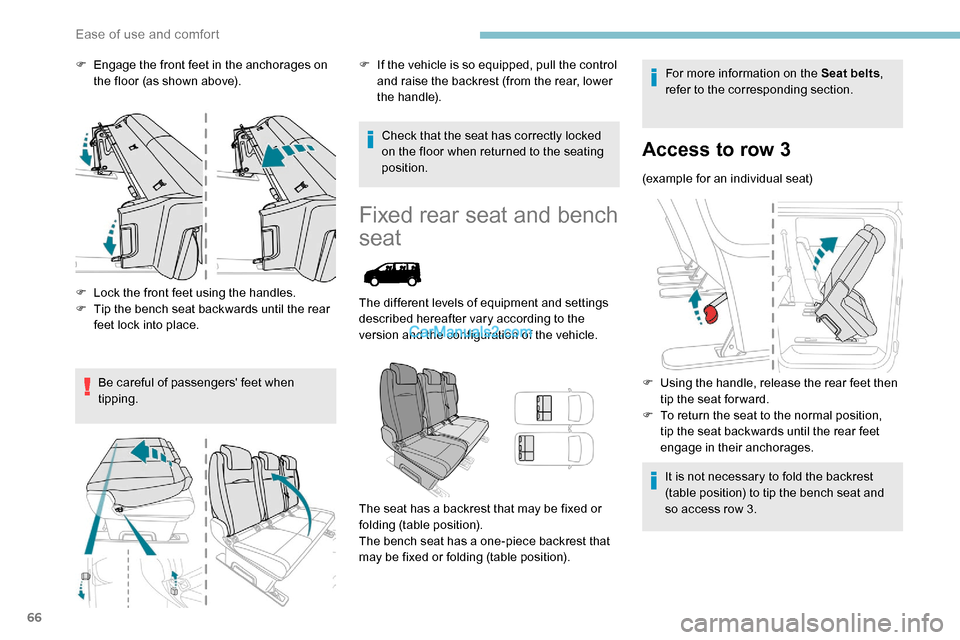
F Engage the front feet in the anchorages on the floor (as shown above).
F
L
ock the front feet using the handles.
F
T
ip the bench seat backwards until the rear
feet lock into place.
Be careful of passengers' feet when
tipping. F
I f the vehicle is so equipped, pull the control
and raise the backrest (from the rear, lower
the handle).
Check that the seat has correctly locked
on the floor when returned to the seating
position.
Fixed rear seat and bench
seat
The different levels of equipment and settings
described hereafter vary according to the
version and the configuration of the vehicle.
The seat has a backrest that may be fixed or
folding (table position).
The bench seat has a one-piece backrest that
may be fixed or folding (table position). For more information on the Seat belts
,
refer to the corresponding section.
Access to row 3
(example for an individual seat)
F
U
sing the handle, release the rear feet then
tip the seat for ward.
F
T
o return the seat to the normal position,
tip the seat backwards until the rear feet
engage in their anchorages.
It is not necessary to fold the backrest
(table position) to tip the bench seat and
so access row 3.
Ease of use and comfort
Page 69 of 324
67
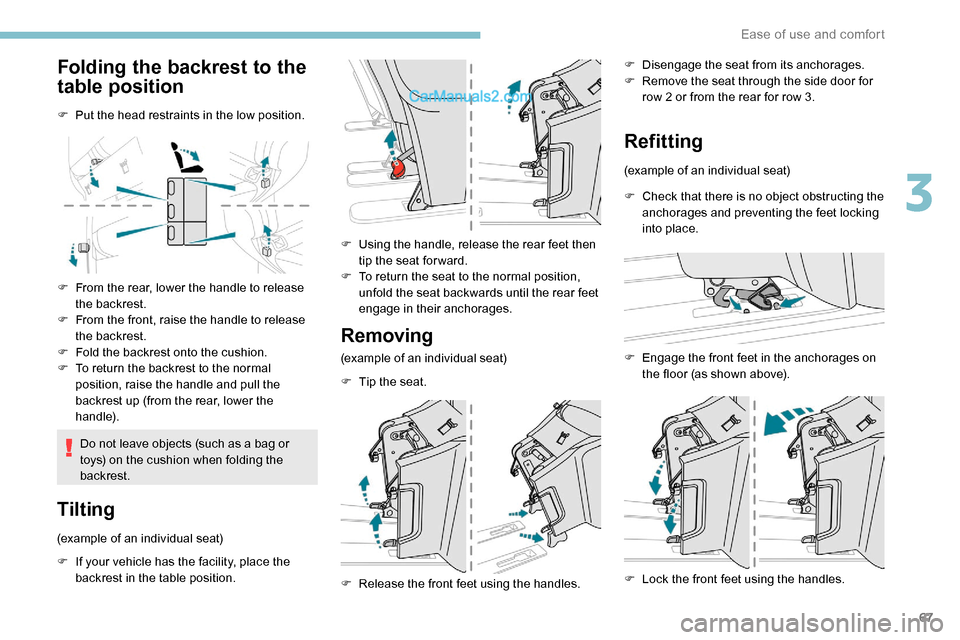
Folding the backrest to the
table position
F Put the head restraints in the low position.
F
F
rom the rear, lower the handle to release
the backrest.
F
F
rom the front, raise the handle to release
the backrest.
F
F
old the backrest onto the cushion.
F
T
o return the backrest to the normal
position, raise the handle and pull the
backrest up (from the rear, lower the
handle).
Do not leave objects (such as a bag or
toys) on the cushion when folding the
backrest.
Tilting
(example of an individual seat)
F
I
f your vehicle has the facility, place the
backrest in the table position. F
U
sing the handle, release the rear feet then
tip the seat for ward.
F
T
o return the seat to the normal position,
unfold the seat backwards until the rear feet
engage in their anchorages.
Removing
(example of an individual seat)
F
T
ip the seat. F
D
isengage the seat from its anchorages.
F
R
emove the seat through the side door for
row 2 or from the rear for row 3.
Refitting
(example of an individual seat)
F
C
heck that there is no object obstructing the
anchorages and preventing the feet locking
into place.
F
E
ngage the front feet in the anchorages on
the floor (as shown above).
F
L
ock the front feet using the handles.
F
R
elease the front feet using the handles.
3
Ease of use and comfort
Page 72 of 324
70
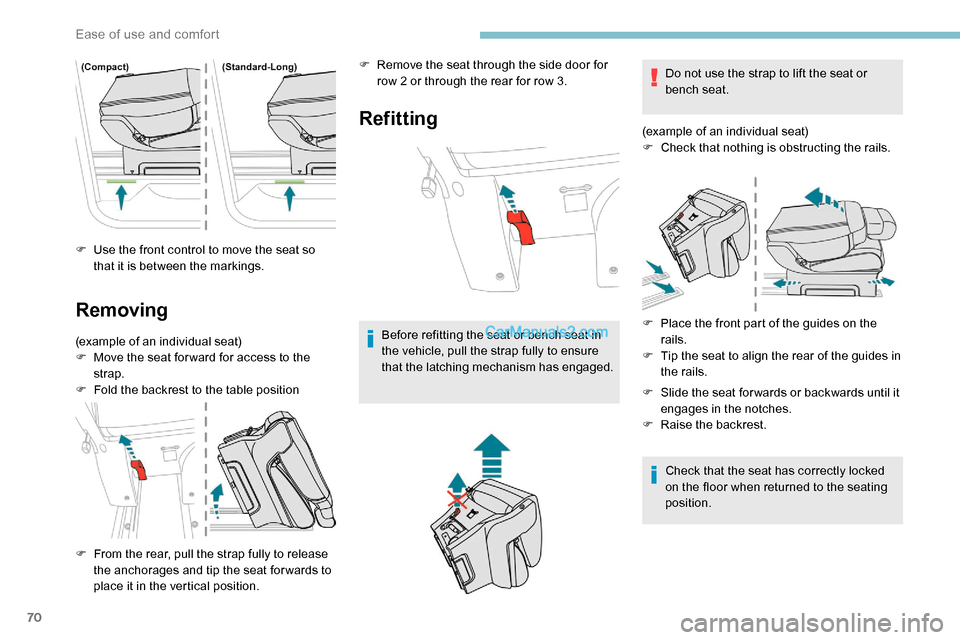
F Use the front control to move the seat so that it is between the markings.
Removing
(example of an individual seat)
F M ove the seat for ward for access to the
strap.
F
F
old the backrest to the table position
Refitting
Before refitting the seat or bench seat in
the vehicle, pull the strap fully to ensure
that the latching mechanism has engaged.
F
F
rom the rear, pull the strap fully to release
the anchorages and tip the seat for wards to
place it in the vertical position. F
R
emove the seat through the side door for
row 2 or through the rear for row 3. Do not use the strap to lift the seat or
bench seat.
(example of an individual seat)
F
C
heck that nothing is obstructing the rails.
F P lace the front part of the guides on the
rails.
F
T
ip the seat to align the rear of the guides in
the rails.
F
S
lide the seat for wards or backwards until it
engages in the notches.
F
Ra
ise the backrest.
Check that the seat has correctly locked
on the floor when returned to the seating
position.
Ease of use and comfort
Page 74 of 324
72
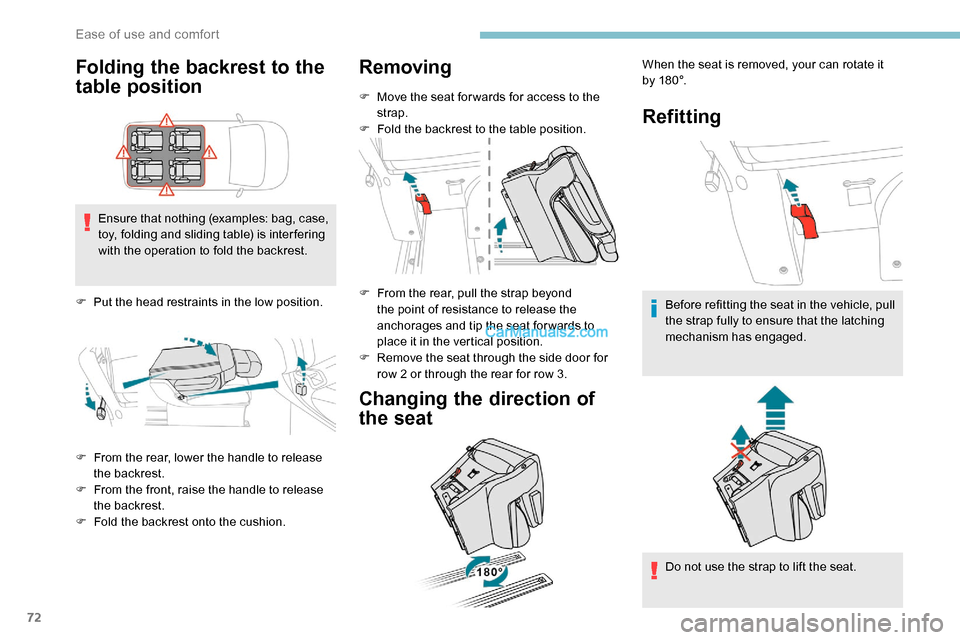
Folding the backrest to the
table position
Ensure that nothing (examples: bag, case,
toy, folding and sliding table) is inter fering
with the operation to fold the backrest.
F
P
ut the head restraints in the low position.
F
F
rom the rear, lower the handle to release
the backrest.
F
F
rom the front, raise the handle to release
the backrest.
F
F
old the backrest onto the cushion.
Removing
F Move the seat for wards for access to the strap.
F
F
old the backrest to the table position.
F
F
rom the rear, pull the strap beyond
the point of resistance to release the
anchorages and tip the seat for wards to
place it in the vertical position.
F
R
emove the seat through the side door for
row 2 or through the rear for row 3.
Changing the direction of
the seat Refitting
When the seat is removed, your can rotate it
by 18 0 °.
Before refitting the seat in the vehicle, pull
the strap fully to ensure that the latching
mechanism has engaged.
Do not use the strap to lift the seat.
Ease of use and comfort
Page 77 of 324
75
Never put your hand underneath the
bench seat to guide it downwards, as you
could get your fingers trapped.
Ensure there are no objects or feet
beneath the bench seat or obstructing
the anchorage system, preventing the
assembly from being correctly locked.
Do not attach anything to the cab fixing
structure.
Do not exceed the number of passengers
indicated on the registration certificate.
In the rear, the load space is intended for
carrying goods only.
It is recommended to place goods or
heavy objects as far for wards as possible
in the load space (towards the cab) and
secure them by means of straps using the
stowing rings on the floor.
The rear seat belt frames are not designed
to secure the load being carried.Interior fittings
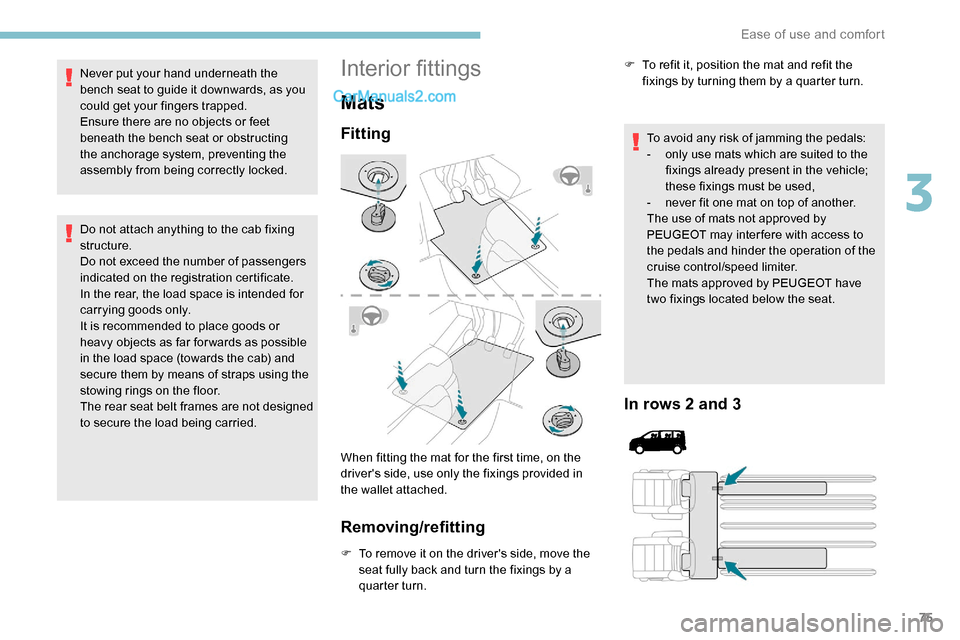
Mats
Fitting
When fitting the mat for the first time, on the
driver's side, use only the fixings provided in
the wallet attached.
Removing/refitting
F To remove it on the driver's side, move the seat fully back and turn the fixings by a
quarter turn. F
T
o refit it, position the mat and refit the
fixings by turning them by a quarter turn.
To avoid any risk of jamming the pedals:
-
o
nly use mats which are suited to the
fixings already present in the vehicle;
these fixings must be used,
-
n
ever fit one mat on top of another.
The use of mats not approved by
PEUGEOT may inter fere with access to
the pedals and hinder the operation of the
cruise control/speed limiter.
The mats approved by PEUGEOT have
two fixings located below the seat.
In rows 2 and 3
3
Ease of use and comfort
Page 83 of 324
81
Seating area fittings
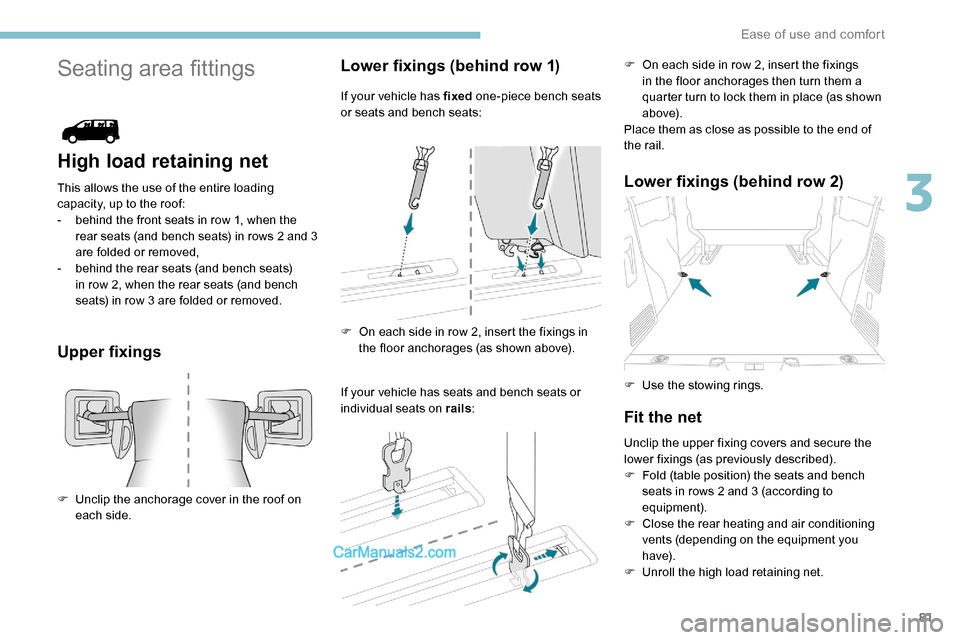
High load retaining net
This allows the use of the entire loading
capacity, up to the roof:
-
b
ehind the front seats in row 1, when the
rear seats (and bench seats) in rows 2 and 3
are folded or removed,
-
b
ehind the rear seats (and bench seats)
in row 2, when the rear seats (and bench
seats) in row 3 are folded or removed.
Upper fixings Lower fixings (behind row 1)
If your vehicle has fixed
one-piece bench seats
or seats and bench seats:
If your vehicle has seats and bench seats or
individual seats on rails :
Lower fixings (behind row 2)
Fit the net
F Unclip the anchorage cover in the roof on each side. F
O
n each side in row 2, insert the fixings in
the floor anchorages (as shown above). F
O
n each side in row 2, insert the fixings
in the floor anchorages then turn them a
quarter turn to lock them in place (as shown
a b ove).
Place them as close as possible to the end of
the rail.
F
U
se the stowing rings.
Unclip the upper fixing covers and secure the
lower fixings (as previously described).
F
F
old (table position) the seats and bench
seats in rows 2 and 3 (according to
equipment).
F
C
lose the rear heating and air conditioning
vents (depending on the equipment you
h ave).
F
U
nroll the high load retaining net.
3
Ease of use and comfort
Page 84 of 324
82
F Position the net upper fixings in the corresponding anchorages in the roof (first
one side, then the other).
F
F
ully extend the straps.
F
O
n each side, attach the bottom fixings of
the net to the lower anchorages (behind row
1) or in the stowing rings (behind row 2).
F
T
ension the straps to extend the net.
F
C
heck that the net is attached securely and
properly extended.
Never use the ISOFIX ring provided for
fixing the strap of a child seat with Top
Tether.
Rear windows in row 2
If the vehicle is so equipped, the side windows
of row 2 can be opened. For more information on the Child
lock for rear windows
, refer to the
corresponding section.
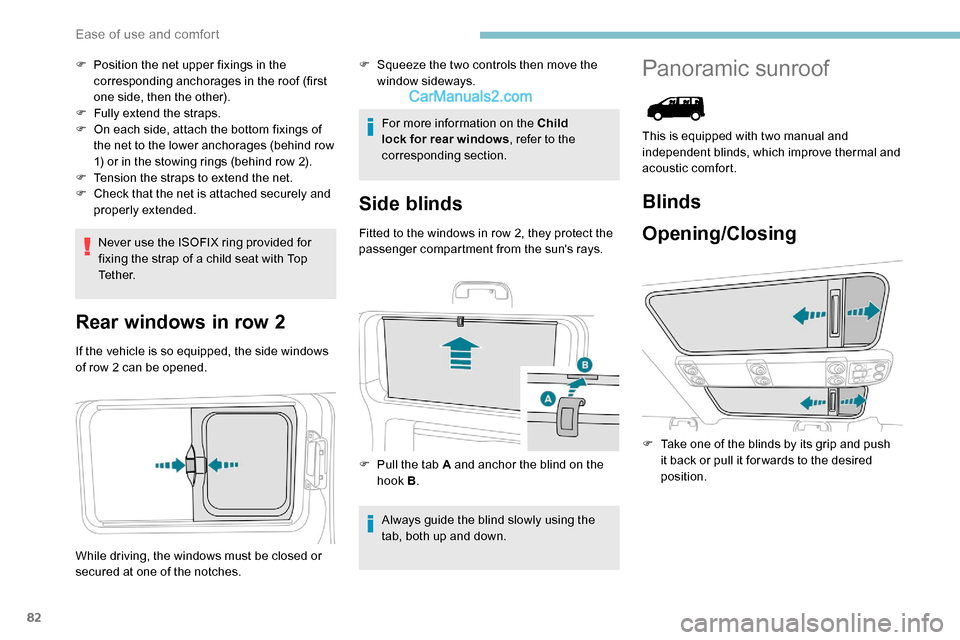
Side blinds
Fitted to the windows in row 2, they protect the
passenger compartment from the sun's rays.
While driving, the windows must be closed or
secured at one of the notches. Always guide the blind slowly using the
tab, both up and down.
F
P
ull the tab A and anchor the blind on the
hook B .
Panoramic sunroof
This is equipped with two manual and
independent blinds, which improve thermal and
acoustic comfort.
Blinds
Opening/Closing
F Take one of the blinds by its grip and push
it back or pull it for wards to the desired
position.
F
S
queeze the two controls then move the
window sideways.
Ease of use and comfort