Esc Peugeot Expert 2019 Owner's Manual
[x] Cancel search | Manufacturer: PEUGEOT, Model Year: 2019, Model line: Expert, Model: Peugeot Expert 2019Pages: 324, PDF Size: 13.07 MB
Page 3 of 324
Welcome
Thank you for choosing a Peugeot Expert or a Peugeot Traveller.
Your vehicle will be fitted with only some of the equipment described in
this document, depending on its trim level, version and the specification
for the country in which it was sold.
The descriptions and illustrations are given as indications only.
Automobiles PEUGEOT reser ves the right to modify the technical
specifications, equipment and accessories without having to update this
edition of the guide.
If ownership of your vehicle is transferred, please ensure this
Handbook is passed on to the new owner.
All of the operating instructions and recommendations are provided
in detail there to make the most of your vehicle. It is strongly
recommended that you familiarise yourself with it as well as the
Maintenance and Warranty Guide, which provides information about
the warranties, ser vicing and roadside assistance associated with the
vehicle.
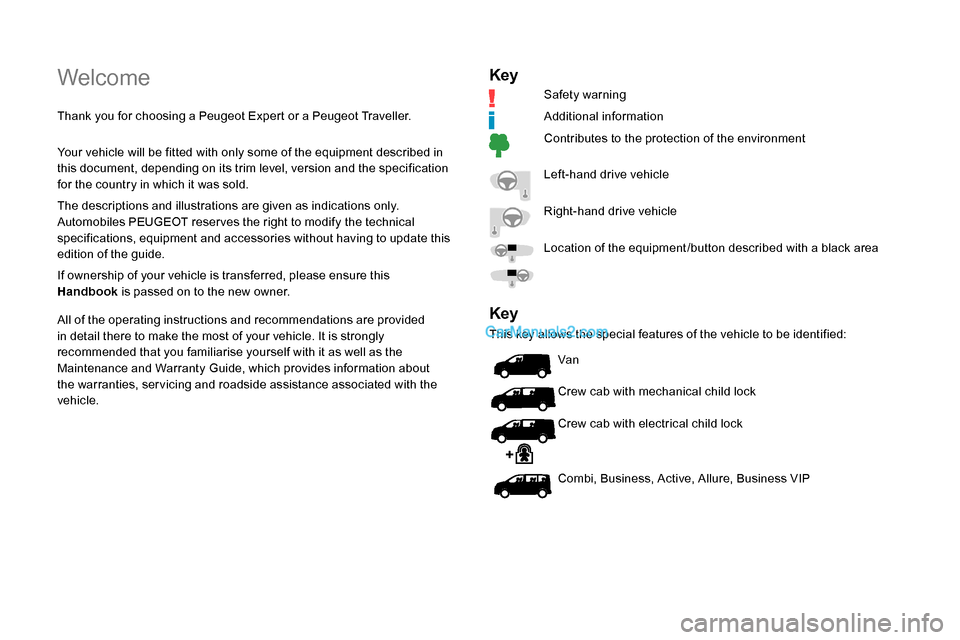
Key
Safety warning
Additional information
Contributes to the protection of the environment
Left-hand drive vehicle
Right-hand drive vehicle
Location of the equipment /button described with a black area
Key
This key allows the special features of the vehicle to be identified: Van
Crew cab with mechanical child lock
Crew cab with electrical child lock
Combi, Business, Active, Allure, Business VIP
Page 4 of 324
2
.
.
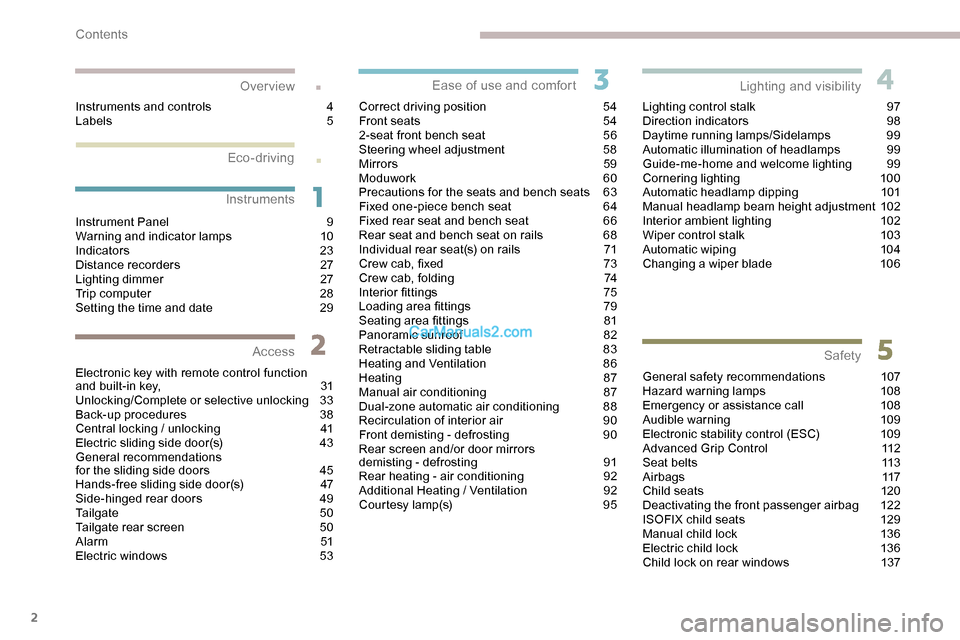
Instrument Panel 9
W arning and indicator lamps 1 0
Indicators
23
Distance recorders
2
7
Lighting dimmer
2
7
Trip computer
2
8
Setting the time and date
2
9
Electronic key with remote control function
and built-in key,
3
1
Unlocking/Complete or selective unlocking
3
3
Back-up procedures
3
8
Central locking / unlocking
4
1
Electric sliding side door(s)
4
3
General recommendations
for the sliding side doors
4
5
Hands-free sliding side door(s)
4
7
Side-hinged rear doors
4
9
Tailgate
5
0
Tailgate rear screen
5
0
Alarm
51
Electric windows
5
3Correct driving position
5
4
Front seats
5
4
2-seat front bench seat
5
6
Steering wheel adjustment
5
8
Mirrors 59
Moduwork
6
0
Precautions for the seats and bench seats
6
3
Fixed one-piece bench seat 6 4
Fixed rear seat and bench seat 6 6
Rear seat and bench seat on rails 6 8
Individual rear seat(s) on rails
7
1
Crew cab, fixed
7
3
Crew cab, folding
7
4
Interior fittings
7
5
Loading area fittings
7
9
Seating area fittings
8
1
Panoramic sunroof
8
2
Retractable sliding table
8
3
Heating and Ventilation
8
6
Heating
87
Manual air conditioning
8
7
Dual-zone automatic air conditioning
8
8
Recirculation of interior air
9
0
Front demisting - defrosting
9
0
Rear screen and/or door mirrors
demisting - defrosting
9
1
Rear heating - air conditioning
9
2
Additional Heating / Ventilation
9
2
Courtesy lamp(s)
9
5Lighting control stalk
9
7
Direction indicators
9
8
Daytime running lamps/Sidelamps
9
9
Automatic illumination of headlamps
9
9
Guide-me-home and welcome lighting
9
9
Cornering lighting
1
00
Automatic headlamp dipping
1
01
Manual headlamp beam height adjustment 1 02
Interior ambient lighting 1 02
Wiper control stalk 1 03
Automatic wiping
1
04
Changing a wiper blade
1
06
General safety recommendations
1
07
Hazard warning lamps
1
08
Emergency or assistance call
1
08
Audible warning
1
09
Electronic stability control (ESC)
1
09
Advanced Grip Control
1
12
Seat belts
1
13
Airbags
117
Child seats
1
20
Deactivating the front passenger airbag
1
22
ISOFIX child seats
1
29
Manual child lock
1
36
Electric child lock
1
36
Child lock on rear windows
1
37
Over view
Instruments
Access Ease of use and comfort
Safety
Lighting and visibility
Instruments and controls 4
L abels 5
Eco-driving
Contents
Page 12 of 324
10
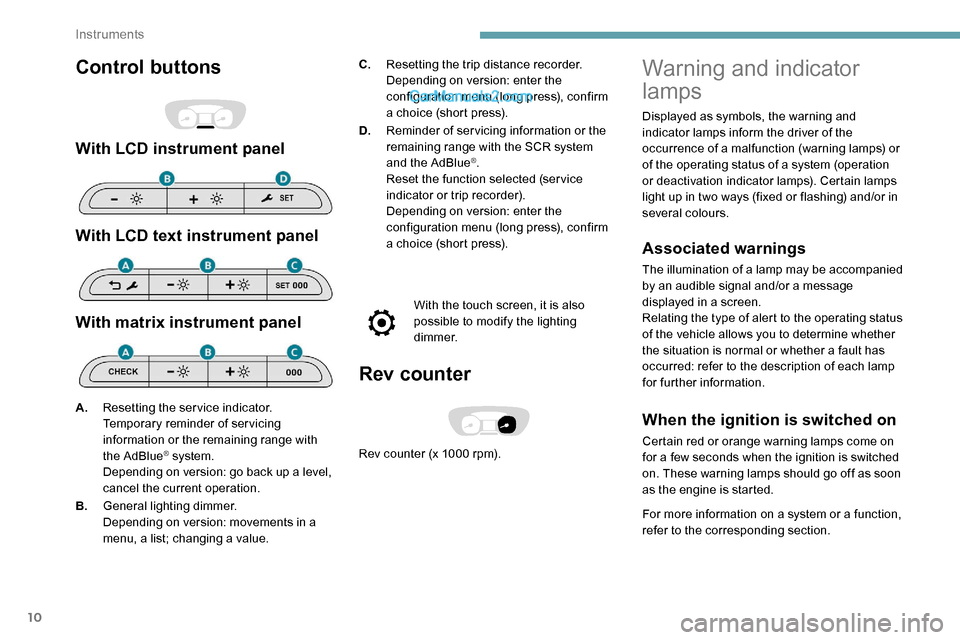
Control buttons
With LCD instrument panel
With LCD text instrument panel
With matrix instrument panel
C.Resetting the trip distance recorder.
Depending on version: enter the
configuration menu (long press), confirm
a choice (short press).
D. Reminder of servicing information or the
remaining range with the SCR system
and the AdBlue
®.
Reset the function selected (ser vice
indicator or trip recorder).
Depending on version: enter the
configuration menu (long press), confirm
a choice (short press).
With the touch screen, it is also
possible to modify the lighting
d i m m e r.
Rev counter
Rev counter (x 1000 rpm).
A.
Resetting the service indicator.
Temporary reminder of servicing
information or the remaining range with
the AdBlue® system.
Depending on version: go back up a level,
cancel the current operation.
B. General lighting dimmer.
Depending on version: movements in a
menu, a list; changing a value.
Warning and indicator
lamps
Displayed as symbols, the warning and
indicator lamps inform the driver of the
occurrence of a malfunction (warning lamps) or
of the operating status of a system (operation
or deactivation indicator lamps). Certain lamps
light up in two ways (fixed or flashing) and/or in
several colours.
Associated warnings
The illumination of a lamp may be accompanied
by an audible signal and/or a message
displayed in a screen.
Relating the type of alert to the operating status
of the vehicle allows you to determine whether
the situation is normal or whether a fault has
occurred: refer to the description of each lamp
for further information.
When the ignition is switched on
Certain red or orange warning lamps come on
for a few seconds when the ignition is switched
on. These warning lamps should go off as soon
as the engine is started.
For more information on a system or a function,
refer to the corresponding section.
Instruments
Page 13 of 324
11
Persistent warning lamp
When the engine is running or the vehicle is
being driven, the illumination of a red or orange
warning lamp indicates a fault that needs
further investigation, using any associated
message and the description of the warning
lamp in the documentation.
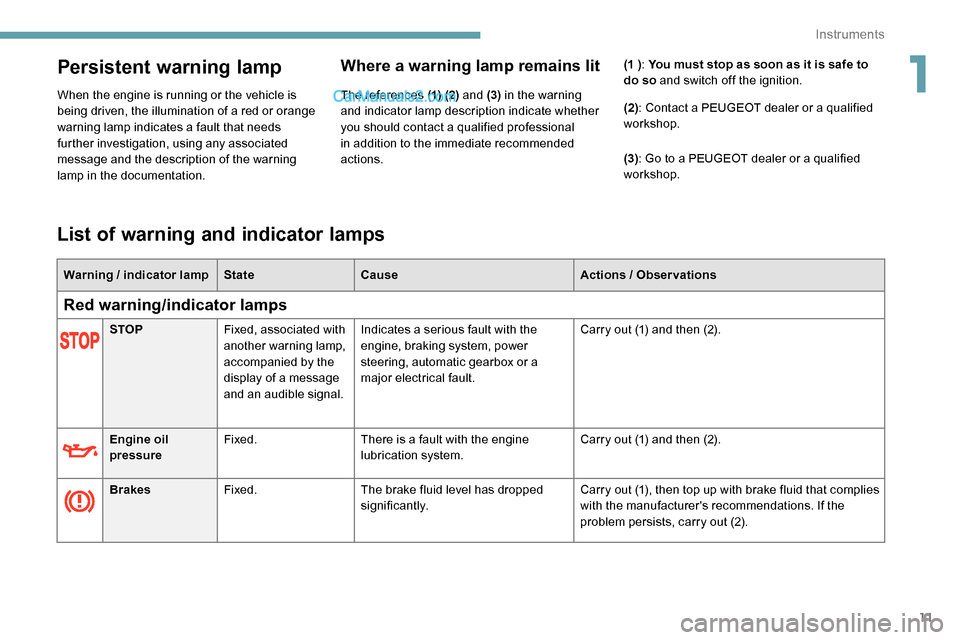
Where a warning lamp remains lit
The references (1) (2) and (3) in the warning
and indicator lamp description indicate whether
you should contact a qualified professional
in addition to the immediate recommended
actions. (1 )
: You must stop as soon as it is safe to
do so and switch off the ignition.
(2): Contact a PEUGEOT dealer or a qualified
workshop.
(3) : Go to a PEUGEOT dealer or a qualified
workshop.
STOP Fixed, associated with
another warning lamp,
accompanied by the
display of a message
and an audible signal. Indicates a serious fault with the
engine, braking system, power
steering, automatic gearbox or a
major electrical fault.
Carry out (1) and then (2).
Engine oil
pressure Fixed.
There is a fault with the engine
lubrication system. Carry out (1) and then (2).
Brakes Fixed. The brake fluid level has dropped
significantly. Carry out (1), then top up with brake fluid that complies
with the manufacturer's recommendations. If the
problem persists, carry out (2).
List of warning and indicator lamps
Warning
/ indicator lamp State Cause Actions / Observations
Red warning/indicator lamps
1
Instruments
Page 66 of 324
64
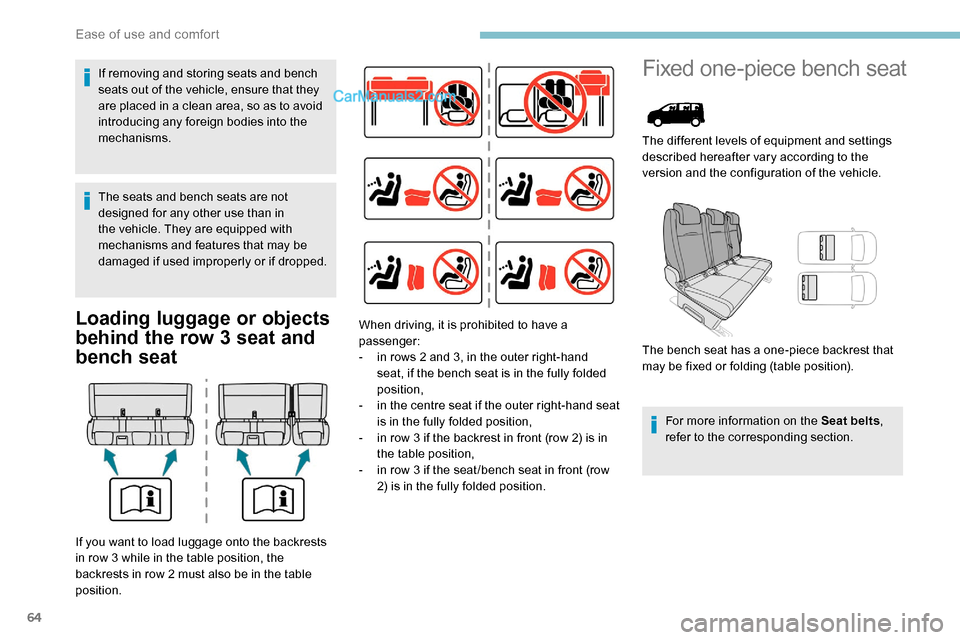
Loading luggage or objects
behind the row 3 seat and
bench seat
Fixed one-piece bench seat
The different levels of equipment and settings
described hereafter vary according to the
version and the configuration of the vehicle.
The bench seat has a one-piece backrest that
may be fixed or folding (table position).For more information on the Seat belts ,
refer to the corresponding section.
When driving, it is prohibited to have a
passenger:
-
i
n rows 2 and 3, in the outer right-hand
seat, if the bench seat is in the fully folded
position,
-
i
n the centre seat if the outer right-hand seat
is in the fully folded position,
-
i
n row 3 if the backrest in front (row 2) is in
the table position,
-
i
n row 3 if the seat /bench seat in front (row
2) is in the fully folded position.
If you want to load luggage onto the backrests
in row 3 while in the table position, the
backrests in row 2 must also be in the table
position. If removing and storing seats and bench
seats out of the vehicle, ensure that they
are placed in a clean area, so as to avoid
introducing any foreign bodies into the
mechanisms.
The seats and bench seats are not
designed for any other use than in
the vehicle. They are equipped with
mechanisms and features that may be
damaged if used improperly or if dropped.
Ease of use and comfort
Page 68 of 324
66
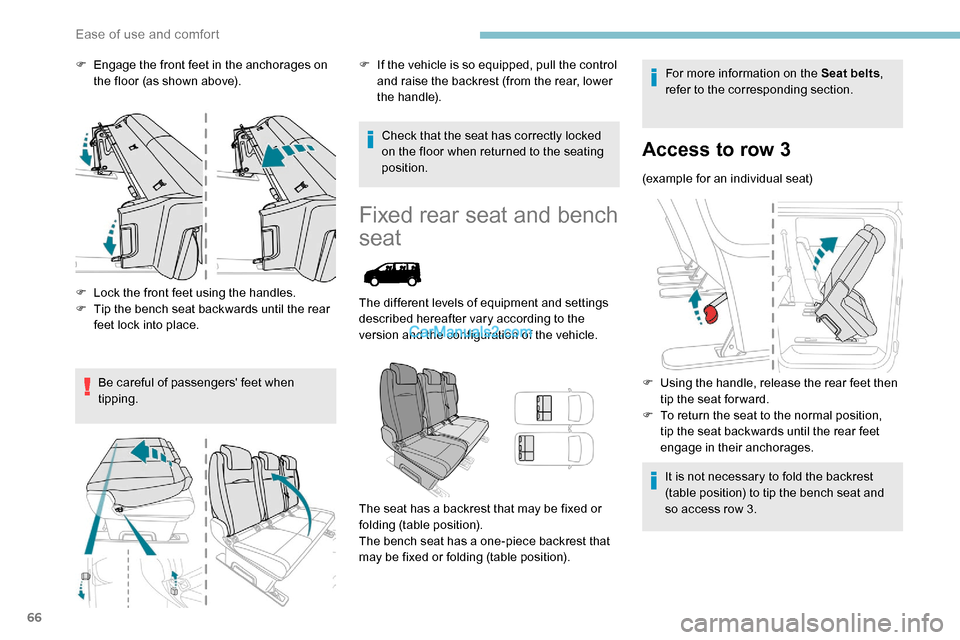
F Engage the front feet in the anchorages on the floor (as shown above).
F
L
ock the front feet using the handles.
F
T
ip the bench seat backwards until the rear
feet lock into place.
Be careful of passengers' feet when
tipping. F
I f the vehicle is so equipped, pull the control
and raise the backrest (from the rear, lower
the handle).
Check that the seat has correctly locked
on the floor when returned to the seating
position.
Fixed rear seat and bench
seat
The different levels of equipment and settings
described hereafter vary according to the
version and the configuration of the vehicle.
The seat has a backrest that may be fixed or
folding (table position).
The bench seat has a one-piece backrest that
may be fixed or folding (table position). For more information on the Seat belts
,
refer to the corresponding section.
Access to row 3
(example for an individual seat)
F
U
sing the handle, release the rear feet then
tip the seat for ward.
F
T
o return the seat to the normal position,
tip the seat backwards until the rear feet
engage in their anchorages.
It is not necessary to fold the backrest
(table position) to tip the bench seat and
so access row 3.
Ease of use and comfort
Page 70 of 324
68
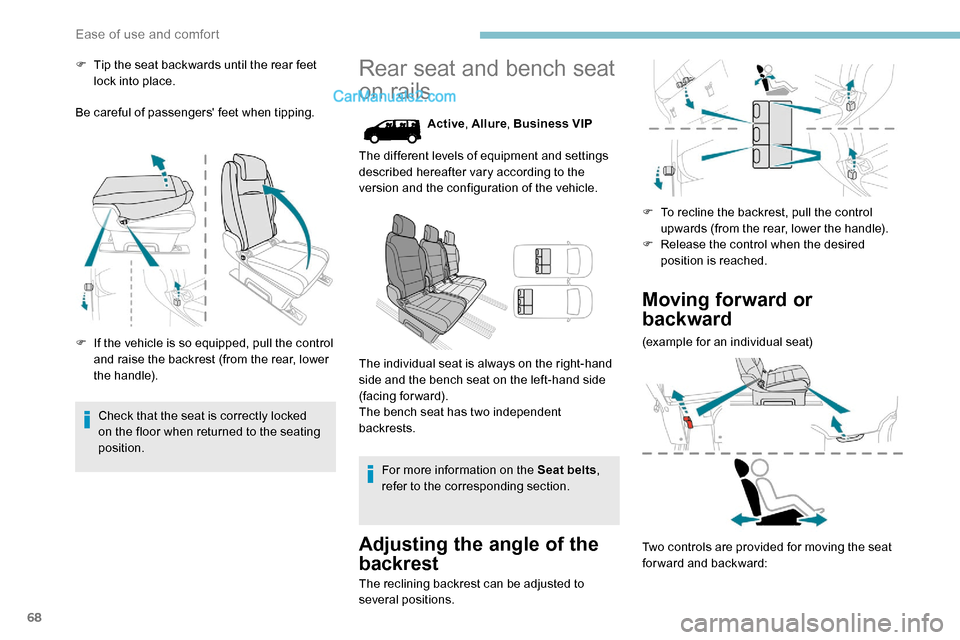
F Tip the seat backwards until the rear feet lock into place.
Be careful of passengers' feet when tipping.
F
I
f the vehicle is so equipped, pull the control
and raise the backrest (from the rear, lower
the handle).
Check that the seat is correctly locked
on the floor when returned to the seating
position.Rear seat and bench seat
on rails
Active , Allure , Business VIP
The different levels of equipment and settings
described hereafter vary according to the
version and the configuration of the vehicle.
The individual seat is always on the right-hand
side and the bench seat on the left-hand side
(facing forward).
The bench seat has two independent
backrests.
For more information on the Seat belts ,
refer to the corresponding section.
Adjusting the angle of the
backrest
The reclining backrest can be adjusted to
several positions. F
T
o recline the backrest, pull the control
upwards (from the rear, lower the handle).
F
R
elease the control when the desired
position is reached.
Moving forward or
backward
(example for an individual seat)
Two controls are provided for moving the seat
forward and backward:
Ease of use and comfort
Page 73 of 324
71
Individual rear seat(s) on
rails
Allure, Business VIP
The different levels of equipment and settings
described hereafter vary according to the
version and the configuration of the vehicle.
The individual seat is fitted with a three-point
inertia reel seat belt.
It can be placed facing forward or rearward
facing.
If there is a rear ward facing individual
seat in row 2, ensure that the seat in row
1 (driver or passenger) is not too far back,
in order to avoid contact between the two
seats.
This could cause significant wear of the
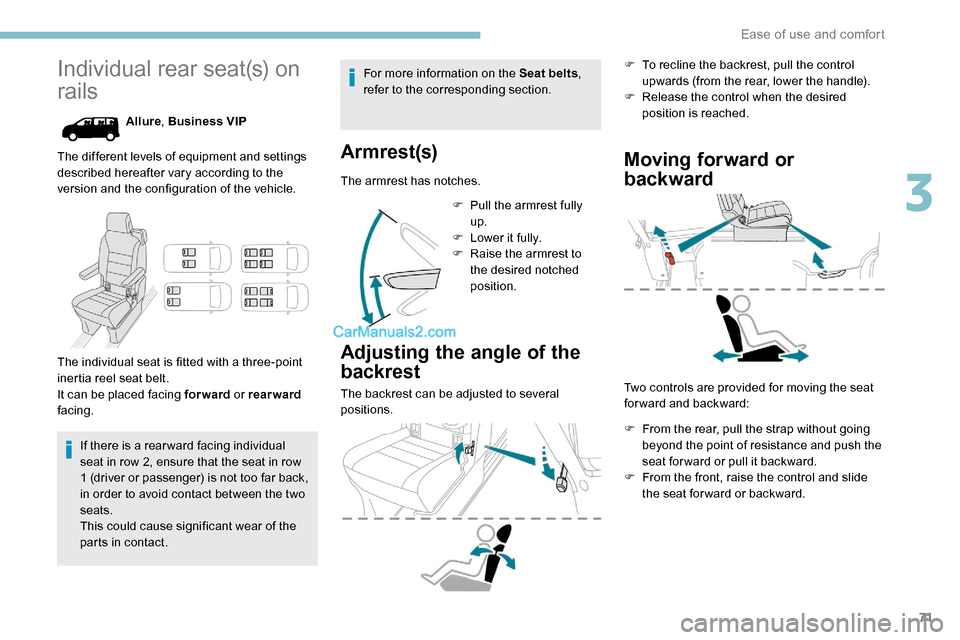
parts in contact. The backrest can be adjusted to several
positions.
Moving forward or
backward
Ar mrest(s)
The armrest has notches.
Adjusting the angle of the
backrest
F Pull the armrest fully
up.
F
L
ower it fully.
F
R
aise the armrest to
the desired notched
position.
For more information on the Seat belts
,
refer to the corresponding section. F
T
o recline the backrest, pull the control
upwards (from the rear, lower the handle).
F
R
elease the control when the desired
position is reached.
Two controls are provided for moving the seat
forward and backward:
F
F
rom the rear, pull the strap without going
beyond the point of resistance and push the
seat for ward or pull it backward.
F
F
rom the front, raise the control and slide
the seat for ward or backward.
3
Ease of use and comfort
Page 76 of 324
74
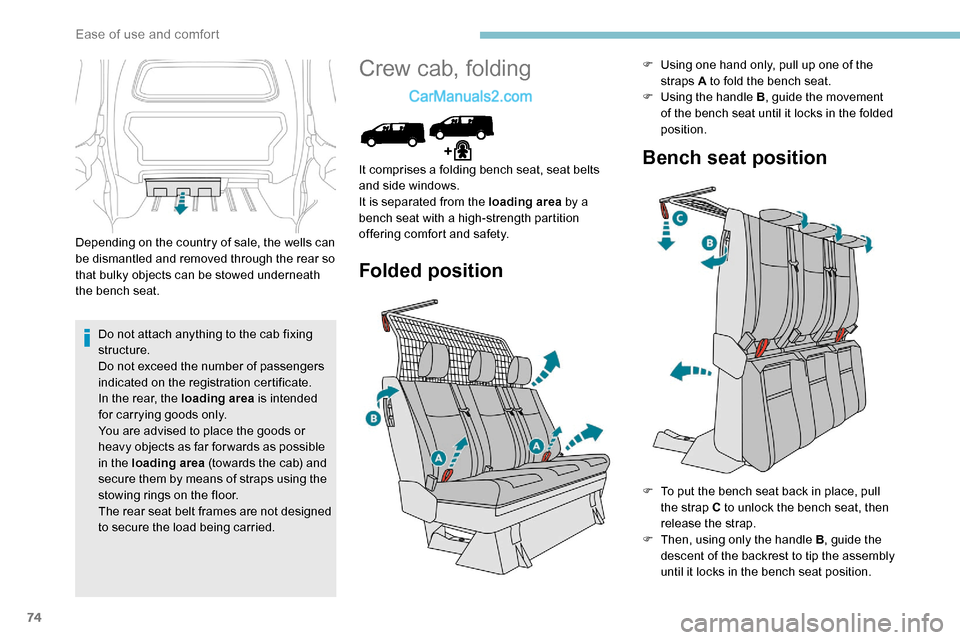
Depending on the country of sale, the wells can
be dismantled and removed through the rear so
that bulky objects can be stowed underneath
the bench seat.Do not attach anything to the cab fixing
structure.
Do not exceed the number of passengers
indicated on the registration certificate.
In the rear, the loading area is intended
for carrying goods only.
You are advised to place the goods or
heavy objects as far for wards as possible
in the loading area (towards the cab) and
secure them by means of straps using the
stowing rings on the floor.
The rear seat belt frames are not designed
to secure the load being carried.
Crew cab, folding
It comprises a folding bench seat, seat belts
and side windows.
It is separated from the loading area by a
bench seat with a high-strength partition
offering comfort and safety.
Folded position
F Using one hand only, pull up one of the straps A to fold the bench seat.
F
Us
ing the handle B , guide the movement
of the bench seat until it locks in the folded
position.
F
T
o put the bench seat back in place, pull
the strap C to unlock the bench seat, then
release the strap.
F
T
hen, using only the handle B , guide the
descent of the backrest to tip the assembly
until it locks in the bench seat position.
Bench seat position
Ease of use and comfort
Page 83 of 324
81
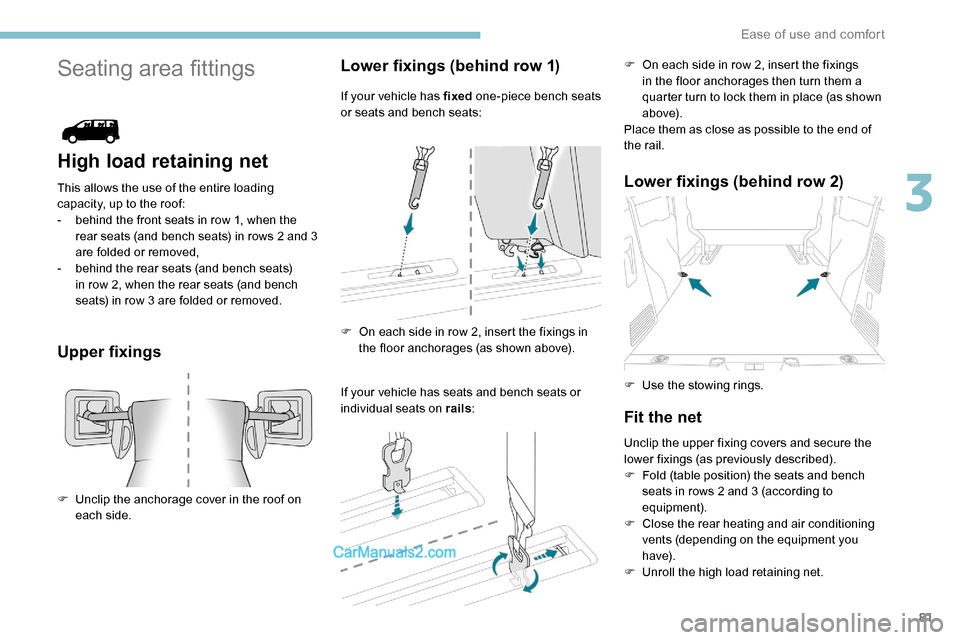
Seating area fittings
High load retaining net
This allows the use of the entire loading
capacity, up to the roof:
-
b
ehind the front seats in row 1, when the
rear seats (and bench seats) in rows 2 and 3
are folded or removed,
-
b
ehind the rear seats (and bench seats)
in row 2, when the rear seats (and bench
seats) in row 3 are folded or removed.
Upper fixings Lower fixings (behind row 1)
If your vehicle has fixed
one-piece bench seats
or seats and bench seats:
If your vehicle has seats and bench seats or
individual seats on rails :
Lower fixings (behind row 2)
Fit the net
F Unclip the anchorage cover in the roof on each side. F
O
n each side in row 2, insert the fixings in
the floor anchorages (as shown above). F
O
n each side in row 2, insert the fixings
in the floor anchorages then turn them a
quarter turn to lock them in place (as shown
a b ove).
Place them as close as possible to the end of
the rail.
F
U
se the stowing rings.
Unclip the upper fixing covers and secure the
lower fixings (as previously described).
F
F
old (table position) the seats and bench
seats in rows 2 and 3 (according to
equipment).
F
C
lose the rear heating and air conditioning
vents (depending on the equipment you
h ave).
F
U
nroll the high load retaining net.
3
Ease of use and comfort