ECU PEUGEOT EXPERT 2023 User Guide
[x] Cancel search | Manufacturer: PEUGEOT, Model Year: 2023, Model line: EXPERT, Model: PEUGEOT EXPERT 2023Pages: 348, PDF Size: 12 MB
Page 77 of 348
75
Ease of use and comfort
3Storage
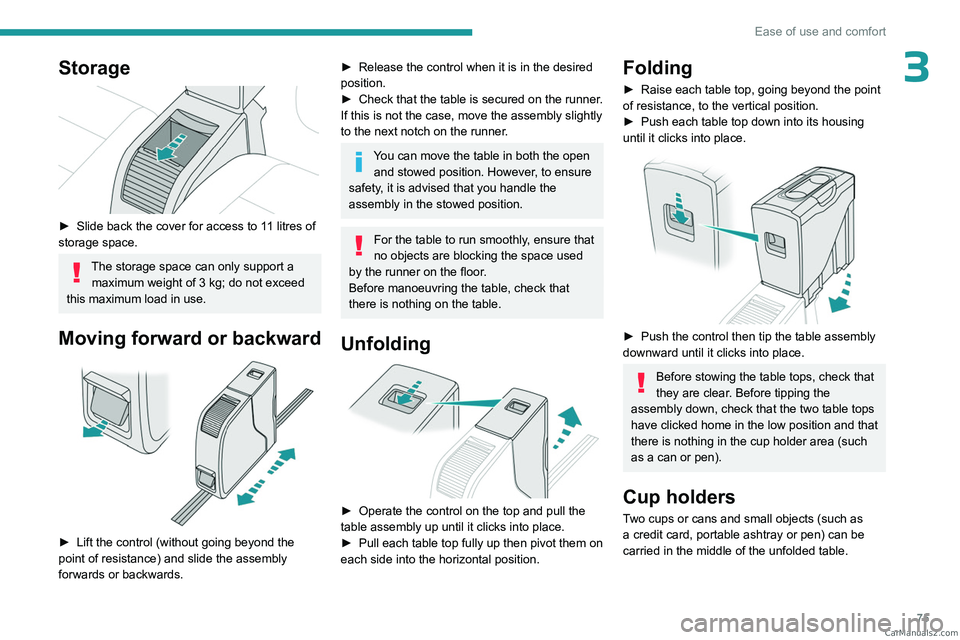
► Slide back the cover for access to 11 litres of
storage space.
The storage space can only support a maximum weight of 3 kg; do not exceed
this maximum load in use.
Moving forward or backward
► Lift the control (without going beyond the
point of resistance) and slide the assembly
forwards or backwards.
► Release the control when it is in the desired
position.
►
Check that the table is secured on the runner
.
If this is not the case, move the assembly slightly
to the next notch on the runner.
You can move the table in both the open and stowed position. However, to ensure
safety, it is advised that you handle the
assembly in the stowed position.
For the table to run smoothly, ensure that
no objects are blocking the space used
by the runner on the floor.
Before manoeuvring the table, check that
there is nothing on the table.
Unfolding
► Operate the control on the top and pull the
table assembly up until it clicks into place.
►
Pull each table top fully up then pivot them on
each side into the horizontal position.
Folding
► Raise each table top, going beyond the point
of resistance, to the vertical position.
►
Push each table top down into its housing
until it clicks into place.
► Push the control then tip the table assembly
downward until it clicks into place.
Before stowing the table tops, check that
they are clear. Before tipping the
assembly down, check that the two table tops
have clicked home in the low position and that
there is nothing in the cup holder area (such
as a can or pen).
Cup holders
Two cups or cans and small objects (such as
a credit card, portable ashtray or pen) can be
carried in the middle of the unfolded table. CarM an uals 2 .c o m
Page 88 of 348
86
Ease of use and comfort
► Select the time of entry into the vehicle and
the desired days. Press OK.
►
Press
ON to activate this programme.
The temperature pre-conditioning sequence
begins approximately 45 minutes before the
programmed time when the vehicle is connected
(20 minutes when it is not connected) and is
maintained for 10 minutes after.
You can set multiple programmes. Each one is saved in the system.
To optimise the driving range, we recommend
starting a programme while the vehicle is
connected.
The fan noise that occurs during temperature pre-conditioning is perfectly
normal.
Operating conditions
– The function is only activated when the
ignition is switched off and the
vehicle
locked.
–
When the vehicle is not connected, the
function is only activated if the battery charge
level is greater than 30%.
–
When the vehicle is not connected and a
recurring programme is active (e.g. from Monday
to Friday), if two temperature pre-conditioning
sequences are run without the vehicle being
used, the programme will be deactivated.
Courtesy lamp(s)
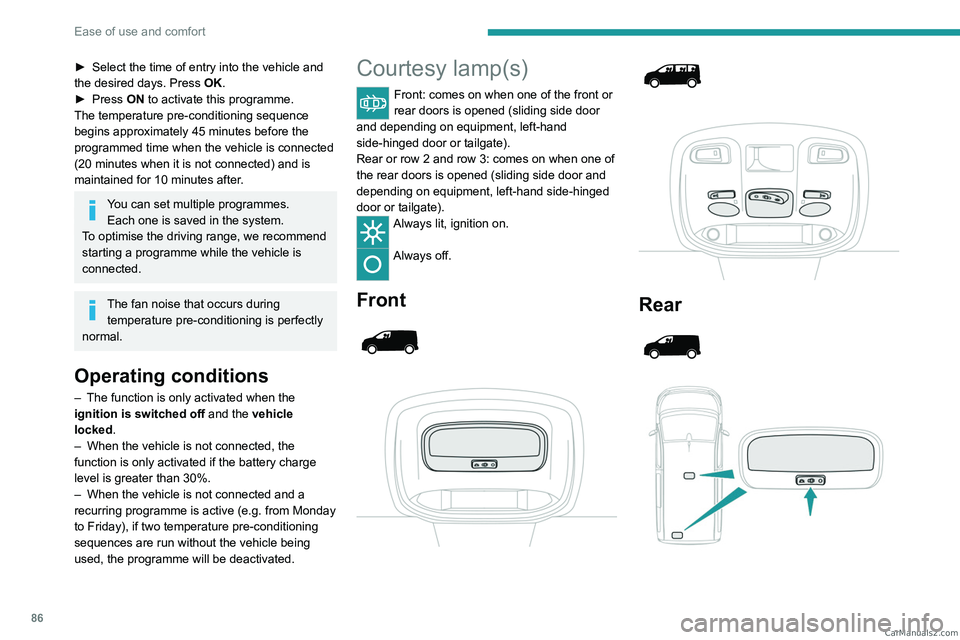
Front: comes on when one of the front or
rear doors is opened (sliding side door
and depending on equipment, left-hand
side-hinged door or tailgate).
Rear or row 2 and row 3: comes on when one of
the rear doors is opened (sliding side door and
depending on equipment, left-hand side-hinged
door or tailgate).
Always lit, ignition on.
Always off.
Front
Rear
CarM an uals 2 .c o m
Page 108 of 348
106
Safety
Seat belt(s) warning lamps
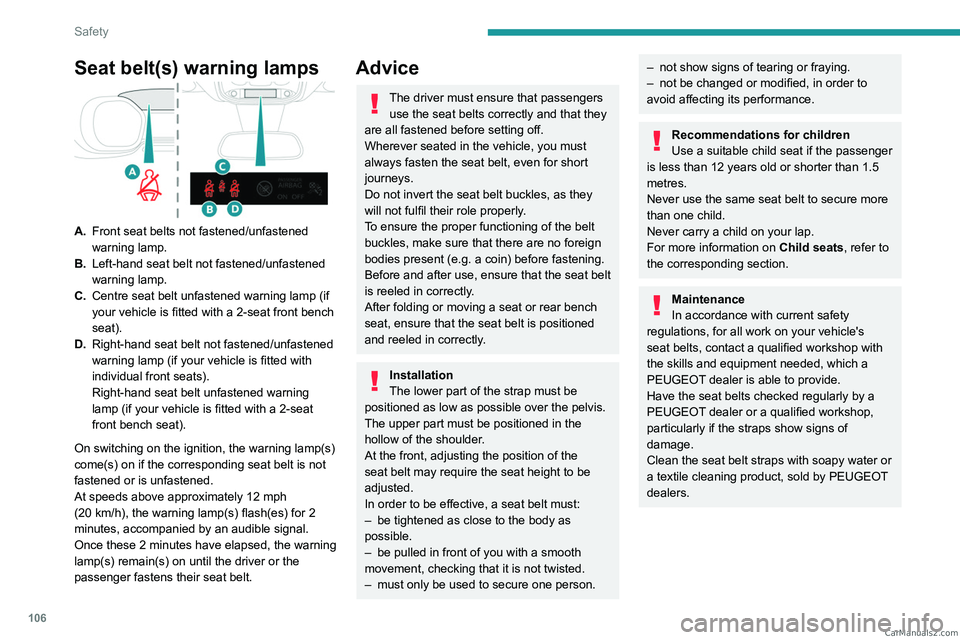
A.Front seat belts not fastened/unfastened
warning lamp.
B. Left-hand seat belt not fastened/unfastened
warning lamp.
C. Centre seat belt unfastened warning lamp (if
your vehicle is fitted with a 2-seat front bench
seat).
D. Right-hand seat belt not fastened/unfastened
warning lamp (if your vehicle is fitted with
individual front seats).
Right-hand seat belt unfastened warning
lamp (if your vehicle is fitted with a 2-seat
front bench seat).
On switching on the ignition, the warning lamp(s)
come(s) on if the corresponding seat belt is not
fastened or is unfastened.
At speeds above approximately 12 mph
(20
km/h), the warning lamp(s) flash(es) for 2
minutes, accompanied by an audible signal.
Once these 2 minutes have elapsed, the warning
lamp(s) remain(s) on until the driver or the
passenger fastens their seat belt.
Advice
The driver must ensure that passengers use the seat belts correctly and that they
are all fastened before setting off.
Wherever seated in the vehicle, you must
always fasten the seat belt, even for short
journeys.
Do not invert the seat belt buckles, as they
will not fulfil their role properly.
To ensure the proper functioning of the belt
buckles, make sure that there are no foreign
bodies present (e.g.
a coin) before fastening.
Before and after use, ensure that the seat belt
is reeled in correctly.
After folding or moving a seat or rear bench
seat, ensure that the seat belt is positioned
and reeled in correctly.
Installation
The lower part of the strap must be
positioned as low as possible over the pelvis.
The upper part must be positioned in the
hollow of the shoulder.
At the front, adjusting the position of the
seat belt may require the seat height to be
adjusted.
In order to be effective, a seat belt must:
–
be tightened as close to the body as
possible.
–
be pulled in front of you with a smooth
movement, checking that it is not twisted.
–
must only be used to secure one person.
– not show signs of tearing or fraying.
– not be changed or modified, in order to
avoid affecting its performance.
Recommendations for children
Use a suitable child seat if the passenger
is less than 12 years old or shorter than 1.5
metres.
Never use the same seat belt to secure more
than one child.
Never carry a child on your lap.
For more information on Child seats, refer to
the corresponding section.
Maintenance
In accordance with current safety
regulations, for all work on your vehicle's
seat belts, contact a qualified workshop with
the skills and equipment needed, which a
PEUGEOT
dealer is able to provide.
Have the seat belts checked regularly by a
PEUGEOT dealer or a qualified workshop,
particularly if the straps show signs of
damage.
Clean the seat belt straps with soapy water or
a textile cleaning product, sold by PEUGEOT
dealers. CarM an uals 2 .c o m
Page 111 of 348
109
Safety
5not fix or attach anything near or in the path of
the airbags, as this could cause injuries when
they are deployed.
Never modify the original definition of the
vehicle, particularly in the area directly around
the airbags.
Even if all of the precautions mentioned are
observed, a risk of injury or of minor burns to
the head, chest or arms cannot be ruled out
when an airbag is deployed. The bag inflates
almost instantly (within a few milliseconds)
then deflates within the same time,
discharging the hot gas via openings provided
for this purpose.
After an accident or if the vehicle has been
stolen, have the airbag systems checked.
All work must be carried out only by a
PEUGEOT dealer or a qualified workshop
Front airbags
Do not drive holding the steering wheel
by its spokes or resting your hands on the
centre part of the wheel.
Passengers must not place their feet on the
dashboard.
Do not smoke as deployment of the airbags
can cause burns or the risk of injury from a
cigarette or pipe.
Never remove or pierce the steering wheel or
hit it violently.
Do not fix or attach anything to the steering
wheel or dashboard, as this could cause
injuries when the airbags are deployed.
Lateral airbags
Use only approved seat covers
compatible with the deployment of these
airbags. For information on the range of seat
covers suitable for your vehicle, contact a
PEUGEOT dealer.
Do not fix or attach anything to the seat
backrests (e.g.
clothing) as this could cause
injuries to the chest or arm when the airbag is
deployed.
Do not sit with the upper part of the body any
nearer to the door than necessary.
The vehicle's front door panels include side
impact sensors.
A damaged door or any unauthorised or
incorrectly executed work (modification or
repair) on the front doors or their interior trim
could compromise the operation of these
sensors - risk of malfunction of the lateral
airbags!
All work must be carried out only by a
PEUGEOT dealer or a qualified workshop
Active, Allure, Business VIP
Curtain airbags
Do not fix or attach anything to the roof,
as this could cause head injuries when the
curtain airbag is deployed.
Do not remove the grab handles installed on
the roof, as these help to secure the curtain
airbags.
Child seats
The regulations on carrying children are specific to each country. Refer to the
legislation in force in your country.
For maximum safety, please observe the
following recommendations:
–
In accordance with European regulations,
all children under the age of 12 or less than
1.5 metres tall must travel in approved child
seats suited to their weight , on seats fitted with
a seat belt or ISOFIX mountings.
–
Statistically
, the safest seats in your
vehicle for carrying children are the rear
seats.
–
Children weighing less than 9 kg must
travel in the "rearward facing" position,
whether in the front or rear of the vehicle.
It is recommended that children travel
on the rear seats of the vehicle:
–
"rearward facing" up to the age of 3.
–
"forward facing" over the age of 3. CarM an uals 2 .c o m
Page 112 of 348
11 0
Safety
Make sure that the seat belt is correctly
positioned and tightened.
For child seats with a support leg, ensure that
the support leg is in firm and steady contact
with the floor.
An incorrectly installed child seat in a vehicle compromises the child's safety in
the event of an accident.
Ensure that there is no seat belt or seat belt
buckle under the child seat, as this could
destabilise it.
Remember to fasten the seat belts or the
child seat harness keeping the slack relative
to the child's body to a minimum, even for
short journeys.
When installing a child seat using the seat
belt, ensure that the seat belt is tightened
correctly on the child seat and that it secures
the child seat firmly on the vehicle seat. If
the passenger seat is adjustable, move it
forwards if necessary.
Remove the head restraint before
installing a child seat with a backrest on a
passenger seat.
Ensure that the head restraint is stored or
attached securely to prevent it from being
thrown around the vehicle in the event of
sharp braking. Refit the head restraint once
the child seat has been removed.
Installing a booster seat
The chest part of the seat belt must be
positioned on the child's shoulder without
touching the neck.
Ensure that the lap part of the seat belt
passes correctly over the child's thighs.
Use a booster seat with a backrest, equipped
with a belt guide at shoulder level.
Additional protections
To prevent accidental opening of the
doors and rear windows, use the "Child lock".
Take care not to open the rear windows by
more than one third.
To protect young children from the sun's rays,
fit side blinds on the rear windows.
As a safety measure, do not leave:
–
A
child alone and unsupervised inside a
vehicle.
–
A
child or an animal in a vehicle which is
exposed to the sun, with the windows closed.
–
The keys within reach of children inside the
vehicle.
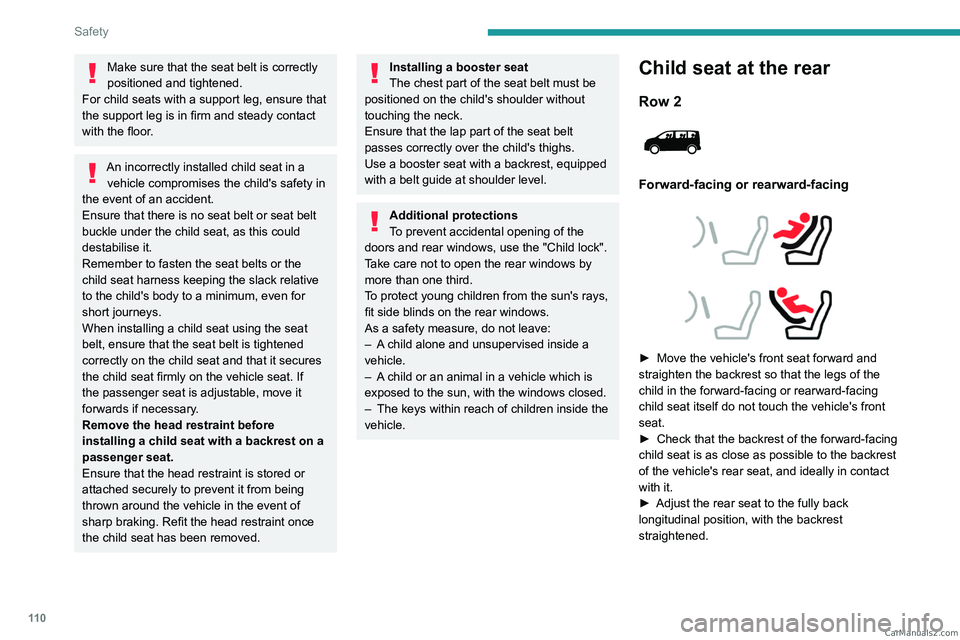
Child seat at the rear
Row 2
Forward-facing or rearward-facing
► Move the vehicle's front seat forward and
straighten the backrest so that the legs of the
child in the forward-facing or rearward-facing
child seat itself do not touch the vehicle's front
seat.
►
Check that the backrest of the forward-facing
child seat is as close as possible to the backrest
of the vehicle's rear seat, and ideally in contact
with it.
►
Adjust the rear seat to the fully back
longitudinal position, with the backrest
straightened. CarM an uals 2 .c o m
Page 114 of 348
11 2
Safety
injured or killed in the event of deployment of
the airbag.
Vehicles not equipped with a
deactivation/reactivation control
Installing a "rearward
facing" child seat on the
front passenger seat or bench seat is strictly
prohibited - risk of death or serious injury in
the event of airbag deployment!
Deactivating/Reactivating the front
passenger airbag
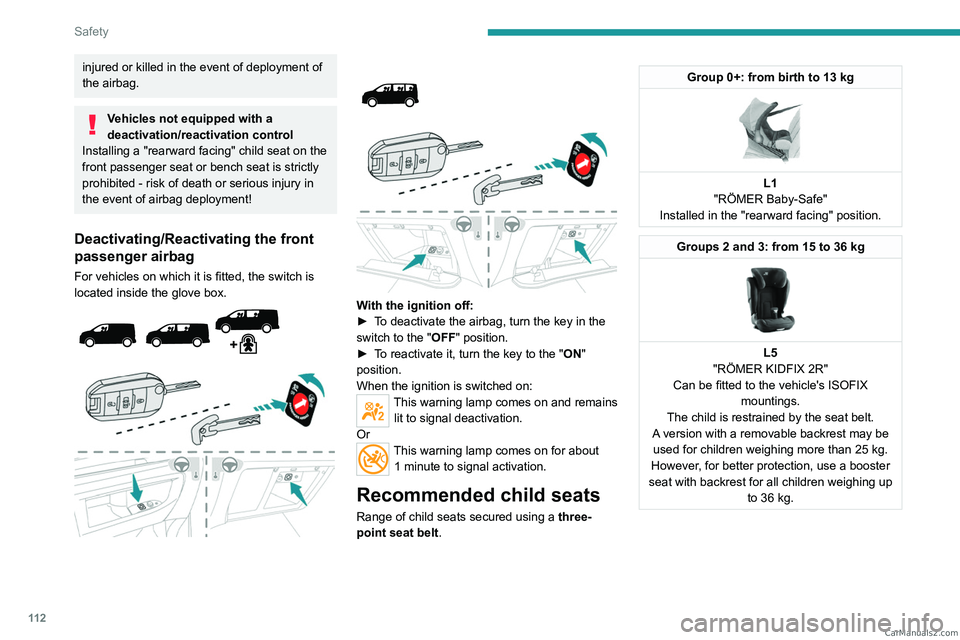
For vehicles on which it is fitted, the switch is
located inside the glove box.
With the ignition off:
► T o deactivate the airbag, turn the key in the
switch to the "OFF " position.
►
T
o reactivate it, turn the key to the "ON"
position.
When the ignition is switched on:
This warning lamp comes on and remains lit to signal deactivation.
Or
This warning lamp comes on for about 1 minute to signal activation.
Recommended child seats
Range of child seats secured using a three-
point seat belt .
Group 0+: from birth to 13 kg
L1
"RÖMER Baby-Safe"
Installed in the "rearward facing" position.
Groups 2 and 3: from 15 to 36 kg
L5
"RÖMER KIDFIX 2R"
Can be fitted to the vehicle's ISOFIX mountings.
The child is restrained by the seat belt.
A version with a removable backrest may be used for children weighing more than 25 kg.
However, for better protection, use a booster
seat with backrest for all children weighing up to 36 kg. CarM an uals 2 .c o m
Page 115 of 348

11 3
Safety
5Locations for child seats secured using the seat belt
In accordance with European regulations, the table indicates the options\
for installing child seats secured using a seat belt and universally ap\
proved (a)
according to the weight of the child and the seating position in the veh\
icle.
Weight of the child /indicative age
Seats Under 13 kg
(groups 0 (b) and 0+)
Up to about 1 year old From 9 to 18 kg
(group 1)
From about
1 to 3
years old From 15 to 25 kg
(group 2)
From about
3 to 6
years old From 22 to 36 kg
(group 3)
From about
6 to 10
years old
Cab/Row 1 (c) (f)
Individual seat,
passenger seat U
Bench seat, outer seat
U
Bench seat, centre
seat X
Row 2 (d) (Fixed and folding bench seat)
Rear seats U CarM an uals 2 .c o m
Page 119 of 348
11 7
Safety
5U:Seat position suitable for the installation of
a child seat secured using the seat belt and
universally approved for "rearward facing"
and/or "forward facing" use.
UF: Seat position suitable for the installation a
child seat secured using the seat belt and
universally approved for "forward facing"
use.
X: Seat position not suitable for the installation
of a child seat for the specified weight group.
(a) Universal child seat: child seat that can be
installed in all vehicles using the seat belt.
(b) Group 0: from birth to 10 kg. Carrycots and
"car" infant carriers cannot be installed on
the front passenger seat(s) or the seats in
row 3.
(c) Refer to the current legislation in the country
in which you are driving before placing a
child in this seat position.
(d) To install a "rearward facing" or "forward
facing" child seat on a rear seat, move the
seats in front of it forward, then straighten
their backrests to allow sufficient room for
the child seat and the child's legs.
(e) The seat can be installed centrally in the
vehicle; it then prevents the use of the outer
seats. (f)
When a "rearward facing" child seat is
installed on the front passenger seat, the
front passenger airbag must be deactivated.
Otherwise, the child risks being severely
injured or killed if the airbag is deployed.
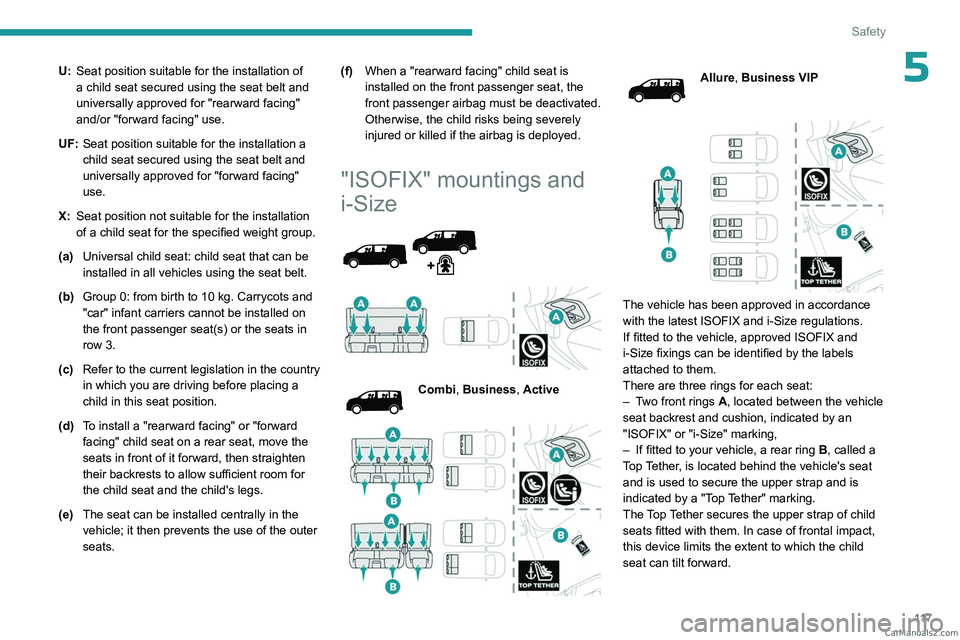
"ISOFIX" mountings and
i-Size
Combi, Business, Active
Allure, Business VIP
The vehicle has been approved in accordance
with the latest ISOFIX and i-Size regulations.
If fitted to the vehicle, approved ISOFIX and
i-Size fixings can be identified by the labels
attached to them.
There are three rings for each seat:
–
T
wo front rings A, located between the vehicle
seat backrest and cushion, indicated by an
"ISOFIX" or "i-Size" marking,
–
If fitted to your vehicle, a rear ring
B, called a
Top Tether, is located behind the vehicle's seat
and is used to secure the upper strap and is
indicated by a "Top Tether" marking.
The Top Tether secures the upper strap of child
seats fitted with them. In case of frontal impact,
this device limits the extent to which the child
seat can tilt forward. CarM an uals 2 .c o m
Page 120 of 348
11 8
Safety
This ISOFIX and i-Size mounting system
provides fast, reliable and safe fitting of a child
seat inside the vehicle.
ISOFIX and
i-Size child seats are fitted with two
latches which are secured to the two front rings
A.
Some child seats also have an upper strap which
is attached to rear ring B.
To secure the child seat to the Top Tether:
–
remove and stow the head restraint before
installing a child seat on this seat (refit it once
the child seat has been removed),
–
pass the strap
of the child seat over the top
of the seat backrest, centring it between the
openings for the head restraint rods,
–
attach the hook of the upper strap to rear ring
B
,
–
tighten the upper strap.
Incorrect installation of a child seat in a
vehicle can compromise a child's safety
in the event of an accident.
Strictly follow the fitting instructions provided
in the installation guide supplied with the child
seat.
For information on the various options for
installing ISOFIX child seats in your
vehicle, refer to the summary table.
Recommended ISOFIX child
seats
Also consult the user guide from the child seat’s manufacturer to find out how to
install and remove the seat.
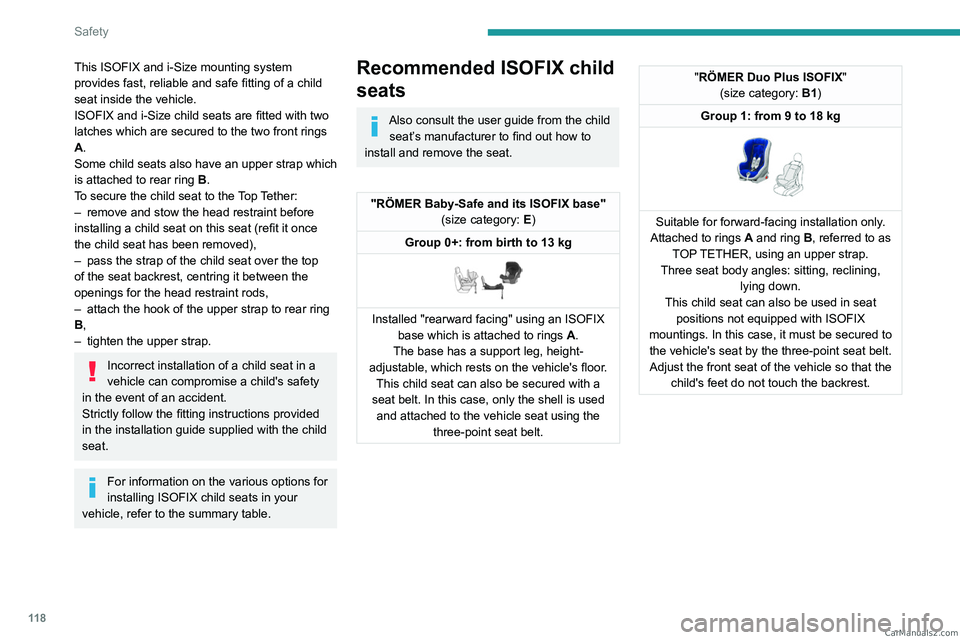
"RÖMER Baby-Safe and its ISOFIX base" (size category: E)
Group 0+: from birth to 13 kg
Installed "rearward facing" using an ISOFIX base which is attached to rings A .
The base has a support leg, height-
adjustable, which rests on the vehicle's floor. This child seat can also be secured with a
seat belt. In this case, only the shell is used and attached to the vehicle seat using the three-point seat belt.
"RÖMER Duo Plus ISOFIX "
(size category: B1)
Group 1: from 9 to 18 kg
Suitable for forward-facing installation only.
Attached to rings A and ring B, referred to as
TOP TETHER, using an upper strap.
Three seat body angles: sitting, reclining, lying down.
This child seat can also be used in seat positions not equipped with ISOFIX
mountings. In this case, it must be secured to the vehicle's seat by the three-point seat belt. Adjust the front seat of the vehicle so that the child's feet do not touch the backrest. CarM an uals 2 .c o m
Page 130 of 348
128
Safety
IUF:Seat position suitable for the installation of
an Isofix Universal seat, "Forward facing",
secured using the upper strap.
IL: Seat position suitable for the installation
of an
Isofix Semi-Universa L seat which is
either:
–
"rearward facing" fitted with an upper
strap or a support leg,
–
"forward facing" fitted with a support leg,
–
a carrycot fitted with an upper strap or a
support leg.
X: Seat position not suitable for the installation
of
an ISOFIX child seat or carrycot for the
specified weight group.(a) Refer to the current legislation in the country
in which you are driving before placing a
child in this seat position.
(b) The seat can be installed centrally in the
vehicle; it then prevents the use of the outer
seats.
For information on securing the upper
strap using the ISOFIX mountings , refer
to the corresponding section.
(1) Installing a carrycot on this seat may
prevent the use of one or more of the other
seats in this row.
(2) Installation possible only behind the driver's
seat. (3)
Installation possible only behind the driver's
seat with individual passenger seat.
(4) The seat in row 2 must be adjusted so that
there is no contact between the child in row
3 and the seat immediately in front.
(5) The front seat must be adjusted so that
there is no contact between the child in row
2 and the seat immediately in front.
(6) The front seat must be adjusted so that
there is no contact between the child in row
2 and the seat immediately in front (with the
front seat adjusted to 2 notches ahead of
the centre of the slide).
i-Size child seats
i-Size child seats have two latches that are anchored to the two rings A.
These i-Size child seats also have:
–
either an upper strap that is attached to ring B
.
–
or a support leg that rests on the vehicle floor
, compatible with the approved i-Size seat position.
Their role is to prevent the child seat from tipping forward in the even\
t of a collision.
For more information on the ISOFIX mountings, refer to the corresponding section.
Locations for i-Size child seats
In accordance with the new European regulations, this table indicates the options for installing i-Size child seats on seats in the vehicle fitted with i-Size
approved ISOFIX mountings. CarM an uals 2 .c o m