ECU PEUGEOT EXPERT 2023 Owners Manual
[x] Cancel search | Manufacturer: PEUGEOT, Model Year: 2023, Model line: EXPERT, Model: PEUGEOT EXPERT 2023Pages: 348, PDF Size: 12 MB
Page 17 of 348
15
Dashboard instruments
1Fixed.
A minor engine fault has been
detected.
Carry out (3).
Fixed.
A major engine fault has been
detected.
Carry out (1) and then (2).
Automatic functions deactivated (electric
parking brake)
Fixed.
The "automatic application" (on switching
off the engine) and "automatic release" (on
acceleration) functions are deactivated.
If automatic application/release is no longer
possible:
►
Start the engine.
►
Use the control to apply the electric parking
brake.
►
T
ake your foot fully off the brake pedal.
►
Hold the control pressed in the release
direction for between 10 and 15
seconds.
►
Release the control.
►
Depress and hold the brake pedal.
►
Pull the control in the application direction for
2
seconds.
►
Release the control and the brake pedal.
Malfunction (with electric parking brake)Fixed, accompanied by the
message "Parking brake fault".
The vehicle cannot be immobilised with the
engine running. If manual application and release commands are
not working, the electric parking brake control is
faulty.
The automatic functions must be used at all
times and are automatically reactivated in the
event of a fault with the control.
Carry out (2).
Fixed, accompanied by the
message "Parking brake
fault".
The electric parking brake is faulty: manual and
automatic functions may not be working.
When stationary, to immobilise the vehicle:
►
Pull the electric parking brake control and
hold it for approximately 7 to 15
seconds, until
the indicator lamp lights up on the instrument
panel.
If this procedure does not work, secure the
vehicle:
►
Park on a level surface.
►
With a manual gearbox, engage a gear
.
►
With an automatic gearbox or drive selector
,
select mode
P, then place the supplied chock
against one of the wheels.
Then carry out (2).
BrakingFixed.
A minor fault with the braking system has
been detected.
Drive carefully.
Carry out (3).
Collision Risk Alert/Active Safety BrakeFlashing.
The system activates and brakes the
vehicle momentarily to reduce the speed of
collision with the vehicle in front.
For more information, refer to the Driving
section.
Fixed, accompanied by a message and
an audible signal.
The system has a fault.
Carry out (3).
Fixed, accompanied by the display of a
message.
The system has been deactivated via the vehicle
configuration menu.
Dynamic stability control (DSC)/Anti-slip
regulation (ASR)
Flashing.
DSC/ASR system regulation is activated
in the event of a loss of grip or trajectory.
Fixed.
The DSC/ASR system has a fault.
Carry out (3).
Emergency brake malfunction (with
electric parking brake)
Fixed, accompanied by the
message "Parking brake fault".
Emergency braking does not deliver optimal
performance.
If automatic release is not available, use manual
release or carry out (3). CarM an uals 2 .c o m
Page 40 of 348
38
Access
When transporting an oversized load
(tailgate or side-hinged doors open),
press the button to lock only the front and rear
doors (sliding side door).
When locking from inside, the door
mirrors do not fold.
Central locking from the inside does not
operate if one of the doors is open (indicated
by a mechanical noise coming from the
locks).
When the tailgate or side-hinged doors are
open, only the other doors are locked (the
button does not light up).
Automatic (anti-intrusion security)
The doors and the tailgate or the side-hinged
doors can lock automatically while driving (speed
above 6 mph (10
km/h)).
To deactivate/reactivate this function (activated
by default):
►
Press the button until an audible signal is
heard and/or a message appears on the screen.
Electric sliding side
door(s)
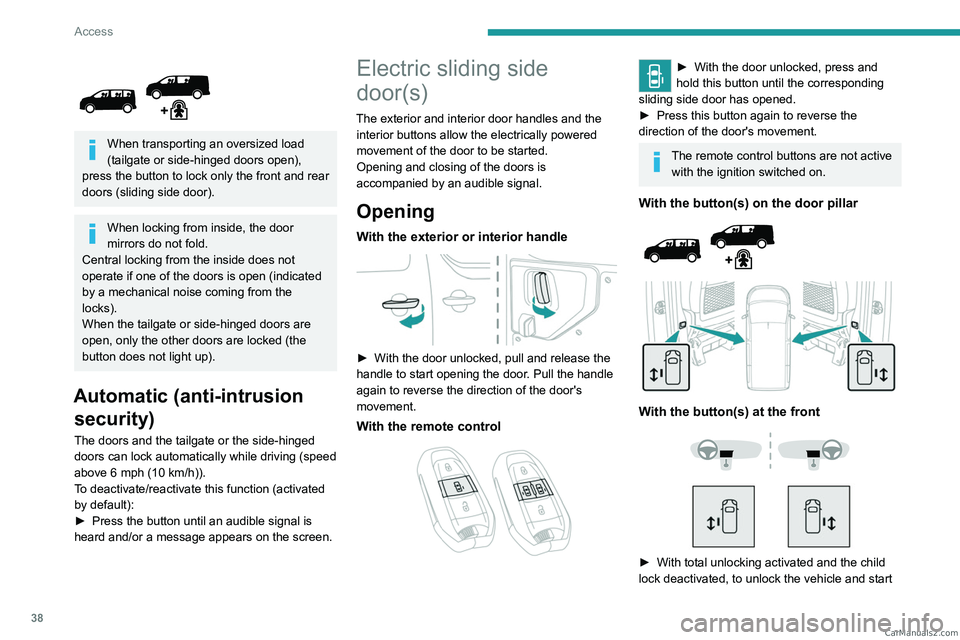
The exterior and interior door handles and the interior buttons allow the electrically powered
movement of the door to be started.
Opening and closing of the doors is
accompanied by an audible signal.
Opening
With the exterior or interior handle
► With the door unlocked, pull and release the
handle to start opening the door . Pull the handle
again to reverse the direction of the door's
movement.
With the remote control
► With the door un locked, press and
hold this button until the corresponding
sliding side door has opened.
►
Press this button again to reverse the
direction of the door's movement.
The remote control buttons are not active with the ignition switched on.
With the button(s) on the door pillar
With the button(s) at the front
► With total unlocking activated and the child
lock deactivated, to unlock the vehicle and start CarM an uals 2 .c o m
Page 56 of 348
54
Ease of use and comfort
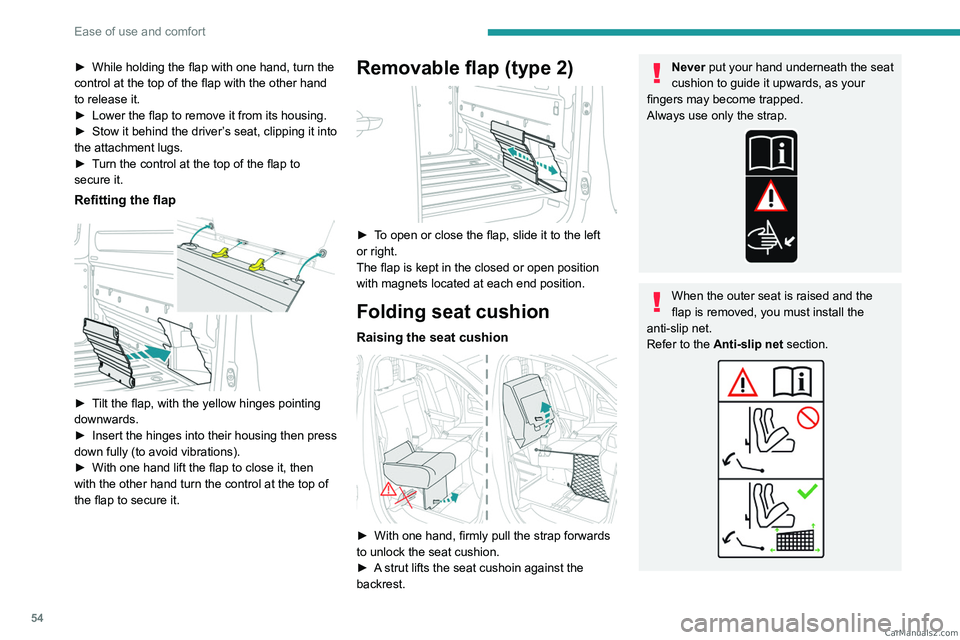
► While holding the flap with one hand, turn the
control at the top of the flap with the other hand
to release it.
►
Lower the flap to remove it from its housing.
►
Stow
it behind the driver’s seat, clipping it into
the attachment lugs.
►
T
urn the control at the top of the flap to
secure it.
Refitting the flap
► Tilt the flap, with the yellow hinges pointing
downwards.
►
Insert the hinges into their housing then press
down fully (to avoid vibrations).
►
With one hand lift the flap to close it, then
with the other hand turn the control at the top of
the flap to secure it.
Removable flap (type 2)
► To open or close the flap, slide it to the left
or right.
The flap is kept in the closed or open position
with magnets located at each end position.
Folding seat cushion
Raising the seat cushion
► With one hand, firmly pull the strap forwards
to unlock the seat cushion.
►
A
strut lifts the seat cushoin against the
backrest.
Never put your hand underneath the seat
cushion to guide it upwards, as your
fingers may become trapped.
Always use only the strap.
When the outer seat is raised and the
flap is removed, you must install the
anti-slip net.
Refer to the Anti-slip net section. CarM an uals 2 .c o m
Page 57 of 348
55
Ease of use and comfort
3Lowering the seat cushion
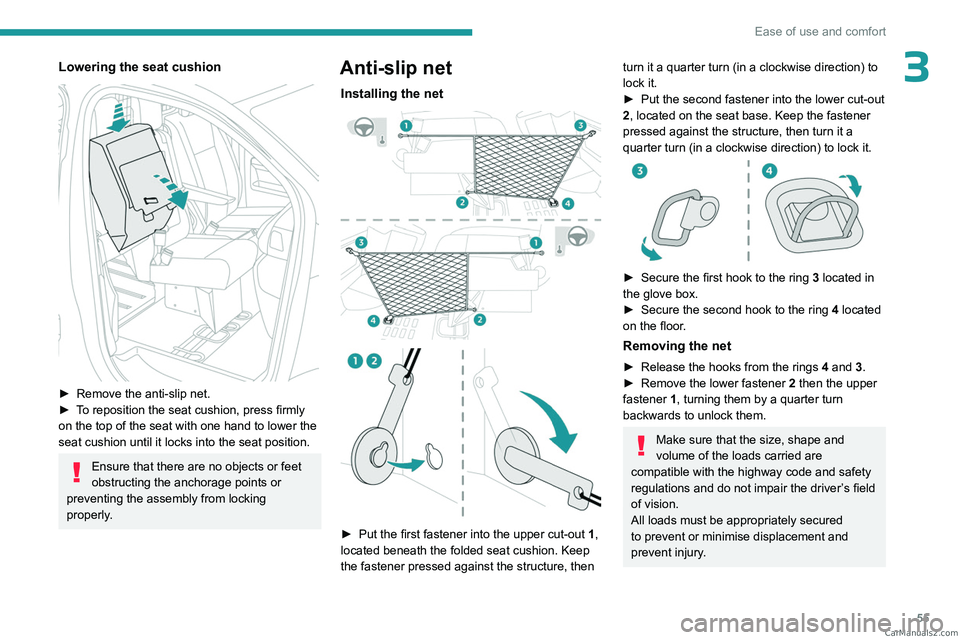
► Remove the anti-slip net.
► T o reposition the seat cushion, press firmly
on the top of the seat with one hand to lower the
seat cushion until it locks into the seat position.
Ensure that there are no objects or feet
obstructing the anchorage points or
preventing the assembly from locking
properly.
Anti-slip net
Installing the net
► Put the first fastener into the upper cut-out 1,
located beneath the folded seat cushion. Keep
the fastener pressed against the structure, then
turn it a quarter turn (in a clockwise direction) to
lock it.
►
Put the second fastener into the lower cut-out
2
, located on the seat base. Keep the fastener
pressed against the structure, then turn it a
quarter turn (in a clockwise direction) to lock it.
► Secure the first hook to the ring 3 located in
the glove box.
►
Secure the second hook to the ring 4
located
on the floor.
Removing the net
► Release the hooks from the rings 4 and 3.
► Remove the lower fastener 2
then the upper
fastener 1, turning them by a quarter turn
backwards to unlock them.
Make sure that the size, shape and
volume of the loads carried are
compatible with the highway code and safety
regulations and do not impair the driver’s field
of vision.
All loads must be appropriately secured
to prevent or minimise displacement and
prevent injury. CarM an uals 2 .c o m
Page 58 of 348
56
Ease of use and comfort
Install the anti-slip net (supplied with the
vehicle) every time that the seat is raised and
the partition flap removed.
Never use the net for any other purposes.
Regularly check the condition of the anti-
slip net. As soon as signs of wear or tear
appear, contact a PEUGEOT dealer to have
it replaced by an anti-slip net that meets the
specifications required by PEUGEOT for the
vehicle.
Always fit the removable flap back into place
when you are not carrying any long loads.
"Rotating writing table"
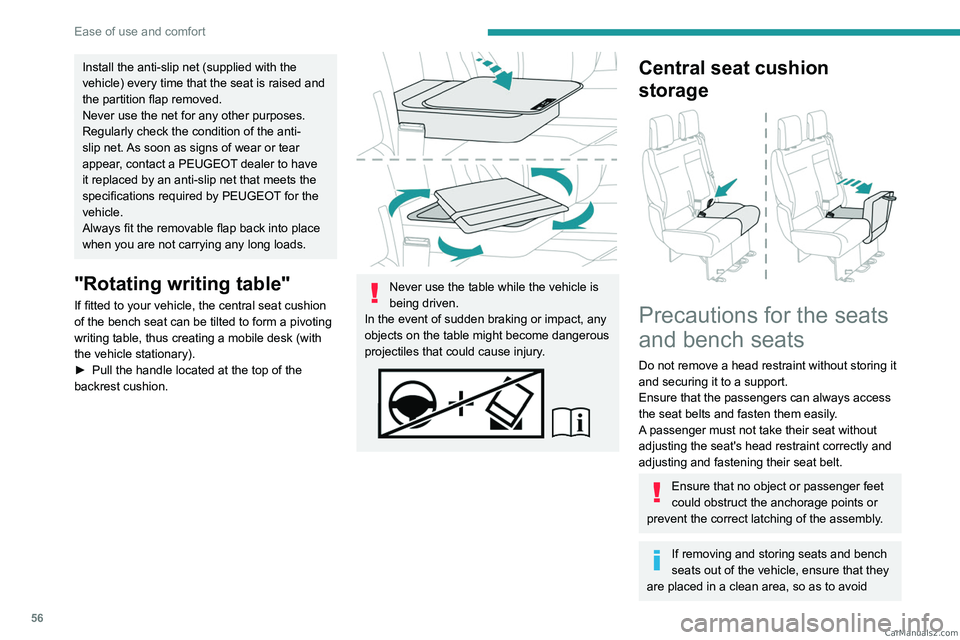
If fitted to your vehicle, the central seat cushion
of the bench seat can be tilted to form a pivoting
writing table, thus creating a mobile desk (with
the vehicle stationary).
►
Pull the handle located at the top of the
backrest cushion.
Never use the table while the vehicle is
being driven.
In the event of sudden braking or impact, any
objects on the table might become dangerous
projectiles that could cause injury.
Central seat cushion
storage
Precautions for the seats
and bench seats
Do not remove a head restraint without storing it
and securing it to a support.
Ensure that the passengers can always access
the seat belts and fasten them easily.
A passenger must not take their seat without
adjusting the seat's head restraint correctly and
adjusting and fastening their seat belt.
Ensure that no object or passenger feet
could obstruct the anchorage points or
prevent the correct latching of the assembly.
If removing and storing seats and bench
seats out of the vehicle, ensure that they
are placed in a clean area, so as to avoid CarM an uals 2 .c o m
Page 68 of 348
66
Ease of use and comfort
Under seat cushion storage
wells
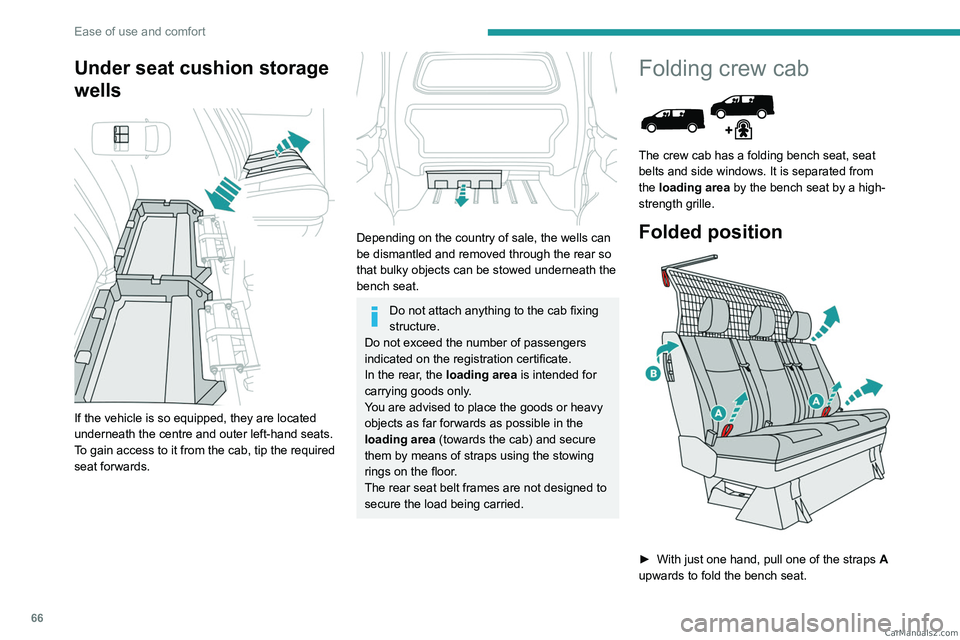
If the vehicle is so equipped, they are located
underneath the centre and outer left-hand seats.
To gain access to it from the cab, tip the required
seat forwards.
Depending on the country of sale, the wells can
be dismantled and removed through the rear so
that bulky objects can be stowed underneath the
bench seat.
Do not attach anything to the cab fixing
structure.
Do not exceed the number of passengers
indicated on the registration certificate.
In the rear, the loading area is intended for
carrying goods only.
You are advised to place the goods or heavy
objects as far forwards as possible in the
loading area (towards the cab) and secure
them by means of straps using the stowing
rings on the floor.
The rear seat belt frames are not designed to
secure the load being carried.
Folding crew cab
The crew cab has a folding bench seat, seat
belts and side windows. It is separated from
the loading area by the bench seat by a high-
strength grille.
Folded position
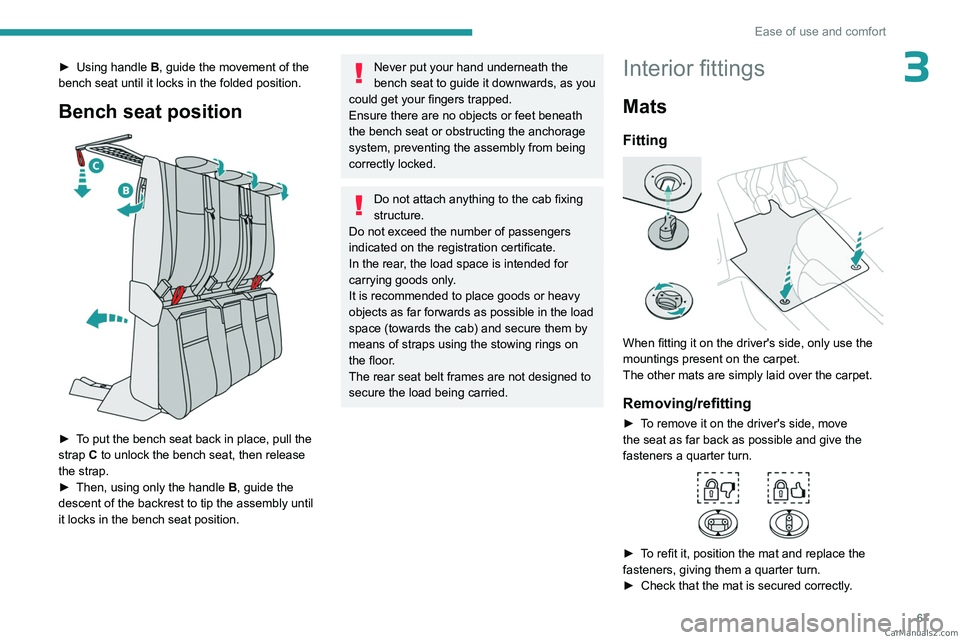
► With just one hand, pull one of the straps A
upwards to fold the bench seat. CarM an uals 2 .c o m
Page 69 of 348
67
Ease of use and comfort
3► Using handle B , guide the movement of the
bench seat until it locks in the folded position.
Bench seat position
► To put the bench seat back in place, pull the
strap C to unlock the bench seat, then release
the strap.
►
Then, using only the handle
B
, guide the
descent of the backrest to tip the assembly until
it locks in the bench seat position.
Never put your hand underneath the
bench seat to guide it downwards, as you
could get your fingers trapped.
Ensure there are no objects or feet beneath
the bench seat or obstructing the anchorage
system, preventing the assembly from being
correctly locked.
Do not attach anything to the cab fixing
structure.
Do not exceed the number of passengers
indicated on the registration certificate.
In the rear, the load space is intended for
carrying goods only.
It is recommended to place goods or heavy
objects as far forwards as possible in the load
space (towards the cab) and secure them by
means of straps using the stowing rings on
the floor.
The rear seat belt frames are not designed to
secure the load being carried.
Interior fittings
Mats
Fitting
When fitting it on the driver's side, only use the
mountings present on the carpet.
The other mats are simply laid over the carpet.
Removing/refitting
► To remove it on the driver's side, move
the seat as far back as possible and give the
fasteners a quarter turn.
► To refit it, position the mat and replace the
fasteners, giving them a quarter turn.
►
Check that the mat is secured correctly
. CarM an uals 2 .c o m
Page 73 of 348
71
Ease of use and comfort
3► To install it, insert the guides into their
housings.
In the event of sudden deceleration,
objects placed on the load space cover
can turn into projectiles.
Loading area fittings
Stowing rings
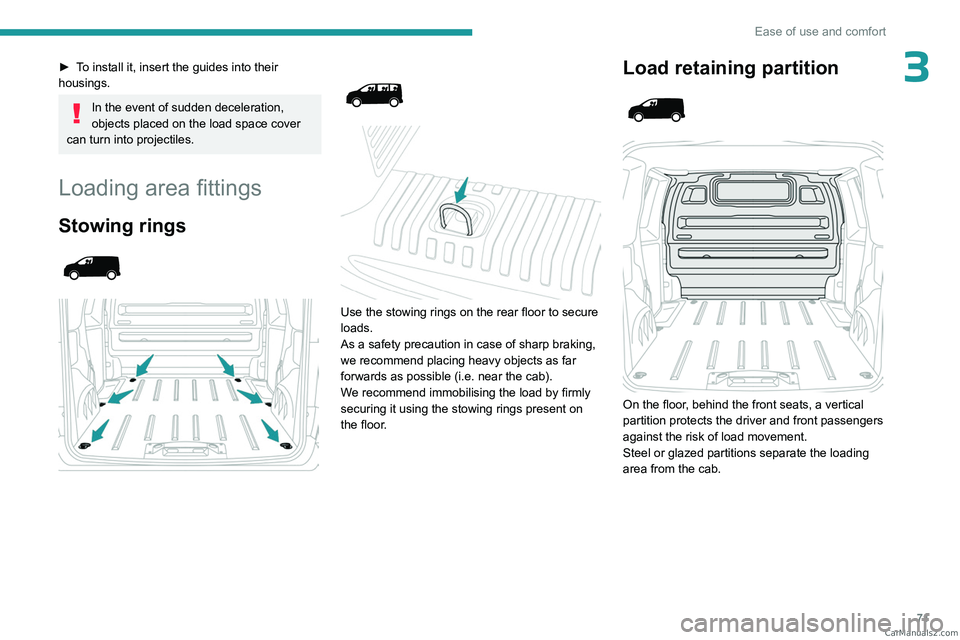
Use the stowing rings on the rear floor to secure
loads.
As a safety precaution in case of sharp braking,
we recommend placing heavy objects as far
forwards as possible (i.e. near the cab).
We recommend immobilising the load by firmly
securing it using the stowing rings present on
the floor.
Load retaining partition
On the floor, behind the front seats, a vertical
partition protects the driver and front passengers
against the risk of load movement.
Steel or glazed partitions separate the loading
area from the cab. CarM an uals 2 .c o m
Page 74 of 348
72
Ease of use and comfort
Recommendations on
loading
The weight of the load must comply with the Gross Train Weight (GTW).
For more information on Engine technical
data and towed loads , refer to the
corresponding section.
If you are using a carrying system (roof
bars/roof rack), comply with the
maximum loads associated with this system.
For more information on Roof bars/Roof
rack , refer to the corresponding section.
Make sure that the size, shape and
volume of the loads carried are
compatible with the highway code and safety
regulations and do not impair the driver’s field
of vision.
The load must be evenly distributed in the loading area so as not to interfere
with driving the vehicle.
Place the load close to the side wall panels,
or push it against the side wall panels
between the wheel arches.
However, it is recommended that heavy
objects are placed as close to the cab as
possible as a precaution in case of sharp
braking.
Firmly secure all parts of the load using
the stowing rings on the floor of the
loading area.
For more information on the Interior fittings
and in particular on the stowing rings, refer to
the corresponding section.
To avoid the risk of injury or accident, the load must be made stable so that it
cannot slide, tip over, fall or be projected. To
do this, use only retaining straps that conform
to current standards (DIN, for example).
For more information on putting straps in
place, refer to the manufacturer’s user guide.
To prevent the load from sliding, there must
not be any empty spaces between the load
items and the vehicle wall panels.
As well as the straps, optimise the stability
of the load with stable handling equipment
(wedges, rigid blocks of wood or padding).
When washing your vehicle, never clean
the inside directly using a water jet.
Seating area fittings
High load retaining net
This allows the use of the entire loading capacity,
up to the roof:
–
behind the front seats in row 1, when the rear
seats (and bench seats) in rows 2 and 3 are
folded or removed,
–
behind the rear seats (and bench seats) in row
2, when the rear seats (and bench seats) in row
3 are folded or removed.
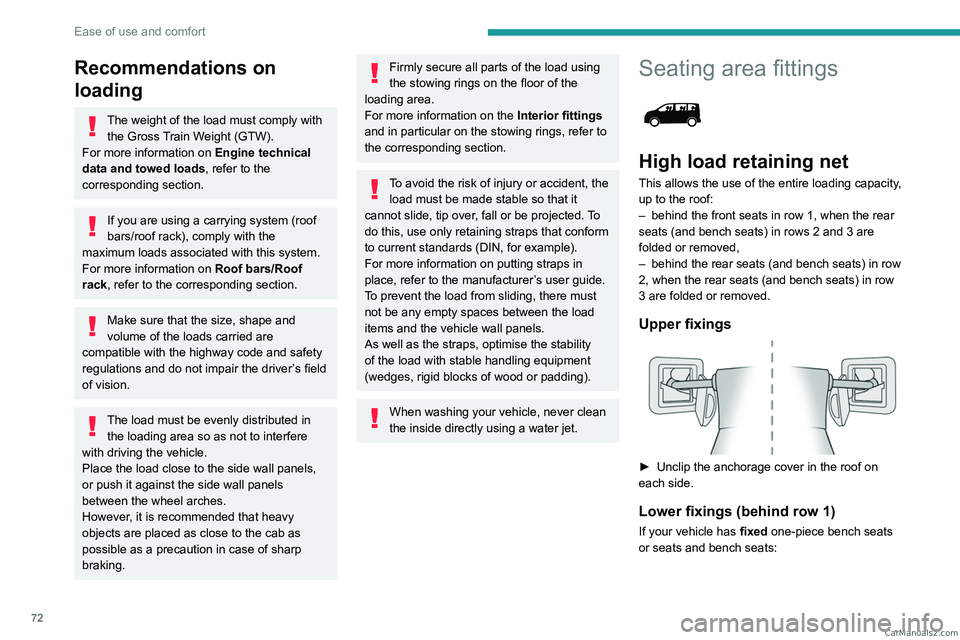
Upper fixings
► Unclip the anchorage cover in the roof on
each side.
Lower fixings (behind row 1)
If your vehicle has fixed one-piece bench seats
or seats and bench seats:
CarM an uals 2 .c o m
Page 75 of 348
73
Ease of use and comfort
3
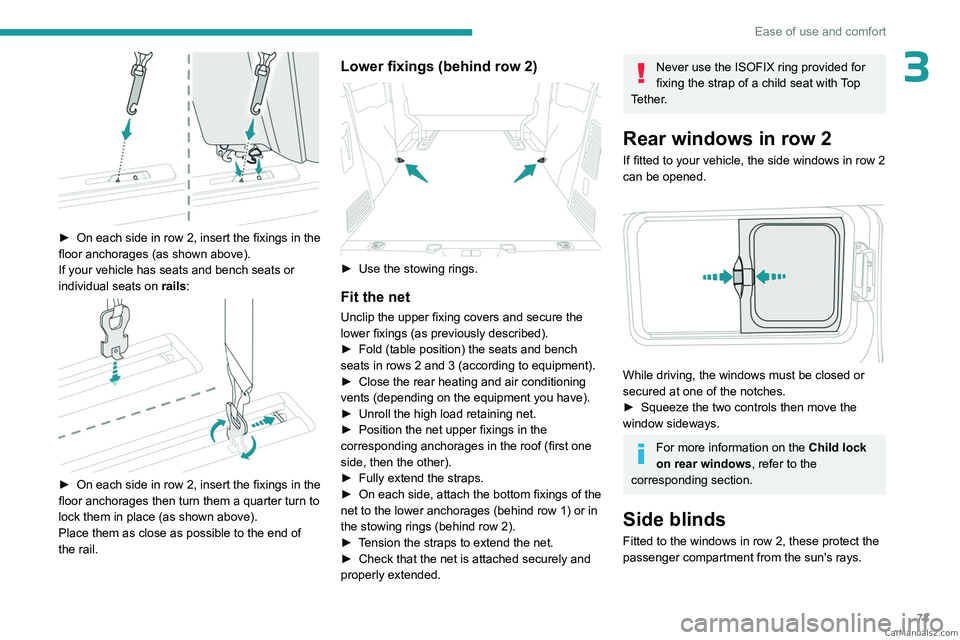
► On each side in row 2, insert the fixings in the
floor anchorages (as shown above).
If your vehicle has seats and bench seats or
individual seats on rails:
► On each side in row 2, insert the fixings in the
floor anchorages then turn them a quarter turn to
lock them in place (as shown above).
Place them as close as possible to the end of
the rail.
Lower fixings (behind row 2)
► Use the stowing rings.
Fit the net
Unclip the upper fixing covers and secure the
lower fixings (as previously described).
►
Fold (table position) the seats and bench
seats in rows 2 and 3 (according to equipment).
►
Close the rear heating and air conditioning
vents (depending on the equipment you have).
►
Unroll the high load retaining net.
►
Position the net upper fixings in the
corresponding anchorages in the roof (first one
side, then the other).
►
Fully extend the straps.
►
On each side, attach the bottom fixings of the
net to the lower anchorages (behind row 1) or in
the stowing rings (behind row 2).
►
T
ension the straps to extend the net.
►
Check that the net is attached securely and
properly extended.
Never use the ISOFIX ring provided for
fixing the strap of a child seat with Top
Tether.
Rear windows in row 2
If fitted to your vehicle, the side windows in row 2
can be opened.
While driving, the windows must be closed or
secured at one of the notches.
►
Squeeze the two controls then move the
window sideways.
For more information on the Child lock
on rear windows , refer to the
corresponding section.
Side blinds
Fitted to the windows in row 2, these protect the
passenger compartment from the sun's rays.
CarM an uals 2 .c o m