trailer PEUGEOT EXPERT 2023 User Guide
[x] Cancel search | Manufacturer: PEUGEOT, Model Year: 2023, Model line: EXPERT, Model: PEUGEOT EXPERT 2023Pages: 348, PDF Size: 12 MB
Page 190 of 348
188
Practical information
Load reduction mode
This system manages the use of certain
functions according to the level of charge
remaining in the battery.
When the vehicle is being driven, the load
reduction function temporarily deactivates certain
functions, such as the air conditioning and the
heated rear screen.
The deactivated functions are reactivated
automatically as soon as conditions permit.
Snow chains
In wintry conditions, snow chains improve
traction as well as the behaviour of the vehicle
when braking.
Snow chains must be fitted only to the
front wheels.
They must never be fitted to "space-saver"
type spare wheels.
Observe the legislation in force in your
country relating to the use of snow
chains and maximum authorised speeds.
Only use chains that have been designed for the
type of wheel fitted to your vehicle.
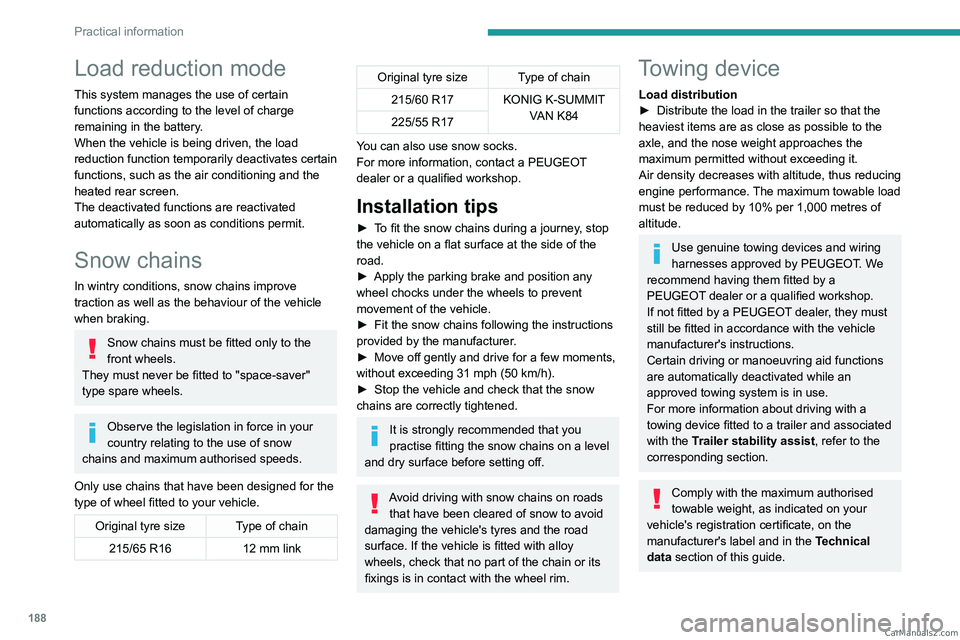
Original tyre size Type of chain 215/65 R16 12
mm link
Original tyre size Type of chain215/60 R17 KONIG K-SUMMIT VAN K84
225/55 R17
You can also use snow socks.
For more information, contact a PEUGEOT
dealer or a qualified workshop.
Installation tips
► To fit the snow chains during a journey, stop
the vehicle on a flat surface at the side of the
road.
►
Apply the parking brake and position any
wheel chocks under the wheels to prevent
movement of the vehicle.
►
Fit the snow chains following the instructions
provided by the manufacturer
.
►
Move off gently and drive for a few moments,
without exceeding 31
mph (50 km/h).
►
Stop the vehicle and check that the snow
chains are correctly tightened.
It is strongly recommended that you
practise fitting the snow chains on a level
and dry surface before setting off.
Avoid driving with snow chains on roads that have been cleared of snow to avoid
damaging the vehicle's tyres and the road
surface. If the vehicle is fitted with alloy
wheels, check that no part of the chain or its
fixings is in contact with the wheel rim.
Towing device
Load distribution
► Distribute the load in the trailer so that the
heaviest items are as close as possible to the
axle, and the nose weight approaches the
maximum permitted without exceeding it.
Air density decreases with altitude, thus reducing
engine performance.
The maximum towable load
must be reduced by 10% per 1,000
metres of
altitude.
Use genuine towing devices and wiring
harnesses approved by PEUGEOT. We
recommend having them fitted by a
PEUGEOT dealer or a qualified workshop.
If not fitted by a PEUGEOT dealer, they must
still be fitted in accordance with the vehicle
manufacturer's instructions.
Certain driving or manoeuvring aid functions
are automatically deactivated while an
approved towing system is in use.
For more information about driving with a
towing device fitted to a trailer and associated
with the Trailer stability assist, refer to the
corresponding section.
Comply with the maximum authorised
towable weight, as indicated on your
vehicle's registration certificate, on the
manufacturer's label and in the Technical
data section of this guide. CarM an uals 2 .c o m
Page 191 of 348
189
Practical information
7If using accessories attached to the
towing device (e.g. bicycle carriers, tow
boxes):
–
Comply with the maximum authorised nose
weight.
–
Do not transport more than 4 conventional
bicycles or 2 electric bicycles.
When loading bicycles onto a bicycle carrier
on a towball, be sure to place the heaviest
bicycles as close as possible to the vehicle.
Observe the legislation in force in the
country where you are driving.
Electric motor
An electric vehicle may be fitted with a
towing device.
It is therefore possible to tow a trailer or
caravan.
Contact a PEUGEOT dealer or qualified
workshop for more information and to obtain a
suitable towing device.
Roof bars/Roof rack
As a safety measure and to avoid damaging the roof, it is essential to use
the roof bars and roof racks approved for your
vehicle.
Observe the instructions on fitting and use
contained in the guide supplied with the roof
bars and racks.
Recommendations
Distribute the load uniformly, taking care
to avoid overloading one of the sides.
Arrange the heaviest part of the load as close
as possible to the roof.
Secure the load firmly.
Drive gently: the vehicle will be more
susceptible to the effects of side winds and its
stability may be affected.
Regularly check the security and tight
fastening of the roof bars, at least before each
trip.
Remove the roof bars once they are no longer
needed.
As this value may change, please verify the maximum load quoted in the guide
supplied with the roof bars.
If the height exceeds 40 cm, adapt the speed
of the vehicle to the profile of the road to
avoid damaging the roof bars and the fixings
on the vehicle.
Be sure to refer to national legislation in order
to comply with the regulations for transporting
objects that are longer than the vehicle.
Roof bars
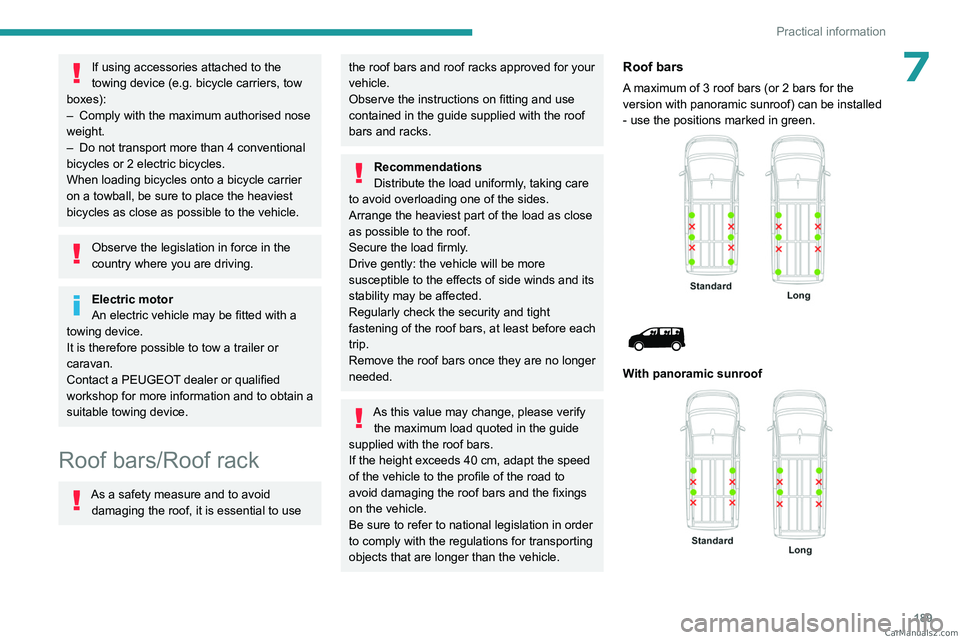
A maximum of 3 roof bars (or 2 bars for the
version with panoramic sunroof) can be installed
- use the positions marked in green.
With panoramic sunroof
CarM an uals 2 .c o m
Page 225 of 348
223
Technical data
9Engine technical data and
towed loads
Engines
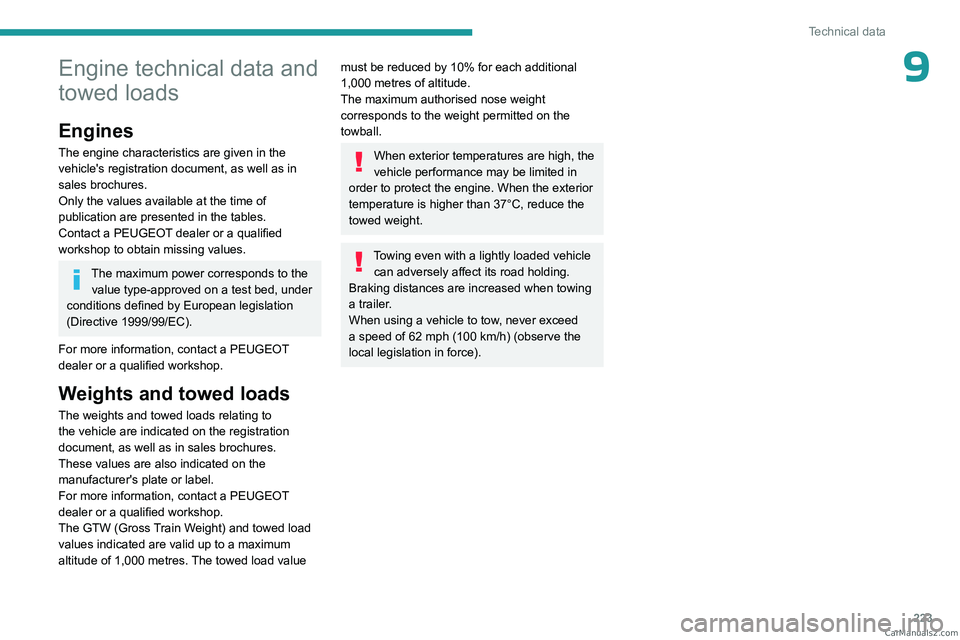
The engine characteristics are given in the
vehicle's registration document, as well as in
sales brochures.
Only the values available at the time of
publication are presented in the tables.
Contact a PEUGEOT dealer or a qualified
workshop to obtain missing values.
The maximum power corresponds to the value type-approved on a test bed, under
conditions defined by European legislation
(Directive 1999/99/EC).
For more information, contact a PEUGEOT
dealer or a qualified workshop.
Weights and towed loads
The weights and towed loads relating to
the vehicle are indicated on the registration
document, as well as in sales brochures.
These values are also indicated on the
manufacturer's plate or label.
For more information, contact a PEUGEOT
dealer or a qualified workshop.
The GTW (Gross Train Weight) and towed load
values indicated are valid up to a maximum
altitude of 1,000 metres. The towed load value
must be reduced by 10% for each additional
1,000 metres of altitude.
The maximum authorised nose weight
corresponds to the weight permitted on the
towball.
When exterior temperatures are high, the
vehicle performance may be limited in
order to protect the engine. When the exterior
temperature is higher than 37°C, reduce the
towed weight.
Towing even with a lightly loaded vehicle can adversely affect its road holding.
Braking distances are increased when towing
a trailer.
When using a vehicle to tow, never exceed
a speed of 62 mph (100
km/h) (observe the
local legislation in force). CarM an uals 2 .c o m
Page 226 of 348
224
Technical data
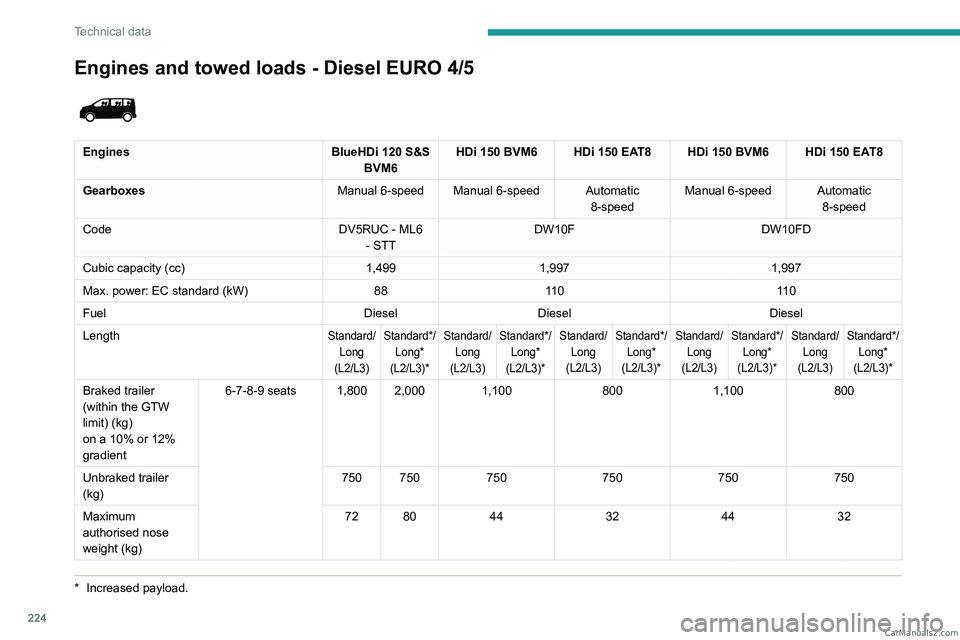
Engines and towed loads - Diesel EURO 4/5
* Increased payload.
Engines BlueHDi 120 S&S
BVM6 HDi 150 BVM6 HDi 150 EAT8 HDi 150 BVM6 HDi 150 EAT8
Gearboxes Manual 6-speed Manual 6-speed Automatic
8-speedManual 6-speed Automatic
8-speed
Code DV5RUC - ML6
- STT DW10F
DW10FD
Cubic capacity (cc) 1,4991,997 1,997
Max. power: EC standard (kW) 8811 0 11 0
Fuel DieselDiesel Diesel
Length
Standard/ Long
(L2/L3) Standard*/
Long*
(L2/L3)* Standard/
Long
(L2/L3) Standard*/
Long*
(L2/L3)* Standard/
Long
(L2/L3) Standard*/
Long*
(L2/L3)* Standard/
Long
(L2/L3) Standard*/
Long*
(L2/L3)* Standard/
Long
(L2/L3) Standard*/
Long*
(L2/L3)*
Braked trailer
(within the GTW
limit) (kg)
on a 10% or 12%
gradient 6-7-8-9 seats
1,800 2,000 1,100 8001,100 800
Unbraked trailer
(kg) 750 750
750750750750
Maximum
authorised nose
weight (kg) 72 80
44324432 CarM an uals 2 .c o m
Page 227 of 348
225
Technical data
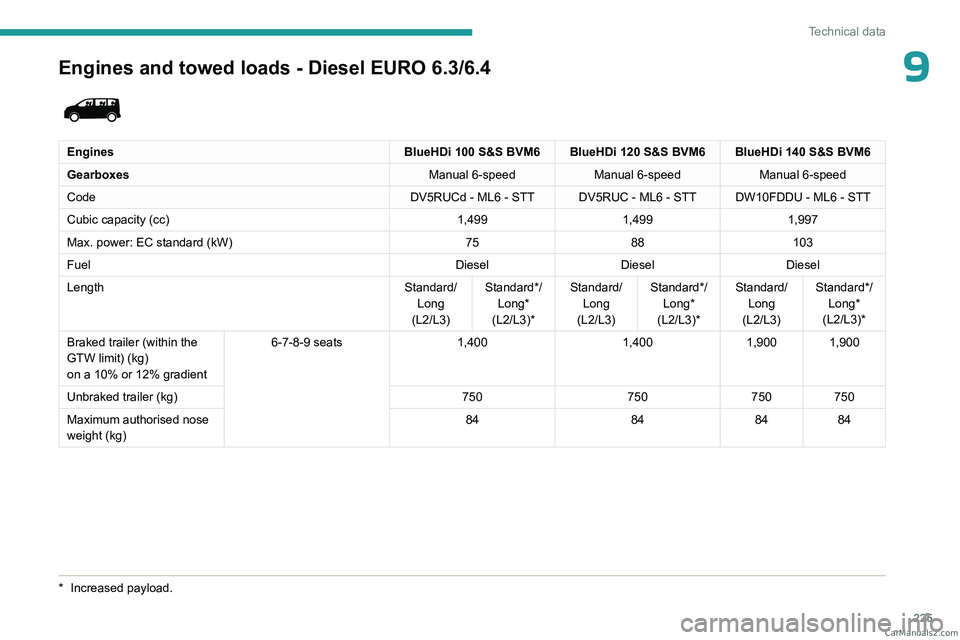
9Engines and towed loads - Diesel EURO 6.3/6.4
EnginesBlueHDi 100 S&S BVM6 BlueHDi 120 S&S BVM6 BlueHDi 140 S&S BVM6
Gearboxes Manual 6-speedManual 6-speedManual 6-speed
Code DV5RUCd - ML6 - STT DV5RUC - ML6 - STT DW10FDDU - ML6 - STT
Cubic capacity (cc) 1,4991,4991,997
Max. power: EC standard (kW) 7588103
Fuel DieselDieselDiesel
Length Standard/
Long
(L2/L3) Standard*/
Long*
(L2/L3)* Standard/
Long
(L2/L3) Standard*/
Long*
(L2/L3)* Standard/
Long
(L2/L3) Standard*/
Long*
(L2/L3)*
Braked trailer (within the
GTW limit) (kg)
on a 10% or 12% gradient 6-7-8-9 seats
1,4001,4001,900 1,900
Unbraked trailer (kg) 750750750750
Maximum authorised nose
weight (kg) 84
848484
* Increased payloa d. CarM an uals 2 .c o m
Page 228 of 348
226
Technical data
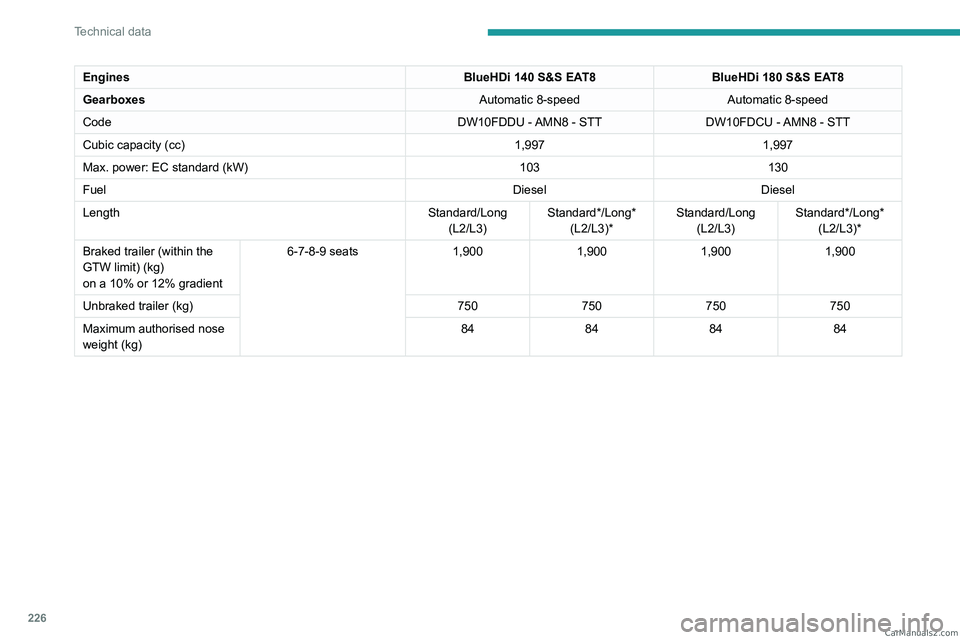
EnginesBlueHDi 140 S&S EAT8BlueHDi 180 S&S EAT8
Gearboxes Automatic 8-speedAutomatic 8-speed
Code DW10FDDU - AMN8 - STTDW10FDCU - AMN8 - STT
Cubic capacity (cc) 1,9971,997
Max. power: EC standard (kW) 103130
Fuel DieselDiesel
Length Standard/Long
(L2/L3) Standard*/Long*
(L2/L3)* Standard/Long
(L2/L3) Standard*/Long*
(L2/L3)*
Braked trailer (within the
GTW limit) (kg)
on a 10% or 12% gradient 6-7-8-9 seats
1,9001,9001,9001,900
Unbraked trailer (kg) 750750750750
Maximum authorised nose
weight (kg) 84
848484 CarM an uals 2 .c o m
Page 230 of 348
228
Technical data
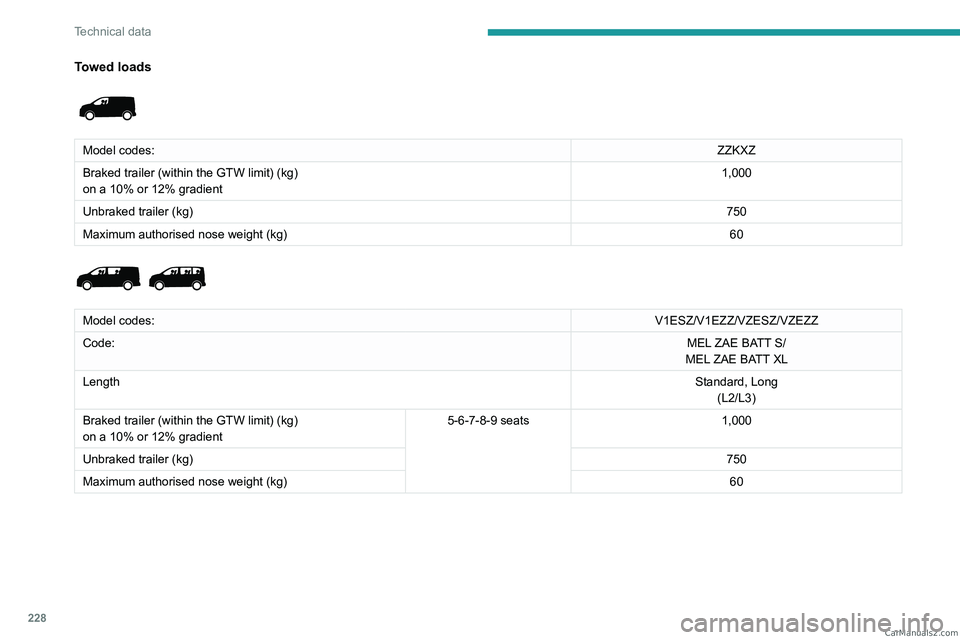
Towed loads
Model codes:ZZKXZ
Braked trailer (within the GTW limit) (kg)
on a 10% or 12% gradient 1,000
Unbraked trailer (kg) 750
Maximum authorised nose weight (kg) 60
Model codes:V1ESZ/V1EZZ/VZESZ/VZEZZ
Code: MEL ZAE BATT S/
MEL ZAE BATT XL
Length Standard, Long
(L2/L3)
Braked trailer (within the GTW limit) (kg)
on a 10% or 12% gradient 5-6-7-8-9 seats
1,000
Unbraked trailer (kg) 750
Maximum authorised nose weight (kg) 60 CarM an uals 2 .c o m
Page 293 of 348
291
Alphabetical index
Telephone 238–241, 252–253, 274–276
Telephone, Bluetooth with
voice recognition
241
Temperature, coolant
19–20
Thermal comfort consumption indicator
(Electric)
23
Thermal comfort equipment
23
Third brake lamp
214
Time (setting)
28, 254, 278
TMC (Traffic info)
265
Tool box
203
Tools
204, 207
Topping-up AdBlue®
197
Total distance recorder
23
Touch screen
26–27, 85
Towbar
102, 188
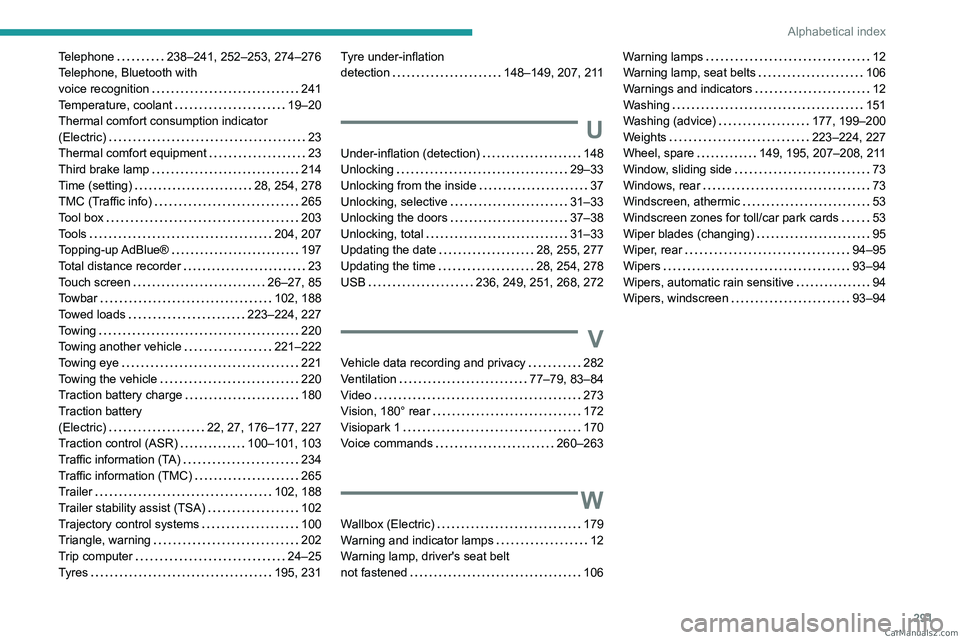
Towed loads
223–224, 227
Towing
220
Towing another vehicle
221–222
Towing eye
221
Towing the vehicle
220
Traction battery charge
180
Traction battery
(Electric)
22, 27, 176–177, 227
Traction control (ASR)
100–101, 103
Traffic information (TA)
234
Traffic information (TMC)
265
Trailer
102, 188
Trailer stability assist (TSA)
102
Trajectory control systems
100
Triangle, warning
202
Trip computer
24–25
Tyres
195, 231Tyre under-inflation
detection
148–149, 207, 211
U
Under-inflation (detection) 148
Unlocking
29–33
Unlocking from the inside
37
Unlocking, selective
31–33
Unlocking the doors
37–38
Unlocking, total
31–33
Updating the date
28, 255, 277
Updating the time
28, 254, 278
USB
236, 249, 251, 268, 272
V
Vehicle data recording and privacy 282
Ventilation
77–79, 83–84
Video
273
Vision, 180° rear
172
Visiopark 1
170
Voice commands
260–263
W
Wallbox (Electric) 179
Warning and indicator lamps
12
Warning lamp, driver's seat belt
not fastened
106
Warning lamps 12
Warning lamp, seat belts
106
Warnings and indicators
12
Washing
151
Washing (advice)
177, 199–200
Weights
223–224, 227
Wheel, spare
149, 195, 207–208, 211
Window, sliding side
73
Windows, rear
73
Windscreen, athermic
53
Windscreen zones for toll/car park cards
53
Wiper blades (changing)
95
Wiper, rear
94–95
Wipers
93–94
Wipers, automatic rain sensitive
94
Wipers, windscreen
93–94 CarM an uals 2 .c o m