ignition Peugeot Expert Tepee 2011 User Guide
[x] Cancel search | Manufacturer: PEUGEOT, Model Year: 2011, Model line: Expert Tepee, Model: Peugeot Expert Tepee 2011Pages: 268, PDF Size: 9.78 MB
Page 36 of 268
34
Instruments and controls
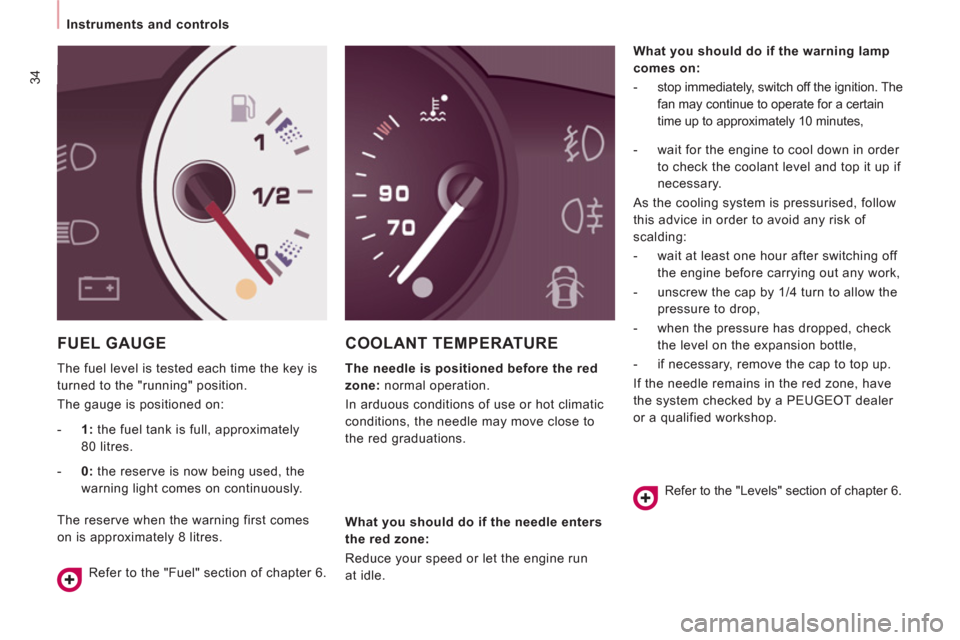
FUEL GAUGE
The fuel level is tested each time the key is
turned to the "running" position.
The gauge is positioned on:
COOLANT TEMPERATURE
The needle is positioned before the red
zone:
normal operation.
In arduous conditions of use or hot climatic
conditions, the needle may move close to
the red graduations.
What you should do if the warning lamp
comes on:
- stop immediately, switch off the ignition. The
fan may continue to operate for a certain
time up to approximately 10 minutes,
- 1:
the fuel tank is full, approximately
80 litres.
- 0:
the reserve is now being used, the
warning light comes on continuously.
The reserve when the warning first comes
on is approximately 8 litres.
Refer to the "Fuel" section of chapter 6.
What you should do if the needle enters
the red zone:
Reduce your speed or let the engine run
at idle.
- wait for the engine to cool down in order
to check the coolant level and top it up if
necessary.
As the cooling system is pressurised, follow
this advice in order to avoid any risk of
scalding:
- wait at least one hour after switching off
the engine before carrying out any work,
- unscrew the cap by 1/4 turn to allow the
pressure to drop,
- when the pressure has dropped, check
the level on the expansion bottle,
- if necessary, remove the cap to top up.
If the needle remains in the red zone, have
the system checked by a PEUGEOT dealer
or a qualified workshop.
Refer to the "Levels" section of chapter 6.
Page 37 of 268

35
Instruments and controls
READY TO SET OFF
2
The points at which a service is due are
calculated from the last indicator zero reset.
The point at which a service is due is
determined by two parameters:
- the distance travelled,
- the time which has elapsed since the
last service.
A few seconds after the ignition is switched
on, the oil level is displayed, then the total
distance recorder resumes normal operation
showing the total and trip distances.
Less than 1 000 miles/km before
the next service is due
Each time the ignition is switched on and for a few
seconds, the spanner fl ashes and the number of
miles/kilometres remaining is displayed:
A few seconds after the ignition is switched
on, the oil level is displayed, then the total
distance recorder resumes normal operation
and the spanner remains on. This indicates
that a service should be carried out shortly.
Service overdue
With the engine running the spanner
remains on until the service has been
carried out.
First of the two terms reached: the spanner
also comes on if the two-year interval has
elapsed.
The distance remaining before the next
service may be weighted by the time
factor, depending on the type of driving.
More than 1 000 miles/km before
the next service is due
Example:
4 800 miles/km remain before
the next service is due. When the ignition
is switched on and for a few seconds, the
screen shows:
This programmes service intervals according
to the use of the vehicle.
EMISSIONS CONTROLS
The driver is warned of any malfunction
of this emission control system by the
illumination of this specific warning lamp in
the instrument panel.
There is a risk of damage to the catalytic
converter. Have it checked by a PEUGEOT
dealer or a qualified workshop. EOBD (European On Board
Diagnosis) is a diagnostics system
which complies with, among
others, the standards concerning
authorised emissions of:
- CO (carbon monoxide),
- HC (unburnt hydrocarbons),
- NOx (nitrous oxides) or particles,
detected by oxygen sensors placed
upstream and downstream of the
catalytic converters.
Each time the ignition is switched
on and for a few seconds, the
spanner fl ashes and the excess
distance is displayed.
Operation
A few moments after the ignition has been
switched on, the spanner indicating a
service operation comes on; the display for
the total distance recorder gives (in round
figures) the distance remaining before the
next service.
Page 38 of 268
Instruments and controls
After this operation, if you wish to
disconnect the battery, lock the vehicle
and wait for at least five minutes, otherwise
the zero re-set will not be registered.
Zero re-set
Your PEUGEOT dealer or a qualified
workshop carries out this operation after
each service.
However, if you carry out the service
yourself, the re-set procedure is as follows:
- switch off the ignition,
- press and hold the trip recorder reset
button,
- switch on the ignition.
The display begins a countdown.
When the display shows "=0"
, release the
button; the spanner disappears.
Engine oil level indicator
When the ignition is switched on, the engine
oil level is indicated for a few seconds, after
the service information.
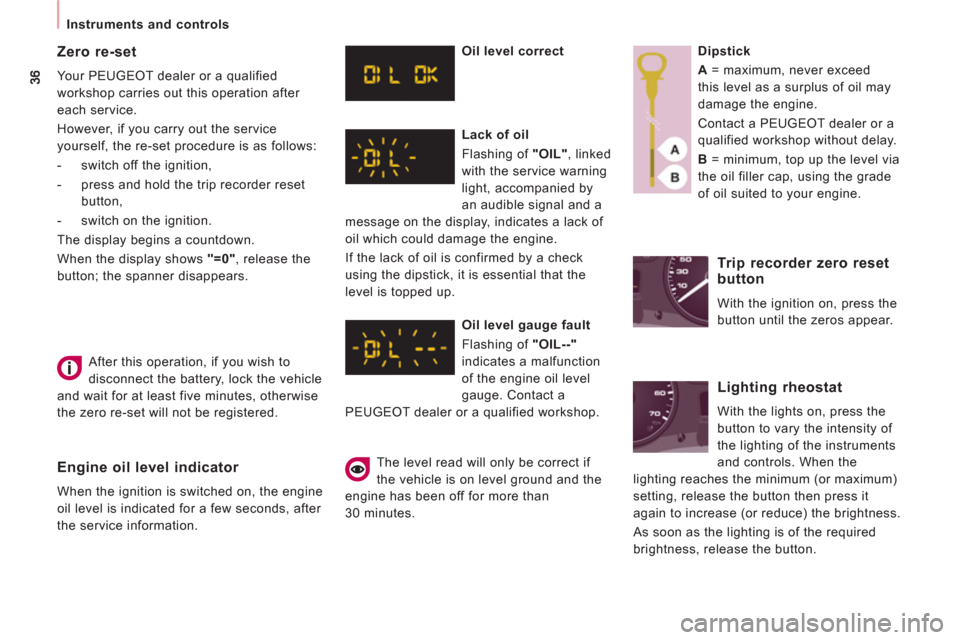
Oil level correct
Lack of oil
Flashing of "OIL"
, linked
with the service warning
light, accompanied by
an audible signal and a
message on the display, indicates a lack of
oil which could damage the engine.
If the lack of oil is confirmed by a check
using the dipstick, it is essential that the
level is topped up.
Oil level gauge fault
Flashing of "OIL--"
indicates a malfunction
of the engine oil level
gauge. Contact a
PEUGEOT dealer or a qualified workshop.
The level read will only be correct if
the vehicle is on level ground and the
engine has been off for more than
30 minutes.
Dipstick
A
= maximum, never exceed
this level as a surplus of oil may
damage the engine.
Contact a PEUGEOT dealer or a
qualified workshop without delay.
B
= minimum, top up the level via
the oil filler cap, using the grade
of oil suited to your engine.
Trip recorder zero reset
button
With the ignition on, press the
button until the zeros appear.
Lighting rheostat
With the lights on, press the
button to vary the intensity of
the lighting of the instruments
and controls. When the
lighting reaches the minimum (or maximum)
setting, release the button then press it
again to increase (or reduce) the brightness.
As soon as the lighting is of the required
brightness, release the button.
Page 43 of 268
41
READY TO SET OFF
2
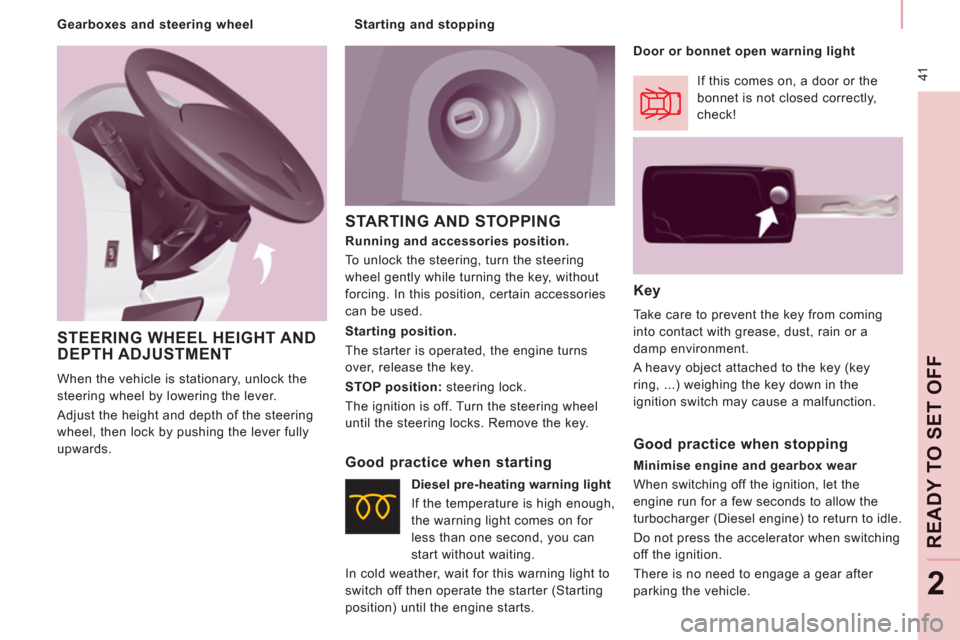
STARTING AND STOPPING
Key
Take care to prevent the key from coming
into contact with grease, dust, rain or a
damp environment.
A heavy object attached to the key (key
ring, ...) weighing the key down in the
ignition switch may cause a malfunction.
Starting position.
The starter is operated, the engine turns
over, release the key.
STOP position:
steering lock.
The ignition is off. Turn the steering wheel
until the steering locks. Remove the key.
Good practice when starting
If this comes on, a door or the
bonnet is not closed correctly,
check!
Diesel pre-heating warning light
If the temperature is high enough,
the warning light comes on for
less than one second, you can
start without waiting.
In cold weather, wait for this warning light to
switch off then operate the starter (Starting
position) until the engine starts.
Good practice when stopping
Minimise engine and gearbox wear
When switching off the ignition, let the
engine run for a few seconds to allow the
turbocharger (Diesel engine) to return to idle.
Do not press the accelerator when switching
off the ignition.
There is no need to engage a gear after
parking the vehicle.
Running and accessories position.
To unlock the steering, turn the steering
wheel gently while turning the key, without
forcing. In this position, certain accessories
can be used.
Door or bonnet open warning light
STEERING WHEEL HEIGHT ANDDEPTH ADJUSTMENT
When the vehicle is stationary, unlock the
steering wheel by lowering the lever.
Adjust the height and depth of the steering
wheel, then lock by pushing the lever fully
upwards.
Starting and stopping
Gearboxes and steering wheel
Page 44 of 268

42
Steering mounted controls
Dipped beam/main beam change
Pull the stalk fully towards you. Automatic lights
if your vehicle is fitted with a
brightness sensor. Lights off
Dipped beam (green)
Main beam (blue)
LIGHTING CONTROL
STEERING MOUNTED CONTROLS
Side lights
Lights-on buzzer
When the ignition is switched off, when the
driver’s door is opened, a buzzer sounds if
you have left your lights on.
DIRECTION INDICATORS (flashing)
Left
: downwards passing
the point of resistance.
Right
: upwards passing
the point of resistance.
Front and rear lights
Selection is by turning ring A
.
Checking by means of the indicator
lights on the instrument panel is
described in the "Instruments and
controls" section of chapter 2.
Page 48 of 268
Steering mounted controls
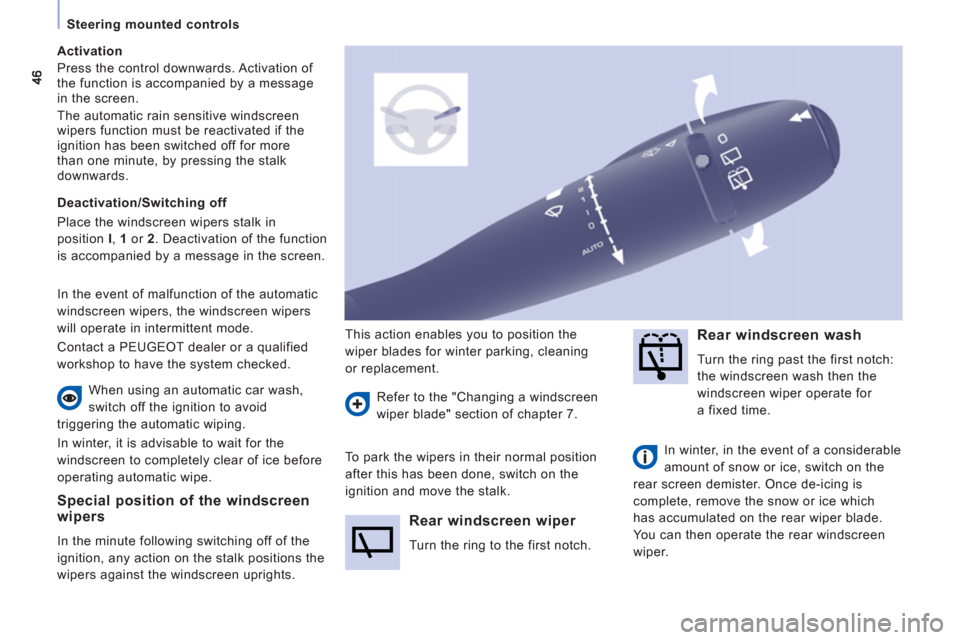
Special position of the windscreen
wipers
In the minute following switching off of the
ignition, any action on the stalk positions the
wipers against the windscreen uprights. This action enables you to position the
wiper blades for winter parking, cleaning
or replacement.
Refer to the "Changing a windscreen
wiper blade" section of chapter 7.
To park the wipers in their normal position
after this has been done, switch on the
ignition and move the stalk. When using an automatic car wash,
switch off the ignition to avoid
triggering the automatic wiping.
In winter, it is advisable to wait for the
windscreen to completely clear of ice before
operating automatic wipe.
Rear windscreen wiper
Turn the ring to the first notch.
Rear windscreen wash
Turn the ring past the first notch:
the windscreen wash then the
windscreen wiper operate for
a fixed time.
In winter, in the event of a considerable
amount of snow or ice, switch on the
rear screen demister. Once de-icing is
complete, remove the snow or ice which
has accumulated on the rear wiper blade.
You can then operate the rear windscreen
wiper.
Activation
Press the control downwards. Activation of
the function is accompanied by a message
in the screen.
The automatic rain sensitive windscreen
wipers function must be reactivated if the
ignition has been switched off for more
than one minute, by pressing the stalk
downwards.
Deactivation/Switching off
Place the windscreen wipers stalk in
position I
, 1
or 2
. Deactivation of the function
is accompanied by a message in the screen.
In the event of malfunction of the automatic
windscreen wipers, the windscreen wipers
will operate in intermittent mode.
Contact a PEUGEOT dealer or a qualified
workshop to have the system checked.
Page 51 of 268
49
Steering mounted controls
EASE OF USE and COMFOR
T
3
Switching the function off
- Place the dial in position 0
or switch off
the ignition to switch everything off.
Good practice
When changing the programmed reference
speed by means of a maintained press,
pay attention as the speed can increase
or decrease rapidly.
Do not use the cruise control on slippery
roads or in heavy traffic.
In the event of a steep slope, the cruise
control cannot prevent the vehicle from
exceeding the programmed speed.
In any event, the cruise control cannot
replace the need to observe the speed
limits, nor can it replace the need for
vigilance and responsibility on the part
of the driver.
It is advisable to leave your feet near the
pedals.
To avoid any jamming under the pedals:
- ensure that the mat and its fixings
on the floor are positioned correctly,
- never place one mat on top of another.
Operating fault
The programmed speed is cleared then
replaced by three dashes. Contact a
PEUGEOT dealer or a qualified workshop
to have the system checked. Using the accelerator:
- exceed the memorised speed until the
speed required is reached,
- press the Set +
or Set -
button.
To memorise a speed lower than the
previous one:
- press the Set -
button.
A brief press decreases the speed by
1 mph (km/h).
A maintained press decreases the speed
in steps of 5 mph (km/h).
Cancelling the programmedreference speed
When the vehicle becomes stationary, after
switching off the ignition, the system no
longer memorises a speed.
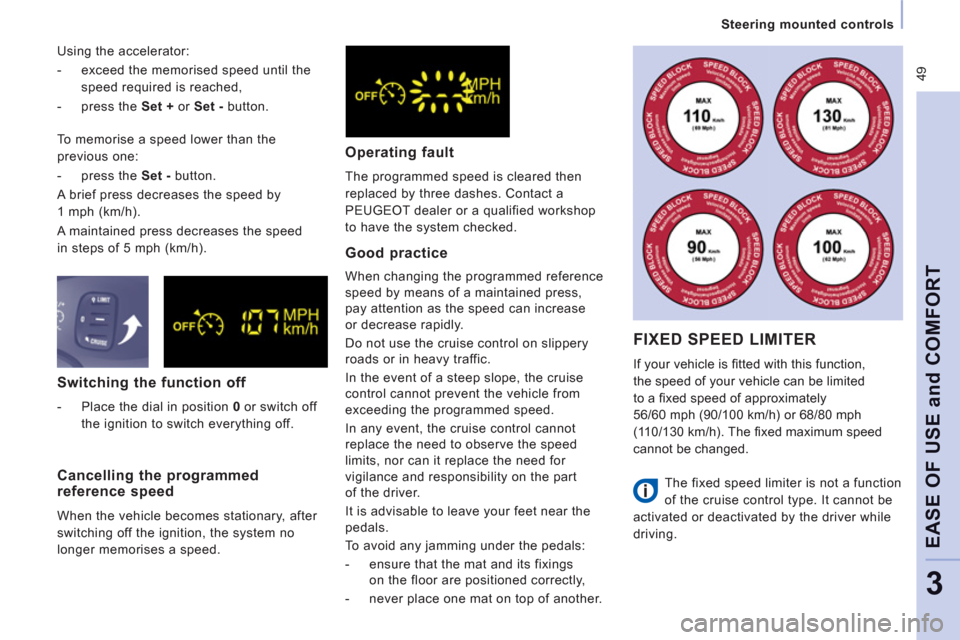
FIXED SPEED LIMITER
If your vehicle is fi tted with this function,
the speed of your vehicle can be limited
to a fi xed speed of approximately
56/60 mph (90/100 km/h) or 68/80 mph
(110/130 km/h). The fi xed maximum speed
cannot be changed.
The fixed speed limiter is not a function
of the cruise control type. It cannot be
activated or deactivated by the driver while
driving.
Page 54 of 268
52
Steering mounted controls
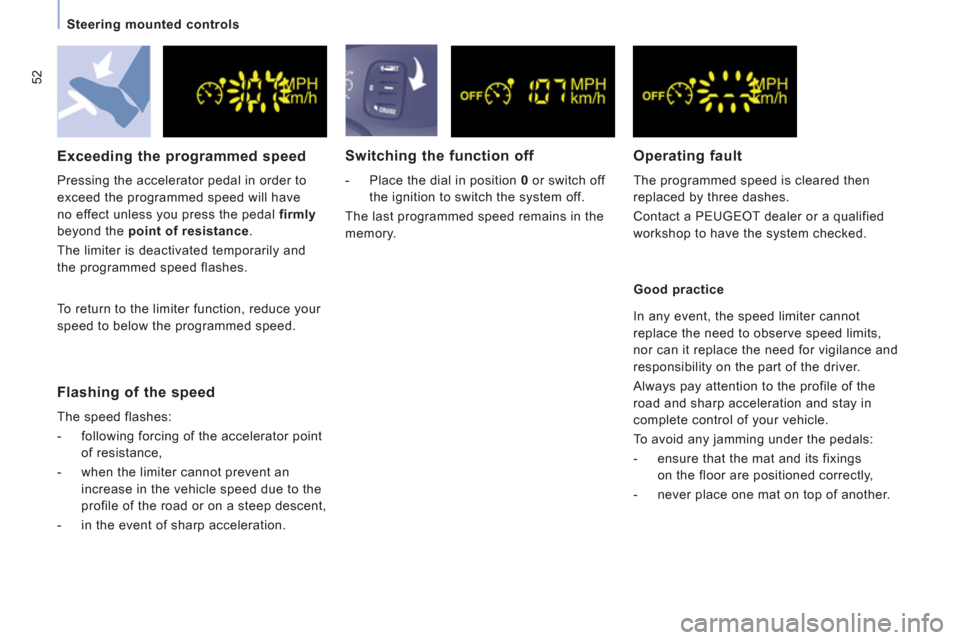
Switching the function off
- Place the dial in position 0
or switch off
the ignition to switch the system off.
The last programmed speed remains in the
memory.
Exceeding the programmed speed
Pressing the accelerator pedal in order to
exceed the programmed speed will have
no effect unless you press the pedal firmly
beyond the point of resistance
.
The limiter is deactivated temporarily and
the programmed speed flashes.
Good practice
Operating fault
The programmed speed is cleared then
replaced by three dashes.
Contact a PEUGEOT dealer or a qualified
workshop to have the system checked.
Flashing of the speed
The speed flashes:
- following forcing of the accelerator point
of resistance,
- when the limiter cannot prevent an
increase in the vehicle speed due to the
profile of the road or on a steep descent,
- in the event of sharp acceleration.
To return to the limiter function, reduce your
speed to below the programmed speed. In any event, the speed limiter cannot
replace the need to observe speed limits,
nor can it replace the need for vigilance and
responsibility on the part of the driver.
Always pay attention to the profile of the
road and sharp acceleration and stay in
complete control of your vehicle.
To avoid any jamming under the pedals:
- ensure that the mat and its fixings
on the floor are positioned correctly,
- never place one mat on top of another.
Page 58 of 268

56
Ventilation
Driver or passenger side comfort value
The value indicated on the display
corresponds to a level of comfort and
not a temperature in degrees Celsius or
Fahrenheit.
Automatic operation
Do not cover the sunshine sensor,
located on the windscreen behind the
mirror, it is used for regulation of the air
conditioning.
AUTO comfort programme
This is the normal air conditioning system
operating mode.
Press this button, the AUTO
symbol
is displayed.
In accordance with the comfort
value selected, the system controls
the distribution, the fl ow and the intake of air to
guarantee comfort and a suffi cient circulation
of air in the passenger compartment. No
further action on your part is required.
When the engine is cold, to prevent an
excessive diffusion of cold air, the ventilation
will reach its optimum level gradually.
For your comfort, the settings are stored
when the ignition is switched off and are
reinstated the next time the vehicle is
started, if the temperature in the passenger
compartment has not changed significantly;
otherwise, operation resumes in automatic
mode. Turn this control to the left or to
the right to decrease or increase
the value. A setting around the
value 21 provides optimum
comfort. However, depending on your
requirements, a setting between 18 and
24 is usual.
Page 82 of 268
80
Practical information
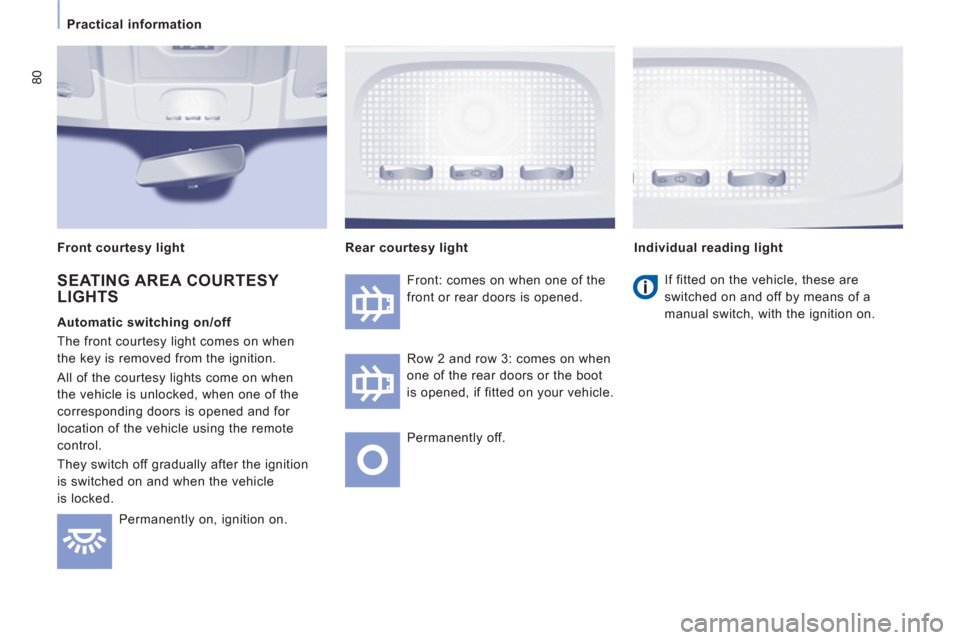
Permanently on, ignition on. Front: comes on when one of the
front or rear doors is opened.
Row 2 and row 3: comes on when
one of the rear doors or the boot
is opened, if fitted on your vehicle.
Permanently off.
Individual reading light
Rear courtesy light
If fitted on the vehicle, these are
switched on and off by means of a
manual switch, with the ignition on.
SEATING AREA COURTESY LIGHTS
Automatic switching on/off
The front courtesy light comes on when
the key is removed from the ignition.
All of the courtesy lights come on when
the vehicle is unlocked, when one of the
corresponding doors is opened and for
location of the vehicle using the remote
control.
They switch off gradually after the ignition
is switched on and when the vehicle
is locked.
Front courtesy light