warning light Peugeot Expert VU 2016 User Guide
[x] Cancel search | Manufacturer: PEUGEOT, Model Year: 2016, Model line: Expert VU, Model: Peugeot Expert VU 2016Pages: 599, PDF Size: 13.14 MB
Page 164 of 599
162
Expert_en_Chap05_securite_ed01-2016
Anti-lock braking system
(ABS) and electronic brake
force distribution
(EBFD)
In emergency braking, press ver y
firmly and maintain this pressure. When changing wheels (tyres and
rims), ensure that these are approved
for your vehicle.
Normal operation of the ABS may make
itself felt by slight vibrations of the brake
pedal.
th
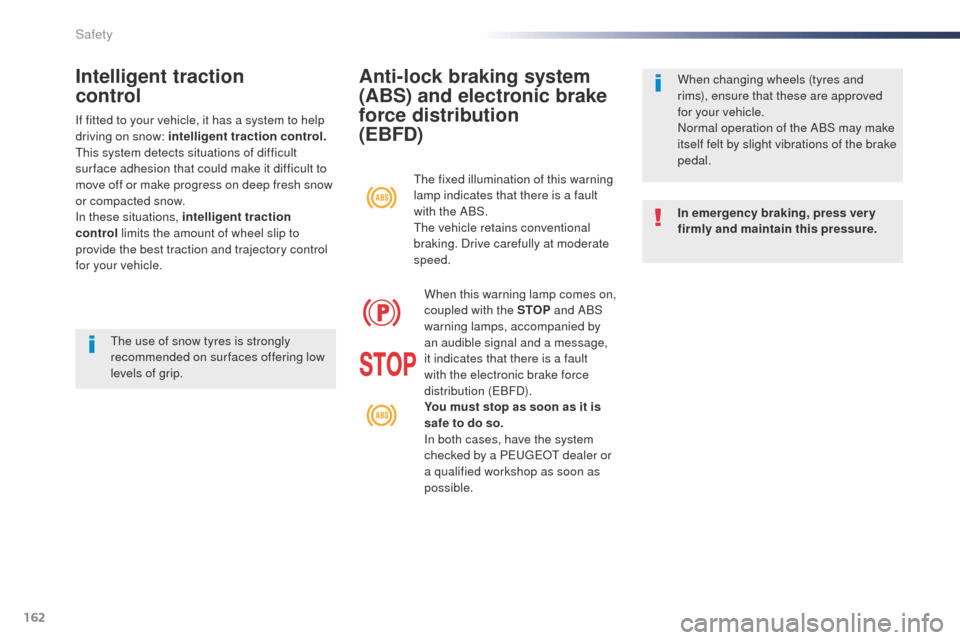
e fixed illumination of this warning
lamp indicates that there is a fault
with the ABS.th
e vehicle retains conventional
braking. Drive carefully at moderate
speed.
When this warning lamp comes on,
coupled with the STOP and ABS
warning lamps, accompanied by
an audible signal and a message,
it indicates that there is a fault
with the electronic brake force
distribution (EBFD).
You must stop as soon as it is
safe to do so.
In both cases, have the system
checked by a PE
u
g
Eo
t
dealer or
a qualified workshop as soon as
possible.
Intelligent traction
control
If fitted to your vehicle, it has a system to help
driving on snow: intelligent traction control.
th
is system detects situations of difficult
sur face adhesion that could make it difficult to
move off or make progress on deep fresh snow
or compacted snow.
In these situations, intelligent traction
control limits the amount of wheel slip to
provide the best traction and trajectory control
for your vehicle.
th
e use of snow tyres is strongly
recommended on sur faces offering low
levels of grip.
Safety
Page 171 of 599
169
Expert_en_Chap05_securite_ed01-2016
Advice
In the event of an impact
Depending on the nature and
seriousness of the impact, the
pretensioning device may be deployed
before and independently of the airbags.
Deployment of the pretensioners is
accompanied by a slight discharge of
harmless smoke and a noise, due to the
activation of the pyrotechnic cartridge
incorporated in the system.
In all cases, the airbag warning lamp
comes
on.
Following an impact, have the seat belts
system checked, and if necessary replaced,
by a PE
u
g
Eo
t dealer or a qualified
workshop.
In order to be effective, a seat belt must:
-
b
e tightened as close to the body as
possible,
-
b
e pulled in front of you with a smooth
movement, checking that it does not
twist,
-
b
e used to restrain only one person,
-
n
ot bear any trace of cuts or fraying,
-
n
ot be converted or modified to avoid
affecting its performance.
In accordance with current safety
regulations, for all repairs on your vehicle's
seat belts, go to a qualified workshop with
the skills and equipment needed, which a
PEugEo
t d
ealer is able to provide.
Have your seat belts checked regularly by a
PE
u
g
Eo
t
dealer or a qualified workshop,
particularly if the straps show signs of
damage.
Clean the seat belt straps with soapy
water or a textile cleaning product, sold by
PE
u
g
Eo
t
d
ealers.
After folding or moving a seat or rear bench
seat, ensure that the seat belt is positioned
and reeled in correctly.
Recommendations
for children
use a suitable child seat if the passenger is
less than 12 years old or shorter than one
and a half metres.
Never use the same seat belt to secure more
than one person.
Never allow a child to travel on your lap.
For more information on Child seats , refer
to the corresponding section.the
driver must ensure that passengers use
the seat belts correctly and that they are all
fastened before setting off.
Wherever you are seated in the vehicle,
always fasten your seat belt, even for short
journeys.
Do not interchange the seat belt buckles as
they will not fulfill their role fully.
th
e seat belts are fitted with an inertia reel
permitting automatic adjustment of the
length of the strap to your size.
t
h
e seat belt
is stowed automatically when not in use.
Before and after use, ensure that the seat
belt is reeled in correctly.
th
e lower part of the strap must be
positioned as low as possible on the pelvis.
th
e upper part must be positioned in the
hollow of the shoulder.
th
e inertia reels are fitted with an automatic
locking device which comes into operation in
the event of a collision, emergency braking
or if the vehicle rolls over. You can release
the device by pulling the strap firmly and
then releasing it so that it reels in slightly.
5
Safety
Page 200 of 599
198
Expert_en_Chap06_conduite_ed01-2016
When towing
Distribution of loads
F Distribute the load in the trailer so that the
heaviest items are as close as possible to
the axle and the nose weight approaches
the maximum permitted without exceeding it.
Air density decreases with altitude, thus
reducing engine performance. Above
1 000 metres, the maximum towed load must
be reduced by 10
% for every 1 000 metres of
altitude.
Side wind
F take into account the increased sensitivity to side wind.
Cooling
towing a trailer on a slope increases the
temperature of the coolant.
As the fan is electrically controlled, its cooling
capacity is not dependent on the engine speed.
F
t
o l
ower the engine speed, reduce your
speed.
th
e maximum towed load on a long incline
depends on the gradient and the ambient
temperature.
In all cases, keep a check on the coolant
temperature.
F
I
f the warning lamp and the
STOP warning lamp come on,
stop the vehicle and switch off
the engine as soon as possible.
Braking
towing a trailer increases the braking distance.to a void overheating of the brakes, the use of
engine braking is recommended.
Ty r e s
F Check the tyre pressures of the towing vehicle and of the trailer, observing the
recommended pressures.
Lighting
F Check the electrical lighting and signalling on the trailer and the headlamp beam
height of your vehicle.
For more information on Weights
, refer
to the corresponding section.
th
e rear parking sensors will be
deactivated automatically to avoid the
audible signal if a genuine PE
u
g
Eo
t
towbar is used.
If the ambient temperature is high, it
is recommended that the engine be
allowed to idle for 1 to 2 minutes after
the vehicle comes to a stop, to facilitate
its cooling. For more information on Adjusting the
headlamp beam height
, refer to the
corresponding section.
Driving
Page 248 of 599
246
Expert_en_Chap06_conduite_ed01-2016
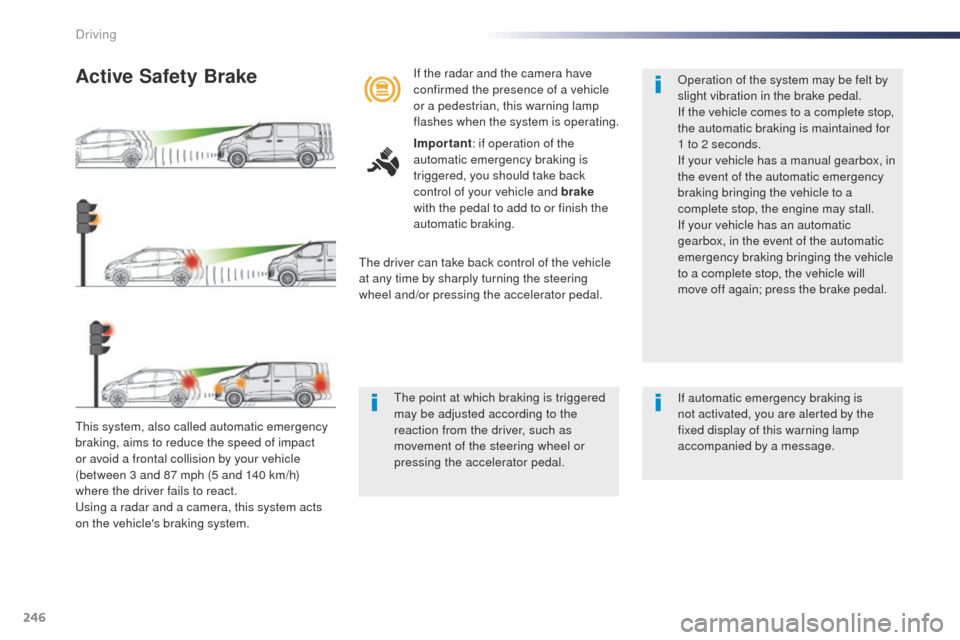
this system, also called automatic emergency
braking, aims to reduce the speed of impact
or avoid a frontal collision by your vehicle
(between 3 and 87 mph (5 and 140 km/h)
where the driver fails to react.
us
ing a radar and a camera, this system acts
on the vehicle's braking system.
Active Safety Brake
the driver can take back control of the vehicle
at any time by sharply turning the steering
wheel and/or pressing the accelerator pedal.
op
eration of the system may be felt by
slight vibration in the brake pedal.
If the vehicle comes to a complete stop,
the automatic braking is maintained for
1 to 2 seconds.
If your vehicle has a manual gearbox, in
the event of the automatic emergency
braking bringing the vehicle to a
complete stop, the engine may stall.
If your vehicle has an automatic
gearbox, in the event of the automatic
emergency braking bringing the vehicle
to a complete stop, the vehicle will
move off again; press the brake pedal.
If automatic emergency braking is
not activated, you are alerted by the
fixed display of this warning lamp
accompanied by a message.
If the radar and the camera have
confirmed the presence of a vehicle
or a pedestrian, this warning lamp
flashes when the system is operating.
Important
: if operation of the
automatic emergency braking is
triggered, you should take back
control of your vehicle and brake
with the pedal to add to or finish the
automatic braking.
th
e point at which braking is triggered
may be adjusted according to the
reaction from the driver, such as
movement of the steering wheel or
pressing the accelerator pedal.
Driving
Page 249 of 599
247
Expert_en_Chap06_conduite_ed01-2016
Deactivation / Activation of
the alert and the braking
By default, the function is automatically
activated at every engine start.
th
e deactivation or activation of the function is
done in the vehicle configuration menu.
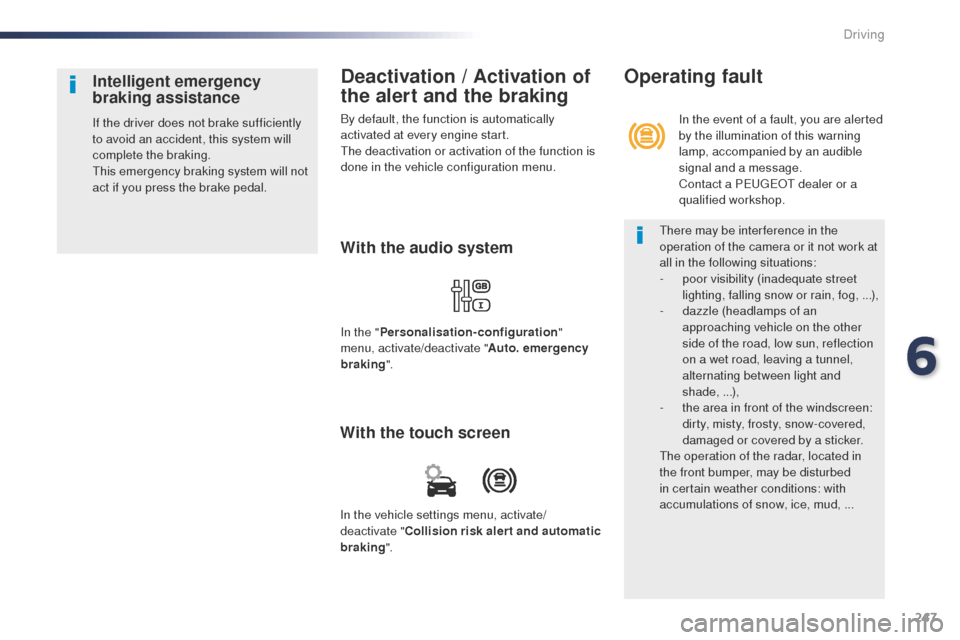
With the audio system
In the " Personalisation-configuration "
menu, activate/deactivate " Auto. emergency
braking ".
Intelligent emergency
braking assistance
If the driver does not brake sufficiently
to avoid an accident, this system will
complete the braking.
th
is emergency braking system will not
act if you press the brake pedal.
With the touch screen
In the vehicle settings menu, activate/
deactivate " Collision risk alert and automatic
braking ". In the event of a fault, you are alerted
by the illumination of this warning
lamp, accompanied by an audible
signal and a message.
Contact a PE
u
g
Eo
t dealer or a
qualified workshop.
Operating fault
there may be interference in the
operation of the camera or it not work at
all in the following situations:
-
p
oor visibility (inadequate street
lighting, falling snow or rain, fog, ...),
-
d
azzle (headlamps of an
approaching vehicle on the other
side of the road, low sun, reflection
on a wet road, leaving a tunnel,
alternating between light and
shade, ...),
-
t
he area in front of the windscreen:
dirty, misty, frosty, snow-covered,
damaged or covered by a sticker.
th
e operation of the radar, located in
the front bumper, may be disturbed
in certain weather conditions: with
accumulations of snow, ice, mud, ...
6
Driving
Page 251 of 599
249
Expert_en_Chap06_conduite_ed01-2016
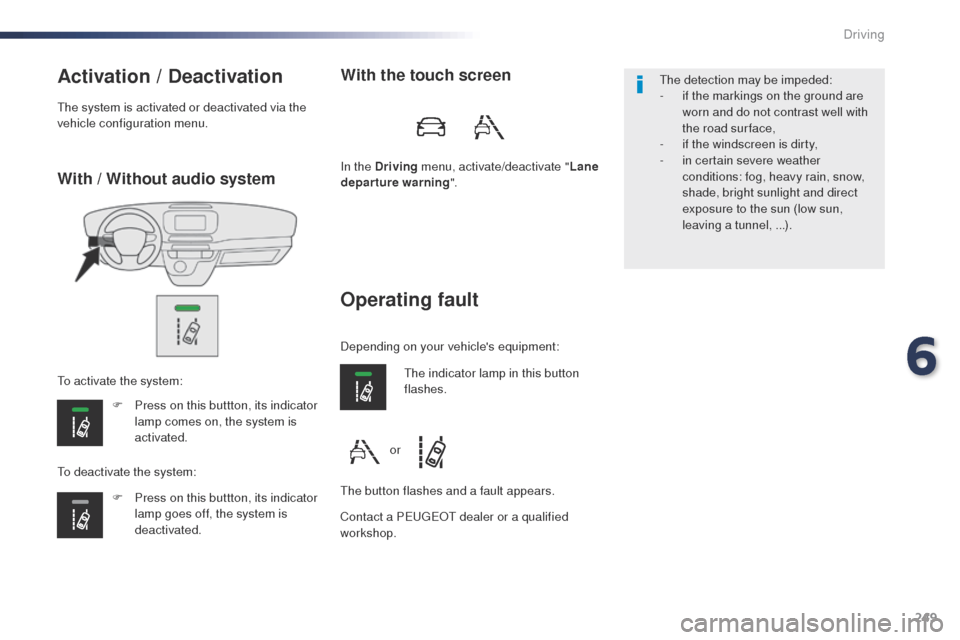
With / Without audio system
Activation / Deactivation
F Press on this buttton, its indicator lamp comes on, the system is
activated.
F
P
ress on this buttton, its indicator
lamp goes off, the system is
deactivated.
to a
ctivate the system:
to d
eactivate the system:
th
e system is activated or deactivated via the
vehicle configuration menu.
Operating fault
With the touch screen
In the Driving menu, activate/deactivate " Lane
departure warning ".
Contact a PE
u
g
Eo
t dealer or a qualified
workshop.
th
e indicator lamp in this button
flashes.
th
e button flashes and a fault appears.
Depending on your vehicle's equipment:
th
e detection may be impeded:
-
i
f the markings on the ground are
worn and do not contrast well with
the road sur face,
-
i
f the windscreen is dirty,
- i n certain severe weather
conditions: fog, heavy rain, snow,
shade, bright sunlight and direct
exposure to the sun (low sun,
leaving a tunnel, ...).
or
6
Driving
Page 253 of 599
251
Expert_en_Chap06_conduite_ed01-2016
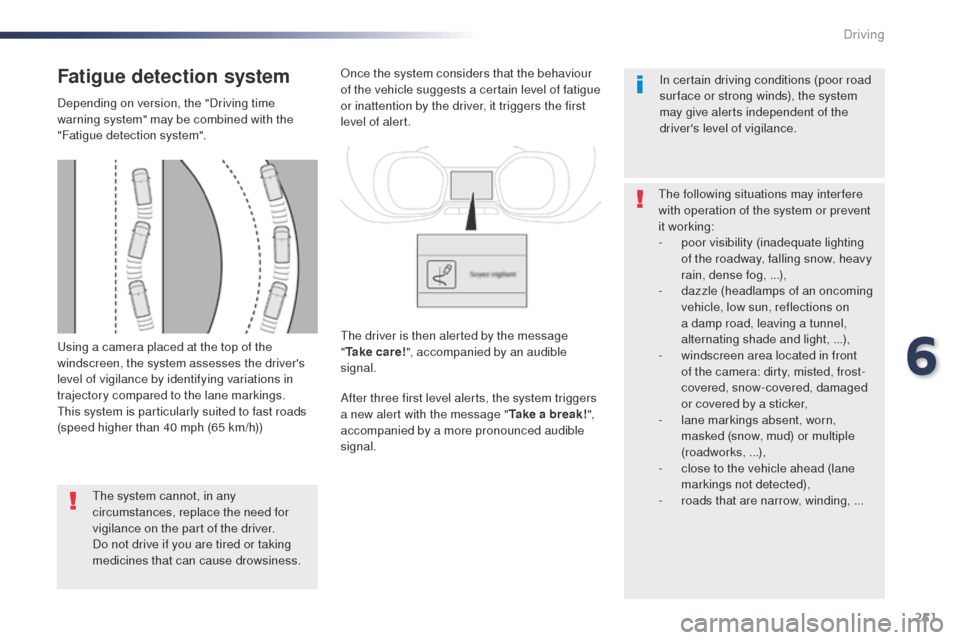
using a camera placed at the top of the
windscreen, the system assesses the driver's
level of vigilance by identifying variations in
trajectory compared to the lane markings.
th
is system is particularly suited to fast roads
(speed higher than 40 mph (65 km/h))
Fatigue detection system
Depending on version, the "Driving time
warning system" may be combined with the
"Fatigue detection system".
th
e system cannot, in any
circumstances, replace the need for
vigilance on the part of the driver.
Do not drive if you are tired or taking
medicines that can cause drowsiness.
on
ce the system considers that the behaviour
of the vehicle suggests a certain level of fatigue
or inattention by the driver, it triggers the first
level of alert.
After three first level alerts, the system triggers
a new alert with the message " Take a break!",
accompanied by a more pronounced audible
signal. In certain driving conditions (poor road
sur face or strong winds), the system
may give alerts independent of the
driver's level of vigilance.
th
e following situations may inter fere
with operation of the system or prevent
it working:
-
p
oor visibility (inadequate lighting
of the roadway, falling snow, heavy
rain, dense fog, ...),
-
d
azzle (headlamps of an oncoming
vehicle, low sun, reflections on
a damp road, leaving a tunnel,
alternating shade and light, ...),
-
w
indscreen area located in front
of the camera: dirty, misted, frost-
covered, snow-covered, damaged
or covered by a sticker,
-
l
ane markings absent, worn,
masked (snow, mud) or multiple
(roadworks, ...),
-
c
lose to the vehicle ahead (lane
markings not detected),
-
r
oads that are narrow, winding, ...
th
e driver is then alerted by the message
" Ta k e c a r e ! ", accompanied by an audible
signal.
6
Driving
Page 254 of 599
252
Expert_en_Chap06_conduite_ed01-2016
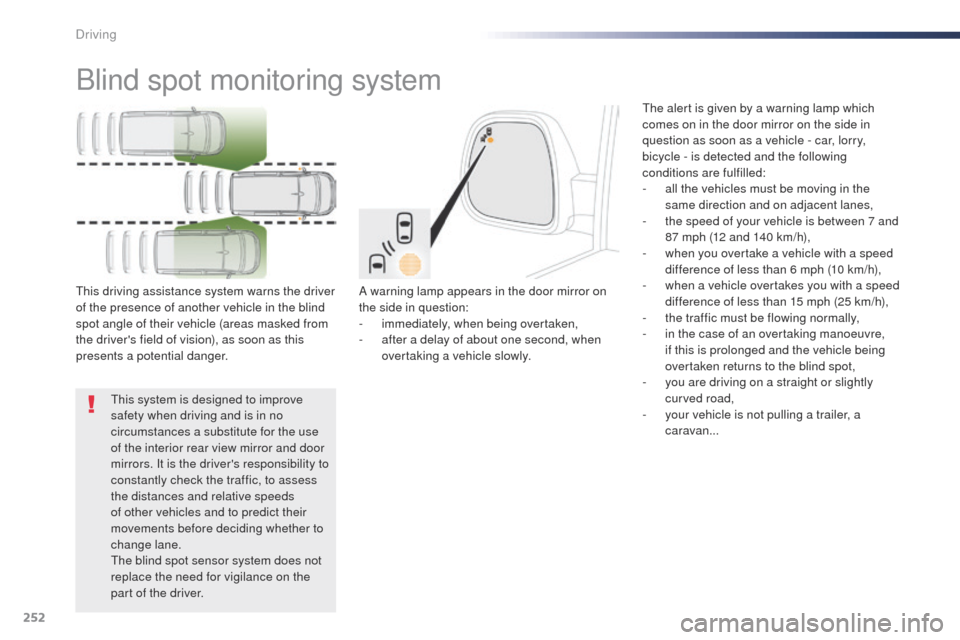
Blind spot monitoring system
A warning lamp appears in the door mirror on
the side in question:
-
i
mmediately, when being overtaken,
-
a
fter a delay of about one second, when
overtaking a vehicle slowly.th
is driving assistance system warns the driver
of the presence of another vehicle in the blind
spot angle of their vehicle (areas masked from
the driver's field of vision), as soon as this
presents a potential danger.
th
e alert is given by a warning lamp which
comes on in the door mirror on the side in
question as soon as a vehicle - car, lorry,
bicycle - is detected and the following
conditions are fulfilled:
-
a
ll the vehicles must be moving in the
same direction and on adjacent lanes,
-
t
he speed of your vehicle is between 7 and
87 mph (12 and 140 km/h),
-
w
hen you overtake a vehicle with a speed
difference of less than 6 mph (10 km/h),
- w hen a vehicle overtakes you with a speed
difference of less than 15 mph (25 km/h),
-
t
he traffic must be flowing normally,
-
i
n the case of an overtaking manoeuvre,
if this is prolonged and the vehicle being
overtaken returns to the blind spot,
-
y
ou are driving on a straight or slightly
curved road,
-
y
our vehicle is not pulling a trailer, a
caravan...
th
is system is designed to improve
safety when driving and is in no
circumstances a substitute for the use
of the interior rear view mirror and door
mirrors. It is the driver's responsibility to
constantly check the traffic, to assess
the distances and relative speeds
of other vehicles and to predict their
movements before deciding whether to
change lane.
th
e blind spot sensor system does not
replace the need for vigilance on the
part of the driver.
Driving
Page 273 of 599
271
Expert_en_Chap07_info-pratiques_ed01-2016
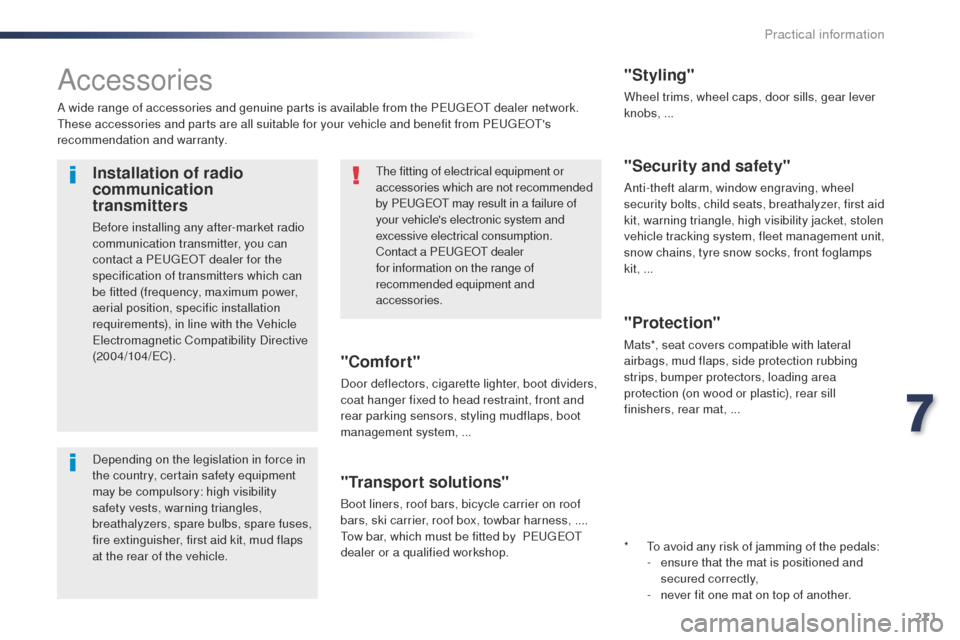
Accessories
A wide range of accessories and genuine parts is available from the PEugEo t dealer network.th
ese accessories and parts are all suitable for your vehicle and benefit from PEu gEo t' s
recommendation and warranty.
"Comfort"
Door deflectors, cigarette lighter, boot dividers,
coat hanger fixed to head restraint, front and
rear parking sensors, styling mudflaps, boot
management system, ...
"Transport solutions"
Boot liners, roof bars, bicycle carrier on roof
bars, ski carrier, roof box, towbar harness, ....
to
w bar, which must be fitted by PE
u
g
Eo
t
dealer or a qualified workshop.
"Styling"
Wheel trims, wheel caps, door sills, gear lever
knobs, ...
"Security and safety"
Anti-theft alarm, window engraving, wheel
security bolts, child seats, breathalyzer, first aid
kit, warning triangle, high visibility jacket, stolen
vehicle tracking system, fleet management unit,
snow chains, tyre snow socks, front foglamps
kit, ...
"Protection"
Mats*, seat covers compatible with lateral
airbags, mud flaps, side protection rubbing
strips, bumper protectors, loading area
protection (on wood or plastic), rear sill
finishers, rear mat,
...
th
e fitting of electrical equipment or
accessories which are not recommended
by PE
u
g
Eo
t
may result in a failure of
your vehicle's electronic system and
excessive electrical consumption.
Contact a PE
u
g
Eo
t
dealer
for information on the range of
recommended equipment and
accessories.
Installation of radio
communication
transmitters
Before installing any after-market radio
communication transmitter, you can
contact a PE
u
g
Eo
t dealer for the
specification of transmitters which can
be fitted (frequency, maximum power,
aerial position, specific installation
requirements), in line with the Vehicle
Electromagnetic Compatibility Directive
(2004/104/EC).
Depending on the legislation in force in
the country, certain safety equipment
may be compulsory: high visibility
safety vests, warning triangles,
breathalyzers, spare bulbs, spare fuses,
fire extinguisher, first aid kit, mud flaps
at the rear of the vehicle. *
t
o a
void any risk of jamming of the pedals:
-
e
nsure that the mat is positioned and
secured correctly,
-
n
ever fit one mat on top of another.
7
Practical information
Page 509 of 599
507
Expert_en_Chap11_index-alpha_ed01-2016
D
E
DAB (Digital Audio Broadcasting) - Digital radio ................... 396, 397, 452, 453, 490, 491
Date (setting)
...............................
....46, 420, 476
Daytime running lamps
.........146, 149, 3 0 4 - 3 0 6
Deactivating the passenger airbag
.......171, 17 7
Deactivation of DSC (ESC)
...........................163
Deadlocking
........................................ 51, 58, 65
Defrosting
.............................................. 132, 14 4
Demisting
...............................
.......................132
Demisting, rear
...................................... 13
3, 13 4
Demisting, rear screen
.........................13 3, 13 4
Diagnostic system, engine
..............................21
Dial
............................................................ 15, 16
Dials and gauges
............................................ 14
Dimensions
........................................... 328-330
Dipstick
................
.................................... 34, 278
Direction indicators
....148, 304, 307, 308, 310, 313, 315
Display, head-up
........................................... 222
Display screen, instrument panel
......14 -16, 2 0 8
Door pockets
................................................. 12
0
Doors
............................................................... 74
Doors, rear
...................................................... 91
Doors, side-hinged
........64, 65, 91-93, 310, 311 EBA
...............................................................161
EBFD
.............................................................161
Eco-driving (advice)
........................................12
Economy mode
.............................................270
Electric windows
.............................................98
Electronic brake force distribution (EBFD)
........................................................161
Emergency call
..................................... 16
0, 338
Emergency warning lamps
................... 1
60, 287
Emissions control system, SCR
.....................27
Energy economy mode
.................................270
Engine compartment
....................................277
Engine, Diesel
............21, 267, 277, 327, 333, 335, 336
Environment
...............................
.12, 54, 70, 139
ESC/ASR
...............................
........................161
ESC (electronic stability control)
....................25
ESC system
.....................................................25
Changing a fuse
............................
316, 317, 320
Changing a wheel
.........................................
296
Changing a wiper blade
........................
15 9 , 2 74
Changing the remote control battery
........
54, 70
Checking the engine oil level
..........................
34
Checking the levels
...............................
278-280
Checking tyre pressures (using the kit)
..............................
................
290
Checks
...............
...........................
277, 281, 282
Checks, routine
.....................................
281, 282
Child lock
...............................
................
19 4, 195
Child lock, electric
...............................
..........
19 4
Child lock on rear windows
...........................
195
Children
...............................
..
182, 187, 188, 190
Children (safety) ...............................
.............
19 4
Child seats
..............................
..... 16 9, 174 -176 ,
180 -182, 18 4, 193
Child seats, conventional
.............. 180 -182, 18 4
Child seats, IS
oF
IX
...................... 1
87, 188, 190
Closing the boot
.............................................. 94
Closing the doors
... 5
9, 64, 74, 75, 77, 82, 91, 93
Collision risk alert
................... 2
3, 243-245, 247
Compressor, tyre inflation
............................ 290
Connection, Bluetooth
.... 380, 406 - 408, 436, 462- 464, 498
Connection, MirrorLink
........ 382, 384, 438, 440
Connection, Wi-Fi network
................... 3 81, 4 37
Connectivity
.......................................... 378, 434
Control, emergency boot release
................... 94
Control, emergency door
..........................53, 68
Control, heated seats
............................ 103, 105
Control stalk, lighting
.............................. 3
0, 146
Control stalk, wipers
............................. 15 6, 157
Courtesy lamp
............................................... 312
Courtesy lamp, front
.............. 141, 142, 312, 315
Courtesy lamp, rear
............... 141, 142, 312, 315
Courtesy lamps
...................... 141, 142, 312, 315
Cover, load space
......................................... 12
3
Crew cab, fixed
............................................. 117Cruise control
................
2
24, 227, 232, 233, 237
Cruise control, adaptive
........................ 2
2 7, 2 3 6
Cruise control by speed limit recognition
.....
2
27
Driver's door open warning
.............................
75
Driver’s fatigue warning
........................ 25
0, 251
Driving abroad ............................................... 148
Driving economically ....................................... 12
Driving time warning
.............................
250, 251
DSC
............................................................... 16
1
Dynamic stability control (DSC)
....................................
25, 161, 163, 16 4
.
Alphabetical index