light Peugeot Expert VU 2016 Workshop Manual
[x] Cancel search | Manufacturer: PEUGEOT, Model Year: 2016, Model line: Expert VU, Model: Peugeot Expert VU 2016Pages: 599, PDF Size: 13.14 MB
Page 261 of 599

259
Expert_en_Chap06_conduite_ed01-2016
180° rear vision
this system allows the near surroundings of the
vehicle to be viewed in the display screen using
cameras located at the rear of the vehicle. t
h
e
parking sensors in the rear and/or front bumper
complete the information on the view from
above the vehicle (right-hand part).
In addition to the view from above the vehicle
(right-hand part) several types of view can be
displayed (left-hand part):
-
s
tandard rear view,
-
1
80° rear view,
-
r
econstructed zoom rear view.
Principle of image
reconstruction
the system displays the contextual view
(left-hand part) as well as the view from above
the vehicle in its close surroundings.
By default, A
u
to
m
atic mode is activated.
In this mode, the system chooses the best view
to display (standard or zoom) according to the
information received from the parking sensors.
th
e 180° view is only available through the
menus.
th
e display disappears above
approximately 6 mph (10 km/h).
th
e system is automatically deactivated
about 7 seconds after coming out of
reverse or on opening a door or the
boot.
th
is system is a visual aid and cannot
in any circumstances replace the need
for vigilance on the part of the driver.
th
e images provided by the cameras
may appear distorted by the
surroundings (exterior conditions,
driving mode, ...).
th
e presence of areas in shadow, bright
sunlight, or poor lighting conditions
may make the image dark and reduce
contrast.
us
ing the rear camera, the system records the
vehicle's surroundings during a manoeuvre.
An image from above your vehicle in its close
surroundings is reconstructed (represented
between the blue brackets) in real time and as
the manoeuvre progresses.
th
is representation facilitates the alignment of
your vehicle when parking and allows you to
see all of the obstacles close to the vehicle.
th
is reconstructed view is automatically erased
if the vehicle remains stationary for too long.
6
Driving
Page 273 of 599
271
Expert_en_Chap07_info-pratiques_ed01-2016
Accessories
A wide range of accessories and genuine parts is available from the PEugEo t dealer network.th
ese accessories and parts are all suitable for your vehicle and benefit from PEu gEo t' s
recommendation and warranty.
"Comfort"
Door deflectors, cigarette lighter, boot dividers,
coat hanger fixed to head restraint, front and
rear parking sensors, styling mudflaps, boot
management system, ...
"Transport solutions"
Boot liners, roof bars, bicycle carrier on roof
bars, ski carrier, roof box, towbar harness, ....
to
w bar, which must be fitted by PE
u
g
Eo
t
dealer or a qualified workshop.
"Styling"
Wheel trims, wheel caps, door sills, gear lever
knobs, ...
"Security and safety"
Anti-theft alarm, window engraving, wheel
security bolts, child seats, breathalyzer, first aid
kit, warning triangle, high visibility jacket, stolen
vehicle tracking system, fleet management unit,
snow chains, tyre snow socks, front foglamps
kit, ...
"Protection"
Mats*, seat covers compatible with lateral
airbags, mud flaps, side protection rubbing
strips, bumper protectors, loading area
protection (on wood or plastic), rear sill
finishers, rear mat,
...
th
e fitting of electrical equipment or
accessories which are not recommended
by PE
u
g
Eo
t
may result in a failure of
your vehicle's electronic system and
excessive electrical consumption.
Contact a PE
u
g
Eo
t
dealer
for information on the range of
recommended equipment and
accessories.
Installation of radio
communication
transmitters
Before installing any after-market radio
communication transmitter, you can
contact a PE
u
g
Eo
t dealer for the
specification of transmitters which can
be fitted (frequency, maximum power,
aerial position, specific installation
requirements), in line with the Vehicle
Electromagnetic Compatibility Directive
(2004/104/EC).
Depending on the legislation in force in
the country, certain safety equipment
may be compulsory: high visibility
safety vests, warning triangles,
breathalyzers, spare bulbs, spare fuses,
fire extinguisher, first aid kit, mud flaps
at the rear of the vehicle. *
t
o a
void any risk of jamming of the pedals:
-
e
nsure that the mat is positioned and
secured correctly,
-
n
ever fit one mat on top of another.
7
Practical information
Page 284 of 599
282
Expert_en_Chap07_info-pratiques_ed01-2016
Manual gearbox
the gearbox does not require any
maintenance (no oil change).
Refer to the manufacturer's service
schedule for the checking interval for
this component.Brake wear depends on the style
of driving, particularly in the case
of vehicles used in town, over short
distances. It may be necessary to
Brake pads
For information on checking brake
disc wear, contact a PEugEo t
dealer or a qualified workshop.
Brake disc wear
only use products recommended by
PEu gEo t or products of equivalent
quality and specification.
In order to optimise the operation of
units as important as those in the
braking system, PE
u
g
Eo
t selects and
offers very specific products.
After washing the vehicle, dampness,
or in wintry conditions, ice can form
on the brake discs and pads: braking
efficiency may be reduced. Make light
brake applications to dry and defrost
the brakes.
Parking brake
If excessive travel or a loss of
effectiveness of this system is
noticed, the parking brake must be
checked, even between two services.
Checking this system must be done by a
PE
u
g
Eo
t dealer or a qualified workshop.
have the condition of the brakes checked, even
between vehicle services.
un
less there is a leak in the circuit, a drop in
the brake fluid level indicates that the brake
pads are worn.
Automatic gearbox
the gearbox does not require any
maintenance (no oil change).
Refer to the manufacturer's service
schedule for the checking interval for
this component.
Electronic gearbox
the gearbox does not require any
maintenance (no oil change).
Refer to the manufacturer's service
schedule for the checking interval for
this component.
Practical information
Page 287 of 599
285
Expert_en_Chap07_info-pratiques_ed01-2016
Recommendations on storage
Never store bottles of AdBlue® in your
vehicle.
AdBlue
® freezes at about -11°C and
deteriorates above 25°C. It is recommended
that bottles be stored in a cool area and
protected from direct sunlight.
un
der these conditions, the fluid can be kept
for at least a year.
If the additive has frozen, it can be used once it
has completely thawed out.
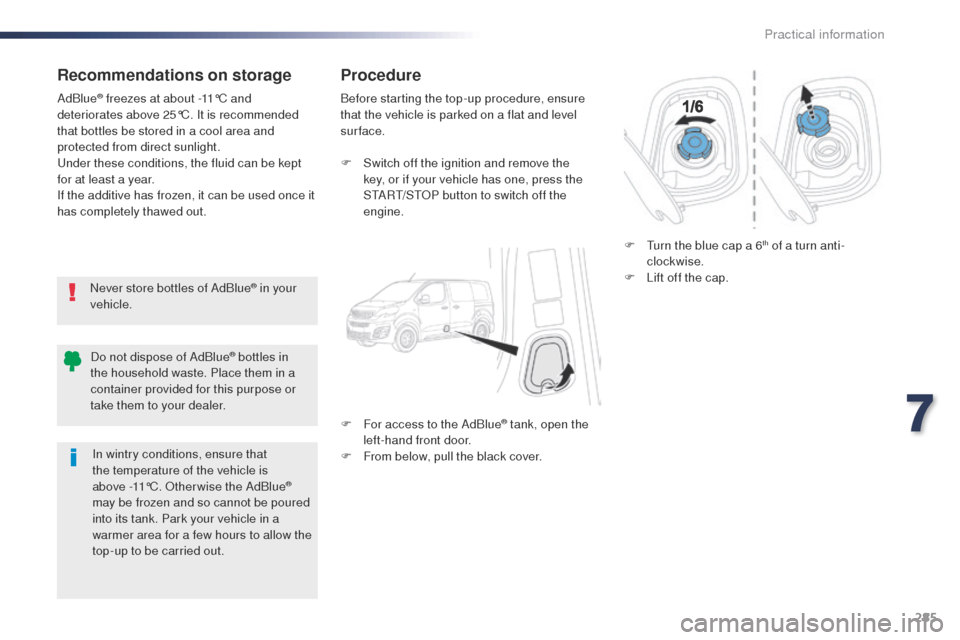
Procedure
Before starting the top-up procedure, ensure
that the vehicle is parked on a flat and level
sur face.
F
S
witch off the ignition and remove the
key, or if your vehicle has one, press the
S
tA
R
t/
S
t
o
P b
utton to switch off the
engine.
F
F
or access to the AdBlue
® tank, open the
left-hand front door.
F
F
rom below, pull the black cover. F
t
u
rn the blue cap a 6
th of a turn anti-
clockwise.
F
L
ift off the cap.
Do not dispose of AdBlue
® bottles in
the household waste. Place them in a
container provided for this purpose or
take them to your dealer.
In wintry conditions, ensure that
the temperature of the vehicle is
above
-11°C.
o
t
her wise the AdBlue
®
may be frozen and so cannot be poured
into its tank. Park your vehicle in a
warmer area for a few hours to allow the
top-up to be carried out.
7
Practical information
Page 290 of 599
288
Expert_en_Chap08_En-cas-de-panne_ed01-2016
Stowing
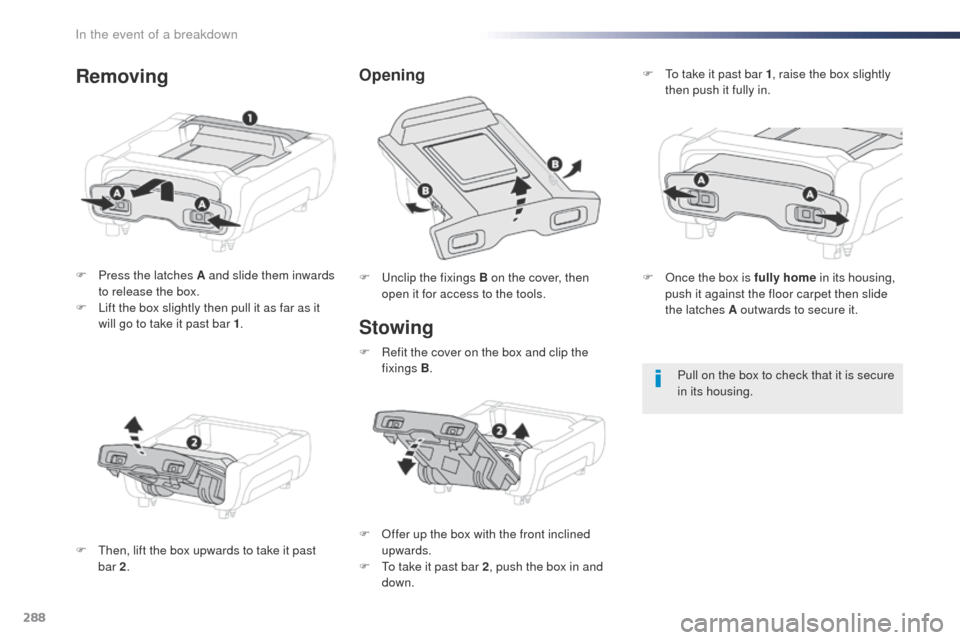
F Press the latches A and slide them inwards to release the box.
F
L
ift the box slightly then pull it as far as it
will go to take it past bar 1 .
F
t
h
en, lift the box upwards to take it past
bar 2 . F
un clip the fixings B on the cover, then
open it for access to the tools.
OpeningRemoving
Pull on the box to check that it is secure
in its housing.
F
o
f
fer up the box with the front inclined
upwards.
F
t
o t
ake it past bar 2 , push the box in and
down. F
t
o t
ake it past bar 1
, raise the box slightly
then push it fully in.
F
R
efit the cover on the box and clip the
fixings B . F
o
n
ce the box is fully home
in its housing,
push it against the floor carpet then slide
the latches A outwards to secure it.
In the event of a breakdown
Page 305 of 599
303
Expert_en_Chap08_En-cas-de-panne_ed01-2016
Changing a bulb
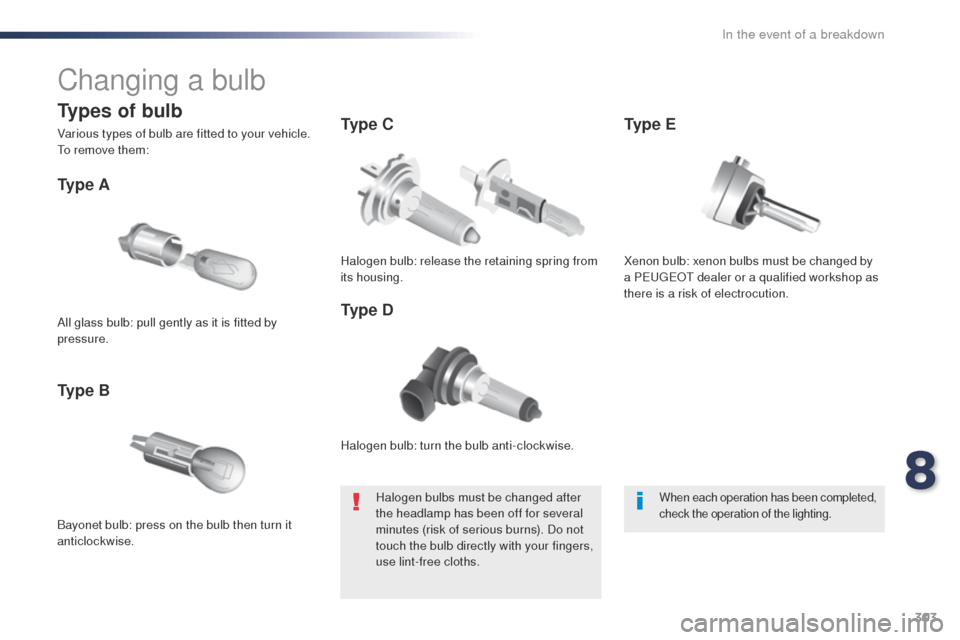
Halogen bulb: turn the bulb anti-clockwise.
Ty p e A
Bayonet bulb: press on the bulb then turn it
anticlockwise.
Ty p e BTy p e C
Ty p e D
All glass bulb: pull gently as it is fitted by
pressure.
Halogen bulb: release the retaining spring from
its housing.
Halogen bulbs must be changed after
the headlamp has been off for several
minutes (risk of serious burns). Do not
touch the bulb directly with your fingers,
use lint-free cloths.
When each operation has been completed,
check the operation of the lighting.
Types of bulb
Various types of bulb are fitted to your vehicle. to remove them:
Xenon bulb: xenon bulbs must be changed by
a PE
u
g
Eo
t dealer or a qualified workshop as
there is a risk of electrocution.Ty p e E
8
In the event of a breakdown
Page 306 of 599
304
Expert_en_Chap08_En-cas-de-panne_ed01-2016
Front lamps
Xenon headlamps
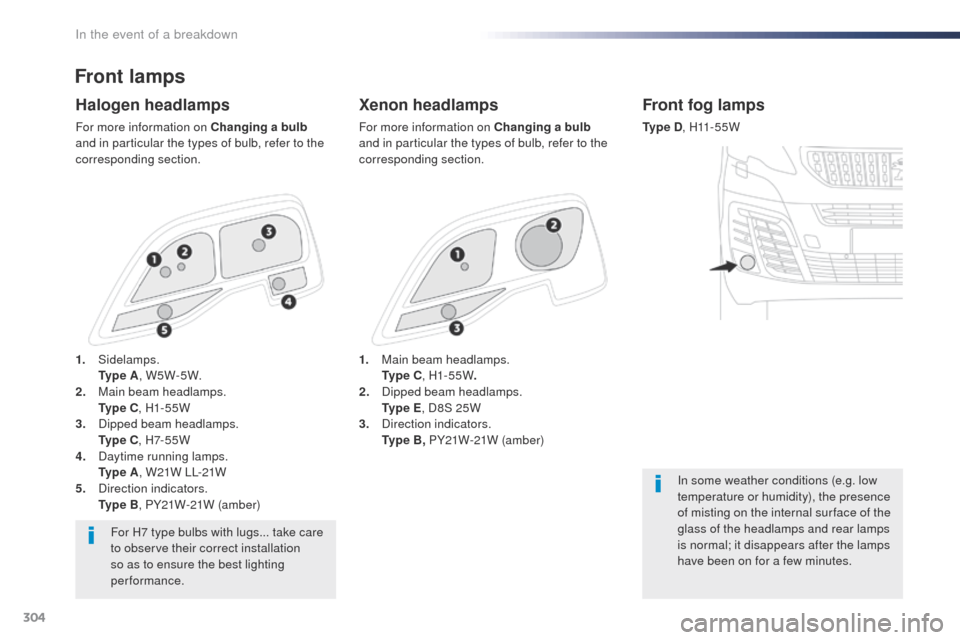
For more information on Changing a bulb
and in particular the types of bulb, refer to the
corresponding section.
Halogen headlamps
For more information on Changing a bulb
and in particular the types of bulb, refer to the
corresponding section.
For H7 type bulbs with lugs... take care
to observe their correct installation
so as to ensure the best lighting
performance.
Front fog lamps
Ty p e D , H11 - 5 5 W
In some weather conditions (e.g. low
temperature or humidity), the presence
of misting on the internal sur face of the
glass of the headlamps and rear lamps
is normal; it disappears after the lamps
have been on for a few minutes.
1.
M
ain beam headlamps.
Ty
p e C , H1- 55W.
2.
D
ipped beam headlamps.
Ty
p e E , D8S 25W
3.
D
irection indicators.
Ty
p e B , PY21W-21W (amber)
1.
Sidelamps.
Ty
p e A , W5W-5W.
2.
M
ain beam headlamps.
Ty
p e C , H1- 55W
3.
D
ipped beam headlamps.
Ty
p e C , H7- 5 5 W
4.
D
aytime running lamps.
Ty
p e A , W21W LL-21W
5.
D
irection indicators.
Ty
p e B , PY21W-21W (amber)
In the event of a breakdown
Page 307 of 599
305
Expert_en_Chap08_En-cas-de-panne_ed01-2016
Direction indicator side
repeater
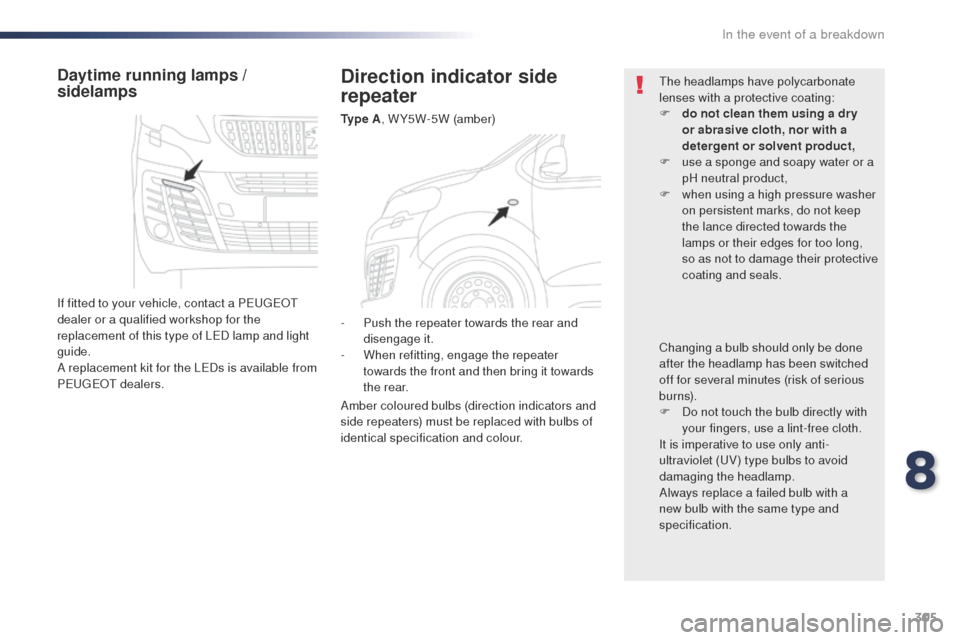
Ty p e A, W Y5W-5W (amber)
Daytime running lamps /
sidelamps
If fitted to your vehicle, contact a PEu gEo t
dealer or a qualified workshop for the
replacement of this type of LED lamp and light
guide.
A replacement kit for the LEDs is available from
PE
u
g
Eo
t
d
ealers.
th
e headlamps have polycarbonate
lenses with a protective coating:
F
d
o not clean them using a dr y
or abrasive cloth, nor with a
detergent or solvent product,
F
u
se a sponge and soapy water or a
pH neutral product,
F
w
hen using a high pressure washer
on persistent marks, do not keep
the lance directed towards the
lamps or their edges for too long,
so as not to damage their protective
coating and seals.
Changing a bulb should only be done
after the headlamp has been switched
off for several minutes (risk of serious
burns).
F
D
o not touch the bulb directly with
your fingers, use a lint-free cloth.
It is imperative to use only anti-
ultraviolet (
uV
) type bulbs to avoid
damaging the headlamp.
Always replace a failed bulb with a
new bulb with the same type and
specification.
-
P
ush the repeater towards the rear and
disengage it.
-
W
hen refitting, engage the repeater
towards the front and then bring it towards
the rear.
Amber coloured bulbs (direction indicators and
side repeaters) must be replaced with bulbs of
identical specification and colour.
8
In the event of a breakdown
Page 312 of 599
310
Expert_en_Chap08_En-cas-de-panne_ed01-2016
Rear lamps
(side-hinged rear doors)
For more information on Changing a bulb and
in particular, the types of bulbs, refer to the
corresponding section.
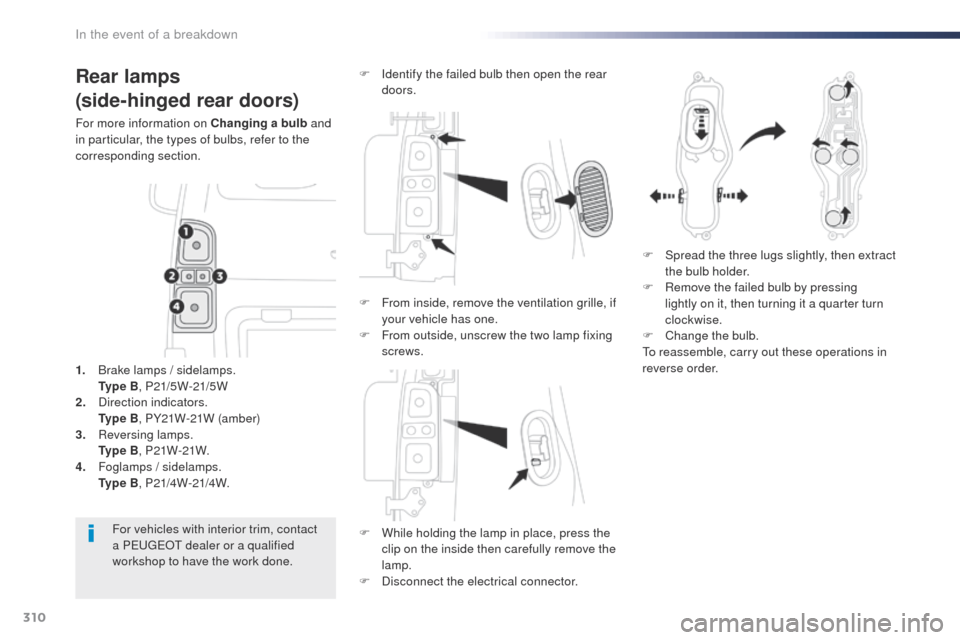
F
W
hile holding the lamp in place, press the
clip on the inside then carefully remove the
lamp.
F
D
isconnect the electrical connector.
For vehicles with interior trim, contact
a PE
u
g
Eo
t dealer or a qualified
workshop to have the work done.
1.
B
rake lamps / sidelamps.
Ty
p e B, P21/5W-21/5W
2.
D
irection indicators.
Ty
p e B, PY21W-21W (amber)
3.
R
eversing lamps.
Ty
p e B, P21W-21W.
4.
F
oglamps / sidelamps.
Ty
p e B, P21/4W-21/4W. F
I
dentify the failed bulb then open the rear
doors.
F
S
pread the three lugs slightly, then extract
the bulb holder.
F
R
emove the failed bulb by pressing
lightly on it, then turning it a quarter turn
clockwise.
F
C
hange the bulb.
to r
eassemble, carry out these operations in
reverse order.
F
F
rom inside, remove the ventilation grille, if
your vehicle has one.
F
F
rom outside, unscrew the two lamp fixing
screws.
In the event of a breakdown
Page 315 of 599
313
Expert_en_Chap08_En-cas-de-panne_ed01-2016
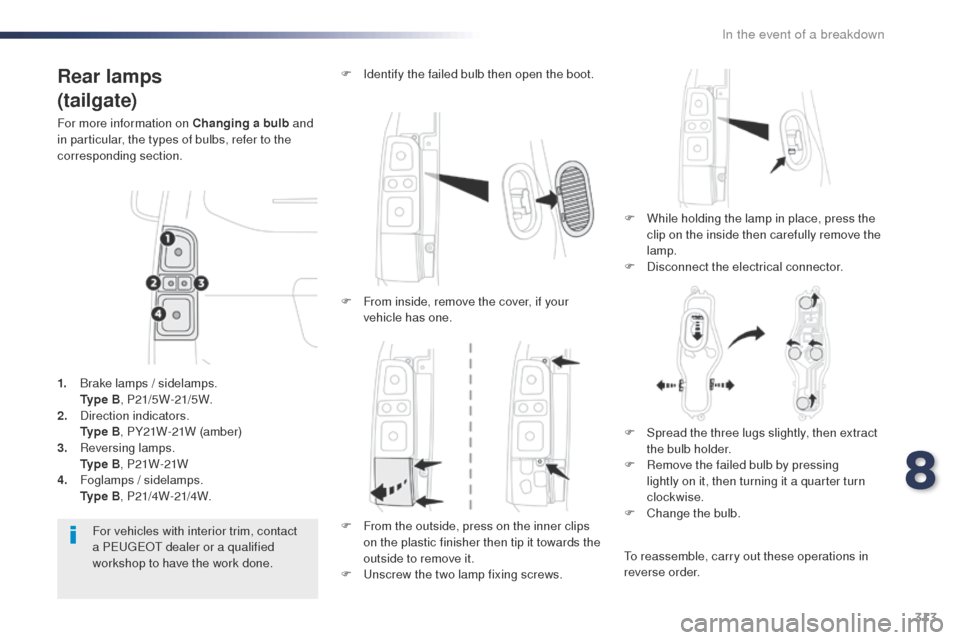
Rear lamps
(tailgate)
For more information on Changing a bulb and
in particular, the types of bulbs, refer to the
corresponding section.
F
W
hile holding the lamp in place, press the
clip on the inside then carefully remove the
lamp.
F
D
isconnect the electrical connector.
F
I
dentify the failed bulb then open the boot.
For vehicles with interior trim, contact
a PE
u
g
Eo
t dealer or a qualified
workshop to have the work done.
1.
B
rake lamps / sidelamps.
Ty
p e B, P21/5W-21/5W.
2.
D
irection indicators.
Ty
p e B, PY21W-21W (amber)
3.
R
eversing lamps.
Ty
p e B, P21W-21W
4.
F
oglamps / sidelamps.
Ty
p e B, P21/4W-21/4W. F
F
rom inside, remove the cover, if your
vehicle has one.
F
F
rom the outside, press on the inner clips
on the plastic finisher then tip it towards the
outside to remove it.
F
u
n
screw the two lamp fixing screws.F
S
pread the three lugs slightly, then extract
the bulb holder.
F
R
emove the failed bulb by pressing
lightly on it, then turning it a quarter turn
clockwise.
F
C
hange the bulb.
to r
eassemble, carry out these operations in
reverse order.
8
In the event of a breakdown