dimensions PEUGEOT LANDTREK 2023 Owners Manual
[x] Cancel search | Manufacturer: PEUGEOT, Model Year: 2023, Model line: LANDTREK, Model: PEUGEOT LANDTREK 2023Pages: 164, PDF Size: 6.1 MB
Page 5 of 164
3
Contents
Checks 100
AdBlue® (BlueHDi) 103
Maintenance 105
Free-wheeling 111
Advice on care and maintenance 111
8In the event of a breakdownWarning triangle 11 4
Fire extinguisher 11 4
Running out of fuel (Diesel) 11 5
Tool kit 11 5
Spare wheel 11 6
Changing a bulb 120
Fuses 124
12
V battery 124
Towing the vehicle 128
9Technical dataEngine technical data and towed loads 131
Petrol engines 132
Diesel engines 133
Dimensions 135
Identification markings 135
10Bluetooth® audio systemMenus 137
Steering mounted controls 138
Radio 138
Media 139
Telephone 139
11Peugeot Connect 10" TouchscreenFirst steps 141
Steering mounted controls 141
Menus 142
Navigation 143
Radio 143
Music player 143
Telephone 144
Applications 145
Settings 146
12Vehicle data recording and privacy
■
Alphabetical index CarM an uals 2 .c o m
Page 68 of 164
66
Driving
Driving recommendations
► Observe the driving regulations and remain
vigilant whatever the traffic conditions.
►
Monitor your environment and keep your
hands on the wheel to be able to react to
anything that may happen any time.
►
Drive smoothly
, anticipate the need for
braking and maintain a longer safety distance,
especially in bad weather.
►
Stop the vehicle before performing operations
that require sustained attention (e.g.
settings).
►
During long trips, take a break every 2 hours.
T
o ensure the durability of the vehicle and
for safety reasons, remember that certain
precautionary measures must be taken when
driving the vehicle:
Manoeuvre cautiously, at low speed
Manoeuvre slowly.
Before turning, check that there are no obstacles
at mid-height along the sides.
Before reversing, check that there are no
obstacles, particularly at high level behind the
vehicle.
Load the vehicle correctly
Observe the Gross Train Weight.
To avoid unbalancing the vehicle, centre the
load, placing the heaviest part on the floor in
front of the rear wheels.
Observe the maximum weight for the roof
anchoring points, communicated by a PEUGEOT
dealer. Loads must be securely lashed down.
Loads that are not properly secured in the
loading bay can disturb the vehicle’s behaviour
and cause an accident.
The dimensions of the load in the loading
bay
must respect the (overall) dimensions of the
vehicle.
Drive the vehicle carefully
Take corners gently.
Anticipate the need to brake as the stopping
distance is increased, particularly on wet or icy
roads.
Be aware of the effect of side winds on the
vehicle.
Avoid rough manoeuvres; improper driving can
lead to loss of control of the vehicle.
Precautions for off-road driving
Before driving off-road:
– Check the engine oil level.
–
Check the condition of the wheels and tyres.
–
Make sure that you transport the tool kit as
well as specialised equipment adapted to the
terrain.
Driving on uneven terrain or roads increases the
risk of the vehicle being damaged and the driver
or passengers being injured. Drive carefully
according to the conditions of the terrain.
–
Fasten seat belts (even at low speed).
–
Do not hold the steering wheel on the inside
or by its spokes (risk of injury due to the wheel
spinning back).
– Do not accelerate suddenly and do not drive at
excessive speed.
–
Do not make sharp turns.
–
A
void dangerous areas and avoid hitting
obstacles.
–
Do not drive perpendicularly or turn around on
a steep slope (risk of tipping over). Go up/down
or reverse in a straight line (with reverse gear
engaged if reversing).
–
Never reverse on a steep slope in neutral or
with the clutch pedal depressed (with a manual
gearbox).
On a descent, the vehicle speed can increase
without any action on the accelerator pedal.
In this case, use the engine brake to slow the
vehicle down. If necessary
, depress the brake
pedal without using it for an extended period
(risk of overheating the braking system).
As a precautionary measure, anticipate the
arrival at the top of a slope (steep slope on the
other side or presence of obstacle).
It is recommended to clean the brakes
regularly after driving off-road. In the
event of noise or loss of braking efficiency, it
is essential to visit a PEUGEOT dealer or a
qualified workshop to have the braking
system checked.
Maintenance
Inflate to the minimum pressure indicated on the
label, or even over-inflate by 0.2 to 0.3 bar for
long journeys. CarM an uals 2 .c o m
Page 137 of 164
135
Technical data
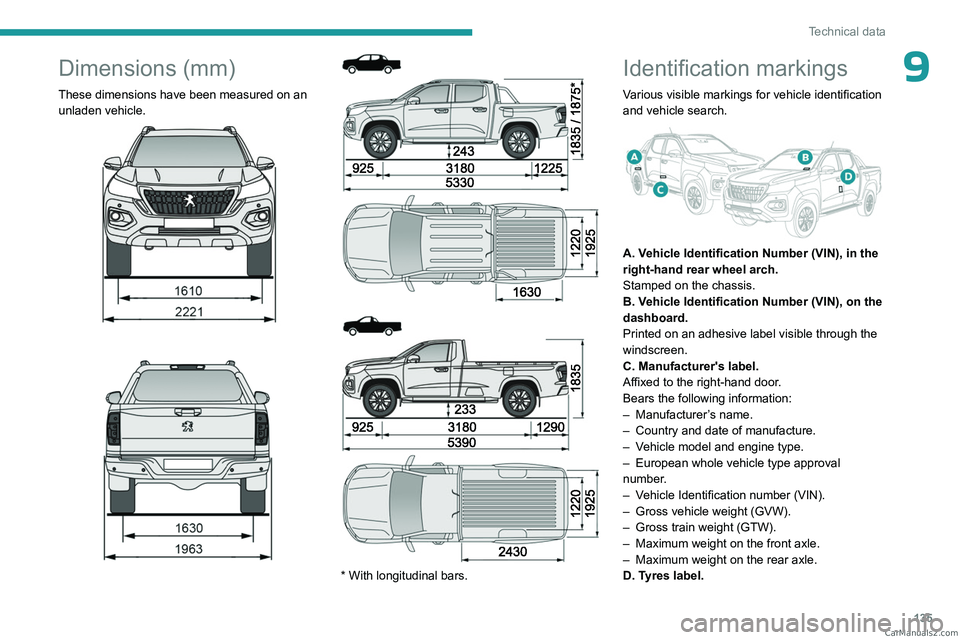
9Dimensions (mm)
These dimensions have been measured on an unladen vehicle.
* With longitudinal bars.
Identification markings
Various visible markings for vehicle identification
and vehicle search.
A. Vehicle Identification Number (VIN), in the
right-hand rear wheel arch.
Stamped on the chassis.
B. Vehicle Identification Number (VIN), on the
dashboard.
Printed on an adhesive label visible through the
windscreen.
C. Manufacturer's label.
Affixed to the right-hand door.
Bears the following information:
–
Manufacturer
’s name.
–
Country and date of manufacture.
–
V
ehicle model and engine type.
–
European whole vehicle type approval
number
.
–
V
ehicle Identification number (VIN).
–
Gross vehicle weight (GVW).
–
Gross train weight (GTW).
–
Maximum weight on the front axle.
–
Maximum weight on the rear axle.
D. T
yres label. CarM an uals 2 .c o m
Page 138 of 164
136
Technical data
Affixed to the left-hand door.
Bears the following information about the tyres:
–
T
yre pressures, unladen and laden.
–
T
yre specification, made up of the dimensions
and type.
–
Spare tyre inflation pressure.
The vehicle may be originally equipped with tyres with higher load and speed
indices than those indicated on the label,
without affecting tyre pressure (on cold tyres).
In the event of a change in the type of tyres,
contact a PEUGEOT dealer for the tyre fits
approved for the vehicle. CarM an uals 2 .c o m
Page 154 of 164
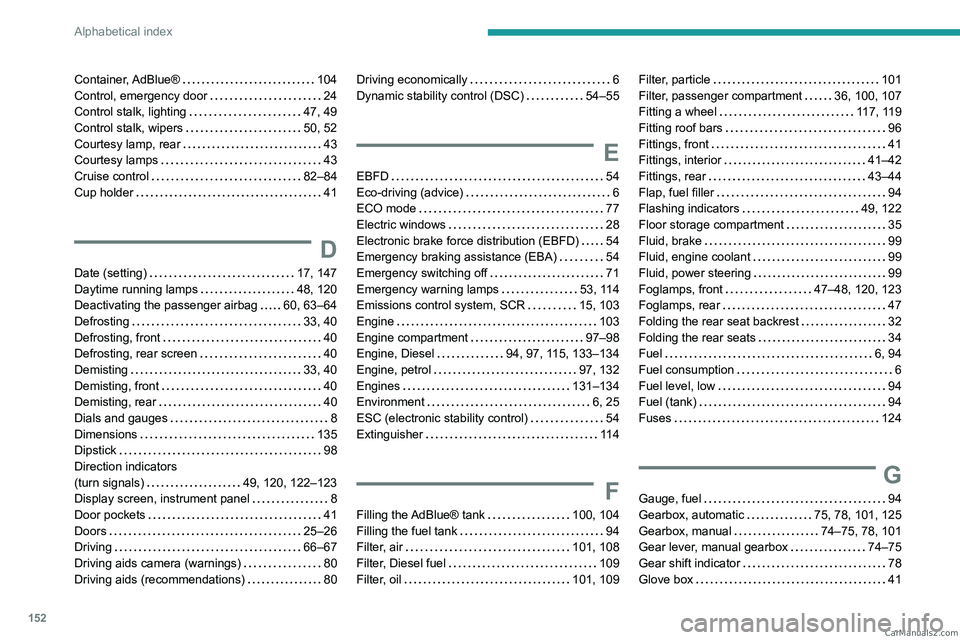
152
Alphabetical index
Container, AdBlue® 104
Control, emergency door
24
Control stalk, lighting
47, 49
Control stalk, wipers
50, 52
Courtesy lamp, rear
43
Courtesy lamps
43
Cruise control
82–84
Cup holder
41
D
Date (setting) 17, 147
Daytime running lamps
48, 120
Deactivating the passenger airbag
60, 63–64
Defrosting
33, 40
Defrosting, front
40
Defrosting, rear screen
40
Demisting
33, 40
Demisting, front
40
Demisting, rear
40
Dials and gauges
8
Dimensions
135
Dipstick
98
Direction indicators
(turn signals)
49, 120, 122–123
Display screen, instrument panel
8
Door pockets
41
Doors
25–26
Driving
66–67
Driving aids camera (warnings)
80
Driving aids (recommendations)
80
Driving economically 6
Dynamic stability control (DSC)
54–55
E
EBFD 54
Eco-driving (advice)
6
ECO mode
77
Electric windows
28
Electronic brake force distribution (EBFD)
54
Emergency braking assistance (EBA)
54
Emergency switching off
71
Emergency warning lamps
53, 114
Emissions control system, SCR
15, 103
Engine
103
Engine compartment
97–98
Engine, Diesel
94, 97, 115, 133–134
Engine, petrol
97, 132
Engines
131–134
Environment
6, 25
ESC (electronic stability control)
54
Extinguisher
11 4
F
Filling the AdBlue® tank 100, 104
Filling the fuel tank
94
Filter, air
101, 108
Filter, Diesel fuel
109
Filter, oil
101, 109
Filter, particle 101
Filter, passenger compartment
36, 100, 107
Fitting a wheel
117, 119
Fitting roof bars
96
Fittings, front
41
Fittings, interior
41–42
Fittings, rear
43–44
Flap, fuel filler
94
Flashing indicators
49, 122
Floor storage compartment
35
Fluid, brake
99
Fluid, engine coolant
99
Fluid, power steering
99
Foglamps, front
47–48, 120, 123
Foglamps, rear
47
Folding the rear seat backrest
32
Folding the rear seats
34
Fuel
6, 94
Fuel consumption
6
Fuel level, low
94
Fuel (tank)
94
Fuses
124
G
Gauge, fuel 94
Gearbox, automatic
75, 78, 101, 125
Gearbox, manual
74–75, 78, 101
Gear lever, manual gearbox
74–75
Gear shift indicator
78
Glove box
41 CarM an uals 2 .c o m