bonnet Peugeot Partner 2016 User Guide
[x] Cancel search | Manufacturer: PEUGEOT, Model Year: 2016, Model line: Partner, Model: Peugeot Partner 2016Pages: 260, PDF Size: 8.83 MB
Page 53 of 260
51
Partner-2-Vu_en_Chap03_Pret-a-partir_ed02-2015
Reactivation
Press the "ECO OFF" switch again.
The system is active again; this is
confirmed by the switch warning
lamp going off and a message in the
instrument panel.The system is reactivated
automatically at every new start
using the key.
Operating fault
In the event of a malfunction
with the system, the "ECO
OFF" switch warning lamp
flashes, then comes on
continuously.
have it checked by a PEUGEOT dealer
or a qualified workshop.
In the event of a fault in STOP mode,
the vehicle may stall. All of the warning
lamps in the instrument panel come
on. It is then necessary to switch off
the ignition and start the engine again
using the key.
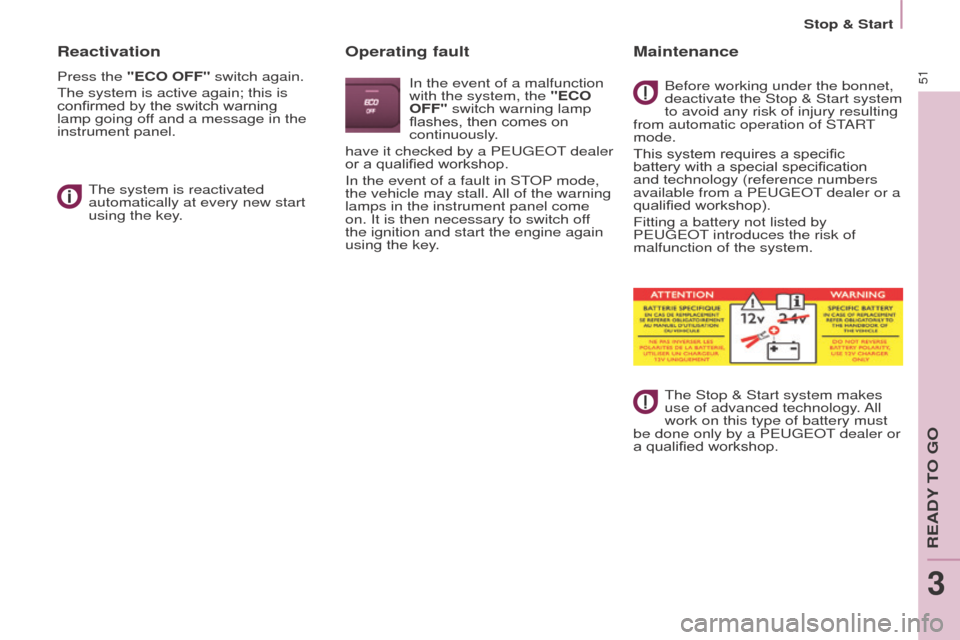
Maintenance
Before working under the bonnet,
deactivate the Stop & Start system
to avoid any risk of injury resulting
from automatic operation of START
mode.
This system requires a specific
battery with a special specification
and technology (reference numbers
available from a PEUGEOT dealer or a
qualified workshop).
Fitting a battery not listed by
PEUGEOT
introduces the risk of
malfunction of the system.
The Stop & Start system makes
use of advanced technology. All
work on this type of battery must
be done only by a PEUGEOT dealer or
a qualified workshop.
READY TO GO
3
Stop & Start
Page 54 of 260
52
Starting and switching off
Partner-2-Vu_en_Chap03_Pret-a-partir_ed02-2015
Good practice when stopping Good practice when starting
Diesel pre-heating warning
lamp
If the temperature is high
enough, the warning lamp
comes on for less than
one second, you can start
without waiting.
In cold weather, wait for this warning
lamp to go off then operate the starter
(Starting position) until the engine
starts.
Door or bonnet open warning lamp
If this comes on, a door or the
bonnet is not closed correctly, check!
Minimise engine and gearbox wear
When switching off the ignition, let the
engine run for a few seconds to allow
the turbocharger (Diesel engine) to
return to idle.
Do not press the accelerator when
switching off the ignition.
There is no need to engage a gear
after parking the vehicle.
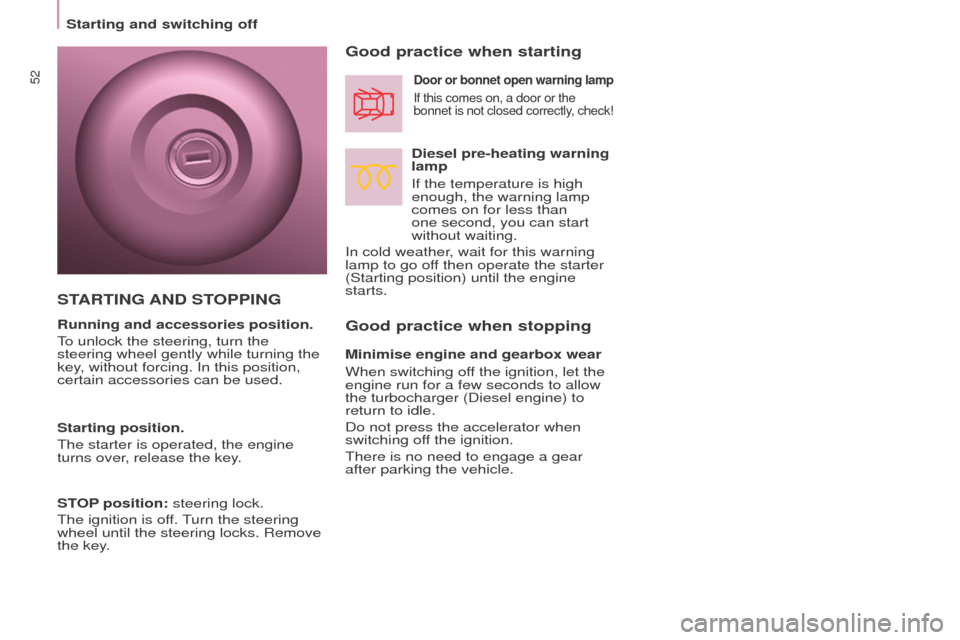
STARTING AND ST OPPING
Running and accessories position.
To unlock the steering, turn the
steering wheel gently while turning the
key, without forcing. In this position,
certain accessories can be used.
Starting position.
The starter is operated, the engine
turns over, release the key.
STOP position: steering lock.
The ignition is off. Turn the steering
wheel until the steering locks. Remove
the key.
Page 101 of 260
99
Driving safely
Partner-2-Vu_en_Chap05_Securite_ed02-2015
Operation
When your vehicle is too close to or
approaches the vehicle ahead too
quickly the system automatically
applies the brakes to avoid a collision.
You are then alerted by the display of a
message.
The brake lamps on your vehicle come
on to warn other road users.
The collision can be avoided
automatically if the difference in
speed between your vehicle and the
vehicle ahead does not exceed 9 mph
(15 km/h).
Above this threshold, the system will
do what is possible to avoid or reduce
the accident by lowering the speed of
impact.
The automatic braking may bring
the vehicle to a complete stop if the
situation requires it.
In this case, the vehicle is held
stationary temporarily (for about
1.5
seconds) to allow the driver to take
back control by pressing the brake
pedal. The triggering of the system may
cause the engine to stall, unless
the driver depresses the clutch
pedal quickly enough during
automatic braking.
During automatic braking, the
driver can always obtain a higher
rate of deceleration than that
controlled by the system, by pressing
firmly on the brake pedal.
After an impact, the system is
automatically put out of service: it
no longer operates.
You must go to a PEUGEOT dealer
or a qualified workshop to have the
system made operational again.
Operating limits
The system only detects vehicles that
are stationary or moving in the same
direction as your vehicle.
It does not detect small vehicles
(bicycles, motorcycles),
pedestrians or animals, nor non-
reflective stationary objects.
The system is not triggered or is
interrupted if the driver:
-
accelerates strongly
-
or turns the steering wheel
suddenly (avoiding manoeuvre). In difficult weather conditions (very
heavy rain, snow
, fog, hail...),
braking distances increase, which
can reduce the ability of the system to
avoid a collision.
The driver must therefore remain
particularly vigilant.
Never leave accumulations of
snow or any object projecting
above the bonnet or in front of
the roof: this might fall into the field of
vision of the sensor and generate a
detection.
SAFETY
5
Page 126 of 260
124
Partner-2-Vu_en_Chap07_Verification_ed02-2015
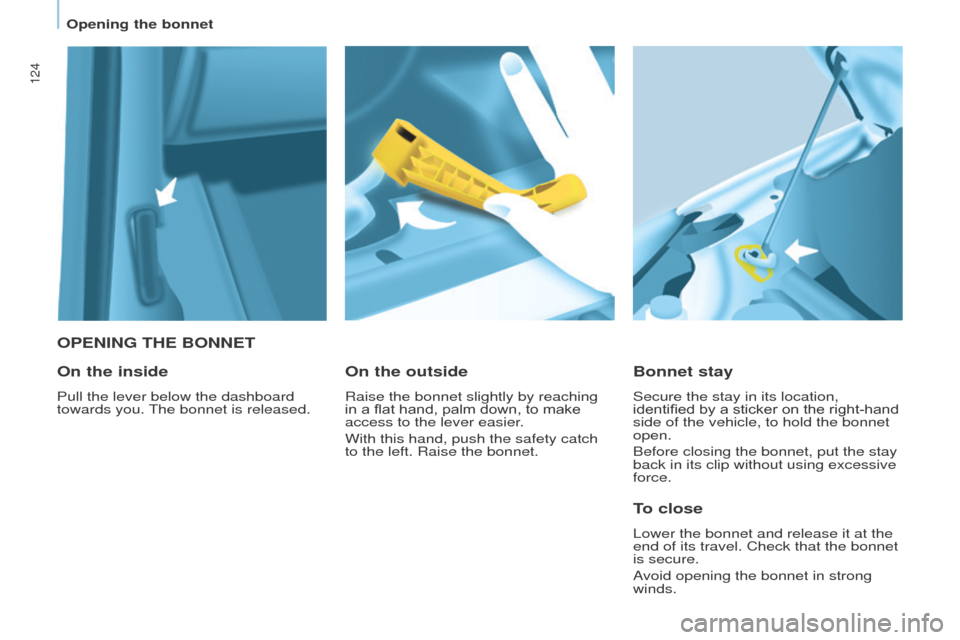
OPENING THE BONNET
Bonnet stay
Secure the stay in its location,
identified by a sticker on the right-hand
side of the vehicle, to hold the bonnet
open.
Before closing the bonnet, put the stay
back in its clip without using excessive
force.
On the outside
Raise the bonnet slightly by reaching
in a flat hand, palm down, to make
access to the lever easier.
With this hand, push the safety catch
to the left. Raise the bonnet.
On the inside
Pull the lever below the dashboard
towards you. The bonnet is released.
To close
Lower the bonnet and release it at the
end of its travel. Check that the bonnet
is secure.
Avoid opening the bonnet in strong
winds.
Opening the bonnet
Page 127 of 260
125
Partner-2-Vu_en_Chap07_Verification_ed02-2015
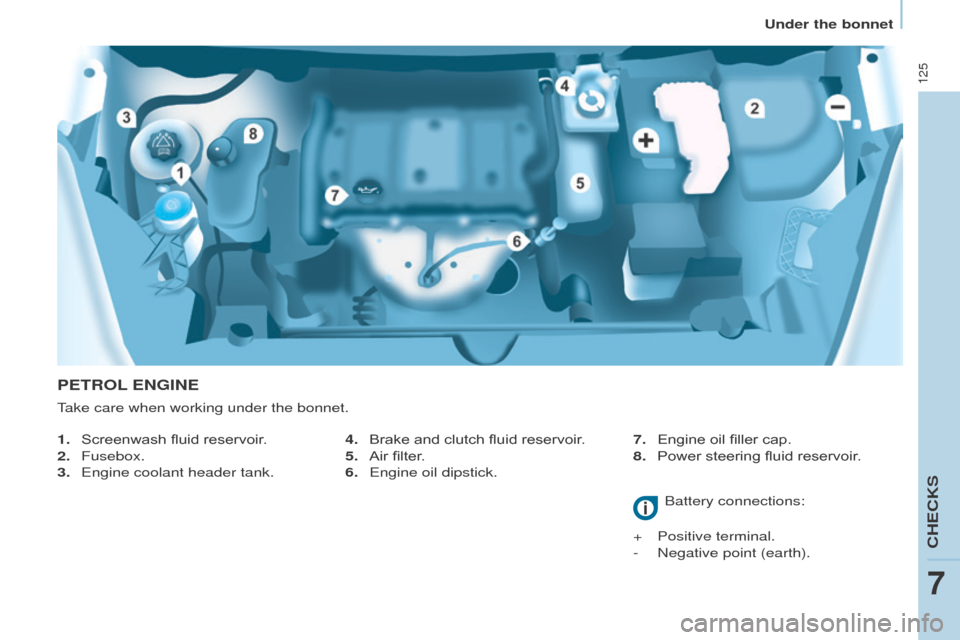
PETROL ENGINE
1. Screenwash fluid reservoir .
2.
Fusebox.
3.
Engine coolant header tank. Battery connections:
+
Positive terminal.
-
Negative point (earth).
T
ake care when working under the bonnet.
4. Brake and clutch fluid reservoir .
5.
Air filter
.
6.
Engine oil dipstick.7.
Engine oil filler cap.
8.
Power steering fluid reservoir
.
CHECKS
7
Under the bonnet
Page 128 of 260
126
Partner-2-Vu_en_Chap07_Verification_ed02-2015
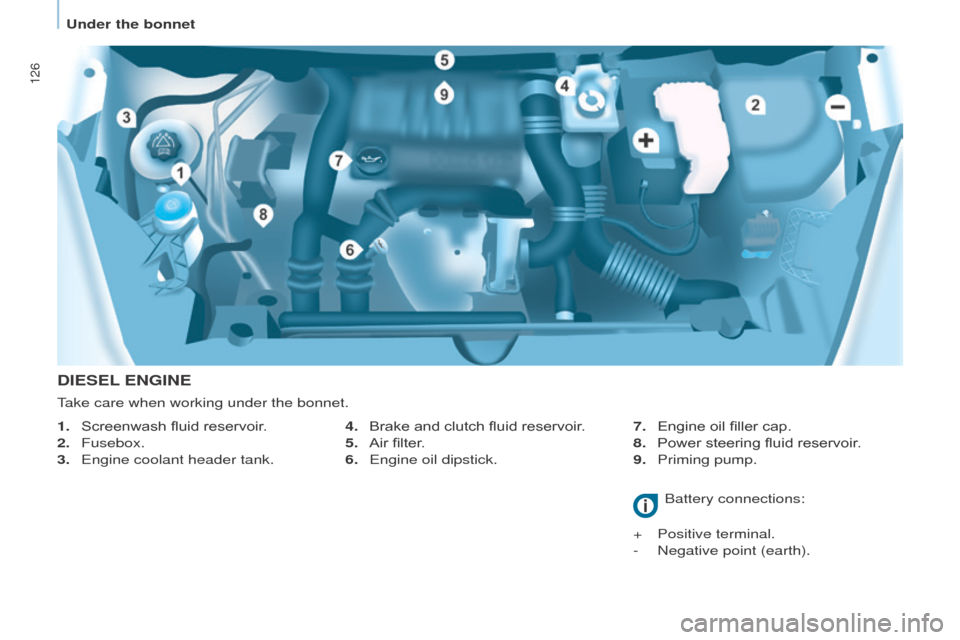
DIESEL ENGINE
4. Brake and clutch fluid reservoir .
5.
Air filter
.
6.
Engine oil dipstick. 7.
Engine oil filler cap.
8.
Power steering fluid reservoir
.
9.
Priming pump.
1.
Screenwash fluid reservoir
.
2.
Fusebox.
3.
Engine coolant header tank.
Battery connections:
+
Positive terminal.
-
Negative point (earth).
T
ake care when working under the bonnet.
Under the bonnet
Page 129 of 260
127
Partner-2-Vu_en_Chap07_Verification_ed02-2015
LEVELS
Oil change
This must be carried out at
the intervals specified in the
manufacturer's servicing schedule. Ask
for advice from a PEUGEOT dealer.
Remove the dipstick before filling.
Check the level after filling (never
exceed the max mark).
Refit the oil filler cap before closing the
bonnet.
Changing the brake fluid
The brake fluid must be changed at
the intervals stated, according to the
manufacturer's servicing schedule.
Use fluids recommended by the
manufacturer, which meet the DOT4
standard.
The level must be between the MIN
and MAX marks on the reservoir.
If fluid has to be added frequently,
this indicates a fault which must be
checked by a PEUGEOT dealer or
a qualified workshop as soon as
possible.
Warning lamps
If you have to remove / refit the
engine style cover, handle it with
care to avoid damaging the fixing clips.
Oil level
It is recommended that the oil level be
checked every 3 000 miles (5 000 km)
and topped up if necessary between oil
changes.
Check the level with the vehicle level,
engine cold, using the dipstick.
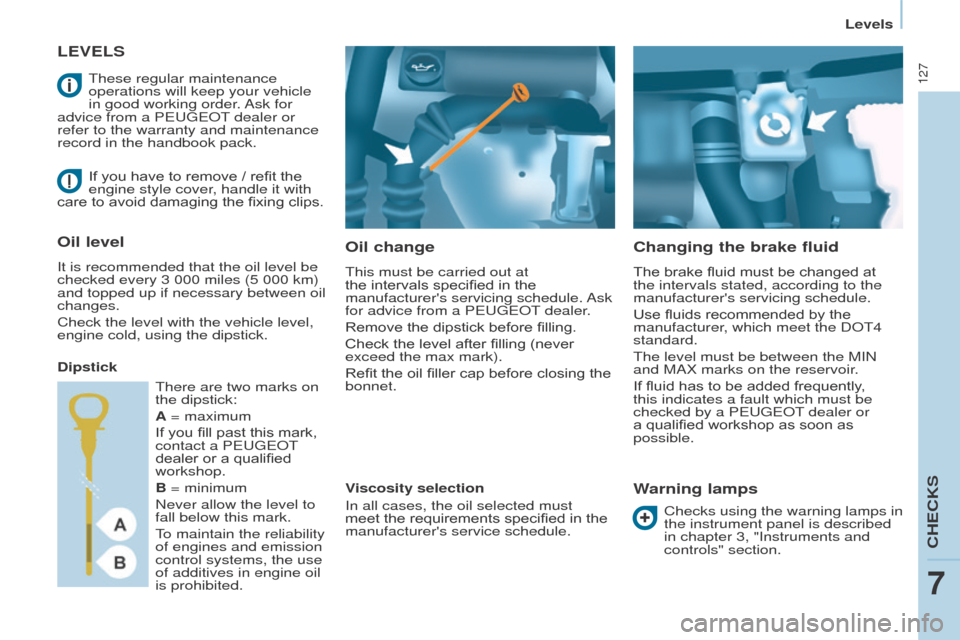
Dipstick
Viscosity selection
In all cases, the oil selected must
meet the requirements specified in the
manufacturer's service schedule.
These regular maintenance
operations will keep your vehicle
in good working order. Ask for
advice from a PEUGEOT dealer or
refer to the warranty and maintenance
record in the handbook pack.
Checks using the warning lamps in
the instrument panel is described
in chapter 3, "Instruments and
controls" section.
There are two marks on
the dipstick:
A = maximum
If you fill past this mark,
contact a PEUGEOT
dealer or a qualified
workshop.
B = minimum
Never allow the level to
fall below this mark.
To maintain the reliability
of engines and emission
control systems, the use
of additives in engine oil
is prohibited.
CHECKS
7
Levels
Page 134 of 260
DIESEL
132
Partner-2-Vu_en_Chap07_Verification_ed02-2015
FUEL CUT- OFF
The flashing of this warning
lamp is accompanied by a
message in the screen.
Check that there is no odour or
leakage of fuel outside the vehicle and
re-establish the fuel supply:
-
switch of
f the ignition (STOP
position),
-
remove the key
,
-
put the key back in the ignition,
-
switch on the ignition and start.
DIESEL PRIMING PUMPFuel used for Diesel engines
The Diesel engines are compatible with
biofuels which conform to current and
future European standards (Diesel fuel
which complies with standard EN 590
mixed with a biofuel which complies
with standard EN 14214) available at
the pumps (containing up to 7 % Fatty
Acid Methyl Ester).
B30 biofuel can be used in certain
Diesel engines. However, this use,
even occasional, requires strict
application of the special servicing
conditions. Contact a PEUGEOT
dealer or a qualified workshop.
The use of any other type of (bio)
fuel (vegetable or animal oils, pure
or diluted, domestic fuel...) is strictly
prohibited (risk of damage to the
engine and fuel system). In a serious collision, a mechanism
automatically prevents fuel from
reaching the engine.
If you run out of fuel, it is necessary to
prime the fuel circuit.
Other HDi engines
- Fill the fuel tank with at least five
litres of Diesel.
-
Squeeze and release the manual
priming pump, under the bonnet,
under the protective cover
.
-
Operate the starter until the engine
starts.
BlueHDi engine
- Fill the fuel tank with at least
five litres of Diesel.
-
Switch on the ignition (without
starting the engine).
-
W
ait around 6 seconds and switch
off the ignition.
-
Repeat the operation 10 times.
-
Operate the starter to run the
engine.
Fuel
Page 151 of 260
149
Partner-2-Vu_en_Chap08_Aide-rapide_ed02-2015
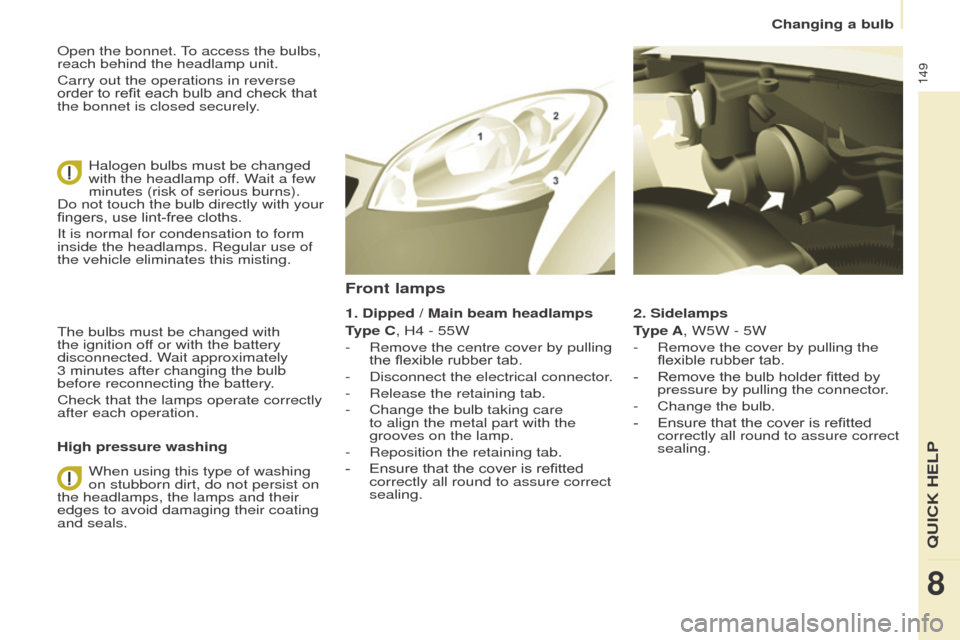
Open the bonnet. To access the bulbs,
reach behind the headlamp unit.
Carry out the operations in reverse
order to refit each bulb and check that
the bonnet is closed securely.Halogen bulbs must be changed
with the headlamp off. Wait a few
minutes (risk of serious burns).
Do not touch the bulb directly with your
fingers, use lint-free cloths.
It is normal for condensation to form
inside the headlamps. Regular use of
the vehicle eliminates this misting.
The bulbs must be changed with
the ignition off or with the battery
disconnected. Wait approximately
3
minutes after changing the bulb
before reconnecting the battery.
Check that the lamps operate correctly
after each operation.
High pressure washing
When using this type of washing
on stubborn dirt, do not persist on
the headlamps, the lamps and their
edges to avoid damaging their coating
and seals. 2. Sidelamps
Type A, W5W - 5W
-
Remove the cover by pullin
g the
flexible rubber tab.
-
Remove the bulb holder fitted by
pressure by pullin
g the connector.
-
Change the bulb.
-
Ensure that the cover is refitted
correctly all round to assure correct
sealing.
Front lamps
1. Dipped / Main beam headlamps
T ype C, H4 - 55W
-
Remove the centre cover by pullin
g
the flexible rubber tab.
-
Disconnect the electrical connector
.
-
Release the retaining tab.
-
Change the bulb taking care
to align the metal part with the
grooves on the lamp.
-
Reposition the retaining tab.
-
Ensure that the cover is refitted
correctly all round to assure correct
sealing.
QUICK HELP
8
Changing a bulb
Page 156 of 260
154
Partner-2-Vu_en_Chap08_Aide-rapide_ed02-2015
CHANGING A FUSE
The fuseboxes are located:
-
in the lower dashboard on the left-
hand side (behind the cover),
-
under the bonnet (near the battery).
If fitted on your vehicle, an additional
fusebox is used for towing, the
towbar and the connections for
the coachbuilder and platform cab
modifications. It is located on the right
behind the load retaining partition.
The indications communicated
are only those fuses which can be
changed by the user using the tweezer
,
located behind the dashboard storage
compartment on the right-hand side.
For any other work, visit a PEUGEOT
dealer or a qualified workshop.
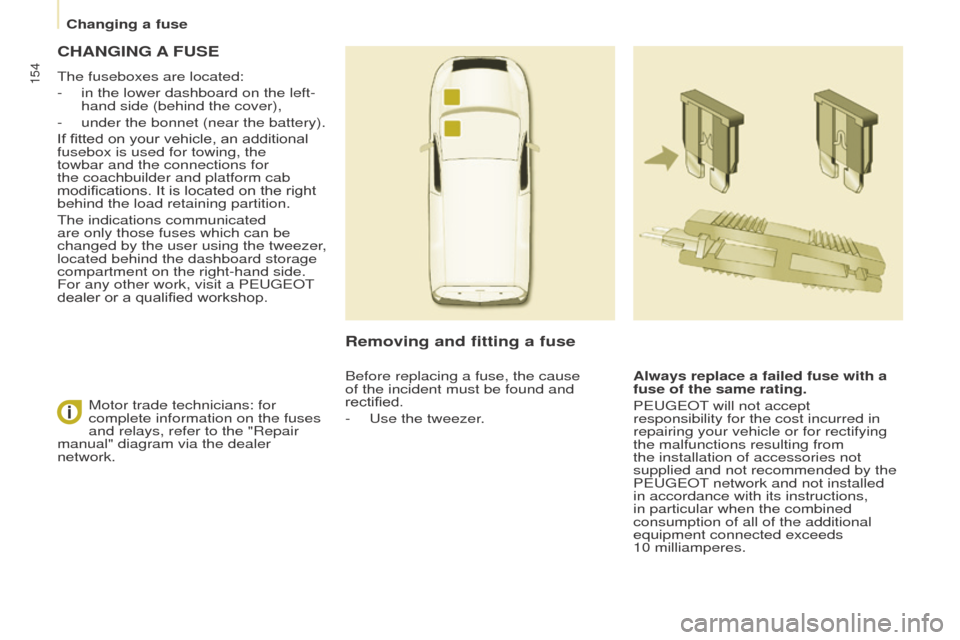
Removing and fitting a fuse
Always replace a failed fuse with a
fuse of the same rating.
PEUGEOT will not accept
responsibility for the cost incurred in
repairing your vehicle or for rectifying
the malfunctions resulting from
the installation of accessories not
supplied and not recommended by the
PEUGEOT network and not installed
in accordance with its instructions,
in particular when the combined
consumption of all of the additional
equipment connected exceeds
10
milliamperes.
Motor trade technicians: for
complete information on the fuses
and relays, refer to the "Repair
manual" diagram via the dealer
network. Before replacing a fuse, the cause
of the incident must be found and
rectified.
-
Use the tweezer
.
Changing a fuse