lock Peugeot Partner 2017 User Guide
[x] Cancel search | Manufacturer: PEUGEOT, Model Year: 2017, Model line: Partner, Model: Peugeot Partner 2017Pages: 260, PDF Size: 9.05 MB
Page 24 of 260
22
Access
Partner-2-VU_en_Chap03_Pret-a-partir_ed02-2016
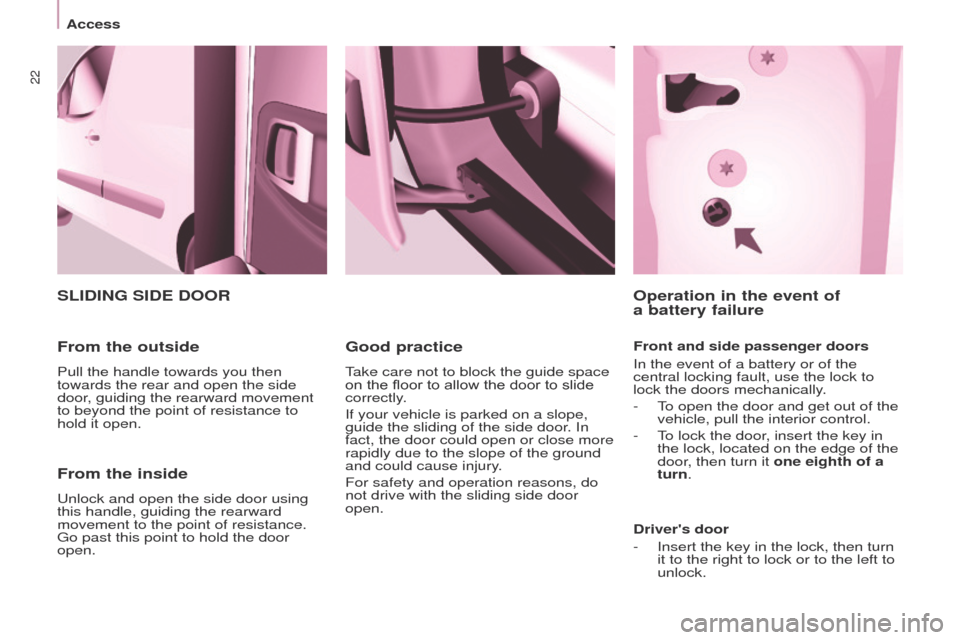
From the inside
Unlock and open the side door using
this handle, guiding the rearward
movement to the point of resistance.
Go past this point to hold the door
open.
Good practice
Take care not to block the guide space
on the floor to allow the door to slide
correctly.
If your vehicle is parked on a slope,
guide the sliding of the side door. In
fact, the door could open or close more
rapidly due to the slope of the ground
and could cause injury.
For safety and operation reasons, do
not drive with the sliding side door
open.
SLIDING SIDE DOOR
From the outside
Pull the handle towards you then
towards the rear and open the side
door, guiding the rearward movement
to beyond the point of resistance to
hold it open.
Operation in the event of
a battery failure
Front and side passenger doors
In the event of a battery or of the
central locking fault, use the lock to
lock the doors mechanically.
-
T
o open the door and get out of the
vehicle, pull the interior control.
-
T
o lock the door, insert the key in
the lock, located on the edge of the
door, then turn it one eighth of a
turn.
Driver's door
-
Insert the key in the lock, then turn
it to the right to lock or to the left to
unlock.
Page 25 of 260
23
Access
Partner-2-VU_en_Chap03_Pret-a-partir_ed02-2016
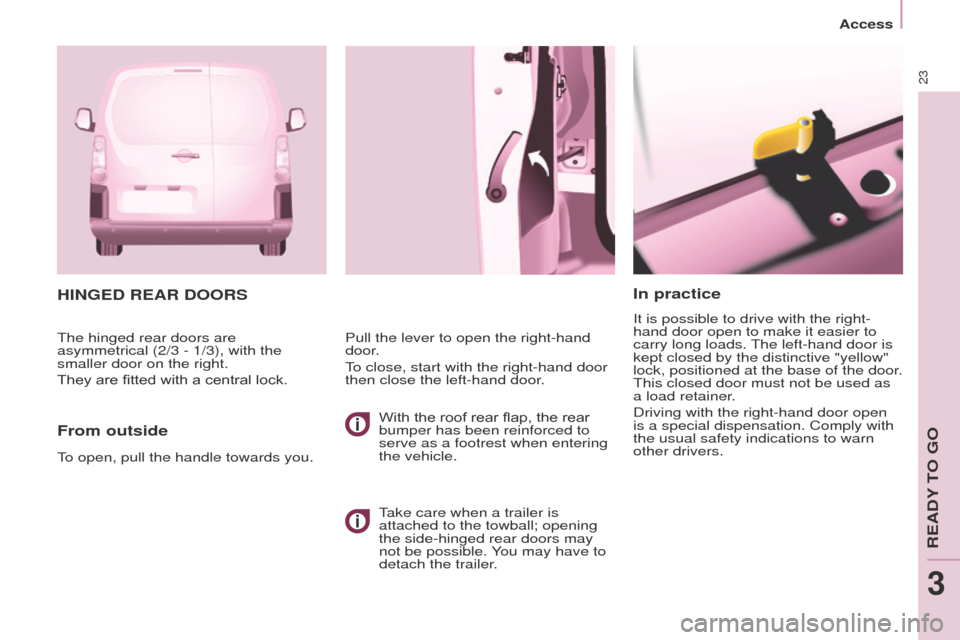
In practice
It is possible to drive with the right-
hand door open to make it easier to
carry long loads. The left-hand door is
kept closed by the distinctive "yellow"
lock, positioned at the base of the door.
This closed door must not be used as
a load retainer.
Driving with the right-hand door open
is a special dispensation. Comply with
the usual safety indications to warn
other drivers.
HINGED REAR DOORS
From outside
Pull the lever to open the right-hand
door.
To close, start with the right-hand door
then close the left-hand door.
To open, pull the handle towards you. The hinged rear doors are
asymmetrical (2/3 - 1/3), with the
smaller door on the right.
They are fitted with a central lock. With the roof rear flap, the rear
bumper has been reinforced to
serve as a footrest when entering
the vehicle.
Take care when a trailer is
attached to the towball; opening
the side-hinged rear doors may
not be possible. You may have to
detach the trailer.
READY TO GO
3
Page 27 of 260
25
Access
Partner-2-VU_en_Chap03_Pret-a-partir_ed02-2016
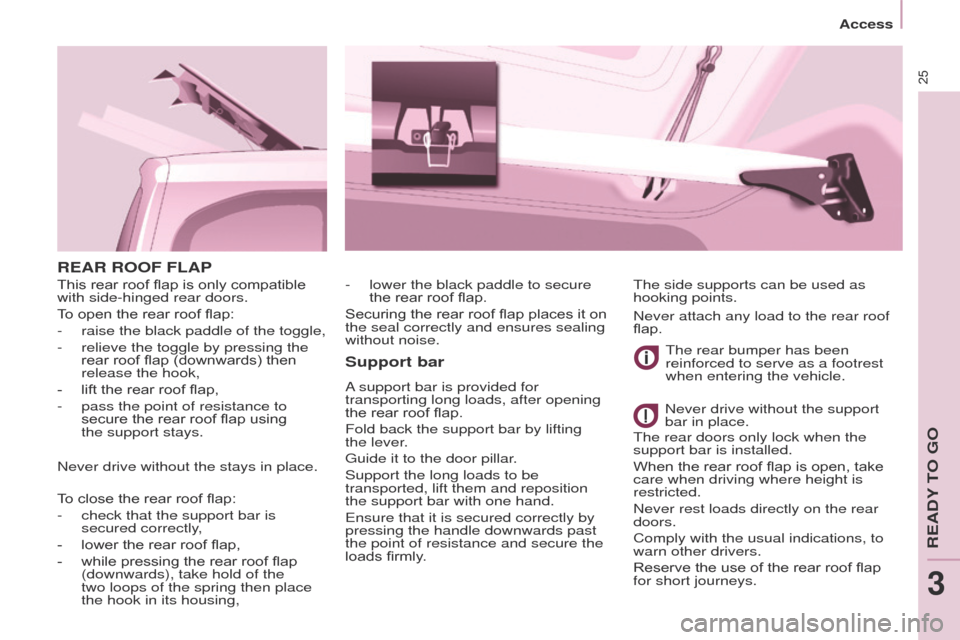
REAR ROOF FLAP
Support bar
A support bar is provided for
transporting long loads, after opening
the rear roof flap.
Fold back the support bar by lifting
the lever.
Guide it to the door pillar.
Support the long loads to be
transported, lift them and reposition
the
support bar with one hand.
Ensure that it is secured correctly by
pressing the handle downwards past
the point of resistance and secure the
loads firmly. The rear bumper has been
reinforced to serve as a footrest
when entering the vehicle.
Never drive without the support
bar in place.
The side supports can be used as
hooking points.
-
lower the black paddle to secure
the rear roof flap.
Securing the rear roof flap places it on
the seal correctly and ensures sealing
without noise.
T
o close the rear roof flap:
-
check that the support bar is
secured correctly
,
-
lower the rear roof flap,
-
while pressing the rear roof flap
(downwards), take hold of the
two
loops of the spring then place
the hook in its housing,
This rear roof flap is only compatible
with side-hinged rear doors.
To open the rear roof flap:
-
raise the black paddle of the toggle,
-
relieve the toggle by pressing the
rear roof flap (downwards) then
release the hook,
-
lift the rear roof flap,
-
pass the point of resistance to
secure the rear roof flap using
the
support stays.
Never drive without the stays in place. Never attach any load to the rear roof
flap.
The rear doors only lock when the
support bar is installed.
When the rear roof flap is open, take
care when driving where height is
restricted.
Never rest loads directly on the rear
doors.
Comply with the usual indications, to
warn other drivers.
Reserve the use of the rear roof flap
for short journeys.
READY TO GO
3
Page 28 of 260
26
Access
Partner-2-VU_en_Chap03_Pret-a-partir_ed02-2016
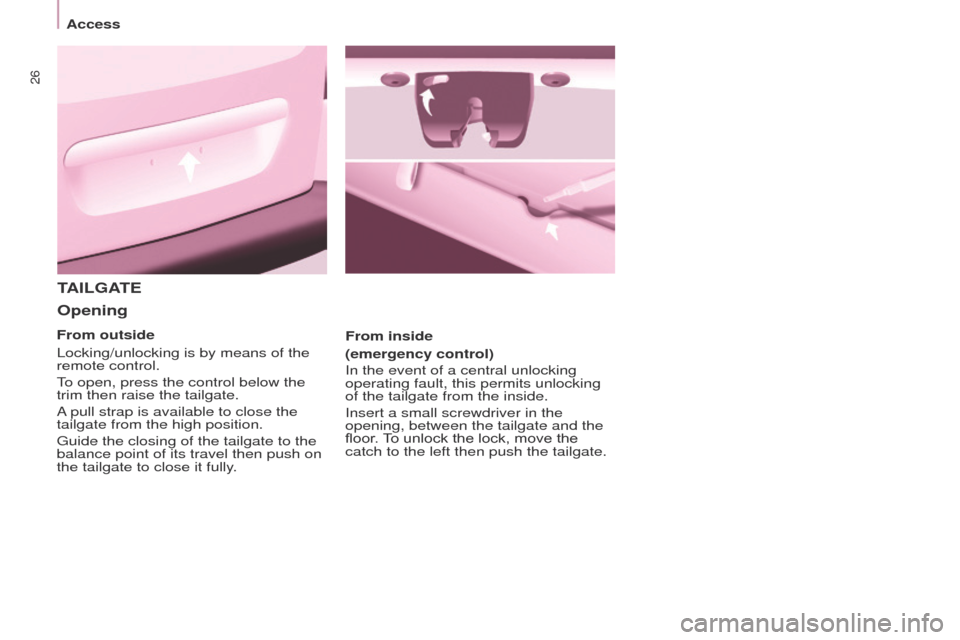
TAILGATE
Opening
From inside
(emergency control)
In the event of a central unlocking
operating fault, this permits unlocking
of the tailgate from the inside.
Insert a small screwdriver in the
opening, between the tailgate and the
floor. To unlock the lock, move the
catch to the left then push the tailgate.
From outside
Locking/unlocking is by means of the
remote control.
To open, press the control below the
trim then raise the tailgate.
A pull strap is available to close the
tailgate from the high position.
Guide the closing of the tailgate to the
balance point of its travel then push on
the tailgate to close it fully.
Page 29 of 260
27
Access
Partner-2-VU_en_Chap03_Pret-a-partir_ed02-2016
Driving with the doors locked may
make access to the interior more
difficult in an emergency.
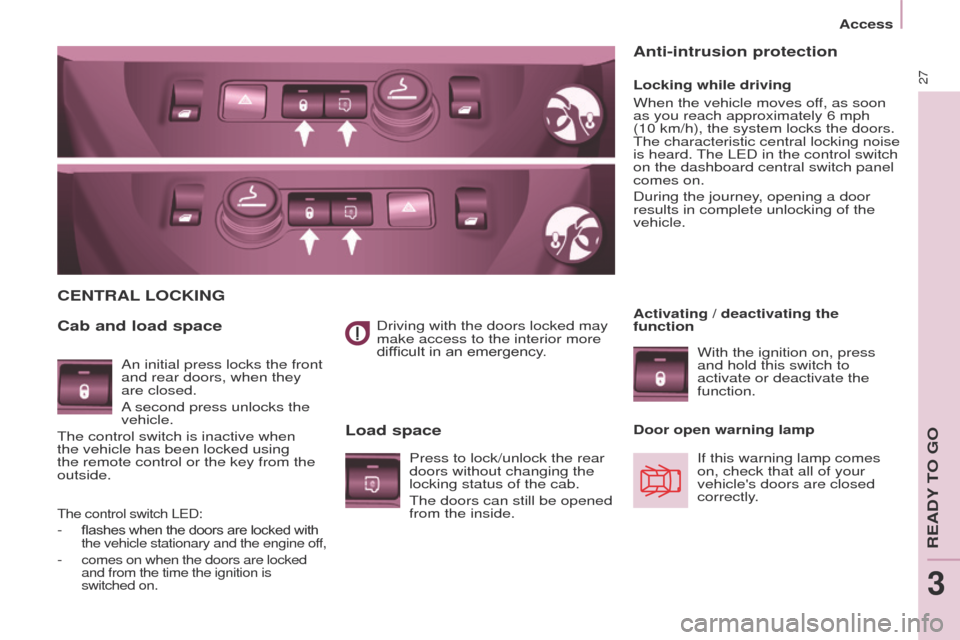
CENTRAL LOCKING
Cab and load space
Load space
Locking while driving
When the vehicle moves off, as soon
as you reach approximately 6 mph
(10 km/h), the system locks the doors.
The characteristic central locking noise
is heard. The LED in the control switch
on the dashboard central switch panel
comes on.
During the journey, opening a door
results in complete unlocking of the
vehicle.
Anti-intrusion protection
An initial press locks the front
and rear doors, when they
are closed.
A second press unlocks the
vehicle.
The control switch is inactive when
the vehicle has been locked using
the remote control or the key from the
outside. Activating / deactivating the
function
With the ignition on, press
and hold this switch to
activate or deactivate the
function.
Door open warning lamp If this warning lamp comes
on, check that all of your
vehicle's doors are closed
correctly.
Press to lock/unlock the rear
doors without changing the
locking status of the cab.
The doors can still be opened
from the inside.
The control switch LED:
- flashes when the doors are locked with
the vehicle stationary and the engine off,
- comes on when the doors are locked
and from the time the ignition is
switched on.
READY TO GO
3
Page 37 of 260
+
ABS
35
Partner-2-VU_en_Chap03_Pret-a-partir_ed02-2016
Instruments and controls
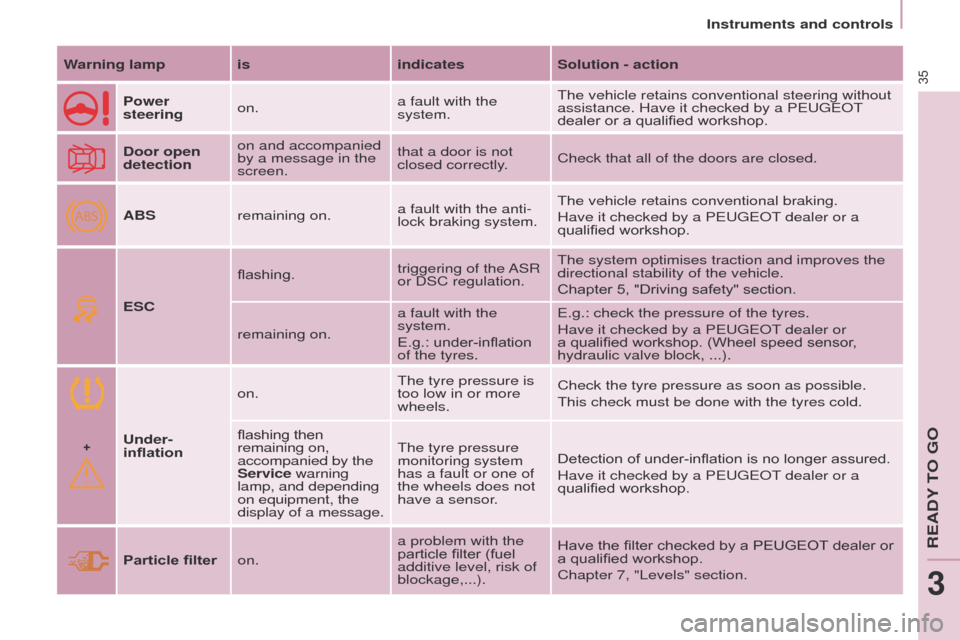
Warning lamp is indicatesSolution - action
Power
steering on. a fault with the
system.The vehicle retains conventional steering without
assistance. Have it checked by a PEUGEOT
dealer or a qualified workshop.
Door open
detection on and accompanied
by a message in the
screen. that a door is not
closed correctly.
Check that all of the doors are closed.
ABS remaining on. a fault with the anti-
lock braking system.The vehicle retains conventional braking.
Have it checked by a PEUGEOT dealer or a
qualified workshop.
ESC flashing.
triggering of the ASR
or DSC regulation.The system optimises traction and improves the
directional stability of the vehicle.
Chapter 5, "Driving safety" section.
remaining on. a fault with the
system.
E.g.: under-inflation
of the tyres.E.g.: check the pressure of the tyres.
Have it checked by a PEUGEOT dealer or
a qualified workshop. (Wheel speed sensor,
hydraulic valve block, ...).
Under-
inflation on.
The tyre pressure is
too low in or more
wheels.Check the tyre pressure as soon as possible.
This check must be done with the tyres cold.
flashing then
remaining on,
accompanied by the
Service warning
lamp, and depending
on equipment, the
display of a message. The tyre pressure
monitoring system
has a fault or one of
the wheels does not
have a sensor.
Detection of under-inflation is no longer assured.
Have it checked by a PEUGEOT dealer or a
qualified workshop.
Particle filter on. a problem with the
particle filter (fuel
additive level, risk of
blockage,...).Have the filter checked by a PEUGEOT dealer or
a qualified workshop.
Chapter 7, "Levels" section.
READY TO GO
3
Page 46 of 260
44
Partner-2-VU_en_Chap03_Pret-a-partir_ed02-2016
Instruments and controls
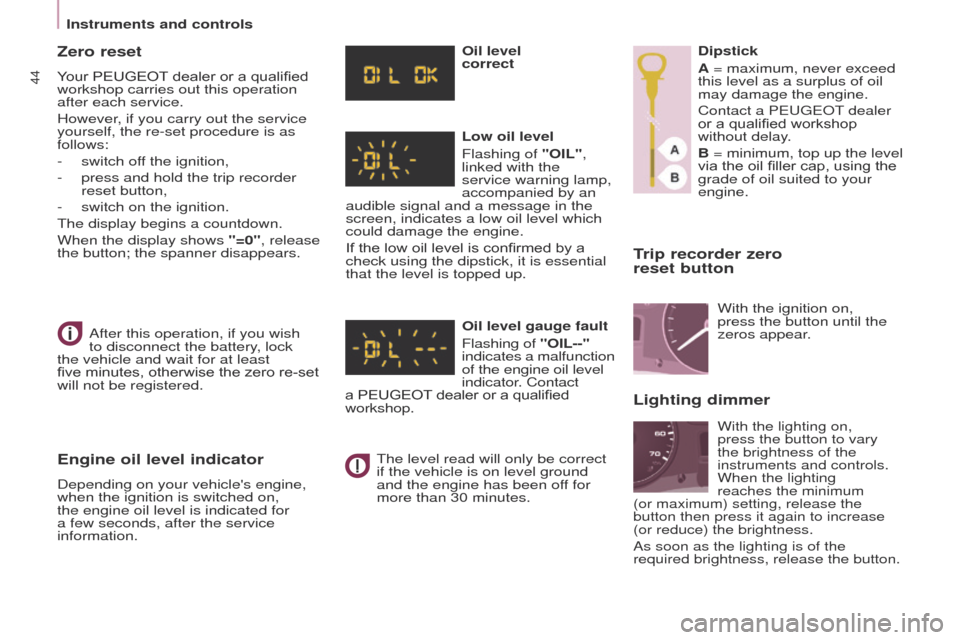
Trip recorder zero
reset button
After this operation, if you wish
to disconnect the battery, lock
the vehicle and wait for at least
five
minutes, otherwise the zero re-set
will not be registered.
Zero reset
Your PEUGEOT dealer or a qualified
workshop carries out this operation
after each service.
However, if you carry out the service
yourself, the re-set procedure is as
follows:
-
switch of
f the ignition,
-
press and hold the trip recorder
reset button,
-
switch on the ignition.
The display begins a countdown.
When the display shows
"=0", release
the button; the spanner disappears.
Engine oil level indicator
Depending on your vehicle's engine,
when the ignition is switched on,
the engine oil level is indicated for
a few
seconds, after the service
information. Oil level
correct
Low oil level
Flashing of "OIL",
linked with the
service warning lamp,
accompanied by an
audible signal and a message in the
screen, indicates a low oil level which
could damage the engine.
If the low oil level is confirmed by a
check using the dipstick, it is essential
that the level is topped up.
Oil level gauge fault
Flashing of "OIL--"
indicates a malfunction
of the engine oil level
indicator. Contact
a PEUGEOT dealer or a qualified
workshop.
The level read will only be correct
if the vehicle is on level ground
and the engine has been off for
more than 30 minutes. Dipstick
A = maximum, never exceed
this level as a surplus of oil
may damage the engine.
Contact a PEUGEOT dealer
or a qualified workshop
without delay.
B = minimum, top up the level
via the oil filler cap, using the
grade of oil suited to your
engine.
With the lighting on,
press the button to vary
the brightness of the
instruments and controls.
When the lighting
reaches the minimum
(or
maximum) setting, release the
button then press it again to increase
(or reduce) the brightness.
As soon as the lighting is of the
required brightness, release the button.
With the ignition on,
press the button until the
zeros
appear.
Lighting dimmer
Page 47 of 260
45
Partner-2-VU_en_Chap03_Pret-a-partir_ed02-2016
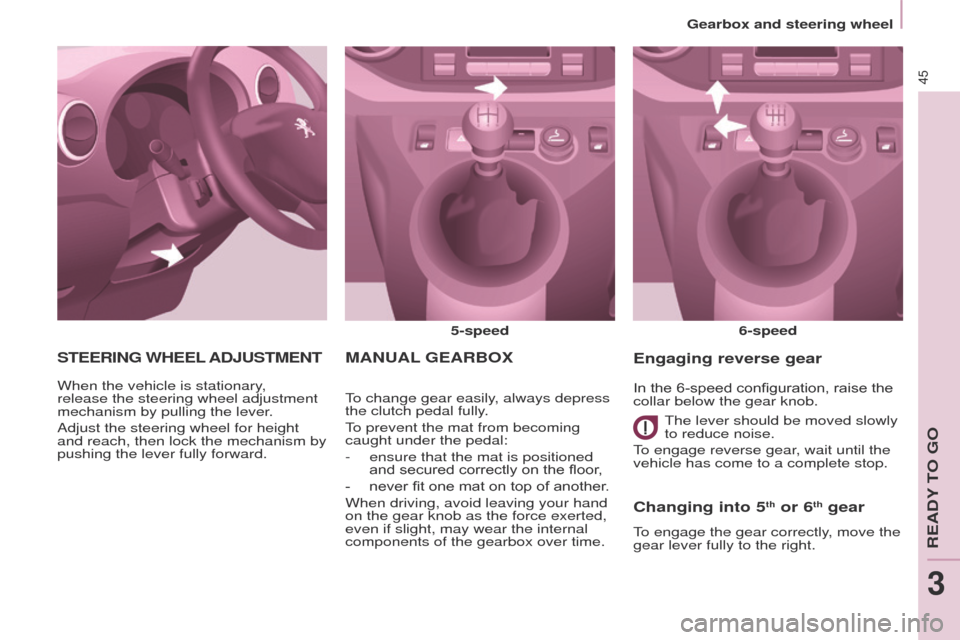
MANUAL GEARBO x
5-speed
6-speed
To change gear easily, always depress
the clutch pedal fully.
To prevent the mat from becoming
caught under the pedal:
-
ensure that the mat is positioned
and secured correctly on the floor
,
-
never fit one mat on top of another
.
When driving, avoid leaving your hand
on the gear knob as the force exerted,
even if slight, may wear the internal
components of the gearbox over time.
Changing into 5th or 6th gear
To engage the gear correctly, move the
gear lever fully to the right. In the 6-speed configuration, raise the
collar below the gear knob.
Engaging reverse gear
S
TEERING
WHEEL
ADJUSTMENT
When the vehicle is stationary,
release the steering wheel adjustment
mechanism by pulling the lever.
Adjust the steering wheel for height
and reach, then lock the mechanism by
pushing the lever fully forward. The lever should be moved slowly
to reduce noise.
To engage reverse gear, wait until the
vehicle has come to a complete stop.
READY TO GO
3
Gearbox and steering wheel
Page 54 of 260
52
Partner-2-VU_en_Chap03_Pret-a-partir_ed02-2016
Starting and switching off
Good practice when stopping Good practice when starting
Diesel pre-heating warning
lamp
If the temperature is high
enough, the warning lamp
comes on for less than
one second, you can start
without waiting.
In cold weather, wait for this warning
lamp to go off then operate the starter
(Starting position) until the engine
starts.
Door or bonnet open warning lamp
If this comes on, a door or the
bonnet is not closed correctly, check!
Minimise engine and gearbox wear
When switching off the ignition, let the
engine run for a few seconds to allow
the turbocharger (Diesel engine) to
return to idle.
Do not press the accelerator when
switching off the ignition.
There is no need to engage a gear
after parking the vehicle.
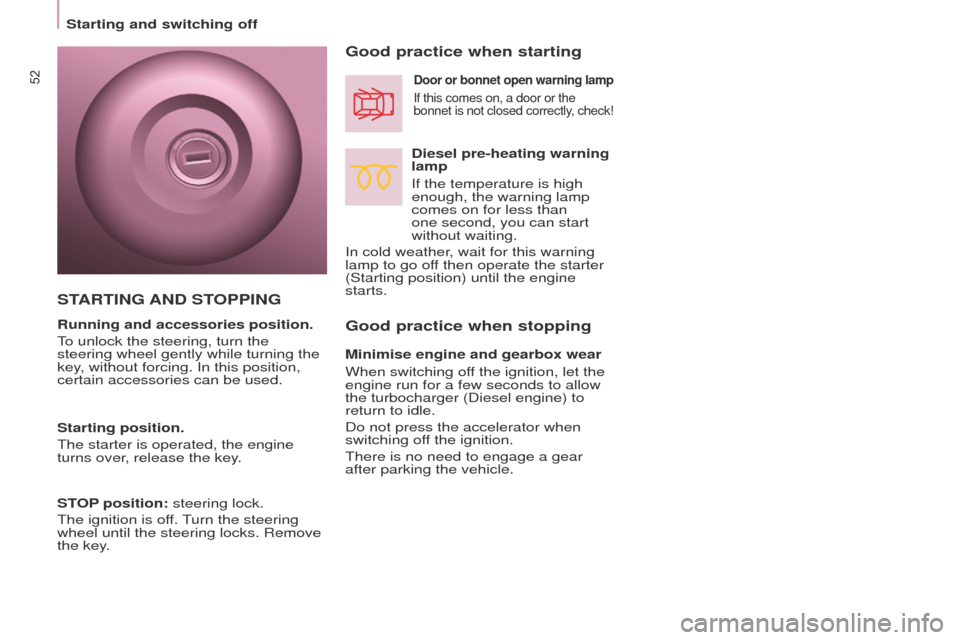
STARTING AND ST OPPING
Running and accessories position.
To unlock the steering, turn the
steering wheel gently while turning the
key, without forcing. In this position,
certain accessories can be used.
Starting position.
The starter is operated, the engine
turns over, release the key.
STOP position: steering lock.
The ignition is off. Turn the steering
wheel until the steering locks. Remove
the key.
Page 75 of 260
73
Partner-2-VU_en_Chap04_Ergonomie_ed02-2016
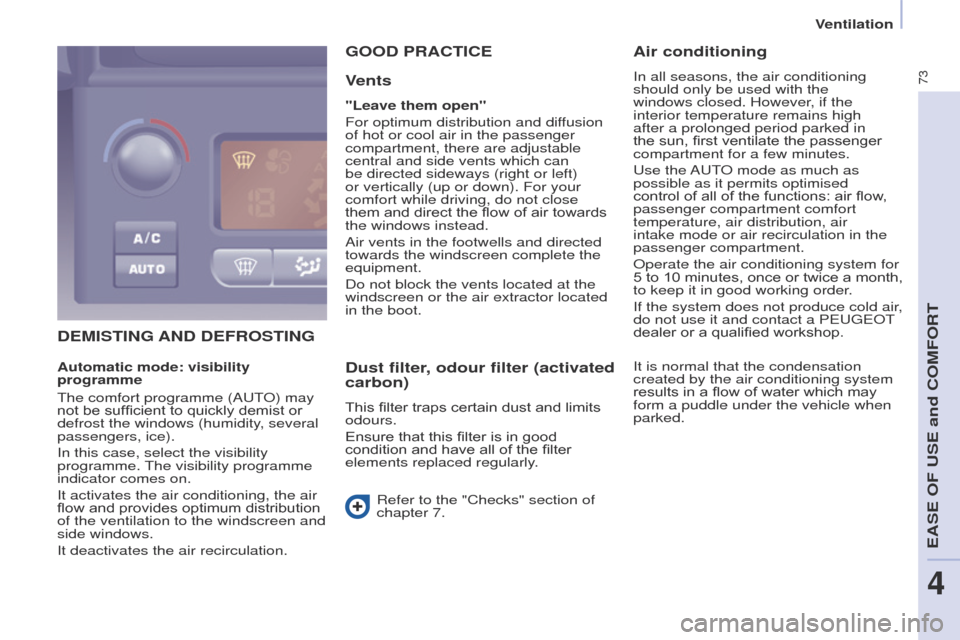
DEMISTING AND DEFROSTING
G
OOD PRACTICE
V
ents
"Leave them open"
For optimum distribution and diffusion
of hot or cool air in the passenger
compartment, there are adjustable
central and side vents which can
be directed sideways (right or left)
or vertically (up or down). For your
comfort while driving, do not close
them and direct the flow of air towards
the windows instead.
Air vents in the footwells and directed
towards the windscreen complete the
equipment.
Do not block the vents located at the
windscreen or the air extractor located
in the boot.
Dust filter, odour filter (activated
carbon)
This filter traps certain dust and limits
odours.
Ensure that this filter is in good
condition and have all of the filter
elements replaced regularly.
Refer to the "Checks" section of
chapter 7.
Air conditioning
In all seasons, the air conditioning
should only be used with the
windows closed. However, if the
interior temperature remains high
after a prolonged period parked in
the sun, first ventilate the passenger
compartment for a few minutes.
Use the AUTO mode as much as
possible as it permits optimised
control of all of the functions: air flow,
passenger compartment comfort
temperature, air distribution, air
intake mode or air recirculation in the
passenger compartment.
Operate the air conditioning system for
5 to 10 minutes, once or twice a month,
to keep it in good working order.
If the system does not produce cold air,
do not use it and contact a PEUGEOT
dealer or a qualified workshop.
Automatic mode: visibility
programme
The comfort programme (AUTO) may
not be sufficient to quickly demist or
defrost the windows (humidity, several
passengers, ice).
In this case, select the visibility
programme. The visibility programme
indicator comes on.
It activates the air conditioning, the air
flow and provides optimum distribution
of the ventilation to the windscreen and
side windows.
It deactivates the air recirculation. It is normal that the condensation
created by the air conditioning system
results in a flow of water which may
form a puddle under the vehicle when
parked.
EASE OF USE and COMFORT
4
Ventilation