lock Peugeot Partner 2017 Owner's Guide
[x] Cancel search | Manufacturer: PEUGEOT, Model Year: 2017, Model line: Partner, Model: Peugeot Partner 2017Pages: 260, PDF Size: 9.05 MB
Page 77 of 260
75
Partner-2-VU_en_Chap04_Ergonomie_ed02-2016
Seats
Never drive with the head
restraints removed; they must be
in place and correctly adjusted.
Armrest Front heated seats
control
Each individual front seat may be fitted
with a control located on the side of the
seat base.
With the 2+1 bench, the driver's seat
control also switches the bench outer
seat heated cushion on or off.
Press to switch on the cushion heating.
Press again to switch it off.PASSENGER
SEAT
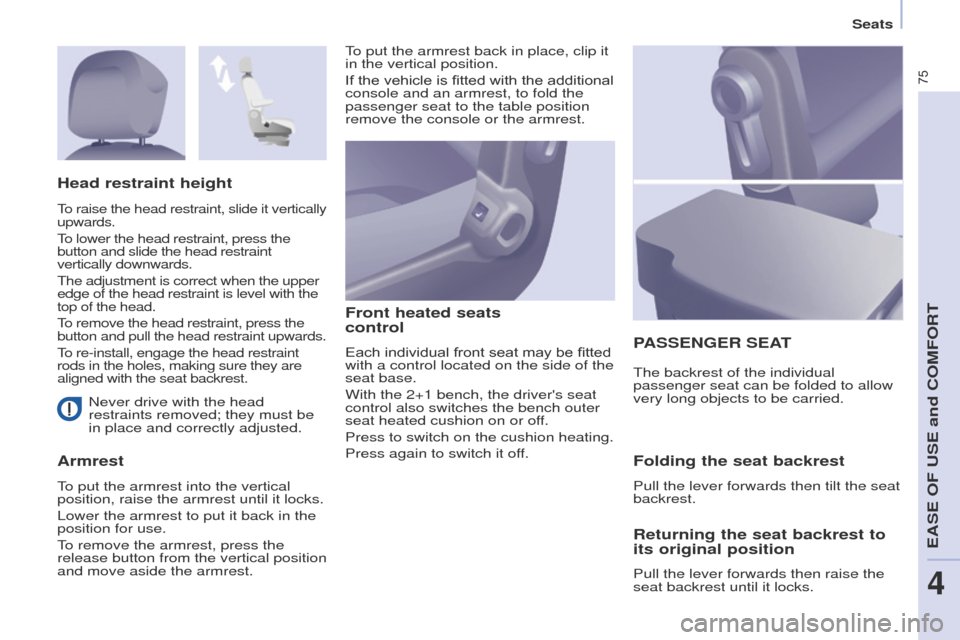
Head restraint height
The backrest of the individual
passenger seat can be folded to allow
very long objects to be carried.
Folding the seat backrest
Pull the lever forwards then tilt the seat
backrest.
To put the armrest back in place, clip it
in the vertical position.
If the vehicle is fitted with the additional
console and an armrest, to fold the
passenger seat to the table position
remove the console or the armrest.
To raise the head restraint, slide it vertically
upwards.
To lower the head restraint, press the
button and slide the head restraint
vertically downwards.
The adjustment is correct when the upper
edge of the head restraint is level with the
top of the head.
To remove the head restraint, press the
button and pull the head restraint upwards.
To re-install, engage the head restraint
rods in the holes, making sure they are
aligned with the seat backrest.
To put the armrest into the vertical
position, raise the armrest until it locks.
Lower the armrest to put it back in the
position for use.
To remove the armrest, press the
release button from the vertical position
and move aside the armrest.
Returning the seat backrest to
its original position
Pull the lever forwards then raise the
seat backrest until it locks.
EASE OF USE and COMFORT
4
Page 78 of 260
76
Partner-2-VU_en_Chap04_Ergonomie_ed02-2016
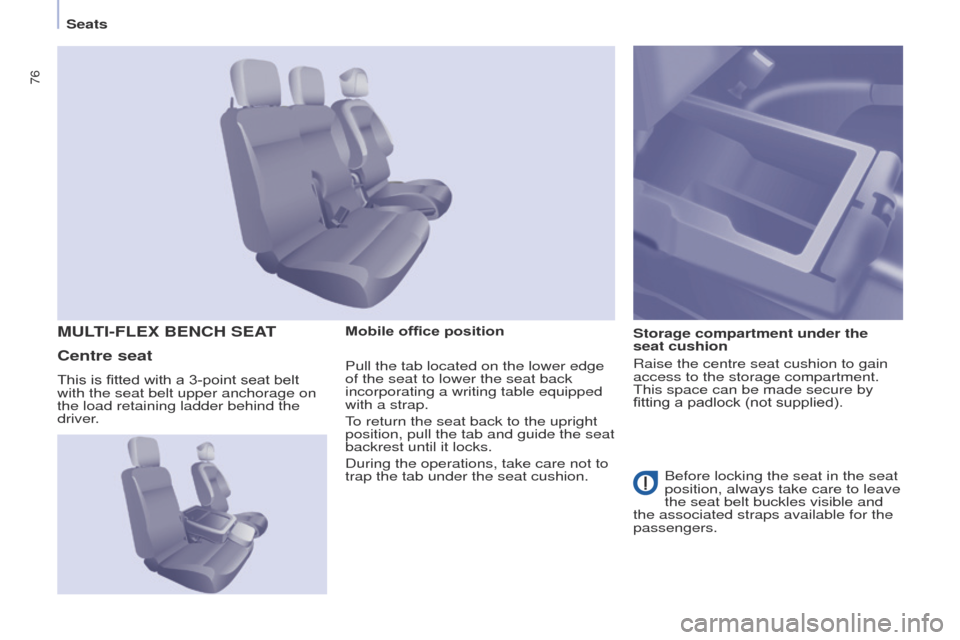
SeatsMobile office position Storage compartment under the
seat cushion
Raise the centre seat cushion to gain
access to the storage compartment.
This space can be made secure by
fitting a padlock (not supplied).
MULTI-FLEx BENCH SEAT
Centre seat
Before locking the seat in the seat
position, always take care to leave
the seat belt buckles visible and
the associated straps available for the
passengers.
This is fitted with a 3-point seat belt
with the seat belt upper anchorage on
the load retaining ladder behind the
driver.
Pull the tab located on the lower edge
of the seat to lower the seat back
incorporating a writing table equipped
with a strap.
To return the seat back to the upright
position, pull the tab and guide the seat
backrest until it locks.
During the operations, take care not to
trap the tab under the seat cushion.
Page 79 of 260
77
Partner-2-VU_en_Chap04_Ergonomie_ed02-2016
Seats
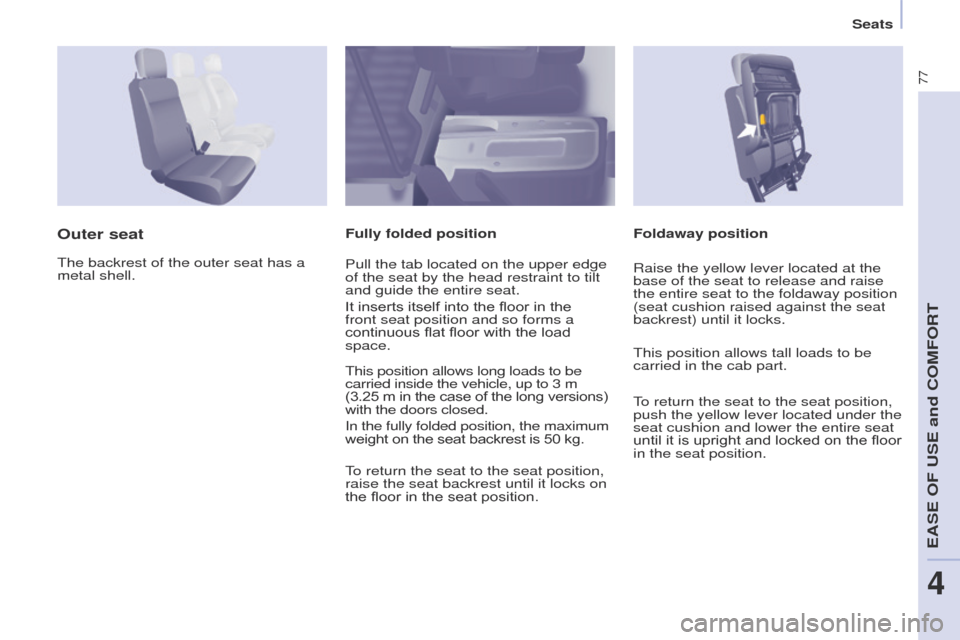
Foldaway position
Outer seatFully folded position
The backrest of the outer seat has a
metal shell. Pull the tab located on the upper edge
of the seat by the head restraint to tilt
and guide the entire seat.
It inserts itself into the floor in the
front seat position and so forms a
continuous flat floor with the load
space.
This position allows long loads to be
carried inside the vehicle, up to 3 m
(3.25 m in the case of the long versions)
with the doors closed.
In the fully folded position, the maximum
weight on the seat backrest is 50 kg.
To return the seat to the seat position,
raise the seat backrest until it locks on
the floor in the seat position. Raise the yellow lever located at the
base of the seat to release and raise
the entire seat to the foldaway position
(seat cushion raised against the seat
backrest) until it locks.
This position allows tall loads to be
carried in the cab part.
To return the seat to the seat position,
push the yellow lever located under the
seat cushion and lower the entire seat
until it is upright and locked on the floor
in the seat position.
EASE OF USE and COMFORT
4
Page 83 of 260

81
Partner-2-VU_en_Chap04_Ergonomie_ed02-2016
Automatic operation
The front courtesy lamp comes on
when the key is removed from the
ignition, when the vehicle is unlocked,
when one of the front doors is opened
and for location of the vehicle using the
remote control.
It goes off gradually after the ignition
is switched on and when the vehicle is
locked.Cab: comes on when one of
the front doors is opened.
These are switched on and off by
means of a manual switch, with
the ignition on.
Load space: comes on when
one of the rear doors is
opened.
If the doors remain open for
a few minutes, the courtesy
lamps go off.
Permanently off.
Permanently on, ignition on.
Front courtesy lamp
COURTESY
LAMPS
Rear courtesy lamp Front individual reading lamps
EASE OF USE and COMFORT
4
Practical information
Page 85 of 260

83
Partner-2-VU_en_Chap04_Ergonomie_ed02-2016
Returning to the seat position
-
In a single movement: take hold of
the red strap and pull the assembly
horizontally towards the rear
.
Guide the movement until the feet
of the bench seat lock on the floor
.
-
Raise the seat backrest.
The control
A locks in place
automatically.
-
Check that the bench is locked on
the floor correctly once it has been
returned to the seat position.
Do not let the assembly fall sharply
.
Good practice
There is no need to assist, guide or
support the tilting movement using
your free arm.
The rear seat belt casings are not
designed for securing the load
transported. Use the stowing rings on
the floor only.
The bench seat of the crew cab is not
suitable for the installation of a child
seat.
-
Using the same hand, fold the seat
backrest and the associated grille
onto the seat cushion.
-
T
ake hold of the red strap (like
a handle) and lift the assembly
vertically, guiding the movement to
the fully folded position.
The raised seat rests against the
backrests of the seats of row 1.
Head restraints and seat
belts
The three seats are equipped with
inertia reel seat belts. The seat belts
of the outer seats are secured to the
body, whereas the seat belt of the
centre seat is secured to the backrest
of the bench seat.
Each seat has a head restraint bolted
onto the load retaining grille and which
can be removed.
Do not store a head restraint inside
the vehicle unless it is properly
stowed or fixed to a support.
Do not drive with rear passengers
without first bolting the head restraints
in place.
EASE OF USE and COMFORT
4
Practical information
Page 93 of 260
91
Driving safely
Partner-2-VU_en_Chap05_Securite_ed02-2016
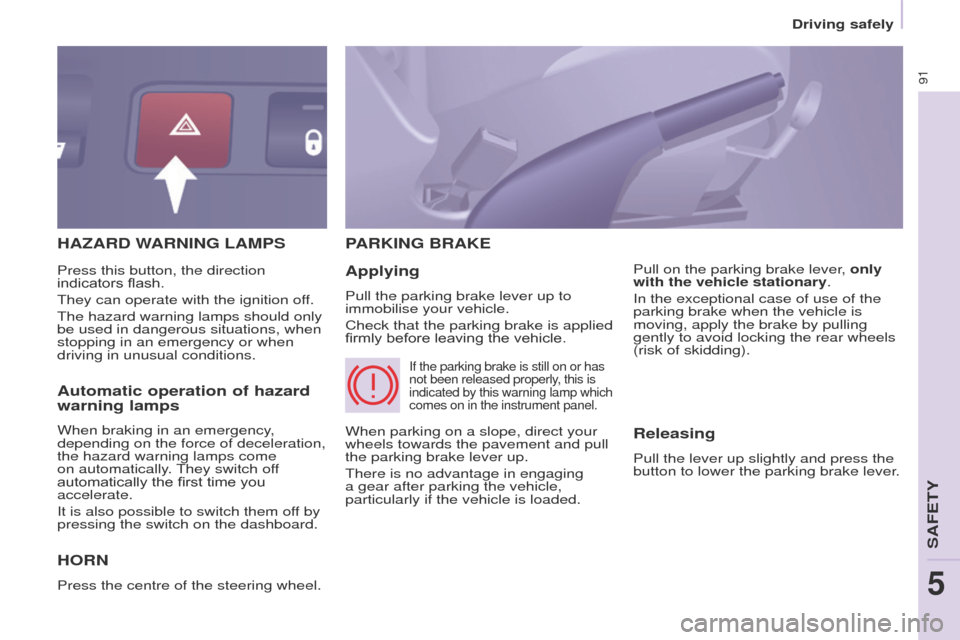
HAZARD WARNING LAMPS
H
ORN
Press the centre of the steering wheel.
PARKING BRAKE
Applying
Pull the parking brake lever up to
immobilise your vehicle.
Check that the parking brake is applied
firmly before leaving the vehicle. Pull on the parking brake lever, only
with the vehicle stationary.
In the exceptional case of use of the
parking brake when the vehicle is
moving, apply the brake by pulling
gently to avoid locking the rear wheels
(risk of skidding).
Press this button, the direction
indicators flash.
They can operate with the ignition off.
The hazard warning lamps should only
be used in dangerous situations, when
stopping in an emergency or when
driving in unusual conditions.
When parking on a slope, direct your
wheels towards the pavement and pull
the parking brake lever up.
There is no advantage in engaging
a gear after parking the vehicle,
particularly if the vehicle is loaded.
If the parking brake is still on or has
not been released properly, this is
indicated by this warning lamp which
comes on in the instrument panel.
Automatic operation of hazard
warning lamps
When braking in an emergency,
depending on the force of deceleration,
the hazard warning lamps come
on automatically. They switch off
automatically the first time you
accelerate.
It is also possible to switch them off by
pressing the switch on the dashboard.Releasing
Pull the lever up slightly and press the
button to lower the parking brake lever.
SAFETY
5
Page 97 of 260
ABS
ABS
95
Driving safely
Partner-2-VU_en_Chap05_Securite_ed02-2016
ANTI-LOCK BRAKING SYSTEM
(ABS / EBFD)
The ABS and EBFD (electronic brake
force distribution) systems improve the
stability and manoeuvrability of your
vehicle on braking, in particular on
poor or slippery surfaces.
The ABS prevents locking of the
wheels, the EBFD provides control of
the braking pressure wheel by wheel. If this warning lamp comes
on, accompanied by an
audible signal and a message
in the screen, it indicates a
malfunction of the ABS which
could result in a loss of control of the
vehicle on braking.
If this warning lamp comes
on, together with the brake
and STOP warning lamps,
accompanied by an audible
signal and a message in the
screen, it indicates a malfunction of
the electronic brake force distribution
which could result in a loss of control of
the vehicle on braking.
EMERGENCY BRAKING
ASSIST
ANCE (EBA)
In an emergency, this system enables
the optimum braking pressure to be
reached more quickly, press the pedal
firmly without releasing it.
It is triggered by the speed at which the
brake pedal is pressed down.
This alters the resistance of the brake
pedal under your foot.
To maintain operation of the
emergency braking assistance system:
keep your foot on the brake pedal.
Good practice
The anti-lock braking system comes
into operation automatically when
there is a risk of wheel lock. It does not
reduce the braking distance.
On very slippery surfaces (ice, oil,
etc...) the ABS may increase the
braking distance. When braking in
an emergency, do not hesitate to
press the brake pedal firmly, without
releasing the pressure, even on a
slippery surface, you will then be able
to continue to manoeuvre the vehicle
to avoid an obstacle.
Normal operation of the ABS may be
felt by slight vibration of the brake
pedal.
When changing wheels (tyres and
rims), ensure that these are listed by
PEUGEOT for the vehicle. Stop as soon as it is safe to do so.
In both cases, contact a PEUGEOT
dealer or a qualified workshop.
SAFETY
5
Page 106 of 260
104
Partner-2-VU_en_Chap05_Securite_ed02-2016
The inertia reels are fitted with a device
which automatically locks the strap in
the event of a collision or emergency
braking or if the vehicle rolls over.
You can unfasten the seat belt by
pressing the red button on the buckle.
Guide the seat belt after unfastening.
The airbag warning lamp comes on
if the pretensioners are deployed.
Contact a PEUGEOT dealer or a
qualified workshop.Recommendations for children:
-
use a suitable child seat if the
passenger is less than 12 years old
or shorter than one metre fifty
,
-
never allow a child to travel on
your lap, even with the seat belt
fastened.For more information on child
seats, refer to the "Child safety"
section of chapter 5.
Clean the seat belt straps with
soapy water or a textile cleaning
product, sold by PEUGEOT
dealers.
In accordance with current safety
regulations, your PEUGEOT dealer
can guarantee all work or any checks,
from testing to maintenance, on your
seat belt equipment.
Have the seat belts checked regularly
(even after a minor impact) by a
PEUGEOT dealer or a qualified
workshop: they must not show any
signs of wear, cutting or fraying
and they must not be converted or
modified.Front seat belts
The front seats are fitted with
pretensioners and force limiters.
The seat belt associated with the
centre seat of the front bench does not
have a pretensioner.
In order to be effective, a seat belt:
-
must restrain one person only
,
-
must not be twisted, check by
pullin
g in front of you with an even
movement,
-
must be tightened as close to the
body as possible.
The upper part of the seat belt should
be positioned in the hollow of the
shoulder
.
The lap part should be placed as low
as possible on the pelvis.
Do not interchange the seat belt
buckles as they will not fulfil their role
properly. If the seats are fitted with
armrests, the lap part of the seat belt
should always pass under the armrest.
Check that the seat belt is fastened
correctly by pulling the strap firmly.
Seat belts
Page 119 of 260
11 7
Partner-2-VU_en_Chap05_Securite_ed02-2016
ADVICE ON CHILD SEATS
The incorrect installation of a child seat
in a vehicle compromises the child's
protection in the event of an accident.
Check that there is no seat belt or seat
belt buckle under the child seat, as this
could destabilise the seat.
Remember to fasten the seat belts or
the child seat harnesses keeping the
slack relative to the child's body to a
minimum, even for short journeys.
For the installation of a child seat using
the seat belt, ensure that the seat belt
is well tensioned on the child seat
and that it is holding the child seat
firmly against the vehicle's seat. If the
passenger seat is adjustable, move it
forward if necessary.
At the rear, always leave sufficient
space between the front seat and:
-
a rearward facing child seat,
-
the feet of a child seated in a
forward facing child seat.
For this, move the front seat forward
and, if necessary
, straighten its
backrest as well. For the optimum installation of a
forward facing child seat, ensure that
the back of the child seat is as close as
possible to the backrest of the vehicle's
seat, or in contact if possible.
The head restraint must be removed
before installing a child seat with a
backrest on the passenger seat.
Ensure that the head restraint is
stowed or attached securely so that it
is not thrown around the vehicle in the
event of sharp braking.
Refit the head restraint as soon as the
child seat is removed.
Children at the front
The legislation on carrying a child on
the front passenger seat is specific to
each country. Refer to the legislation in
force in your country.
Deactivate the passenger's airbag
when a rearward facing child seat is
installed on the front seat.
Otherwise, the child would risk being
seriously injured or killed if the airbag
were deployed.
Installing a booster seat
The chest part of the seat belt must
be positioned on the child's shoulder
without touching the neck.
Ensure that the lap part of the seat belt
passes correctly over the child's thighs.
PEUGEOT recommends the use of a
booster seat which has a back, fitted
with a seat belt guide at shoulder level.
As a safety precaution, never leave:
-
one or more children alone and
unsupervised in a vehicle,
-
a child or an animal in a vehicle
which is exposed to the sun, with
the windows closed,
-
the keys within reach of children
inside the vehicle.
T
o prevent accidental opening of the
doors, use the "Child Lock".
Take care not to open the rear windows
by more than one third.
To protect young children from the rays
of the sun, fit side blinds to the rear
windows.
SAFETY
5
Child safety
Page 122 of 260
120
Towing a trailer
Partner-2-VU_en_Chap06_Accessoire_ed02-2016
TOWBAR WITH SWAN NECK
T
OWBALL ,
LOCKABLE AND QUICKLY DETACHABLE
Presentation
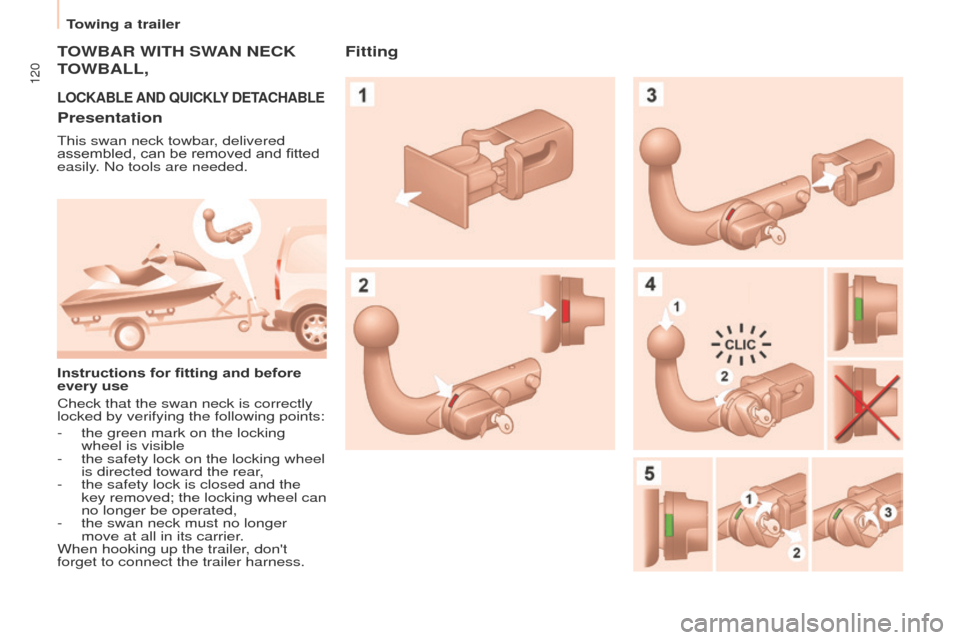
This swan neck towbar, delivered
assembled, can be removed and fitted
easily. No tools are needed.
Instructions for fitting and before
every use
Check that the swan neck is correctly
locked by verifying the following points:
-
the green mark on the locking
wheel is visible
-
the safety lock on the locking wheel
is directed toward the rear
,
-
the safety lock is closed and the
key removed; the locking wheel can
no longer be operated,
-
the swan neck must no longer
move at all in its carrier
.
When hooking up the trailer, don't
forget to connect the trailer harness.
Fitting