tow Peugeot Partner 2017 User Guide
[x] Cancel search | Manufacturer: PEUGEOT, Model Year: 2017, Model line: Partner, Model: Peugeot Partner 2017Pages: 260, PDF Size: 9.05 MB
Page 61 of 260
59
Partner-2-VU_en_Chap04_Ergonomie_ed02-2016
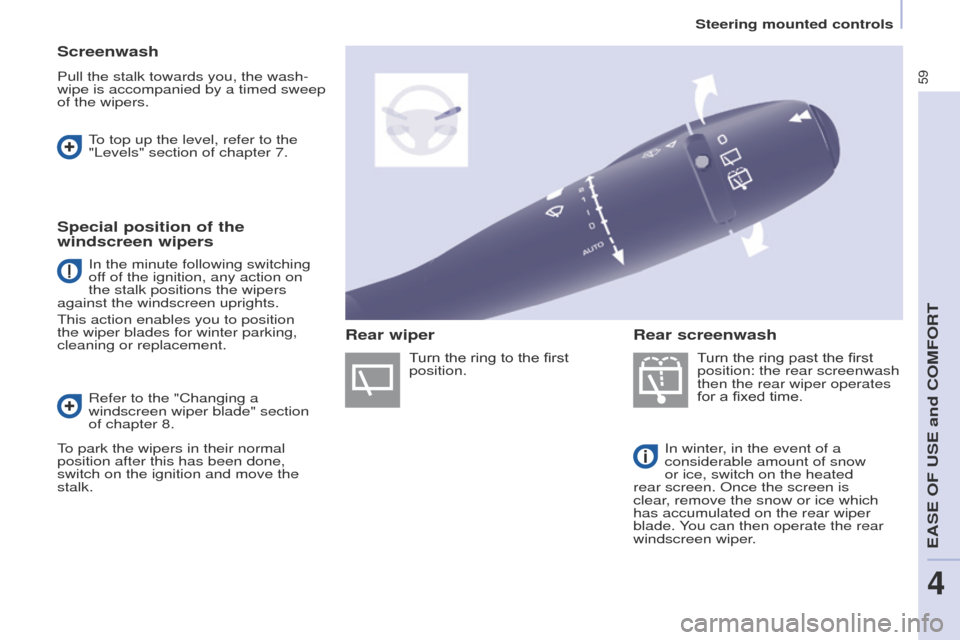
Screenwash
Pull the stalk towards you, the wash-
wipe is accompanied by a timed sweep
of the wipers.Turn the ring past the first
position: the rear screenwash
then the rear wiper operates
for a fixed time.
In winter, in the event of a
considerable amount of snow
or ice, switch on the heated
rear screen. Once the screen is
clear, remove the snow or ice which
has accumulated on the rear wiper
blade. You can then operate the rear
windscreen wiper.
To top up the level, refer to the
"Levels" section of chapter 7.
Special position of the
windscreen wipers
Refer to the "Changing a
windscreen wiper blade" section
of chapter 8.
To park the wipers in their normal
position after this has been done,
switch on the ignition and move the
stalk. Turn the ring to the first
position.
Rear screenwash
Rear wiper
In the minute following switching
off of the ignition, any action on
the stalk positions the wipers
against the windscreen uprights.
This action enables you to position
the wiper blades for winter parking,
cleaning or replacement.
Steering mounted controls
EASE OF USE and COMFORT
4
Page 72 of 260
70
Partner-2-VU_en_Chap04_Ergonomie_ed02-2016
Manual operation
You can, according to your
requirements, make a different selection
from that offered by the system by
changing a setting. The other functions
will still be controlled automatically.
Pressing the AUTO button restores fully
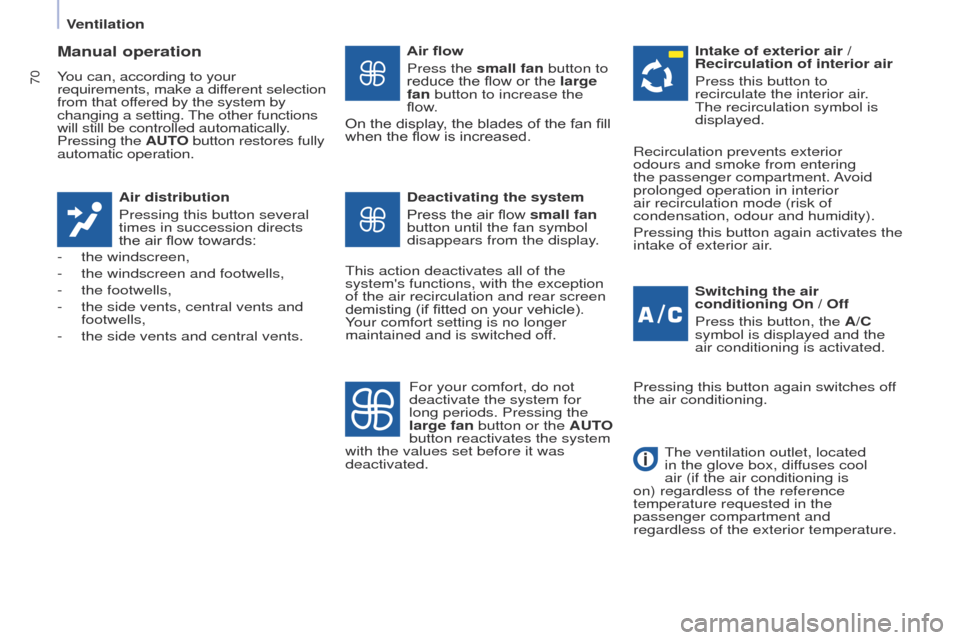
automatic operation.Air distribution
Pressing this button several
times in succession directs
the air flow towards:
-
the windscreen,
-
the windscreen and footwells,
-
the footwells,
-
the side vents, central vents and
footwells,
-
the side vents and central vents. Air flow
Press the
small fan button to
reduce the flow or the large
fan button to increase the
flow.
On the display, the blades of the fan fill
when the flow is increased.
Switching the air
conditioning On / Off
Press this button, the A/C
symbol is displayed and the
air conditioning is activated.
Deactivating the system
Press the air flow small fan
button until the fan symbol
disappears from the display.
This action deactivates all of the
system's functions, with the exception
of the air recirculation and rear screen
demisting (if fitted on your vehicle).
Your comfort setting is no longer
maintained and is switched off. Intake of exterior air /
Recirculation of interior air
Press this button to
recirculate the interior air.
The recirculation symbol is
displayed.
For your comfort, do not
deactivate the system for
long periods. Pressing the
large fan button or the AUTO
button reactivates the system
with the values set before it was
deactivated. Recirculation prevents exterior
odours and smoke from entering
the passenger compartment. Avoid
prolonged operation in interior
air recirculation mode (risk of
condensation, odour and humidity).
Pressing this button again activates the
intake of exterior air.
Pressing this button again switches off
the air conditioning.
The ventilation outlet, located
in the glove box, diffuses cool
air (if the air conditioning is
on) regardless of the reference
temperature requested in the
passenger compartment and
regardless of the exterior temperature.
Ventilation
Page 75 of 260
73
Partner-2-VU_en_Chap04_Ergonomie_ed02-2016
DEMISTING AND DEFROSTING
G
OOD PRACTICE
V
ents
"Leave them open"
For optimum distribution and diffusion
of hot or cool air in the passenger
compartment, there are adjustable
central and side vents which can
be directed sideways (right or left)
or vertically (up or down). For your
comfort while driving, do not close
them and direct the flow of air towards
the windows instead.
Air vents in the footwells and directed
towards the windscreen complete the
equipment.
Do not block the vents located at the
windscreen or the air extractor located
in the boot.
Dust filter, odour filter (activated
carbon)
This filter traps certain dust and limits
odours.
Ensure that this filter is in good
condition and have all of the filter
elements replaced regularly.
Refer to the "Checks" section of
chapter 7.
Air conditioning
In all seasons, the air conditioning
should only be used with the
windows closed. However, if the
interior temperature remains high
after a prolonged period parked in
the sun, first ventilate the passenger
compartment for a few minutes.
Use the AUTO mode as much as
possible as it permits optimised
control of all of the functions: air flow,
passenger compartment comfort
temperature, air distribution, air
intake mode or air recirculation in the
passenger compartment.
Operate the air conditioning system for
5 to 10 minutes, once or twice a month,
to keep it in good working order.
If the system does not produce cold air,
do not use it and contact a PEUGEOT
dealer or a qualified workshop.
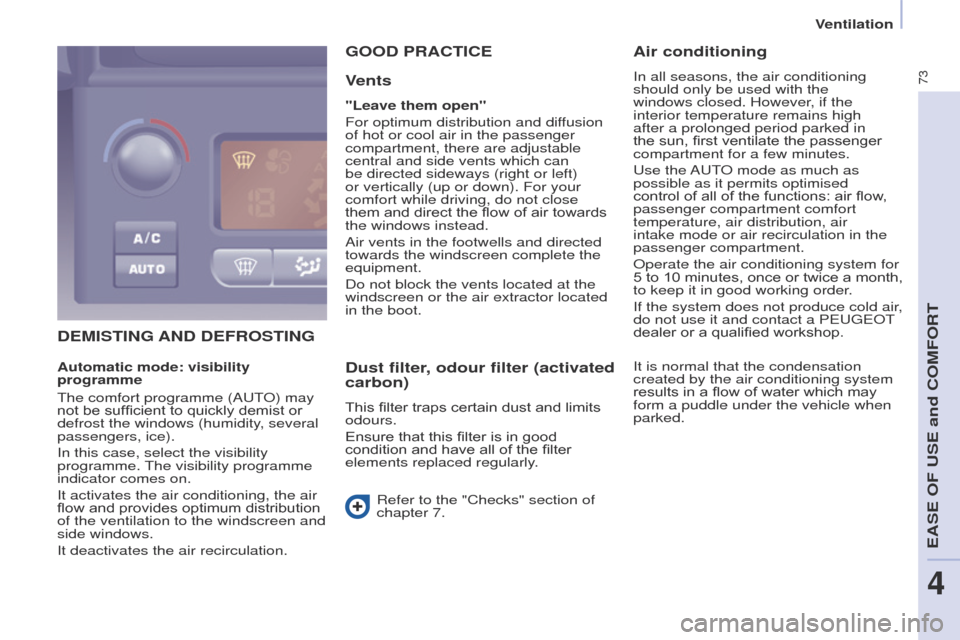
Automatic mode: visibility
programme
The comfort programme (AUTO) may
not be sufficient to quickly demist or
defrost the windows (humidity, several
passengers, ice).
In this case, select the visibility
programme. The visibility programme
indicator comes on.
It activates the air conditioning, the air
flow and provides optimum distribution
of the ventilation to the windscreen and
side windows.
It deactivates the air recirculation. It is normal that the condensation
created by the air conditioning system
results in a flow of water which may
form a puddle under the vehicle when
parked.
EASE OF USE and COMFORT
4
Ventilation
Page 85 of 260

83
Partner-2-VU_en_Chap04_Ergonomie_ed02-2016
Returning to the seat position
-
In a single movement: take hold of
the red strap and pull the assembly
horizontally towards the rear
.
Guide the movement until the feet
of the bench seat lock on the floor
.
-
Raise the seat backrest.
The control
A locks in place
automatically.
-
Check that the bench is locked on
the floor correctly once it has been
returned to the seat position.
Do not let the assembly fall sharply
.
Good practice
There is no need to assist, guide or
support the tilting movement using
your free arm.
The rear seat belt casings are not
designed for securing the load
transported. Use the stowing rings on
the floor only.
The bench seat of the crew cab is not
suitable for the installation of a child
seat.
-
Using the same hand, fold the seat
backrest and the associated grille
onto the seat cushion.
-
T
ake hold of the red strap (like
a handle) and lift the assembly
vertically, guiding the movement to
the fully folded position.
The raised seat rests against the
backrests of the seats of row 1.
Head restraints and seat
belts
The three seats are equipped with
inertia reel seat belts. The seat belts
of the outer seats are secured to the
body, whereas the seat belt of the
centre seat is secured to the backrest
of the bench seat.
Each seat has a head restraint bolted
onto the load retaining grille and which
can be removed.
Do not store a head restraint inside
the vehicle unless it is properly
stowed or fixed to a support.
Do not drive with rear passengers
without first bolting the head restraints
in place.
EASE OF USE and COMFORT
4
Practical information
Page 86 of 260

84
Partner-2-VU_en_Chap04_Ergonomie_ed02-2016
LOAD SPACE FITTINGS
12 volt socket (120 W max)
It is advisable to limit its use to avoid
discharging the battery.
Lashing rings
Use the lashing rings on the rear floor
to secure your loads.
Trim panels
The lower parts of the sides are fitted
with load protection trim panels.
As a safety precaution in case of
sharp braking, you are advised to
immobilise the load by securing
it firmly using the stowing rings and
place heavy objects as far forward as
possible (towards the cab).
The connection of an electrical
device not approved by
PEUGEOT, such as a USB
charger, may adversely affect the
operation of vehicle electrical systems,
causing faults such as poor telephone
reception or interference with displays
in the screens.
Practical information
Page 93 of 260
91
Driving safely
Partner-2-VU_en_Chap05_Securite_ed02-2016
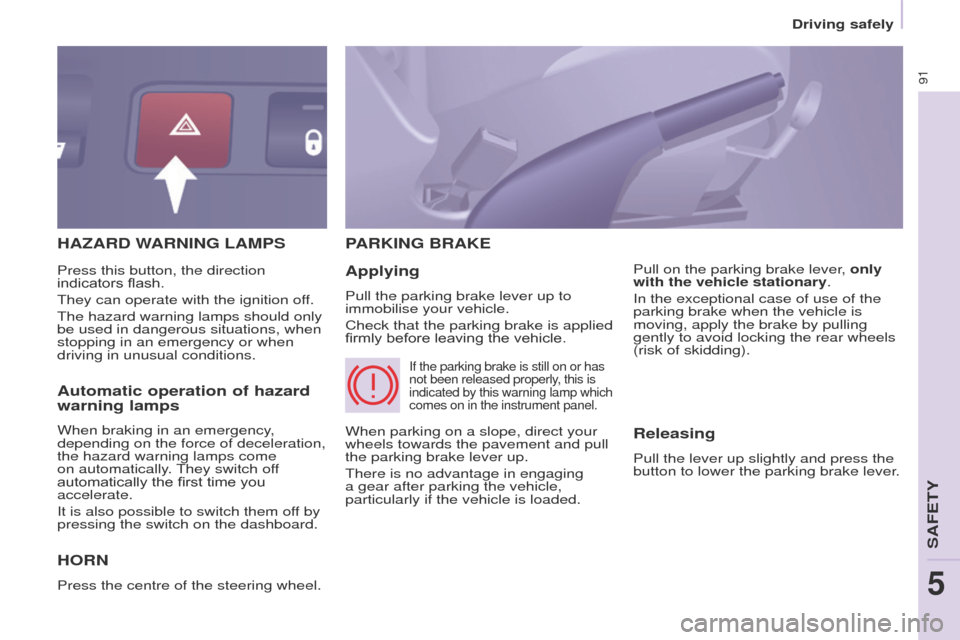
HAZARD WARNING LAMPS
H
ORN
Press the centre of the steering wheel.
PARKING BRAKE
Applying
Pull the parking brake lever up to
immobilise your vehicle.
Check that the parking brake is applied
firmly before leaving the vehicle. Pull on the parking brake lever, only
with the vehicle stationary.
In the exceptional case of use of the
parking brake when the vehicle is
moving, apply the brake by pulling
gently to avoid locking the rear wheels
(risk of skidding).
Press this button, the direction
indicators flash.
They can operate with the ignition off.
The hazard warning lamps should only
be used in dangerous situations, when
stopping in an emergency or when
driving in unusual conditions.
When parking on a slope, direct your
wheels towards the pavement and pull
the parking brake lever up.
There is no advantage in engaging
a gear after parking the vehicle,
particularly if the vehicle is loaded.
If the parking brake is still on or has
not been released properly, this is
indicated by this warning lamp which
comes on in the instrument panel.
Automatic operation of hazard
warning lamps
When braking in an emergency,
depending on the force of deceleration,
the hazard warning lamps come
on automatically. They switch off
automatically the first time you
accelerate.
It is also possible to switch them off by
pressing the switch on the dashboard.Releasing
Pull the lever up slightly and press the
button to lower the parking brake lever.
SAFETY
5
Page 95 of 260
93
Partner-2-VU_en_Chap05_Securite_ed02-2016
Activation / DeactivationMalfunction
In the event of a malfunction, the LED
in the button comes on, accompanied
by an audible signal and a message in
the screen.
Contact a PEUGEOT dealer or
qualified workshop.
Good practice
In bad weather or in winter, ensure that
the sensors are not covered with mud,
ice or snow.
The system will be deactivated
automatically if a trailer is being towed
or if a bicycle carrier is fitted (vehicle
fitted with a towbar or bicycle carrier
recommended by PEUGEOT).
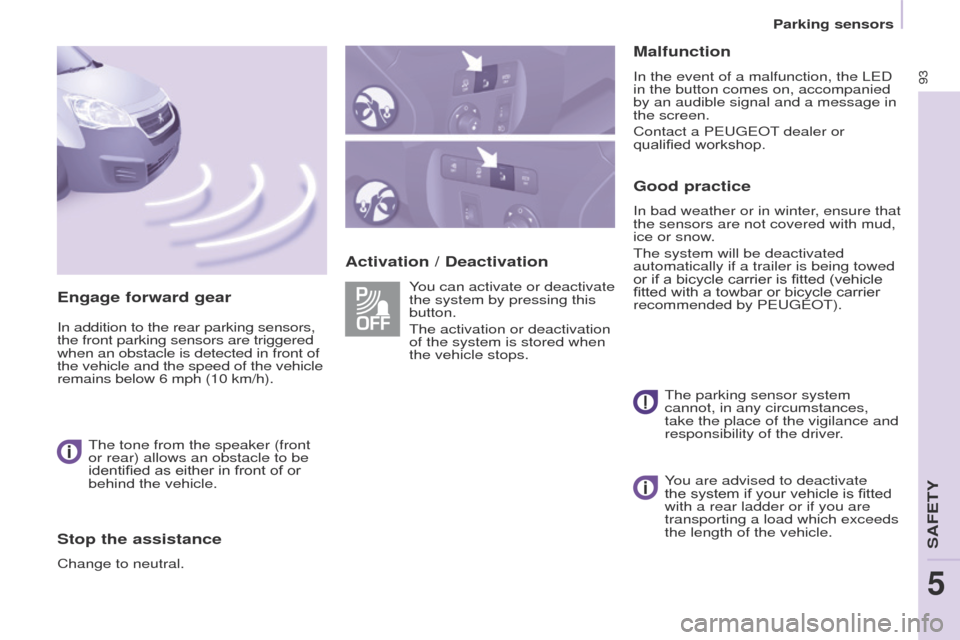
You can activate or deactivate
the system by pressing this
button.
The activation or deactivation
of the system is stored when
the vehicle stops.
The parking sensor system
cannot, in any circumstances,
take the place of the vigilance and
responsibility of the driver.
Engage forward gear
In addition to the rear parking sensors,
the front parking sensors are triggered
when an obstacle is detected in front of
the vehicle and the speed of the vehicle
remains below 6 mph (10 km/h).
The tone from the speaker (front
or rear) allows an obstacle to be
identified as either in front of or
behind the vehicle.
Stop the assistance
Change to neutral. You are advised to deactivate
the system if your vehicle is fitted
with a rear ladder or if you are
transporting a load which exceeds
the length of the vehicle.
SAFETY
5
Parking sensors
Page 104 of 260
102
Driving safely
Partner-2-VU_en_Chap05_Securite_ed02-2016
Operating faults
Sensor fault
The operation of the laser sensor may
suffer interference from accumulations
of dirt or misting of the windscreen.
In this case you are warned by the
display of a message.
Use the windscreen demisting
and regularly clean the area of the
windscreen in front of the sensor.Do not stick or otherwise fix any
object on the windscreen in front
of the sensor. System fault
In the event of a malfunction of the
system, you are warned by an audible
signal and the display of the message "
Automatic braking system fault ".
Have the system checked by a
PEUGEOT dealer or a qualified
workshop.
In the event of an impact to
the windscreen at the sensor,
deactivate the system and contact
a PEUGEOT dealer or a qualified
workshop
to
have your windscreen
replaced.
Never try to remove, adjust or test
the sensor.
Only a PEUGEOT dealer or a
qualified workshop is able to work
on the system.
When towing a trailer or when the
vehicle is being towed, the system
must be deactivated.
Page 107 of 260
105
Partner-2-VU_en_Chap05_Securite_ed02-2016
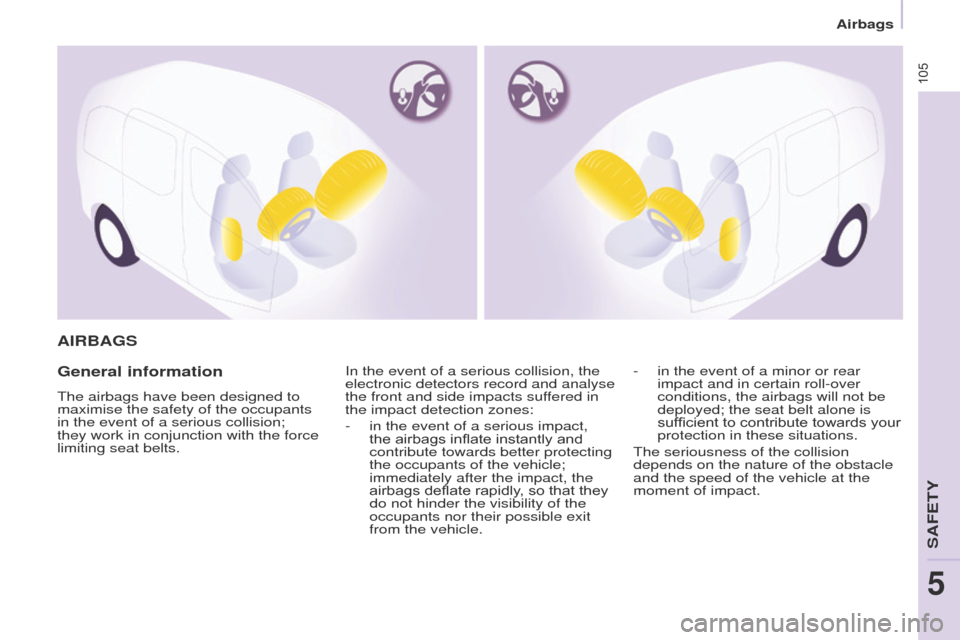
AIRBAGS
General information
The airbags have been designed to
maximise the safety of the occupants
in the event of a serious collision;
they work in conjunction with the force
limiting seat belts.In the event of a serious collision, the
electronic detectors record and analyse
the front and side impacts suffered in
the impact detection zones:
-
in the event of a serious impact,
the airbags inflate instantly and
contribute towards better protecting
the occupants of the vehicle;
immediately after the impact, the
airbags deflate rapidly
, so that they
do not hinder the visibility of the
occupants nor their possible exit
from the vehicle. -
in the event of a minor or rear
impact and in certain roll-over
conditions, the airbags will not be
deployed; the seat belt alone is
sufficient to contribute towards your
protection in these situations.
The seriousness of the collision
depends on the nature of the obstacle
and the speed of the vehicle at the
moment of impact.
SAFETY
5
Airbags
Page 109 of 260
107
Partner-2-VU_en_Chap05_Securite_ed02-2016
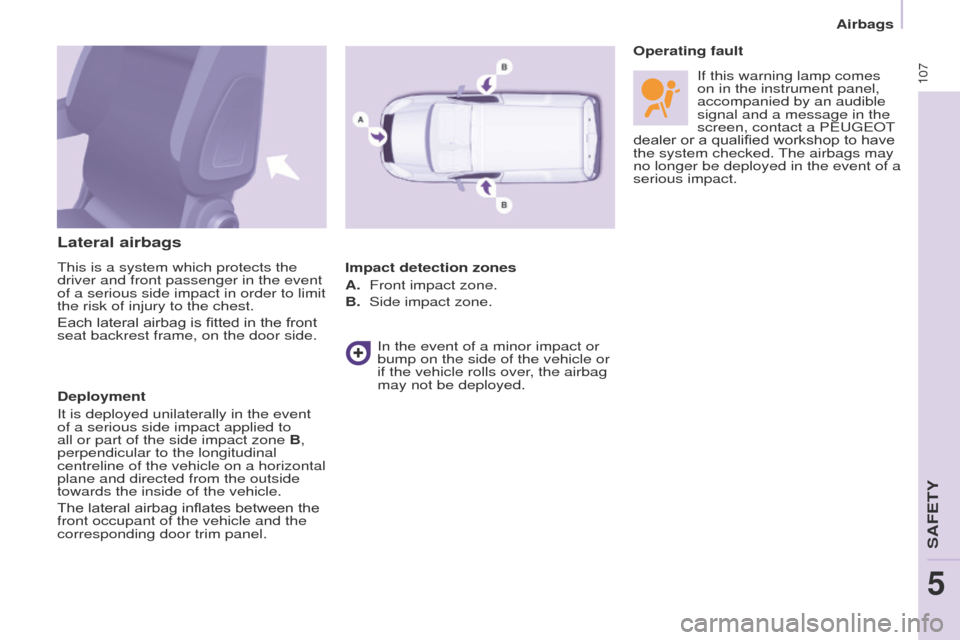
Lateral airbags
This is a system which protects the
driver and front passenger in the event
of a serious side impact in order to limit
the risk of injury to the chest.
Each lateral airbag is fitted in the front
seat backrest frame, on the door side.
Deployment
It is deployed unilaterally in the event
of a serious side impact applied to
all or part of the side impact zone B,
perpendicular to the longitudinal
centreline of the vehicle on a horizontal
plane and directed from the outside
towards the inside of the vehicle.
The lateral airbag inflates between the
front occupant of the vehicle and the
corresponding door trim panel. Impact detection zones
A.
Front impact zone.
B.
Side impact zone.
In the event of a minor impact or
bump on the side of the vehicle or
if the vehicle rolls over
, the airbag
may not be deployed. Operating fault
If this warning lamp comes
on in the instrument panel,
accompanied by an audible
signal and a message in the
screen, contact a PEUGEOT
dealer or a qualified workshop to have
the system checked. The airbags may
no longer be deployed in the event of a
serious impact.
SAFETY
5
Airbags