brake Peugeot Partner 2017 Owner's Guide
[x] Cancel search | Manufacturer: PEUGEOT, Model Year: 2017, Model line: Partner, Model: Peugeot Partner 2017Pages: 260, PDF Size: 9.05 MB
Page 151 of 260
149
Partner-2-VU_en_Chap08_Aide-rapide_ed02-2016
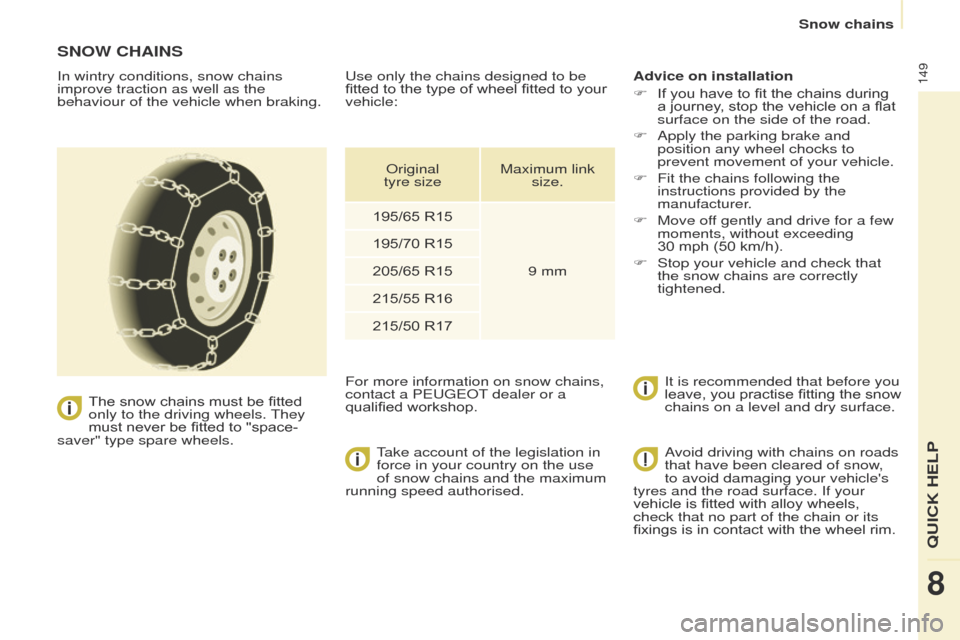
SNOW CHAINS
In wintry conditions, snow chains
improve traction as well as the
behaviour of the vehicle when braking.The snow chains must be fitted
only to the driving wheels. They
must never be fitted to "space-
saver" type spare wheels. Take account of the legislation in
force in your country on the use
of snow chains and the maximum
running speed authorised. Advice on installation
F
If you have to fit the chains during
a journey
, stop the vehicle on a flat
surface on the side of the road.
F
Apply the parking brake and
position any wheel chocks to
prevent movement of your vehicle.
F
Fit the chains following the
instructions provided by the
manufacturer
.
F
Move of
f gently and drive for a few
moments, without exceeding
30 mph (50 km/h).
F
Stop your vehicle and check that
the snow chains are correctly
tightened.It is recommended that before you
leave, you practise fitting the snow
chains on a level and dry surface.
Use only the chains designed to be
fitted to the type of wheel fitted to your
vehicle:
For more information on snow chains,
contact a PEUGEOT
dealer or a
qualified workshop. Original
tyre size Maximum link
size.
195/65
R159
mm
195/70
R15
205/65
R15
215/55
R16
215/50
R17Avoid driving with chains on roads
that have been cleared of snow,
to avoid damaging your vehicle's
tyres and the road surface. If your
vehicle is fitted with alloy wheels,
check that no part of the chain or its
fixings is in contact with the wheel rim.
QUICK HELP
8
Snow chains
Page 156 of 260
154
Partner-2-VU_en_Chap08_Aide-rapide_ed02-2016
This procedure requires the use of
the spanner supplied with the tools for
changing a wheel.-
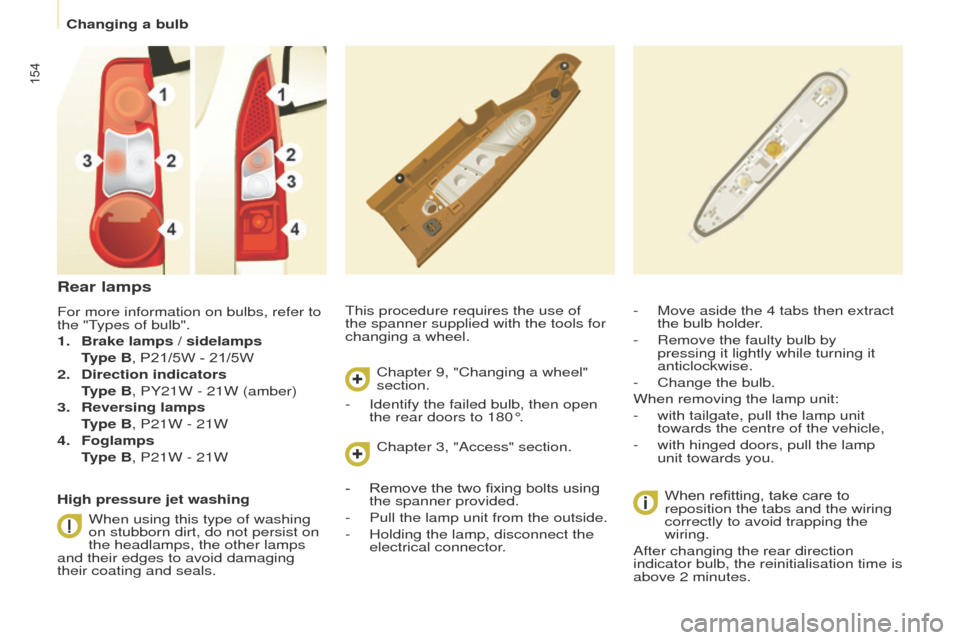
Move aside the 4 tabs then extract
the bulb holder
.
-
Remove the faulty bulb by
pressing it lightly while turning it
anticlockwise.
-
Change the bulb.
When removing the lamp unit:
-
with tailgate, pull the lamp unit
towards the centre of the vehicle,
-
with hinged doors, pull the lamp
unit towards you.When refitting, take care to
reposition the tabs and the wiring
correctly to avoid trapping the
wiring.
After changing the rear direction
indicator bulb, the reinitialisation time is
above 2 minutes.
Rear lamps
For more information on bulbs, refer to
the "Types of bulb".
1.
Brake lamps / sidelamps
T
ype B, P21/5W - 21/5W
2.
Direction indicators
T
ype B, PY21W - 21W (amber)
3.
Reversing lamps
T
ype B, P21W - 21W
4.
Foglamps
T
ype B, P21W - 21W
High pressure jet washing When using this type of washing
on stubborn dirt, do not persist on
the headlamps, the other lamps
and their edges to avoid damaging
their coating and seals. Chapter 9, "Changing a wheel"
section.
Chapter 3, "Access" section.
-
Identify the failed bulb, then open
the rear doors to 180°.
-
Remove the two fixing bolts using
the spanner provided.
-
Pull the lamp unit from the outside.
-
Holding the lamp, disconnect the
electrical connector
.
Changing a bulb
Page 157 of 260
155
Partner-2-VU_en_Chap08_Aide-rapide_ed02-2016
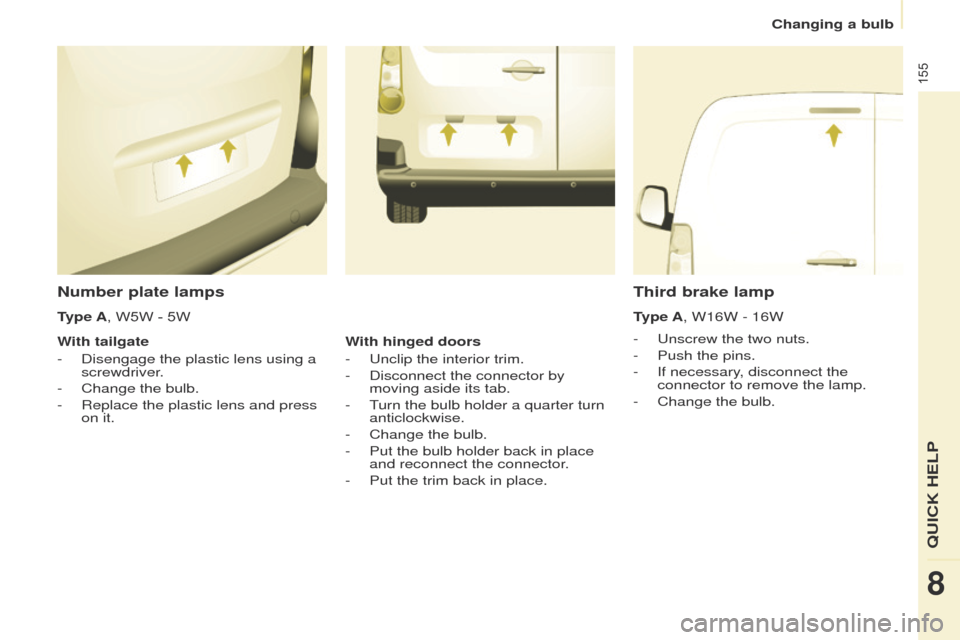
Number plate lamps
- Unscrew the two nuts.
-
Push the pins.
-
If necessary
, disconnect the
connector to remove the lamp.
-
Change the bulb.
Third brake lamp
Type A, W16W - 16W
Type A, W5W - 5W
With tailgate
-
Disengage the plastic lens using a
screwdriver
.
-
Change the bulb.
-
Replace the plastic lens and press
on it. W
ith hinged doors
-
Unclip the interior trim.
-
Disconnect the connector by
moving aside its tab.
-
T
urn the bulb holder a quarter turn
anticlockwise.
-
Change the bulb.
-
Put the bulb holder back in place
and reconnect the connector
.
-
Put the trim back in place.
QUICK HELP
8
Changing a bulb
Page 161 of 260
159
Partner-2-VU_en_Chap08_Aide-rapide_ed02-2016
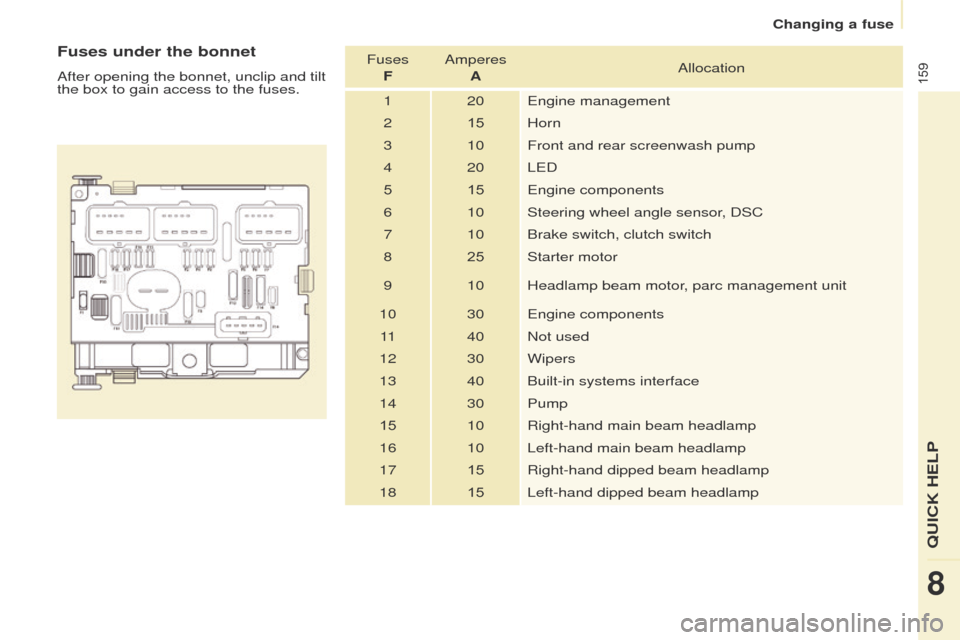
Fuses under the bonnet
After opening the bonnet, unclip and tilt
the box to gain access to the fuses.Fuses
F Amperes
A Allocation
1 20 Engine management
2 15Horn
3 10 Front and rear screenwash pump
4 20 LED
5 15 Engine components
6 10 Steering wheel angle sensor, DSC
7 10 Brake switch, clutch switch
8 25Starter motor
9 10 Headlamp beam motor, parc management unit
10 30 Engine components 11 40 Not used
12 30 Wipers
13 40 Built-in systems interface
14 30 Pump
15 10 Right-hand main beam headlamp
16 10 Left-hand main beam headlamp
17 15Right-hand dipped beam headlamp
18 15Left-hand dipped beam headlamp
QUICK HELP
8
Changing a fuse
Page 171 of 260
169
Partner-2-VU_en_Chap09_Caract-technique_ed02-2016
WEIGHTS AND TOWED LOADS
These values, expressed in kg, can be
found on the manufacturer's VIN plate
or label.
The maximum weights and towed
loads for your vehicle can be found on
the vehicle's registration certificate. The recommended nose weight is
the downward force on the towball
(removable with or without tools).
In each country, it is imperative that
the maximum towed loads authorised
by local legislation are complied
with. To find out your vehicle's towing
capacities and its gross train weight,
consult a PEUGEOT dealer.
The kerb weight is equal to the weight
without load + driver (75 kg) + fuel tank
filled to 90%.
The GTW and towed load values
indicated are valid up to a maximum
altitude of 1000 metres. The value of
the towed load mentioned must be
reduced by 10 % for each additional
1000 metres.
With load transfer, the braked trailer
weight can be increased, on condition
that the equivalent of this load is
removed from the vehicle so that the
GTW is not exceeded. High ambient temperatures
may result in a reduction in the
performance of the vehicle in
order to protect the engine. When
the ambient temperature is higher
than 37 °C, limit the towed weight.
The location of the manufacturer's
plate is given in chapter 9,
"Identification markings" section.
ENGINE CHARACTERISTICS
The engine characteristics (capacity,
maximum power, maximum power
speed, fuel, CO
2 emissions...) for your
vehicle are given in the registration
certificate.
These characteristics correspond
to the values type-approved
on a test bed, under conditions
defined in European legislation
(Directive
1999/99/EC).
For more information, refer to the
manufacturer's website or sales
brochure for the model. Contact
a PEUGEOT dealer or a qualified
workshop. GVW: gross vehicle weight, the
maximum authorised weight.
GTW: gross train weight, the maximum
weight for vehicle plus trailer.
Towing with a lightly loaded
vehicle can adversely affect road
holding.
Towing a trailer increases braking
distances.
When towing, the maximum permitted
speed is reduced (comply with the
legislation in force in the country).
TECHNICAL DATA
9
Weights