light Peugeot Partner Tepee 2011 User Guide
[x] Cancel search | Manufacturer: PEUGEOT, Model Year: 2011, Model line: Partner Tepee, Model: Peugeot Partner Tepee 2011Pages: 232, PDF Size: 7.4 MB
Page 37 of 232
35
READY TO SET OFF
22
Instruments and controls
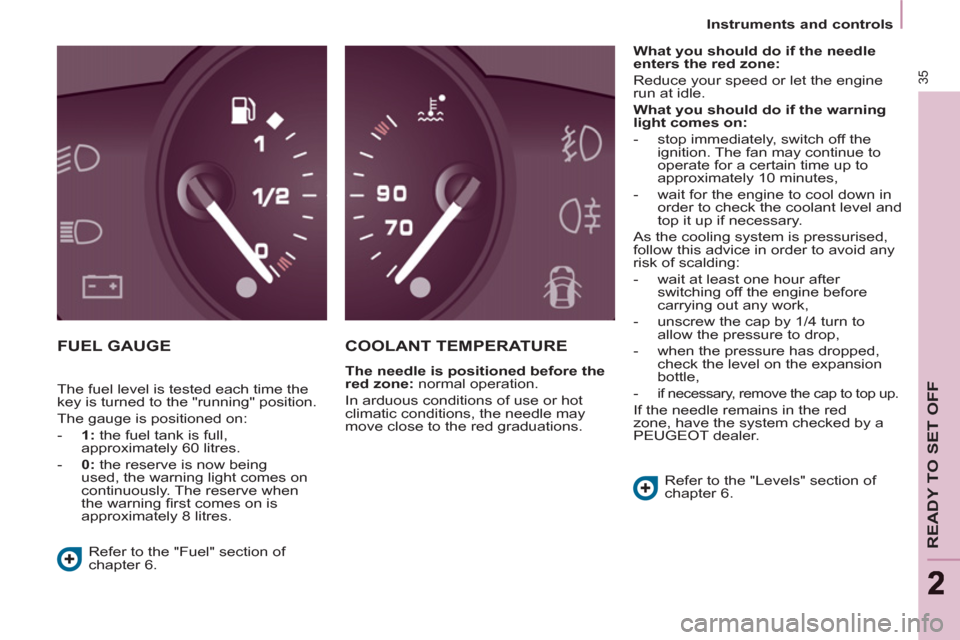
FUEL GAUGE COOLANT TEMPERATURE
The needle is positioned before the
red zone:
normal operation.
In arduous conditions of use or hot
climatic conditions, the needle may
move close to the red graduations.
What you should do if the needle
enters the red zone:
Reduce your speed or let the engine
run at idle.
What you should do if the warning
light comes on:
- stop immediately, switch off the
ignition. The fan may continue to
operate for a certain time up to
approximately 10 minutes,
- wait for the engine to cool down in
order to check the coolant level and
top it up if necessary.
As the cooling system is pressurised,
follow this advice in order to avoid any
risk of scalding:
- wait at least one hour after
switching off the engine before
carrying out any work,
- unscrew the cap by 1/4 turn to
allow the pressure to drop,
- when the pressure has dropped,
check the level on the expansion
bottle,
-
if necessary, remove the cap to top up.
If the needle remains in the red
zone, have the system checked by a
PEUGEOT dealer.
Refer to the "Levels" section of
chapter 6.
Refer to the "Fuel" section of
chapter 6. The fuel level is tested each time the
key is turned to the "running" position.
The gauge is positioned on:
- 1: the fuel tank is full,
approximately 60 litres.
- 0: the reserve is now being
used, the warning light comes on
continuously. The reserve when
the warning fi rst comes on is
approximately 8 litres.
Page 38 of 232
36
Instruments and controls
Puncture
Stop immediately, avoiding any sudden
movement of the steering wheel and
the brakes.
Change the damaged (punctured or
very defl ated) tyre, and have the tyre
pressure checked as soon as possible.
Sensor(s) not detected
Under-infl ation detection is absent
from one (or several) tyre(s). Contact a
PEUGEOT dealer to replace the faulty
sensor(s).
This message is also displayed when
one of the tyres is away from the
vehicle (being repaired) or when a
wheel without a sensor is fi tted.
All repairs and changing of tyres on a
wheel fi tted with this system must be
carried out by a PEUGEOT dealer.
The tyre under-infl ation detection
system is a driving aid which does
not take the place of vigilance or the
responsibility of the driver.
This system does not remove the need
to have the tyre pressure checked
regularly (including the spare wheel), to
ensure that the dynamic performance
of the vehicle remains at its best and
to avoid premature wear of the tyres,
in particular in the case of arduous
driving (heavy load, high speed).
The system may temporarily be
disturbed by radio broadcasts on a
frequency close to it.
TYRE UNDER-INFLATION
DETECTION EMISSION CONTROL
Flat tyre
Check the tyre pressure as soon as
possible.
Refer to the "Changing a wheel"
section of chapter 7.
If the damaged tyre is temporarily
stored inside the vehicle, it will again
emit this message to remind you of the
necessity of having it repaired. This will
prevent another warning of the same
type being displayed.
Sensors check the tyre pressure during
driving (speed higher than 12 mph
[20 km/h]) and trigger a warning in the
event of a malfunction or puncture.
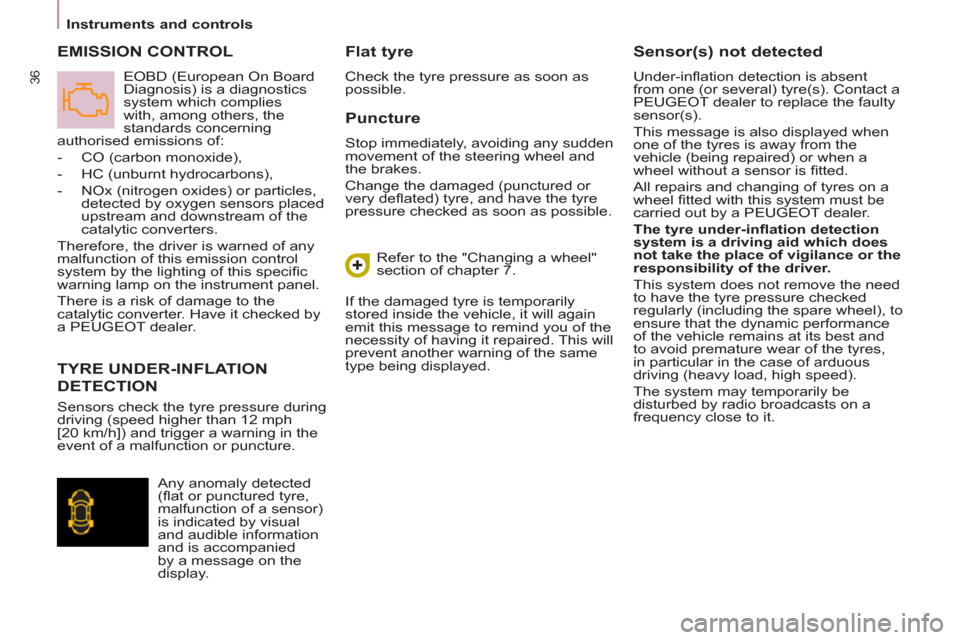
Any anomaly detected
(fl at or punctured tyre,
malfunction of a sensor)
is indicated by visual
and audible information
and is accompanied
by a message on the
display. EOBD (European On Board
Diagnosis) is a diagnostics
system which complies
with, among others, the
standards concerning
authorised emissions of:
- CO (carbon monoxide),
- HC (unburnt hydrocarbons),
- NOx (nitrogen oxides) or particles,
detected by oxygen sensors placed
upstream and downstream of the
catalytic converters.
Therefore, the driver is warned of any
malfunction of this emission control
system by the lighting of this specifi c
warning lamp on the instrument panel.
There is a risk of damage to the
catalytic converter. Have it checked by
a PEUGEOT dealer.
Page 39 of 232
37
READY TO SET OFF
22
Instruments and controls
SERVICE INDICATOR
This programmes service intervals
according to the use of the vehicle.
More than 1 000 miles/km before
the next service is due
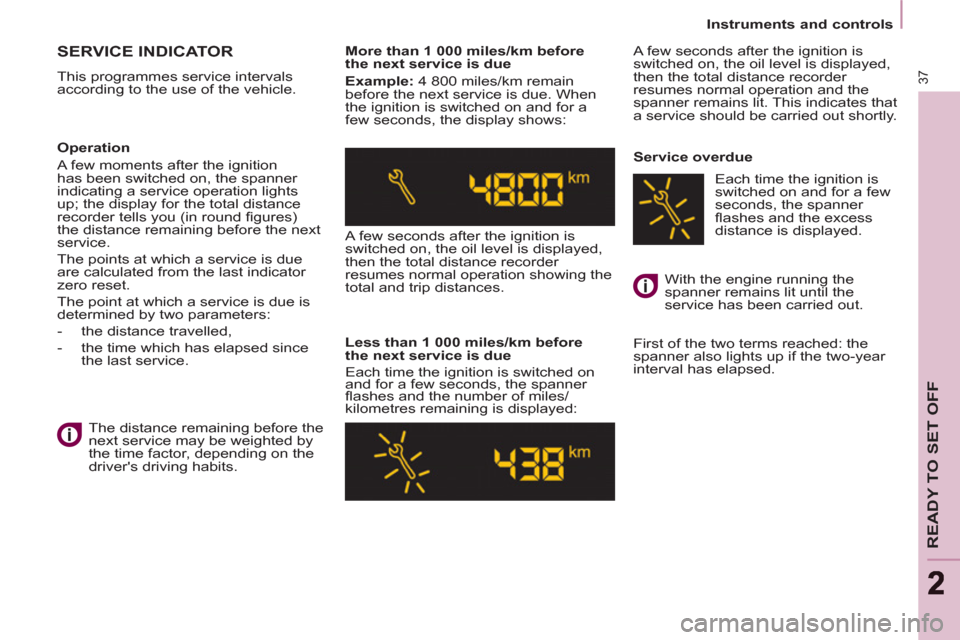
Example: 4 800 miles/km remain
before the next service is due. When
the ignition is switched on and for a
few seconds, the display shows:
A few seconds after the ignition is
switched on, the oil level is displayed,
then the total distance recorder
resumes normal operation showing the
total and trip distances.
Less than 1 000 miles/km before
the next service is due
Each time the ignition is switched on
and for a few seconds, the spanner
fl ashes and the number of miles/
kilometres remaining is displayed: A few seconds after the ignition is
switched on, the oil level is displayed,
then the total distance recorder
resumes normal operation and the
spanner remains lit. This indicates that
a service should be carried out shortly.
Service overdue
First of the two terms reached: the
spanner also lights up if the two-year
interval has elapsed.
Operation
A few moments after the ignition
has been switched on, the spanner
indicating a service operation lights
up; the display for the total distance
recorder tells you (in round fi gures)
the distance remaining before the next
service.
The points at which a service is due
are calculated from the last indicator
zero reset.
The point at which a service is due is
determined by two parameters:
- the distance travelled,
- the time which has elapsed since
the last service.
The distance remaining before the
next service may be weighted by
the time factor, depending on the
driver's driving habits. With the engine running the
spanner remains lit until the
service has been carried out. Each time the ignition is
switched on and for a few
seconds, the spanner
fl ashes and the excess
distance is displayed.
Page 40 of 232
38
Instruments and controls
Trip recorder zero reset
button
After this operation, if you wish
to disconnect the battery, lock
the vehicle and wait for at least
fi ve minutes, otherwise the zero re-set
will not be registered.
Zero re-set
Your PEUGEOT dealer carries out this
operation after each service.
However, if you carry out the service
yourself, the re-set procedure is as
follows:
- switch off the ignition,
- press and hold the trip recorder
reset button,
- switch on the ignition.
The display begins a countdown.
When the display shows "=0" , release
the button; the spanner disappears.
Engine oil level indicator
When the ignition is switched on, the
engine oil level is indicated for a few
seconds, after the service information.
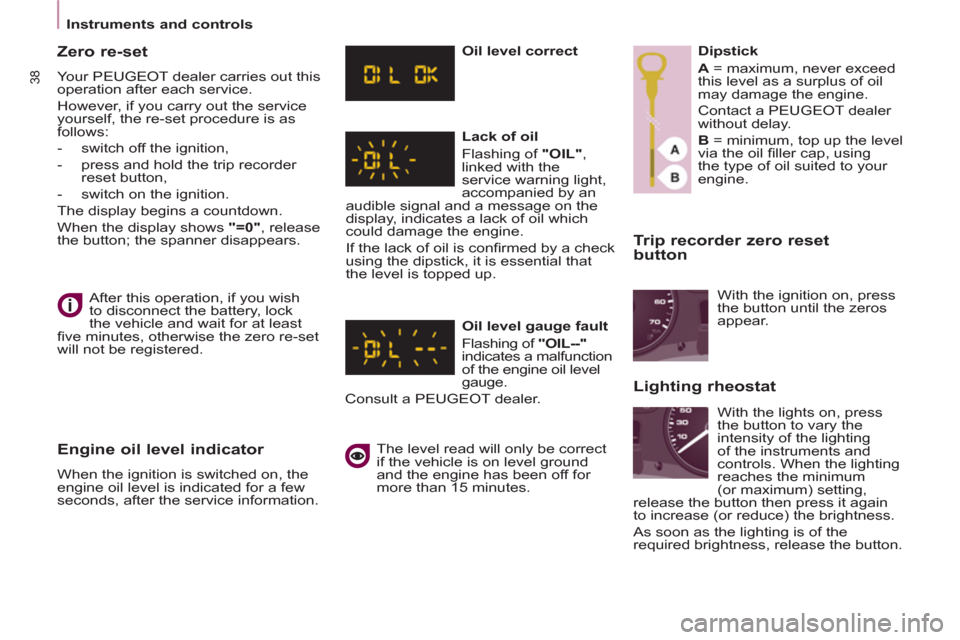
Oil level correct
Lack of oil
Flashing of "OIL"
,
linked with the
service warning light,
accompanied by an
audible signal and a message on the
display, indicates a lack of oil which
could damage the engine.
If the lack of oil is confi rmed by a check
using the dipstick, it is essential that
the level is topped up.
Oil level gauge fault
Flashing of "OIL--"
indicates a malfunction
of the engine oil level
gauge.
Consult a PEUGEOT dealer.
The level read will only be correct
if the vehicle is on level ground
and the engine has been off for
more than 15 minutes.
Dipstick
A
= maximum, never exceed
this level as a surplus of oil
may damage the engine.
Contact a PEUGEOT dealer
without delay.
B
= minimum, top up the level
via the oil fi ller cap, using
the type of oil suited to your
engine.
Lighting rheostat
With the ignition on, press
the button until the zeros
appear.
With the lights on, press
the button to vary the
intensity of the lighting
of the instruments and
controls. When the lighting
reaches the minimum
(or maximum) setting,
release the button then press it again
to increase (or reduce) the brightness.
As soon as the lighting is of the
required brightness, release the button.
Page 41 of 232
39
READY TO SET OFF
22
Gearbox and steering wheel
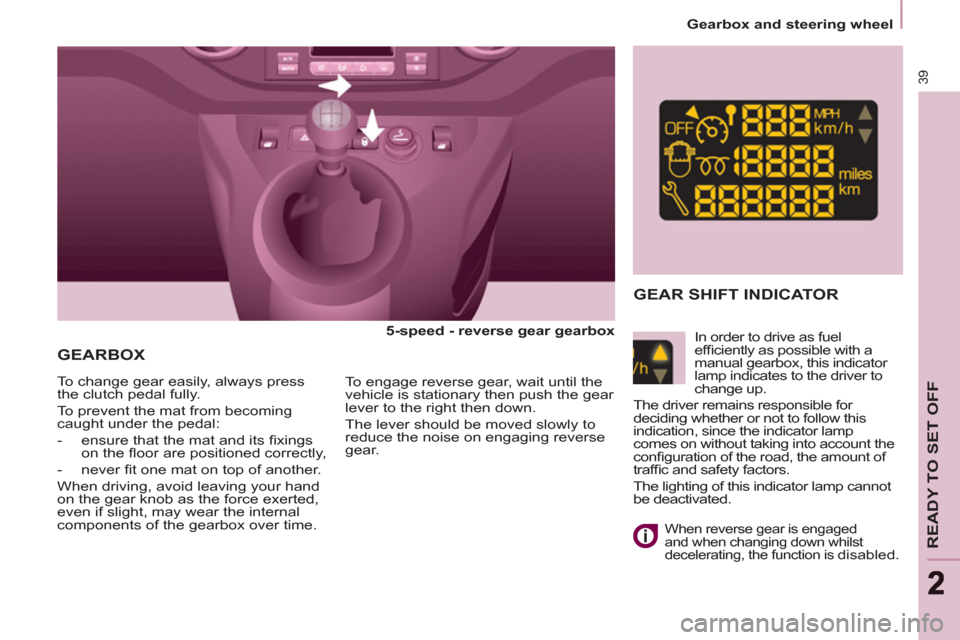
GEARBOX
5-speed - reverse gear gearbox
To change gear easily, always press
the clutch pedal fully.
To prevent the mat from becoming
caught under the pedal:
- ensure that the mat and its fi xings
on the fl oor are positioned correctly,
- never fi t one mat on top of another.
When driving, avoid leaving your hand
on the gear knob as the force exerted,
even if slight, may wear the internal
components of the gearbox over time.
To engage reverse gear, wait until the
vehicle is stationary then push the gear
lever to the right then down.
The lever should be moved slowly to
reduce the noise on engaging reverse
gear.
GEAR SHIFT INDICATOR
In order to drive as fuel
effi ciently as possible with a
manual gearbox, this indicator
lamp indicates to the driver to
change up.
The driver remains responsible for
deciding whether or not to follow this
indication, since the indicator lamp
comes on without taking into account the
confi guration of the road, the amount of
traffi c and safety factors.
The lighting of this indicator lamp cannot
be deactivated.
When reverse gear is engaged
and when changing down whilst
decelerating, the function is
disabled.
Page 45 of 232
43
READY TO SET OFF
22
Stop & Start
STOP & START
The Stop & Start system puts the
engine temporarily on standby - STOP
mode - during stops in the traffi c (red
lights, traffi c jams, or other...). The
engine restarts automatically - START
mode - as soon as you want to move
off. The restart takes place instantly,
quickly and silently.
Perfect for urban use, the Stop & Start
system reduces fuel consumption and
exhaust emissions as well as the noise
level when stationary.
Operation
Going into engine STOP mode
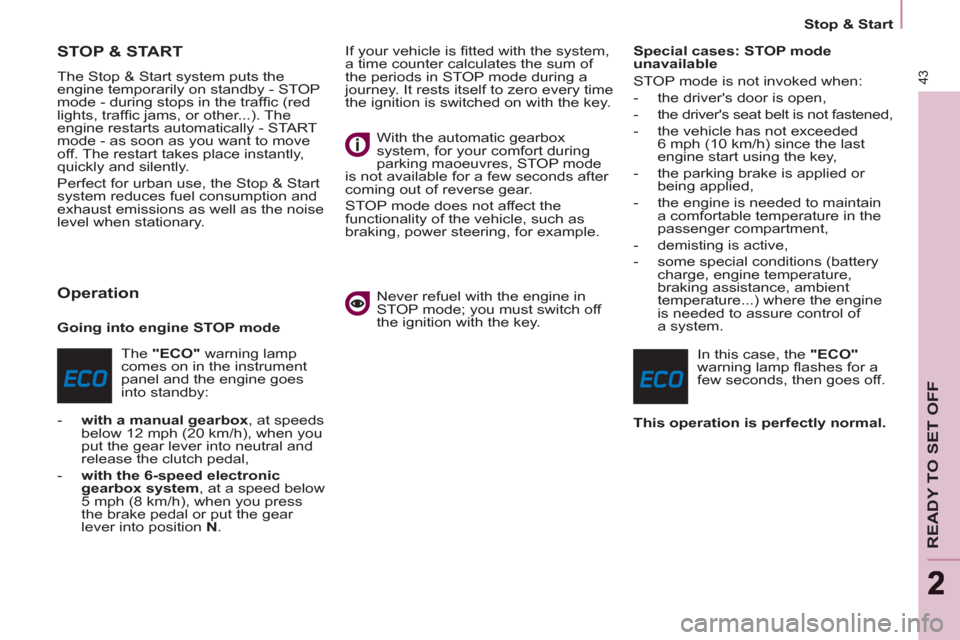
The "ECO"
warning lamp
comes on in the instrument
panel and the engine goes
into standby:
- with a manual gearbox
, at speeds
below 12 mph (20 km/h), when you
put the gear lever into neutral and
release the clutch pedal,
- with the 6-speed electronic
gearbox system
, at a speed below
5 mph (8 km/h), when you press
the brake pedal or put the gear
lever into position N
. If your vehicle is fi tted with the system,
a time counter calculates the sum of
the periods in STOP mode during a
journey. It rests itself to zero every time
the ignition is switched on with the key.
With the automatic gearbox
system, for your comfort during
parking maoeuvres, STOP mode
is not available for a few seconds after
coming out of reverse gear.
STOP mode does not affect the
functionality of the vehicle, such as
braking, power steering, for example.
Never refuel with the engine in
STOP mode; you must switch off
the ignition with the key.
Special cases: STOP mode
unavailable
STOP mode is not invoked when:
- the driver's door is open,
- the driver's seat belt is not fastened,
- the vehicle has not exceeded
6 mph (10 km/h) since the last
engine start using the key,
- the parking brake is applied or
being applied,
- the engine is needed to maintain
a comfortable temperature in the
passenger compartment,
- demisting is active,
- some special conditions (battery
charge, engine temperature,
braking assistance, ambient
temperature...) where the engine
is needed to assure control of
a system.
In this case, the "ECO"
warning lamp fl ashes for a
few seconds, then goes off.
This operation is perfectly normal.
Page 48 of 232
Starting and stopping
Good practice when stopping
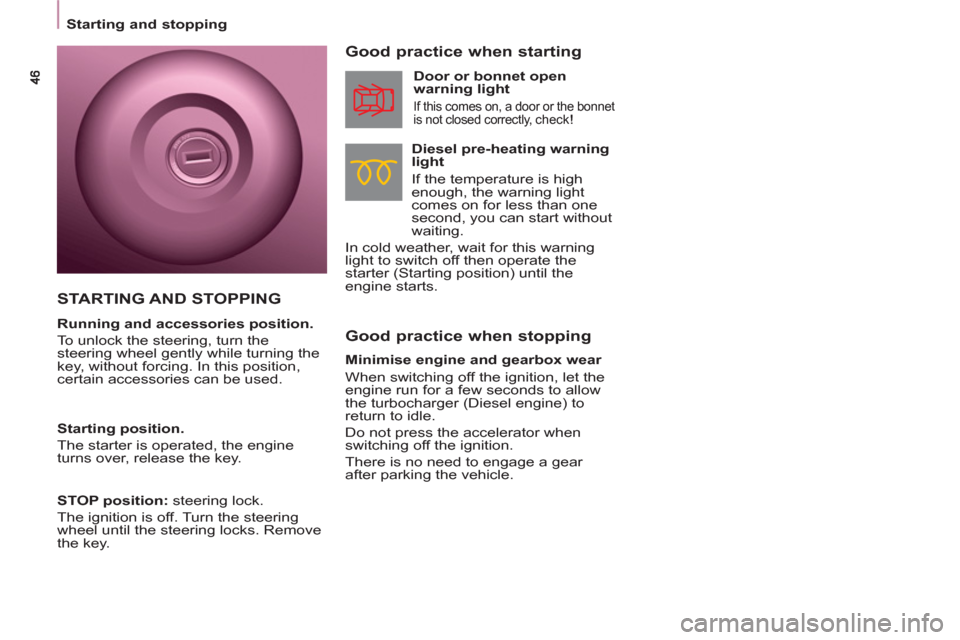
Good practice when starting
Diesel pre-heating warning
light
If the temperature is high
enough, the warning light
comes on for less than one
second, you can start without
waiting.
In cold weather, wait for this warning
light to switch off then operate the
starter (Starting position) until the
engine starts.
Door or bonnet open
warning light
If this comes on, a door or the bonnet
is not closed correctly, check!
Minimise engine and gearbox wear
When switching off the ignition, let the
engine run for a few seconds to allow
the turbocharger (Diesel engine) to
return to idle.
Do not press the accelerator when
switching off the ignition.
There is no need to engage a gear
after parking the vehicle.
STARTING AND STOPPING
Running and accessories position.
To unlock the steering, turn the
steering wheel gently while turning the
key, without forcing. In this position,
certain accessories can be used.
Starting position.
The starter is operated, the engine
turns over, release the key.
STOP position:
steering lock.
The ignition is off. Turn the steering
wheel until the steering locks. Remove
the key.
Page 50 of 232
48
Steering mounted controls
Direction indicators
"Motorway" function
Press the control up or down to fl ash
the corresponding direction indicator
three times.
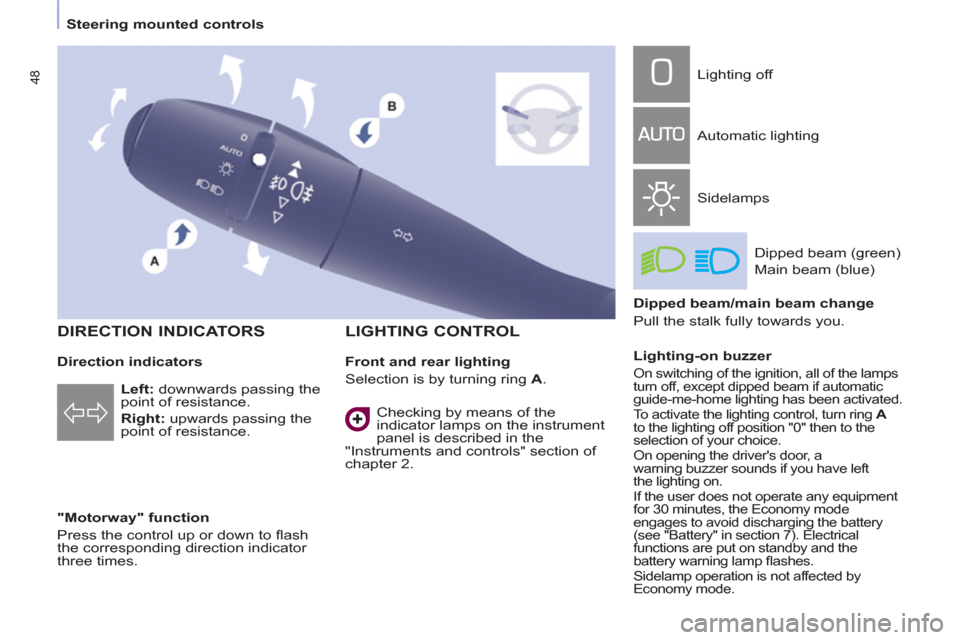
LIGHTING CONTROL
Left
: downwards passing the
point of resistance.
Right
: upwards passing the
point of resistance.
Front and rear lighting
Selection is by turning ring A
. Lighting off
Automatic lighting
Sidelamps
Dipped beam (green)
Main beam (blue)
Dipped beam/main beam change
Pull the stalk fully towards you.
Lighting-on buzzer
On switching of the ignition, all of the lamps
turn off, except dipped beam if automatic
guide-me-home lighting has been activated.
To activate the lighting control, turn ring A
to the lighting off position "0" then to the
selection of your choice.
On opening the driver's door, a
warning buzzer sounds if you have left
the lighting on.
If the user does not operate any equipment
for 30 minutes, the Economy mode
engages to avoid discharging the battery
(see "Battery" in section 7). Electrical
functions are put on standby and the
battery warning lamp fl ashes.
Sidelamp operation is not affected by
Economy mode.
Checking by means of the
indicator lamps on the instrument
panel is described in the
"Instruments and controls" section of
chapter 2.
DIRECTION INDICATORS
Page 51 of 232
49
Steering mounted controls
EASE OF USE
andCOMFOR
T
3
Daytime lights
Depending on the country in which
the vehicle is sold, the vehicle may
be equipped with daytime lights. The
dipped headlamps come on when the
vehicle is started.
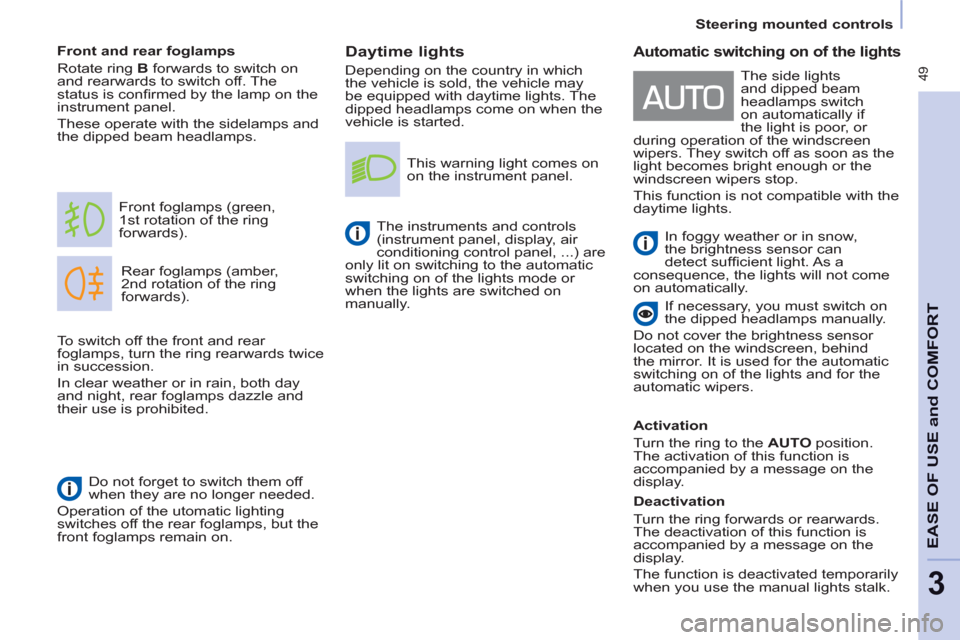
Rear foglamps (amber,
2nd rotation of the ring
forwards). Front foglamps (green,
1st rotation of the ring
forwards).
Front and rear foglamps
Rotate ring B
forwards to switch on
and rearwards to switch off. The
status is confi rmed by the lamp on the
instrument panel.
These operate with the sidelamps and
the dipped beam headlamps.
Do not forget to switch them off
when they are no longer needed.
Operation of the utomatic lighting
switches off the rear foglamps, but the
front foglamps remain on.
This warning light comes on
on the instrument panel.
The instruments and controls
(instrument panel, display, air
conditioning control panel, ...) are
only lit on switching to the automatic
switching on of the lights mode or
when the lights are switched on
manually.
To switch off the front and rear
foglamps, turn the ring rearwards twice
in succession.
In clear weather or in rain, both day
and night, rear foglamps dazzle and
their use is prohibited.
Automatic switching on of the lights
In foggy weather or in snow,
the brightness sensor can
detect suffi cient light. As a
consequence, the lights will not come
on automatically.
If necessary, you must switch on
the dipped headlamps manually.
Do not cover the brightness sensor
located on the windscreen, behind
the mirror. It is used for the automatic
switching on of the lights and for the
automatic wipers.
Activation
Turn the ring to the AUTO position.
The activation of this function is
accompanied by a message on the
display.
Deactivation
Turn the ring forwards or rearwards.
The deactivation of this function is
accompanied by a message on the
display.
The function is deactivated temporarily
when you use the manual lights stalk. The side lights
and dipped beam
headlamps switch
on automatically if
the light is poor, or
during operation of the windscreen
wipers. They switch off as soon as the
light becomes bright enough or the
windscreen wipers stop.
This function is not compatible with the
daytime lights.
Page 52 of 232
50
Steering mounted controls
If the brightness sensor
does not function
correctly, the lights come on
accompanied by the service
warning light, an audible
signal and a message on the display.
Consult a PEUGEOT dealer.
Guide-me-home lighting
The temporary maintaining of the
dipped headlamps lighting, with the
ignition off, makes the driver's exit
easier when the light is poor.
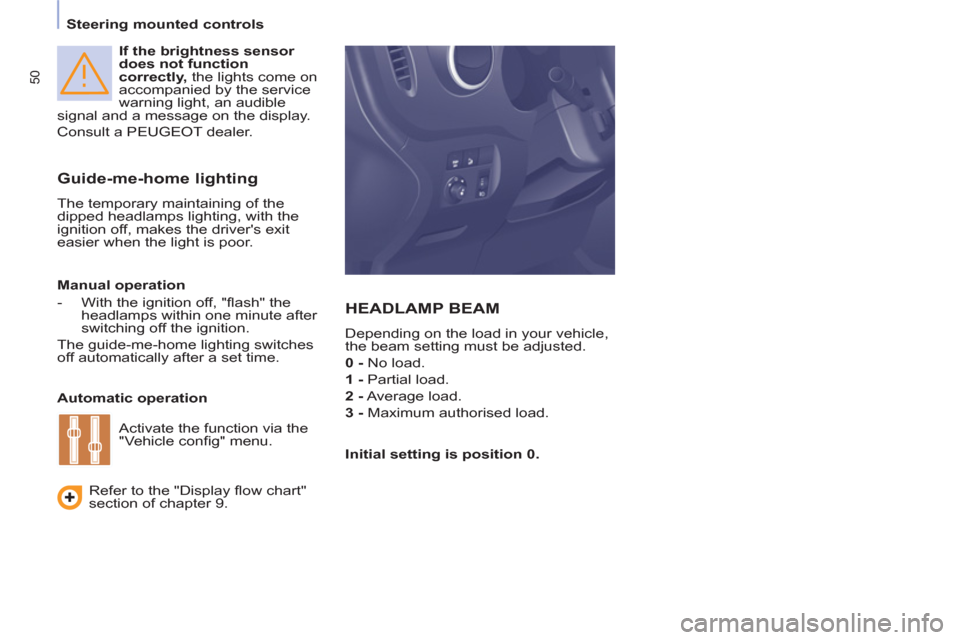
HEADLAMP BEAM
Depending on the load in your vehicle,
the beam setting must be adjusted.
0 - No load.
1 - Partial load.
2 - Average load.
3 - Maximum authorised load.
Manual operation
- With the ignition off, "fl ash" the
headlamps within one minute after
switching off the ignition.
The guide-me-home lighting switches
off automatically after a set time.
Automatic operation
Refer to the "Display fl ow chart"
section of chapter 9.
Initial setting is position 0. Activate the function via the
"Vehicle confi g" menu.