light Peugeot Partner Tepee 2011 Owner's Guide
[x] Cancel search | Manufacturer: PEUGEOT, Model Year: 2011, Model line: Partner Tepee, Model: Peugeot Partner Tepee 2011Pages: 232, PDF Size: 7.4 MB
Page 66 of 232
64
Ventilation
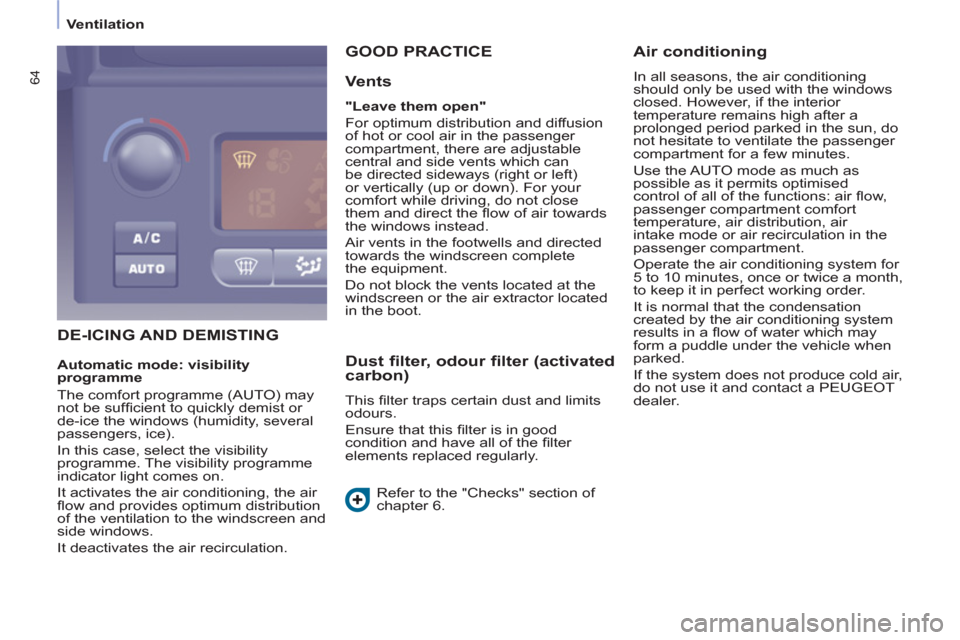
DE-ICING AND DEMISTING GOOD PRACTICE
Vents
"Leave them open"
For optimum distribution and diffusion
of hot or cool air in the passenger
compartment, there are adjustable
central and side vents which can
be directed sideways (right or left)
or vertically (up or down). For your
comfort while driving, do not close
them and direct the fl ow of air towards
the windows instead.
Air vents in the footwells and directed
towards the windscreen complete
the equipment.
Do not block the vents located at the
windscreen or the air extractor located
in the boot.
Dust filter, odour filter (activated
carbon)
This fi lter traps certain dust and limits
odours.
Ensure that this fi lter is in good
condition and have all of the fi lter
elements replaced regularly.
Refer to the "Checks" section of
chapter 6.
Air conditioning
In all seasons, the air conditioning
should only be used with the windows
closed. However, if the interior
temperature remains high after a
prolonged period parked in the sun, do
not hesitate to ventilate the passenger
compartment for a few minutes.
Use the AUTO mode as much as
possible as it permits optimised
control of all of the functions: air fl ow,
passenger compartment comfort
temperature, air distribution, air
intake mode or air recirculation in the
passenger compartment.
Operate the air conditioning system for
5 to 10 minutes, once or twice a month,
to keep it in perfect working order.
It is normal that the condensation
created by the air conditioning system
results in a fl ow of water which may
form a puddle under the vehicle when
parked.
If the system does not produce cold air,
do not use it and contact a PEUGEOT
dealer.
Automatic mode: visibility
programme
The comfort programme (AUTO) may
not be suffi cient to quickly demist or
de-ice the windows (humidity, several
passengers, ice).
In this case, select the visibility
programme. The visibility programme
indicator light comes on.
It activates the air conditioning, the air
fl ow and provides optimum distribution
of the ventilation to the windscreen and
side windows.
It deactivates the air recirculation.
Page 81 of 232
79
EASE OF USE
andCOMFOR
T
3
Seats
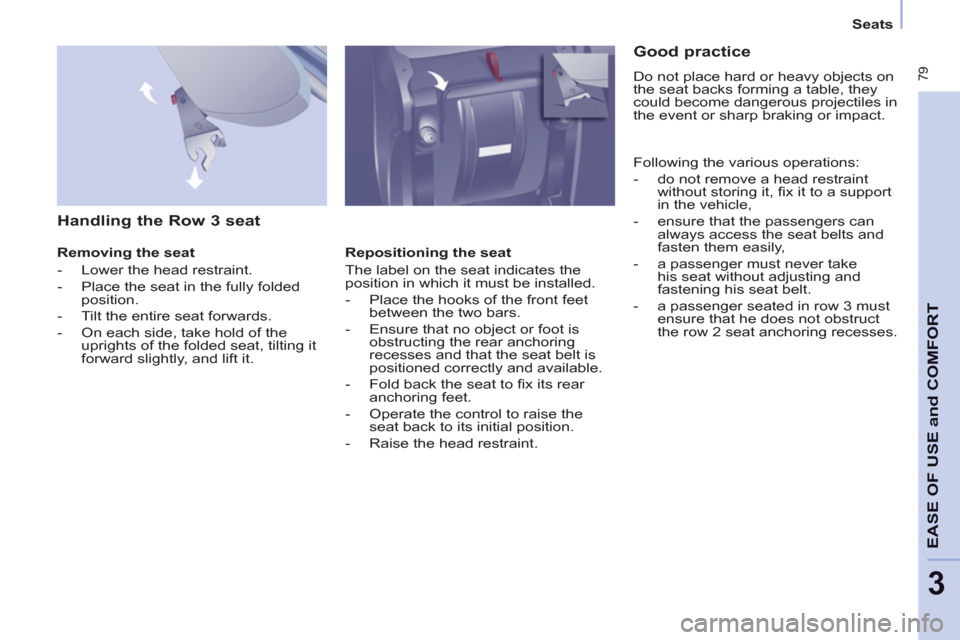
Handling the Row 3 seat
Removing the seat
- Lower the head restraint.
- Place the seat in the fully folded
position.
- Tilt the entire seat forwards.
- On each side, take hold of the
uprights of the folded seat, tilting it
forward slightly, and lift it.
Repositioning the seat
The label on the seat indicates the
position in which it must be installed.
- Place the hooks of the front feet
between the two bars.
- Ensure that no object or foot is
obstructing the rear anchoring
recesses and that the seat belt is
positioned correctly and available.
- Fold back the seat to fi x its rear
anchoring feet.
- Operate the control to raise the
seat back to its initial position.
- Raise the head restraint.
Good practice
Do not place hard or heavy objects on
the seat backs forming a table, they
could become dangerous projectiles in
the event or sharp braking or impact.
Following the various operations:
- do not remove a head restraint
without storing it, fi x it to a support
in the vehicle,
- ensure that the passengers can
always access the seat belts and
fasten them easily,
- a passenger must never take
his seat without adjusting and
fastening his seat belt.
- a passenger seated in row 3 must
ensure that he does not obstruct
the row 2 seat anchoring recesses.
Page 87 of 232
85
EASE OF USE
andCOMFOR
T
3
Practical information
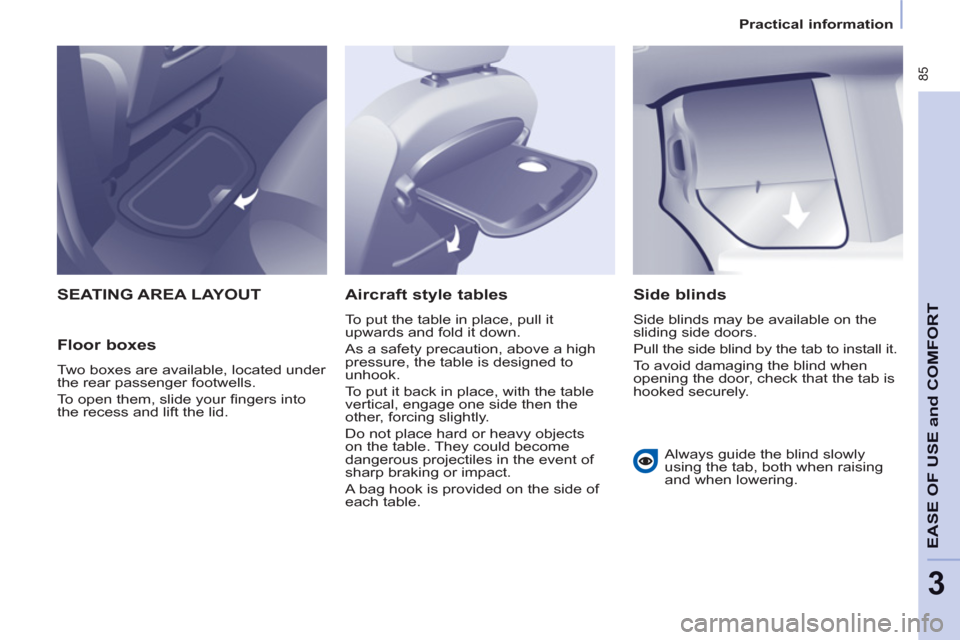
SEATING AREA LAYOUT
Floor boxes
Two boxes are available, located under
the rear passenger footwells.
To open them, slide your fi ngers into
the recess and lift the lid.
Aircraft style tables
To put the table in place, pull it
upwards and fold it down.
As a safety precaution, above a high
pressure, the table is designed to
unhook.
To put it back in place, with the table
vertical, engage one side then the
other, forcing slightly.
Do not place hard or heavy objects
on the table. They could become
dangerous projectiles in the event of
sharp braking or impact.
A bag hook is provided on the side of
each table.
Side blinds
Side blinds may be available on the
sliding side doors.
Pull the side blind by the tab to install it.
To avoid damaging the blind when
opening the door, check that the tab is
hooked securely.
Always guide the blind slowly
using the tab, both when raising
and when lowering.
Page 94 of 232

92
Practical information
Automatic switching on/off
The front courtesy light comes on
when the key is removed from the
ignition, when the vehicle is unlocked,
when one of the front doors is opened
and for location of the vehicle using the
remote control.
It switches off gradually after the
ignition is switched on and when the
vehicle is locked. Front seats: comes on when
one of the front doors is
opened. These are switched on and off by
means of a manual switch, with
the ignition on.
Rear seats: comes on when
one of the rear doors is
opened.
If the doors remain open for
a few minutes, the courtesy
lights are switched off.
Permanently off. Permanently on, ignition on.
Front courtesy light
COURTESY LIGHTS
Rear courtesy light
Front individual reading lights
Page 95 of 232
93
EASE OF USE
andCOMFOR
T
3
Practical information
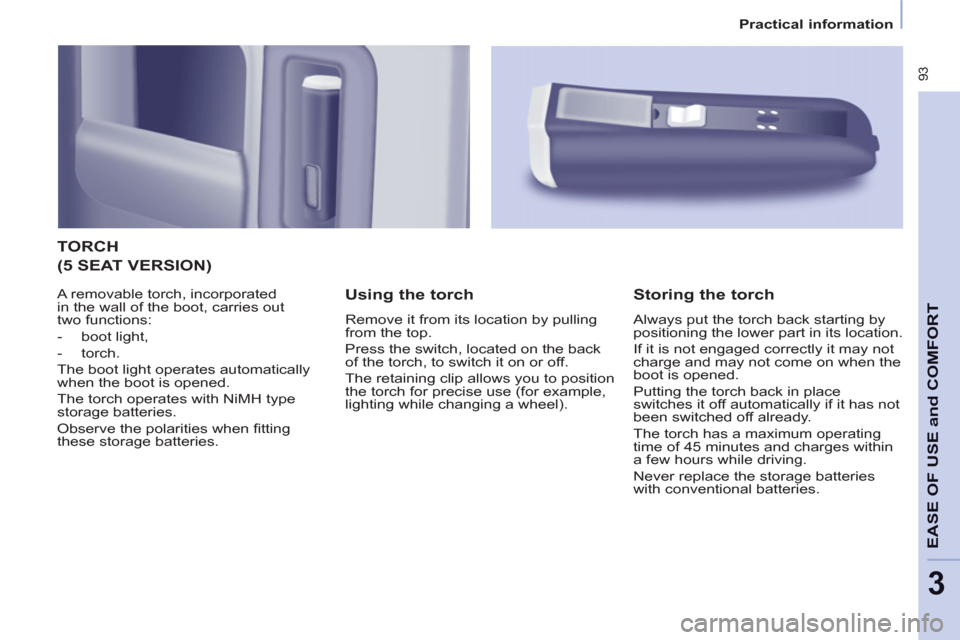
TORCH
Using the torch
Remove it from its location by pulling
from the top.
Press the switch, located on the back
of the torch, to switch it on or off.
The retaining clip allows you to position
the torch for precise use (for example,
lighting while changing a wheel).
Storing the torch
Always put the torch back starting by
positioning the lower part in its location.
If it is not engaged correctly it may not
charge and may not come on when the
boot is opened.
Putting the torch back in place
switches it off automatically if it has not
been switched off already.
The torch has a maximum operating
time of 45 minutes and charges within
a few hours while driving.
Never replace the storage batteries
with conventional batteries.
(5 SEAT VERSION)
A removable torch, incorporated
in the wall of the boot, carries out
two functions:
- boot light,
- torch.
The boot light operates automatically
when the boot is opened.
The torch operates with NiMH type
storage batteries.
Observe the polarities when fi tting
these storage batteries.
Page 103 of 232
101
EASE OF USE
andCOMFOR
T
3
Practical information
The interior rack is not compatible
with the Zenith roof.
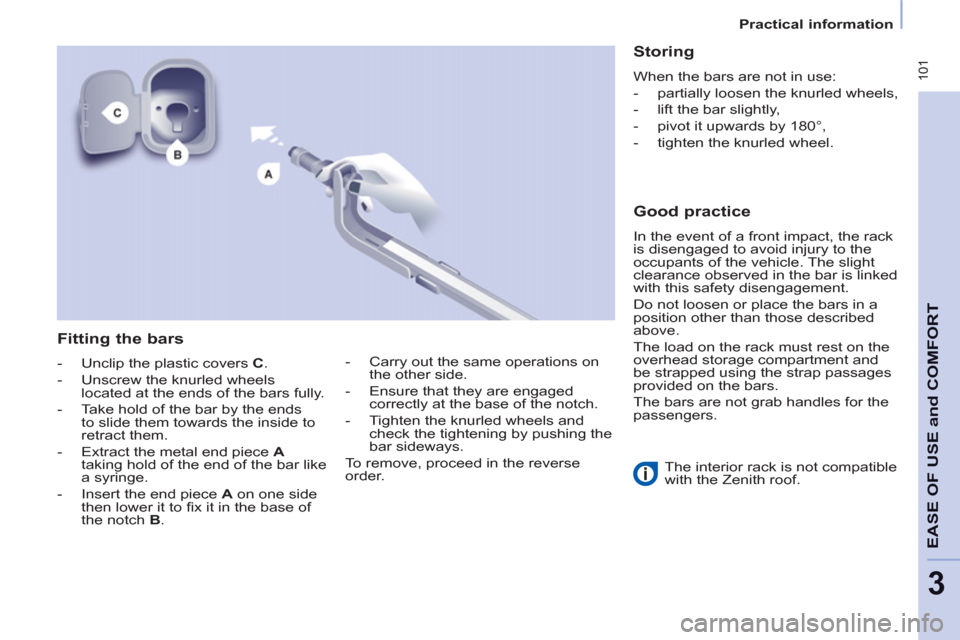
Fitting the bars
- Unclip the plastic covers C .
- Unscrew the knurled wheels
located at the ends of the bars fully.
- Take hold of the bar by the ends
to slide them towards the inside to
retract them.
- Extract the metal end piece A
taking hold of the end of the bar like
a syringe.
- Insert the end piece A on one side
then lower it to fi x it in the base of
the notch B .
Storing
When the bars are not in use:
- partially loosen the knurled wheels,
- lift the bar slightly,
- pivot it upwards by 180°,
- tighten the knurled wheel.
Good practice
In the event of a front impact, the rack
is disengaged to avoid injury to the
occupants of the vehicle. The slight
clearance observed in the bar is linked
with this safety disengagement.
Do not loosen or place the bars in a
position other than those described
above.
The load on the rack must rest on the
overhead storage compartment and
be strapped using the strap passages
provided on the bars.
The bars are not grab handles for the
passengers.
- Carry out the same operations on
the other side.
- Ensure that they are engaged
correctly at the base of the notch.
- Tighten the knurled wheels and
check the tightening by pushing the
bar sideways.
To remove, proceed in the reverse
order.
Page 107 of 232
105
Driving safely
SAFETY
4
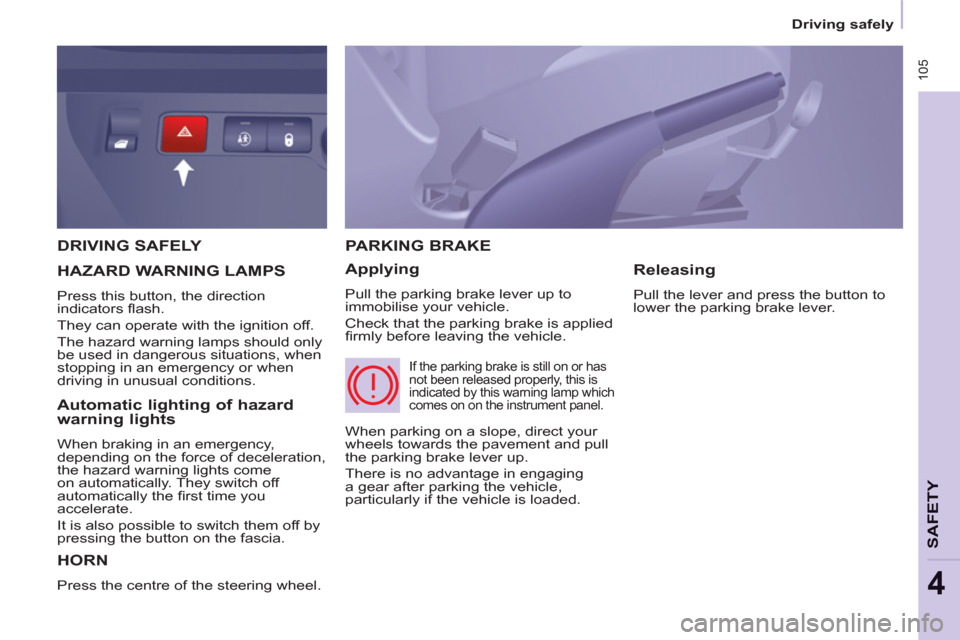
DRIVING SAFELY
HORN
Press the centre of the steering wheel.
PARKING BRAKE
Applying
Pull the parking brake lever up to
immobilise your vehicle.
Check that the parking brake is applied
fi rmly before leaving the vehicle.
Releasing
Pull the lever and press the button to
lower the parking brake lever.
HAZARD WARNING LAMPS
Press this button, the direction
indicators fl ash.
They can operate with the ignition off.
The hazard warning lamps should only
be used in dangerous situations, when
stopping in an emergency or when
driving in unusual conditions.
When parking on a slope, direct your
wheels towards the pavement and pull
the parking brake lever up.
There is no advantage in engaging
a gear after parking the vehicle,
particularly if the vehicle is loaded.
If the parking brake is still on or has
not been released properly, this is
indicated by this warning lamp which
comes on on the instrument panel.
Automatic lighting of hazard
warning lights
When braking in an emergency,
depending on the force of deceleration,
the hazard warning lights come
on automatically. They switch off
automatically the fi rst time you
accelerate.
It is also possible to switch them off by
pressing the button on the fascia.
Page 110 of 232
ABS
ABS
108
Driving safely
(ABS - EBFD)
The ABS and EBFD (electronic brake
force distribution) systems improve the
stability and manoeuvrability of your
vehicle on braking, in particular on
poor or slippery surfaces.
The ABS prevents locking of the
wheels, the EBFD provides control of
the braking pressure wheel by wheel. If this warning light comes on,
accompanied by an audible
signal and a message on
the display, it indicates a
malfunction of the ABS which
could result in a loss of control of the
vehicle on braking.
If this warning light comes
on, together with the brake
and STOP warning lights,
accompanied by an audible
signal and a message on the
display, it indicates a malfunction of
the electronic brake force distribution
which could result in a loss of control of
the vehicle on braking.
EMERGENCY BRAKING
ASSISTANCE SYSTEM
(EBA)
In an emergency, this system enables
the optimum braking pressure to be
reached more quickly, press the pedal
fi rmly without releasing it.
It is triggered by the speed at which the
brake pedal is activated.
This alters the resistance of the brake
pedal under your foot.
To prolong the operation of the
emergency braking assistance system:
keep your foot on the brake pedal.
Good practice
The anti-lock braking system comes
into operation automatically when
there is a risk of wheel lock. It does not
reduce the braking distance.
On very slippery surfaces (ice, oil, etc...)
the ABS may increase the braking
distance. When braking in an
emergency, do not hesitate to press
the brake pedal fi rmly, without
releasing the pressure, even on a
slippery surface, you will then be able
to continue to manoeuvre the vehicle
to avoid an obstacle.
Normal operation of the ABS may be
felt by slight vibration of the brake
pedal.
When changing wheels (tyres
and rims), ensure that these are
recommended by PEUGEOT.
Stop immediately.
In both cases, contact a PEUGEOT
dealer.
Page 111 of 232
ESP OFF
109
Driving safely
SAFETY
4
TRACTION CONTROL (ASR)
AND DYNAMIC STABILITY
CONTROL
(ESP)
These systems are linked and
complement the ABS.
The ASR system is very useful for
maintaining optimum drive and
avoiding losses of control of the vehicle
on acceleration.
The system optimises drive to prevent
the wheels skidding, by acting on the
brakes of the drive wheels and on the
engine. It also allows the directional
stability of the vehicle to be improved
on acceleration.
Use the ESP to hold your course
without attempting to countersteer.
If there is a variation between the
trajectory followed by the vehicle and
that required by the driver, the ESP
system automatically acts on the
engine and the brake of one or more
wheels, in order to put the vehicle back
on course.
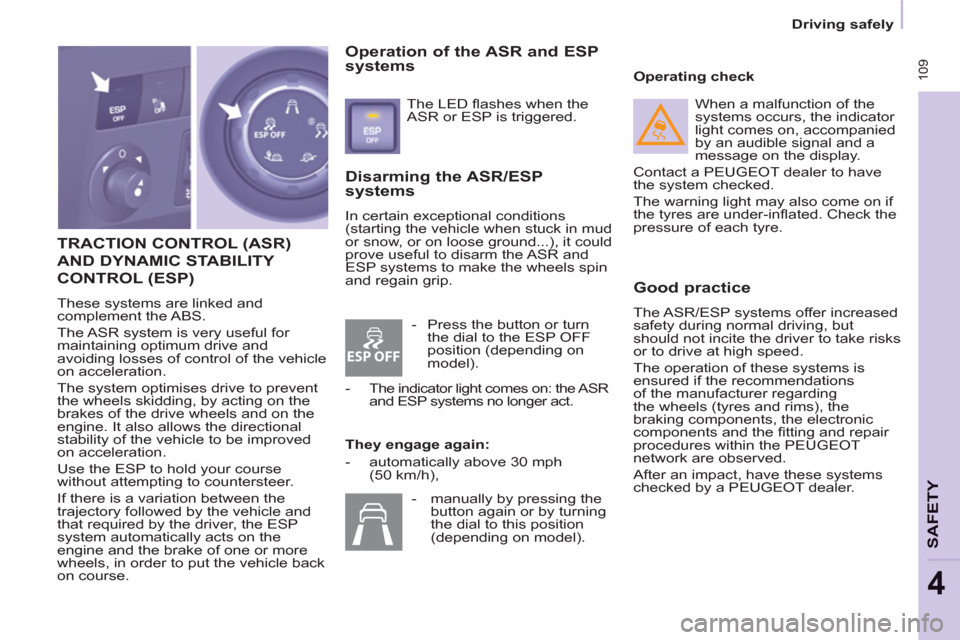
Disarming the ASR/ESP
systems
In certain exceptional conditions
(starting the vehicle when stuck in mud
or snow, or on loose ground...), it could
prove useful to disarm the ASR and
ESP systems to make the wheels spin
and regain grip.
Operating check
Good practice
The ASR/ESP systems offer increased
safety during normal driving, but
should not incite the driver to take risks
or to drive at high speed.
The operation of these systems is
ensured if the recommendations
of the manufacturer regarding
the wheels (tyres and rims), the
braking components, the electronic
components and the fi tting and repair
procedures within the PEUGEOT
network are observed.
After an impact, have these systems
checked by a PEUGEOT dealer.
Operation of the ASR and ESP
systems
The LED fl ashes when the
ASR or ESP is triggered.
They engage again:
- automatically above 30 mph
(50 km/h), When a malfunction of the
systems occurs, the indicator
light comes on, accompanied
by an audible signal and a
message on the display.
Contact a PEUGEOT dealer to have
the system checked.
The warning light may also come on if
the tyres are under-infl ated. Check the
pressure of each tyre.
- Press the button or turn
the dial to the ESP OFF
position (depending on
model).
- The indicator light comes on: the ASR
and ESP systems no longer act.
- manually by pressing the
button again or by turning
the dial to this position
(depending on model).
Page 115 of 232
11 3
SAFETY
4
Seat belts
SEAT BELTS
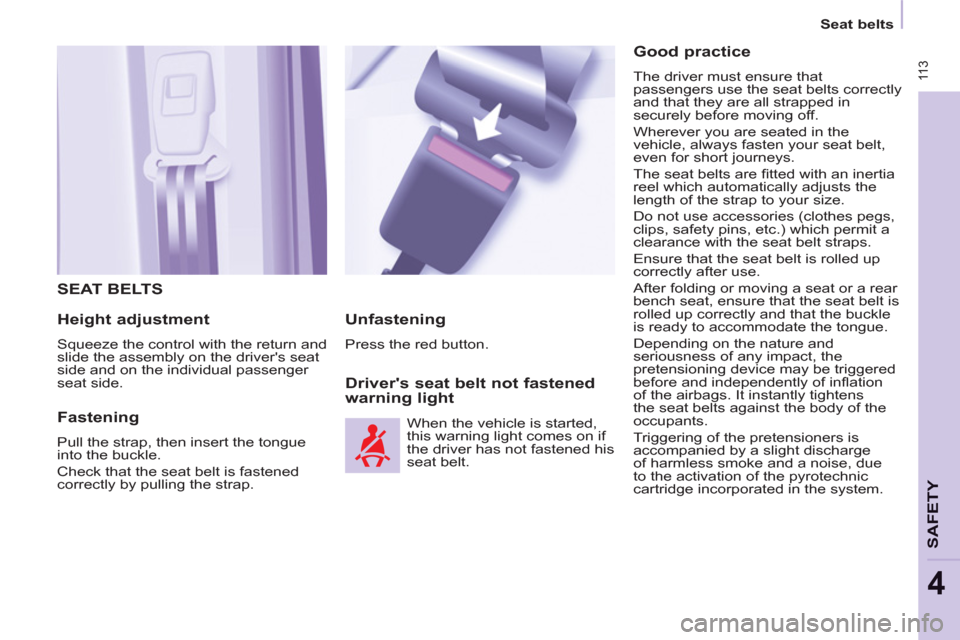
Height adjustment
Squeeze the control with the return and
slide the assembly on the driver's seat
side and on the individual passenger
seat side.
Fastening
Pull the strap, then insert the tongue
into the buckle.
Check that the seat belt is fastened
correctly by pulling the strap.
Driver's seat belt not fastened
warning light
Unfastening
Press the red button.
When the vehicle is started,
this warning light comes on if
the driver has not fastened his
seat belt.
Good practice
The driver must ensure that
passengers use the seat belts correctly
and that they are all strapped in
securely before moving off.
Wherever you are seated in the
vehicle, always fasten your seat belt,
even for short journeys.
The seat belts are fi tted with an inertia
reel which automatically adjusts the
length of the strap to your size.
Do not use accessories (clothes pegs,
clips, safety pins, etc.) which permit a
clearance with the seat belt straps.
Ensure that the seat belt is rolled up
correctly after use.
After folding or moving a seat or a rear
bench seat, ensure that the seat belt is
rolled up correctly and that the buckle
is ready to accommodate the tongue.
Depending on the nature and
seriousness of any impact, the
pretensioning device may be triggered
before and independently of infl ation
of the airbags. It instantly tightens
the seat belts against the body of the
occupants.
Triggering of the pretensioners is
accompanied by a slight discharge
of harmless smoke and a noise, due
to the activation of the pyrotechnic
cartridge incorporated in the system.