remove Peugeot Partner Tepee 2011 Owner's Guide
[x] Cancel search | Manufacturer: PEUGEOT, Model Year: 2011, Model line: Partner Tepee, Model: Peugeot Partner Tepee 2011Pages: 232, PDF Size: 7.4 MB
Page 103 of 232
101
EASE OF USE
andCOMFOR
T
3
Practical information
The interior rack is not compatible
with the Zenith roof.
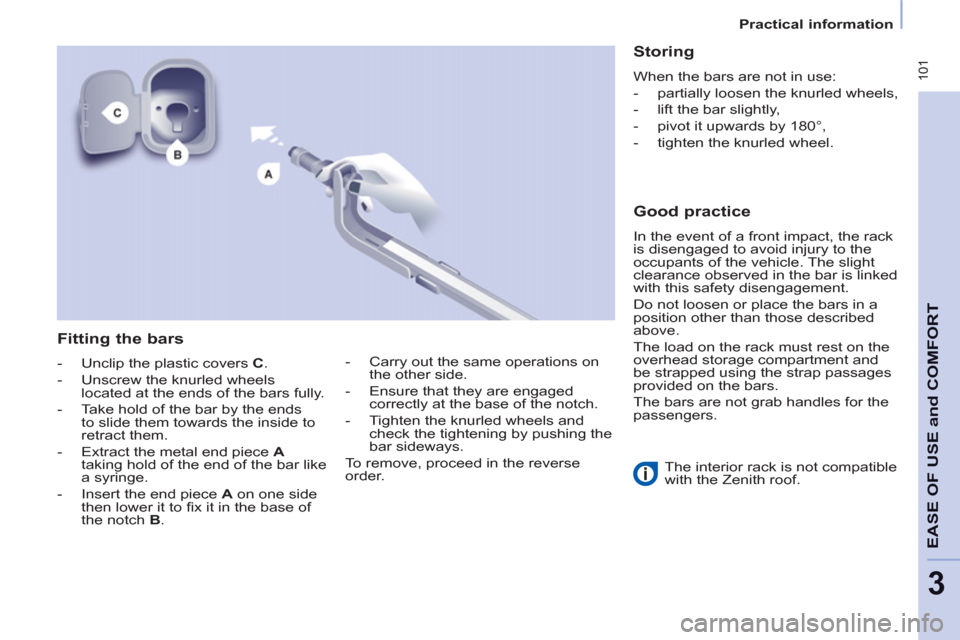
Fitting the bars
- Unclip the plastic covers C .
- Unscrew the knurled wheels
located at the ends of the bars fully.
- Take hold of the bar by the ends
to slide them towards the inside to
retract them.
- Extract the metal end piece A
taking hold of the end of the bar like
a syringe.
- Insert the end piece A on one side
then lower it to fi x it in the base of
the notch B .
Storing
When the bars are not in use:
- partially loosen the knurled wheels,
- lift the bar slightly,
- pivot it upwards by 180°,
- tighten the knurled wheel.
Good practice
In the event of a front impact, the rack
is disengaged to avoid injury to the
occupants of the vehicle. The slight
clearance observed in the bar is linked
with this safety disengagement.
Do not loosen or place the bars in a
position other than those described
above.
The load on the rack must rest on the
overhead storage compartment and
be strapped using the strap passages
provided on the bars.
The bars are not grab handles for the
passengers.
- Carry out the same operations on
the other side.
- Ensure that they are engaged
correctly at the base of the notch.
- Tighten the knurled wheels and
check the tightening by pushing the
bar sideways.
To remove, proceed in the reverse
order.
Page 119 of 232
11 7
SAFETY
4
11 7
Airbags
Good practice
Sit in a normal upright position.
Wear a correctly adjusted seat belt.
Do not leave anything between the
occupants and the airbags (a child,
pet, object...). This could hamper the
operation of the airbags or injure the
occupants.
After an accident or if the vehicle has
been stolen or broken into, have the
airbag systems checked.
All work on the airbag system is strictly
forbidden unless it is carried out by
qualifi ed personnel of the PEUGEOT
network.
Even if all of the precautions
mentioned are observed, a risk of
injury or of minor burns to the head,
chest or arms when an airbag is
triggered cannot be ruled out. In fact,
the bag infl ates almost instantly (within
a few milliseconds) then defl ates within
the same time discharging the hot gas
via openings provided for this purpose.
Side airbags
Only put recommended covers on the
seats. These will not hinder infl ation of
the side airbags. Consult a PEUGEOT
dealer.
Do not fi x or glue anything to the seat
backs. This could cause injury to the
chest or arms when the side airbag
infl ates.
Do not sit with the upper part of the
body any nearer to the door than
necessary.
Front airbags
Do not drive holding the steering wheel
by its spokes or resting your hands on
the centre part of the wheel.
Do not allow passengers to place their
feet on the fascia, they risk serious
injury if the airbag is triggered.
Smoke as little as possible as
deployment of the airbags can cause
burns or the risk of injury from a
cigarette or pipe.
Never remove or pierce the steering
wheel or hit it violently.
Airbags only operate when the
ignition is switched on.
This equipment only operates once.
If a second impact occurs (during the
same or a subsequent accident), the
airbag will not operate.
The triggering of an airbag or airbags
is accompanied by a slight discharge
of harmless smoke and a noise, due
to the activation of the pyrotechnic
cartridge incorporated in the system.
This smoke is not harmful, but
sensitive individuals may experience
some irritation.
The noise of the detonation may result
in a slight loss of hearing for a short
time.
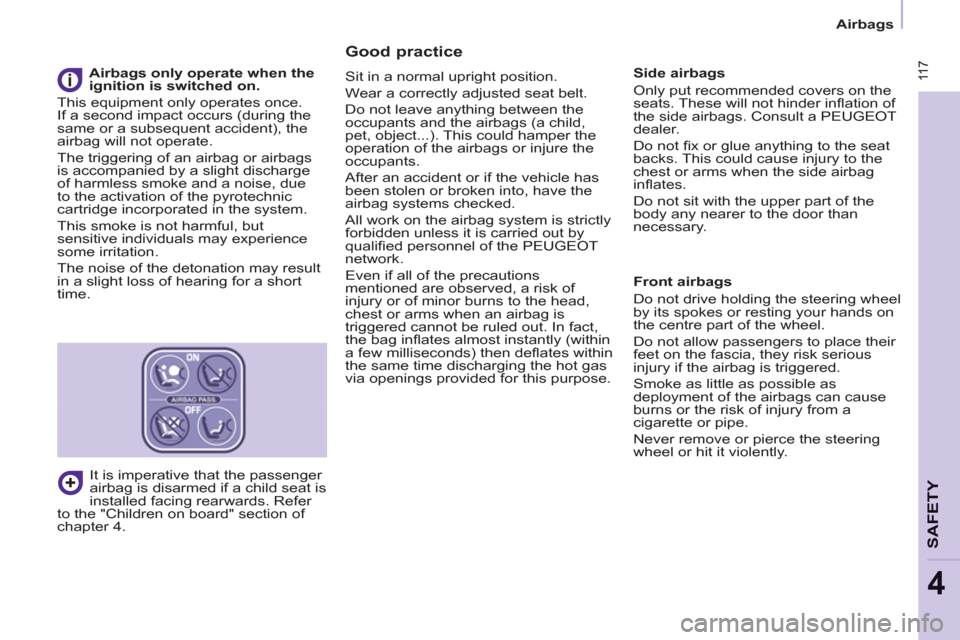
It is imperative that the passenger
airbag is disarmed if a child seat is
installed facing rearwards. Refer
to the "Children on board" section of
chapter 4.
Page 121 of 232
11 9
SAFETY
4
11 9
Airbags
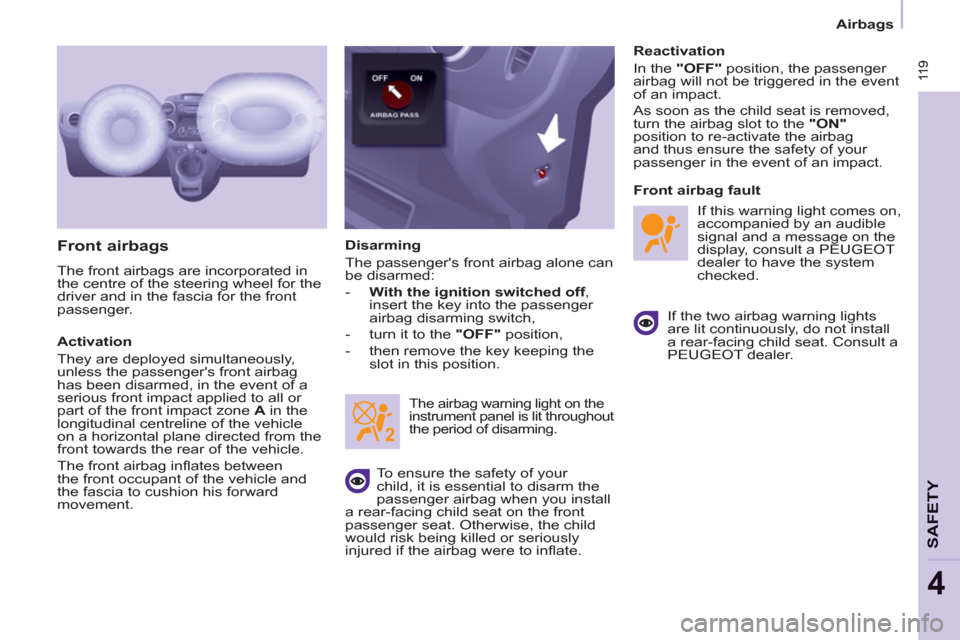
Front airbags
The front airbags are incorporated in
the centre of the steering wheel for the
driver and in the fascia for the front
passenger.
Activation
They are deployed simultaneously,
unless the passenger's front airbag
has been disarmed, in the event of a
serious front impact applied to all or
part of the front impact zone A in the
longitudinal centreline of the vehicle
on a horizontal plane directed from the
front towards the rear of the vehicle.
The front airbag infl ates between
the front occupant of the vehicle and
the fascia to cushion his forward
movement.
Disarming
The passenger's front airbag alone can
be disarmed:
- With the ignition switched off
,
insert the key into the passenger
airbag disarming switch,
- turn it to the "OFF" position,
- then remove the key keeping the
slot in this position.
The airbag warning light on the
instrument panel is lit throughout
the period of disarming.
If the two airbag warning lights
are lit continuously, do not install
a rear-facing child seat. Consult a
PEUGEOT dealer.
Front airbag fault
To ensure the safety of your
child, it is essential to disarm the
passenger airbag when you install
a rear-facing child seat on the front
passenger seat. Otherwise, the child
would risk being killed or seriously
injured if the airbag were to infl ate.
Reactivation
In the "OFF" position, the passenger
airbag will not be triggered in the event
of an impact.
As soon as the child seat is removed,
turn the airbag slot to the "ON"
position to re-activate the airbag
and thus ensure the safety of your
passenger in the event of an impact.
If this warning light comes on,
accompanied by an audible
signal and a message on the
display, consult a PEUGEOT
dealer to have the system
checked.
Page 123 of 232
121
4
121
Child safety
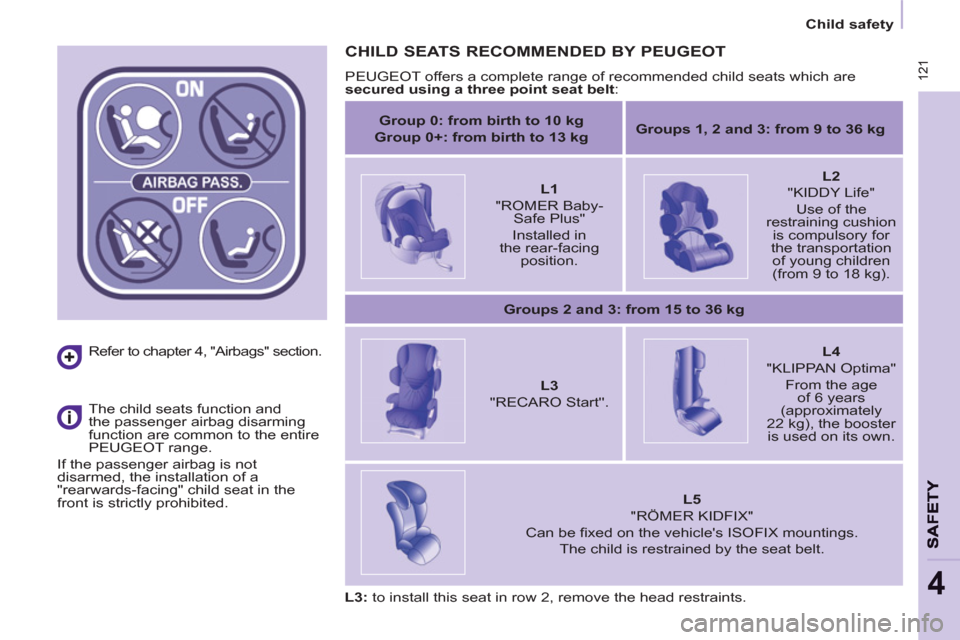
Refer to chapter 4, "Airbags" section.
The child seats function and
the passenger airbag disarming
function are common to the entire
PEUGEOT range.
If the passenger airbag is not
disarmed, the installation of a
"rearwards-facing" child seat in the
front is strictly prohibited.
CHILD SEATS RECOMMENDED BY PEUGEOT
PEUGEOT offers a complete range of recommended child seats which are
secured using a three point seat belt
:
Group 0: from birth to 10 kg
Group 0+: from birth to 13 kg
Groups 1, 2 and 3: from 9 to 36 kg
L1
"ROMER Baby-
Safe Plus"
Installed in
the rear-facing
position
.
L2
"KIDDY Life"
Use of the
restraining cushion
is compulsory for
the transportation
of young children
(from 9 to 18 kg).
Groups 2 and 3: from 15 to 36 kg
L3
"RECARO Start''
.
L4
"KLIPPAN Optima"
From the age
of 6 years
(approximately
22 kg), the booster
is used on its own.
L5
"RÖMER KIDFIX"
Can be fi xed on the vehicle's ISOFIX mountings.
The child is restrained by the seat belt.
L3: to install this seat in row 2, remove the head restraints.
Page 124 of 232
122 122
Child safety
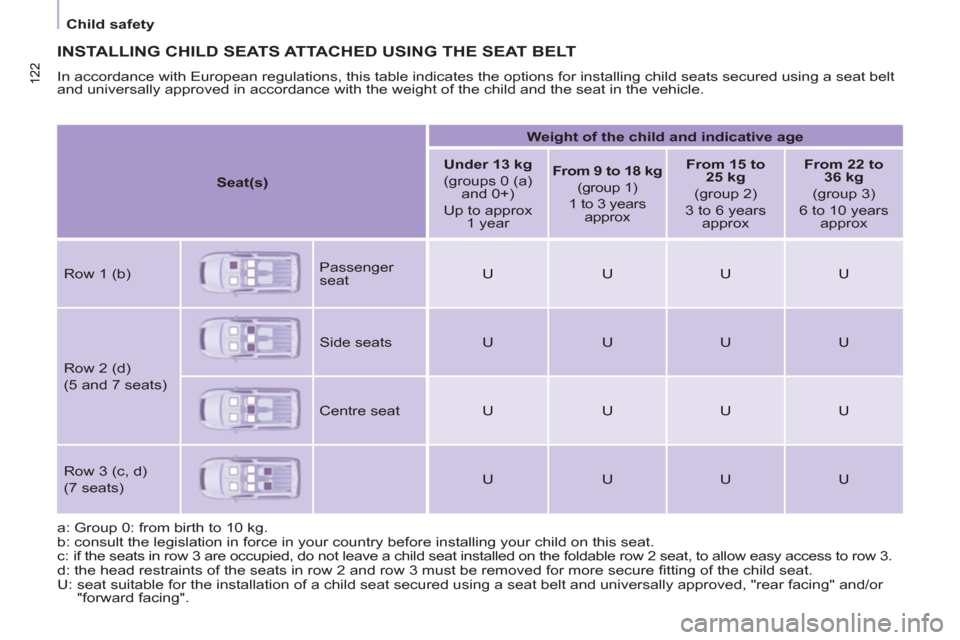
INSTALLING CHILD SEATS ATTACHED USING THE SEAT BELT
In accordance with European regulations, this table indicates the options for installing child seats secured using a seat belt
and universally approved in accordance with the weight of the child and the seat in the vehicle.
a: Group 0: from birth to 10 kg.
b: consult the legislation in force in your country before installing your child on this seat.
c: if the seats in row 3 are occupied, do not leave a child seat installed on the foldable row 2 seat, to allow easy access to row 3.
d: the head restraints of the seats in row 2 and row 3 must be removed for more secure fi tting of the child seat.
U: seat suitable for the installation of a child seat secured using a seat belt and universally approved, "rear facing" and/or
"forward facing".
Seat(s)
Weight of the child and indicative age
Under 13 kg
(groups 0 (a)
and 0+)
Up to approx
1 year
From 9 to 18 kg
(group 1)
1 to 3 years
approx
From 15 to
25 kg
(group 2)
3 to 6 years
approx
From 22 to
36 kg
(group 3)
6 to 10 years
approx
Row 1 (b) Passenger
seat
U
U
U
U
Row 2 (d)
(5 and 7 seats) Side seats
U
U
U
U
Centre seat
U
U
U
U
Row 3 (c, d)
(7 seats)
U
U
U
U
Page 128 of 232
126 126
Child safety
ADVICE ON CHILD SEATS
The incorrect installation of a child seat
in a vehicle compromises the child's
protection in the event of an accident.
Remember to fasten the seat belts or
the child seat harnesses keeping the
slack
in relation to the child's body to a
minimum
, even for short journeys.
For optimum installation of the "forward
facing" child seat, ensure that the back
of the child seat is in contact with the
back of the vehicle's seat and that the
head restraint does not cause any
discomfort.
If the head restraint has to be removed,
ensure that it is stored or attached
securely to prevent it from being
thrown around the vehicle in the event
of sharp braking.
Children under the age of 10 must not
travel in the "forward facing" position
on the front passenger seat, unless
the rear seats are already occupied by
other children, cannot be used or are
absent.
Deactivate the passenger airbag when
a "rear facing" child seat is installed on
the front seat.
Otherwise, the child would risk being
seriously injured or killed if the airbag
were to infl ate.
As a safety precaution, do not leave:
- one or more children alone and
unsupervised in a vehicle,
- a child or an animal in a vehicle
which is exposed to the sun, with
the windows closed,
- the keys within reach of children
inside the vehicle.
Installing a booster seat
The chest part of the seat belt must
be positioned on the child's shoulder
without touching the neck.
Ensure that the lap part of the seat belt
passes correctly over the child's thighs.
PEUGEOT recommends the use of a
booster seat which has a back, fi tted
with a seat belt guide at shoulder level.
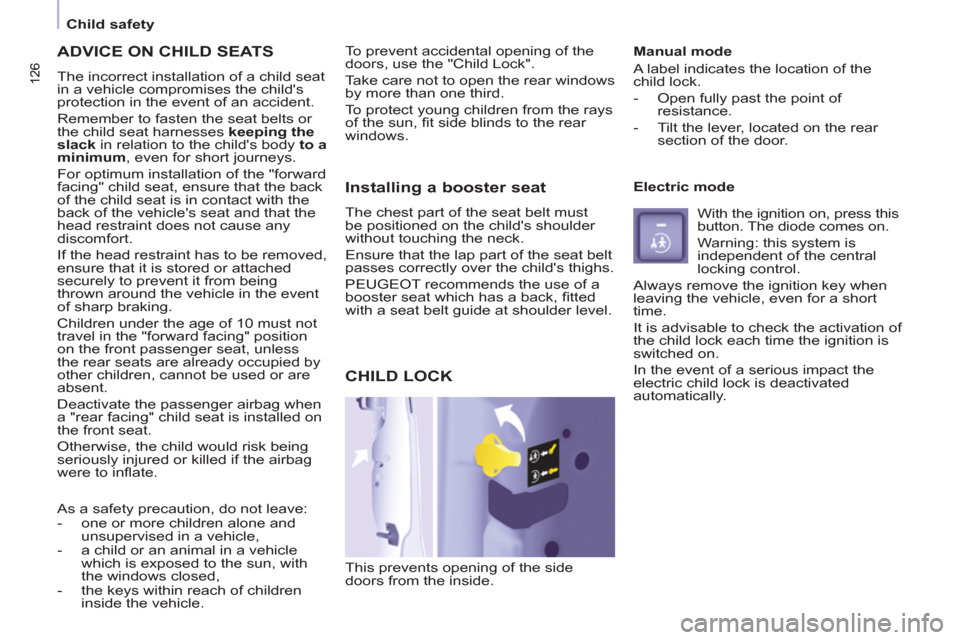
CHILD LOCK
This prevents opening of the side
doors from the inside.
Manual mode
A label indicates the location of the
child lock.
- Open fully past the point of
resistance.
- Tilt the lever, located on the rear
section of the door.
Electric mode
With the ignition on, press this
button. The diode comes on.
Warning: this system is
independent of the central
locking control.
Always remove the ignition key when
leaving the vehicle, even for a short
time.
It is advisable to check the activation of
the child lock each time the ignition is
switched on.
In the event of a serious impact the
electric child lock is deactivated
automatically.
To prevent accidental opening of the
doors, use the "Child Lock".
Take care not to open the rear windows
by more than one third.
To protect young children from the rays
of the sun, fi t side blinds to the rear
windows.
Page 137 of 232
135
CHECK
S
6
Levels
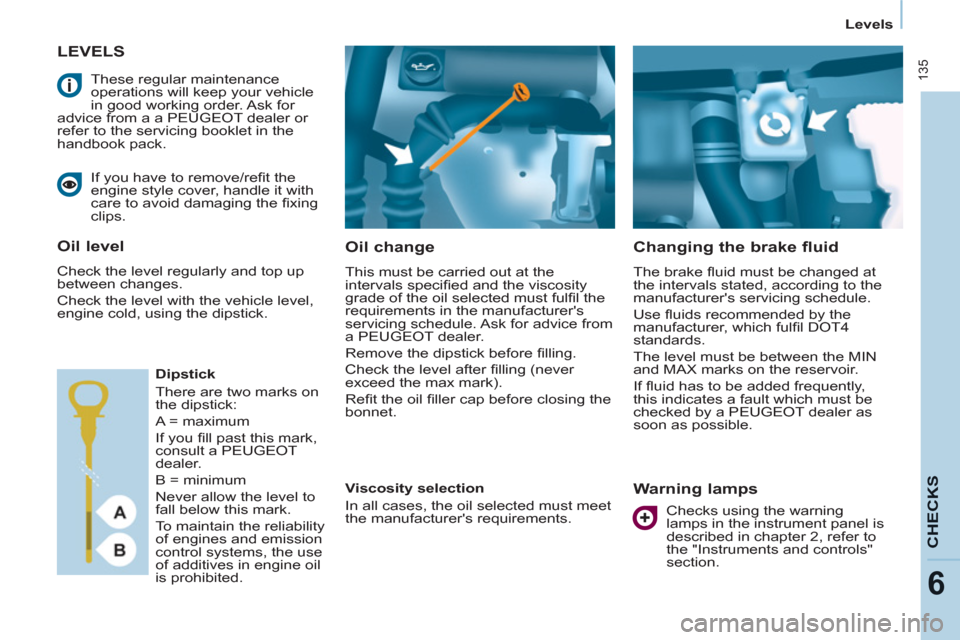
LEVELS
Oil change
This must be carried out at the
intervals specifi ed and the viscosity
grade of the oil selected must fulfi l the
requirements in the manufacturer's
servicing schedule. Ask for advice from
a PEUGEOT dealer.
Remove the dipstick before fi lling.
Check the level after fi lling (never
exceed the max mark).
Refi t the oil fi ller cap before closing the
bonnet.
Changing the brake fluid
The brake fl uid must be changed at
the intervals stated, according to the
manufacturer's servicing schedule.
Use fl uids recommended by the
manufacturer, which fulfi l DOT4
standards.
The level must be between the MIN
and MAX marks on the reservoir.
If fl uid has to be added frequently,
this indicates a fault which must be
checked by a PEUGEOT dealer as
soon as possible.
Warning lamps
If you have to remove/refi t the
engine style cover, handle it with
care to avoid damaging the fi xing
clips.
Oil level
Check the level regularly and top up
between changes.
Check the level with the vehicle level,
engine cold, using the dipstick.
Dipstick
There are two marks on
the dipstick:
A = maximum
If you fi ll past this mark,
consult a PEUGEOT
dealer.
B = minimum
Never allow the level to
fall below this mark.
To maintain the reliability
of engines and emission
control systems, the use
of additives in engine oil
is prohibited.
Viscosity selection
In all cases, the oil selected must meet
the manufacturer's requirements.
These regular maintenance
operations will keep your vehicle
in good working order. Ask for
advice from a a PEUGEOT dealer or
refer to the servicing booklet in the
handbook pack.
Checks using the warning
lamps in the instrument panel is
described in chapter 2, refer to
the "Instruments and controls"
section.
Page 138 of 232
136
Levels
Cooling system
Only use the fl uid recommended by the
manufacturer.
Otherwise, you risk seriously damaging
your engine.
When the engine is warm, the
temperature of the coolant is controlled
by the engine fan. As this fan can
operate with the ignition key removed
and because the cooling system is
pressurised, wait for at least one hour
after the engine has stopped before
carrying out any work.
Slacken the cap by 1/4 of a turn to
release the pressure to prevent any
risk of scalding. When the pressure
has dropped, remove the cap and top
up the level with coolant.
If fl uid has to be added frequently,
this indicates a fault which must be
checked by a PEUGEOT dealer as
soon as possible.
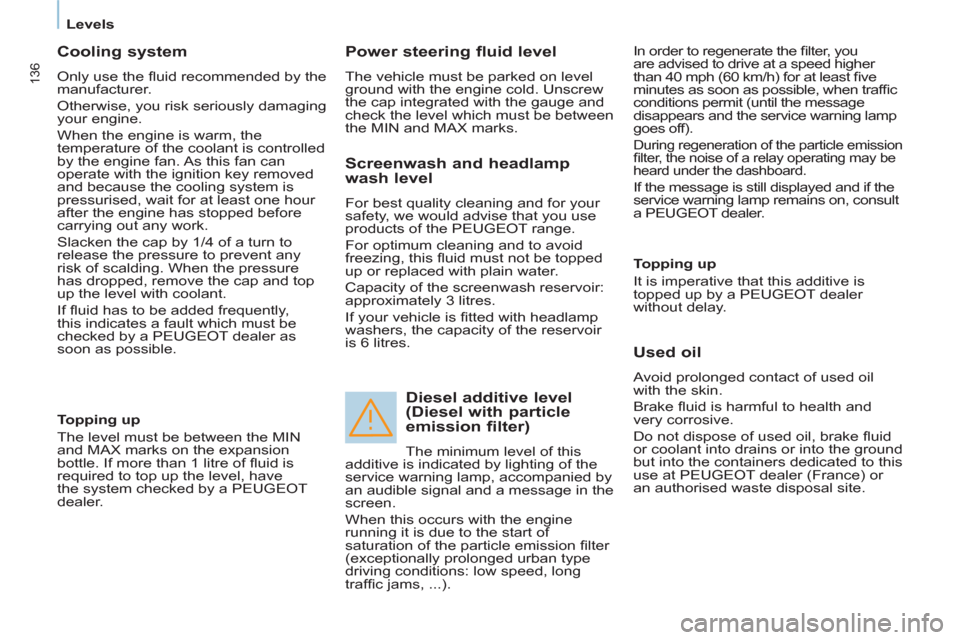
Power steering fluid level
The vehicle must be parked on level
ground with the engine cold. Unscrew
the cap integrated with the gauge and
check the level which must be between
the MIN and MAX marks. In order to regenerate the fi lter, you
are advised to drive at a speed higher
than 40 mph (60 km/h) for at least fi ve
minutes as soon as possible, when traffi c
conditions permit (until the message
disappears and the service warning lamp
goes off).
During regeneration of the particle emission
fi lter, the noise of a relay operating may be
heard under the dashboard.
If the message is still displayed and if the
service warning lamp remains on, consult
a PEUGEOT dealer.
Topping up
The level must be between the MIN
and MAX marks on the expansion
bottle. If more than 1 litre of fl uid is
required to top up the level, have
the system checked by a PEUGEOT
dealer.
Screenwash and headlamp
wash level
For best quality cleaning and for your
safety, we would advise that you use
products of the PEUGEOT range.
For optimum cleaning and to avoid
freezing, this fl uid must not be topped
up or replaced with plain water.
Capacity of the screenwash reservoir:
approximately 3 litres.
If your vehicle is fi tted with headlamp
washers, the capacity of the reservoir
is 6 litres.
Diesel additive level
(Diesel with particle
emission filter)
The minimum level of this
additive is indicated by lighting of the
service warning lamp, accompanied by
an audible signal and a message in the
screen.
When this occurs with the engine
running it is due to the start of
saturation of the particle emission fi lter
(exceptionally prolonged urban type
driving conditions: low speed, long
traffi c jams, ...).
Topping up
It is imperative that this additive is
topped up by a PEUGEOT dealer
without delay.
Used oil
Avoid prolonged contact of used oil
with the skin.
Brake fl uid is harmful to health and
very corrosive.
Do not dispose of used oil, brake fl uid
or coolant into drains or into the ground
but into the containers dedicated to this
use at PEUGEOT dealer (France) or
an authorised waste disposal site.
Page 141 of 232
139
6
Fuel
FILLING WITH FUEL
Low fuel level
Filling
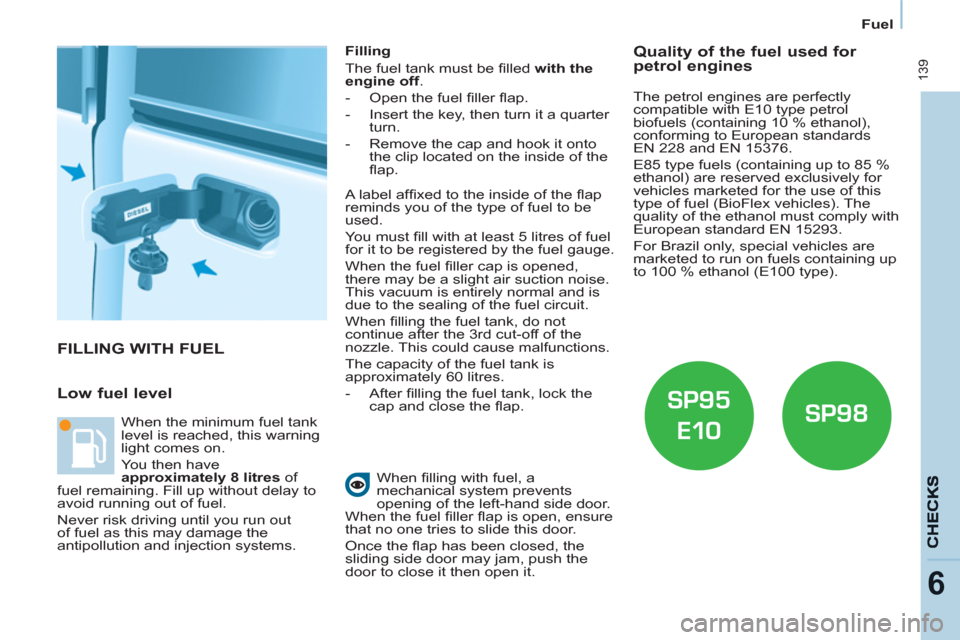
The fuel tank must be fi lled with the
engine off
.
- Open the fuel fi ller fl ap.
- Insert the key, then turn it a quarter
turn.
- Remove the cap and hook it onto
the clip located on the inside of the
fl ap.
When fi lling with fuel, a
mechanical system prevents
opening of the left-hand side door.
When the fuel fi ller fl ap is open, ensure
that no one tries to slide this door.
Once the fl ap has been closed, the
sliding side door may jam, push the
door to close it then open it. When the minimum fuel tank
level is reached, this warning
light comes on.
You then have
approximately 8 litres
of
fuel remaining. Fill up without delay to
avoid running out of fuel.
Never risk driving until you run out
of fuel as this may damage the
antipollution and injection systems. A label affi xed to the inside of the fl ap
reminds you of the type of fuel to be
used.
You must fi ll with at least 5 litres of fuel
for it to be registered by the fuel gauge.
When the fuel fi ller cap is opened,
there may be a slight air suction noise.
This vacuum is entirely normal and is
due to the sealing of the fuel circuit.
When fi lling the fuel tank, do not
continue after the 3 rd cut-off of the
nozzle. This could cause malfunctions.
The capacity of the fuel tank is
approximately 60 litres.
- After fi lling the fuel tank, lock the
cap and close the fl ap.
Quality of the fuel used for
petrol engines
The petrol engines are perfectly
compatible with E10 type petrol
biofuels (containing 10 % ethanol),
conforming to European standards
EN 228 and EN 15376.
E85 type fuels (containing up to 85 %
ethanol) are reserved exclusively for
vehicles marketed for the use of this
type of fuel (BioFlex vehicles). The
quality of the ethanol must comply with
European standard EN 15293.
For Brazil only, special vehicles are
marketed to run on fuels containing up
to 100 % ethanol (E100 type).
Page 142 of 232
DIESEL
140
Fuel
FUEL CIRCUIT DISARMED
In a serious collision, a mechanism
automatically prevents fuel from
reaching the engine.
The fl ashing of this warning
light is accompanied by a
message on the display.
Check that there is no odour or
leakage of fuel outside the vehicle and
re-establish the fuel supply:
- switch off the ignition (STOP position),
- remove the key,
- put the key back in the ignition,
- switch on the ignition and start.
DIESEL REPRIMING PUMP
If you should run out of fuel, it is
necessary to re-prime the circuit:
- fi ll the fuel tank with at least fi ve
litres of diesel,
- squeeze and release the manual
re-priming pump, under the bonnet
under the protective cover,
- operate the starter until the engine
starts.
Refer to the "Under the bonnet"
section of chapter 6.
Quality of the fuel used for
Diesel engines
The Diesel engines are perfectly
compatible with biofuels which conform
to current and future European
standards (Diesel fuel which complies
with standard EN 590 mixed with a
biofuel which complies with standard
EN 14214) available at the pumps
(containing up to 7 % Fatty Acid Methyl
Ester).
The B30 biofuel can be used in certain
Diesel engines; however, this use
is subject to strict application of the
special servicing conditions. Consult a
PEUGEOT dealer.
The use of any other type of (bio)fuel
(vegetable or animal oils, pure or
diluted, domestic fuel...) is strictly
prohibited (risk of damage to the
engine and fuel system).