key Peugeot Partner Tepee 2015 User Guide
[x] Cancel search | Manufacturer: PEUGEOT, Model Year: 2015, Model line: Partner Tepee, Model: Peugeot Partner Tepee 2015Pages: 276, PDF Size: 12.76 MB
Page 49 of 276
47
Partner_2_VP_en_Chap03_Pret-a-partir_ed02-2014
STOP & START
the Stop & Start system puts the
engine temporarily on standby - S tOP
mode - during stops in the traffic (red
lights, traffic jams, or other...). The
engine restarts automatically - S
t
ARt
mode - as soon as you want to move
of
f.
t
he restart takes place instantly,
quickly and silently.
Perfect for urban use, the Stop & Start
system reduces fuel consumption and
exhaust emissions as well as the noise
level when stationary.
Operation
Going into engine STOP mode
the "ECO" warning lamp comes
on in the instrument panel and
the engine goes into standby:
- with a manual gearbox , at speeds
below 12 mph (20 km/h), when you
put the gear lever into neutral and
release the clutch pedal,
-
with the 6-speed electronic gear
control gearbox
, at a speed below
5 mph (8 km/h), when you press
the brake pedal or put the gear
lever into position N. If your vehicle is fitted with the system,
a time counter calculates the sum of
the periods in S
t
OP
mode during a
journey. It rests itself to zero every time
the ignition is switched on with the key.
With the automatic gearbox
system, for your comfort during
parking manoeuvres, S t
OP
mode
is not available for a few seconds after
coming out of reverse gear.
S t
OP
mode does not affect the
functionality of the vehicle, such as
braking, power steering, for example.
Never refuel with the engine in
S t
OP
mode; you must switch off
the ignition with the key. Special cases: STOP mode
unavailable
S t
OP
mode is not invoked when:
-
the driver's door is open,
-
the driver's seat belt is not
fastened,
-
the vehicle has not exceeded
6
mph (10 km/h) since the last
engine start using the key,
-
the engine is needed to maintain
a comfortable temperature in the
passenger compartment,
-
demisting is on,
-
some special conditions (battery
charge, engine temperature,
braking assistance, ambient
temperature...) where the engine
is needed to assure control of a
system.
In this case, the
"ECO"
warning lamp flashes for a
few seconds, then goes off.
This operation is perfectly normal.
Stop & Start
ReADY tO Set OFF
3
Page 51 of 276
49
Partner_2_VP_en_Chap03_Pret-a-partir_ed02-2014
Reactivation
Press the "ECO OFF" switch again.
t
he system is active again; this is
confirmed by the switch warning
lamp going off and a message in the
instrument panel.
t
he system is reactivated
automatically at every new start
using the key.
Operating fault
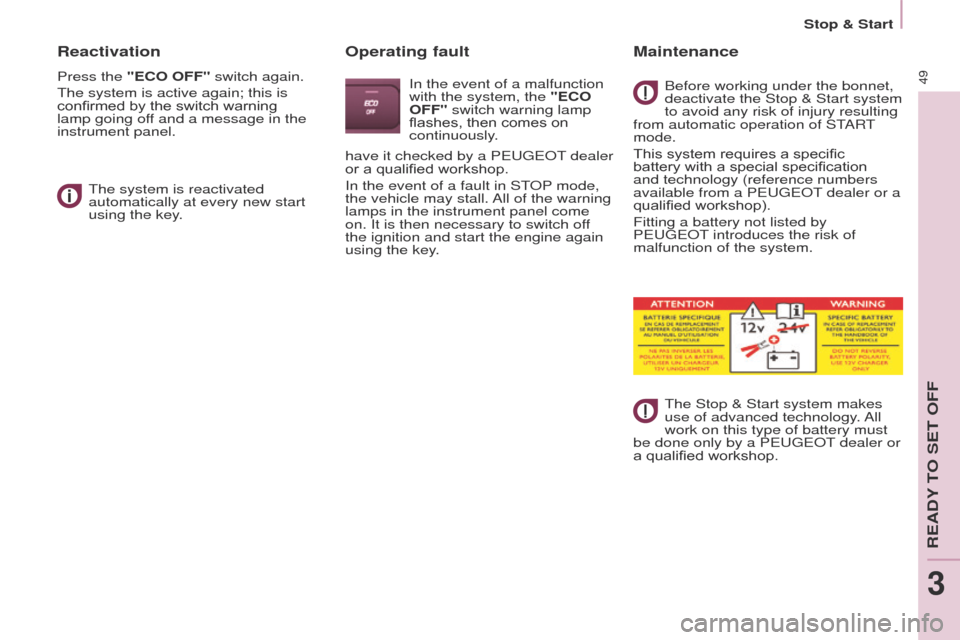
In the event of a malfunction
with the system, the "ECO
OFF" switch warning lamp
flashes, then comes on
continuously.
Maintenance
Before working under the bonnet,
deactivate the Stop & Start system
to avoid any risk of injury resulting
from automatic operation of S
t
ARt
mode.
This system requires a specific
battery with a special specification
and technology (reference numbers
available from a P
euge O t
dealer or a
qualified workshop).
Fitting a battery not listed by
P
euge O t introduces the risk of
malfunction of the system.
t
he Stop & Start system makes
use of advanced technology. All
work on this type of battery must
be done only by a P
euge O t
dealer or
a qualified workshop.
have it checked by a P
euge
O
t
dealer
or a qualified workshop.
In the event of a fault in S
t
OP
mode,
the vehicle may stall. All of the warning
lamps in the instrument panel come
on. It is then necessary to switch off
the ignition and start the engine again
using the key.
Stop & Start
ReADY tO Set OFF
3
Page 52 of 276
50
Partner_2_VP_en_Chap03_Pret-a-partir_ed02-2014
Good practice when stopping Good practice when starting
Diesel pre-heating warning
lamp
If the temperature is high
enough, the warning lamp
comes on for less than
one second, you can start
without waiting.
In cold weather, wait for this warning
lamp to go off then operate the starter
(Starting position) until the engine
starts.
Door or bonnet open warning lamp
If this comes on, a door or
the bonnet is not closed
correctly, check!
Minimise engine and gearbox wear
When switching off the ignition, let the
engine run for a few seconds to allow
the turbocharger (Diesel engine) to
return to idle.
Do not press the accelerator when
switching off the ignition.
t
here is no need to engage a gear
after parking the vehicle.
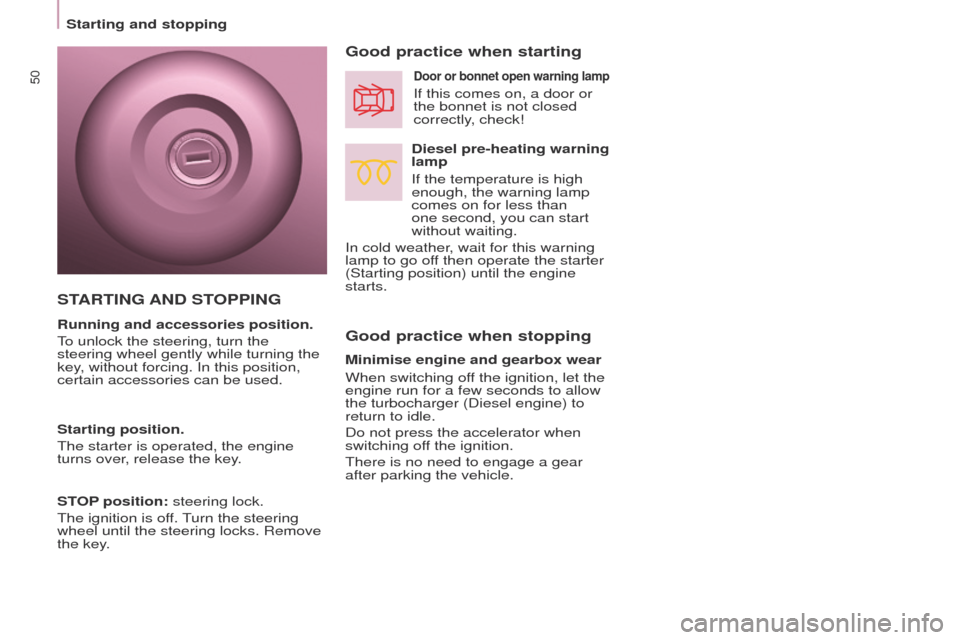
STARTING AND STOPPING
Running and accessories position.
to unlock the steering, turn the
steering wheel gently while turning the
key
, without forcing. In this position,
certain accessories can be used.
Starting position.
t
he starter is operated, the engine
turns over, release the key.
STOP position: steering lock.
t
he ignition is off.
turn the steering
wheel until the steering locks. Remove
the key
.
Starting and stopping
Page 98 of 276
96
Partner_2_VP_en_Chap04_ergonomie_ed02-2014
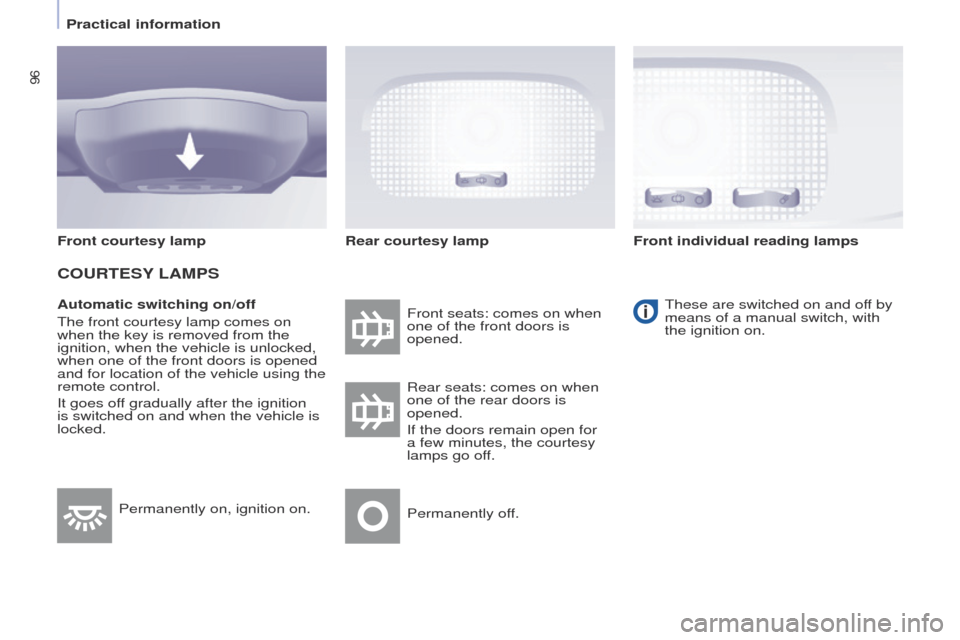
Automatic switching on/off
t
he front courtesy lamp comes on
when the key is removed from the
ignition, when the vehicle is unlocked,
when one of the front doors is opened
and for location of the vehicle using the
remote control.
It goes off gradually after the ignition
is switched on and when the vehicle is
locked. Front seats: comes on when
one of the front doors is
opened.t
hese are switched on and off by
means of a manual switch, with
the ignition on.
Rear seats: comes on when
one of the rear doors is
opened.
If the doors remain open for
a few minutes, the courtesy
lamps go off.
Permanently off.
Permanently on, ignition on.
Front courtesy lamp
COURTESY LAMPS
Rear courtesy lamp
Front individual reading lamps
Practical information
Page 121 of 276
11 9
Partner_2_VP_en_Chap05_Securite_ed02-2014
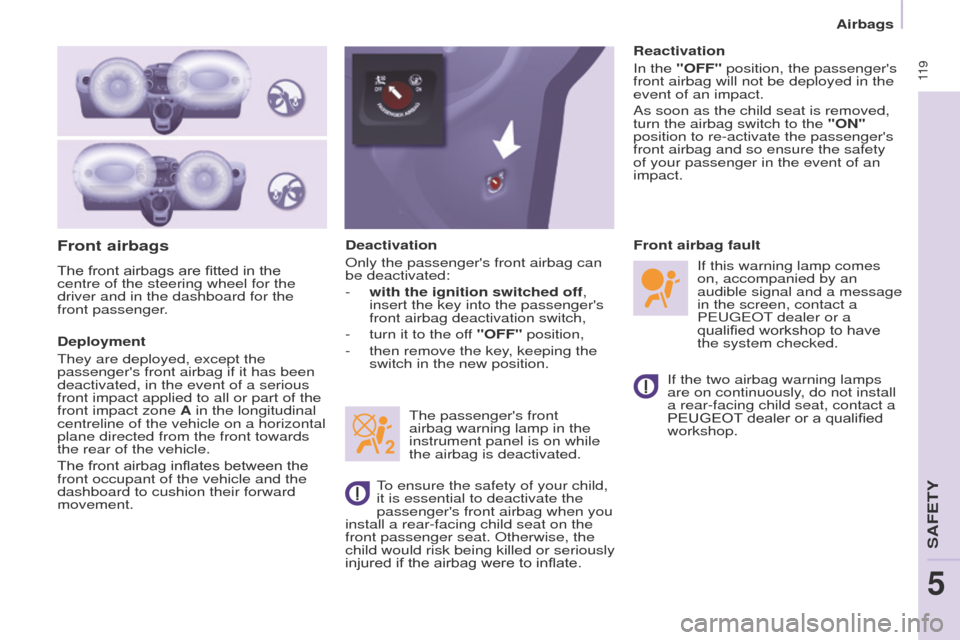
Front airbags
The front airbags are fitted in the
centre of the steering wheel for the
driver and in the dashboard for the
front passenger.
Deployment
t
hey are deployed, except the
passenger's front airbag if it has been
deactivated, in the event of a serious
front impact applied to all or part of the
front impact zone A in the longitudinal
centreline of the vehicle on a horizontal
plane directed from the front towards
the rear of the vehicle.
The front airbag inflates between the
front occupant of the vehicle and the
dashboard to cushion their forward
movement. Deactivation
Only the passenger's front airbag can
be deactivated:
-
with the ignition switched off
,
insert the key into the passenger's
front airbag deactivation switch,
-
turn it to the of
f "OFF" position,
-
then remove the key
, keeping the
switch in the new position.
t
he passenger's front
airbag warning lamp in the
instrument panel is on while
the airbag is deactivated. If the two airbag warning lamps
are on continuously, do not install
a rear-facing child seat, contact a
PEUGEOT dealer or a qualified
workshop.
Front airbag fault
to ensure the safety of your child,
it is essential to deactivate the
passenger's front airbag when you
install a rear-facing child seat on the
front passenger seat. Otherwise, the
child would risk being kille
d or seriously
injured if the airbag were to inflate. Reactivation
In the "OFF" position, the passenger's
front airbag will not be deployed in the
event of an impact.
As soon as the child seat is removed,
turn the airbag switch to the "ON"
position to re-activate the passenger's
front airbag and so ensure the safety
of your passenger in the event of an
impact.
If this warning lamp comes
on, accompanied by an
audible signal and a message
in the screen, contact a
P euge O t
dealer or a
qualified workshop to have
the system checked.
Airbags
SAFetY
5
Page 135 of 276
133
Partner_2_VP_en_Chap05_Securite_ed02-2014
ADVICE ON CHILD SEATS
At the rear, always leave sufficient
space between the front seat and:
-
a "rearward facing" child seat,
-
the feet of a child seated in a
"forward facing" child seat.
For this, move the front seat forward
and, if necessary
, straighten its
backrest as well.
t
he incorrect installation of a child seat
in a vehicle compromises the child's
protection in the event of an accident.
Check that there is no seat belt or seat
belt buckle under the child seat, as this
could destabilise the seat.
Remember to fasten the seat belts or
the child seat harnesses keeping the
slack relative to the child's body to a
minimum, even for short journeys.
For the installation of a child seat using
the seat belt, ensure that the seat belt
is well tensioned on the child seat
and that it is holding the child seat
firmly against the vehicle's seat. If the
passenger seat is adjustable, move it
forward if necessary. For the optimum installation of a
"forward facing" child seat, ensure that
the back of the child seat is as close as
possible to the backrest of the vehicle's
seat, or in contact if possible.
t
he head restraint must be removed
before installing a child seat with a
backrest on the passenger seat.
e
nsure that the head restraint is
stowed or attached securely so that it
is not thrown around the vehicle in the
event of sharp braking.
Refit the head restraint as soon as the
child seat is removed.Children at the front
the legislation on carrying a child on
the front passenger seat is specific to
each country
. Refer to the legislation in
force in your country.
Deactivate the passenger's airbag
when a "rearward facing" child seat is
installed on the front seat.
Otherwise, the child would risk being
seriously injured or killed if the airbag
were deployed.
Installing a booster seat
the chest part of the seat belt must
be positioned on the child's shoulder
without touching the neck.
e
nsure that the lap part of the seat belt
passes correctly over the child's thighs.
P
euge O t
recommends the use of a
booster seat which has a back, fitted
with a seat belt guide at shoulder level.
As a safety precaution, never leave:
-
one or more children alone and
unsupervised in a vehicle,
-
a child or an animal in a vehicle
which is exposed to the sun, with
the windows closed,
-
the keys within reach of children
inside the vehicle.
to prevent accidental opening of the
doors, use the "Child Lock".
take care not to open the rear windows
by more than one third.
to protect young children from the rays
of the sun, fit side blinds to the rear
windows.
For an installation in row 3, put the
backrests of the outer and centre
seats in row 2 in the table position, or
remove these seats in row 2, so that
the child seat or the child's legs do not
touch the seats in row 2.
Child safety
SAFetY
5
Page 136 of 276
134
Partner_2_VP_en_Chap05_Securite_ed02-2014
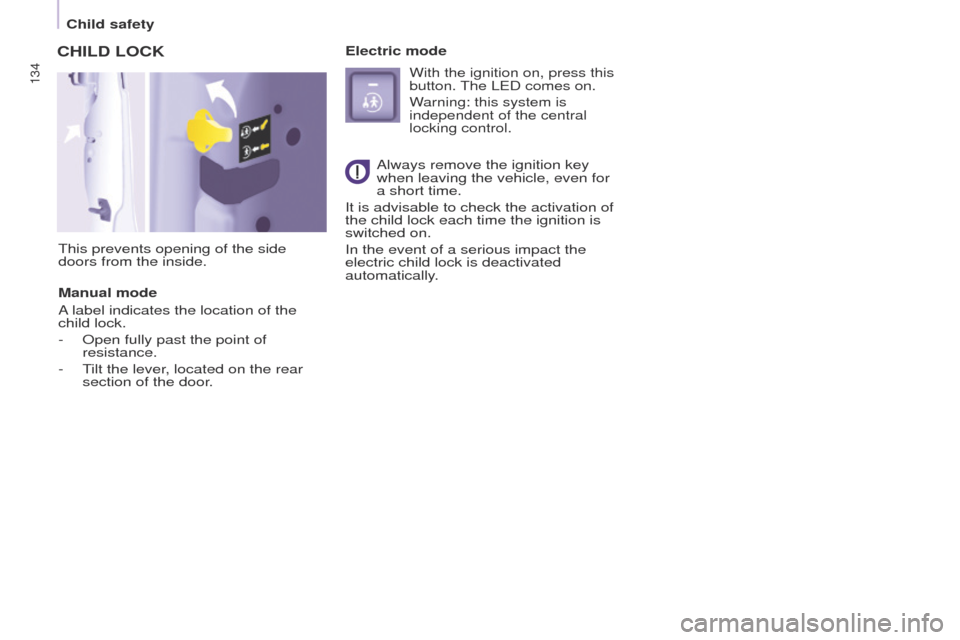
CHILD LOCK
this prevents opening of the side
doors from the inside.
Manual mode
A
label indicates the location of the
child lock.
-
Open fully past the point of
resistance.
-
t
ilt the lever
, located on the rear
section of the door. Electric mode
With the ignition on, press this
button. t
he L e D comes on.
W
arning: this system is
independent of the central
locking control.
Always remove the ignition key
when leaving the vehicle, even for
a short time.
It is advisable to check the activation of
the child lock each time the ignition is
switched on.
In the event of a serious impact the
electric child lock is deactivated
automatically.
Child safety
Page 141 of 276
139
Partner_2_VP_en_Chap07_Verification_ed02-2014
PeugeOt & t O tA L,
A PARtNeRSHIP tO DeL IVe R
Be
tte R
P
e
RFORMANC
e
!
Innovation, the key to success
the tOtAL Research and Development and
Pe
ugeOt teams work together to develop high
quality lubricants that meet the requirements
of P
e
uge
Ot
vehicles. For you, this is the
assurance that the performance of your engine
is optimised while also ensuring its durability.
th
e 208 HYbrid F
e
demonstrates the ability of
P
e
uge
Ot
and
tOtA
L to develop innovative
technologies and provide other ways of moving
towards the future.
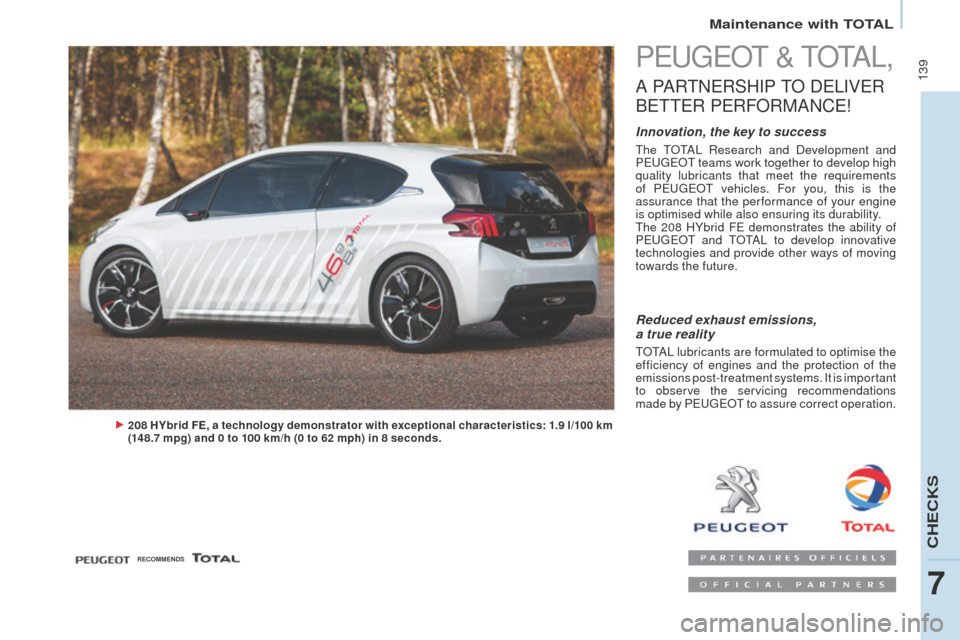
208 HYbrid FE, a technology demonstrator with exceptional characteristics: 1.9 l/100 km
( 148.7 mpg) and 0 to 100 km/h (0 to 62 mph) in 8 seconds.
Reduced exhaust emissions,
a true reality
tOtAL lubricants are formulated to optimise the
efficiency of engines and the protection of the
emissions post-treatment systems. It is important
to observe the servicing recommendations
made by P
e
uge
Ot
to assure correct operation.
RECOMMENDS
Maintenance with tOtAL
CHeCKS
7
Page 146 of 276
144
Partner_2_VP_en_Chap07_Verification_ed02-2014
Cooling system
Only use the fluid recommended by the
manufacturer.
Otherwise, you risk seriously damaging
your engine.
When the engine is warm, the
temperature of the coolant is controlled
by the engine fan. As this fan can
operate with the ignition key removed
and because the cooling system is
pressurised, wait for at least one hour
after the engine has stopped before
carrying out any work.
Slacken the cap by 1/4 of a turn to
release the pressure to prevent any
risk of scalding. When the pressure
has dropped, remove the cap and top
up the level with coolant.
If fluid has to be added frequently,
this indicates a fault which must be
checked by a Peuge O t
dealer as
soon as possible.
Power steering fluid level
the vehicle must be parked on level
ground with the engine cold. u nscrew
the cap integrated with the gauge and
check the level which must be between
the MIN and MAX marks. In order to regenerate the filter, you
are advised to drive at a speed higher
than 40 mph (60 km/h) for at least five
minutes as soon as possible, when
traffic conditions permit (until the
message disappears and the service
warning lamp goes off).
During regeneration of the particle
emission filter, the noise of a relay
operating may be heard under the
dashboard.
If the message is still displayed and
if the service warning lamp remains
on, contact a P
euge O t
dealer or a
qualified workshop.
T
opping up
t
he level must be between the MIN
and MAX marks on the expansion
bottle. If more than 1 litre of fluid is
required to top up the level, have
the system checked by a P
euge
O
t
dealer or a qualified workshop.
Screenwash and headlamp
wash level
For best quality cleaning and for your
safety, we would advise that you use
products of the P
euge O t
range.
For optimum cleaning and to avoid
freezing, this fluid must not be topped
up or replaced with plain water
.
Capacity of the screenwash reservoir:
approximately 3 litres.
If your vehicle is fitted with headlamp
washers, the capacity of the reservoir
is 6 litres.
Diesel additive level
(Diesel with particle
emission filter)
Topping up
t
his additive must be topped up by
a PEUGEOT dealer or a qualified
workshop without delay.
Waste products
Avoid prolonged contact of used oil
with the skin.
Brake fluid is harmful to health and
very corrosive.
Do not dispose of used oil, brake fluid
or coolant into drains or into the ground
but into the containers dedicated to this
use at a P
euge O t
dealer (France) or
an authorised waste disposal site.
t
he minimum level of this additive
is indicated by lighting of the service
warning lamp, accompanied by an
audible signal and a message in the
screen.
When this occurs with the engine
running it is due to the start of
saturation of the particle emission filter
(exceptionally prolonged urban type
driving conditions: low speed, long
traffic jams, ...).
Levels
Page 149 of 276
147
Partner_2_VP_en_Chap07_Verification_ed02-2014
FILLING WITH FUEL
Low fuel level
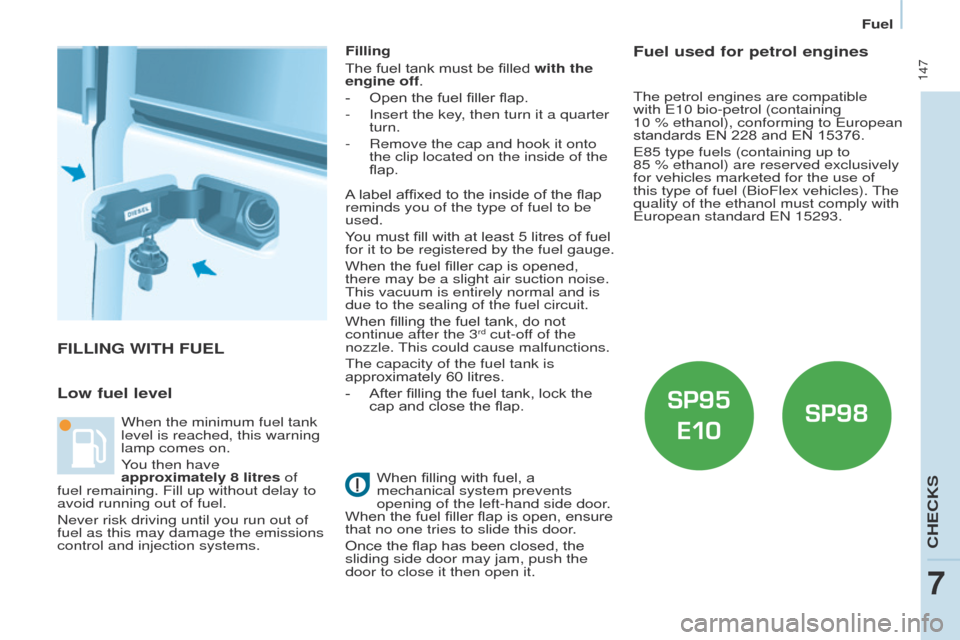
Filling
The fuel tank must be filled with the
engine off.
-
Open the fuel filler flap.
-
Insert the key
, then turn it a quarter
turn.
-
Remove the cap and hook it onto
the clip located on the inside of the
flap.
When fillin
g with fuel, a
mechanical system prevents
opening of the left-hand side door.
When the fuel filler flap is open, ensure
that no one tries to slide this door.
Once the flap has been closed, the
sliding side door may jam, push the
door to close it then open it.
When the minimum fuel tank
level is reached, this warning
lamp comes on.
You then have
approximately 8 litres of
fuel remaining. Fill up without delay to
avoid running out of fuel.
Never risk driving until you run out of
fuel as this may damage the emissions
control and injection systems. A label affixed to the inside of the flap
reminds you of the type of fuel to be
used.
You must fill with at least 5 litres of fuel
for it to be registered by the fuel gauge.
When the fuel filler cap is opened,
there may be a slight air suction noise.
t
his vacuum is entirely normal and is
due to the sealing of the fuel circuit.
When filling the fuel tank, do not
continue after the 3
rd cut-off of the
nozzle. t
his could cause malfunctions.
t
he capacity of the fuel tank is
approximately 60 litres.
-
After fillin
g the fuel tank, lock the
cap and close the flap.
Fuel used for petrol engines
the petrol engines are compatible
with e 10 bio-petrol (containing
10
% ethanol), conforming to e uropean
standards EN 228 and EN 15376.
e
85 type fuels (containing up to
85
% ethanol) are reserved exclusively
for vehicles marketed for the use of
this type of fuel (BioFlex vehicles).
t
he
quality of the ethanol must comply with
e
uropean standard e N 15293.
Fuel
CHeCKS
7