lock Peugeot Partner Tepee 2015 Owner's Guide
[x] Cancel search | Manufacturer: PEUGEOT, Model Year: 2015, Model line: Partner Tepee, Model: Peugeot Partner Tepee 2015Pages: 276, PDF Size: 12.76 MB
Page 52 of 276
50
Partner_2_VP_en_Chap03_Pret-a-partir_ed02-2014
Good practice when stopping Good practice when starting
Diesel pre-heating warning
lamp
If the temperature is high
enough, the warning lamp
comes on for less than
one second, you can start
without waiting.
In cold weather, wait for this warning
lamp to go off then operate the starter
(Starting position) until the engine
starts.
Door or bonnet open warning lamp
If this comes on, a door or
the bonnet is not closed
correctly, check!
Minimise engine and gearbox wear
When switching off the ignition, let the
engine run for a few seconds to allow
the turbocharger (Diesel engine) to
return to idle.
Do not press the accelerator when
switching off the ignition.
t
here is no need to engage a gear
after parking the vehicle.
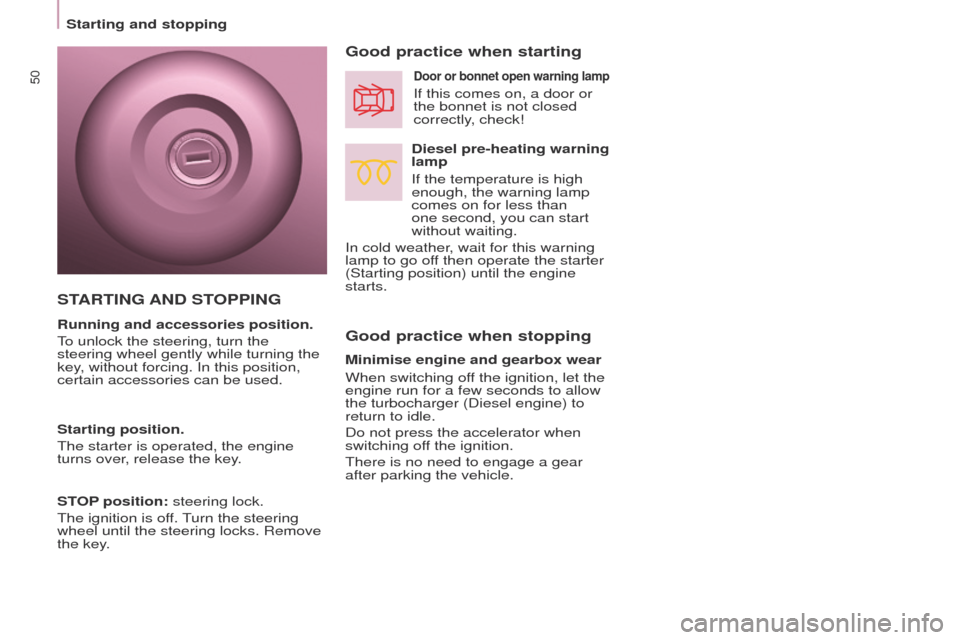
STARTING AND STOPPING
Running and accessories position.
to unlock the steering, turn the
steering wheel gently while turning the
key
, without forcing. In this position,
certain accessories can be used.
Starting position.
t
he starter is operated, the engine
turns over, release the key.
STOP position: steering lock.
t
he ignition is off.
turn the steering
wheel until the steering locks. Remove
the key
.
Starting and stopping
Page 70 of 276
68
Partner_2_VP_en_Chap04_ergonomie_ed02-2014
DEMISTING AND DEFROSTINGGOOD PRACTICE
Vents
"Leave them open"
For optimum distribution and diffusion
of hot or cool air in the passenger
compartment, there are adjustable
central and side vents which can
be directed sideways (right or left)
or vertically (up or down). For your
comfort while driving, do not close
them and direct the flow of air towards
the windows instead.
Air vents in the footwells and directed
towards the windscreen complete the
equipment.
Do not block the vents located at the
windscreen or the air extractor located
in the boot.
Dust filter, odour filter
(activated carbon)
This filter traps certain dust and limits
odours.
Ensure that this filter is in good
condition and have all of the filter
elements replaced regularly.
Refer to the "Checks" section of
chapter 7.
Air conditioning
In all seasons, the air conditioning
should only be used with the windows
closed. However, if the interior
temperature remains high after a
prolonged period parked in the sun, do
not hesitate to ventilate the passenger
compartment for a few minutes.
u
se the A ut
O mode as much as
possible as it permits optimised
control of all of the functions: air flow
,
passenger compartment comfort
temperature, air distribution, air
intake mode or air recirculation in the
passenger compartment.
Operate the air conditioning system for
5 to 10 minutes, once or twice a month,
to keep it in good working order.
If the system does not produce cold air,
do not use it and contact a P
euge O t
dealer or a qualified workshop.
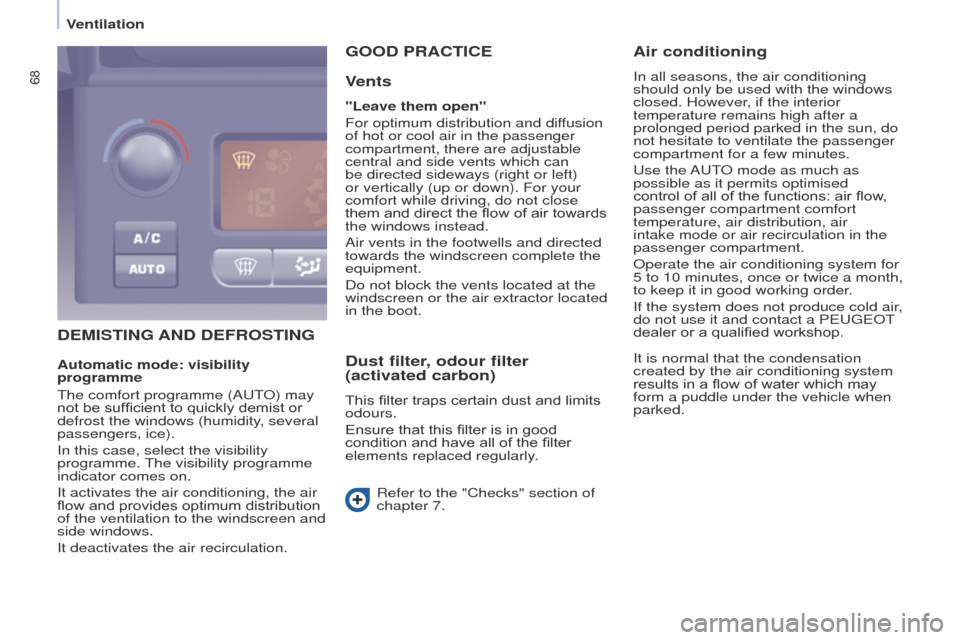
Automatic mode: visibility
programme
t
he comfort programme (A
ut
O) may
not be sufficient to quickly demist or
defrost the windows (humidity
, several
passengers, ice).
In this case, select the visibility
programme.
t
he visibility programme
indicator comes on.
It activates the air conditioning, the air
flow and provides optimum distribution
of the ventilation to the windscreen and
side windows.
It deactivates the air recirculation. It is normal that the condensation
created by the air conditioning system
results in a flow of water which may
form a puddle under the vehicle when
parked.
Ventilation
Page 72 of 276
70
Partner_2_VP_en_Chap04_ergonomie_ed02-2014
Never drive with the head
restraints removed; they must be
in place and correctly adjusted.Adjustable armrest
to access the vertical position, raise
the armrest until it locks.
Lower the armrest to return it to a
position for use.
to remove the armrest, press the
release
button from the vertical position
and move aside the armrest.
to put the armrest back in place, clip it
in the vertical position.
If the vehicle is fitted with the additional
console and an armrest, to fold the
passenger seat to the table position
remove the console or the armrest.
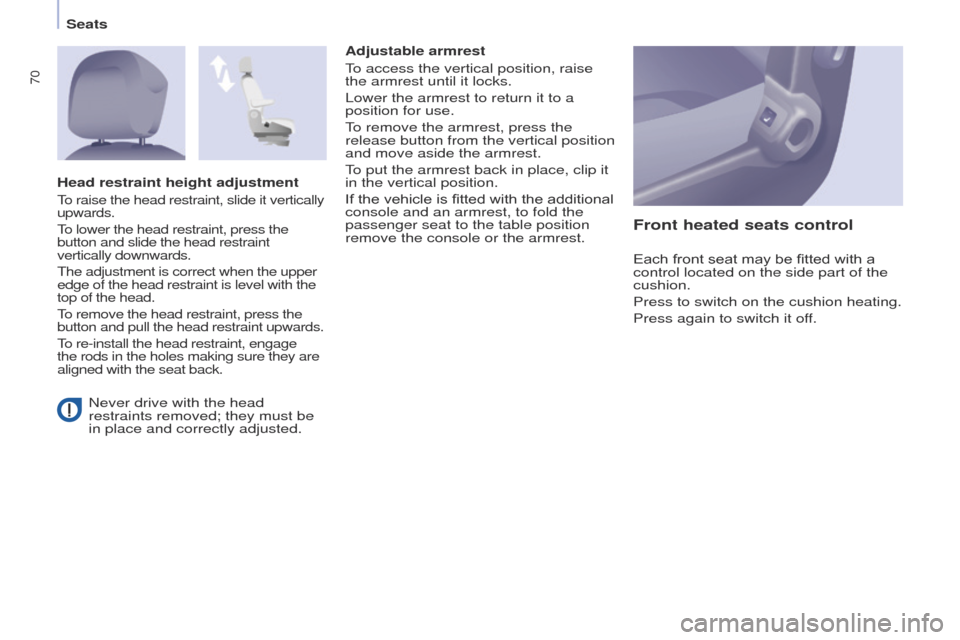
Front heated seats control
Each front seat may be fitted with a
control located on the side part of the
cushion.
Press to switch on the cushion heating.
Press again to switch it off.
Head restraint height adjustment
to raise the head restraint, slide it vertically
upwards.
to lower the head restraint, press the
button and slide the head restraint
vertically downwards.
t
he adjustment is correct when the upper
edge of the head restraint is level with the
top of the head.
to remove the head restraint, press the
button and pull the head restraint upwards.
to re-install the head restraint, engage
the rods in the holes making sure they are
aligned with the seat back.
Seats
Page 74 of 276
72
Partner_2_VP_en_Chap04_ergonomie_ed02-2014
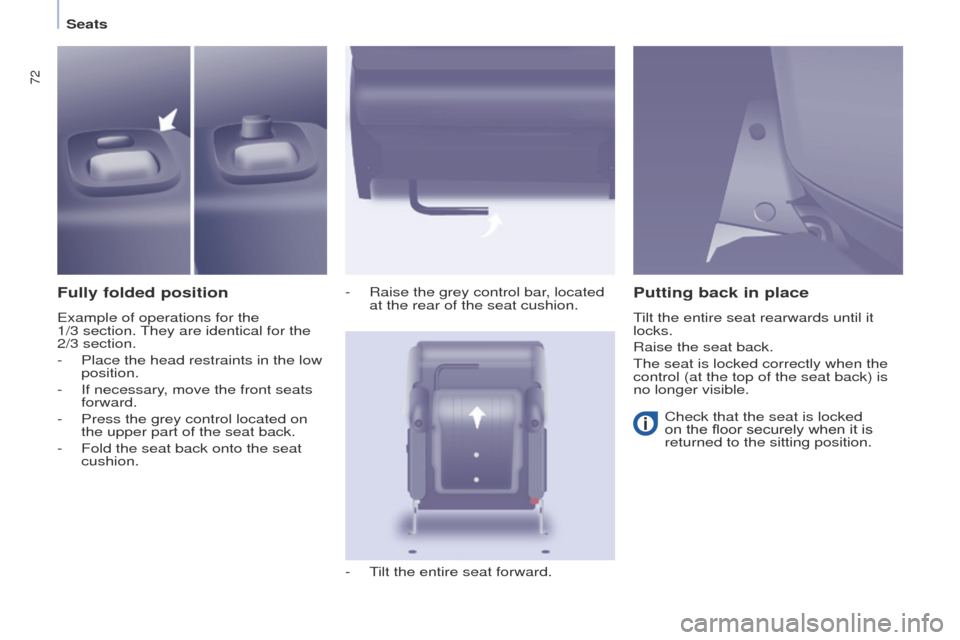
Fully folded position
example of operations for the
1/3 section. t hey are identical for the
2/3 section.
-
Place the head restraints in the low
position.
-
If necessary
, move the front seats
forward.
-
Press the grey control located on
the upper part of the seat back.
-
Fold the seat back onto the seat
cushion. -
Raise the grey control bar
, located
at the rear of the seat cushion.
- t
ilt the entire seat forward.
Putting back in place
tilt the entire seat rearwards until it
locks.
Raise the seat back.
t
he seat is locked correctly when the
control (at the top of the seat back) is
no longer visible.
Check that the seat is locked
on the floor securely when it is
returned to the sitting position.
Seats
Page 76 of 276
74
Partner_2_VP_en_Chap04_ergonomie_ed02-2014
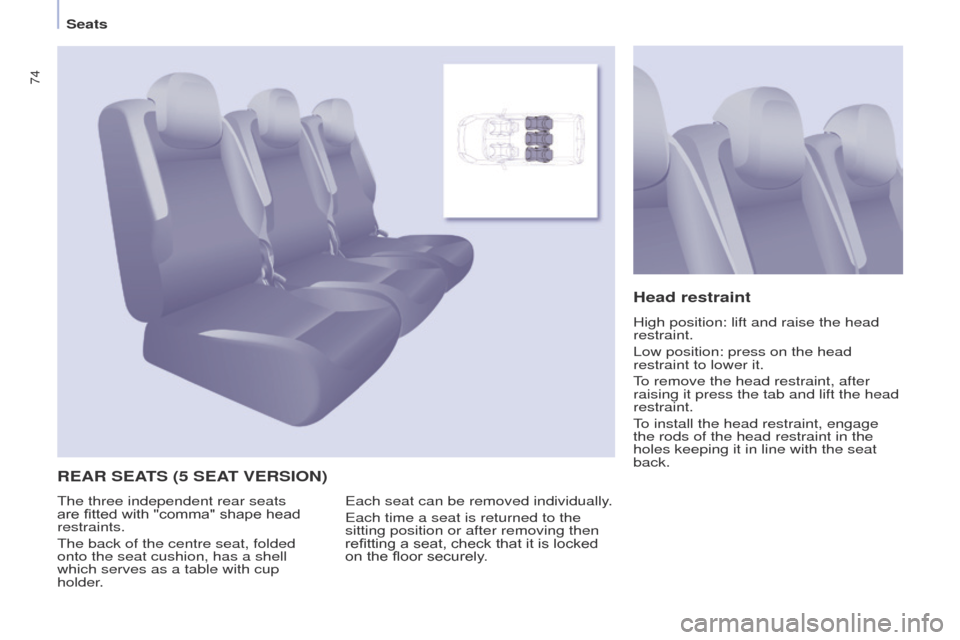
REAR SEATS (5 SEAT VERSION)Head restraint
High position: lift and raise the head
restraint.
Low position: press on the head
restraint to lower it.
to remove the head restraint, after
raising it press the tab and lift the head
restraint.
to install the head restraint, engage
the rods of the head restraint in the
holes keeping it in line with the seat
back.
e
ach seat can be removed individually.
e
ach time a seat is returned to the
sitting position or after removing then
refitting a seat, check that it is locked
on the floor securely.
t
he three independent rear seats
are fitted with "comma" shape head
restraints.
t
he back of the centre seat, folded
onto the seat cushion, has a shell
which serves as a table with cup
holder.
Seats
Page 77 of 276
75
Partner_2_VP_en_Chap04_ergonomie_ed02-2014
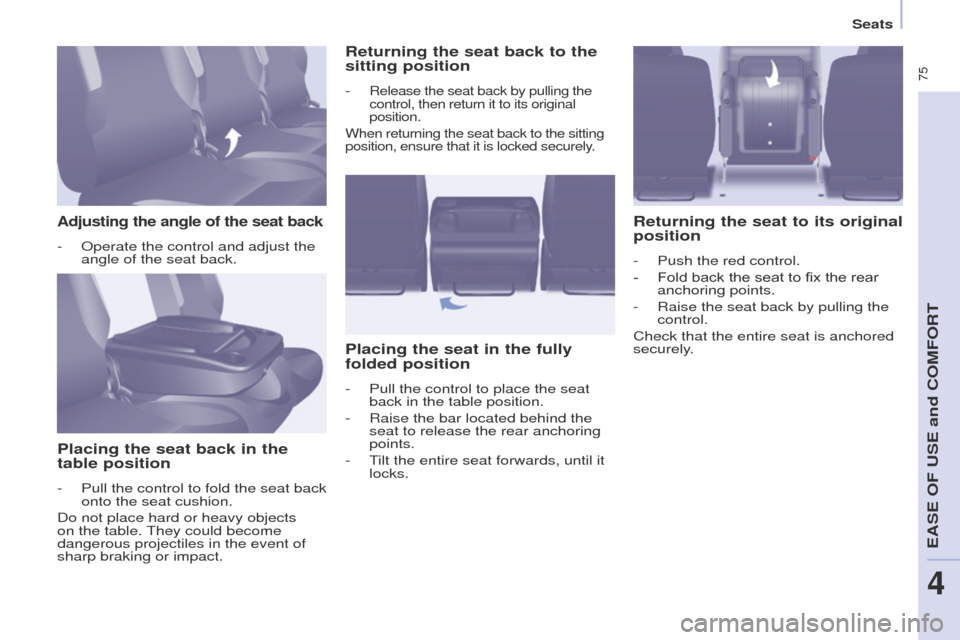
Adjusting the angle of the seat back
- Operate the control and adjust the
angle of the seat back.
Placing the seat back in the
table position
- Pull the control to fold the seat back
onto the seat cushion.
Do not place hard or heavy objects
on the table.
t
hey could become
dangerous projectiles in the event of
sharp braking or impact.
Returning the seat back to the
sitting position
- Release the seat back by pulling the
control, then return it to its original
position.
When returning the seat back to the sitting
position, ensure that it is locked securely.
Placing the seat in the fully
folded position
- Pull the control to place the seat
back in the table position.
-
Raise the bar located behind the
seat to release the rear anchoring
points.
-
t
ilt the entire seat forwards, until it
locks.
Returning the seat to its original
position
- Push the red control.
-
Fold back the seat to fix the rear
anchoring points.
-
Raise the seat back by pullin
g the
control.
Check that the entire seat is anchored
securely.
Seats
eASe OF uSe and COMFORt
4
Page 78 of 276
76
Partner_2_VP_en_Chap04_ergonomie_ed02-2014
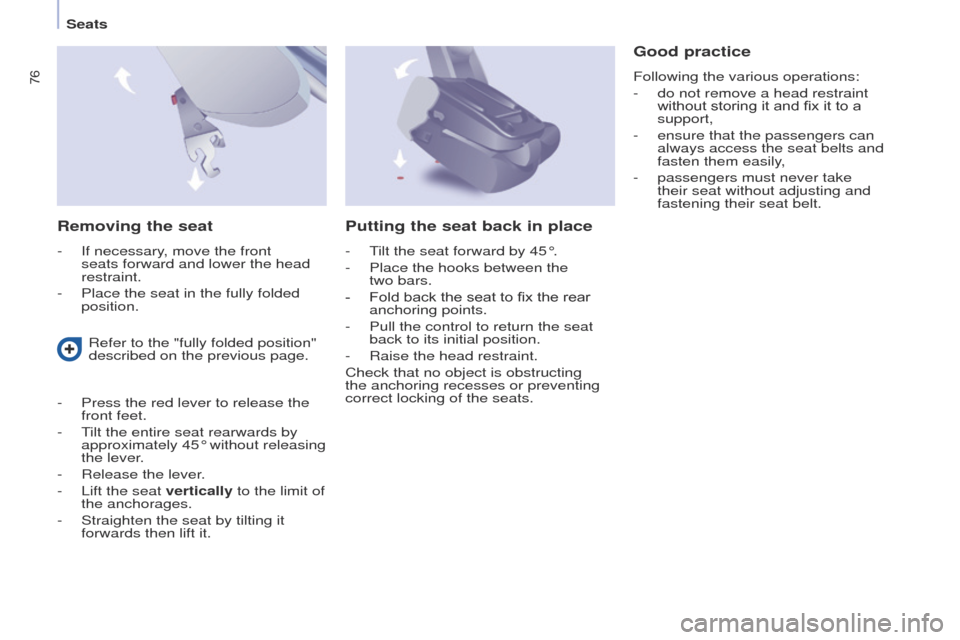
Removing the seat
- If necessary, move the front
seats forward and lower the head
restraint.
-
Place the seat in the fully folded
position.
Good practice
Following the various operations:
-
do not remove a head restraint
without storing it and fix it to a
support,
-
ensure that the passengers can
always access the seat belts and
fasten them easily
,
-
passengers must never take
their seat without adjusting and
fastening their seat belt.
Refer to the "fully folded position"
described on the previous page.
-
Press the red lever to release the
front feet.
-
t
ilt the entire seat rearwards by
approximately 45° without releasing
the lever
.
-
Release the lever
.
-
Lift the seat
vertically to the limit of
the anchorages.
-
Straighten the seat by tilting it
forwards then lift it.
Putting the seat back in place
- tilt the seat forward by 45°.
-
Place the hooks between the
two bars.
-
Fold back the seat to fix the rear
anchoring points.
-
Pull the control to return the seat
back to its initial position.
-
Raise the head restraint.
Check that no object is obstructing
the anchoring recesses or preventing
correct locking of the seats.
Seats
Page 81 of 276
79
Partner_2_VP_en_Chap04_ergonomie_ed02-2014
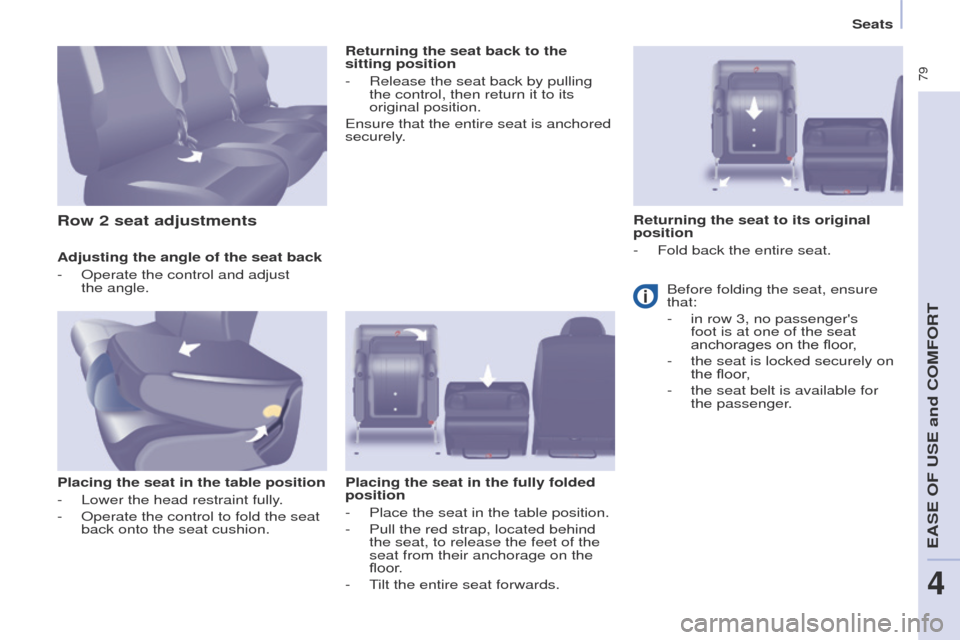
Adjusting the angle of the seat back
-
Operate the control and adjust
the
angle.
Placing the seat in the table position
-
Lower the head restraint fully
.
-
Operate the control to fold the seat
back onto the seat cushion. Returning the seat back to the
sitting position
-
Release the seat back by pullin
g
the control, then return it to its
original position.
e
nsure that the entire seat is anchored
securely.
Placing the seat in the fully folded
position
-
Place the seat in the table position.
-
Pull the red strap, located behind
the seat, to release the feet of the
seat from their anchorage on the
floor
.
-
t
ilt the entire seat forwards.
Row 2 seat adjustmentsReturning the seat to its original
position
-
Fold back the entire seat.
Before folding the seat, ensure
that:
-
in row 3, no passenger's
foot is at one of the seat
anchorages on the floor
,
-
the seat is locked securely on
the floor
,
-
the seat belt is available for
the passenger
.
Seats
eASe OF uSe and COMFORt
4
Page 82 of 276
80
Partner_2_VP_en_Chap04_ergonomie_ed02-2014
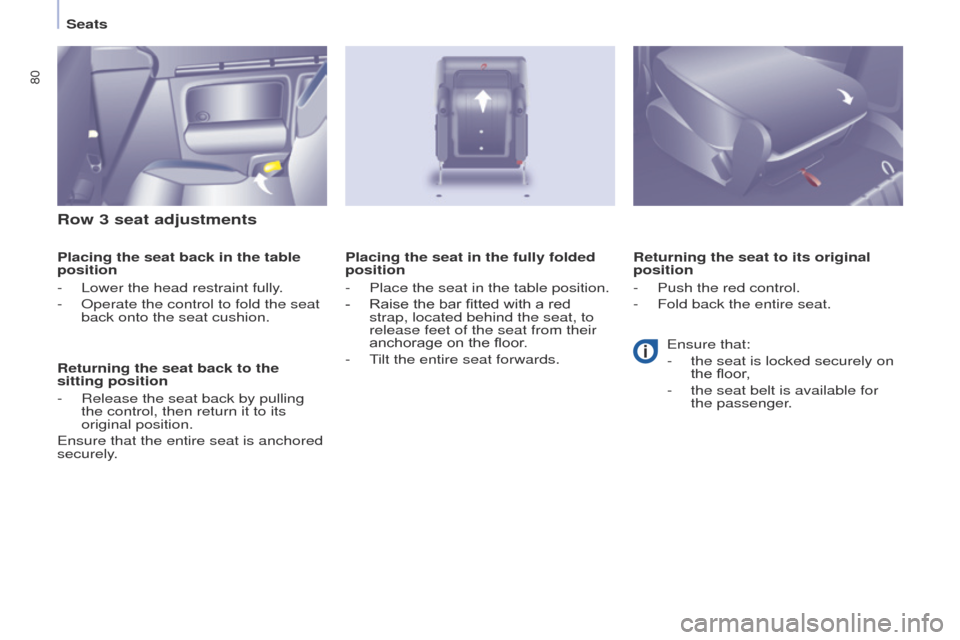
Row 3 seat adjustments
Placing the seat back in the table
position
-
Lower the head restraint fully
.
-
Operate the control to fold the seat
back onto the seat cushion.
Returning the seat back to the
sitting position
-
Release the seat back by pullin
g
the control, then return it to its
original position.
e
nsure that the entire seat is anchored
securely. Returning the seat to its original
position
-
Push the red control.
-
Fold back the entire seat.
Placing the seat in the fully folded
position
-
Place the seat in the table position.
-
Raise the bar fitted with a red
strap, located behind the seat, to
release feet of the seat from their
anchorage on the floor
.
-
t
ilt the entire seat forwards.e
nsure that:
-
the seat is locked securely on
the floor
,
-
the seat belt is available for
the passenger
.
Seats
Page 84 of 276
82
Partner_2_VP_en_Chap04_ergonomie_ed02-2014
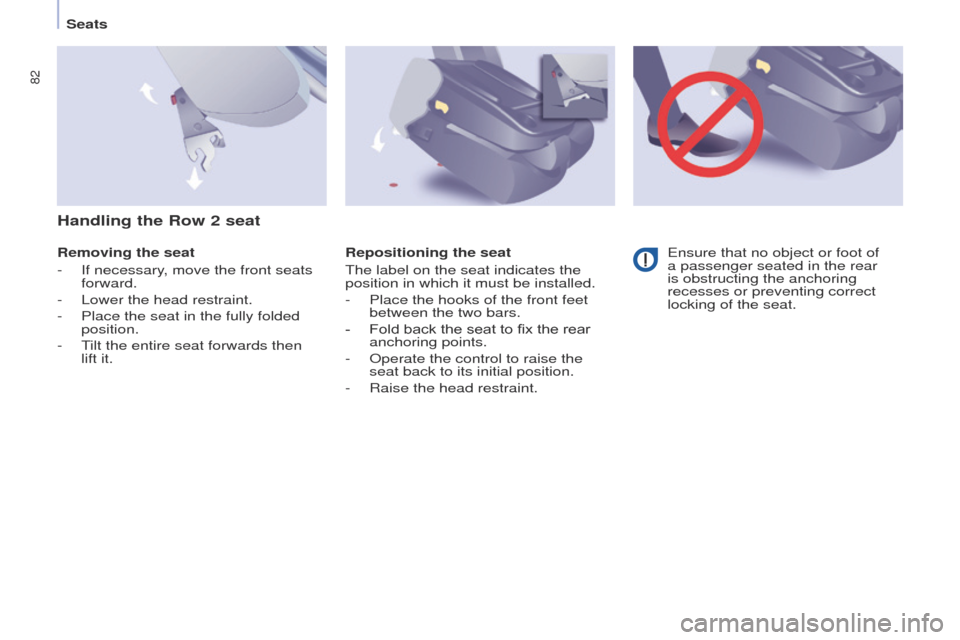
Removing the seat
-
If necessary
, move the front seats
forward.
-
Lower the head restraint.
-
Place the seat in the fully folded
position.
-
t
ilt the entire seat forwards then
lift
it. Repositioning the seat
t
he label on the seat indicates the
position in which it must be installed.
-
Place the hooks of the front feet
between the two bars.
-
Fold back the seat to fix the rear
anchoring points.
-
Operate the control to raise the
seat back to its initial position.
-
Raise the head restraint.
e nsure that no object or foot of
a passenger seated in the rear
is obstructing the anchoring
recesses or preventing correct
locking of the seat.
Handling the Row 2 seat
Seats