wheel Peugeot Partner Tepee 2017 User Guide
[x] Cancel search | Manufacturer: PEUGEOT, Model Year: 2017, Model line: Partner Tepee, Model: Peugeot Partner Tepee 2017Pages: 292, PDF Size: 10.49 MB
Page 37 of 292
+
ABS
35
Partner2VP_en_Chap03_Pret-a-partir_ed02-2016Partner2VP_en_Chap03_Pret-a-partir_ed02-2016
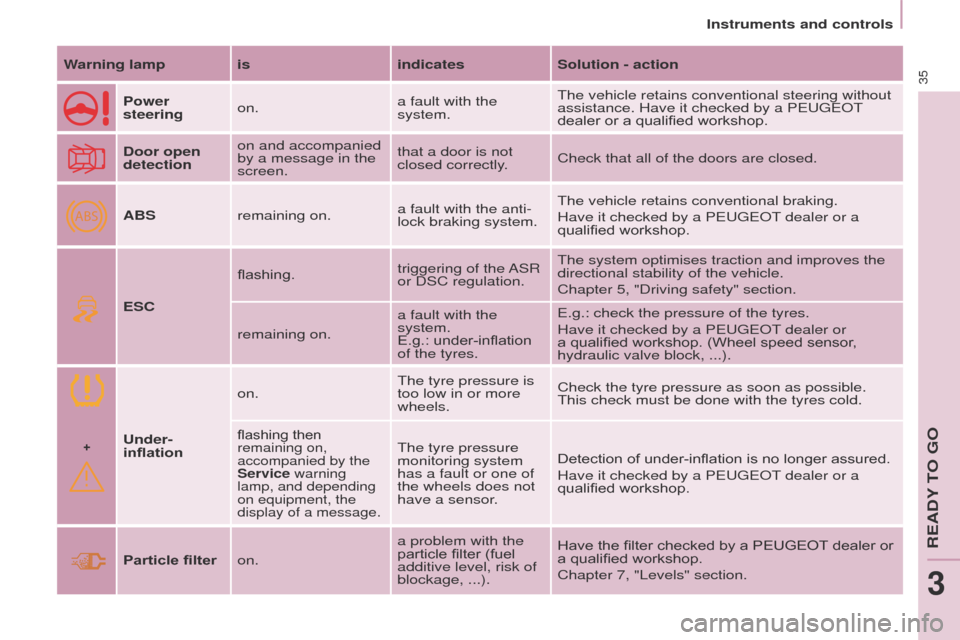
Warning lamp isindicatesSolution - action
Power
steering on. a fault with the
system.The vehicle retains conventional steering without
assistance. Have it checked by a PEUGEOT
dealer or a qualified workshop.
Door open
detection on and accompanied
by a message in the
screen. that a door is not
closed correctly.
Check that all of the doors are closed.
ABS remaining on. a fault with the anti-
lock braking system.The vehicle retains conventional braking.
Have it checked by a PEUGEOT dealer or a
qualified workshop.
ESC flashing.
triggering of the ASR
or DSC regulation.The system optimises traction and improves the
directional stability of the vehicle.
Chapter 5, "Driving safety" section.
remaining on. a fault with the
system.
E.g.: under-inflation
of the tyres.E.g.: check the pressure of the tyres.
Have it checked by a PEUGEOT dealer or
a qualified workshop. (Wheel speed sensor,
hydraulic valve block,
...).
Under-
inflation on.
The tyre pressure is
too low in or more
wheels.Check the tyre pressure as soon as possible.
This check must be done with the tyres cold.
flashing then
remaining on,
accompanied by the
Service warning
lamp, and depending
on equipment, the
display of a message.The tyre pressure
monitoring system
has a fault or one of
the wheels does not
have a sensor.Detection of under-inflation is no longer assured.
Have it checked by a PEUGEOT dealer or a
qualified workshop.
Particle filter on. a problem with the
particle filter (fuel
additive level, risk of
blockage,
...). Have the filter checked by a PEUGEOT dealer or
a qualified workshop.
Chapter 7, "Levels" section.
READY TO GO
3
Instruments and controls
Page 43 of 292
41
Partner2VP_en_Chap03_Pret-a-partir_ed02-2016Partner2VP_en_Chap03_Pret-a-partir_ed02-2016
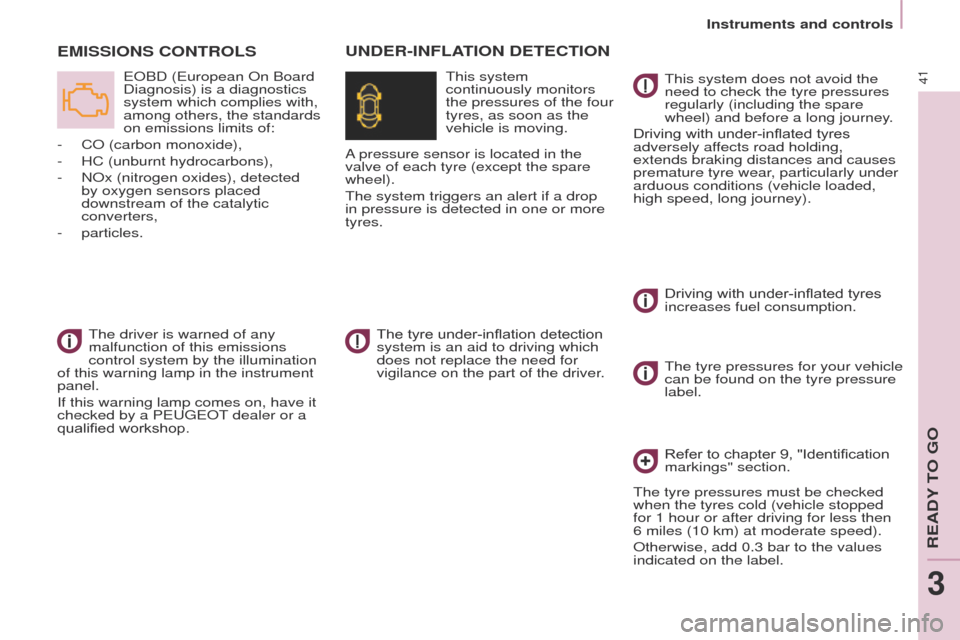
EMISSIONS CONTROLS
EOBD (European On Board
Diagnosis) is a diagnostics
system which complies with,
among others, the standards
on emissions limits of:
-
CO (carbon monoxide),
-
HC (unburnt hydrocarbons),
-
NOx (nitrogen oxides), detected
by oxygen sensors placed
downstream of the catalytic
converters,
-
particles.
UNDER-INFLATION DETECTION
This system
continuously monitors
the pressures of the four
tyres, as soon as the
vehicle is moving.
A pressure sensor is located in the
valve of each tyre (except the spare
wheel).
The system triggers an alert if a drop
in pressure is detected in one or more
tyres.
The tyre under-inflation detection
system is an aid to driving which
does not replace the need for
vigilance on the part of the driver.
The driver is warned of any
malfunction of this emissions
control system by the illumination
of this warning lamp in the instrument
panel.
If this warning lamp comes on, have it
checked by a PEUGEOT dealer or a
qualified workshop. This system does not avoid the
need to check the tyre pressures
regularly (including the spare
wheel) and before a long journey
.
Driving with under-inflated tyres
adversely affects road holding,
extends braking distances and causes
premature tyre wear, particularly under
arduous conditions (vehicle loaded,
high speed, long journey).
Driving with under-inflated tyres
increases fuel consumption.
The tyre pressures for your vehicle
can be found on the tyre pressure
label.
Refer to chapter 9, "Identification
markings" section.
The tyre pressures must be checked
when the tyres cold (vehicle stopped
for 1 hour or after driving for less then
6 miles (10 km) at moderate speed).
Otherwise, add 0.3 bar to the values
indicated on the label.
READY TO GO
3
Instruments and controls
Page 44 of 292
42
Partner2VP_en_Chap03_Pret-a-partir_ed02-2016Partner2VP_en_Chap03_Pret-a-partir_ed02-2016
The alert is maintained
until the tyre or tyres concerned
is reinflated, repaired or
replaced.
The spare wheel (space-saver type or
a steel rim) does not have a sensor.
Operating fault
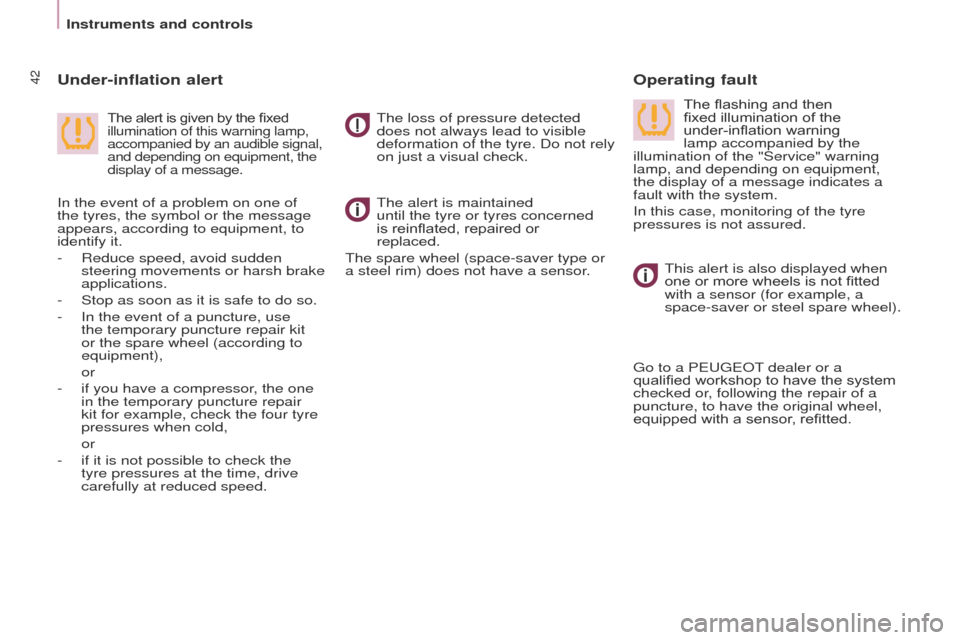
Under-inflation alert
The loss of pressure detected
does not always lead to visible
deformation of the tyre. Do not rely
on just a visual check.The alert is given by the fixed
illumination of this warning lamp,
accompanied by an audible signal,
and depending on equipment, the
display of a message.The flashing and then
fixed illumination of the
under-inflation warning
lamp accompanied by the
illumination of the "Service" warning
lamp, and depending on equipment,
the display of a message indicates a
fault with the system.
In this case, monitoring of the tyre
pressures is not assured.
In the event of a problem on one of
the tyres, the symbol or the message
appears, according to equipment, to
identify it.
-
Reduce speed, avoid sudden
steering movements or harsh brake
applications.
-
Stop as soon as it is safe to do so.
-
In the event of a puncture, use
the temporary puncture repair kit
or the spare wheel (according to
equipment),
or
-
if you have a compressor
, the one
in the temporary puncture repair
kit for example, check the four tyre
pressures when cold,
or
-
if it is not possible to check the
tyre pressures at the time, drive
carefully at reduced speed.
This alert is also displayed when
one or more wheels is not fitted
with a sensor (for example, a
space-saver or steel spare wheel).
Go to a PEUGEOT
dealer or a
qualified workshop
to have the system
checked or, following the repair of a
puncture, to have the original wheel,
equipped with a sensor, refitted.
Instruments and controls
Page 45 of 292
43
Partner2VP_en_Chap03_Pret-a-partir_ed02-2016Partner2VP_en_Chap03_Pret-a-partir_ed02-2016
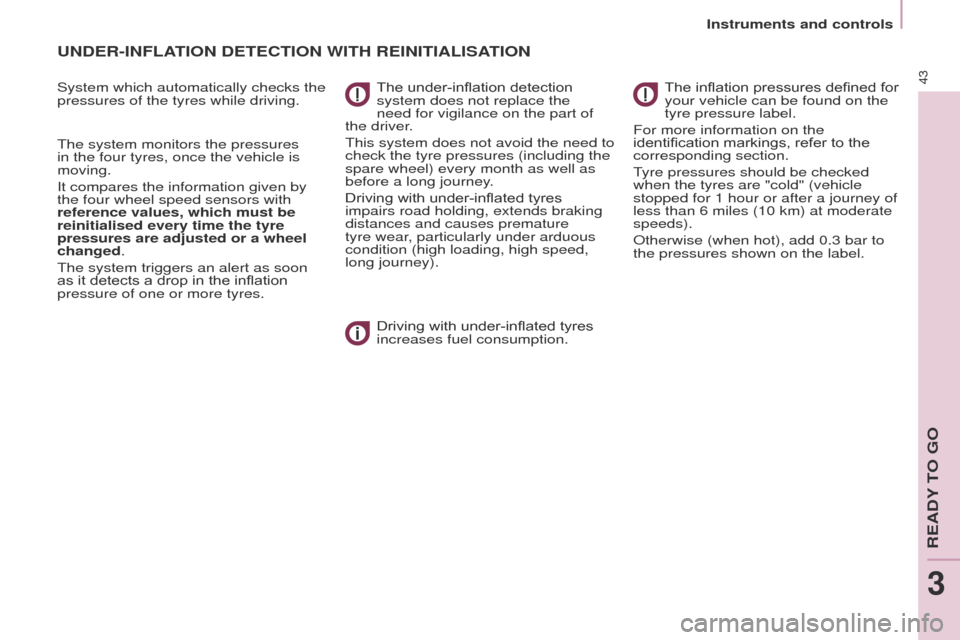
UNDER-INFLATION DETECTION WITH REINITIALISATION
System which automatically checks the
pressures of the tyres while driving.
The system monitors the pressures
in the four tyres, once the vehicle is
moving.
It compares the information given by
the four wheel speed sensors with
reference values, which must be
reinitialised every time the tyre
pressures are adjusted or a wheel
changed.
The system triggers an alert as soon
as it detects a drop in the inflation
pressure of one or more tyres.The under-inflation detection
system does not replace the
need for vigilance on the part of
the
driver.
This system does not avoid the need to
check the tyre pressures (including the
spare wheel) every month as well as
before a long journey.
Driving with under-inflated tyres
impairs road holding, extends braking
distances and causes premature
tyre wear, particularly under arduous
condition (high loading, high speed,
long journey).
Driving with under-inflated tyres
increases fuel consumption. The inflation pressures defined for
your vehicle can be found on the
tyre pressure label.
For more information on the
identification markings, refer to the
corresponding section.
Tyre pressures should be checked
when the tyres are "cold" (vehicle
stopped for 1 hour or after a journey of
less than 6 miles (10 km) at moderate
speeds).
Otherwise (when hot), add 0.3 bar to
the pressures shown on the label.
READY TO GO
3
Instruments and controls
Page 46 of 292
44
Partner2VP_en_Chap03_Pret-a-partir_ed02-2016Partner2VP_en_Chap03_Pret-a-partir_ed02-2016
Under-inflation alert
This is given by fixed illumination
of this warning lamp, accompanied
by an audible signal and,
depending on equipment, the
display of a message.
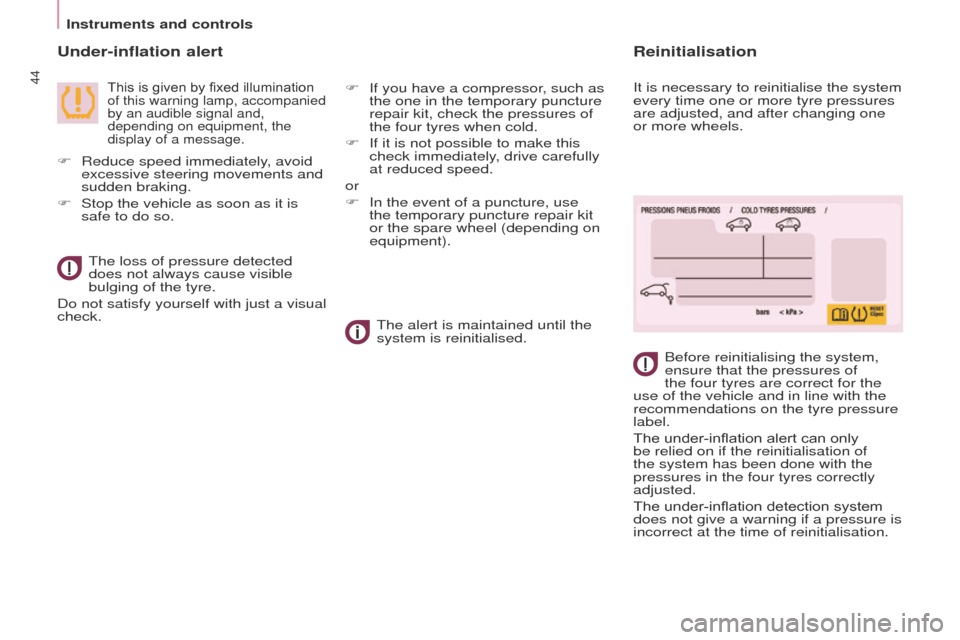
Before reinitialising the system,
ensure that the pressures of
the four tyres are correct for the
use of the vehicle and in line with the
recommendations on the tyre pressure
label.
The under-inflation alert can only
be relied on if the reinitialisation of
the system has been done with the
pressures in the four tyres correctly
adjusted.
The under-inflation detection system
does not give a warning if a pressure is
incorrect at the time of reinitialisation.
The loss of pressure detected
does not always cause visible
bulging of the tyre.
Do not satisfy yourself with just a visual
check. The alert is maintained until the
system is reinitialised.
F
Reduce speed immediately
, avoid
excessive steering movements and
sudden braking.
F
Stop the vehicle as soon as it is
safe to do so.
F
If you have a compressor
, such as
the one in the temporary puncture
repair kit, check the pressures of
the four tyres when cold.
F
If it is not possible to make this
check immediately
, drive carefully
at reduced speed.
or
F
In the event of a puncture, use
the temporary puncture repair kit
or the spare wheel (depending on
equipment).
Reinitialisation
It is necessary to reinitialise the system
every time one or more tyre pressures
are adjusted, and after changing one
or more wheels.
Instruments and controls
Page 51 of 292
49
Partner2VP_en_Chap03_Pret-a-partir_ed02-2016Partner2VP_en_Chap03_Pret-a-partir_ed02-2016
MANUAL GEARBO x
5-speed
6-speed
To change gear easily, always depress
the clutch pedal fully.
To prevent the mat from becoming
caught under the pedal:
-
ensure that the mat is positioned
and secured correctly on the floor
,
-
never fit one mat on top of another
.
When driving, avoid leaving your hand
on the gear knob as the force exerted,
even if slight, may wear the internal
components of the gearbox over time.
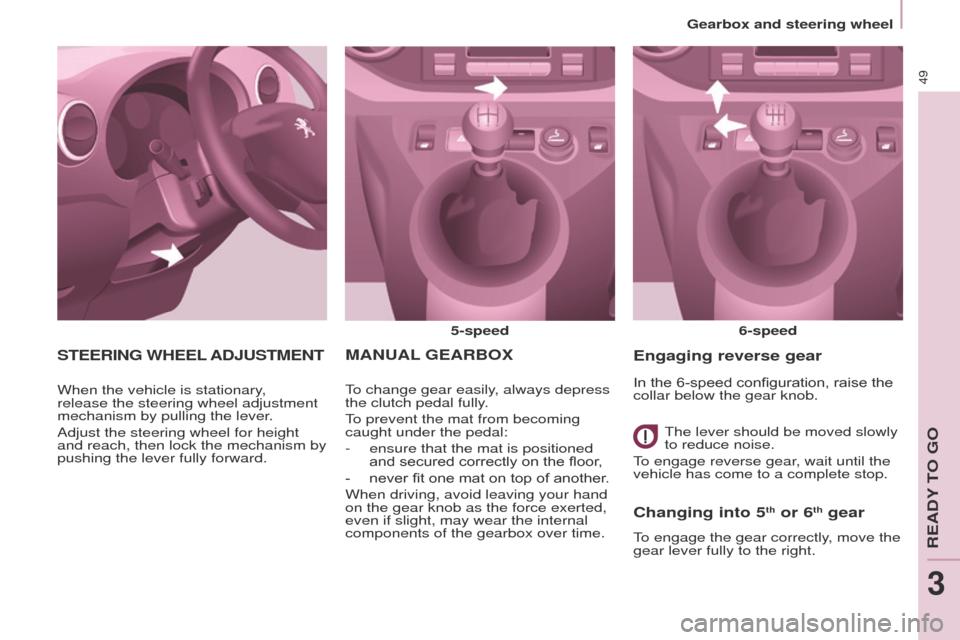
Changing into 5th or 6th gear
To engage the gear correctly, move the
gear lever fully to the right.
Engaging reverse gear
The lever should be moved slowly
to reduce noise.
To engage reverse gear, wait until the
vehicle has come to a complete stop.
STEERING WHEEL ADJUSTMENT
When the vehicle is stationary,
release the steering wheel adjustment
mechanism by pulling the lever.
Adjust the steering wheel for height
and reach, then lock the mechanism by
pushing the lever fully forward. In the 6-speed configuration, raise the
collar below the gear knob.
READY TO GO
3
Gearbox and steering wheel
Page 52 of 292
50
Partner2VP_en_Chap03_Pret-a-partir_ed02-2016Partner2VP_en_Chap03_Pret-a-partir_ed02-2016
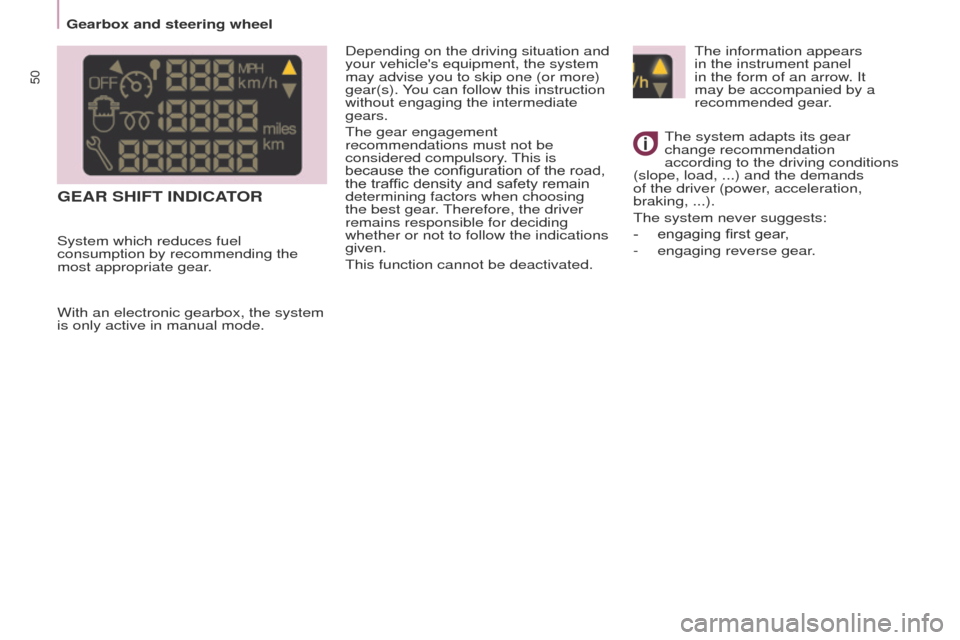
The information appears
in the instrument panel
in the form of an arrow. It
may be accompanied by a
recommended gear.
The system adapts its gear
change recommendation
according to the driving conditions
(slope, load,
...) and the demands
of the driver (power, acceleration,
braking,
...).
The system never suggests:
-
engaging first gear
,
-
engaging reverse gear
.
With an electronic gearbox, the system
is only active in manual mode.
GEAR SHIFT INDICATOR
Depending on the driving situation and
your vehicle's equipment, the system
may advise you to skip one (or more)
gear(s). You can follow this instruction
without engaging the intermediate
gears.
The gear engagement
recommendations must not be
considered compulsory. This is
because the configuration of the road,
the traffic density and safety remain
determining factors when choosing
the best gear. Therefore, the driver
remains responsible for deciding
whether or not to follow the indications
given.
This function cannot be deactivated.
System which reduces fuel
consumption by recommending the
most appropriate gear.
Gearbox and steering wheel
Page 53 of 292
51
Partner2VP_en_Chap03_Pret-a-partir_ed02-2016Partner2VP_en_Chap03_Pret-a-partir_ed02-2016
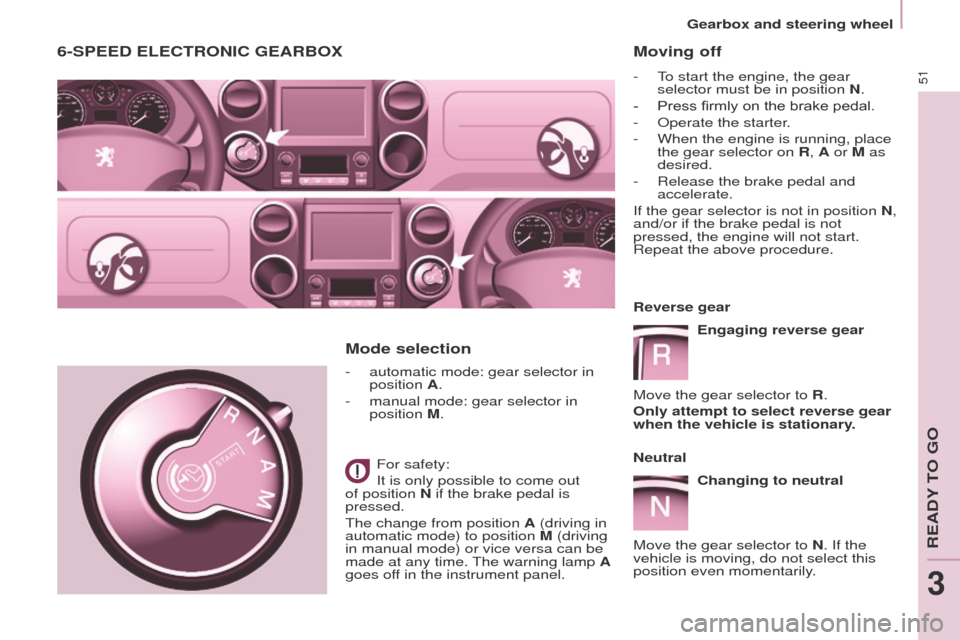
6-SPEED ELECTRONIC GEARBOx
- automatic mode: gear selector in
position A.
-
manual mode: gear selector in
position
M.
For safety:
It is only possible to come out
of position N if the brake pedal is
pressed.
The change from position A (driving in
automatic mode) to position M (driving
in manual mode) or vice versa can be
made at any time. The warning lamp A
goes off in the instrument panel.
Mode selection Moving off
- To start the engine, the gear
selector must be in position N.
-
Press firmly on the brake pedal.
-
Operate the starter
.
-
When the engine is running, place
the gear selector on
R, A or M as
desired.
-
Release the brake pedal and
accelerate.
If the gear selector is not in position
N,
and/or if the brake pedal is not
pressed, the engine will not start.
Repeat the above procedure.
Reverse gear
Engaging reverse gear
Move the gear selector to R.
Only attempt to select reverse gear
when the vehicle is stationary.
Neutral Changing to neutral
Move the gear selector to N. If the
vehicle is moving, do not select this
position even momentarily.
READY TO GO
3
Gearbox and steering wheel
Page 54 of 292
52
Partner2VP_en_Chap03_Pret-a-partir_ed02-2016Partner2VP_en_Chap03_Pret-a-partir_ed02-2016
Acceleration
For optimum acceleration (e.g. to
overtake another vehicle), simply
press the pedal beyond the point of
resistance at the end of its travel, by
pressing down firmly.
Vehicle stationary, with the
engine running
In the event of a prolonged stop with
the engine running, the gearbox
changes automatically to neutral N.
Stopping the vehicle
Before stopping the engine, put the
gear selector in position N.
In all cases, it is essential to apply
the parking brake. Check that the
parking brake warning lamp is on in the
instrument panel.Before doing anything in the
engine compartment, check that
the gear selector is in neutral N.
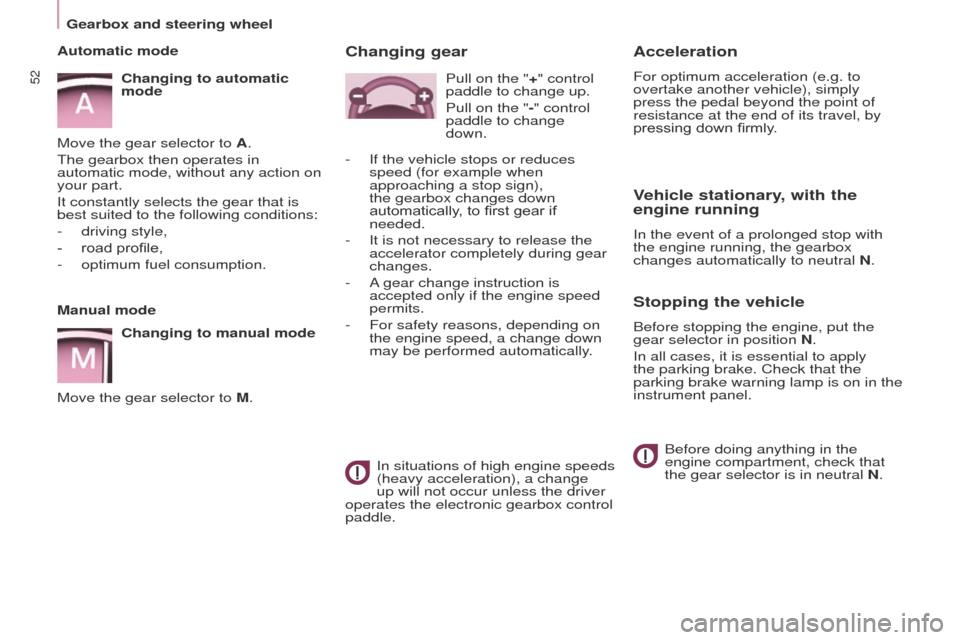
Changing gear
In situations of high engine speeds
(heavy acceleration), a change
up will not occur unless the driver
operates the electronic gearbox control
paddle. Pull on the "+" control
paddle to change up.
Pull on the "-" control
paddle to change
down.
-
If the vehicle stops or reduces
speed (for example when
approaching a stop sign),
the gearbox changes down
automatically
, to first gear if
needed.
-
It is not necessary to release the
accelerator completely during gear
changes.
-
A
gear change instruction is
accepted only if the engine speed
permits.
-
For safety reasons, depending on
the engine speed, a change down
may be performed automatically
.
Manual mode
Changing to manual mode
Move the gear selector to M. Automatic mode Changing to automatic
mode
Move the gear selector to A.
The gearbox then operates in
automatic mode, without any action on
your part.
It constantly selects the gear that is
best suited to the following conditions:
-
driving style,
-
road profile,
-
optimum fuel consumption.
Gearbox and steering wheel
Page 57 of 292
55
Partner2VP_en_Chap03_Pret-a-partir_ed02-2016Partner2VP_en_Chap03_Pret-a-partir_ed02-2016
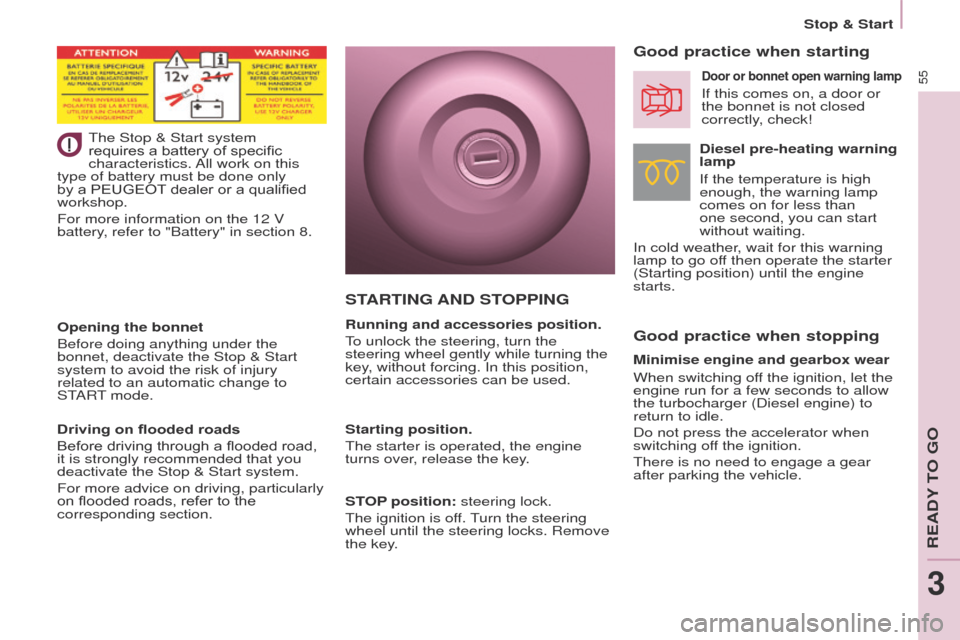
The Stop & Start system
requires a battery of specific
characteristics. All work on this
type of battery must be done only
by a PEUGEOT dealer or a qualified
workshop.
For more information on the 12 V
battery, refer to "Battery" in section 8.
Good practice when stopping Good practice when starting
Diesel pre-heating warning
lamp
If the temperature is high
enough, the warning lamp
comes on for less than
one
second, you can start
without waiting.
In cold weather, wait for this warning
lamp to go off then operate the starter
(Starting position) until the engine
starts.
Door or bonnet open warning lamp
If this comes on, a door or
the bonnet is not closed
correctly, check!
Minimise engine and gearbox wear
When switching off the ignition, let the
engine run for a few seconds to allow
the turbocharger (Diesel engine) to
return to idle.
Do not press the accelerator when
switching off the ignition.
There is no need to engage a gear
after parking the vehicle.
STARTING AND ST OPPING
Running and accessories position.
To unlock the steering, turn the
steering wheel gently while turning the
key, without forcing. In this position,
certain accessories can be used.
Starting position.
The starter is operated, the engine
turns over, release the key.
STOP position: steering lock.
The ignition is off. Turn the steering
wheel until the steering locks. Remove
the key.
Opening the bonnet
Before doing anything under the
bonnet, deactivate the Stop & Start
system to avoid the risk of injury
related to an automatic change to
START mode.
Driving on flooded roads
Before driving through a flooded road,
it is strongly recommended that you
deactivate the Stop & Start system.
For more advice on driving, particularly
on flooded roads, refer to the
corresponding section.
READY TO GO
3
Stop & Start