wheel Peugeot Partner Tepee 2017 Owner's Guide
[x] Cancel search | Manufacturer: PEUGEOT, Model Year: 2017, Model line: Partner Tepee, Model: Peugeot Partner Tepee 2017Pages: 292, PDF Size: 10.49 MB
Page 59 of 292
57
Partner2VP_en_Chap03_Pret-a-partir_ed02-2016Partner2VP_en_Chap03_Pret-a-partir_ed02-2016
DRIVING RECOMMENDATIONS
Observe the driving regulations and
remain vigilant whatever the traffic
conditions.
Pay close attention to the traffic and
keep your hands on the wheel so that
you are ready to react at any time to
any eventuality.
As a safety precaution, the driver
must only carry out actions requiring
sustained attention when the vehicle is
stationary.
On a long journey, a break every two
hours is strongly recommended.
In difficult weather, drive smoothly,
anticipate the need to brake and
increase the distance from other
vehicles.
Driving on flooded roads
We strongly advise against driving
on flooded roads, as this could cause
serious damage to the engine or
gearbox, as well as to the electrical
systems of your vehicle.If you are obliged to drive through
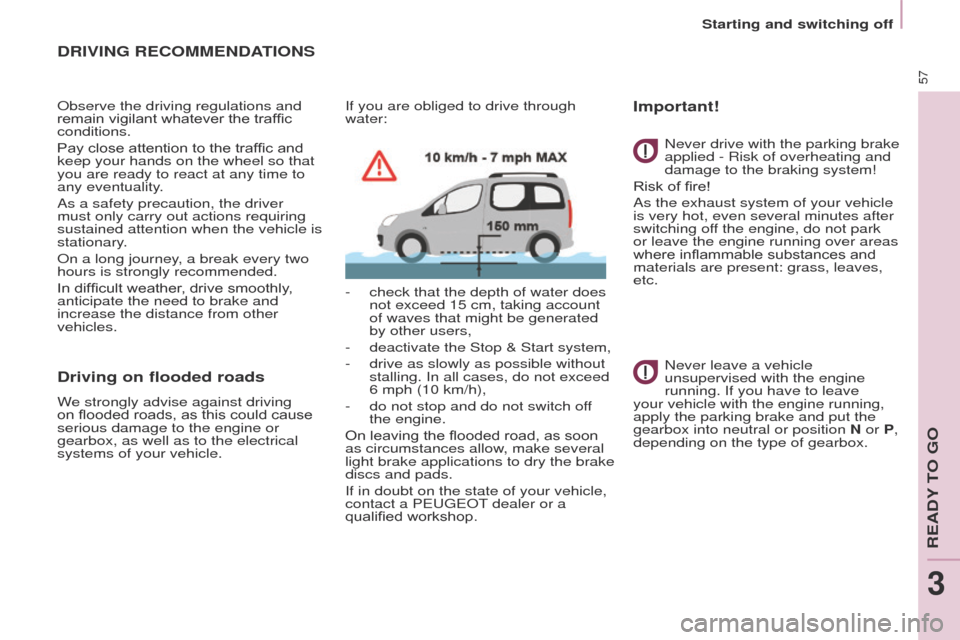
water:
-
check that the depth of water does
not exceed 15 cm, taking account
of waves that might be generated
by other users,
-
deactivate the Stop & Start system,
-
drive as slowly as possible without
stallin
g. In all cases, do not exceed
6 mph (10 km/h),
- do not stop and do not switch of f
the engine.
On leaving the flooded road, as soon
as circumstances allow, make several
light brake applications to dry the brake
discs and pads.
If in doubt on the state of your vehicle,
contact a PEUGEOT dealer or a
qualified workshop. Never drive with the parking brake
applied - Risk of overheating and
damage to the braking system!
Risk of fire!
As the exhaust system of your vehicle
is very hot, even several minutes after
switching off the engine, do not park
or leave the engine running over areas
where inflammable substances and
materials are present: grass, leaves,
etc.
Never leave a vehicle
unsupervised with the engine
running. If you have to leave
your vehicle with the engine running,
apply the parking brake and put the
gearbox into neutral or position N or P,
depending on the type of gearbox.
Important!
READY TO GO
3
Starting and switching off
Page 62 of 292
60
Partner2VP_en_Chap04_Ergonomie_ed02-2016
If the sunshine sensor
does not function correctly,
the lighting comes on
accompanied by the service
warning lamp, an audible
signal and a message in the screen.
Contact a PEUGEOT dealer or a
qualified workshop.
Guide-me-home lighting
Keeping the dipped beam headlamps
on temporarily with the ignition off,
makes the driver's exit easier when the
light is poor.
HEADLAMP BEAM
The beam setting must be adjusted to
suit the load in the vehicle.
0 - No load.
1 - Partial load.
2 - Average load.
3 - Maximum authorised load.
Manual operation
-
With the ignition of
f, "flash" the
headlamps within one minute after
switching off the ignition.
The guide-me-home lighting switches
off automatically after a set time.
Automatic operation
Refer to chapter 10, "Screen
menu map" section. Initial setting is position 0.
Activate the function via the
vehicle configuration menu. Programming
The system is activated or deactivated
in the vehicle configuration menu.
The system is activated by default. Switching off
The system does not operate:
-
below a certain angle of rotation of
the steering wheel,
-
above 25 mph (40 km/h),
-
when reverse gear is engaged.
Switching on
This function starts:
-
when the corresponding direction
indicator is switched on,
or
-
from a certain angle of rotation of
the steering wheel.
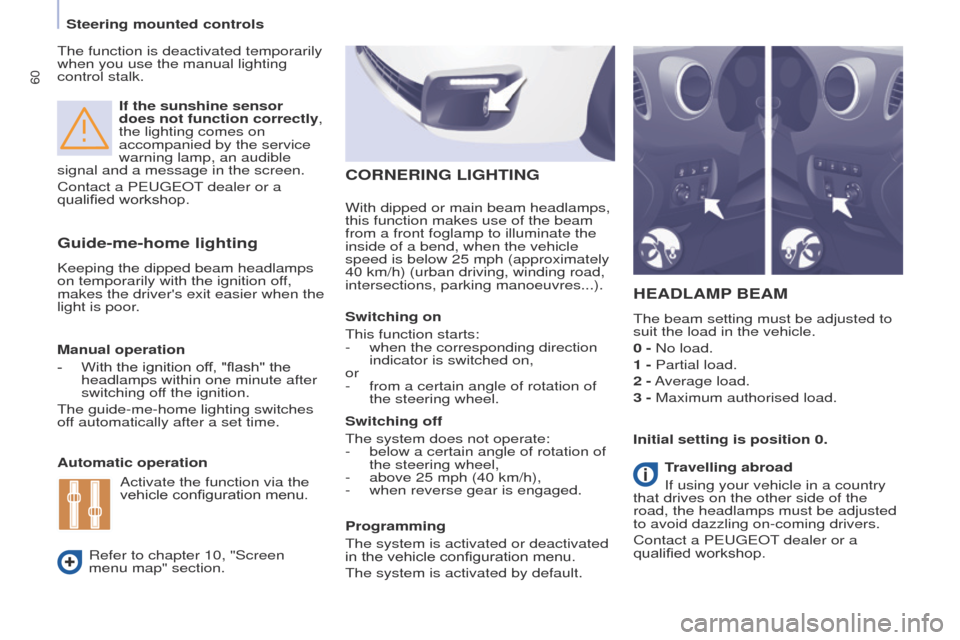
With dipped or main beam headlamps,
this function makes use of the beam
from a front foglamp to illu
minate the
inside of a bend, when the vehicle
speed is below 25 mph (approximately
40 km/h) (urban driving, winding road,
intersections, parking manoeuvres...).
CORNERING LIGHTING
Travelling abroad
If using your vehicle in a country
that drives on the other side of the
road, the headlamps must be adjusted
to avoid dazzling on-coming drivers.
Contact a PEUGEOT dealer or a
qualified workshop.
The function is deactivated temporarily
when you use the manual lighting
control stalk.
Steering mounted controls
Page 96 of 292
94
Partner2VP_en_Chap04_Ergonomie_ed02-2016Partner2VP_en_Chap04_Ergonomie_ed02-2016
FRONT FITTINGS
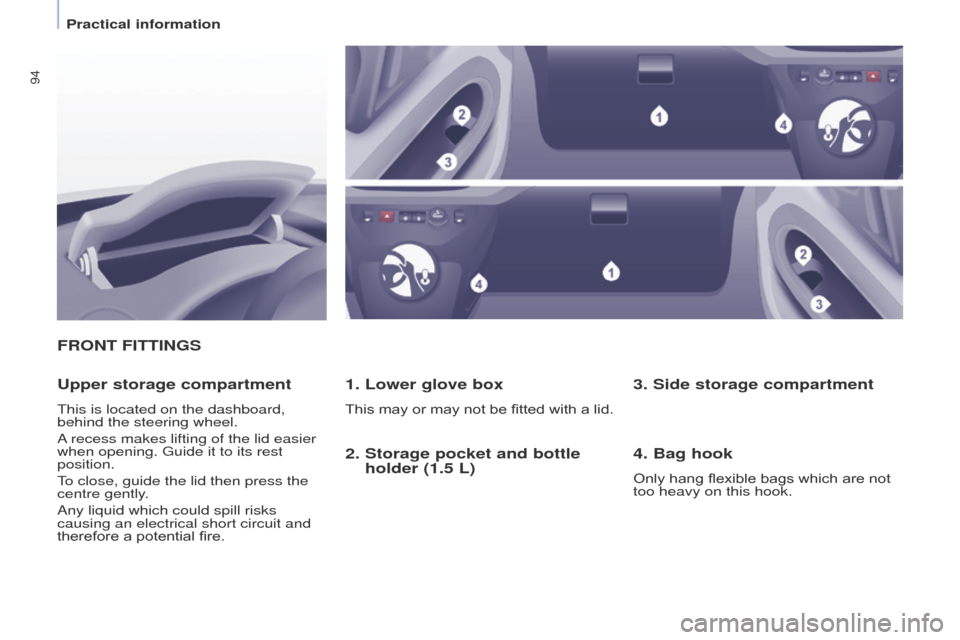
1. Lower glove box
This may or may not be fitted with a lid.
Upper storage compartment
This is located on the dashboard,
behind the steering wheel.
A recess makes lifting of the lid easier
when opening. Guide it to its rest
position.
To close, guide the lid then press the
centre gently.
Any liquid which could spill risks
causing an electrical short circuit and
therefore a potential fire.
3. Side storage compartment
4. Bag hook
Only hang flexible bags which are not
too heavy on this hook.
2. Storage pocket and bottle
holder (1.5 L)
Practical information
Page 103 of 292
101
Partner2VP_en_Chap04_Ergonomie_ed02-2016Partner2VP_en_Chap04_Ergonomie_ed02-2016
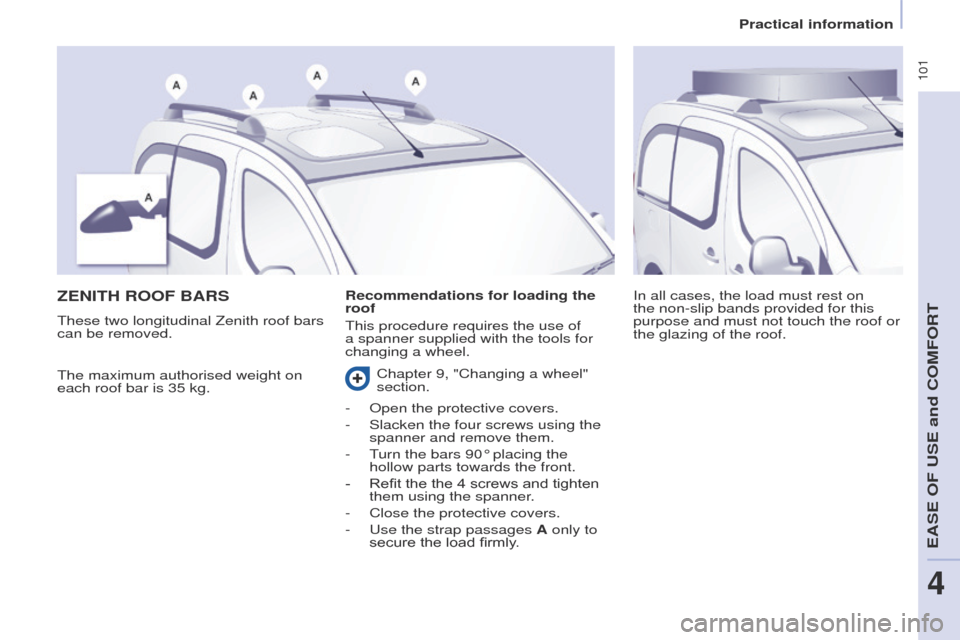
ZENITH ROOF BARS
The maximum authorised weight on
each roof bar is 35 kg.In all cases, the load must rest on
the non-slip bands provided for this
purpose and must not touch the roof or
the glazing of the roof.
Recommendations for loading the
roof
This procedure requires the use of
a spanner supplied with the tools for
changing a wheel.
These two longitudinal Zenith roof bars
can be removed.
Chapter 9, "Changing a wheel"
section.
-
Open the protective covers.
-
Slacken the four screws using the
spanner and remove them.
-
T
urn the bars 90° placing the
hollow parts towards the front.
-
Refit the the 4 screws and tighten
them using the spanner
.
-
Close the protective covers.
-
Use the strap passages
A only to
secure the load firmly.
EASE OF USE and COMFORT
4
Practical information
Page 116 of 292
11 4
Partner2VP_en_Chap05_Securite_ed02-2016
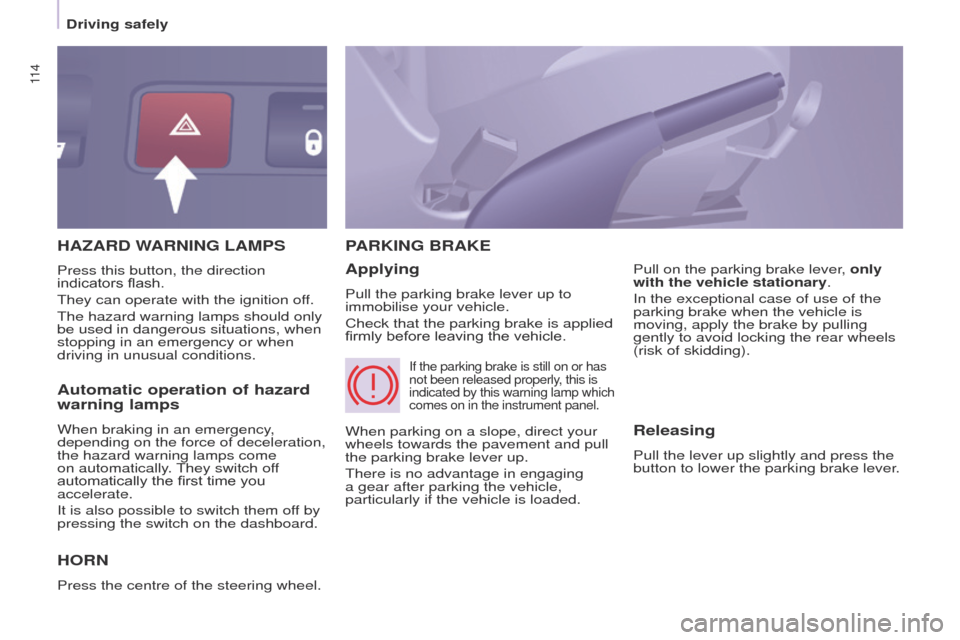
HAZARD WARNING LAMPS
H
ORN
Press the centre of the steering wheel.
PARKING BRAKE
Applying
Pull the parking brake lever up to
immobilise your vehicle.
Check that the parking brake is applied
firmly before leaving the vehicle. Pull on the parking brake lever, only
with the vehicle stationary.
In the exceptional case of use of the
parking brake when the vehicle is
moving, apply the brake by pulling
gently to avoid locking the rear wheels
(risk of skidding).
Press this button, the direction
indicators flash.
They can operate with the ignition off.
The hazard warning lamps should only
be used in dangerous situations, when
stopping in an emergency or when
driving in unusual conditions.
When parking on a slope, direct your
wheels towards the pavement and pull
the parking brake lever up.
There is no advantage in engaging
a gear after parking the vehicle,
particularly if the vehicle is loaded.
If the parking brake is still on or has
not been released properly, this is
indicated by this warning lamp which
comes on in the instrument panel.
Automatic operation of hazard
warning lamps
When braking in an emergency,
depending on the force of deceleration,
the hazard warning lamps come
on automatically. They switch off
automatically the first time you
accelerate.
It is also possible to switch them off by
pressing the switch on the dashboard.Releasing
Pull the lever up slightly and press the
button to lower the parking brake lever.
Driving safely
Page 120 of 292
ABS
ABS
11 8
Partner2VP_en_Chap05_Securite_ed02-2016
ANTI-LOCK BRAKING SYSTEM
(ABS / EBFD)
The ABS and EBFD (electronic brake
force distribution) systems improve the
stability and manoeuvrability of your
vehicle on braking, in particular on
poor or slippery surfaces.
The ABS prevents locking of the
wheels, the EBFD provides control of
the braking pressure wheel by wheel. If this warning lamp comes
on, accompanied by an
audible signal and a message
in the screen, it indicates a
malfunction of the ABS which
could result in a loss of control of the
vehicle on braking.
If this warning lamp comes
on, together with the brake
and STOP warning lamps,
accompanied by an audible
signal and a message in the
screen, it indicates a malfunction of
the electronic brake force distribution
which could result in a loss of control of
the vehicle on braking.
EMERGENCY BRAKING
ASSIST
ANCE (EBA)
In an emergency, this system enables
the optimum braking pressure to be
reached more quickly, press the pedal
firmly without releasing it.
It is triggered by the speed at which the
brake pedal is pressed down.
This alters the resistance of the brake
pedal under your foot.
To maintain operation of the
emergency braking assistance system:
keep your foot on the brake pedal.
Good practice
The anti-lock braking system comes
into operation automatically when
there is a risk of wheel lock. It does not
reduce the braking distance.
On very slippery surfaces (ice, oil,
etc...) the ABS may increase the
braking distance. When braking in
an emergency, do not hesitate to
press the brake pedal firmly, without
releasing the pressure, even on a
slippery surface, you will then be able
to continue to manoeuvre the vehicle
to avoid an obstacle.
Normal operation of the ABS may be
felt by slight vibration of the brake
pedal.
When changing wheels (tyres and
rims), ensure that these are listed by
PEUGEOT for the vehicle. Stop as soon as it is safe to do so.
In both cases, contact a PEUGEOT
dealer or a qualified workshop.
Driving safely
Page 121 of 292
11 9
Partner2VP_en_Chap05_Securite_ed02-2016
ANTI-SLIP REGULATION (ASR)
AND
DYNAMIC STABILITY
CONTROL (DSC)
These systems are linked and
complement the ABS.
The ASR system is very useful for
maintaining optimum drive and
avoiding losses of control of the vehicle
on acceleration.
The system optimises drive to prevent
the wheels skidding, by acting on the
brakes of the drive wheels and on the
engine. It also allows the directional
stability of the vehicle to be improved
on acceleration.
Use the DSC to hold your course
without attempting to countersteer.
If there is a variation between the
trajectory followed by the vehicle and
that required by the driver, the DSC
system automatically acts on the
engine and the brake of one or more
wheels, in order to put the vehicle back
on course.
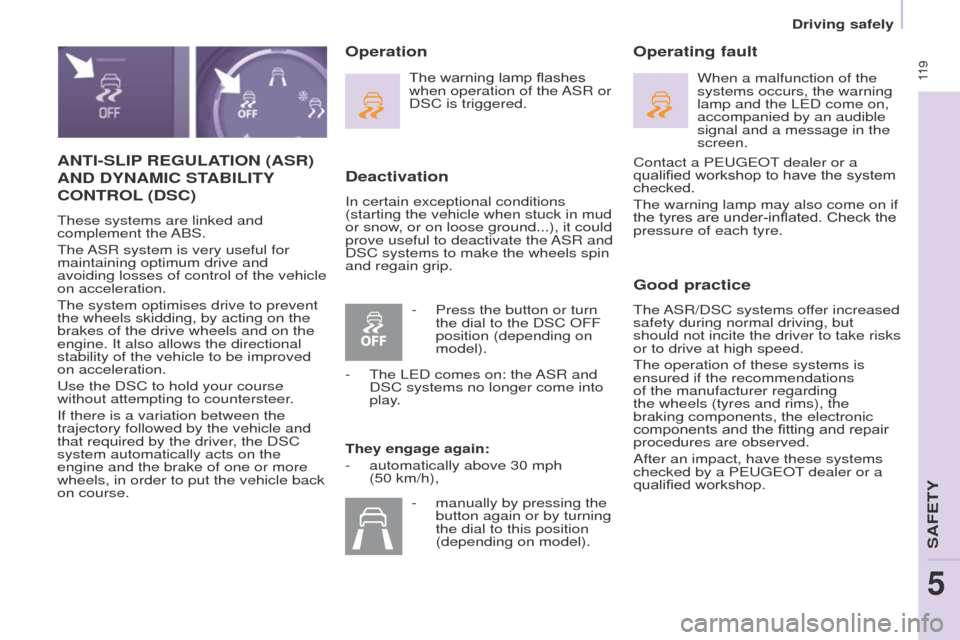
Deactivation
In certain exceptional conditions
(starting the vehicle when stuck in mud
or snow, or on loose ground...), it could
prove useful to deactivate the ASR and
DSC systems to make the wheels spin
and regain grip.
Operating fault
Good practice
The ASR/DSC systems offer increased
safety during normal driving, but
should not incite the driver to take risks
or to drive at high speed.
The operation of these systems is
ensured if the recommendations
of the manufacturer regarding
the wheels (tyres and rims), the
braking components, the electronic
components and the fitting and repair
procedures are observed.
After an impact, have these systems
checked by a PEUGEOT dealer or a
qualified workshop.
Operation
The warning lamp flashes
when operation of the ASR or
DSC is triggered.
They engage again:
-
automatically above 30 mph
(50 km/h), When a malfunction of the
systems occurs, the warning
lamp and the LED come on,
accompanied by an audible
signal and a message in the
screen.
-
Press the button or turn
the dial to the DSC OFF
position (depending on
model).
-
The LED comes on: the
ASR and
DSC systems no longer come into
play.
-
manually by pressing the
button again or by turning
the dial to this position
(depending on model). Contact a PEUGEOT
dealer or a
qualified workshop to have the system
checked.
The warning lamp may also come on if
the tyres are under-inflated. Check the
pressure of each tyre.
Driving safely
SAFETY
5
Page 123 of 292
121
Partner2VP_en_Chap05_Securite_ed02-2016
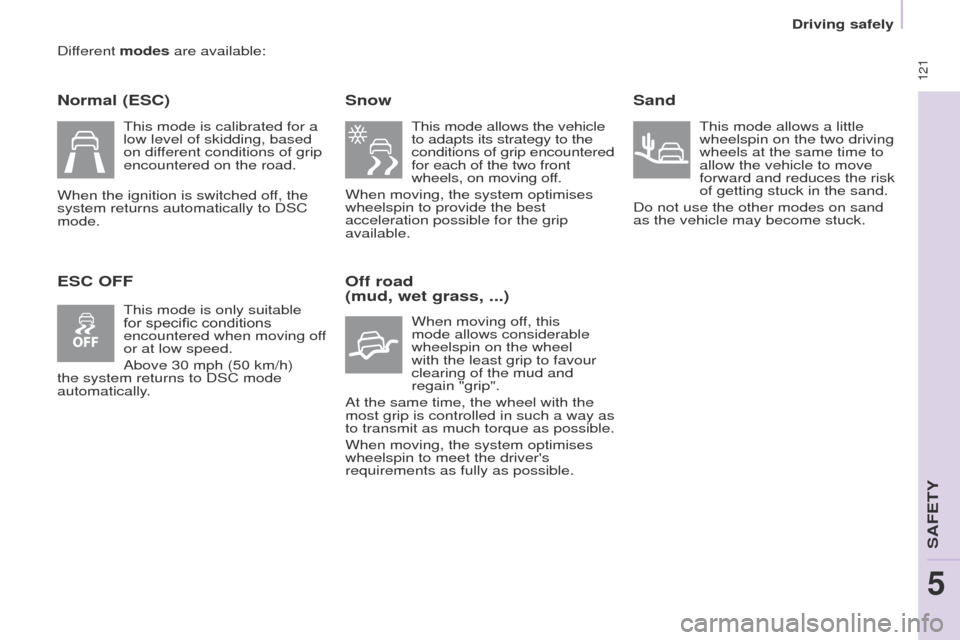
Different modes are available:
Normal (ESC)
ESC OFFSnow
This mode allows the vehicle
to adapts its strategy to the
conditions of grip encountered
for each of the two
front
wheels, on moving off.
When moving, the system optimises
wheelspin to provide the best
acceleration possible for the grip
available.
Off road
(mud, wet grass, ...)
When moving off, this
mode allows considerable
wheelspin on the wheel
with the least grip to favour
clearing of the mud and
regain "grip".
At the same time, the wheel with the
most grip is controlled in such a way as
to transmit as much torque as possible.
When moving, the system optimises
wheelspin to meet the driver's
requirements as fully as possible.
Sand
This mode allows a little
wheelspin on the two driving
wheels at the same time to
allow the vehicle to move
forward and reduces the risk
of getting stuck in the sand.
Do not use the other modes on sand
as the vehicle may become stuck.
This mode is calibrated for a
low level of skidding, based
on different conditions of grip
encountered on the road.
When the ignition is switched off, the
system returns automatically to DSC
mode.
This mode is only suitable
for specific conditions
encountered when moving off
or at low speed.
Above 30 mph (50 km/h)
the system returns to DSC mode
automatically.
Driving safely
SAFETY
5
Page 125 of 292
123
Partner2VP_en_Chap05_Securite_ed02-2016
Operation
When your vehicle is too close to or
approaches the vehicle ahead too
quickly the system automatically
applies the brakes to avoid a collision.
You are then alerted by the display of a
message.
The brake lamps on your vehicle come
on to warn other road users.
The collision can be avoided
automatically if the difference in
speed between your vehicle and the
vehicle ahead does not exceed 9 mph
(15 km/h).
Above this threshold, the system will
do what is possible to avoid or reduce
the accident by lowering the speed of
impact.
The automatic braking may bring
the vehicle to a complete stop if the
situation requires it.
In this case, the vehicle is held
stationary temporarily (for about
1.5
seconds) to allow the driver to take
back control by pressing the brake
pedal. The triggering of the system may
cause the engine to stall, unless
the driver depresses the clutch
pedal quickly enough during automatic
braking.
During automatic braking, the
driver can always obtain a higher
rate of deceleration than that
controlled by the system, by pressing
firmly on the brake pedal.
After an impact, the system is
automatically put out of service:
it
no longer operates.
You must go to a PEUGEOT dealer
or a qualified workshop to have the
system made operational again.
Operating limits
The system only detects vehicles that
are stationary or moving in the same
direction as your vehicle.
It does not detect small vehicles
(bicycles, motorcycles),
pedestrians or animals, nor non-
reflective stationary objects.
The system is not triggered or is
interrupted if the driver:
-
accelerates strongly
-
or turns the steering wheel
suddenly (avoiding manoeuvre). In difficult weather conditions (very
heavy rain, snow
, fog, hail...),
braking distances increase, which
can reduce the ability of the system to
avoid a collision.
The driver must therefore remain
particularly vigilant.
Never leave accumulations of
snow or any object projecting
above the bonnet or in front of
the roof: this might fall into the field of
vision of the sensor and generate a
detection.
Driving safely
SAFETY
5
Page 132 of 292
130
Partner2VP_en_Chap05_Securite_ed02-2016
130
Partner2VP_en_Chap05_Securite_ed02-2016
Advice
Sit in a normal upright position.
Wear a correctly adjusted seat belt.
Do not allow anything to come between
the occupants and the airbags
(a child, pet, object...), do not attach or
fix anything near to the airbags or their
trajectories when inflating as this could
cause injuries when the airbags are
deployed.
Never modify the original definition of
your vehicle, particularly in the area
directly around the airbags.
After an accident or if the vehicle has
been stolen or broken into, have the
airbag systems checked.
All work on the airbag system must be
carried out by a PEUGEOT dealer or a
qualified workshop.
Even if all of the precautions
mentioned are observed, a risk of
injury or of minor burns to the head,
chest or arms when an airbag is
deployed cannot be ruled out. The bag
inflates almost instantly (within a few
milliseconds) then deflates within the
same time discharging the hot gas via
openings provided for this purpose.Front airbags
Do not drive holding the steering wheel
by its spokes or resting your hands on
the centre part of the wheel.
Passengers must not place their feet
on the dashboard.
Do not smoke as deployment of the
airbags can cause burns or the risk of
injury from a cigarette or pipe.
Never remove or pierce the steering
wheel or hit it violently.
Do not fit or attach anything to the
steering wheel or dashboard, this could
cause injuries with deployment of the
airbags.
Lateral airbags
Use only approved covers on the
seats, compatible with the deployment
the lateral airbags. For information
on the range of seat covers suitable
for your vehicle, you can contact a
PEUGEOT
dealer.
For more information on accessories,
refer to "Other accessories" in section 6.
Do not fix or attach anything to the seat
backs (clothing...). This could cause
injury to the chest or arms if the lateral
airbag is deployed.
Do not sit with the upper part of the
body any nearer to the door than
necessary.
Airbags only operate when the
ignition is switched on.
This equipment only operates once.
If a second impact occurs (during the
same or a subsequent accident), the
airbag will not operate.
The deployment of an airbag or airbags
is accompanied by a slight discharge
of smoke and a noise, due to the
activation of the pyrotechnic cartridge
incorporated in the system.
This smoke is not harmful, but
sensitive individuals may experience
some irritation.
The noise of the detonation may result
in a slight loss of hearing for a short
time.
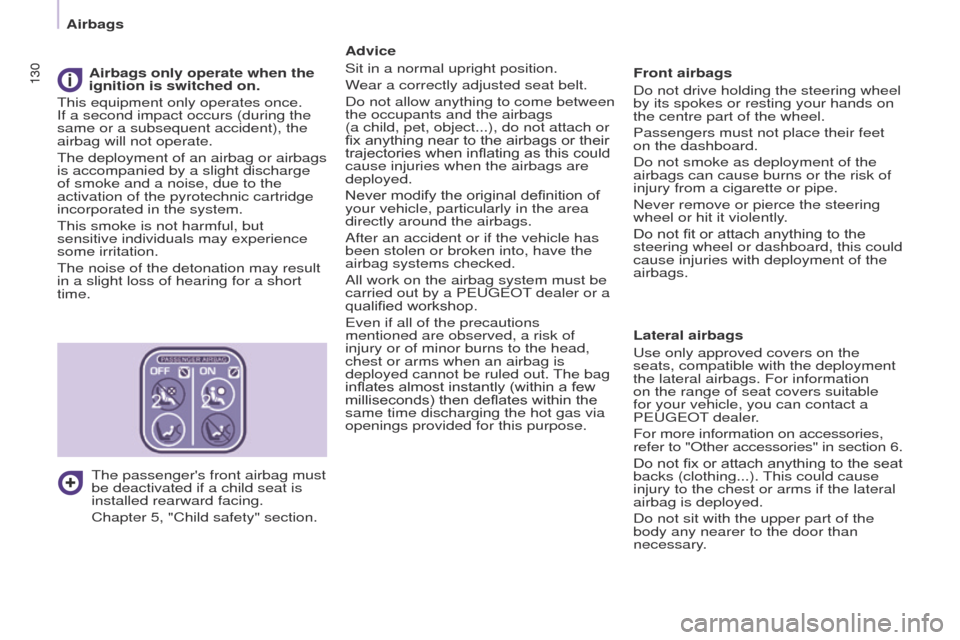
The passenger's front airbag must
be deactivated if a child seat is
installed rearward facing.
Chapter 5, "Child safety" section.
Airbags