air conditioning PEUGEOT PARTNER TEPEE 2020 Owners Manual
[x] Cancel search | Manufacturer: PEUGEOT, Model Year: 2020, Model line: PARTNER TEPEE, Model: PEUGEOT PARTNER TEPEE 2020Pages: 216, PDF Size: 8.46 MB
Page 4 of 216
2
.
.
Instrument panel 7
W arning and indicator lamps 8
I
ndic ators
18
Lighting dimmer
2
2
Trip computer
2
2
Date and time setting
2
3
Instruments and controls
4
K
ey
25
Remote control
2
5
Front doors
2
8
Sliding side door(s)
2
8
Operation in the event of a battery failure
2
9
Tailgate
29
Side-hinged rear doors
3
0
Rear roof flap
3
2
Central locking
3
3
Alarm
34
Rear windows
3
5
Electric windows
3
5Steering wheel adjustment
3
7
Mirrors
37
Surveillance mirror
3
8
Front seats
3
8
Individual passenger seat
4
0
Multi-Flex bench seat
4
0
Rear bench seat
4
2
Rear seats (5 seats) 4 3
Rear seats (7 seats) 4 6
Crew cab
5
0
Seat modularity and configurations
5
2
Front fittings
5
4
Seating area fittings
5
5
Zenith
56
Fragrance diffuser
5
7
Courtesy lamps
5
9
Rear fittings (5 seats)
6
0
Rear fittings (7 seats)
6
1
Load space layout
6
4
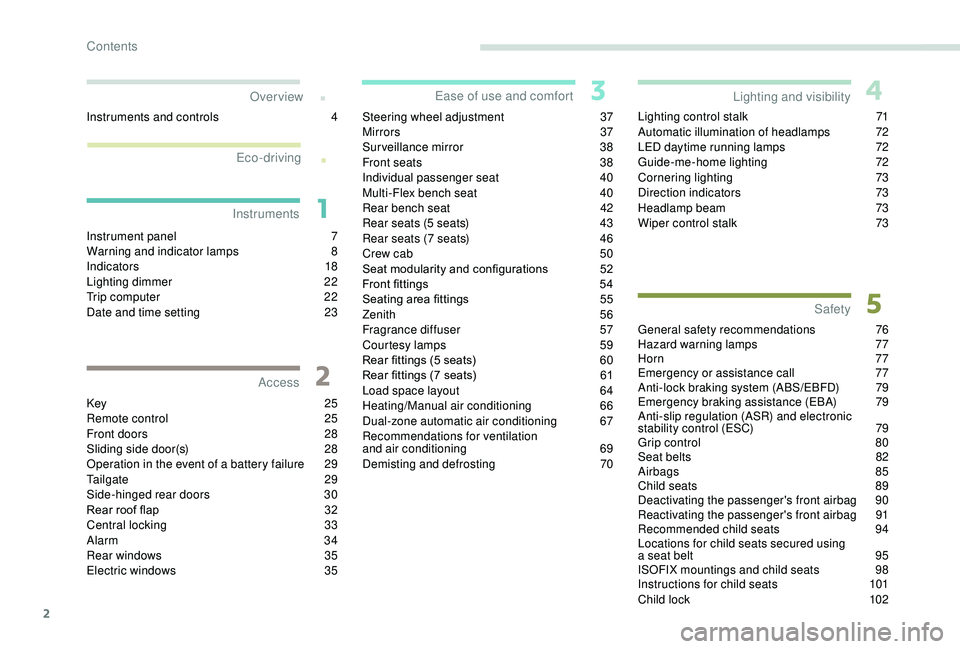
Heating/Manual air conditioning
6
6
Dual-zone automatic air conditioning
6
7
Recommendations for ventilation
and air conditioning
6
9
Demisting and defrosting
7
0Lighting control stalk
7
1
Automatic illumination of headlamps
7
2
LED daytime running lamps
7
2
Guide-me-home lighting
7
2
Cornering lighting
7
3
Direction indicators
7
3
Headlamp beam
7
3
Wiper control stalk 7 3
General safety recommendations
7
6
Hazard warning lamps
7
7
Horn
77
Emergency or assistance call
7
7
Anti-lock braking system (ABS/EBFD)
7
9
Emergency braking assistance (EBA)
7
9
Anti-slip regulation (ASR) and electronic
stability control (ESC)
7
9
Grip control
8
0
Seat belts
8
2
Airbags
85
Child seats
8
9
Deactivating the passenger's front airbag
9
0
Reactivating the passenger's front airbag
9
1
Recommended child seats
9
4
Locations for child seats secured using
a seat belt
9
5
ISOFIX mountings and child seats
9
8
Instructions for child seats
1
01
Child lock
1
02
Over view
Instruments
Access Ease of use and comfort
Safety
Lighting and visibility
Eco-driving
Contents
Page 7 of 216
5
As a passenger, if you avoid connecting your
multimedia devices (film, music, video game,
etc.), you will contribute towards limiting
the consumption of electrical energy and
therefore of fuel.
Disconnect your portable devices before
leaving the vehicle.
Eco- driving
Eco-driving is a range of everyday practices that allow the motorist to optimise their fuel consumption and CO2 emissions.
Optimise the use of your
gearbox
With a manual gearbox, move off gently and
change up without waiting. While accelerating,
change up early.
With an automatic gearbox, give preference
to automatic mode and avoid pressing the
accelerator pedal heavily or suddenly.
The gear shift indicator invites you to engage
the most suitable gear: as soon as the
indication is displayed in the instrument panel,
follow it straight away.
For vehicles fitted with an automatic gearbox,
this indicator appears only in manual mode.
Drive smoothly
Maintain a safe distance between vehicles,
use engine braking rather than the brake
pedal and press the accelerator gradually.
These practices contribute towards a
reduction in fuel consumption and CO
2
emissions and also help to reduce the
background traffic noise.
If your vehicle has cruise control, make use of
the system at speeds above 25
mph (40 km/h)
when the traffic is flowing well.
Control the use of your electrical
equipment
Before moving off, if the passenger
compartment is too warm, ventilate it by opening
the windows and air vents before using the air
conditioning.
Above 31
mph (50 km/h), close the windows and
open the air vents.
Consider using equipment that can help keep
the temperature in the passenger compartment
down (sunroof blind and window blinds, etc.).
Switch off the headlamps and foglamps when
there is sufficient visibility without them.
Avoid running the engine before moving off,
particularly in winter; your vehicle will warm up
much faster while driving.
Unless it has automatic regulation, switch off
the air conditioning as soon as the desired
temperature has been reached.
Switch off the demisting and defrosting controls,
if these are not automatically managed.
Switch off the heated seat as soon as possible.
.
.
Eco-drivingsommaire
Page 68 of 216
66
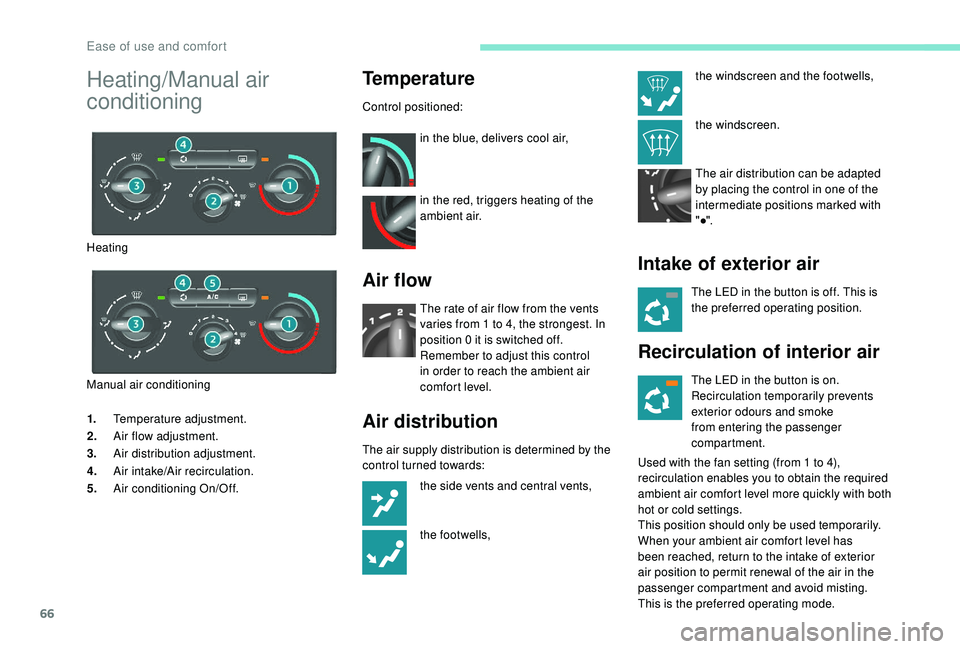
1.Temperature adjustment.
2. Air flow adjustment.
3. Air distribution adjustment.
4. Air intake/Air recirculation.
5. Air conditioning On/Off.
Temperature
Control positioned:
in the blue, delivers cool air,
in the red, triggers heating of the
ambient air.
Air flow
The rate of air flow from the vents
varies from 1 to 4, the strongest. In
position 0 it is switched off.
Remember to adjust this control
in order to reach the ambient air
comfort level.
Air distribution
The air supply distribution is determined by the
control turned towards: the side vents and central vents,
the footwells,
Intake of exterior air
The LED in the button is off. This is
the preferred operating position.
Recirculation of interior air
The LED in the button is on.
Recirculation temporarily prevents
exterior odours and smoke
from entering the passenger
compartment.
Used with the fan setting (from 1 to 4),
recirculation enables you to obtain the required
ambient air comfort level more quickly with both
hot or cold settings.
This position should only be used temporarily.
When your ambient air comfort level has
been reached, return to the intake of exterior
air position to permit renewal of the air in the
passenger compartment and avoid misting.
This is the preferred operating mode.
Heating/Manual air
conditioning
Heating
Manual air conditioning the windscreen and the footwells,
the windscreen.
The air distribution can be adapted
by placing the control in one of the
intermediate positions marked with
"●".
Ease of use and comfort
Page 69 of 216
67
Air conditioning A/C
The air conditioning only works with the engine
running.Pressing the button switches the air
conditioning on; the LED comes on.
Pressing the button again switches
the function off; the LED goes off.
The air conditioning cannot operate when the
air flow is set to 0.
Dual-zone automatic air
conditioning
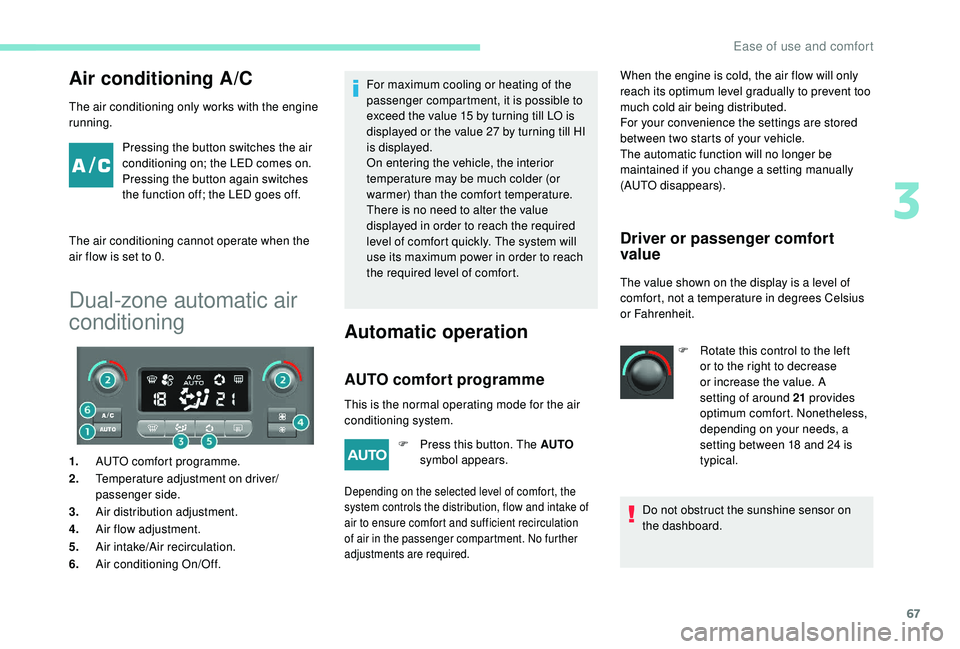
1. AUTO comfort programme.
2. Temperature adjustment on driver/
passenger side.
3. Air distribution adjustment.
4. Air flow adjustment.
5. Air intake/Air recirculation.
6. Air conditioning On/Off. For maximum cooling or heating of the
passenger compartment, it is possible to
exceed the value 15 by turning till LO is
displayed or the value 27 by turning till HI
is displayed.
On entering the vehicle, the interior
temperature may be much colder (or
warmer) than the comfort temperature.
There is no need to alter the value
displayed in order to reach the required
level of comfort quickly. The system will
use its maximum power in order to reach
the required level of comfort.
Automatic operation
AUTO comfort programme
Driver or passenger comfort
value
The value shown on the display is a level of
comfort, not a temperature in degrees Celsius
or Fahrenheit.
This is the normal operating mode for the air
conditioning system. F
P
ress this button. The AUTO
symbol appears. When the engine is cold, the air flow will only
reach its optimum level gradually to prevent too
much cold air being distributed.
For your convenience the settings are stored
between two starts of your vehicle.
The automatic function will no longer be
maintained if you change a setting manually
(AUTO disappears).
Depending on the selected level of comfort, the
system controls the distribution, flow and intake of
air to ensure comfort and sufficient recirculation
of air in the passenger compartment. No further
adjustments are required.
F Rotate this control to the left
or to the right to decrease
or increase the value. A
setting of around 21 provides
optimum comfort. Nonetheless,
depending on your needs, a
setting between 18 and 24 is
typical.
Do not obstruct the sunshine sensor on
the dashboard.
3
Ease of use and comfort
Page 70 of 216
68
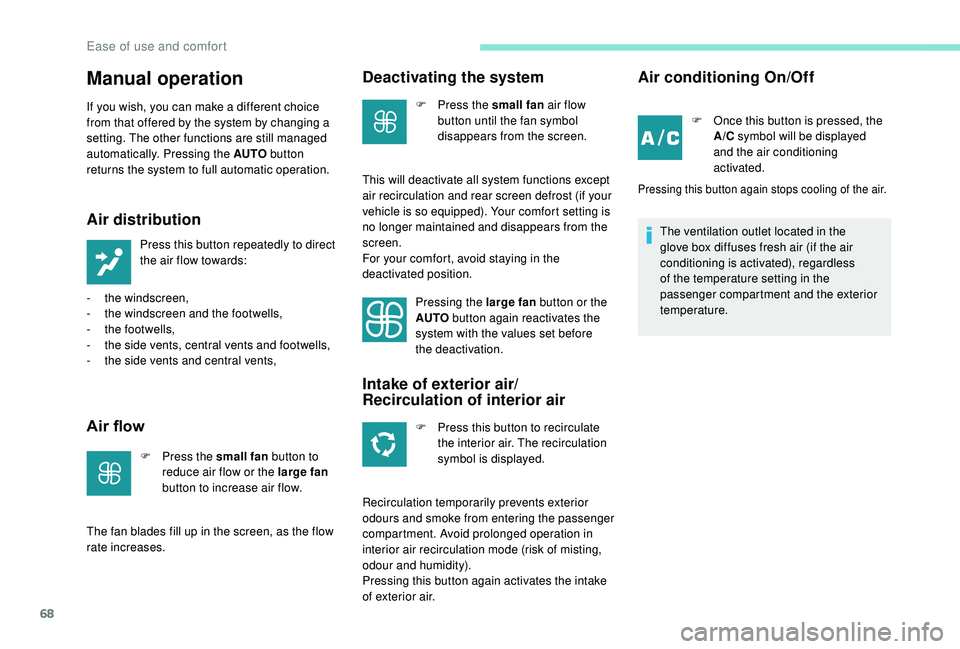
Manual operation
If you wish, you can make a different choice
from that offered by the system by changing a
setting. The other functions are still managed
automatically. Pressing the AUTO button
returns the system to full automatic operation.
Air distribution
Press this button repeatedly to direct
the air flow towards:
-
t
he windscreen,
-
t
he windscreen and the footwells,
-
t
he footwells,
-
t
he side vents, central vents and footwells,
-
t
he side vents and central vents,
Air flow
F Press the small fan button to
reduce air flow or the large fan
button to increase air flow.
The fan blades fill up in the screen, as the flow
rate increases.
Deactivating the system
F Press the small fan air flow
button until the fan symbol
disappears from the screen.
This will deactivate all system functions except
air recirculation and rear screen defrost (if your
vehicle is so equipped). Your comfort setting is
no longer maintained and disappears from the
screen.
For your comfort, avoid staying in the
deactivated position. Pressing the large fan button or the
AUTO button again reactivates the
system with the values set before
the deactivation.
Intake of exterior air/
Recirculation of interior air
F Press this button to recirculate the interior air. The recirculation
symbol is displayed.
Recirculation temporarily prevents exterior
odours and smoke from entering the passenger
compartment. Avoid prolonged operation in
interior air recirculation mode (risk of misting,
odour and humidity).
Pressing this button again activates the intake
of exterior air.
Air conditioning On/Off
F Once this button is pressed, the A/C symbol will be displayed
and the air conditioning
activated.
Pressing this button again stops cooling of the air.
The ventilation outlet located in the
glove box diffuses fresh air (if the air
conditioning is activated), regardless
of the temperature setting in the
passenger compartment and the exterior
temperature.
Ease of use and comfort
Page 71 of 216
69
Recommendations for ventilation and air conditioning
In order for these systems to be fully effective,
follow the operation and maintenance
guidelines below:
F
T
o ensure that the air is distributed evenly,
keep the external air intake grilles at the
base of the windscreen, the nozzles, the
vents, the air outlets and the air extractor
in the boot free from obstructions.
F
D
o not cover the sunshine sensor,
located on the dashboard; this is used for
regulation of the automatic air conditioning
system.
F
O
perate the air conditioning system for
at least 5 to 10
minutes once or twice a
month to keep it in per fect working order.
F
E
nsure that the passenger compartment
filter is in good condition and have the
filter elements replaced regularly. We
recommend the use of a combined
passenger compartment filter. Thanks to
its special active additive, it contributes
to the purification of the air breathed by
the occupants and the cleanliness of the
passenger compartment (reduction of
allergic symptoms, bad odours and greasy
deposits). If after an extended stop in sunshine, the
interior temperature is very high, first air
the passenger compartment for a few
moments.
Put the air flow control at a setting high
enough to quickly change the air in the
passenger compartment.
The condensation created by the air
conditioning results in a discharge of water
under the vehicle which is per fectly normal.
Depending on version and country
of sale, the air conditioning system
contains fluorinated greenhouse gas
R13 4A
.
Gas capacity: 0.450
kg (+/- 0.025 kg),
GWP index 1,430 t (equivalent CO
2:
0.6 4 4 t).
F
T
o ensure correct operation of the
air conditioning system, you are also
advised to have it checked regularly
as recommended in the Warranty and
Maintenance Record.
F
I
f the system does not produce cold air,
switch it off and contact a PEUGEOT
dealer or a qualified workshop.
When towing the maximum load on a steep
gradient in high temperatures, switching off
the air conditioning increases the available
engine power and so improves the towing
ability.
To avoid the windows misting up and
deterioration in the quality of the air:
-
d
o not drive for too long with the
ventilation switched off.
-
d
o not keep air recirculation set for an
extended period.
Stop & Star t
The heating and air conditioning systems
only work when the engine is running.
Temporarily deactivate the Stop &
Start system to maintain a comfortable
temperature in the passenger
compartment.
For more information on Stop & Star t,
refer to the corresponding section.
3
Ease of use and comfort
Page 72 of 216
70
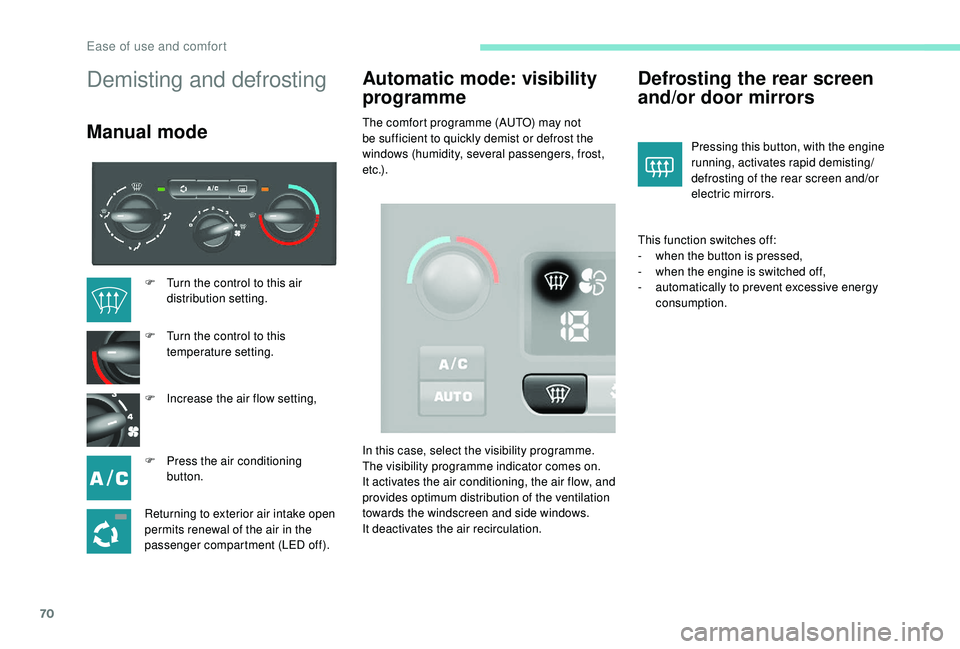
Demisting and defrosting
Manual modeAutomatic mode: visibility
programmeThe comfort programme (AUTO) may not
be sufficient to quickly demist or defrost the
windows (humidity, several passengers, frost,
e t c .) .
Defrosting the rear screen
and/or door mirrors
Pressing this button, with the engine
running, activates rapid demisting/
defrosting of the rear screen and/or
electric mirrors.
This function switches off:
-
w
hen the button is pressed,
-
w
hen the engine is switched off,
-
a
utomatically to prevent excessive energy
consumption.
F
T
urn the control to this air
distribution setting.
F
T
urn the control to this
temperature setting.
F
I
ncrease the air flow setting,
F
P
ress the air conditioning
button.
Returning to exterior air intake open
permits renewal of the air in the
passenger compartment (LED off). In this case, select the visibility programme.
The visibility programme indicator comes on.
It activates the air conditioning, the air flow, and
provides optimum distribution of the ventilation
towards the windscreen and side windows.
It deactivates the air recirculation.
Ease of use and comfort
Page 106 of 216
104
In some cases of particularly demanding use
(when towing the maximum load on a steep
gradient in high temperatures), the engine
power is automatically limited. In such a case,
the air conditioning is automatically switched
off to increase the available engine power.F
I
f this warning lamp and the
STOP warning lamp come on,
stop the vehicle and switch off
the engine as soon as possible.
New vehicle
Do not pull a trailer before having driven at
least 620
miles (1,000 kilometres).
Braking
Towing a trailer increases the braking distance.
To avoid overheating of the brakes, the use of
engine braking is recommended.
Ty r e s
F Check the tyre pressures of the towing vehicle and of the trailer, observing the
recommended pressures.
Lighting
F Check the electrical lighting and signalling on the trailer and the headlamp beam height
of your vehicle. For more information on adjusting
the Headlamp beam
, refer to the
corresponding section.
The rear parking sensors will be
deactivated automatically to avoid the
audible signal if a genuine PEUGEOT
towbar is used.
Starting and stopping
Running and accessories position.
To unlock the steering, turn the steering wheel
gently while turning the key, without forcing. In
this position, certain accessories can be used. Starting position.
The starter is operated. the engine turns over,
release the key.
STOP position
: anti-theft.
The ignition is off. Turn the steering wheel until
the steering column locks. Remove the key.
If this warning lamp comes on, a door
or the bonnet is not closed correctly.
Please check!Diesel engines
If the temperature is high enough,
the warning lamp comes on for
less than a second, you can start
without waiting.
In cold weather, wait for this warning lamp to go
off then operate the starter (starting position)
until the engine starts.
When switching off the ignition, let the
engine run for a few seconds to allow the
turbocharger (Diesel engine) to return to
idle.
Do not press the accelerator when
switching off the ignition.
There is no need to engage a gear after
parking the vehicle.
Driving
Page 141 of 216
139
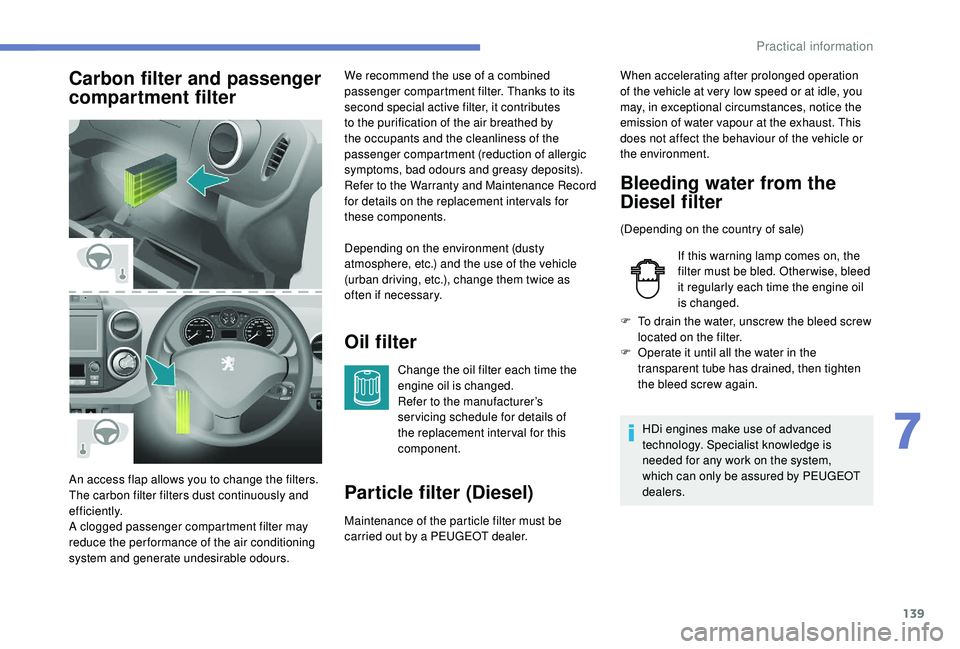
Carbon filter and passenger
compartment filterOil filter
Change the oil filter each time the
engine oil is changed.
Refer to the manufacturer’s
ser vicing schedule for details of
the replacement inter val for this
component.
Particle filter (Diesel)
Maintenance of the particle filter must be
carried out by a PEUGEOT dealer.
An access flap allows you to change the filters.
The carbon filter filters dust continuously and
ef f i c i e nt l y.
A clogged passenger compartment filter may
reduce the per formance of the air conditioning
system and generate undesirable odours. We recommend the use of a combined
passenger compartment filter. Thanks to its
second special active filter, it contributes
to the purification of the air breathed by
the occupants and the cleanliness of the
passenger compartment (reduction of allergic
symptoms, bad odours and greasy deposits).
Refer to the Warranty and Maintenance Record
for details on the replacement inter vals for
these components.
Depending on the environment (dusty
atmosphere, etc.) and the use of the vehicle
(urban driving, etc.), change them twice as
often if necessary.
Bleeding water from the
Diesel filter
(Depending on the country of sale)
If this warning lamp comes on, the
filter must be bled. Other wise, bleed
it regularly each time the engine oil
is changed.
F
T
o drain the water, unscrew the bleed screw
located on the filter.
F
O
perate it until all the water in the
transparent tube has drained, then tighten
the bleed screw again.
HDi engines make use of advanced
technology. Specialist knowledge is
needed for any work on the system,
which can only be assured by PEUGEOT
dealers.
When accelerating after prolonged operation
of the vehicle at very low speed or at idle, you
may, in exceptional circumstances, notice the
emission of water vapour at the exhaust. This
does not affect the behaviour of the vehicle or
the environment.
7
Practical information
Page 157 of 216
155
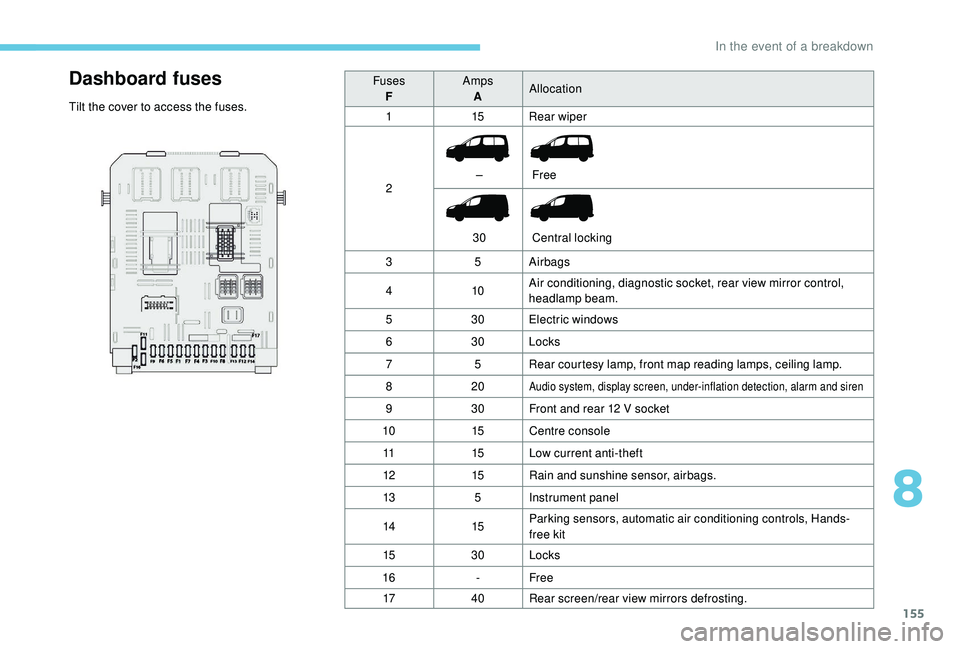
Dashboard fuses
Tilt the cover to access the fuses.Fuses
F Amps
A Allocation
1 15Rear wiper
2 –
30 Free
Central locking
3 5Airbags
4 10Air conditioning, diagnostic socket, rear view mirror control,
headlamp beam.
5 30Electric windows
6 30Locks
7 5Rear courtesy lamp, front map reading lamps, ceiling lamp.
8 20
Audio system, display screen, under-inflation detection, alarm and siren
930Front and rear 12 V socket
10 15Centre console
11 15Low current anti-theft
12 15Rain and sunshine sensor, airbags.
13 5Instrument panel
14 15Parking sensors, automatic air conditioning controls, Hands-
free kit
15 30Locks
16 -Free
17 40Rear screen/rear view mirrors defrosting.
8
In the event of a breakdown