check engine light PONTIAC BONNEVILLE 1993 User Guide
[x] Cancel search | Manufacturer: PONTIAC, Model Year: 1993, Model line: BONNEVILLE, Model: PONTIAC BONNEVILLE 1993Pages: 322, PDF Size: 16.31 MB
Page 112 of 322
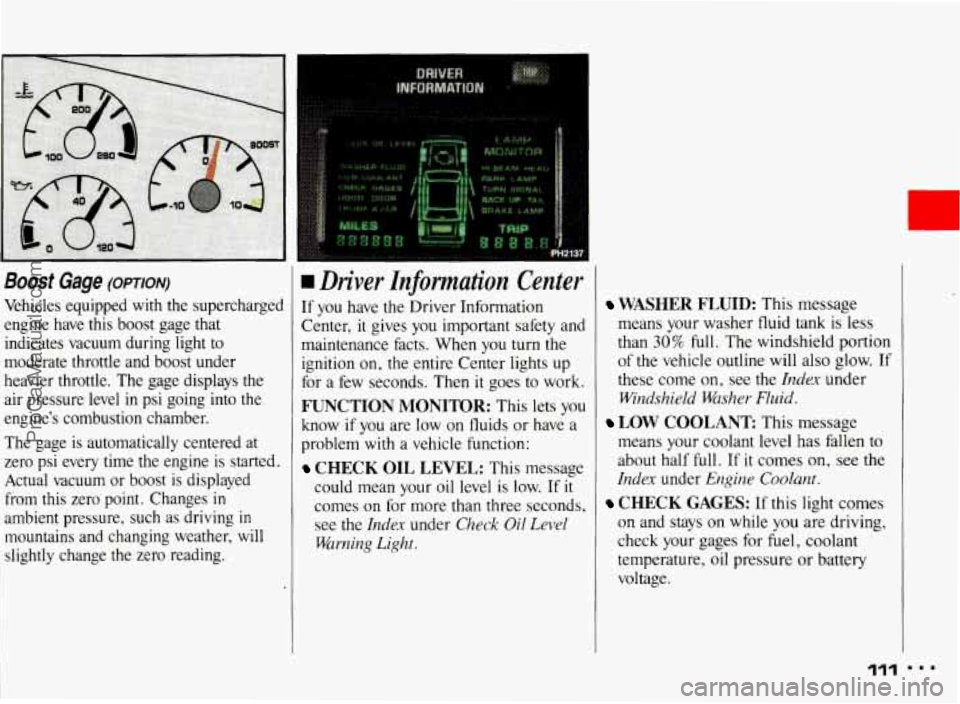
Boost Gage (OPTION)
Vehicles equipped with the supercharged
engine have this boost gage that indicates vacuum during light to
moderate throttle and boost under
heavier throttle. The gage displays the
air pressure level
in psi going into the
engine’s combustion chamber.
The gage is automatically centered at
zero psi
every time the engine is started.
Actual vacuum or boost
is displayed
from this zero point. Changes
in
ambient pressure, such as driving in
mountains and changing weather, will slightly change
the zero reading.
I
rn Driver Znformation Center
If you have the Driver Information
Center, it gives you important safety and
maintenance facts. When you turn the ignition on, the entire Center lights up
for a few seconds. Then it goes to work.
FUNCTION MONITOR: This lets you
know if you are low
on fluids or have a
problem with a vehicle function:
CHECK OIL LEVEL: This message
could mean your oil level is low. If
it
comes on for more than three seconds, see
the Index under Check Oil Level
Warning Light.
WASHER FLUID: This message
means your washer fluid tank is less
than
30% full. The windshield portion
of the vehicle outline will also glow. If
these come on, see the
Index under
Windshield Washer Fluid.
means your coolant level has fallen to
about half full. If it comes on,
see the
Index under Engine Coolant.
CHECK GAGES: If this light comes
on and stays on while
you are driving,
check your gages for fuel, coolant
temperature, oil pressure or battery
voltage.
LOW COOLANT This message
111
ProCarManuals.com
Page 175 of 322
Your Driving and the Road
Driving a Long Distance
Although most long trips today are
made on freeways, there are still many
made on regular highways.
Long-distance driving on freeways and
regular highways
is the same in some
ways. The trip has to be planned and the
vehicle prepared, you drive
at higher-
than-city speeds, and there are longer
turns behind the wheel. You’ll enjoy
your trip more if
you and your vehicle
are in good shape. Here are some tips
for a successful long trip.
174
Before Leaving on a Long Trip
Make sure you’re ready. Try to be well Here are some things you can check
rested. If you must start when you’re not
fresh-such as after a day’s work-don’t
plan to make too many miles that first
part of the journey. Wear comfortable
clothing and shoes you can easily drive
in.
Is your vehicle ready for a long trip? If
you keep it serviced and maintained, it’s
ready to go. If it needs service, have it
done before starting out.
Of course,
you’ll find experienced and able service
experts in Pontiac dealerships all across
North America. They’ll be ready and
willing to help if you need it. before
a trip:
Windshield Washer Fluid: Is the
reservoir full? Are all windows clean
inside and outside?
shape?
Have you checked all levels?
lenses clean?
safe, trouble-free trip.
Is the tread
good enough for long-distance
driving? Are the tires all inflated to
the recommended pressure?
weather outlook along your route?
Should you delay your trip a short
time to avoid a major storm system?
Maps: Do you have up-to-date maps?
Wiper Blades: Are they in good
Fuel, Engine Oil, Other Fluids:
Lights: Are they all working? Are the
Tires: They are vitally important to a
Weather Forecasts: What’s the
ProCarManuals.com
Page 176 of 322
3n the Road
Mess you are the only driver, it is
;ood to share the driving task with
Ithers. Limit turns behind the wheel to
ibout 100 miles
(160 km) or two hours
it a sitting. Then, either change drivers
x stop for some refreshment like coffee,
:ea or
soft drinks and some limbering
lp. But do stop and move around. Eat
lightly along the way. Heavier meals
:end to make some people sleepy.
3n two-lane highways or undivided
multilane highways that do not have
;ontrolled access, you’ll want to watch for some situations not usually found on
freeways. Examples are: stop signs and
signals, shopping centers with direct
access to the highway, no passing zones
and school zones, vehicles turning left
and right off the road, pedestrians,
cyclists, parked vehicles, and even
animals.
Highway Hypnosis
Is there actually such a condition as
“highway hypnosis”? Or is it just plain
falling asleep at the wheel? Call it
highway hypnosis, lack
of awareness, o
whatever.
There is something about an easy stretch
of road with the same scenery, along
with the hum of the tires on the road,
the drone of the engine, and the rush of
the wind against the vehicle that can
make you sleepy. Don’t
let it happen to
you! If it does, your vehicle can leave
the road in
less than a second, and you
could crash and be injured.
What can you do about highway
hypnosis? First, be aware that it can
happen.
Then here are some tips:
Mike sure your vehicle is well
ventilated, with a comfortably cool interior.
Keep your eyes moving. Scan the road
ahead and to the sides. Check your
rearview mirrors frequently and your
instruments from time to time. This
can help you avoid a fixed stare.
Wear good sunglasses in bright light.
Glare can cause drowsiness. But don’t
wear sunglasses at night. They will
drastically reduce your overall vision
at the very time you need all the
seeing power
you have.
If you get sleepy, pull off the road into
a rest, service, or parking area and
take a nap, get some exercise, or both.
For safety, treat drowsiness on the
highway as an emergency.
As in any driving situation, keep pace
with traffic and allow adequate
following distances.
ProCarManuals.com
Page 196 of 322
, Using a match near a battery
- b can cause battery gas to
explode. People have been hurt
doing this, and some have been
blinded. .Use a flashlight
if you
need more light.
Be sure the batteries have enough
water. You don’t need to add water
to the Delco Freedom@ battery installed in every new
GM vehicle.
But if a battery
has filler caps, be
sure the right amount
of fluid is
there. If
it is low, add water to take
care
of that first. If you don’t,
explosive gas could be present.
Battery fluid contains acid that can
burn you. Don’t get it
on you. If
you accidentally get it in your eyes
or on your skin, flush the place
with water and get medical help immediately.
5. Check that the jumper cables don’t
have loose or missin.g insulation.
If
they do, you could get a shock. The
vehicles could be damaged, too.
Before you connect the cables, here are
some things
you should know. Positive
(+) will go to positive (+) and negative
(-) will go to negative (-) or a metal
engine part. Don’t connect
(+) to (-) or
you’ll get a short that would damage the
battery and maybe other parts, too. Fans
or other moving engine
running.
ProCarManuals.com
Page 239 of 322
Service & Appearance Care
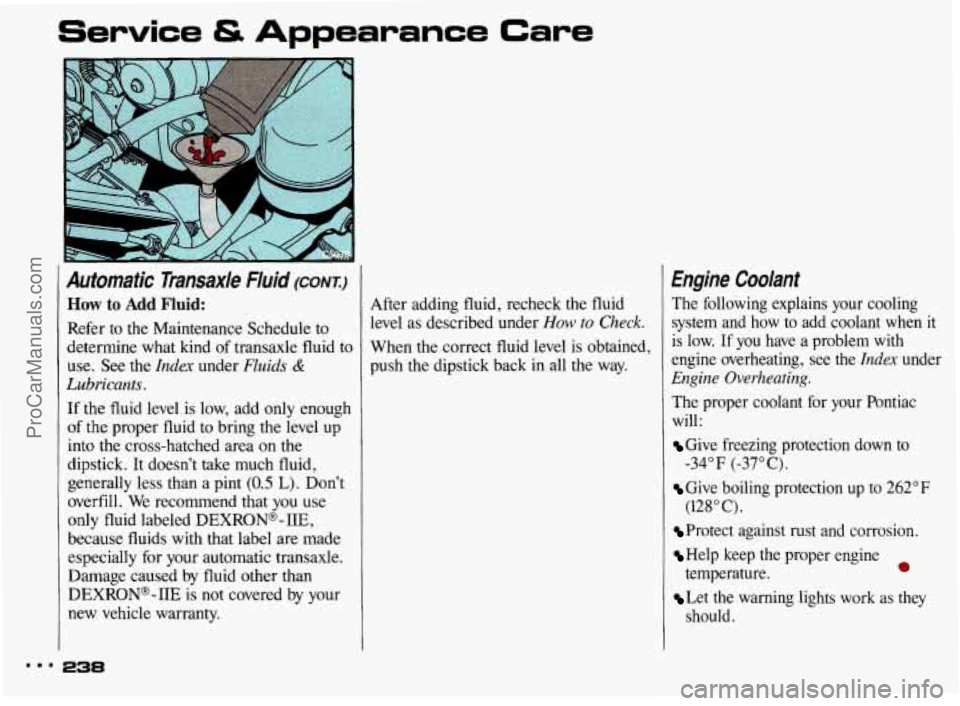
Automatic Transaxle Fluid (CONTJ
How to Add Fluid:
Refer to the Maintenance Schedule to
determine what kind
of transaxle fluid to
use. See the
Index under Fluids &
Lubricants.
If the fluid level is low, add only enough
of the proper fluid to bring
the level up
into the cross-hatched area on the
dipstick. It doesn't take much fluid,
generally less than a pint
(0.5 L). Don't
overfill. We recommend that you use
only fluid labeled DEXRON@-IIE,
because fluids with that label are made
especially for your automatic transaxle.
Damage caused by fluid other than
DEXRON@-IIE is not covered by your
new vehicle warranty. After adding
fluid, recheck the fluid
level as described under
How to Check.
When the correct fluid level is obtained,
push the dipstick back
in all the way.
Engine Coolant
The following explains your cooling
system and how to add coolant when
it
is low. If you have a problem with
engine overheating, see the Index under
Engine Overheating.
The proper coolant for your Pontiac
will:
Give freezing protection down to
Give boiling protection up to 262°F
Protect against rust and corrosion.
-34°F (-37°C).
(128" C).
Help keep the proper engine
temperature.
a
Let the warning lights work as they
should.
I.. 238
ProCarManuals.com
Page 241 of 322
Service & Appearance Care
A’
Adding Coolant
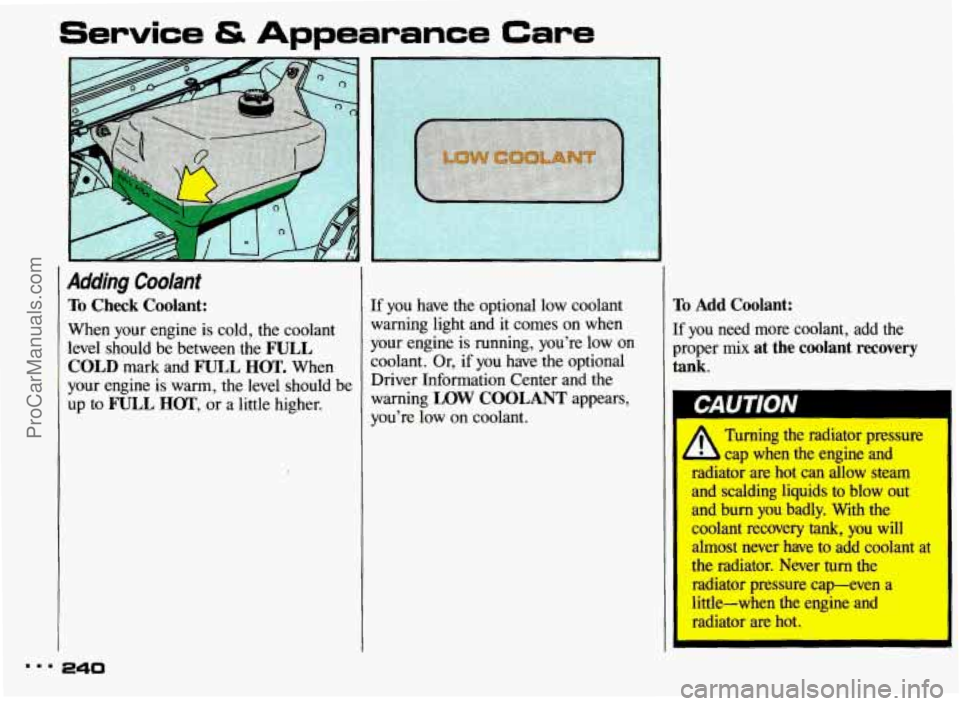
To Check Coolant:
When your engine is cold, the coolant
level should be between the
FULL
COLD mark and FULL HOT. When
your engine is warm, the level should be
up
to FULL HOT, or a little higher.
m.. 240
If you have the optional low coolant
warning light and it comes on when
your engine is running, you’re low on
coolant. Or, if you have the optional
Driver Information Center and the
warning
LOW COOLANT appears,
you’re low on coolant.
To Add Coolant:
If you need more coolant, add the
proper
mix at the coolant recovery
tank.
II Turning the radiator pressure 1
- 1 cap when the engine and
raalator are hot can allow steam
and scalding liquids to blow out
and bum
you badly. With the
coolant recovery
tank, you will
almost never have to add coolant at
the radiator. Never
turn the
radiator pressure cap-even a
little-when the engine and
radiator are hot.
ProCarManuals.com
Page 291 of 322

Maintenance Schedule
Section C: Periodic Maintenance Inspections
Listed below are inspections and services which should be performed at least twice a year (for instance\
, each spring and fall).
You should let your GM dealer’s service department
or other qualified service center do these jobs. Make sure any necessary
repairs are completed at once.
INSPECTION
OR SERVICE
Steering, Suspension
and Front-Wheel-Drive
Axle Boot and Seal
Inspection
Exhaust System Inspection
Throttle Linkage
Inspection
Brake System
Inspection
I
-
WHAT SHOULD BE DONE
Inspect the front and rear suspension and steering system for damaged, loose or missing pa\
rts,
signs of wear,
or lack of lubrication. Inspect the power steering lines and hoses for proper
hookup, binding, leaks, cracks, chafing, etc. Clean and then inspect the drive axle boot seals for
damage, tears or leakage. Replace seals
if necessary.
Inspect the complete exhaust system. Inspect the body near the exhaust system.
Look for broken,
damaged, missing or out-of-position parts as well as open seams, holes, loose connections, or
other conditions which could cause a heat build-up
in the floor pan or could let exhaust fumes
into the vehicle. See
the Index under Engine Exhaust.
Inspect the throttle linkage for interference or binding, and for damaged or missing parts.
Replace parts as needed.
Inspect the complete system. Inspect brake lines and hoses for proper hooku\
p, binding, leaks,
cracks, chafing, etc. Inspect disc brake pads for wear and rotors for surface condition. Also
inspect drum brake linings for wear and cracks. Inspect other brake parts, \
including drums,
wheel cylinders, calipers, parking brake, etc. Check parking brake adjustment.
You may need to
have your brakes inspected more often if your driving habits or conditions result
in frequent braking.
NOTE: A low brake fluid level can indicate worn disc brake pads which may need to be
serviced. Also, if the brake system warning light
stays on or comes on, something may be wrong
with the brake system. See the
Index under Brake System Warning Light. If your anti-lock brake
system warning light stays
on or comes on, something may be wrong with the anti-lock brake
system. See the
Index under Anti-Lock Brake System Warning Light.
ProCarManuals.com
Page 312 of 322
Index
ABS Warning Light ............ 106
Accessory Outlet
................ 93
Adding Brake Fluid
.................. 243
Electrical Equipment
.. .93, 126. 265
Engine Coolant
............... 238
Engine Oil
.................. 231
Power Steering Fluid
.......... 242
l Sound Equipment ............. 126
Transaxle Fluid
.............. 238
Windshield Washer Fluid
....... 243
Adjustable Support Seat
........... 11
AirBag
....................... 22
Air Cleaner Filter
.......... .233. 271
Air Conditioner
........... .120. 123
Air Conditioner Refrigerant
....... 270
Air Inflator System
............. 209
Alcohol, Driving Under the Influence
of .......................... 151
Alcohol in Gasoline
............. 223
Aluminum Wheels Cleaning
.................... 262
Removing
................... 212
Fixed
....................... 142
Power
...................... 142
Antenna Antifreeze
. .205.206.239.240.270.
272
Anti-Lock Brake System (ABS)
.... 155
Warning Light ................ 106
Appearance Care
............... 257
Armrest. Storage
................ 90
Ashtrays
& Lighter ........... .91. 92
Audio Systems
................. 126
AM/FM Stereo Radio
.......... 128
AM/FM Stereo Radio with
Cassette Player
............. 129
AM/FM Stereo with Cassette
Player and Graphic Equalizer
. . 131
AM/FM Stereo with Compact
Disc Player
................ 134
Care
of Audio Systems ......... 141
CD Player Anti-Theft Feature
.... 137
Gain Control
................. 140
Hearing Damage Warning
...... 126
Radio Reception. For the Best
................ 140
Setting the Clock
............. 127
Steering Wheel Controls
........ 139
Adding Fluid
................ 238
Checking Fluid
............... 236
Shifting
...................... 61
Automatic Transaxle Battery
...................... 245
Jump Starting
................ 193
Battery Warning Light
........... 104
Blizzard
...................... 181
Block Heater. Engine
............. 60
“Blowout.” Tire ................ 208
Boost Gage
.................... 111
Brakes Adjustment
.................. 159
Anti-Lock
................... 155
Drums
...................... 159
Fluid
.................. .243. 272
Master Cylinder
.............. 243
Parking
...................... 67
Pedal Travel
................. 159
Replacement
................. 245
Warning Light
................ 105
Wear Indicators-Front Brakes
... 158
Standard Brakes
.............. 105
Anti-Lock Brake System ........ 106
Braking
....................... 154
Braking
in Emergencies .......... 159
Braking Technique
.............. 154
“Break-In,
” New Vehicle .......... 57
Buckling Up (see
Safety Belts)
Brake System Warning Light
311
ProCarManuals.com
Page 313 of 322
Index
..I
Bulb Replacement
Headlight
.............. .246. 273
Taillight
............... .247. 273
Bulbs. Replacement
............. 273
Capacities
& Specifications ...... 270
Carbon Monoxide
in Exhaust
............ .71. 72. 181
Cassette Tape Player
(see
Audio Systems)
Center Front Lap Belt
(see
Safety Belts)
Center Passenger Position ......... 30
Chains. Tire
.............. .218. 256
Changing a Flat Tire
............. 210
Check Gages Warning Light
....... 108
Checking
Brake Fluid
.................. 243
Engine Coolant
.......... .205, 239
Engine
Oil Level .............. 231
Power Steering Fluid
.......... 242
Transaxle Fluid
.............. 236
Restraint Systems
.............. 44
Checking
Things Under the Hood ... 227
312
Check Oil Level Warning Light ... 103
Child Restraints
................. 34
Children and Safety Belts
..... .33. 42
Cigarette Lighter
................ 92
Circuit Breakers
& Fuses ........ 266
City Driving
................... 171
Cleaner. Air
.............. .233, 271
Cleaning Aluminum Wheels
............ 262
Cassette Player
............... 141
Fabric
.................. 258. 259
Finish Care
................. 262
Glass
....................... 2.61
Head-Up Display
............. 118
Inside
of Your Pontiac ......... 258
Outside
of Your Pontiac ........ 261
Power Antenna
.............. -142
Safety Belts
................. 260
Special Problems
............. 259
Underbody Maintenance
....... 264
Vinyl or Leather
............. 260
Warnings
...... .257. 258. 260. 262
Weatherstrips
................ 262
White Sidewall Tires
.......... 262
Windshield and Wiper Blades
... 261
Chemical
Paint Spotting
......... 264 Climate Control
Electronic ................... 123
Standard
.................... 120
Clock. Setting the
.............. 127
Clusters. Instrument Panel
........ 96
Comfort Controls
Electronic Climate Control
..... 123
Standard Climate Control
...... 120
Compact Spare Tire
............. 217
Compass
...................... 113
Control of a Vehicle
............. 153
Convenience Net
................ 56
Convex Outside Mirror ........... 87
Coolant
Checking
&
Function Monitor ............. 111
“Low” Warning Light
......... 101
Proper Mixture to Use ......... 239
Safety Warnings About
.. .202. 204.
205. 206. 228. 240. 241
Temperature Gage
............ 109
Temperature Warning Light
..... 101
Cruise Control
.................. 77
Curves. Driving on
............. 160
Customer Assistance Information
. . 297
Adding
...... .205. 206. 239.
240
ProCarManuals.com
Page 314 of 322
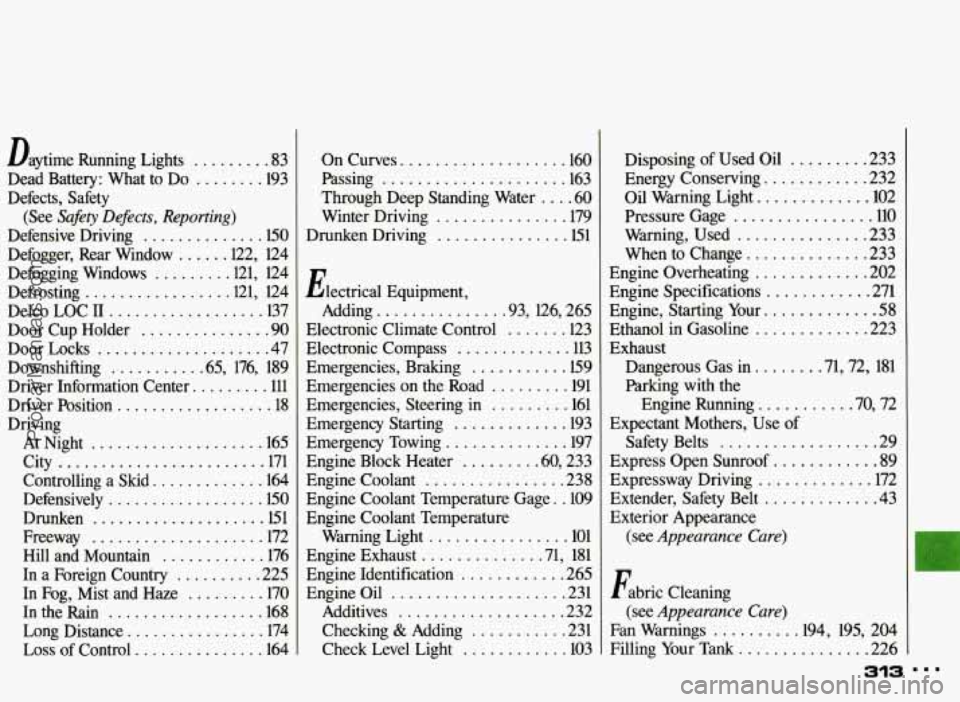
Daytime Running Lights ......... 83
Dead Battery: What to Do
........ 193
Defects. Safety
Defensive Driving
.............. 150
Defogger. Rear Window
..... .l22. 124
Defogging Windows
........ .l21. 124
Defrosting
................ .l21. 124
Delco LOC II .................. 137
DoorLocks
.................... 47
Downshifting
.......... .65. 176. 189
Driver Information Center
......... 111
Driver Fosition
.................. 18
Driving
At Night
.................... 165
City
........................ 171
Controlling a Skid
............. 164
Defensively
.................. 150
Drunken
.................... 151
Freeway
.................... 172
Hill and Mountain
............ 176
In a Foreign Country
.......... 225
In Fog. Mist and Haze
......... 170
In the
Rain .................. 168
Long Distance
................ 174
Loss of Control
............... 164
(See
Safety
Defects. Reporting)
Door Cup Holder ............... 90
On Curves ................... 160
Passing
..................... 163
Through Deep Standing Water
.... 60
Winter Driving
............... 179
Drunken Driving
............... 151
Electrical Equipment.
Adding
.............. .93.126. 265
Electronic Climate Control
....... 123
Emergencies. Braking
........... 159
Emergencies on the Road
......... 191
Emergencies. Steering in
......... 161
Emergency Starting
............. 193
Emergency Towing
.............. 197
Engine Block Heater
........ .60. 233
Engine Coolant
................ 238
Engine Coolant Temperature Gage
. . 109
Engine Coolant Temperature
Warning Light
................ 101
Engine Exhaust
............. .71. 181
Engine Identification
............ 265
Engine
Oil .................... 231
Additives
.................. -232
Electronic
Compass
............. 113
Checking
& Adding ........... 231
Check Level Light
............ 103 Disposing
of Used Oil
......... 233
Energy Conserving
............ 232
Oil Warning Light ............. 102
Pressure Gage
................ 110
Warning. Used
............... 233
When to Change
.............. 233
Engine Overheating
............. 202
Engine Specifications
............ 271
Engine, Starting Your
............. 58
Ethanol in Gasoline ............. 223
Exhaust Dangerous Gas
in ....... .71.72, 181
Parking with the Engine Running
.......... .70. 72
Expectant Mothers. Use of
Safety Belts
.................. 29
Express Open Sunroof
............ 89
Expressway Driving
............. 172
Extender, Safety Belt
............. 43
Exterior Appearance
(see
Appearance Care)
Fabric Cleaning
Fan Warnings ......... .194. 195, 204
Filling Your Tank
............... 226
313
(see Appearance Care)
ProCarManuals.com