engine PONTIAC BONNEVILLE 1995 User Guide
[x] Cancel search | Manufacturer: PONTIAC, Model Year: 1995, Model line: BONNEVILLE, Model: PONTIAC BONNEVILLE 1995Pages: 338, PDF Size: 16.19 MB
Page 68 of 338
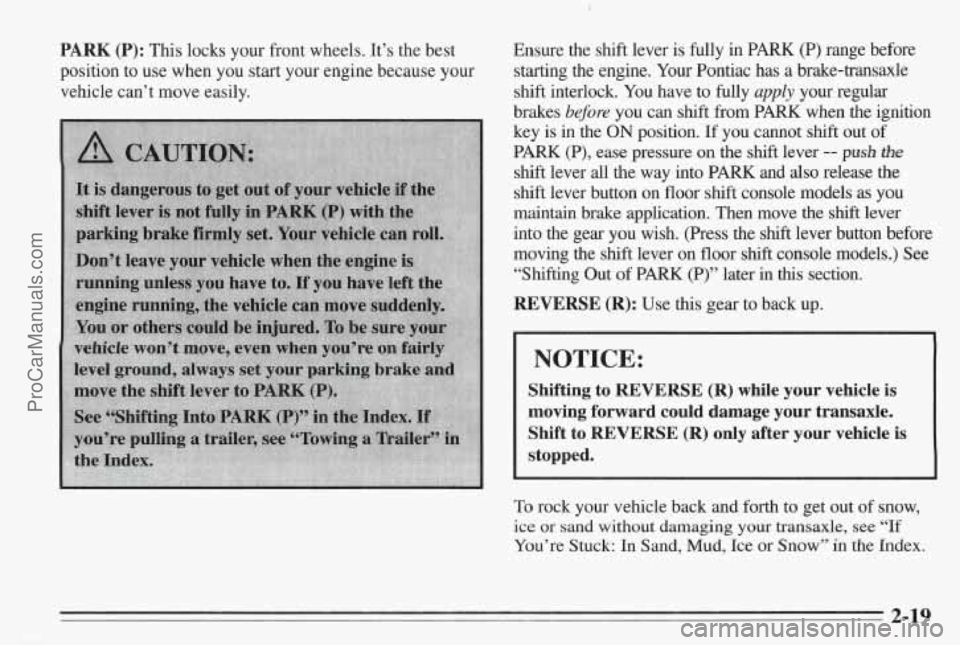
PARK (P): This locks your front wheels. It’s the best
position to use when
you start your engine because your
vehicle can’t move easily. Ensure the shift lever is fully in
PARK (P) range before
starting the engine. Your Pontiac has a brake-transaxle
shift interlock.
You have to fully apply your regular
brakes before you can shift from PARK when the ignition
key is in the
ON position. If you cannot shift out of
PARK (P), ease pressure
on the shift lever -- push t2ze
shift lever all the way into PARK and also release the
shift lever button on floor
shift console models as you
maintain brake application. Then move the shift lever
into the gear you wish. (Press the shift lever button before \
moving the shift lever on floor shift console models.) See
“Shifting Out of PARK (P)” later
in this section.
REVERSE (R): Use this gear to back up.
NOTICE:
Shifting to REVERSE (R) while your vehicle is
moving forward could damage your transaxle.
Shift to REVERSE
(R) only after your vehicle is
stopped.
To rock your vehicle back and forth to get out of snow,
ice or sand without damaging your transaxle, see “If
You’re Stuck: In Sand, Mud, Ice or Snow” in the Index.
2-19
ProCarManuals.com
Page 69 of 338
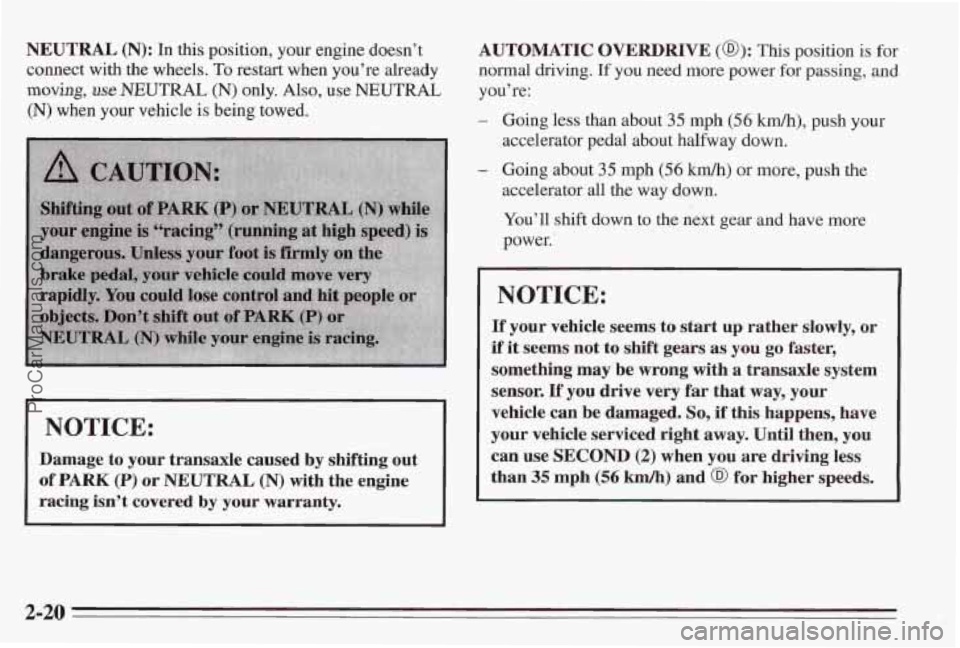
NEUTRAL (N): In this position, your engine doesn’t
connect with the wheels.
To restart when you’re already
moving, use NEUTRAL (N) only. Also, use NEUTRAL
(N) when your vehicle is being towed.
I NOTICE: I
Damage to your transaxle caused by shifting out
of PARK (P) or NEUTRAL (N) with the engine
racing isn’t
covered by your warranty.
AUTOMATIC OVERDRIVE (@): This position is for
normal driving.
If you need more power for passing, and
you’re:
- Going less than about 35 mph (56 km/h), push your
accelerator pedal about halfway down.
- Going about 35 mph (56 lun/h) or more, push the
accelerator all the way down.
You’ll shift down to the next gear and have more
power.
I NOTICE:
If your vehicle seems to start up rather slowly, or
if it seems not to shift gears as you go faster,
something may
be wrong with a transaxle system
sensor.
If you drive very far that way, your
vehicle can be damaged.
So, if this happens, have
your vehicle serviced right away. Until then, you
can use
SECOND (2) when you are driving less
than 35 mph (56 kmh) and @ for higher speeds.
2-20
ProCarManuals.com
Page 70 of 338
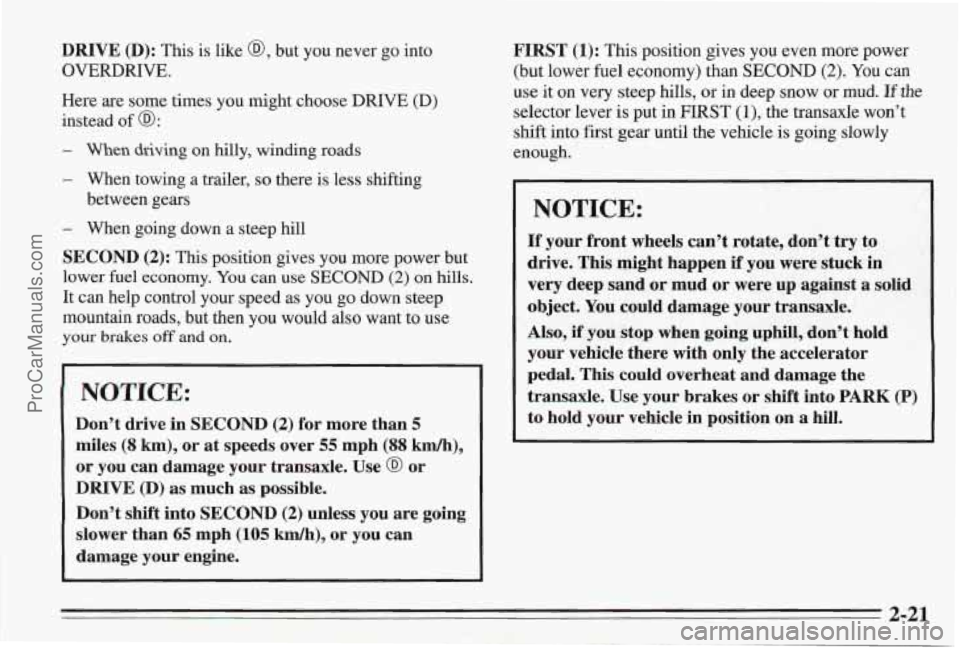
DRIVE (D): This is like @, but you never go into
OVERDRIVE.
Here are some times you might choose DRIVE (D)
instead of
a:
- When driving on hilly, winding roads
- When towing a trailer, so there is less shifting
between gears
- When going down a steep hill
SECOND (2): This position gives you more power but
lower fuel economy. You can
use SECOND (2) on hills.
It can help control your speed as you go down steep
mountain roads, but then you would also want to use
your brakes off and on.
NOTICE:
Don’t drive in SECOND (2) for more than 5
miles (8 km), or at speeds over 55 mph (88 km/h),
or you can damage your transaxle. Use
@ or
DRIVE (D) as much as possible.
Don’t shift into SECOND
(2) unless you are going
slower than
65 mph (105 kd), or you can
damage your engine. FIRST
(1): This
position gives you even more power
(but lower fuel economy) than SECOND
(2). You can
use it on very steep hills, or in deep snow or mud.
If the
selector lever is put in FIRST (l), the transaxle won’t
shift into first gear until
the vehicle is going slowly
enough.
NOTICE:
If your front wheels can’t rotate, don’t try to
drive. This might happen
if you were stuck in
very deep sand or mud or were up against
a solid
object. You could damage your transaxle.
Also,
if you stop when going uphill, don’t hold
your vehicle there with only the accelerator
pedal. This could overheat and damage the
transaxle. Use your brakes or shift into PARK (P)
to hold your vehicle in position on a hill.
2-21
ProCarManuals.com
Page 71 of 338
Performance Shifting (Option)
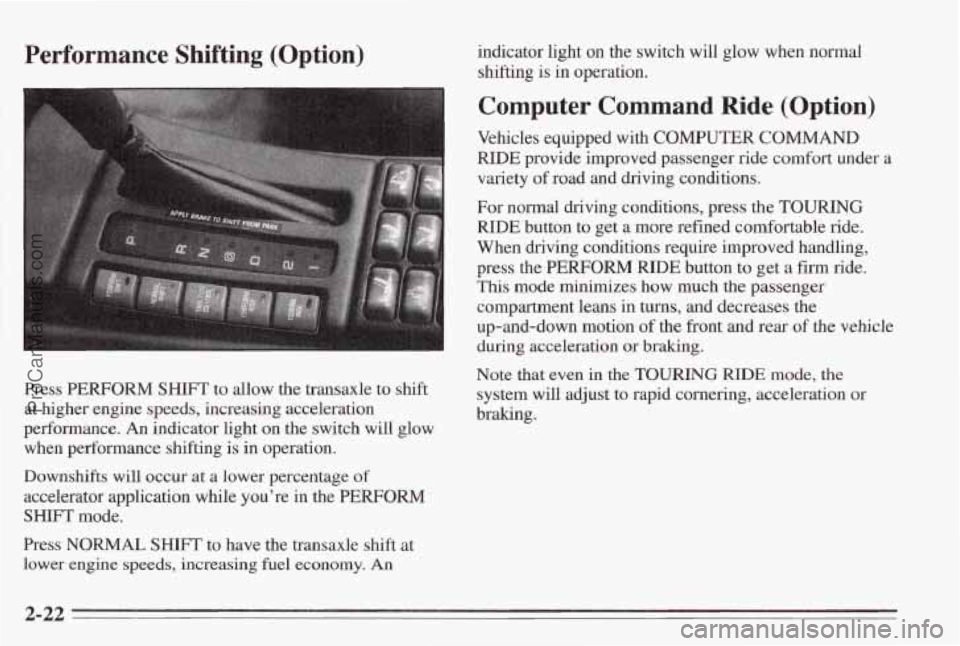
Press PERFORM SHIFT to allow the transaxle to shift
at higher engine speeds, increasing acceleration
performance. An indicator light on
the switch will glow
when performance shifting is in operation.
Downshifts will occur at a lower percentage of
accelerator application while you’re in the
PERFORM
SHIFT mode.
Press NORMAL
SHIFT to have the transaxle shift at
lower engine speeds, increasing fuel economy. An
indicator light on the switch will glow when normal
shifting
is in operation.
Computer Command Ride (Option)
Vehicles equipped with COMPUTER COMMAND
RIDE provide improved passenger ride comfort under a
variety of road and driving conditions.
For normal driving conditions, press the
TOURING
RIDE button to get a more refined comfortable ride.
When driving conditions require improved handling,
press the
PERFORM RIDE button to get a firm ride.
This mode minimizes how much the passenger
compartment leans in turns, and decreases the
up-and-down motion
of the front and rear of the vehicle
during acceleration or braking.
Note that even in the TOURING RIDE mode, the
system will adjust to rapid cornering, acceleration or
braking.
2-22
ProCarManuals.com
Page 75 of 338
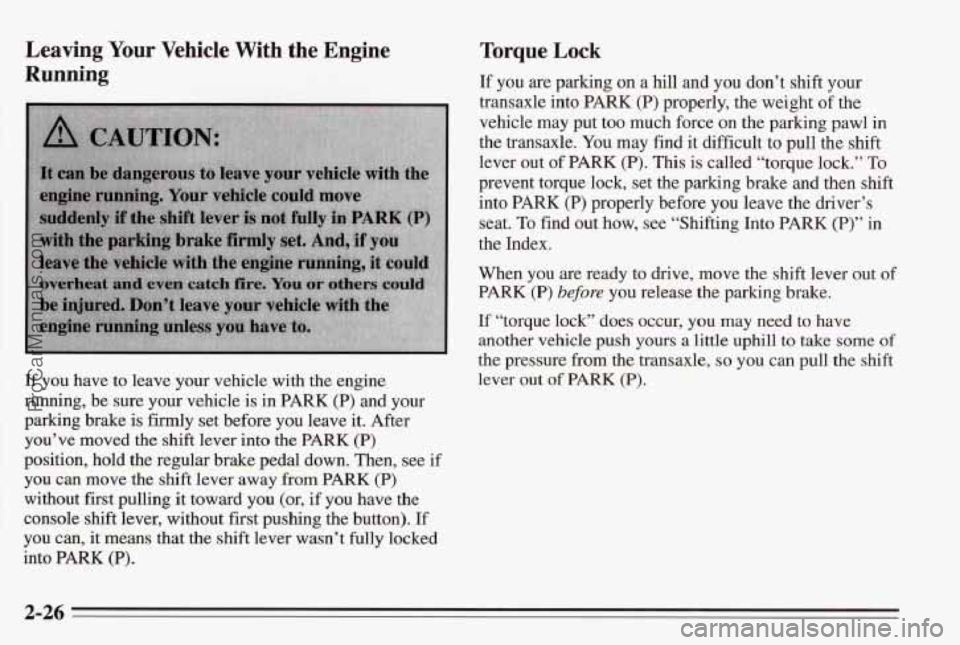
Leaving Your Vehicle With the Engine
Running
If yon have to leave your vehicle with the engine
running,
be sure your vehicle is in PARK (P) and your
parking bralae is fdy set before you leave it. After
you’ve moved the shift lever into the PARK (I?)
position, hold the regular brake pedal down. Then, see if
you can muve the shift lever away from PARK (P)
without first pulling it tow& you (or, if you have the
console shift lever, without first pushing.the button). If
yuu c-an, it mema that the shift lever- w&snB t fully locked
into PARK (P).
Torque Lock
If you are parking on a hill and you don’t shift your
transaxle into
PARK (P) properly, the weight of the
vehicle may put too much force on the
parking pawl in
the transaxle. You may find it difficult to pull the shift
lever out
of PARK (P). This is called “torque lock.” To
prevent torque lock, set the parking brake and then shift
into
PARK (P) properly before you leave the driver’s
seat.
To find out how, see “Shifting Into PARK (P)” in
the Index.
When
you are ready to drive, move the shift lever out of
PARK
(P) before you release the parking brake.
If “torque lock” does occur, you may need to have
another vehicle
push yours a little uphill to take some of
the pressure from the transaxle. so you can pull the shift
lever out of PARK (P).
2-26
ProCarManuals.com
Page 77 of 338
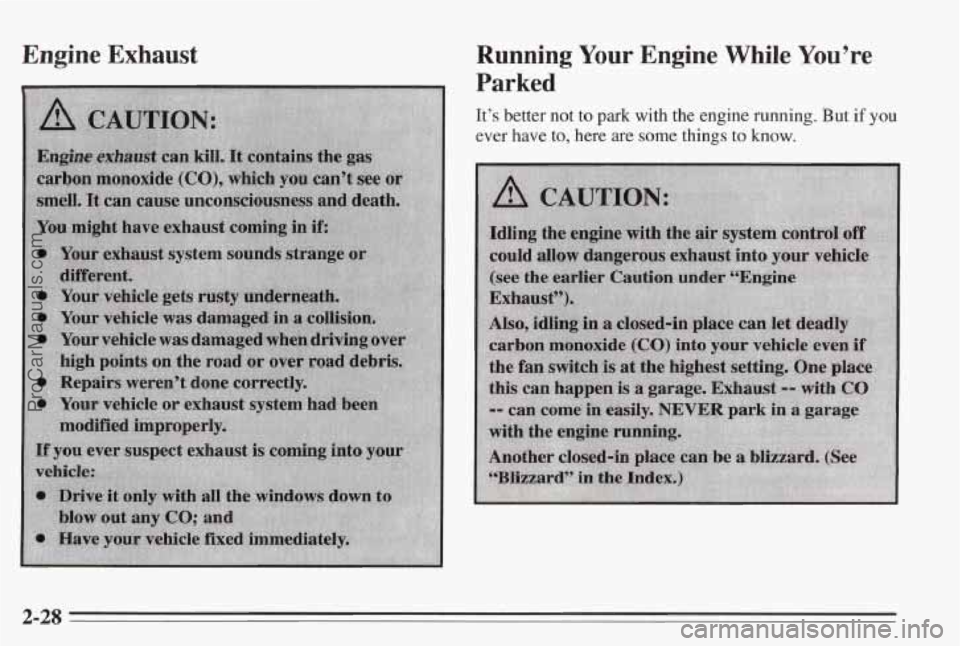
Engine Exhaust Running Your Engine While You’re
Parked
It’s better not to park with the engine running. But if you
ever have to, here are some things to know.
2-28
ProCarManuals.com
Page 100 of 338
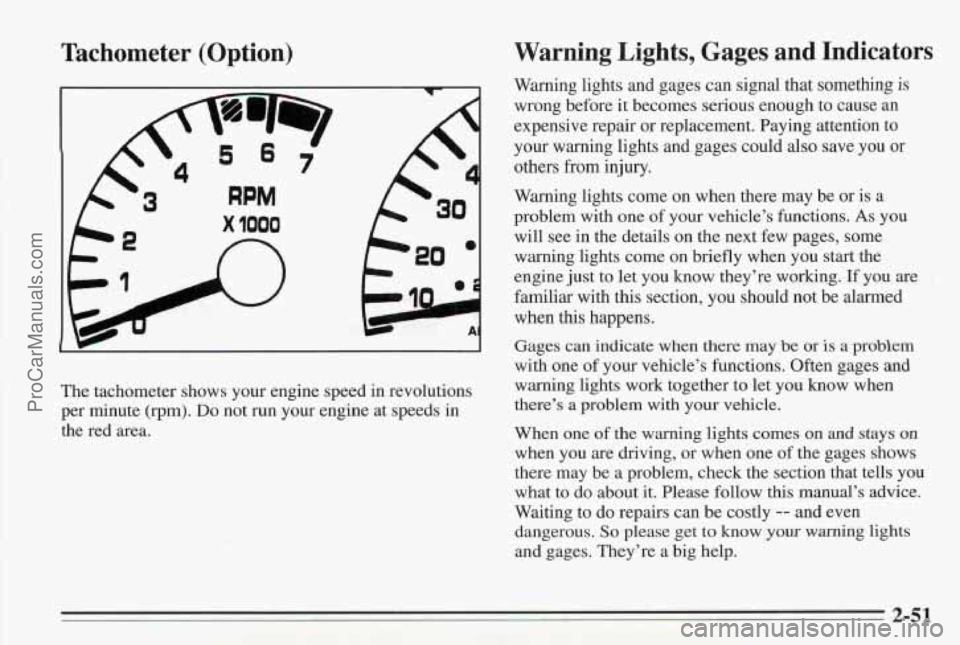
Tachometer (Option) Warning Lights, Gages and Indicators
Warning
lights and gages can signal that something is
wrong before it becomes serious enough to cause an
expensive repair or replacement. Paying attention to
your warning lights and gages could also save
you or
others from injury.
Warning lights come on when there may be or is a
will see in the details on the next few pages, some
warning lights come on briefly when you
start the
engine just to let you know they’re working.
If you are
familiar with this section, you should not be alarmed
when this happens.
Gages can indicate when there may
be or is a problem
with one of your vehicle’s functions. Often gages and
30 problem with one of your vehicle’s functions. As you
The tachometer shows your engine speed in revolutions warning lights
work together to let you know when
per minute
(rpm). Do not run your engine at speeds in there’s a problem
with your vehicle.
the red area. When one
of the warning lights comes on and stays on
when you are driving, or when one of the gages shows
there may be a problem, check the section that tells you
what
to do about it. Please follow this manual’s advice.
Waiting to
do repairs can be costly -- and even
dangerous.
So please get to know your warning lights
and gages. They’re a big help.
ProCarManuals.com
Page 103 of 338
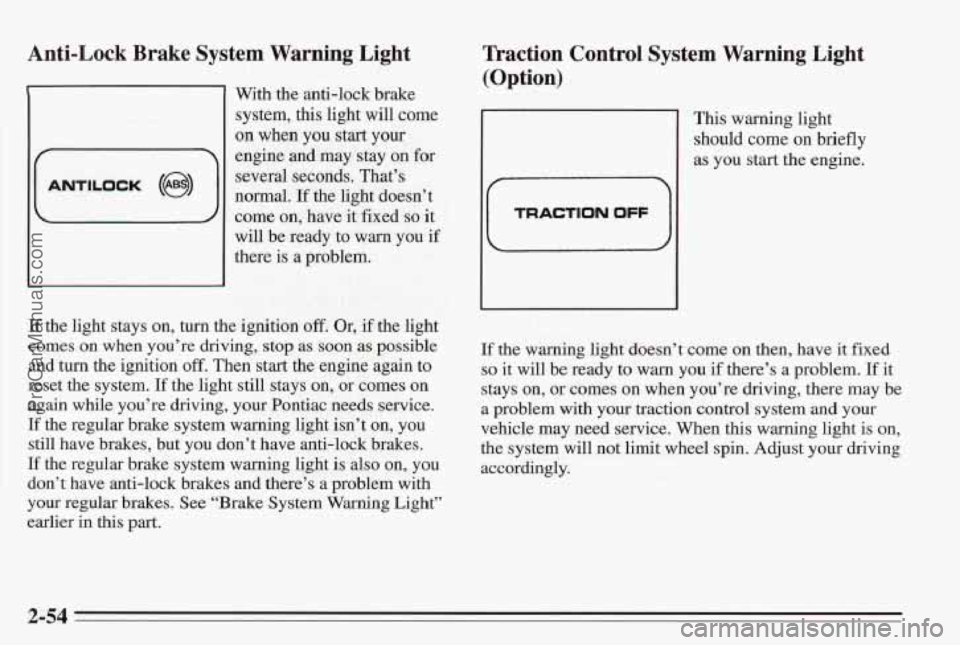
Anti-Lock Brake System Warning Light
E
ANTILOCK (@I)
With the anti-lock brake
system, this light will come
on when you start your
engine and may stay on for
several seconds. That’s
normal.
If the light doesn’t
come on, have it fixed
so it
will be ready to warn you if
there is a problem.
Traction Control System Warning Light
(Option)
This warning light
should come on briefly
as you start the engine.
r TRACTION OFF
If the light stays on, turn the ignition off. Or, if the light
comes on when you’re driving, stop
as soon as possible
and turn the ignition off. Then
start the engine again to
reset the system.
If the light still stays on, or comes on
again while you’re driving, your Pontiac needs service.
If the regular brake system warning light isn’t on, you
still have brakes, but you don’t have anti-lock brakes.
If the regular brake system warning light is also on, you
don’t have anti-lock brakes and there’s a problem with
your regular brakes. See “Brake System Warning Light”
earlier in this part.
If the warning light doesn’t come on then, have it fixed
so it will be ready to warn you if there’s a problem. If it
stays on, or comes on when you’re driving, there may be
a problem with your traction control system
and your
vehicle may need service. When this warning light is on,
the system will not limit wheel spin. Adjust your driving
accordingly.
2-54
ProCarManuals.com
Page 104 of 338
The traction control system warning light may come on
for the following reasons:
0 If you turn the system off by pressing the button
located on the center console, the warning light will
come on and stay on.
To turn the system back on,
press the button again. The warning light should go
off. (See “Traction Control System” in the Index for
more information.)
If there’s a brake system problem that is specifically
related to traction control, the traction control system
will turn off and the warning light
will come on. If
your brakes begin to overheat, the traction control
system will turn
off and the warning light will come
on until
your brakes cool down.
engine-related problem, the system will turn
off and
the warning light will come on.
If the traction control system is affected by an
If the traction control system warning light comes on
and stays on for an extended period of time when the
system is turned on, your vehicle needs service.
Engine Coolant Temperature Warning
Light
1
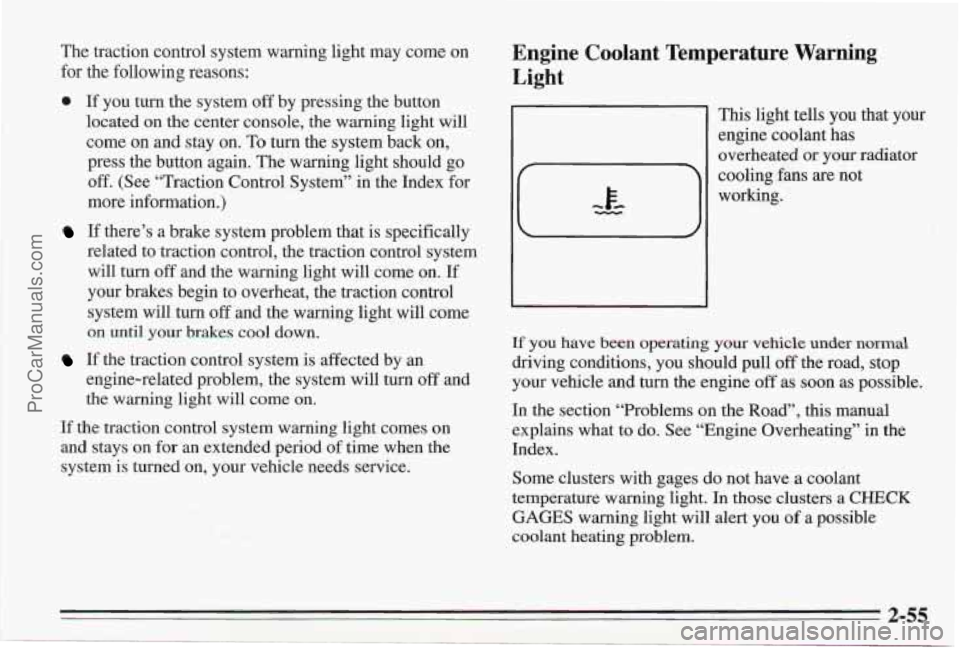
This light tells you that your
engine coolant has
overheated
or your radiator 4
cooling fans are not
working.
If you have been operating your vehicle under normal
driving conditions, you should pull off the road, stop
your vehicle and turn the engine
off as soon as possible.
In the section “Problems on the Road”, this manual
explains what to do. See “Engine Overheating” in the
Index.
Some clusters with gages
do not have a coolant
temperature warning light. In those clusters a
CHECK
GAGES warning light will alert you of a possible
coolant heating problem.
2-55
ProCarManuals.com
Page 105 of 338
Engine Coolant Temperature Gage
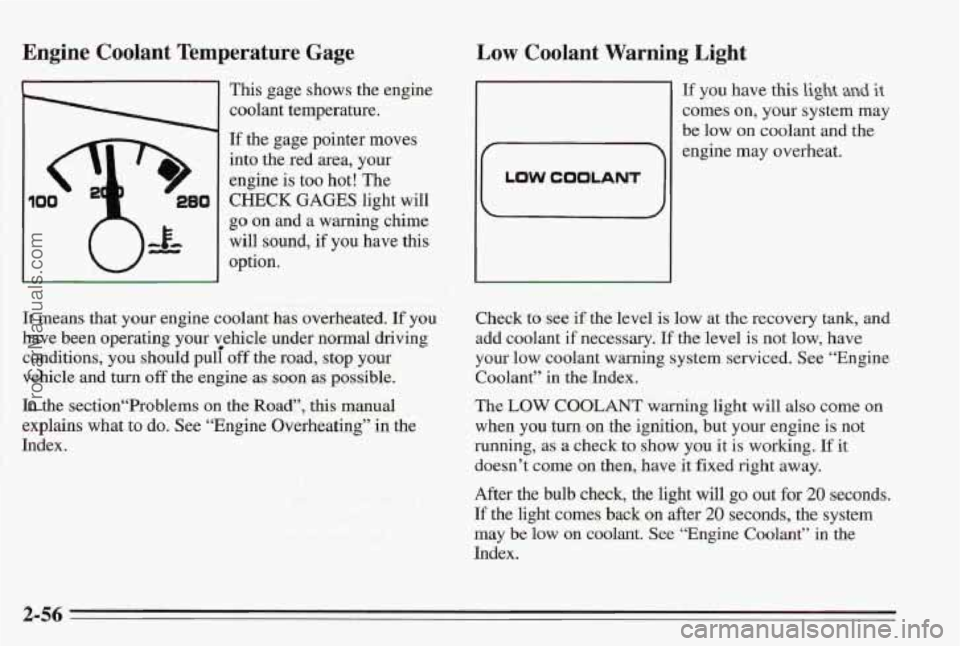
This gage shows the engine
coolant temperature.
If the gage pointer moves
into the red area, your
engine
is too hot! The
CHECK GAGES light will
go on and a warning chime
will sound, if
you have this
option.
It means that your engine coolant has overheated. If you
have been operating your vehicle lander normal driving
conditions, you should puli off the road, stop you
vehicle and turn off the engine as soon as possible.
In the section“Prob1ems on the Road”, this mud
explains what to do. See “Engine Overheating” in the
-. -. . 5 . Index. .~ c.
.L -,
Low Coolant Warning Light
L
LOW COOLANT
If you have this light and it
comes on, your system may
be low on coolant and the
engine
may overheat.
Check to
see if the level is low at the recovery tank, and
add coolant if necessary.
If the level is not low, have
your low coolant warning system serviced. See “Engine
Coolant” in the
Index.
The LOW COOLANT warning light will also come on
when you turn on the ignition, but your engine is not
running, as
a check to show you it is working. If it
doesn’t come
on then, have it fixed right away.
After the
bulb check, the light will go out for 20 seconds.
If the light comes back on after 20 se’conds, the system
may be low on coolant. See “Engine Coolant”
in the
Index.
2-56
ProCarManuals.com