engine PONTIAC BONNEVILLE 1995 Workshop Manual
[x] Cancel search | Manufacturer: PONTIAC, Model Year: 1995, Model line: BONNEVILLE, Model: PONTIAC BONNEVILLE 1995Pages: 338, PDF Size: 16.19 MB
Page 184 of 338
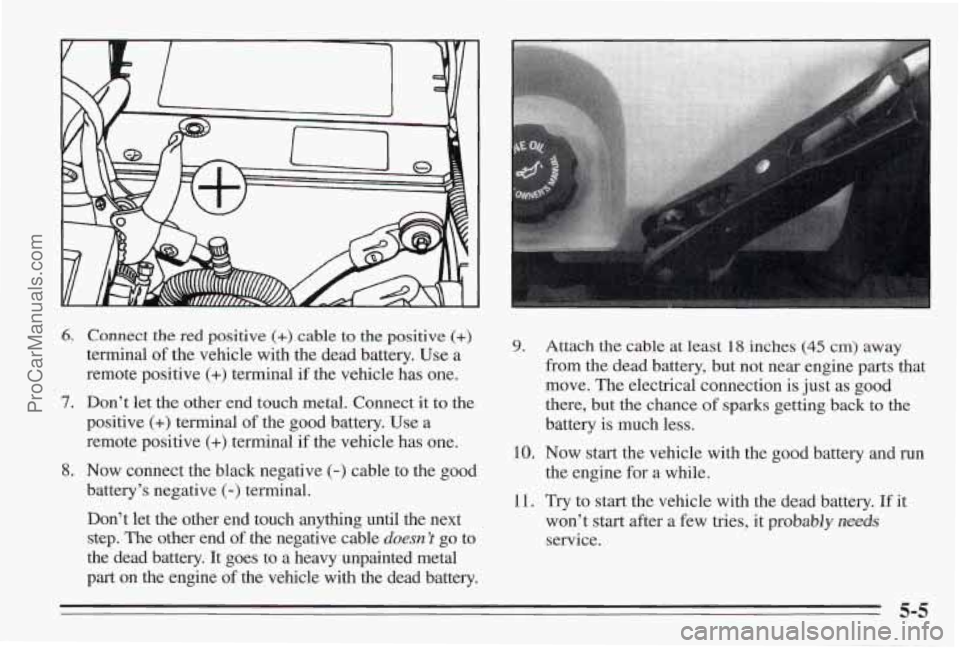
6. Connect the red positive (+) cable to the positive (+)
terminal of the vehicle with the dead battery. Use a
remote positive
(+) terminal if the vehicle has one.
7. Don’t let the other end t’ouch metal. Connect it to the
positive
(+) terminal of the good battery. Use a
remote positive
(+) terminal if the vehicle has one.
8. Now connect the black negative (-) cable to the good
battery’s negative
(-) terminal.
Don’t let the other end touch anything until the next
step.
The other end of the negative cable doesn’t go to
the dead battery. It goes to a heavy unpainted metal
part on the engine of the vehicle with the dead battery.
9. Attach the cable at least 18 inches (45 cm) away
from the dead battery, but not near engine parts that
move. The electrical connection
is just as good
there, but the chance
of sparks getting back to the
battery is much less.
10. Now start the vehicle with the good battery and run
the engine for a while.
11. Try to start the vehicle with the dead battery. If it
won’t start after a few tries, it probably
&s
service.
5-5
ProCarManuals.com
Page 191 of 338
Engine Overheating
You will find a coolant temperature gage or the warning
light about a hot
engine on your Pontiac’s instrument
panel. See “Coolant Temperature Gage” and “Coolant
Temperature Warning Light”
in the Index.
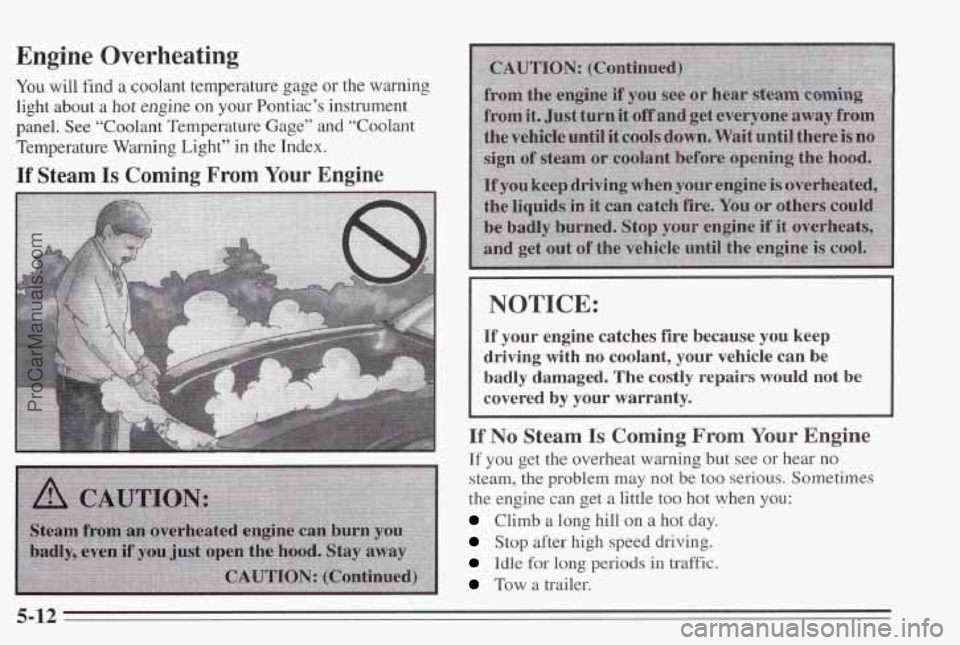
If Steam Is Coming From Your Engine
I NOTICE:
If your engine catches fire because you keep
driving with no coolant, your vehicle can be
badly damaged. The costly repairs would not be
covered by your warranty.
If No Steam Is Coming From Your Engine
If you get the overheat warning but see or hear no
steam,
the problem may not be too serious. Sometimes
the engine can get a little too hot when
you:
Climb a long hill on a hot day.
Stop after high speed driving.
Idle for long periods in traffic.
Tow a trailer.
5-12
ProCarManuals.com
Page 192 of 338
If you get the overheat warning with no sign of steam,
try
this for a minute or so:
1. Turn off your air conditioner.
2. Turn on your heater to full hot at the highest fan
speed and open the window as necessary.
3. If you’re in a traffic jam, shift to NEUTRAL (N);
otherwise, shift to the highest gear while driving --
AUTOMATIC OVERDRIVE (@) or DRIVE (D).
If y’ou no longer have the overheat warning, you can
drive. Just to be safe, drive slower for about ten minutes.
If the warning doesn’t come back
on, you can drive
normally.
If the warning continues, pull over, stop, and park your
vehicle right away.
If there’s still
no sign of steam, you can idle the engine
for two or three minutes while you’re parked, to see if
the warning stops. But then, if you still have the
warning,
turn off the engine and get everyone out of the
vehicle until it cools down.
You may decide not to lift the hood but to get service
help right away.
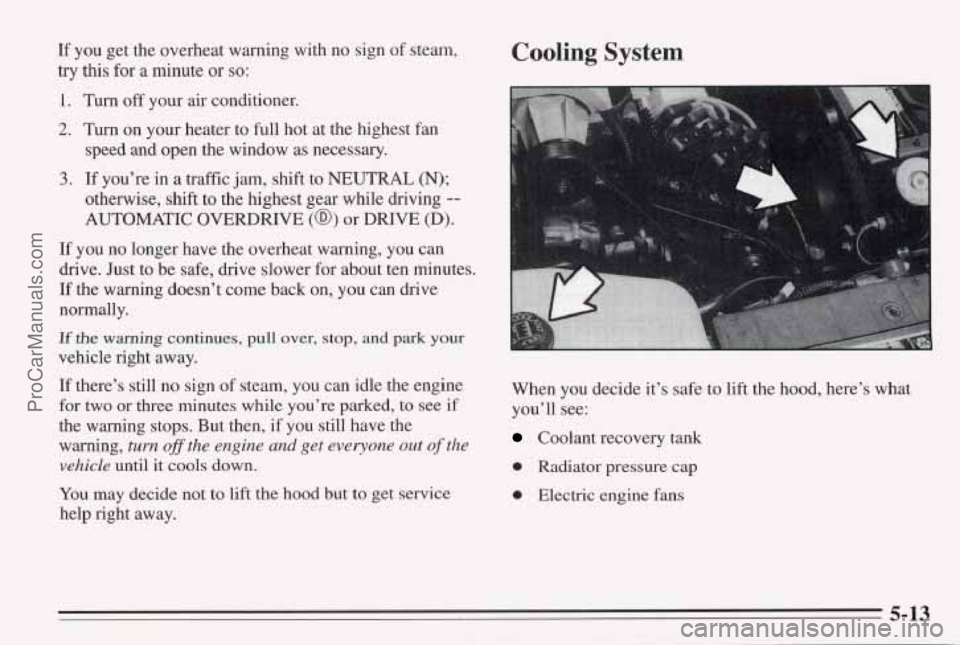
Cooling System
When you decide it’s safe to lift the hood, here’s what
you’ll see:
Coolant recovery tank
0 Radiator pressure cap
0 Electric engine fans
5-13
ProCarManuals.com
Page 193 of 338
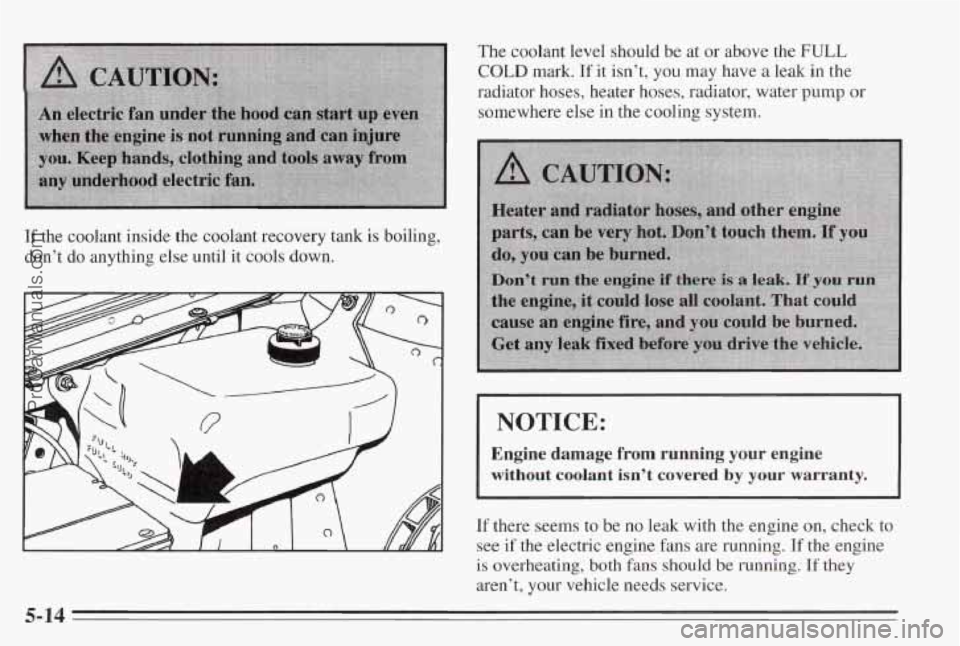
If the coolant inside the coolant recovery tank is boiling,
don’t
do anything else until it cools down.
The coolant level should be at or above the FULL
COLD mark. If it isn’t, you may have a leak in the
radiator hoses, heater hoses, radiator, water
pump or
somewhere else in the cooling system.
NOTICE:
Engine damage from running your engine
without coolant isn’t covered by your warranty.
If there seems to be no leak with the engine an, check to
see if the electric engine fans are running. If the engine
is overheating, both fans should be running. If they
aren’t,
your vehicle needs service.
5-14
ProCarManuals.com
Page 194 of 338
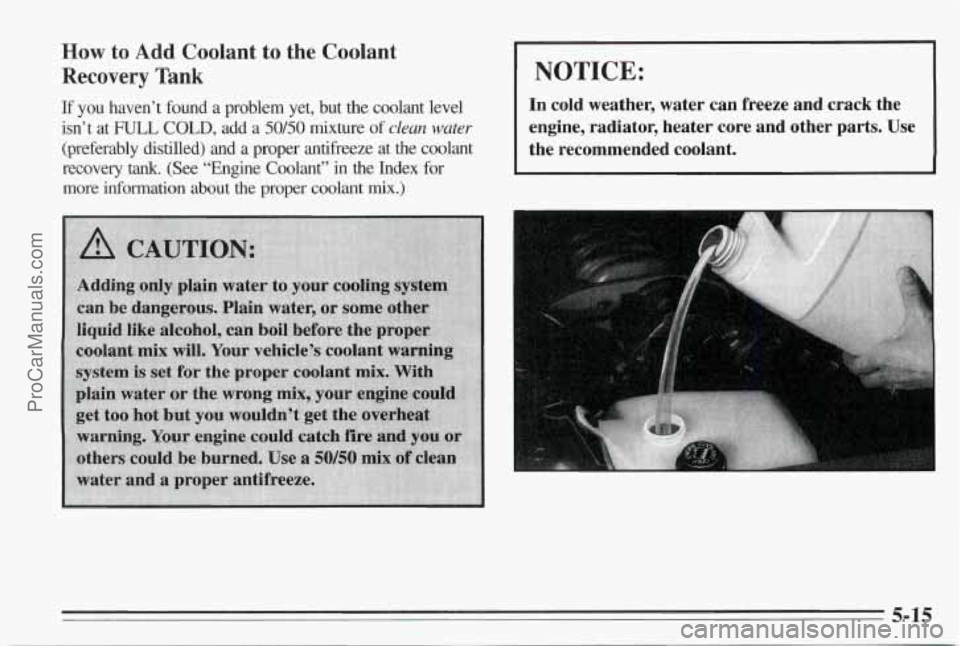
How to Add Coolant to the Coolant
Recovery Tank
If you haven’t found a problem yet, but the coolant level
isn’t at
FULL COLD, add a 50/50 mixture of clean water
(preferably distilled) and a proper antifreeze at the coolant \
recovery
tank. (See “Engine Coolant’’ in the Index for
more information about the proper coolant mix.)
NOTICE:
In cold weather, water can freeze and crack the
engine, radiator, heater core and other parts.
Use
the recommended coolant.
ProCarManuals.com
Page 198 of 338
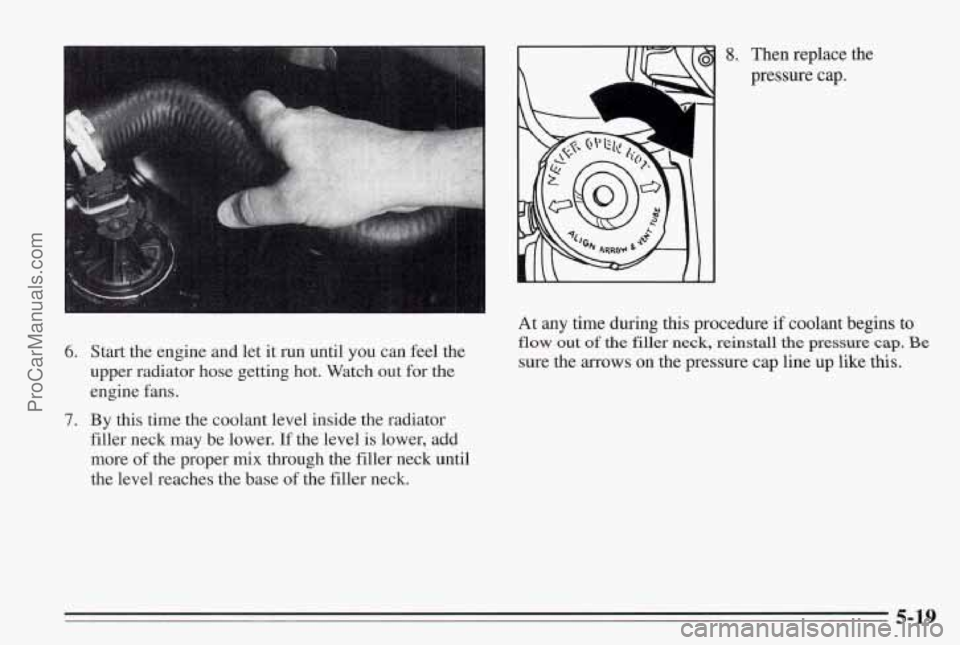
6. Start the engine and let it run until you can feel the
upper radiator hose getting hot. Watch out for the
engine fans.
7. By this time the coolant level inside the radiator
filler neck may
be lower. If the level is lower, add
more
of the proper mix through the filler neck until
the level reaches the base
of the filler neck.
8. Then replace the
pressure cap.
At any time during this procedure
if coolant begins to
flow out of the filler neck, reinstall the pressure cap. Be
sure the arrows on the pressure cap line up like this.
5-19
ProCarManuals.com
Page 216 of 338
Fuel
3800 Engine (Code K)
The 8th digit of your vehicle identification number
(VIN) shows the code letter for your engine. You will
find the VIN at the top left of your instrument panel.
(See “Vehicle Identification Number” in the Index.)
Use regular unleaded gasoline rated at
87 octane or
higher. It should meet specifications ASTM
D48 14 in
the United States and CGSB 3.5-92 in Canada. These
fuels should have the proper additives,
so you should not
have to add anything to the fuel.
In the United States and Canada, it’s easy
to be sure you
get the right kind of gasoline (unleaded). You’ll see
UNLEADED right on the pump. And only unleaded
nozzles will fit into your vehicle’s filler neck.
Be sure the posted octane is at least
87. If the octane is
less than
87, you may get a heavy knocking noise when
you drive. If it’s bad enough, it can damage your engine.
If you’re using fuel rated at 87 octane or higher and you
still hear heavy knocking, your engine needs service.
But don’t
worry if you hear a little pinging noise when
you’re accelerating
or driving up a hill. That’s normal,
and you don’t have to buy
a higher octane fuel to get rid
of pinging. It’s the heavy, constant knock that means
you have
a problem.
What about gasoline with blending materials that
contain oxygen (oxygenates), such as
MTBE or alcohol?
MTBE is “methyl tertiary-butyl ether.” Fuel that is no
more than 15% MTBE is fine for your vehicle.
Ethanol is ethyl or grain alcohol. Properly-blended fuel
that is no more than
10% ethanol is fine for your
vehicle.
Methanol is methyl or wood alcohol.
NOTICE:
Fuel that is more than 5% methanol is bad for
your vehicle. Don’t use it. It can corrode metal
parts in your fuel system and also damage plastic
and rubber parts. That damage wouldn’t be
covered under your warranty. And even at
5% or
less, there must be “cosolvents” and corrosion
preventers in this fuel to help avoid these
problems.
ProCarManuals.com
Page 217 of 338
Gasolines for Cleaner Air
Your use of gasoline with deposit control additives will
help prevent deposits from forming in your engine and
fuel system. That helps keep
your engine in tune and
your emission control system working properly. It’s
good
for your vehicle, and you’ll be doing your R&.fQr
cleaner air.
Many gasolines are now blended with oxygenates.
General Motors recommends that you use gasolines with
these blending materials, such as
MTBE and ethanol. By
doing
so, you can help clean the air, especially in those
parts of the country that have high carbon monoxide
levels.
In addition, some gasoline suppliers
are now producing
reformulated gasolines. These gasolines are specially
designed to reduce vehicle emissions. General Motors
recommends that you use reformulated gasoline.
By
doing so, you can help clean the air, especially in those
parts of the country that have high ozone levels.
You
should ask your service station operators if their
gasolines contain deposit control additives
and
oxygenates, an’d if they have been reformulated to
reduce vehicle emissions.
Fuel
3808 Supercharged Engine (Code 1)
The 8th digit of your vehicle identification number
(VIN) shows the code letter for your engine. You will
find the VIN at the top left
of your instrument panel.
(See “Vehicle Identification Number” in the Index.)
Use premium unleaded gasoline rated at
91 octane or
higher. You may use middle grade or regular unleaded
gasolines, but your vehicle
may not accelerate as well.
The gasoline you use should meet specifications
ASTlM D4814 in the United States and CGSB 3.5-92
in Canada. These fuels should have the proper additives,
so you should not have to add anything to the fuel.
In
the United States and Canada, it’s easy to be sure you
get the right kind of gasoline (unleaded). You’ll see
UNLEADED right on the pump. And only unleaded
nozzles will fit into your vehicle’s
filler neck.
Be sure the posted octane for premium is at least 91
(at least 89 for middle grade and 87 for regular). If the
octane is less than 87, you may get a heavy knocking
noise when
you drive. If it’s bad enough, it can damage
your engine.
6-4
ProCarManuals.com
Page 218 of 338
If you’re using fuel rated at 91 octane or higher and you
still hear heavy knocking, your engine needs service.
But don’t worry if you hear a little pinging noise when
you’re accelerating
or driving up a hill. That’s normal
and you don’t have to buy
a higher octane fuel to get rid
of pinging. It’s the heavy, constant knock that means
you have a problem.
What about gasoline with blending materials that
contain oxygen (oxygenates), such as
MTBE or alcohol?
MTBE is “methyl tertiary-butyl ether.” Fuel that is no
more than 15% MTBE is fine for your vehicle.
Ethanol is ethyl or grain alcohol. Properly-blended fuel
that is no more than
10% ethanol is fine for your vehicle.
Methanol is methyl or wood alcohol.
NOTICE:
Fuel that is more than 5% methanol is bad for
your vehicle. Don’t use it. It can corrode metal
parts in your fuel system and also damage plastic
and rubber
park That damage wouldn’t be
covered under your warranty. And even at
5% or
less, there must be “cosolvents” and corrosion
preventers
in this fuel to help avoid these problems.
6-5
ProCarManuals.com
Page 219 of 338
Gasolines for Cleaner Air
Your use of gasoline with deposit control additives will
help prevent deposits from forming in your engine and
fuel system. That helps keep your engine in tune and
your emission control system working properly. It’s
good for your vehicle, and you’ll be doing your
part for
cleaner air.
Many gasolines are now blended with oxygenates.
General Motors recommends that you use gasolines with
these blending materials, such as MTBE and ethanol. By
doing
so, you can help clean the air, especially in those
parts
of the country that have high carbon monoxide
levels.
In addition, some gasoline suppliers are now producing
reformulated gasolines. These gasolines are specially
designed to reduce vehicle emissions. General Motors
recommends that you use reformulated gasoline. By
doing
so, you can help clean the air, especially in those
parts of the country that have high ozone levels.
You should ask your service station operators if their
gasolines contain deposit control additives and
oxygenates, and if
they have been reformulated to
reduce vehicle emissions.
Fuels in Foreign Countries
If you plan on driving in another country outside the
U.S. or Canada, unleaded fuel may be hard to find. Do
not use leaded gasoline. If you use even one tankful,
your emission controls won’t work well or at all. With
continuous use, spark plugs can get fouled, the exhaust
system can corrode, and your engine oil can deteriorate
quickly. Your vehicle’s oxygen sensor will be damaged.
All
of that means costly repairs that wouldn’t be covered
by your warranty.
To check on fuel availability, ask an auto club, or
contact a major oil company that does business in the
country where you’ll be driving.
You can also write us at the following address for
advice. Just tell us where you’re going and give your
Vehicle Identification Number
(VIN).
General Motors Overseas Distribution Corporation
North American Export Sales (NAES)
1908 Colonel Sam Drive
Oshawa, Ontario
LlH 8P7
6-6
ProCarManuals.com