engine PONTIAC BONNEVILLE 1995 Owner's Guide
[x] Cancel search | Manufacturer: PONTIAC, Model Year: 1995, Model line: BONNEVILLE, Model: PONTIAC BONNEVILLE 1995Pages: 338, PDF Size: 16.19 MB
Page 123 of 338
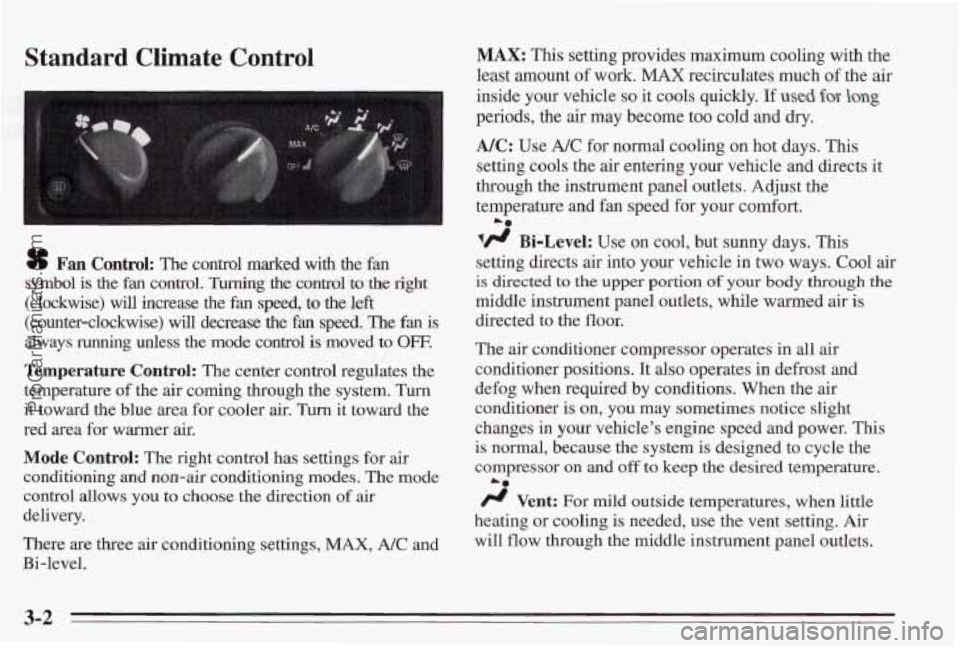
Standard Climate Control
sf Fan Control: The control marked with the fan
symbol is
the fan control. Turning the control to the right
(clockwise) will increase the fan speed, to the left
(counter-clockwise) will decrease the fan speed. The fan is
always running unless the mode control is moved to OFF.
Temperature Control: The center control regulates the
temperature
of the air coming through the system. Turn
it toward the blue area for cooler air.
Turn it toward the
red area for warmer air.
Mode Control: The right control has settings for air
conditioning and non-air conditioning modes.
The mode
control allows
you to choose the direction of air
delivery.
There are three air conditioning settings,
MAX, A/C and
Bi-level.
MAX: This setting provides maximum cooling with the
least amount
of work. MAX recirculates much of the air
inside your vehicle
so it cools quickly. If used for- long
periods, the air may become too cold and dry.
NC: Use A/C for normal cooling on hot days. This
setting cools the air entering your vehicle and directs it
through the instrument panel outlets. Adjust the
temperature
and fan speed for your comfort.
lfl Bi-Level: Use on cool, but sunny days. This
setting directs air into your vehlcle in two ways. Cool air
is directed to the upper portion of your body through the
middle instrument panel outlets, while warmed air is
directed to the floor.
The
air conditioner compressor operates in all air
conditioner positions. It also operates in defrost and
defog when required by conditions. When the
air
conditioner is on, you may sometimes notice slight
changes
in your vehicle’s engine speed and power. This
is
normal, because the system is designed to cycle the
compressor on
and off to keep the desired temperature.
/J Vent: For mild outside temperatures, when little
heating or cooling is needed, use the vent setting. Air
will
flow through the middle instrument panel outlets.
La
3-2
ProCarManuals.com
Page 125 of 338
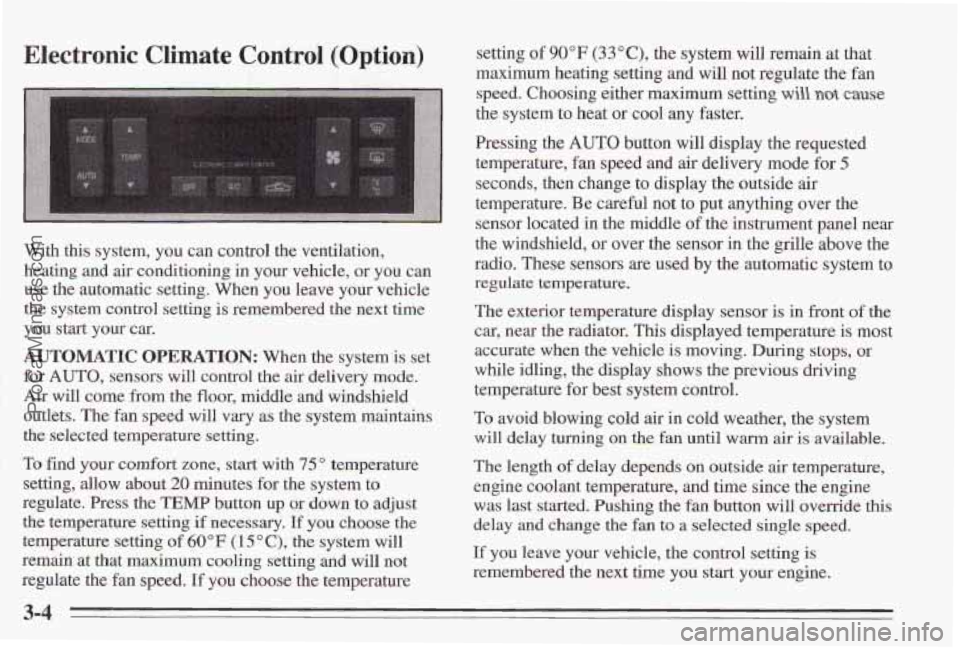
Electronic Climate Control (Option)
With this system, you can control the ventilation,
heating and
air conditioning in your vehicle, or you can
use the automatic setting. When
you leave your vehicle
the system control setting
is remembered the next time
you start your
car.
AUTOMATIC OPERATION: When the system is set
for
AUTO, sensors will control the air delivery mode.
Air will come from the floor, middle and windshield
outlets. The fan speed will
vary as the system maintains
the selected temperature setting.
To find your comfort
zone, start with 75" temperature
setting, allow about
20 minutes for the system to
regulate. Press the
TEMP button up or down to adjust
the temperature setting
if necessary, If you choose the
temperature
setting of 60°F (1 5 O C), the system will
remain at that maximum cooling setting and will not
regulate the fan speed.
If you choose the temperature setting
of 90°F (33"C), the system
will remain at that
maximum heating setting and will
not regulate the fan
speed. Choosing either maximum setting
will not cause
the system to heat or cool any faster.
Pressing the
AUTO button will display the requested
temperature, fan speed and air delivery mode for
5
seconds, then change to display the outside air
temperature. Be careful not to put anything over the
sensor located in the middle
of the instrument panel near
the windshield, or over the sensor in the
grille above the
radio. These sensors are used by the automatic system to
regulate temperature.
The exterior temperature display sensor is in front of the
car, near the radiator,
This displayed temperature is most
accurate when the vehicle is moving. During stops,
or
while idling, the display shows the previous driving
temperature for best system control.
To avoid blowing cold air in cold weather, the system
will delay turning on the
fan until warm air is available.
The length
of delay depeds on outside air temperature,
engine coolant temperature, and time since the engine
was last started. Pushing the
fan button will override this
delay and change the fan
to a selected single speed.
If you leave your vehicle, the control setting is
remembered the next time you start your engine.
3-4
ProCarManuals.com
Page 126 of 338
MANUAL OPERATION: The system can be used in
various ways to manually adjust the air delivery mode or
the fan speed.
Pressing the
MODE button will cause air to be delivered
through the floor, middle or windshield outlets and stay in the mode selected until the mode button or the auto
button is pushed. Notice the arrows
in the display.
The HEAT mode supplies
air to the floor outlets and is
used primarily in cold weather. To adjust the temperature
of the air supplied, press the TEMP button up or down.
DEFOG delivers air to the floor and the windshield
outlets and is used on cold, humid days when
some
window fogging occurs.
BI-LEVEL delivers warm air to the floor and cooler air to
the middle outlets. Bi-level
is used on cool but sunny days.
In each of these modes, the fan speed may be adjusted
by pushing the fan button up or down as necessary for
comfort.
To warrn or cool the air delivered, push the
TEMP button up or down.
OFF: This button is used to turn off the system. Fresh
air will continue to flow through the vehicle, and the
system
will try to maintain the previously set
temperature.
The outside temperature will show in the
display when the system is
OFF.
A/C: Press the A/C button to turn the air conditioning on
and
off. The system will cool and dehumidfy the air inside
the car.
In the AUTO mode the display will indicate that
A/C is on, but the air conditioning compressor only operates
when the system determines it
is needed. Slight changes in
engine power may be felt as the compressor cydes.
Recirc: When RECIRC is selected, the system
will limit the amount of fresh air entering your vehicle.
This is helpful when you are trying to cool the air
quickly or limit odors entering your vehicle. In the
AUTO mode, the system will use RECIRC as necessary
to cool the air. Pressing the RECIRC will change
the
operation to a manual mode and the air will recirculate
for
10 minutes. RECIRC will show in the display and
then return to EXT TEMP display.
9 Defrost: Push the defrost button to clear the
windshield of fogging or icing in extremely humid or
cold conditions. If you select defrost from
AUTO, the
system will control the fan speed. Use the fan button to
adjust the fan speed and the TEMP button to adjust the
air temperature for your comfort.
rear window warm the glass. Press the button to start
warming your window.
Rear Window Defogger: The lines you see on the
3-5
ProCarManuals.com
Page 127 of 338
After 10 minutes, it will go off by itself, or pressing the Ventilation Tips
button again during the heating cycle will turn it off. If
you need additional warming time, push the button
again. The system will then operate for five minutes
before going
off by itself.
Do not attach a temporary vehicle license, tape or decals
across the defogger grid on the rear window.
Keep the hood and front air inlet free of ice, snow, or
any other obstruction (such as leaves). The heater
and defroster will work better, reducing the chance
of fogging your windows.
Control
in cold weather, select a heater function that
0 When you enter a vehicle with Standad Climate
NOTICE:
Don't use a razor blade or something else sharp
on the inside
of the rear window. If you do, you
could cut
or damage the warming grid, and the
repairs wouldn't be covered by your warranty.
OF /"C: Press this button to read the temperature in
degrees Fahrenheit or Celsius.
., .. .
provides air through the floor ducts, then turn the fan
to
HI for a few moments before driving away. This
will blow moist air from the intake ducts toward the
floor, not the windshield. It reduces the chance of
fogging your windows.
If you have the Electronic
Climate Control, the
AUTO setting does this for you.
0 Keep the air path under the fbnt seats clear of objects.
This helps air to circulate throughout your vehicle.
When the engine idles for a long time, the exterior
temperature sensor may cause
the system to blow air
that is too cool. Once the vehicle is moving again the
system
will try to maintain the set temperature inside
your vehicle.
0 When you start your vehicle and the EXT TEMP
display flashes for some time, the system may need
repair. See your Pontiac dealer.
3-6
ProCarManuals.com
Page 139 of 338
Understanding Radio Reception
FM Stereo
FM Stereo will give you the best sound, but FM signals
will reach only about
10 to 40 miles (16 to 65 km). Tall
buildings or
hills can interfere with FM signals, causing
the sound to
come and go.
AM
The range for most AM stations is greater than for Fpv3[,
especially at night. The longer range, however, can
cause stations to interfere with each other.
AM can also
pick up noise from things like storms and power lines.
To lower this noise,
try reducing the treble level.
AM Stereo
Your Delco@ system may be able to receive C-Qum@
stereo broadcasts. Many AM stations around the country
use C-Quam
to produce stereo, though some do not.
C-Quam@
is a registered trademark of Motorola, Inc. If
your Delco system can get C-Quam signals, your stereo
indicator light will come on when you are receiving it.
Be aware that hearing damage from loud noise is almost
undetectable until it
is too late. Your hearing can adapt
to higher volumes of sound. Sound that seems normal
can be loud and harmful to your hearing.
Take
precautions by adjusting the volume control on your
radio to a safe sound level before your hearing adapts to
it.
To help avoid hearing loss or damage:
0 Adjust the volume control to the lowest setting.
Increase volume slowly until you hear comfortably
and clearly.
NOTICE:
Before you add any sound equipment to your
vehicle -- like a tape player, CB radio, mobile
telephone or two-way radio -- be sure you can
add what you want.
If you can, it's very
important
to do it properly. Added sound
equipment may interfere with the operation
of
your vehicle's engine, Delco radio or other
systems, and even damage them. And, your
vehicle's systems may interfere with the
operation of sound equipment that has been
added improperly.
So, before adding sound equipment, check with
your dealer and be
sure to check Federal rules
covering mobile radio and telephone units.
3-18
ProCarManuals.com
Page 148 of 338
Braking
Braking action involves perception time and reaction
time.
First, you have to decide to push on the brake pedal.
That’s perception time. Then you have to bring up your
foot and do it. That’s
reaction time.
Average reaction time is about 3/4 of a second. But
that’s only an average. It might be less with one driver
and as long as two or three seconds or more with
another. Age, physical condition, alertness, coordination,
and eyesight all play a part.
So do alcohol, drugs and
frustration. But even in
3/4 of a second, a vehicle
moving at
60 mph (100 km/h) travels 66 feet (20 m).
That could be a lot of distance in an emergency, so
keeping enough space between your vehicle and others
is important.
And, of course, actual stopping distances vary greatly
with the surface
of the road (whether it’s pavement or
gravel); the condition of the road (wet, dry, icy); tire
tread; and the condition of your brakes. Avoid needless heavy
bralung. Some people drive
in spurts
-- heavy acceleration followed by heavy
braking
-- rather than keeping pace with traffic. This
is a mistake. Your brakes may not have time to cool
between hard stops. Your brakes will wear out much
faster if you do a lot
of heavy braking. If you keep pace
with the traffic and allow realistic following distances,
you will eliminate a lot
of unnecessary braking. That
means better braking and longer brake life.
If your engine ever stops while you’re driving, brake
normally but don’t pump your brakes. If you do, the
pedal may get harder to push down.
If your engine
stops, you will still have some power brake assist. But
you will use it when you brake. Once the power assist is
used up,
it may take longer to stop and the brake pedal
will be harder to push.
4-5
ProCarManuals.com
Page 150 of 338
The anti-lock system can change the brake pressure
faster than any driver could. The computer is
programmed to make the most of available tire
and
road conditions.
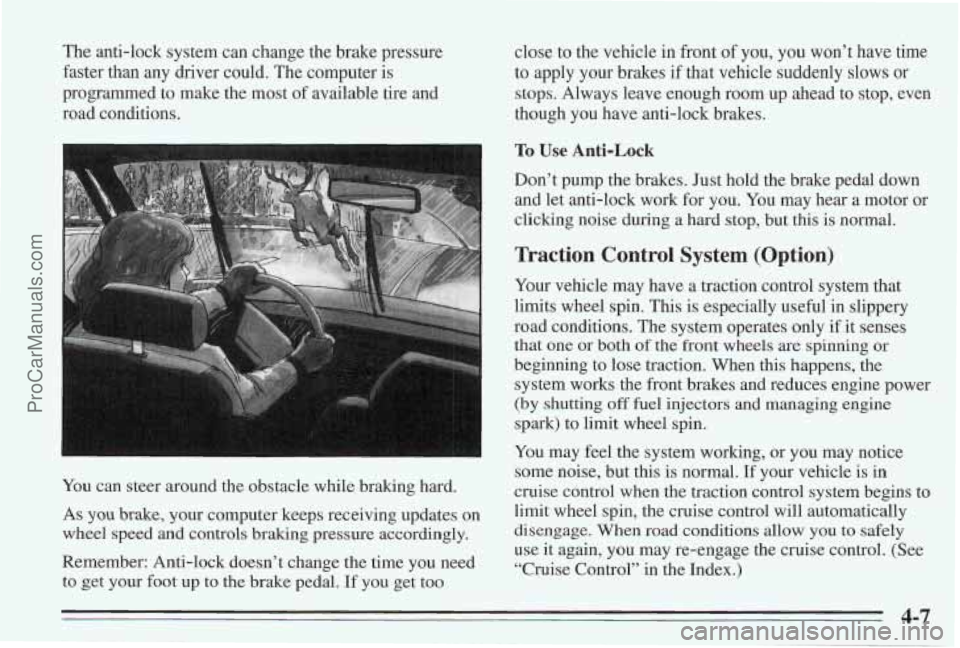
You can steer around the obstacle while braking hard.
As you brake, your computer keeps receiving updates on
wheel speed and controls braking pressure accordingly.
Remember: Anti-lock doesn’t change the time you need
to get your foot up to the brake pedal. If you get too close to
the vehicle in front of you,
you won’t have time
to apply your brakes if that vehicle suddenly slows or
stops. Always leave enough room up ahead
to stop, even
though you have anti-lock brakes.
To Use Anti-Lock
Don’t pump the brakes. Just hold the brake pedal down
and let anti-lock work for you.
You may hear a motor or
clicking noise during a hard stop, but this is normal.
Traction Control System (Option)
Your vehicle may have a traction control system that
limits wheel
spin. This is especially useful in slippery
road conditions. The system operates only if it senses
that one or
both of the front wheels are spinning or
beginning to lose traction. When this happens, the
system works the front brakes and reduces engine power
(by shutting off fuel injectors and managing engine
spark) to limit wheel spin.
You may feel the system working, or you may notice
some noise, but this is normal. If your vehicle is in
cruise control when the traction control system begins to
limit wheel spin, the cruise control will automatically
disengage. When road conditions allow you
to safely
use it again, you may re-engage the cruise control. (See
“Cruise Control” in the Index.)
4-7
ProCarManuals.com
Page 152 of 338
Braking in Emergencies
Use your anti-lock braking system when you need to.
With anti-lock, you can steer and brake at the same
time. In many emergencies, steering can help you more
than even the very best braking.
Steering
Power Steering
If you lose power steering assist because the engine
stops or the system is not functioning, you can steer but
it will take much more effort.
Variable Effort Steering
If your vehicle is equipped with this option, you have a
variable
effort steering system that eases steering effort
at speeds less than 20 mph (32 km/h). This is
particularly useful when parking your vehicle.
Steering Tips
Driving on Curves
It’s important to take curves at a reasonable speed.
A lot of the “driver lost control” accidents mentioned on
the news happen on curves. Here’s why: Experienced driver
or beginner, each
of us is subject to
the same laws
of physics when driving on curves. The
traction of the tires against the road surface makes it
possible for the vehicle to change its path when you turn
the front wheels. If there’s no traction, inertia will keep
the vehicle going in the same direction.
If you’ve ever
tried
to steer a vehicle on wet ice, you’ll understand this.
The traction you can get in a curve depends
on the
condition
of your tires and the road surface, the angle at
which the curve is banked, and your speed. While you’re
in a curve, speed is the one factor you can control.
Suppose you’re steering through a sharp curve. Then you
suddenly accelerate. Both control systems
-- steering and
acceleration
-- have to do their work where the tires meet
the road. Unless you have traction control and the system
is on, adding the sudden acceleration can demand too
much of those places. You can lose control.
What should you do
if this ever happens? Ease up on the
accelerator pedal, steer the vehicle the way you want
it
to go, and slow down.
Speed limit signs near curves warn that you should
adjust your speed. Of course, the posted speeds are
based on good weather and road conditions. Under less
favorable conditions you’ll want to go slower.
4-9
ProCarManuals.com
Page 156 of 338
Loss of Control
Let’s review what driving experts say about what
happens when the three control systems (brakes, steering
and acceleration) don’t have enough friction where the
tires meet
the road to do what the driver has asked.
In any emergency, don’t give up. Keep trying to steer
and constantly seek an escape route or area of less
danger.
Skidding
In a skid, a driver can lose control of the vehicle.
Defensive drivers avoid most skids by taking reasonable
care suited to existing conditions, and by not
“overdriving” those conditions. But
skids are always
possible.
The three types of skids correspond to your Pontiac’s
three control systems. In the braking skid your wheels
aren’t rolling.
In the steering or cornering skid, too
much speed or steering in a curve causes tires to slip and
lose cornering force. And in the acceleration skid too
much throttle causes the driving wheels to spin.
A cornering skid is best handled by easing your foot off
the accelerator pedal.
If you have the traction control system, remember: It
helps avoid only the acceleration skid.
If you do not have traction control, or if the system is
off, then an acceleration skid is also best handled by
easing your foot off the accelerator pedal.
If your vehicle starts to slide, ease your foot
off the
accelerator pedal and quickly steer the way
you want the
vehicle to go. If you start steering quickly enough, your
vehicle may straighten out. Always be ready for a
second skid if it occurs.
Of course, traction is reduced when water, snow, ice,
gravel, or other material is on the road. For safety, you’ll
want
to slow down and adjust your driving to these
conditions. It
is important to slow down on slippery
surfaces because stopping distance
will be longer and
vehicle control more limited.
While driving on a surface with reduced traction, txy your
best to avoid sudden steering, acceleration, or braking
(including engine braking by shifting to a lower gear).
Any sudden changes could cause
the tires to slide. YOU
may not realize the surface is slippery until your vehicle
is skidding. Leam to recognize warning clues -- such as
enough water, ice or packed snow on
the road to make a
“mirrored surface”
-- and slow down when you have
any doubt.
Remember: Any anti-lock brake system (ABS) helps
avoid only the braking
skid.
4-13 ProCarManuals.com
Page 164 of 338
Once you are moving on the freeway, make certain you
allow a reasonable following distance. Expect to move
slightly slower
at night.
When you want to leave the freeway, move to the proper
lane well in advance.
If you miss your exit do not, under
any circumstances, stop and back up. Drive on to the
next exit.
The exit ramp can be curved, sometimes quite sharply.
The exit speed is usually posted.
Reduce your speed according to your speedometer, not
to your sense
of motion. After driving for any distance
at higher speeds, you may tend to think you are going
slower than you actually are.
Before Leaving on a Long Trip
Make sure you’re ready. Try to be well rested. If you
must start when you’re not fresh
-- such as after a day’s
work
-- don’t plan to make too many miles that first part
of the journey. Wear comfortable clothing and shoes you
can easily drive in.
Is your vehicle ready for a long trip? If you keep it
serviced and maintained, it’s ready to go. If it needs
service, have
it done before starting out. Of course,
you’ll find experienced and able service experts in Pontiac dealerships
all across North America. They’ll be
ready and willing to help if you need it.
Here are some things you can check before a trip:
0
0
0
e
0
0
0
Windshield Washer Fluid: Is the reservoir full? Are
all windows clean inside and outside?
Wiper Blades: Are they in good shape?
Fuel, Engine Oil, Other Fluids: Have you checked
all levels?
Lamps: Are they all working? Are the lenses clean?
Tires: They are vitally important to a safe,
trouble-free trip.
Is the tread good enough for
long-distance driving? Are the tires all inflated
to the
recommended pressure?
Weather Forecasts: What’s the weather outlook
along your route? Should you delay your trip a short
time to avoid a major storm system?
Maps: Do you have up-to-date maps?
4-21
ProCarManuals.com