tire pressure PONTIAC BONNEVILLE 2003 User Guide
[x] Cancel search | Manufacturer: PONTIAC, Model Year: 2003, Model line: BONNEVILLE, Model: PONTIAC BONNEVILLE 2003Pages: 418, PDF Size: 20.24 MB
Page 251 of 418
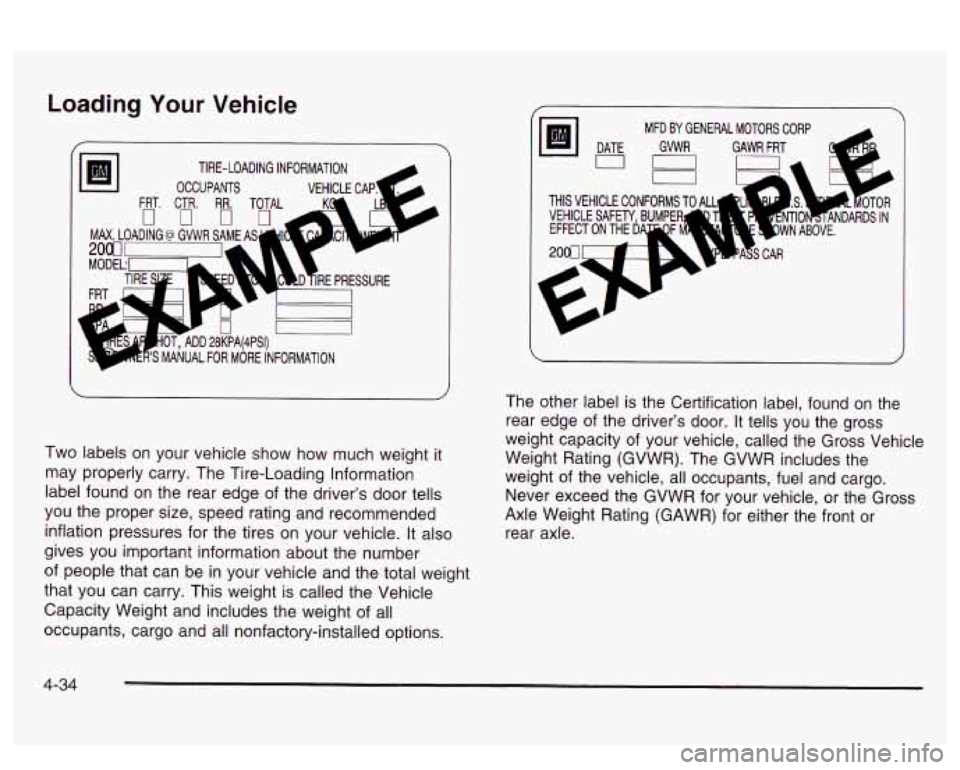
Loading Your Vehicle
Two labels on your vehicle show how much weight it
may properly carry. The Tire-Loading information
label found on the rear edge of the driver’s door tells
you the proper size, speed rating and recommended
inflation pressures for the tires on your vehicle. It also
gives you important information about the number
of people that can be in your vehicle and the total weight
that you can carry. This weight is called the Vehicle
Capacity Weight and includes the weight of all
occupants, cargo and all nonfactory-installed options.
THIS VEHICLE CONFORMS
VEHICLE
SAFETY BUMPER
The other label is the Certification label, found on the
rear edge of the driver’s door. It tells you the gross
weight capacity of your vehicle, called the Gross Vehicle
Weight Rating (GVWR). The GVWR includes the
weight of the vehicle, all occupants, fuel and cargo.
Never exceed the GVWR for your vehicle, or the Gross
Axle Weight Rating (GAWR) for either the front or
rear axle.
4-34
Page 261 of 418
Section 5 Service and Appearance Care
Windshield Wiper Blade Replacement ............. 5-61
Tires .............................................................. 5.62
Inflation
.. Tire Pressure ................................ 5.62
Check Tire Pressure System
.......................... 5.64
Tire Inspection and Rotation
........................... 5.65
When It
Is Time for New Tires ....................... 5-67
Buying New Tires
........................................ 5-67
Uniform Tire Quality Grading
.......................... 5.68
Wheel Replacement
...................................... 5.69
Tire Chains
.................................................. 5-71
Accessory Inflator
......................................... 5.72
If a Tire Goes Flat ........................................ 5.72
Changing a Flat Tire
..................................... 5.73
Compact Spare Tire
..................................... 5-81
Appearance Care ............................................ 5.82
Wheel
Alignment and Tire Balance
.................. 5-69
Cleaning the Inside of Your Vehicle
................. 5-82
Care of Safety Belts
...................................... 5-85
Weatherstrips ............................................... 5.85
Cleaning the Outside of Your Vehicle .............. 5-85
Sheet Metal Damage
..................................... 5.87
Finish Damage
............................................. 5.87
Underbody Maintenance
................... ...... 5.87
Chemical Paint Spotting
................................. 5.88
Vehicle Identification ..................................... 5-90
Vehicle Identification Number (VIN)
...... ., ...... 5-90
Service Parts Identification Label
........ ...... 5-90
Electrical System ............................... ...... 5-91
Add-on Electrical Equipment
................ , ...... 5-91
Headlamp Wiring
.......................................... 5-91
Windshield Wiper Fuses
................................ 5-91
Power Windows and Other Power Options
....... 5-91
Fuses and Circuit Breakers
............................ 5-92
Removing the Rear Seat Cushion
................... 5-95
Capacities and Specifications ........................ 5-100
Normal Maintenance Replacement Parts ......... 5-101
GM Vehicle Care/Appearance Materials .......... 5.88
5-2
Page 321 of 418
Tires
Your new vehicle comes with high-quality tires made by
a leading tire manufacturer.
If you ever have questions
about your tire warranty and where to obtain service,
see your
P tiac Warranty booklet for details.
Poorly maintained and improperly used
Overloading your tires can cause
tires are dangerous.
overheating as a result of too much
friction. You could have an air-out and a
serious accident. See ”Loading Your
Vehicle”
in the Index.
Underinflated tires pose the same danger
as overloaded tires. The resulting accident
could cause serious injury. Check all tires
frequently to maintain the recommended
pressure. Tire pressure should be checked
when your tires are cold.
CAUTION: (Continued)
Overinflated tires are more likely be
cut, punctured or broken by a sudden impact
- such as when you hit a pothole.
Keep tires at the recommended pressure.
If your tread is badly worn, or if your tires
have been damaged, replace them. See
”Inflation
- Tire Pressure” in this section
for inflation pressure adjustment for higher
speed driving.
Worn, old tires can cause accidents.
Inflation -- Tire Pressure
The Tire-Loading Information label, which is on the rear
edge of the driver’s door, shows the correct inflation
pressures for your tires when they’re cold.
“Cold” means
your vehicle has been sitting for at least three hours
or driven no more than
1 mile (1.6 km).
If you’ll be driving at high speeds (e.g., speeds
of
100 mph (160 km/h) or higher), where it is legal,
set the cold inflation pressure to the maximum
inflation pressure shown on the tire sidewall, or
to
35 psi (244 kPa), whichever is lower.
5-62
Page 322 of 418
See the example below. When you end this high-speed
driving, return to the cold inflation pressure shown on
the Tire-Loading Information label.
Example:
You’ll find maximum load and inflation pressure molded
on the tire’s sidewall, in small letters near the rim
flange. It will read something like this: Maximum load
690
kg (1521 Ibs) @ 300 kPa (44 psi) Max. Press.
For this example, you would set the inflation pressure
for high-speed driving at
35 psi (244 kPa).
Notice: Don’t let anyone tell you that underinflation
or overinflation
is all right. It’s not. If your tires
don’t have enough air (underinflation), you can get
the following:
Too much flexing
Too much heat
Tire overloading
Bad wear
Bad handling
Bad fuel economy
If your tires have too much air (overinflation), you
can get the following:
Unusual wear
Bad handling
Rough ride
Needless damage from road hazards
When to Check
Check your tires once a month or more.
Don’t forget your compact spare tire. It should be at
60 psi (420 kPa).
How to Check
Use a good quality pocket-type gage to check tire
pressure. You can’t tell
if your tires are properly inflated
simply by looking at them. Radial tires may look
properly inflated even when they’re underinflated.
Be sure to put the valve caps back
on the valve stems.
They help prevent leaks by keenin9 out dirt and
moisture.
5-63
Page 323 of 418
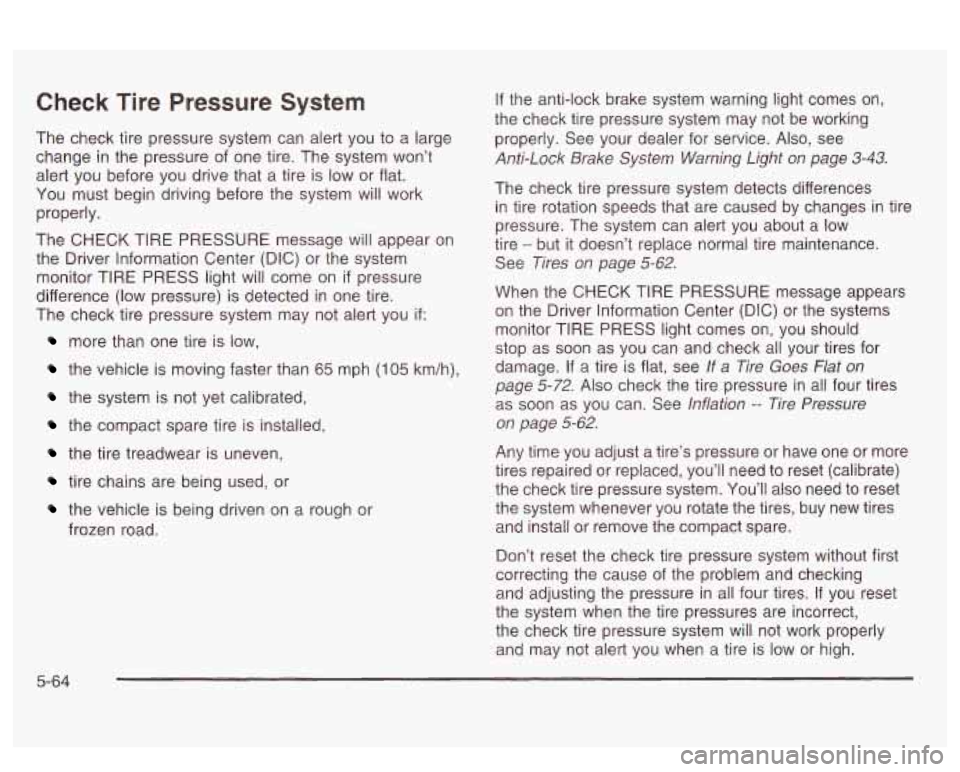
Check Tire Pressure System
The check tire pressure system can alert you to a large
change in the pressure of one tire. The system won’t
alert you before you drive that a tire is low or flat.
You must begin driving before the system will work
properly.
The CHECK TIRE PRESSURE message will appear on
the Driver Information Center (DIC) or the system
monitor TIRE PRESS light will come on
if pressure
difference (low pressure) is detected in one tire.
The check tire pressure system may not alert you
if:
more than one tire is low,
the vehicle is moving faster than 65 mph (105 km/h),
the system is not yet calibrated,
the compact spare tire is installed,
the tire treadwear is uneven,
tire chains are being used, or
the vehicle is being driven on a rough or
frozen road. If
the anti-lock brake system warning light comes on,
the check tire pressure system may not be working
properly. See your dealer for service. Also, see
Anti-Lock Brake System Warning Light on page 3-43.
The check tire pressure system detects differences
in tire rotation speeds that are caused by changes in tire
pressure. The system can alert you about a low
tire
- but it doesn’t replace normal tire maintenance.
See
Tires on page 5-62.
When the CHECK TIRE PRESSURE message appears
on the Driver Information Center (DIC) or the systems
monitor TIRE PRESS light comes on, you should
stop as soon as you can and check all your tires for
damage. If a tire is flat, see
If a Tire Goes Flat on
page
5-72. Also check the tire pressure in all four tires
as soon as you can. See
Inflation -- Tire Pressure
on page
5-62.
Any time you adjust a tire’s pressure or have one or more
tires repaired or replaced, you’ll need to reset (calibrate)
the check tire pressure system. You’ll also need to reset
the system whenever you rotate the tires, buy new tires
and install or remove the compact spare.
Don’t reset the check tire pressure system without first
correcting the cause of the problem and checking
and adjusting the pressure in all four tires.
If you reset
the system when the tire pressures are incorrect,
the check tire pressure system will not work properly
and may not alert you when a tire is low
or high.
5-64
Page 324 of 418
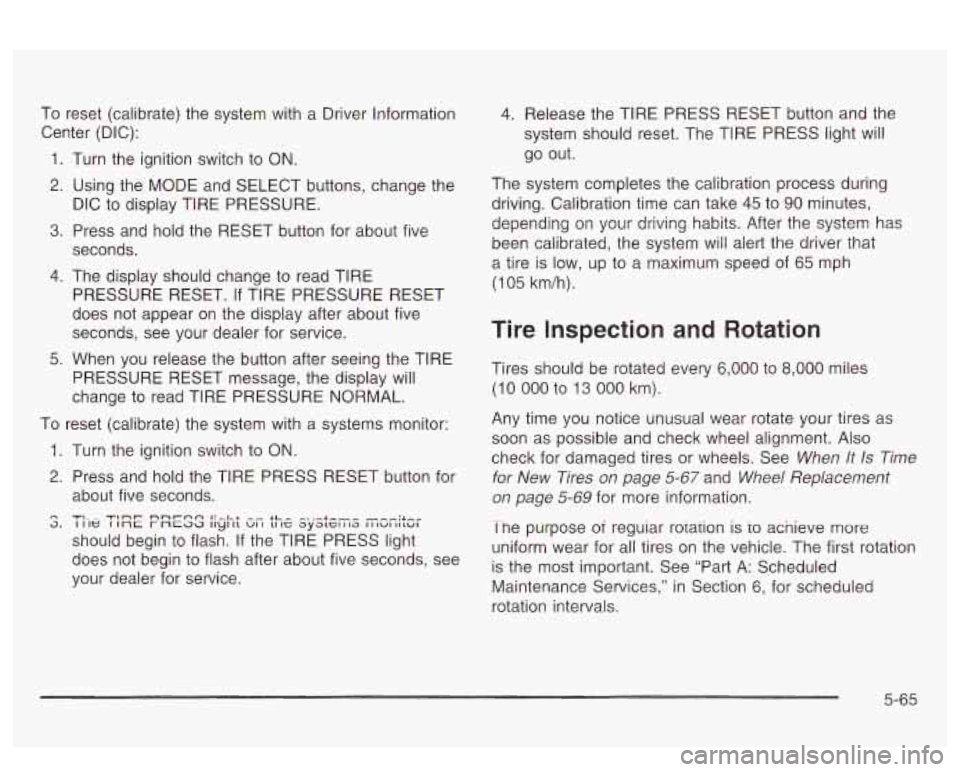
To reset (calibrate) the system with a Driver Information
Center (DIC):
1.
2.
3.
4.
5.
Turn the ignition switch to ON.
Using the MODE and SELECT buttons, change the The system Completes
the calibration process during
DIC to display TIRE PRESSURE. driving. Calibration time
can take
45 to 90 minutes, ..,
Press and hold the RESET button for about five
seconds.
The display should change to read TIRE
PRESSURE RESET. If TIRE PRESSURE RESET
does not appear on the display after about five
seconds, see your dealer for service.
When you release the button after seeing the TIRE
PRESSURE RESET message, the display will
change to read TIRE PRESSURE NORMAL.
1.
2.
4. Release the TIRE PRESS RESET button and the
system should reset. The TIRE PRESS light will
go out.
To reset (calibrate) the system with a systems monitor:
n 3.
Turn the ignition switch to ON.
Press and hold the TIRE PRESS RESET button for
about five seconds.
should begin to flash.
If the TIRE PRESS light
does not begin to flash after about five seconds, see
your dealer for service.
TIL- TI~T nnr-nn I:-.LL -- LL- -..-.I.--- I I le I 1nc r ncaa II~I 11 VI I 11 IC ayatcl I 13 I I IUI IILUI
depending on your driving habits. After the system has
been calibrated, the system will alert the driver that
a tire is low, up to a maximum speed of
65 mph
(1 05 km/h).
Tire Inspection and Rotation
Tires should be rotated every 6,000 to 8,000 miles
(10 000 to 13 000 km).
Any time you notice unusual wear rotate your tires as
soon as possible and check wheel alignment. Also
check for damaged tires or wheels. See
When It Is Time
for New Tires on page 5-67 and Wheel Replacement
on page 5-69 for more information.
Tne purpose
oi reguiar rorarion is io acnieve more
uniform wear for all tires on the vehicle. The first rotation
is the most important. See “Part A: Scheduled
Maintenance Services,” in Section
6, for scheduled
rotation intervals.
5-65
Page 325 of 418
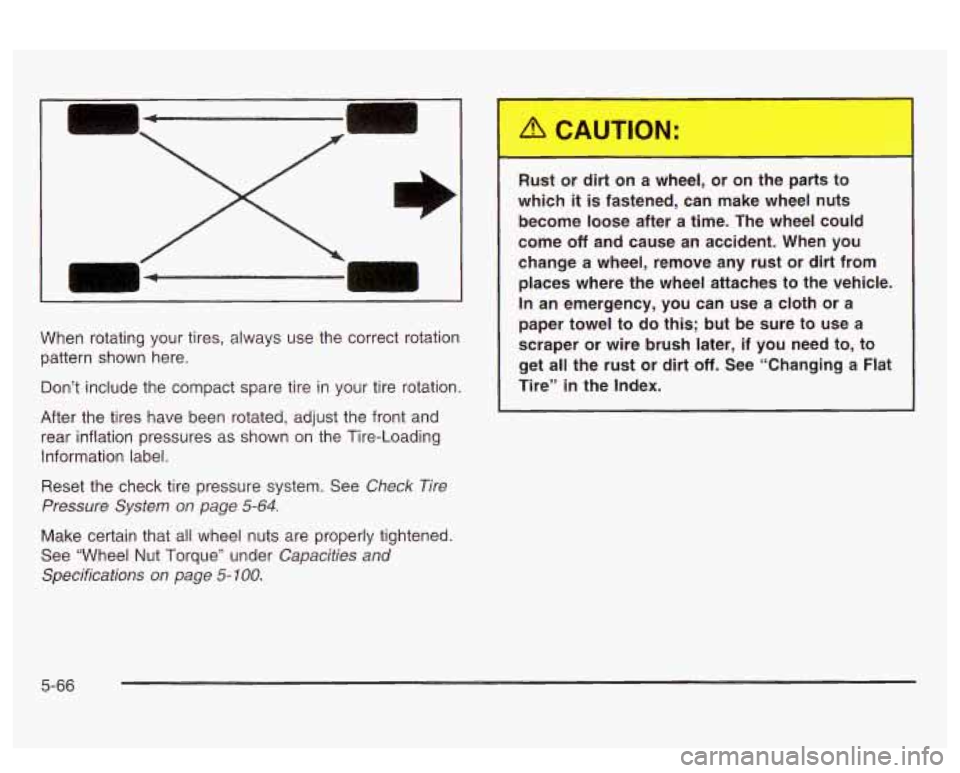
When rotating your tires, always use the correct rotation
pattern shown here.
Don’t include the compact spare tire in your tire rotation.
After the tires have been rotated, adjust the front and
rear inflation pressures as shown on the Tire-Loading
Information label.
Reset the check tire pressure system. See
Check Tire
Pressure System on page
5-64.
Make certain that all wheel nuts are properly tightened.
See “Wheel Nut Torque” under
Capacities and
Specifications on page
5- 100.
Rust or dirt on a wheel, or on the parts to
which
it is fastened, can make wheel nuts
become loose after a time. The wheel could
come
off and cause an accident. When you
change a wheel, remove any rust or dirt from
places where the wheel attaches to
the vehicle.
In an emergency, you can use a cloth or a
paper towel to do this; but be sure to use a
scraper or wire brush later, if you need
to, to
get all the rust or dirt
off. See “Changing a Flat
Tire”
in the Index.
5-66
Page 331 of 418
Accessory Inflator
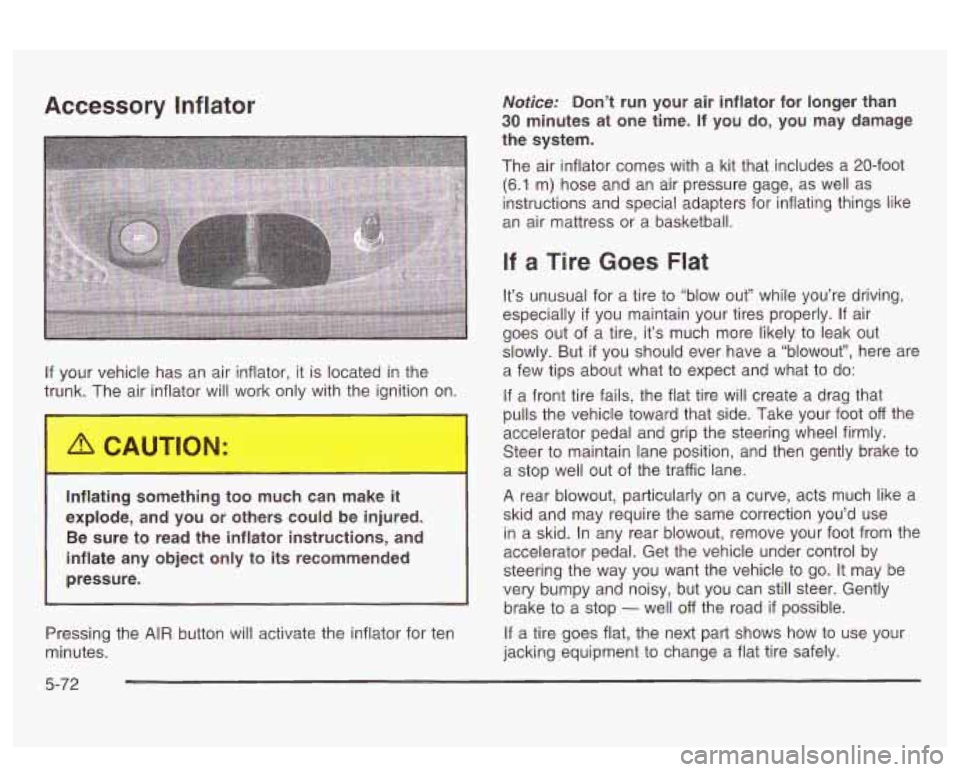
If your vehicle has an air inflator, it is located in the
trunk. The air inflator will wo only with the ignition on.
Inflating something too much can make it
explode, and you or others could be injured.
Be sure to read the inflator instructions, and
inflate any object only to its recommended
pressure.
I -1
Notice: Don’t run your air inflator for longer than
30 minutes at one time. If you do, you may damage
the system.
The air inflator comes with a kit that includes a 20-foot
(6.1 m) hose and an air pressure gage, as well as
instructions and special adapters for inflating things like
an air mattress or a basketball.
If a Tire Goes Flat
It’s unusual for a tire to “blow out” while you’re driving,
especially
if you maintain your tires properly. If air
goes out of a tire, it’s much more likely to leak out
slowly. But
if you should ever have a “blowout”, here are
a few tips about what to expect and what to do:
If a front tire fails, the flat tire will create a drag that
pulls the vehicle toward that side. Take your foot off the
accelerator pedal and grip the steering wheel firmly.
Steer to maintain lane position, and then gently brake to
a stop well out of the traffic lane.
A rear blowout, particularly on a curve, acts much like a
skid and may require the same correction you’d use
in a skid. In any rear blowout, remove your foot from the
accelerator pedal. Get the vehicle under control by
steering the way you want the vehicle to go.
It may be
very bumpy and noisy, but you can still steer. Gently
brake
to a stop - well off the road if possible.
Pressing the
AIR button will activate the inflator for ten If a tire goes flat, the next part shows how to use your
minutes. jacking equipment to change a flat tire safely.
5-72
Page 340 of 418
/
.B
C
I
I E
I I
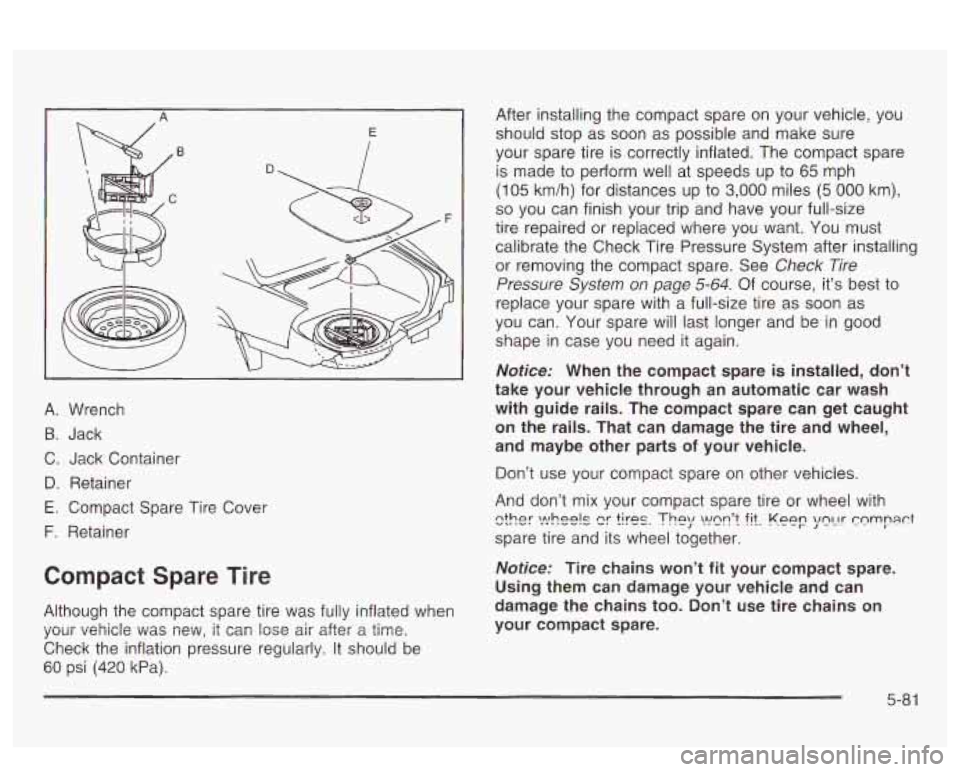
A. Wrench
B. Jack
C. Jack Container
D. Retainer
E. Compact Spare Tire Cover
F. Retainer
Compact Spare Tire
Although the compact spare tire was fully inflated when
Check the inflation pressure regularly. It should be
60 psi (420 kPa).
..^..I yuul vehicle was iievi, it mi7 lose air after a tine. After
installing the compact spare on your vehicle, you
should stop as soon as possible and make sure
your spare tire is correctly inflated. The compact spare
is made to perform well at speeds up to 65 mph
(105 km/h) for distances up to 3,000 miles (5 000 km)~
so you can finish your trip and have your full-size
tire repaired or replaced where you want. You must:
calibrate the Check Tire Pressure System after installing
or removing the compact spare. See
Check Tire
Pressure
System on page 5-64. Of course, it’s best to
replace your spare with a full-size tire as soon as
you can. Your spare will last longer and be in good
shape in case you need
it again.
Notice: When the compact spare is installed, don’t
take your vehic!e through
an automatic car wash
with guide rails. The compact spare can get caught on the rails. That can damage the tire and wheel,
and maybe other parts
of your vehicle.
Don’t use your compact spare on other vehicles.
And don’t mix your compact spare tire or wheel with
spare tire and its wheel together.
ether t!!hee!s ?irks. The;/ w~n’t fit. Kppp yncIr Cnmrpct
Nofice: Tire chains won’t fit your compact spare.
Using them can damage your vehicle and can
damage the chains too. Don’t use tire chains on
your compact spare.
5-81
Page 368 of 418
Footnotes
t The U.S. Environmental Protection Agency or the
California Air Resources Board has determined that the
failure to perform this maintenance item will not nullify
the emission warranty or limit recall liability prior to
the completion of the vehicle
's useful life. We, however,
urge that all recommended maintenance services be
performed at the indicated intervals and the
maintenance be recorded.
*If your vehicle has the GM Oil Life SystemTM,
a
computer system lets you know when to change the oil
and filter. This is based on engine revolutions and
engine temperature and not on mileage. Based
on driving conditions, the mileage at which an oil change
will be indicated can vary considerably. For the oii life
system to work properly, you must reset the system
every time the oil is changed.
When the system has calculated that oil life has been
diminished, it will indicate that an oil change is
necessary. An ENGINE
OIL CHANGE SOON message
will come on. Change your oil as soon as possible
within the next two times you stop for fuel. It is possible
that, if you are driving under the best conditions, the
oil life system may not indicate that an oil change
is necessary for over a year. However, your engine oil
and filter must be changed at least once a year and
at this time the system must be reset. It is also
important to check your oil regularly and keep it at the
proper level.
If the system is ever reset accidentally, you must
change your oil at 3,000 miles
(5 000 km) since your
last oil change. Remember to reset the oil life system
whenever the oil is changed. See Engine Oil on
page
5-15 for information on resetting the system.
@ Whenever the tires are rotated, the Check Tire
Pressure §ystem must be reset.
+A good time to check your brakes is during tire
rotation. See Brake System Inspection on page 6-23.
3,000 Miles (5 000 km)
0 Change engine oil and filter (or every 3 months,
whichever occurs first).
An Emission Control Service.
(See footnote
*.)
6,000 Miles (IO 000 km)
u
n U
Change engine oil and filter (or every 3 months,
whichever occurs first).
An Emission Control Service.
(See footnote
*.)
page 5-65 for proper rotation pattern and additional
information.
(See footnote @.) (See footnote +.)
n-4-4- r?-- -I-:-- I 4:-- -...A n-+-+:-- -- I wlalc LII ~a. UGG I 11 G 11 I~JG~LIVII a1 IU I IvLauvII VII
9,000 Miles (15 000 km)
U Change engine oil and filter (or every 3 months,
whichever occurs first).
An Emission Control Service.
(See footnote
*.)
6-7