fuel cap PONTIAC BONNEVILLE 2003 Owners Manual
[x] Cancel search | Manufacturer: PONTIAC, Model Year: 2003, Model line: BONNEVILLE, Model: PONTIAC BONNEVILLE 2003Pages: 418, PDF Size: 20.24 MB
Page 163 of 418
Find a safe place to park your vehicle. Turn the key off,
wait at least
10 seconds and restart the engine. If
the light remains on steady, see “If the Light Is On
Steady” following.
If the light is still flashing, follow the
previous steps, and drive the vehicle to your dealer
or qualified service center for service.
If the Light Is On Steady
You may be able to correct the emission system
malfunction by considering the following:
Did you recently put fuel into your vehicle?
If so, reinstall the fuel cap, making sure to fully install
the cap. See
Filling Your Tank on page 5-8. The
diagnostic system can determine
if the fuel cap has
been left
off or improperly installed. A loose or missing
fuel cap will allow fuel to evaporate into the atmosphere.
A few driving trips with the cap properly installed
should turn the light off.
Did you just drive through a deep puddle of water?
If so, your electrical system may be wet. The condition
will usually be corrected when the electrical system
dries out.
A few driving trips should turn the light off.
Have you recently changed brands of fuel?
If so, be sure to fuel your vehicle with quality fuel. See
Gasoline Octane on page 5-5. Poor fuel quality will
cause your engine not to run as efficiently as designed.
You may notice this as stalling after start-up, stalling
when you put the vehicle into gear, misfiring, hesitation
on acceleration or stumbling on acceleration. (These
conditions may go away once the engine is warmed up.)
This will be detected by the system and cause the
light to turn on.
If you experience one or more of these conditions,
change the fuel brand you use. It will require at least
one full tank of the proper fuel to turn the light off.
If none of the above steps have made the light turn
off,
have your dealer or qualified service center check
the vehicle. Your dealer has the proper test equipment
and diagnostic tools to fix any mechanical or electrical
problems that may have developed.
Emissions Inspection and Maintenance
Programs
Some state/provincial and local governments have or
may begin programs to inspect the emission control
equipment on your vehicle. Failure to pass this
inspection could prevent you from getting a vehicle
registration.
3-48
Page 169 of 418
On vehicles with a DIC, the CHECK GAGES LOW
FUEL message will be displayed when the fuel gage
reads
in the yellow band. See DIC Warnings and
Messages on page
3-60 for more information.
Here are some things that owners ask about. None of
these show a problem with your fuel gage:
At the service station, the gas pump shuts off
before the gage reads full.
It takes a little more (or less) fuel to fill up than the
gage indicated. For example, the gage may have
indicated the tank was half full, but it actually took a
little more (or less) than half the tank’s capacity
to
fill the tank.
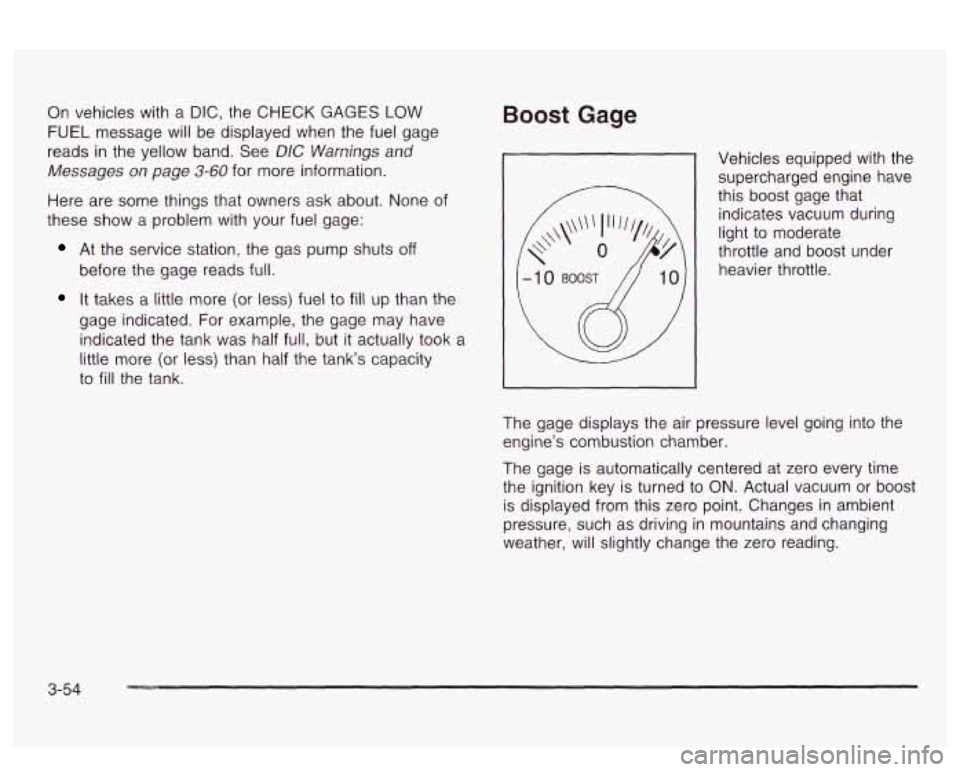
Boost Gage
Vehicles equipped with the supercharged engine have
this boost gage that
indicates vacuum during
light to moderate
throttle and boost under
heavier throttle.
The gage displays the air pressure level going into the
engine’s combustion chamber.
The gage is automatically centered at zero every time
the ignition key is turned to
ON. Actual vacuum or boost
is displayed from this zero point. Changes in ambient
pressure, such as driving in mountains and changing
weather, will slightly change the zero reading.
3-54
Page 175 of 418
DIC Warnings and Messages
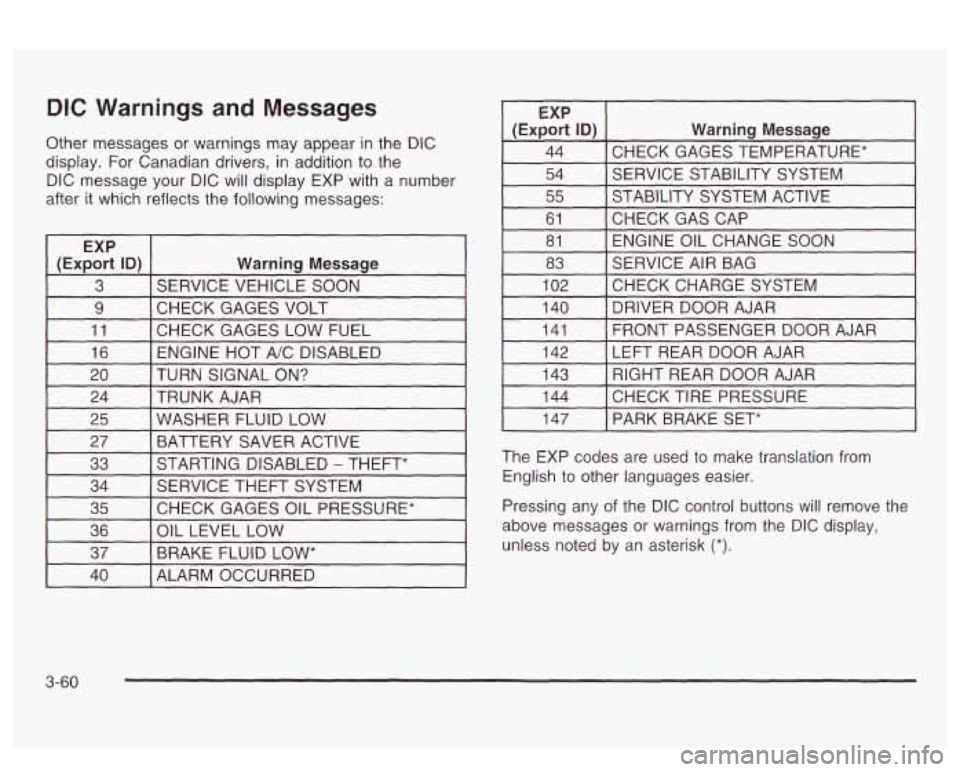
Other messages or warnings may appear in the DIC
display. For Canadian drivers, in addition to the
DIC message your DIC will display EXP with a number
after it which reflects the following messages:
~
EXP
(Export
ID) Warning Message
3 SERVICE VEHICLE SOON
9 I CHECK GAGES VOLT I I
11 [CHECK GAGES LOW FUEL 1
16 I ENGINE HOT A/C DISABLED I
EXP
(Export
ID) Warning Message
44 CHECK GAGES TEMPERATURE* ~~ ~
54 SERVICE STABILITY SYSTEM
55 STABILITY SYSTEM ACTIVE
61 ENGINE OIL CHANGE SOON
81
CHECKGASCAP
83
CHECKCHARGESYSTEM
102 SERVICE
AIR BAG
I 140 I DRIVER DOOR AJAR I
141
LEFT REAR DOOR AJAR
142 FRONT PASSENGER
DOOR AJAR
20 TRUNK AJAR
24 TURN SIGNAL
ON? 143
CHECK TIRE PRESSURE 144 RIGHT REAR DOOR AJAR
25 BATTERY SAVER ACTIVE
27
WASHER FLUID LOW
33
CHECK GAGES OIL PRESSURE*
35 SERVICE
THEFT SYSTEM
34 STARTING DISABLED
- THEFT*
36
BRAKE FLUID
LOW* 37
OIL
LEVEL LOW
I 147 I PARK BRAKE SET*
The EXP codes are used to make translation from
English to other languages easier.
Pressing any of the DIC control buttons
will remove the
above messages or warnings from the DIC display,
unless noted by an asterisk
(*).
40 I ALARM OCCURRED
3-60
Page 251 of 418
Loading Your Vehicle
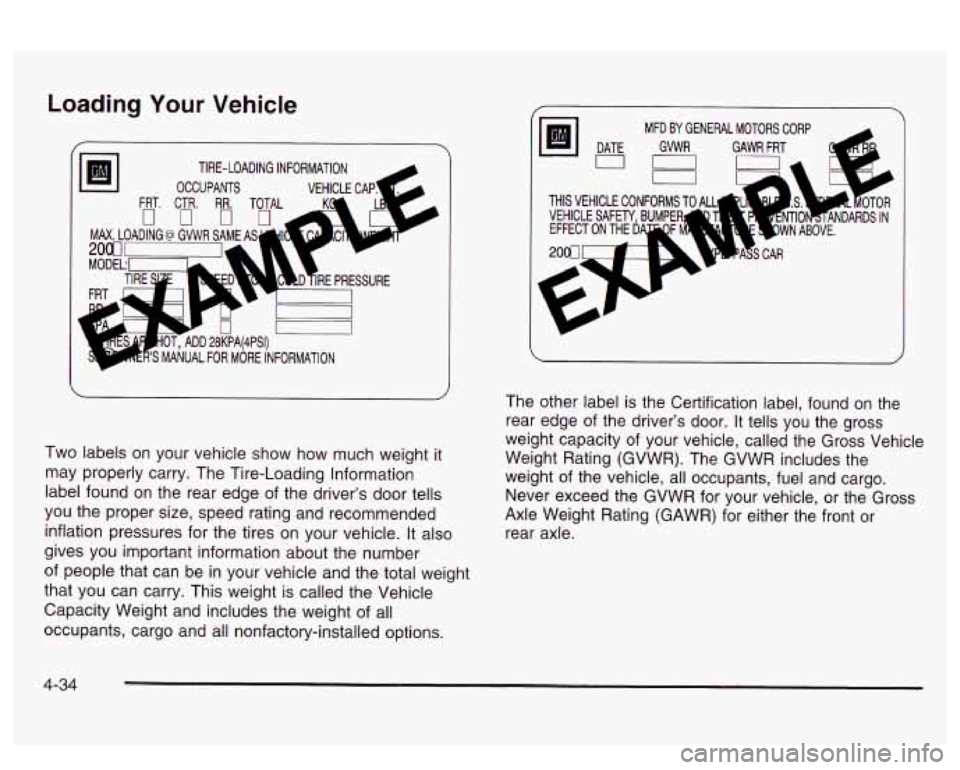
Two labels on your vehicle show how much weight it
may properly carry. The Tire-Loading information
label found on the rear edge of the driver’s door tells
you the proper size, speed rating and recommended
inflation pressures for the tires on your vehicle. It also
gives you important information about the number
of people that can be in your vehicle and the total weight
that you can carry. This weight is called the Vehicle
Capacity Weight and includes the weight of all
occupants, cargo and all nonfactory-installed options.
THIS VEHICLE CONFORMS
VEHICLE
SAFETY BUMPER
The other label is the Certification label, found on the
rear edge of the driver’s door. It tells you the gross
weight capacity of your vehicle, called the Gross Vehicle
Weight Rating (GVWR). The GVWR includes the
weight of the vehicle, all occupants, fuel and cargo.
Never exceed the GVWR for your vehicle, or the Gross
Axle Weight Rating (GAWR) for either the front or
rear axle.
4-34
Page 253 of 418
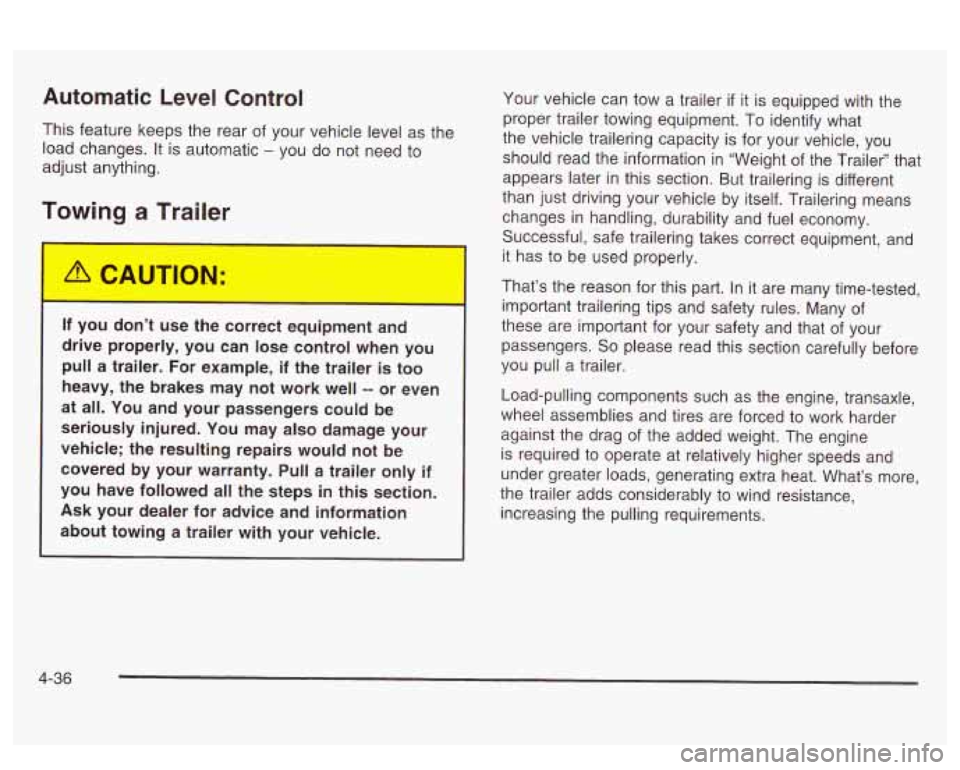
Automatic Level Control
This feature keeps the rear of your vehicle level as the
load changes. It is automatic
- you do not need to
adjust anything.
Towing a Trailer
If you don’t use orr ~ - t equiprr It and
drive properly, you can lose control when you
pull a trailer. For example, if the trailer
is too
heavy, the brakes may not work well
-- or even
at all. You and your passengers could be
seriously injured. You may also damage your
vehicle; the resulting repairs would not be covered by your warranty. Pull a trailer only if
you have followed all the steps in this section.
Ask your dealer for advice and information
about towing a trailer with your vehicle. Your
vehicle can tow a trailer
if it is equipped with the
proper trailer towing equipment. To identify what
the vehicle trailering capacity is for your vehicle, you
should read the information in “Weight of the Trailer” that
appears later in this section. But trailering is different
than just driving your vehicle by itself. Trailering means
changes in handling, durability and fuel economy.
Successful, safe trailering takes correct equipment, and
it has to be used properly.
That’s the reason for this part. In it are many time-tested,
iq3Ortant trailering tips and safety rules. Many of
these are important for your safety and that
of your
passengers. So please read this section carefully before
you pull a trailer.
Load-pulling components such as the engine, transaxle,
wheel assemblies and tires are forced to work harder
against the drag of the added weight. The engine
is required to operate at relatively higher speeds and
under greater loads, generating extra heat. What’s more,
the trailer adds considerably to wind resistance,
increasing the pulling requirements.
4-36
Page 260 of 418
Section 5 Service and Appearance Care
Service ........................................................ 5.3
Doing Your Own Service Work
......................... 5.3
Adding Equipment to the Outside
of Your
Vehicle
...................................................... 5.4
Fuel ................................................................ 5.5
Gasoline Octane
............................................ 5.5
Gasoline Specifications
.................................... 5.6
California Fuel
............................................... 5.6
Additives
....................................................... 5.6
Fuels in Foreign Countries
............................ 5.7
Filling Your Tank
........................... .......... 5.8
Filling
a Portable Fuel Container ..... .... 5.11
the Hood ............................. .... 5.12
Hood Release
.............................. ........ 5.13
Engine Compartment Overview ...................... -5-1 4
Checking Things Under
Engine Oil ................................................... 5.15
Supercharger Oil .......................................... 5.21
Engine Air Cleaner/t-llter
................................ 5-22
Automatic Transaxle Fluid .............................. 5.23
Engine Coolant
............................................. 5.26
Radiator Pressure Cap
.................................. 5.29
Engine Overheating
....................................... 5.29
Cooling System
............................................ 5.32
Power Steering Fluid
..................................... 5.40
Windshield Washer Fluid
................................ 5.40
Brakes
........................................................ 5.42
Battery
........................................................ 5-44
Jump Starting
............................................... 5-46
Headlamp Aiming .......................... ...... 5.52
Bulb Replacement .................................. -5-56
Halogen Bulbs
.............................................. 5.56
Headlamps
.................................................. 5.56
Front Turn Signal and Parking Lamps
.............. 5-57
Taillamps, Turn Signal, Stoplamps and
Back-up Lamps
......................................... 5-59
fiepiacement
Euibs 3.w - ^^ .......................................
5- I
Page 267 of 418
Filling Your Tank
A CAUTION:
Fuel 1 )or is highly flammable. It burns
violently, and that can cause very bad injuries.
Don’t smoke if you’re near fuel or refueling
your vehicle. Keep sparks, flames and smoking
materials away from fuel.
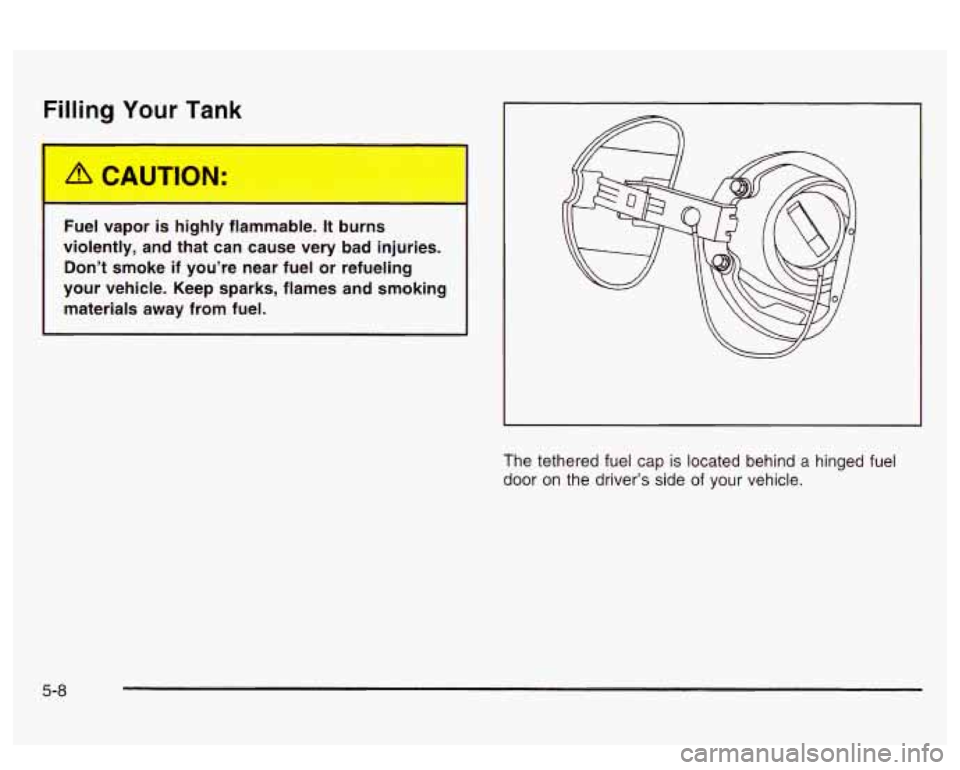
The tethered fuel cap is located behind a hinged fuel
door on the driver’s side of your vehicle.
5-8
Page 268 of 418
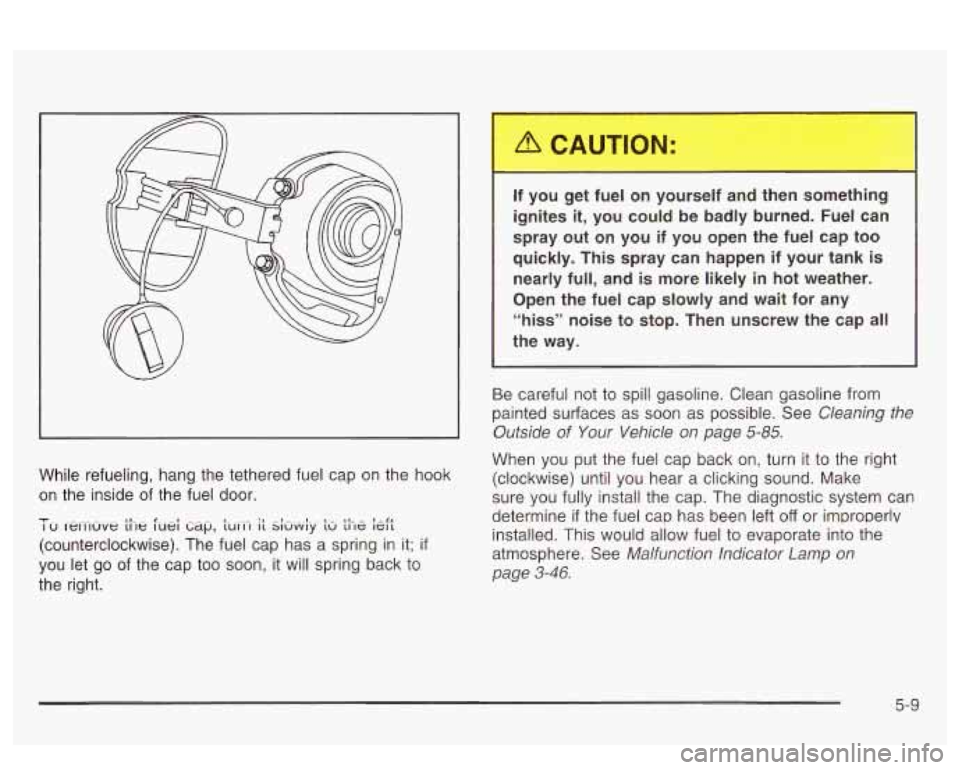
While refueling, hang the tethered fuel cap on the hook
on the inside of the fuel door.
-I- I u rewluve t11e luei ti~~p, ~UCI-I it Si&y t~ the kft I,- - 1
(counterclockwise). The fuel cap has a spring in it; if
you let go of the cap too soon, it will spring back to
the right. If you get fuel on yourself and
then something
ignites
it, you could be badly burned. Fuel can
spray out on you if you open the fuel cap too
quickly. This spray can happen if your tank is nearly full, and is more likely in hot weather.
Open the fuel cap slowly and wait for any
“hiss” noise to stop. Then unscrew the cap
all
the way.
Be careful not to spill gasoline. Clean gasoline from
painted surfaces as soon as possible. See
Cleaning the
Outside
of Your Vehicle on page 5-85.
When you put the fuel cap back on, turn it to the right
(clockwise) until you hear a clicking sound. Make
sure you fully install the cap. The diagnostic system can
determine
if the fuel cap has been left off or improperlv
installed. This would allow fuel to evaporate into the
atmosphere. See
Malfunction Indicator Lamp on
page
3-46.
5-9
Page 269 of 418
If your vehicle has the optional Driver Information
Center (DIC), the CHECK
GAS CAP message will be
displayed
if the fuel cap is not properly reinstalled.
Notice: If you need a new fuel cap, be sure to get
the right type. Your dealer can get one for you.
If you get the wrong type,
it may not fit properly.
This may cause your malfunction indicator lamp to
light and may damage your fuel tank and emissions
system. See “Malfunction Indicator Lamp” in
the Index.
Fuel Door Lock
On models having the optional theft-deterrent system,
the fuel door is locked and unlocked together with
the driver’s power door lock.
To unlock the fuel filler
door, use the power door lock button or the remote
keyless entry transmitter (if equipped). If your
vehicle has a fuel door lock, the fuel door can be
opened manually
in case of an electrical power
failure.
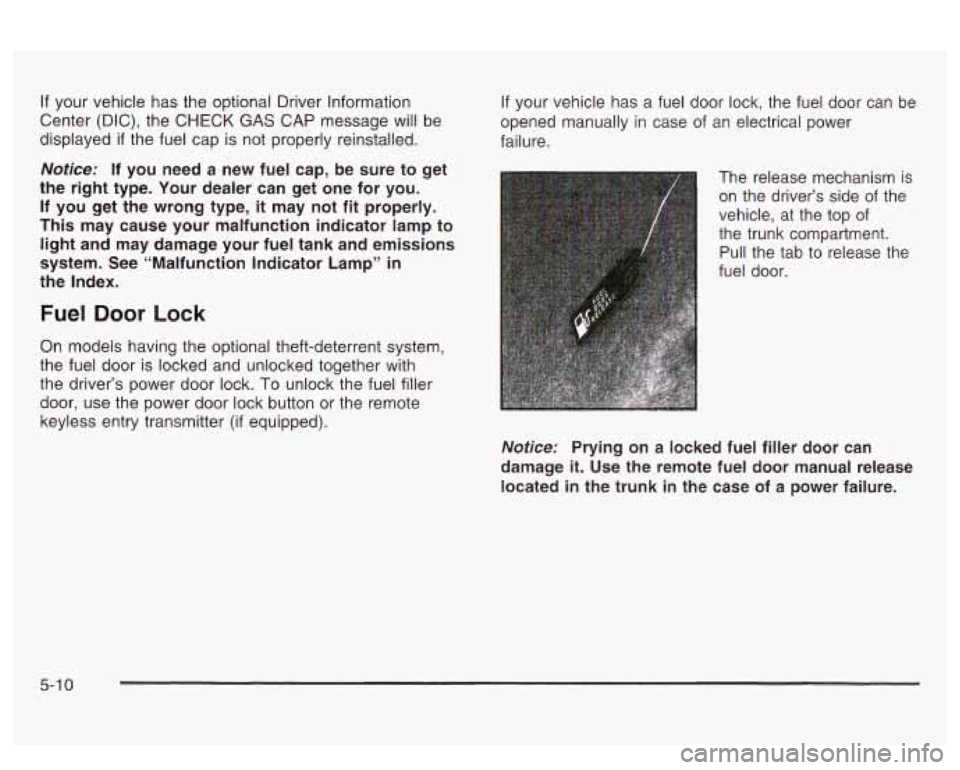
The release mechanism is on the driver’s side of the
vehicle, at the top of
the trunk compartment.
Pull the tab to release the
fuel door.
Notice: Prying on a locked fuel filler door can
damage
it. Use the remote fuel door manual release
located in the trunk in the case of a power failure.
5-1 0
Page 275 of 418
Checking Engine Oil
It’s a good idea to check your engine oil every time you
get fuel. In order to get an accurate reading, the oil
must be warm and the vehicle must be on level ground. Turn
off the engine
and give the oil several minutes to
drain back into the oil pan.
If you don’t, the oil
dipstick might not show the actual level.
Pull out the dipstick and clean it with a paper towel or
cloth, then push
it back in all the way. Remove it again,
keeping the tip down, and check the level.
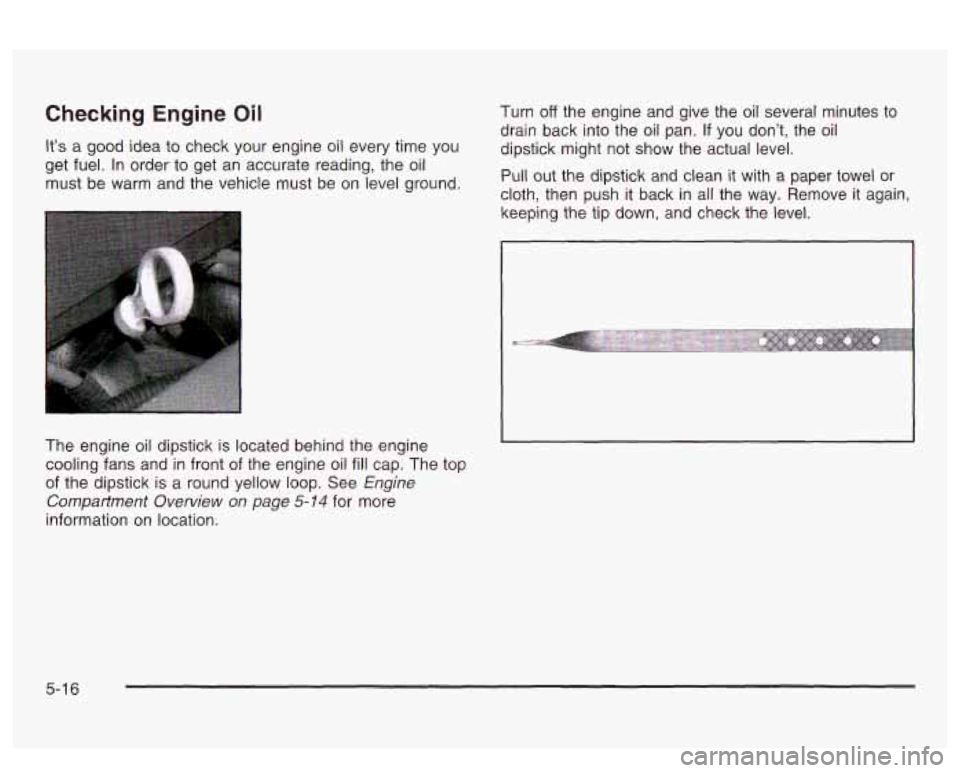
The engine oil dipstick is located behind the engine
cooling fans and in front of the engine
oil fill cap. The top
of the dipstick is a round yellow loop. See
Engine
Comparfment Overview on page 5-74 for more
information on location.
I I
5-1 6