heater PONTIAC BONNEVILLE 2003 Owners Manual
[x] Cancel search | Manufacturer: PONTIAC, Model Year: 2003, Model line: BONNEVILLE, Model: PONTIAC BONNEVILLE 2003Pages: 418, PDF Size: 20.24 MB
Page 66 of 418
Section 2 Features and Controls
Keys ............................................................... 2.3
Remote Keyless Entry System
......................... 2.5
Remote Keyless Entry System Operation
........... 2.6
Doors and Locks ............................................ 2.10
Door Locks
.................................................. 2.10
Central Door Unlocking System
...................... 2-1 1
Power Door Locks ........................................ 2-11
Programmable Automatic
Delayed Locking
........................................... 2-12
Door Locks
................................. ....... 2-13
Rear Door Security Locks
.............................. 2-15
Lockout Protection
........................................ 2-15
Leaving Your Vehicle
.................................... 2-16
Trunk
.......................................................... 2-16
Windows ........................................................ 2-19
Power Windows
............................................ 2-20
Sun Visors
.......... .............................. 2.20
Theft-Deterrent Systems .................. .... 2.21
Universal Theft-Deterrent
............................... 2.21
Content Theft-Deterrent
................................. 2.22
PASS-Key@
I I I Operation ............................... 2-23
Starting and Operating Your Vehicle ................ 2-25
New Vehicle Break-In
................................... -2-25
Ignition Positions
.......................................... 2-25
Starting Your Engine
.................. ............ 2-26
Engine Coolant Heater
........... ........... -2-27
Automatic Transaxle Operation
....................... 2-28
Parking Brake
.............................................. 2-31
Shifting Into Park (P)
..................................... 2-32
Engine Exhaust
............................................ 2-36
Running Your Engine While You Are Parked
.... 2-36
PASS-Key@
Ill .............................................. 2-22
Shifting Out
of Park (P) ................................. 2-35
Parking Over Things That Burn
....................... 2-35
2-
1
Page 92 of 418
Notice: Holding your key in START for longer than
15 seconds at a time will cause your battery to
be drained much sooner. And the excessive heat
can damage your starter motor. Wait about
15
seconds between each try to help avoid draining
your battery
or damaging your starter.
2. If it doesn’t start within 10 seconds, hold your key in
START for about
10 seconds at a time until your
engine starts. Wait about 15 seconds between
each try.
stops), it could be flooded with too much gasoline.
Try pushing your accelerator pedal all the way to the
floor and holding it there as you hold the key
in
START for about three seconds. If the vehicle starts
briefly but then stops again, do the same thing.
This time keep the pedal down for five or six
seconds to clear the extra gasoline from the engine.
After waiting about 15 seconds, repeat the normal
starting procedure.
3. If your engine still won’t start (or starts but then
Notice: Your engine is designed to work with the
electronics
in your vehicle. If you add electrical
parts or accessories, you could change the way the
engine operates. Before adding electrical equipment,
check with your dealer. If you don’t, your engine might not perform properly.
Engine Coolant Heater
If your vehicle has this feature, in very cold weather,
0°F (-18°C) or colder, the engine coolant heater
can help. You’ll get easier starting and better fuel
economy during engine warm-up. Usually, the coolant
heater should be plugged in a minimum of four
hours prior to starting your vehicle. At temperatures
above
32°F (OOC), use of the coolant heater is not
required.
2-27
Page 93 of 418
To Use the Engine Coolant Heater
1. Turn off the engine.
2. Open the hood and unwrap the electrical cord.
The engine coolant heater cord is located on the
passenger’s side of the vehicle, above the
headlamp assembly.
3. Plug it into a normal, grounded 1 IO-volt AC outlet.
Plu ing the cord into an
L Jrounded outlet
could cause an electrical shock.
Also, the
wrong kind of extension cord could overheat
and cause a fire. You could
be seriously
injured. Plug the cord into a properly grounded
three-prong 110-volt
AC outlet. If the cord
won’t reach, use a heavy-duty three-prong
extension cord rated for at least 15 amps.
4. Before starting the engine, be sure to unplug and
store the cord
as it was before to keep it away
from moving engine parts.
If you don’t, it could be
damaged. How long should
you keep the coolant heater plugged
in? The answer depends
on the outside temperature, the
kind of oil you have, and some other things. Instead
of trying to list everything here, we ask that you contact
your dealer in the area where you’ll be parking your
vehicle. The dealer can give you the best advice for that
particular area.
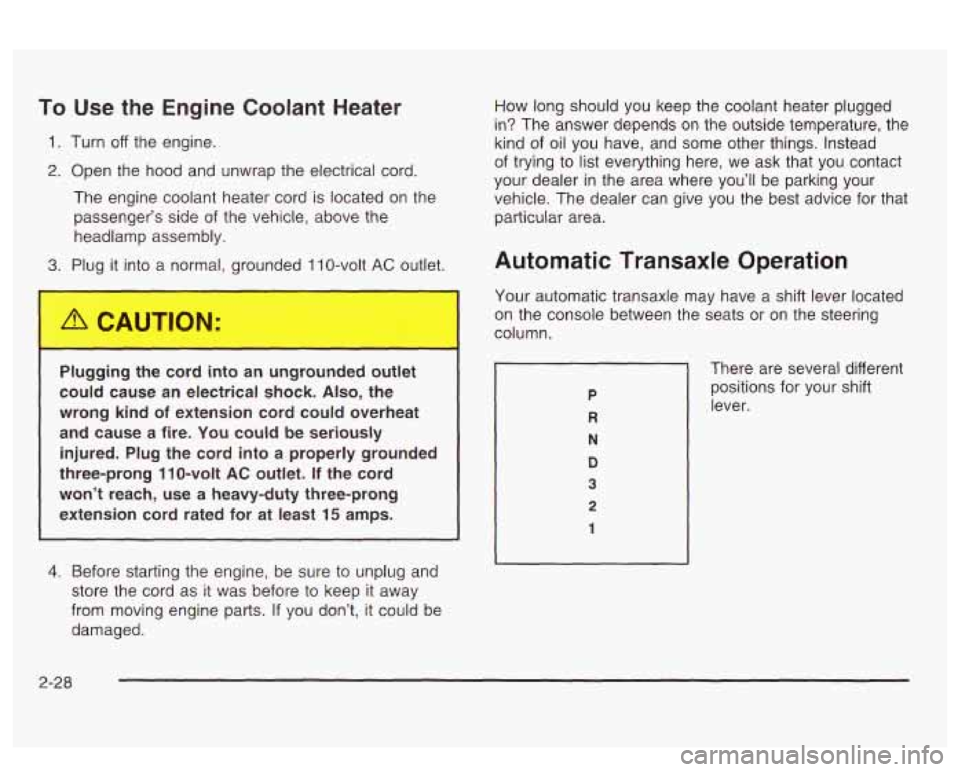
Automatic Transaxle Operation
Your automatic transaxle may have a shift lever located
on the console between the seats or on the steering
column.
There are several different
positions for your shift
lever.
2-28
Page 132 of 418
Entry Lighting
If it is dark enough outside and you press the button
with the unlock symbol on the remote keyless entry
transmitter
(if equipped), the interior courtesy lamps will
come on and stay on for approximately
25 seconds,
The lamps will turn
off immediately by pressing
the button with the lock symbol on the remote keyless
entry transmitter, by turning the ignition key to
ON or by
activating the power door locks.
If a door is left ajar, your interior lamps will turn
off after
10 minutes to save your battery.
Delayed Entry Lighting
When you open the door to enter your vehicle, the
interior lamps will come on
if it is dark enough outside.
When you close the door with the ignition
off, the
interior lamps will stay on for
25 seconds or until the
ignition is turned on. Locking the doors with the power
door lock switch, or with the lock button on the
remote keyless entry transmitter (if equipped), will
override the delayed entry lighting and the lamps will
turn
off immediately.
Theater Dimming
This feature allows for a three to five-second fade out oi
the courtesy lamps instead of immediate turn off after
you remove the key from the ignition.
Delayed Exit Lighting
This feature will turn on the interior lamps for 25 seconds
after you remove the key from the ignition while the
doors are closed and it is night. This
will give you time
to find the door handle or lock switches as you exit
the vehicle.
This lighting will only be deactivated
if the key is
reinserted into the ignition switch or the power door
locks are activated.
Parade Dimming
To activate the instrument panel backlighting during the
day, turn the exterior lamp switch to the parking
lamp or headlamp position. Dimming
oi the instrument
panel display is not possible during daylight hours.
The instrument panel display can only be adjusted when
the parking lamps or headlamps are on and it is dark
outside.
Perimeter Lighting
When the button with the unlock symbol on the remote
keyless entry transmitter
(if equipped) is pressed,
the DRL headlamps, parking lamps and back-up lamps
will turn on
if it is dark enough outside.
3-1 7
Page 246 of 418
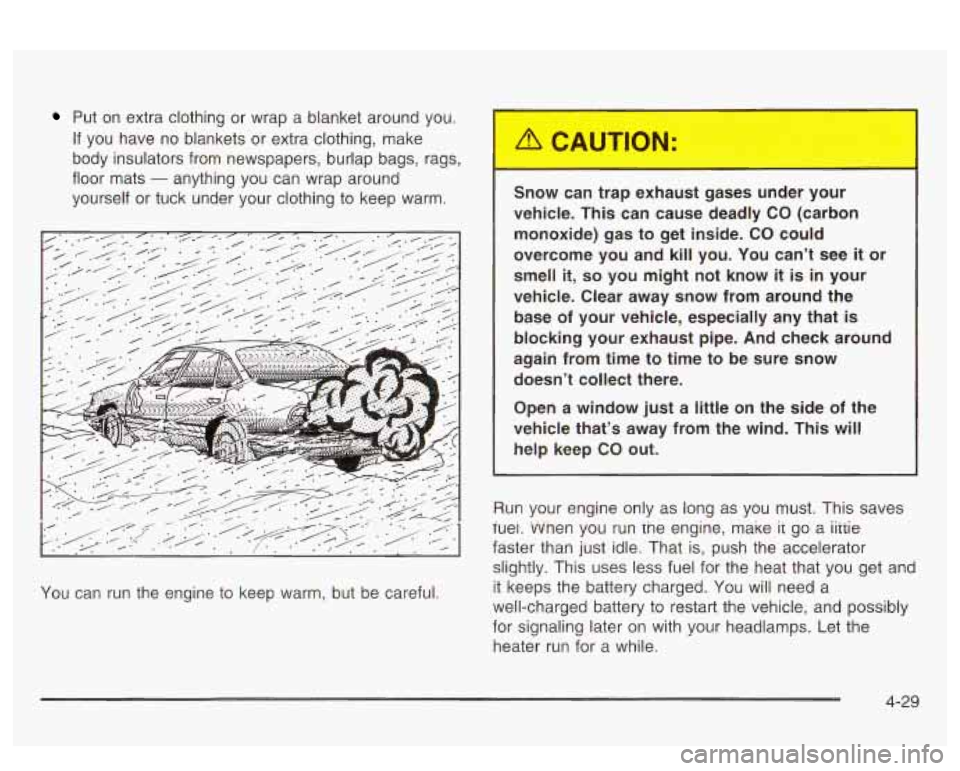
Put on extra clothing or wrap a blanket around you.
If you have no blankets or extra clothing, make
body insulators from newspapers, burlap bags, rags,
floor mats
- anything you can wrap around
yourself
or tuck under your clothing to keep warm.
You can run the engine to keep warm, but be careful. Snow can trap exhaust gases under your
vehicle. This can cause deadly
CO (carbon
monoxide) gas to get inside.
CO could
overcome you and kill you. You can’t see
it or
smell
it, so you might not know it is in your
vehicle. Clear away snow from around the
base of your vehicle, especially any that
is
blocking your exhaust pipe. And check around
again from time to time to be sure snow doesn’t collect there.
Open a window just a little on the side
of the
vehicle that’s away from the wind. This will
help keep CO out.
Run your engine only as long as you must. This saves
iuei. vvnen you run tne engine, make
ir go a iiiiie
faster than just idle. That is, push the accelerator
slightly. This uses less fuel for the heat that you get and
it keeps the battery charged.
You will need a
well-charged battery to restart the vehicle, and possibly
for signaling later on with your headlamps. Let the
heater run for a while.
4-29
Page 286 of 418
Notice: When adding coolant, it is important that
you use only
DEX-COOL@ (silicate-free) coolant.
If coolant other than DEX-COOL@
is added to
the system, premature engine, heater core or
radiator corrosion may result.
In addition, the engine
coolant will require change sooner
-- at 30,000 miles
(50,000 km) or 24 months, whichever occurs first.
Damage caused by the use
of coolant other
than DEX-COOL@ is not covered by your new vehicle
warranty.
What to Use
Use a mixture of one-half clean, drinkable water and
one-half
DEX-COOL@ coolant which won’t damage
aluminum
parts. If you use this coolant mixture,
you don’t need to add anything else. Adding only plain water to your cooling
system can be dangerous. Plain water, or
some other liquid such as alcohol, can boil
before the proper coolant mixture will. Your
vehicle’s coolant warning system
is set for the
proper coolant mixture. With plain water or the
wrong mixture, your engine could get too hot
but you wouldn’t get the overheat warning.
Your engine could catch fire and you or others
could be burned. Use a
50/50 mixture of clean,
drinkable water and
DEX-@SOL@ esslani.
Notice:
If you use an improper coolant mixture,
your engine could overheat and be badly damaged.
The repair cost wouldn’t be covered by your
warranty. Too much water
in the mixture can freeze
and crack the engine, radiator, neater core ana
other parts.
If you have to add coolant more than four times a year,
have your dealer check your cooling system.
Notice: If you use the proper coolant, you don’t
have to add extra inhibitors or additives which claim
to improve the system. These can be harmful.
5-27
Page 290 of 418
If No Steam Is Coming From Your
Engine
If you get an engine overheat warning but see or hear
no steam, the problem may not be too serious.
Sometimes the engine can get a little too hot when you:
Climb a long hill on a hot day.
Stop after high-speed driving.
Idle for long periods in traffic.
Tow a trailer.
If you get the overheat warning with no sign of steam,
try this for a minute or
so:
1. In heavy traffic, let the engine idle in NEUTRAL (N)
while stopped. If it is safe to do so, pull off the road,
shift to PARK
(P) or NEUTRAL (N) and let the
engine idle.
2. Turn on your heater to full hot at the highest fan
speed and open the window
as necessary.
If you no longer have the overheat warning, you can
drive. Just to be safe, drive slower for about
10 minutes.
If the warning doesn’t come back on, you can drive
normally.
If the warning continues and you have not stopped, pull
over, stop, and park your vehicle right away.
If there’s still no sign of steam, you can idle the engine
for three minutes while you’re parked.
If you still
have the warning,
turn off the engine and get everyone
out
of the vehicle until it cools down.
You may decide not to lift the hood but to get service
help right away.
5-31
Page 292 of 418
The coolant level should be at or above the FULL COLD
mark when the engine is cold. The coolant level
should be at the FULL HOT mark under normal
operating conditions.
If it isn’t, you may have a leak at
the pressure cap or in the radiator hoses, heater hoses,
radiator, water pump or somewhere else in the cooling
syster
If there seems to be no leak, with the engine on, check
to see
if the electric engine cooling fans are running.
If the engine is overheating, both fans should be
running.
If they aren’t, your vehicle needs service.
Notice: Engine damage from running your engine
without coolant
isn’t covered by your warranty.
Notice: When adding coolant, it is important that
you use only
DEX-COOL@ (silicate-free) coolant.
If coolant other than
DEX-COOL is added to
the system, premature engine, heater core or
1
Heater and radiator hoses, and other engine radiator corrosion may result.
-In addition, the engine
parts, can be very hot. Don’t touch them. If you coolant will require change sooner - at 30,000 miles
(50 000 km) or 24 months, whichever occurs first.
do, you can be burned.
Damage caused by the use of coolant other
Don’t run the engine if there
is a leak. If you than DEX-COOL@ is not covered by your new vehicie
run the engine,
it could lose all coolant. That warranty.
could cause an engine fire, and you could be
burned. Get any leak fixed before you drive the
vehicle.
5-33
Page 293 of 418
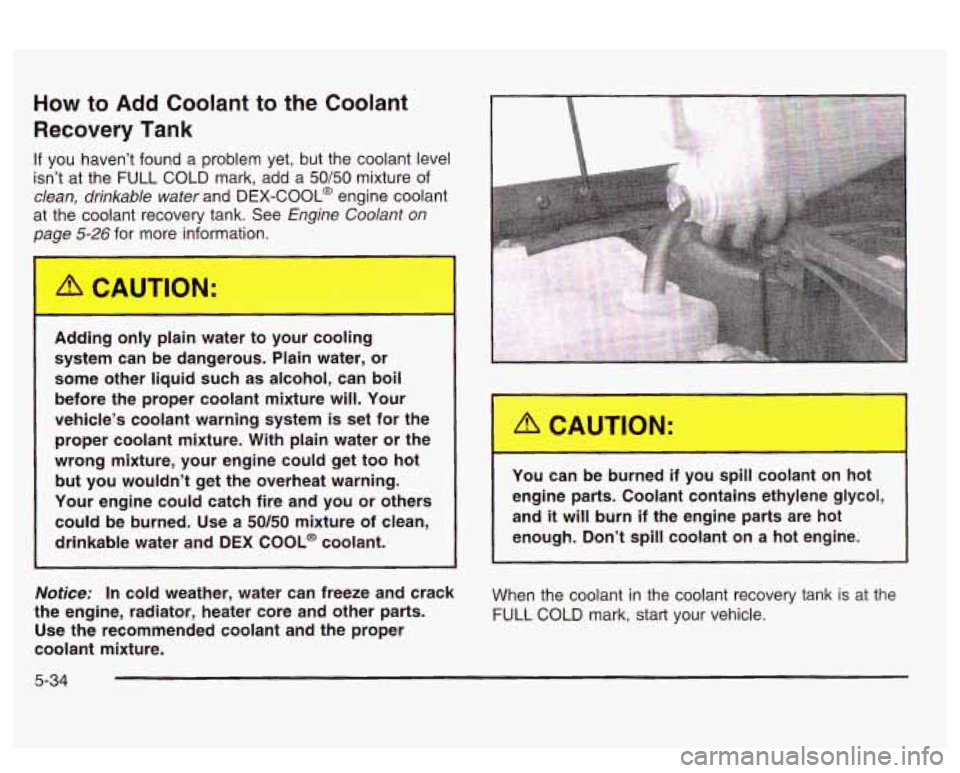
How to Add Coolant to the Coolant
Recovery Tank
If you haven’t found a problem yet, but the coolant level
isn’t at the FULL COLD mark, add a
50/50 mixture of
clean, drinkable water and DEX-COOL@ engine coolant
at the coolant recovery tank. See
Engine Coolant on
page
5-26 for more information.
Adding only plain water to your cooling system can be dangerous. Plain water, or
some other liquid such as alcohol, can boil
before the proper coolant mixture will. Your
vehicle’s coolant warning system
is set for the
proper coolant mixture. With plain water or the
wrong mixture, your engine could get too hot
but you wouldn’t get the overheat warning.
Your engine could catch fire and you or others could be burned. Use a
50/50 mixture of clean,
drinkable water and DEX COOL@ coolant.
Notice: In cold weather, water can freeze and crack
the engine, radiator, heater core and other parts. Use the recommended coolant and the proper
coolant mixture. You
can be burned if you spill coolant on hot
engine parts. Coolant contains ethylene glycol, and
it will burn if the engine parts are hot
enough. Don’t
spill coolant on a hot engine.
When the coolant in the coolant recovery tank is at the
FULL
COLD mark, start your vehicle.
5-34
Page 356 of 418
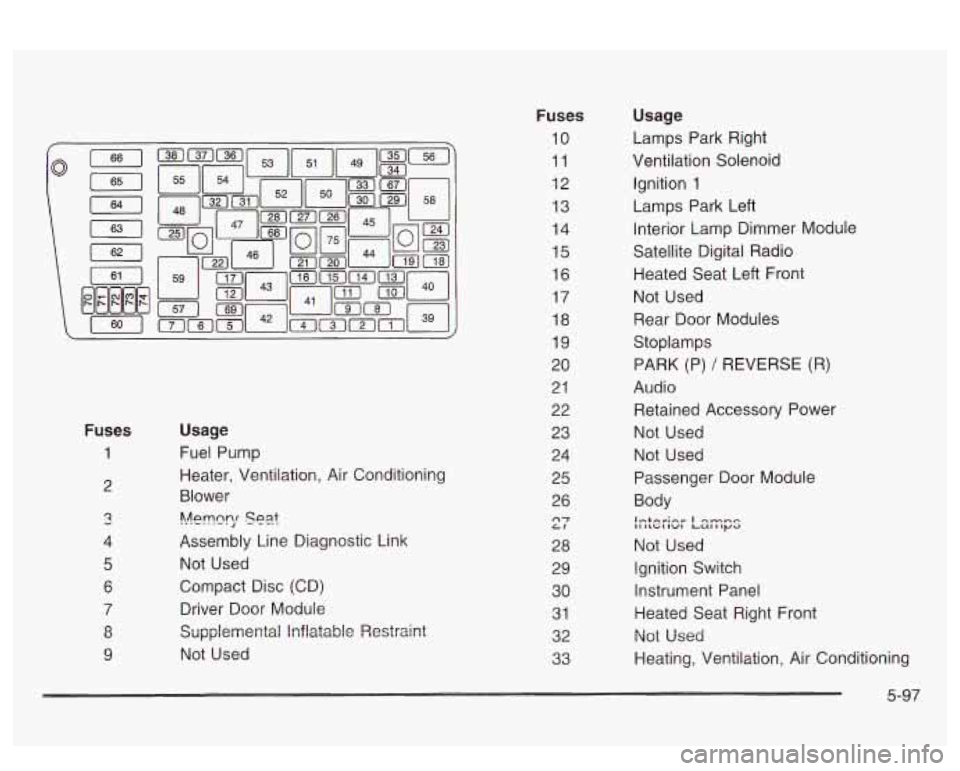
Fuses
1
2
Usage
Fuel Pump
Heater, Ventilation, Air Conditioning
Blower
Assembly Line Diagnostic Link
Not Used
Compact Disc (CD) Driver Door Module
Not Used
hllemCl!-y SP?!
Ssn- uppltz, r\.nr I IGfifCll -I In II lflaLaute I t hl Bestrairrt Fuses
10
11
12
13
14
15
16
17
18
19
20
21
22
23 24
25
26
07 LI
28
29
30
31
32
33
Usage
Lamps Park Right
Ventilation Solenoid
Ignition 1
Lamps Park Left Interior Lamp Dimmer Module
Satellite Digital Radio
Heated Seat Left Front
Not Used Rear Door Modules
Stoplamps PARK (P)
/ REVERSE (R)
Audio Retained Accessory Power
Not Used
Not Used Passenger Door Module
Body
Not Used
Ignition Switch
Instrument Panel
Heated Seat Right Front
iiof: Used
Heating, Ventilation, Air Conditioning
ln+nu;-u I nmnr. I1 ILGI IVI LUI I lvcl
5-97