brake PONTIAC FIREBIRD 1994 Owner's Guide
[x] Cancel search | Manufacturer: PONTIAC, Model Year: 1994, Model line: FIREBIRD, Model: PONTIAC FIREBIRD 1994Pages: 290, PDF Size: 14.84 MB
Page 136 of 290

Loss of Control
Let’s review what driving experts say about what happens when the three
control systems (brakes, steering and
acceleration) don’t have enough friction
where the tires meet the road to do what
the driver has asked.
In any emergency, don’t give up. Keep
trying to steer and constantly seek an
escape route or area of less danger.
Skidding
In a skid, a driver can lose control of the
vehicle. Defensive drivers avoid most
skids by taking reasonable care suited
to existing conditions, and by not
“overdriving” those conditions. But
skids are always possible.
The three types of skids correspond to
your Pontiac’s three control systems. In
the braking skid your wheels aren’t
rolling.
In the steering or cornering skid,
too much speed or steering in a curve
causes tires to slip and lose cornering
force. And in the acceleration skid too
much throttle causes the driving wheels
to spin.
A cornering skid is best handled by
Easing your foot
off the accelerator pedal.
[f you have the traction control system,
remember:
It helps avoid only the
acceleration skid. If you do not have
traction control, or if the system is
off,
then an acceleration skid is also best
handled by easing your foot
off the
accelerator pedal.
If your vehicle starts to slide, ease your
bot off the accelerator pedal and quickly
steer the way you want the vehicle to
go.
If you start steering quickly enough, your
vehicle may straighten out. Always be
ready for a second skid
if it occurs.
Of course, traction is reduced when water,
snow, ice, gravel, or other material is on
the road. For safety, you’ll want to slow
down and adjust your driving to these
conditions. It is important
to slow down
on slippery surfaces because stopping
distance will be longer and vehicle
control more limited. While
driving
on a surface with reduced
traction,
try your best to avoid sudden
steering, acceleration, or braking
(including engine braking by shifting to
a lower gear). Any sudden changes could
cause the tires to slide. You may not
realize the surface is ‘slippery until your
vehicle is skidding. Learn to recqgnize
warning clues
- such as enough water,
ice or packed snow
on the road to make a
“mirrored surface”
- and slow down
when you have any doubt.
Remember: Any anti-lock braking system
(ABS) helps avoid only the braking skid.
*:p? ’
‘.I ,
135 ...
ProCarManuals.com
Page 138 of 290

[t's wise to keep your wiping equipment
.n good 'shape and keep your windshield
washer
tank fdled. Replace your
windshield wiper inserts when they sh0.w
signs of streaking or missing areas on the
windshield, or
when: strips of rubberstart
:o separate from the ins'erts.
Driving too fast though
largk wqkx
puddles or even going through &-me car
washes can cause problems, too.?l"he
water my affect your brakes. Tm, to
avoid puddles. But if you can't, Wy to
slow down before
you hit them. ,,i
137. I ..
ProCarManuals.com
Page 142 of 290

Hill and Mountain
Roads
Driving on steep hills or mountains is
different from driving in flat or rolling
terrain. If you drive regularly in steep
country, or
if you’re planning to visit
there, here are some tips that can make
your trips safer and more enjoyable.
0 Keep your vehicle in good shape. Check all fluid levels and also the
brakes, tires, cooling system and
transmission. These parts can work
hard on mountain roads.
0 Know how to go down hills. The most
important thing to know is this: let
your engine do some of the slowing
down. Shift to a lower gear when you
go down a steep or long hill. Know how
to go uphill. You may
want to shift down to a lower gear.
The lower gears help cool your engine
and transmission, and you can climb
the hill better.
In hilly terrain, you may want to
switch to the
“PERFORMANCE”
mode for better performance.
Stay in your own lane when
driving on two-lane roads in hills or
mountains. Don’t swing wide or cut
across the center of the road. Drive at
speeds that let you stay in
you? own
lane.
As you go over the top of a hill, be
alert. There could be something in
your lane, like a stalled car or’an
accident.
You may see highway signs on
mountains that warn of special
problems. Examples are long grades,
passing or no-passing zones, a’ falling
rocks area, or winding roads. Be alert
to these and take appropriate action.
141 ...
ProCarManuals.com
Page 144 of 290

Whatever the condition - smooth ice,
packed, blowing or loose snow
- drive
with caution. If you have traction control,
keep the system on. It will improve your
ability to accelerate when driving on a
slippery road. Even though your vehicle
has a traction control system, you’ll want
to slow down and adjust your driving to
the road conditions. See “Traction
Control System’’ in the Index. If you
don’t have the traction control
system, accelerate gently. Try not to break
the fragile traction. If you accelerate too
fast, the drive wheels will spin and polish
the surface under the tires even more.
Your anti-lock brakes improve your
ability to make a hard stop on a slippery
road. Even though you have the anti-lock
braking system, you’ll want to begin
stopping sooner than you would
on dry
pavement. See “Anti-Lock” in the Index.
0
0
Allow greater following distance on
any slippery road.
Watch for slippery spots. The road
might be fine until you hit a spot that’s
covered with ice. On an otherwise
clear road, ice patches may appear in
shaded areas where the sun can’t
reach: around clumps of trees, behind
buildings, or under bridges.
Sometimes the surface of a curve or
an overpass may remain icy when the
surrounding roads are clear. If
you
see a patch of ice ahead of you, brake
before you are on it. Try not to brake
while you’re actually on the ice, and
avoid sudden steering maneuvers.
If You’re Caught in a Blizzard
If you are stopped by heavy snow, you
could be
in a serious situation. You should
probably stay with your vehicle unless
you know for sure that
you are near help
and you can hike through the snow. Here
are some things to do
to summon help and
keep yourself and your passengers safe:
Turn on your hazard flashers. Tie a red
cloth to your vehicle to alert police that
you’ve been stopped by the snow. Put
on
extra clothing or wrap a blanket around
you. If
you have no blankets or extra
clothing, make body insulators from
newspapers, burlap bags, rags, floor mats
- anything you can wrap around yourself
or tuck under your clothing to keep warm.
143 ...
ProCarManuals.com
Page 148 of 290

Hitches
It’s important to have the correct hitch
equipment. Crosswinds, large trucks
going by, and rough roads are a few
reasons why you’ll need the right hitch.
Here are some rules to follow:
0
0
Will you have to make any holes in
the body of your vehicle when you
install a trailer hitch? If you do, then
be sure to seal the holes later when
you remove the hitch. If you don’t
seal them, deadly carbon monoxide
(CO) from your exhaust can get into
your vehicle (see “Carbon Monoxide”
in the Index). Dirt and water can,
too.
The bumpers on your vehicle are not
intended for hitches.
Do not attach
rental hitches or other bumper-type
hitches to them. Use only a
frame-mounted hitch that does not
attach to the bumper.
Safety Chains
You should always attach chains between
your vehicle and your trailer. Cross the
safety chains under the tongue of the
trailer
so that the tongue will not drop to
the road if it becomes separated from the
hitch. Instructions about safety chains
may be provided by the hitch manufacturer or
by the trailer
, 1.
manufacturer. Follow the manufacturer’s
recommendation for attaching safety
chains. Always leave just enough slack
so
you can turn with your rig. And, never
allow safety chains to drag on the ground.
Trailer Brakes
If your trailer weighs more than 1,000
pounds (450 kg) loaded, then it needs its
own brakes
- and they must be adequate.
Be sure to read and follow the instructions
for the trailer brakes
so you’ll be able to
install, adjust and maintain them properly.
Because you have anti-lock brakes, do not
try to tap into your vehicle’s brake
system. If
YOU do, both brake systems
won’t work well, or at all.
Driving with a Trailer
Towing a trailer requires a certain amount
of experience. Before setting out for the
open road, you’ll want to get to know
your rig. Acquaint yourself with the feel
of handling and braking with the added
weight
of the trailer. And always keep in
mind that ’the vehicle you are driving is
now a good deal longer and not nearly as
responsive
as your vehicle is by itself. Before you
start, check the trailer hitch
and platform, safety chains, electrical
connector, lights, tires and mirror
adjustment. If
the trailer has electric
brakes,
start your vehicle and trailer
moving and then apply the trailer brake
controller by hand to be sure the brakes
are working. This lets you check your
electrical connection at the same time.
During your trip, check occasionally to
be sure that the load is secure,. and that
the lights and any trailer brakes are still
working.
Following Distance
Stay at least twice as far behind the
vehicle ahead as you would when driving
your vehicle without a trailer.,,This can
help
you avoid situations that’.require
heavy braking and sudden turns.
Passing
You’ll need more passing distance up
ahead when you’re towing a trailer. And,
because you’re a good deal longer, you’ll
need to go much farther beyond the
passed vehicle before you can return to
your lane.
147 ...
ProCarManuals.com
Page 149 of 290

Your Driving and the Road
Backing Up
Hold the bottom of the steering wheel
with one hand. Then, to move the trailer
to the left, just move that hand to the left.
To move the trailer to the right, move
your hand to the right. Always back up
slowly and, if possible, have someone
guide you.
Making 7hms
When you’re turning with a trailer, make
wider turns than normal.
Do this so your
trailer won’t strike soft shoulders, curbs,
road signs, trees, or other objects. Avoid
jerky or sudden maneuvers. Signal well in
advance.
Thrn Signals When Towing a Trailer
When you tow a trailer, your vehicle has
to have a different turn signal flasher and
extra wiring. The green arrows on your
instrument panel will flash whenever you signal a turn or lane change. Properly
hooked up, the trailer lights will also
flash, telling other drivers you’re about to
turn, change lanes or stop. When
towing a trailer, the green arrows
on your instrument panel will flash for
turns even
if the bulbs on the trailer are
burned out. Thus, you may think drivers
behind you are seeing your signal when
they are not. It’s important to check
occasionally to be sure the trailer bulbs
are still working.
Driving on Grades
Reduce speed and shift to a lower gear
before you start down a long or steep
downgrade. If you don’t shift down, you
might have to use your brakes
so much
that they would get hot and no longer
work well.
On a long uphill grade, shift down and
reduce your speed to around
45 mph
(70 km/h) to reduce the possibility of
engine and transmission overheating.
If you are towing a trailer and you
have an automatic transmission with
Overdrive, you may prefer to drive in
“D”
instead of Overdrive (or, as you need to, a
lower gear). Or,
if you have a manual
transmission with fifth (or sixth) gear and
you are towing a trailer, it’s better not to
use fifth (or sixth) gear. Just drive in
fourth gear (fifth gear if you have a six-speed manual transmission) or, as you
need to, a lower gear.
Parking on Hills
You really should not park your vehicle,
with a trailer attached, on a hill. If
-
something goes wrong, your rig could
start to move. People can be injured, and
both your vehicle and the trailer can be
damaged.
But if you ever have to park your rig on a
hill, here’s how to do it:
1. Apply your regular brakes, but don’t
shift into
“P” (Park) yet, or into gear
for a manual transmission.
2. Have someone place chxks under the
3. When the wheel chocks are in place,
release the regular brakes until the
chocks absorb the load. trailer wheels.
4. Reapply the regular brakes. Then
apply your parking brake, and then shift to
“P” (Park), or “R” (Reverse)
for a manual transmission.
5. Release the regular brakes.
. . .I48
ProCarManuals.com
Page 150 of 290
When You Are Ready to Leave after
Parking on a
Hill
1. Apply your regular brakes and hold
the pedal down while you:
0 Start your engine;
0 Shift into a gear; and
0 Release the parking brake.
2. Let up on the brake pedal.
.
3. Drive slowly until the trailer is clear
4. Stop and have someone pick up and
of the chocks.
store the chocks.
Maintenance When Trailer Towing
Your vehicle will need service more often
when you're pulling a trailer. See the
Maintenance Schedule for more on this.
Things that are especially important in
trailer operation are automatic
transmission fluid (don't overfill), engine
oil, axle lubricant, belts, cooling system,
and brake adjustment. Each of these
is
covered in this manual, and the Index will
help you find them quickly. If you're
trailering, it's a good idea to review these
sections before you start your trip.
Check periodically to see that all hitch
nuts and bolts .are tight.
I
I
149.. .
ProCarManuals.com
Page 159 of 290
Problems on the Road
When your vehicle is being towed, have
the ignition key off. The steering wheel
should be clamped in a straight-ahead
position, with a clamping device designed
for towing service. Do not use the
vehicle’s steering column lock for this.
The transmission should be in “Neutral”
and the parking brake released.
Don’t have your vehicle towed on the rear
wheels, unless you must. If the vehicle
must be towed on the rear wheels, don’t
go more than 35 mph (55 km/h) or farther
than
50 miles (80 km) or your
transmission will be damaged. If these
limits must be exceeded, then the rear
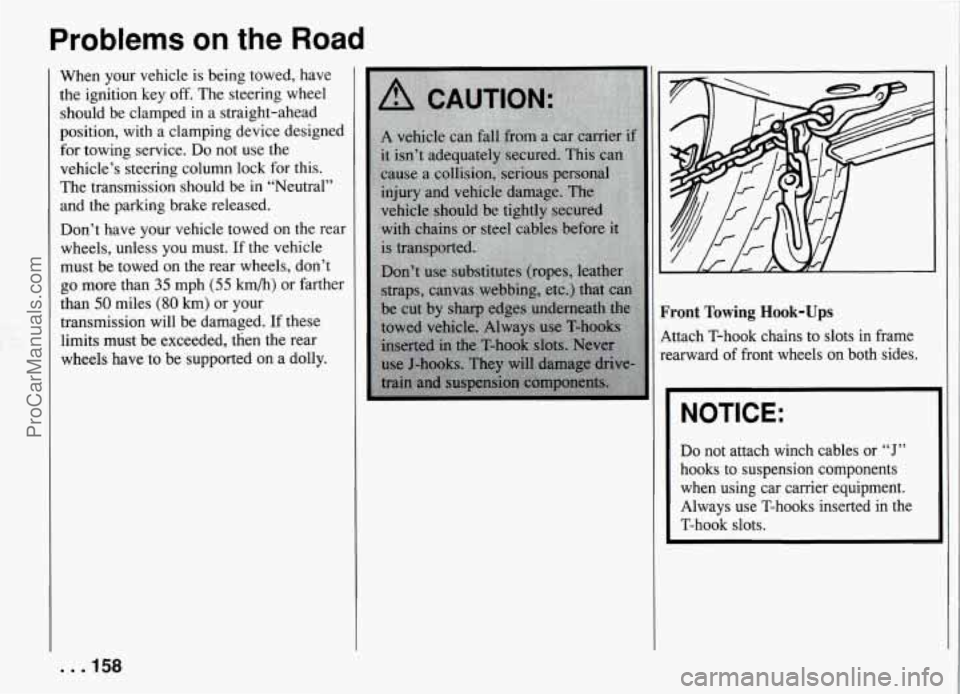
wheels have to be supported on a dolly. Front Towing Hook-Ups
Attach T-hook chains to slots in frame
rearward
of front wheels on both sides.
NOTICE:
Do not attach winch cables or “J”
hooks to suspension components
when using car carrier equipment.
Always use T-hooks inserted in the
T-hook slots.
1
. . .158
ProCarManuals.com
Page 160 of 290

I
I
NOTICE:
Do not tow with sling-type equiment
or fascia/fog light damage will occur.
Use wheel lift or car carrier equip-
ment. Additional ramping may be
required for car carrier equipment.
Use safety chains and wheel straps. Attach a
separate safety chain around
outboard end of each lower control arm.
~TICE:
I
Take care not to damage the brake
pipes and hoses or the
ABS sensor
and wiring.
NOTICE:
Towing a vehicle over rough surfaces
could damage a vehicle. Damage can
occur from vehicle-to-ground
or vehicle-to-wheel-lift-equipment
contact.
To help avoid damage,
install a towing dolly and raise
vehicle until adequate clearance is
obtained between the ground and/or
wheel-lift equipment.
4
159 ...
ProCarManuals.com
Page 161 of 290

Problems on the Road
c
Rear Towing Hook-Ups
Attach T-hook chains in front of rear
wheels in bottom of frame
rail on both
sides.
NOTICE:
Do not attach winch cables or “J”
hooks to suspension components
when using car carrier equipment.
Always use T-hooks inserted in the
T-hook slgts.
b
NOTICE:
Do not tow with sling-type equip-
ment or rear bumper valance will be
damaged.
Use wheel lift or car carrier equip-
ment. Additional ramping may be
required for car carrier equipment.
Use safety chains and wheel straps. Attach a separate safety chain around
outboard end of the rear axle.
I NOTICE:
I
Take care not to damage the brake
pipes and cables.
c
1
. . .160
ProCarManuals.com