brake PONTIAC FIREBIRD 1997 User Guide
[x] Cancel search | Manufacturer: PONTIAC, Model Year: 1997, Model line: FIREBIRD, Model: PONTIAC FIREBIRD 1997Pages: 410, PDF Size: 19.2 MB
Page 81 of 410

This feature is for improved traction only ,when the road
surface is slippery and is not intended for continuous use
or when the vehicle is stuck in sand, mud, ice, snow or
gravel. Always use
NORMAL for normal road
conditions. You may press the 2ND GEAR START
switch again to turn
off this feature. The light on the
switch will
go out. Whenever you start your vehicle, the
transmission is in the NORMAL
mode.
Manual Transmission
5-Speed
1 3 5
2 4 R
This is your shift pattern.
Here’s how to operate
your transmission:
FIRST (1): Press the clutch pedal and shift into
FIRST (1). Then slowly let up on the clutch pedal as
you press the accelerator pedal.
You can shift into FIRST (1) when you’re going less
than
20 mph (32 km/h). If you’ve come to a complete
stop and it’s
hard to shift into FIRST (l), put the shift
lever in NEUTRAL
(N) and let up on the clutch, Press
the clutch pedal back down. Then shift into FIRST
(1).
SECOND (2): Press the clutch pedal to the floor as
you let up on the accelerator pedal and shift into
SECOND
(2). Then, slowly let up on the clutch pedal as
you press the accelerator pedal.
THIRD (3), FOURTH (4), and FIFTH (5): Shift into
THIRD
(3), FOURTH (4) and FIFTH (5) the same way
you
do for SECOND (2). Slowly let up on the clutch
pedal as
you press the accelerator pedal.
To Stop, let up on the accelerator pedal and press the
brake pedal. Just before the vehicle stops, press the
clutch pedal and the brake pedal, and shift to
NEUTRAL
(N),
NEUTRAL (N): Use this position when you start or
idle your engine.
2-32
Page 82 of 410
REVERSE (R): To back up, press down the clutch
pedal and shift into REVERSE (R). Let up on the clutch
pedal slowly while pressing the accelerator pedal.
NOTICE:
Shift to REVERSE (R) only after your vehicle is
stopped. Shifting to REVERSE (R) while your
vehicle
is moving could damage your transmission.
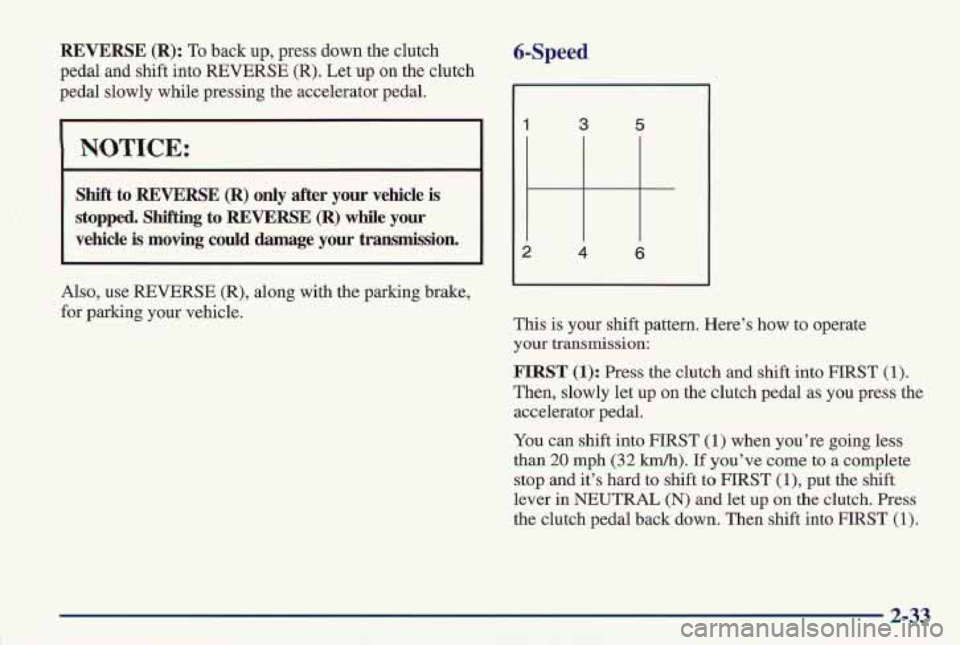
1 3 5
Also, use REVERSE (R), along with the parking brake,
for parking your vehicle.
This is your shift pattern. Here’s how to operate
your transmission:
FIRST (1): Press the clutch and shift into FIRST (1).
Then, slowly let up on the clutch pedal as you press the
accelerator pedal.
You can shift into FIRST
(1) when you’re going less
than 20 mph (32 km/h). If you’ve come to a complete
stop and it’s hard to shift to FIRST
(l), put the shift
lever
in NEUTRAL (N) and let up on the clutch. Press
the clutch pedal back down. Then shift into FIRST
(1).
2-33
Page 83 of 410
SECOND (2): Press the clutch pedal as you let up on
the accelerator pedal and shift into
SECOND (2). Then,
slowly let up on the clutch pedal as you press the
accelerator pedal.
THIRD (3), FOURTH (4), FIFTH (5) and
SIXTH (6): Shift into THIRD (3), FOURTH (4),
FIFTH (5) and SIXTH (4) the same way you do for
SECOND (2). Slowly let up on the clutch pedal as you
press the accelerator pedal.
To Stop, let up on the accelerator pedal and press the
brake pedal. Just before the vehicle stops, press the
clutch pedal and the brake pedal and shift to
NEUTRAL
(N).
NEUTRAL (N): Use this position when you start or
idle your engine.
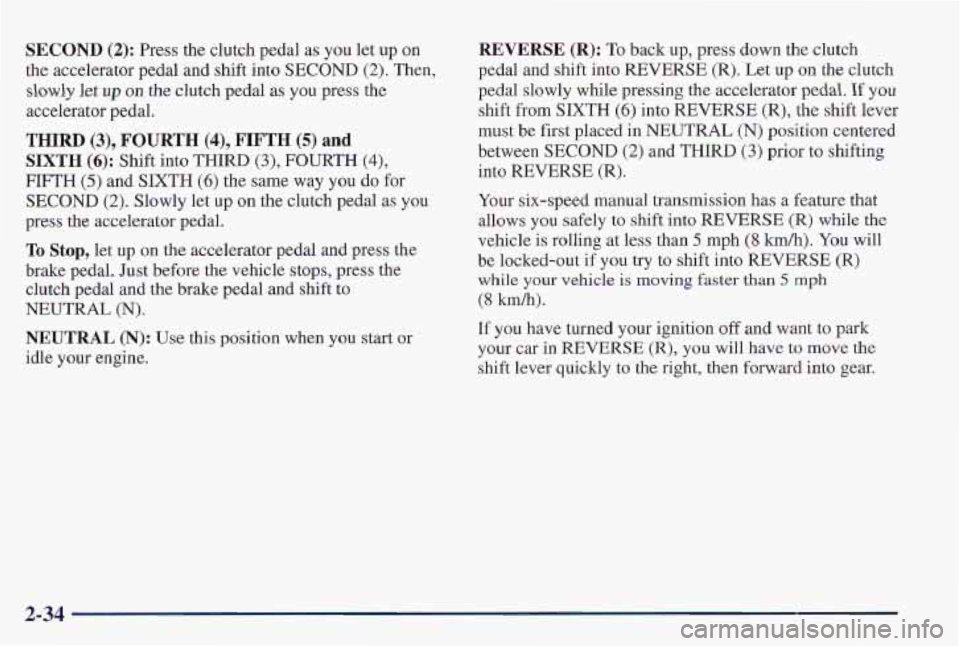
REVERSE (R): To back up, press down the clutch
pedal and shift into
REVERSE (R). Let up on the clutch
pedal slowly while pressing the accelerator
pedal. If you
shift from SIXTH (6) into REVERSE (R), the shift lever
must
be first placed in NEUTRAL (N) position centered
between
SECOND (2) and THIRD (3) prior to shifting
into REVERSE (R).
Your six-speed manual transmission has a feature that
allows
you safely to shift into REVERSE (R) while the
vehicle is rolling at less than
5 mph (8 km/h). You will
be locked-out
if you try to shift into REVERSE (R)
while your vehicle is movins fa ’ :r than 5 mph
(8 km/h).
If you have turned your ignition off and want to park
your car
in REVERSE (R), you will have to move the
shift lever quickly to the right, then forward into gear.
2-34
Page 86 of 410

Parking Brake
To set the parking brake, hold the brake pedal down and
pull up on the parking brake lever.
If the ignition is on,
the brake system
warning light will come on.
To release the parking brake, hold the brake pedal down.
Pull the parking brake lever up until you can push in the
release button. Hold the release button in as you move
the brake lever all the way down.
2-37
Page 87 of 410

I NOTICE:
Driving with the parking brake on can cause
your rear brakes to overheat. You may have to
replace them, and you could also damage other
parts of your vehicle.
If you are towing a trailer and are parlung on any hill,
see
“Towing a Trailer” in the Index. That section shows
what to do first to keep the trailer from moving.
Shifting Into PARK (P) (Automatic
Transmission Models Only)
It can be dangerous to get out of your vehicle if
the shift lever is not fully in
PARK (P) with the
parking brake firmly set. Your vehicle can roll.
If you have left the engine running, the vehicle
can move suddenly. You or others could be
injured.
To be sure your vehicle won’t move, even
when you’re on fairly level ground, use the steps
that follow.
If you’re pulling a trailer, see
‘(Towing a Trailer’’ in the Index.
2-38
Page 88 of 410
2.
3.
4.
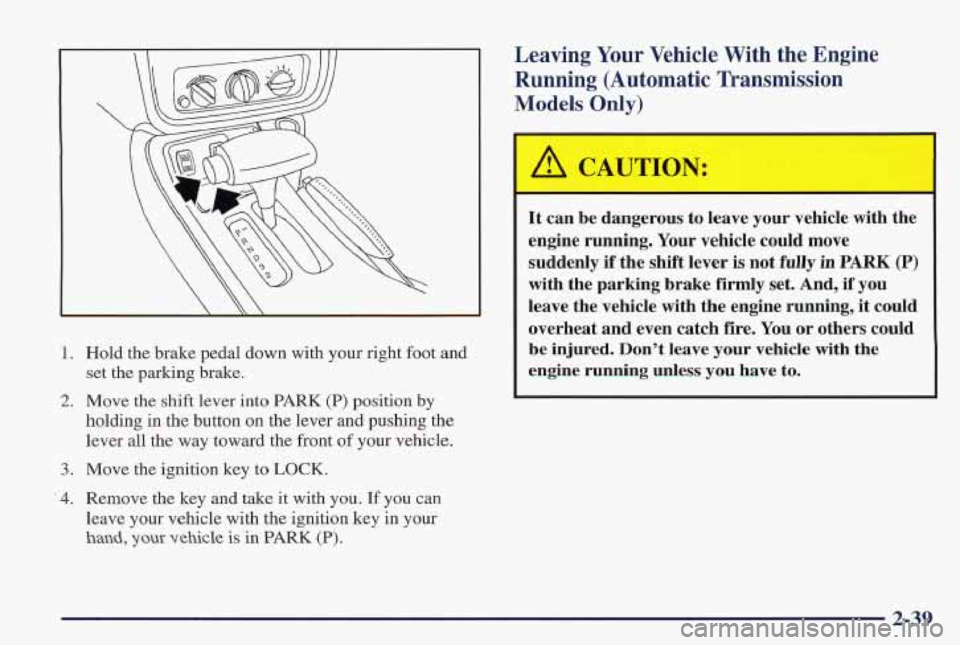
Hold the brake pedal down with your right foot and
set the parking brake.
Move the shift lever
into PARK (P) position by
holding in the button
on the lever and pushing the
lever all the way toward the front
of your vehicle.
Move the ignition key to
LOCK.
Remove the key and take it with you. If you can
leave your vehicle with the ignition key in your
hand, your vehicle is in PARK (P).
Leaving Your Vehicle With the Engine
Running (Automatic Transmission
Models Only)
It can be dangerous to leave your vehicle with the
engine running. Your vehicle could move
suddenly
if the shift lever is not fully in PARK (P)
with the parking brake firmly set. And, if you
leave the vehicle with the engine running,
it could
overheat and even catch fire. You
or others could
be injured. Don’t leave your vehicle
with the
engine running unless you have to.
2-39
Page 89 of 410

Torque Lock (Automatic Transmission)
If you are parking on a hill and you don’t shift your
transmission into
PARK (P) properly, the weight of the
vehicle may put too much force on the parking pawl in
the transmission.
You may find it difficult to pull the
shift lever out of
PARK (P). This is called “torque lock.”
To prevent torque lock, set the parking brake and then
shift into PARK
(P) properly before you leave the
driver’s seat.
To find out how, see “Shifting Into PARK
(P)” in the Index.
When you are ready to drive, move
the shift lever out of
PARK (P) before you release the parking brake.
If torque lock does occur, you may need to have another
vehicle
push yours a little uphill to take some of the
pressure from the parking pawl in the transmission,
so
you can pull the shift lever out of PARK (P).
Parking Your Vehicle
(Manual Transmission)
Before you get out of your vehicle, put your manual
transmission in REVERSE (R) and firmly apply the
parking
brake.
If your vehicle is equipped to tow a trailer, see “Towing
a Trailer” in the Index,
Shifting Out of PARK (P)
(Automatic Transmission)
Your Pontiac has a brake-transmission shift interlock.
You have to fully apply your regular brake before you
can shift from PARK
(P) when the ignition is in the
RUN position.
See “Automatic Trans---’ssion” in
the Index.
If you cannot shift out of PARK (P), ease pressure on
the shift lever
-- push the shift lever all the way into
PARK (P) and release the shift lever button as you
maintain brake application. Then press the shift lever
button and move the shift lever into the gear you wish.
If you ever hold the brake pedal down but still can’t
shift out of PARK (P),
try this:
1. Turn the key to OFF.
2. Apply and hold the brake.
3. Shift to NEUTRAL (N).
4. Start the vehicle and then shift to the drive gear
you want.
5. Have the vehicle fixed as soon as you can.
2-40
Page 91 of 410

Running Your Engine While You’re
Parked (Automatic Transmission)
It’s better not to park with the engine running. But if you
er have to, here are some things.. .fl,.:?=....v,> tg kngw,. ,:+:-., i::, ,..>?pd; y.
Idling the engine with the air system control off
could allow dangerous exhaust into your vehicle
(see the earlier Caution under <‘Engine Exhaustss),
Also, idling in
a closed-in place can let deadly
carbon monoxide (CU) into your vehicle even if
the fan switch is
at the highest setting. One place
this
can happen is a garage. Exhaust -- with
CO -- can come in easily. NEVER park in a
garage with the engine running.
Another closed-in place can be
a blizzard, (See
“Blizzard” in the Index.)
A CAUTION:
It can be dangerous to get out of your vehicle if
the shift lever
is not fully in PARK (P) with the
parking brake
firmly set, Your vehicle can roll.
Don’t leave your vehicle when the engine is
running unless you have to. If you’ve left the
engine running, the
vehicle can move suddenly.
You
or others could be injured. ‘Bo be sure your
vehicle won’t move, even when you’re on fairly
level ground, always set your parking brake and
move the shift PWW to P;ARK (P).
Follow the proper steps to be sure your vehicle won’t
move. See “Shifting Into PARK (P)” in the Index.
If you are parking on a hill and if you’re pulling a
trailer, also see “Towing a Trailer” in the Index.
2-42
Page 96 of 410

Windshield Washer
At the top of the turn signal lever, there’s a paddle with
the word
PUSH on it. To spray washer fluid on the
windshield, just push the paddle for less than a second.
The washer will continue to spray until you release the
paddle. The wipers will clear the window and wipe
a
few more times before stopping or returning to the
previous setting. See “Windshield Washer Fluid” in
the Index.
n freezing weather, don’t I : your was1 r until
the windshield is warmed. Otherwise the washer
fluid can
form ice on the windshield, blocking
your vision.
Cruise Control
With cruise control, you can maintain a speed of ab’out
25 mph (40 kmh) or more without keeping your foot on
the accelerator. This can really help on long trips. Cruise
control does not work at speeds below about
25 mph
(40 kmh).
When you apply your brakes, or push the clutch pedal,
if you have a manual transmission, the ‘cruise control
shuts
off.
2-47
Page 98 of 410

1. Move the cruise control switch to ON. Resuming a Set Speed
2. Get up to the speed you want.
3. Push in the SET button at the end of the lever and
release
it.
4. Take your foot off the accelerator pedal. Suppose
you set your cruise control at
a desired speed
and then apply
the brake or clutch pedal. This, of course,
shuts off the cruise control. But you don't need to reset
it. Once you're going about 25 mph (40 km/h) or more,
you can move the cruise control switch from ON to'
R/A (Resume/Accelerate) for about half a second.
You'll go right back up to your chosen speed and
stay there.