Air PONTIAC FIREBIRD 1998 Owners Manual
[x] Cancel search | Manufacturer: PONTIAC, Model Year: 1998, Model line: FIREBIRD, Model: PONTIAC FIREBIRD 1998Pages: 406, PDF Size: 18.23 MB
Page 3 of 406

GENERAL MOTORS, GM, the GM Emblem,
PONTIAC, the PONTIAC Emblem and the name
F’IREBIRD are registered trademarks of General
Motors Corporation.
This manual includes the latest information at the time it
was printed. We reserve the right to make changes in the
product
after that time without further notice. For
vehicles first sold in Canada, substitute the name “General Motors
of Canada Limited” for Pontiac
Division whenever
it appears in this manual.
WE SUPPORT
VOLUNTARY TECHNICIAN CERTIFICATION THROUGH
National Institute for AUTOMOTIVE SERVICE EXCELLENCE
We support voluntary
technician certification.
For Canadian Owners Who Prefer a
French Language Manual:
Please keep this manual in your vehicle, so it will be Aux propri6taires cmdiens: Vous pouvez vous
there if you ever need it when you’re on the road. If you procurer un exemplaire de ce guide en fransais chez
sell the vehicle, please leave this manual in it
so the new votre concessionaire ou au:
owner can use it.
DGN Marketing Services Ltd.
1577 Meyerside Dr.
Mississauga, Ontario
L5T 1B9
Litho in U.S.A. ‘Copyright General Motors Corporation 1997
Part No. 10417104 A Second Edition
All Rights Reserved
ii
. ?)::Y-. ! ; ,
. ~. ~~ ~~-~
Page 6 of 406
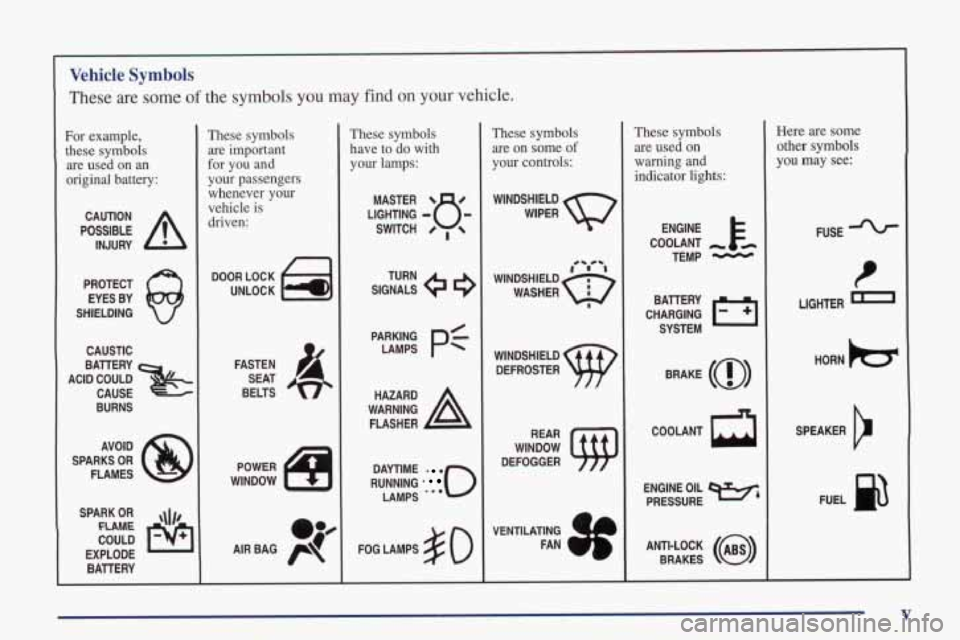
Vehicle Symbols
These are some of the symbols you may find on your vehicle.
For example,
these symbols are used on an
original battery:
POSSIBLE A
CAUTION
INJURY
PROTECT EYES BY
SHIELDING
CAUSTIC
BURNS
SPARK
OR ,\I/,
COULD
FLAUE
EXPLODE BAllERY
These symbols are important
for you and
your passengers whenever your
vehicle
is
driven:
DOOR LOCK
UNLOCK
FASTEN SEAT
BELTS
e?
AIR BAG p
These symbols
have to do with
your lamps:
SIGNALS @ 9
TURN
PARKING
pf
LAMPS
RUNNING
' 0
DAYTIME * 0
LAMPS
FOG LAMPS
$0
These symbols
are on some of
your controls:
WIPER 9
WINDSHIELD
DEFROSTER
WINDOW
DEFOGGER
VENTILATING
'*
FAN '-d
These symbols are used on
warning and
indicator lights:
COOLANT
TEMP
-
CHARGING I-1
BATTERY
SYSTEM
BRAKE
(a)
COOLANT a
ENGINE OIL
PRESSURE
ANTI-LOCK
(@)
BRAKES
Here are some
other symbols
you may see:
FUSE
P
LIGHTER -
HORN )d.
SPEAKER
k
FUEL la
V
Page 8 of 406

Section 1 Seats and Restraint Systems
Here you’ll find information about the seats in your Pontiac and how to use your safety belts proper\
ly. You can also
learn about some things you should not do with air bags and safety belts.
1-2 Seats and Seat Controls
1- 13 Here Are Questions Many People Ask About
1-14 How to Wear Safety Belts Properly
1-8 Safety Belts: They’re for Everyone
Safety
Belts -- and the Answers
1-14 Driver Position
1-21 Safety Belt Use During Pregnancy
1-22 Right Front Passenger Position
1-22
1-28
1-31
1-34
1-44 1-47
1-47 1-47
Supplemental Restraint System (SRS)
Rear Seat Passengers
Children
Child Restraints
Larger Children
Safety Belt Extender
Checking Your Restraint Systems
Replacing Restraint System
Parts After
a Crash
1-1
Page 15 of 406

Folding Rear Seatback
The rear seatback in your vehicle folds down to provide
more storage space.
To fold the seatback down:
1. Pull forward on both levers.
2. Fold the seatback down.
To raise the seatback:
1. Pull it up to the locked, upright position.
2. Be sure both latches hold the seatback in place. Have
them fixed
if they don’t.
Safety Belts: They’re for Everyone
This part of the manual tells you how to use safety belts
properly.
It also tells you some things you should not do
with safety belts.
And it explains
the Supplemental Restraint System
(SRS), or air bag system.
I A CAUTION:
A
-1
Don’t let anyone ride where he or she can’t wear
a safety belt properly. If you are in a crash and
you’re not wearing a safety belt, your injuries
can be much worse.
You can hit things inside the
vehicle or be ejected from it. You can be seriously
injured or killed.
In the same crash, you might
not be if you are buckled up. Always fasten your
safety belt, and check that your passengers’ belts
are fastened properly too.
1-8
Page 20 of 406

Here Are Questions Many People Ask
About Safety Belts -- and the Answers
Won’t I be trapped in the vehicle after an
accident if I’m wearing a safety belt?
A: You could be -- whether you’re wearing a safety
belt or not. But you can unbuckle a safety belt,
even if you’re upside down. And your chance of
being conscious during and after an accident,
so
you can unbuckle and get out, is much greater if
you are belted.
&.’ If my vehicle has air bags, why should I have to
A: Air bags are in many vehicles today and will be
in most of them in the future. But they are
supplemental systems only;
so they work with
safety belts -- not instead of them. Every air bag
system ever offered for sale has required the use
of
safety belts. Even if you’re in a vehicle that has air
bags, you still have
to buckle up to get the most
protection. That’s true not only in frontal collisions, but especially in side and other collisions.
wear safety belts?
@ If I’m a good driver, and I never drive far from
home, why should I wear safety belts?
A: You may be an excellent driver, but if you’re in an
accident
-- even one that isn’t your fault -- you
and your passengers can be
hurt. Being a good
driver doesn’t protect you from things beyond your
control, such as bad drivers.
Most accidents occur within
25 miles (40 km)
of home. And the greatest number of serious
injuries and deaths occur at speeds of less than
40 mph (65 km/h).
Safety belts are for everyone.
1-13
Page 29 of 406

The best way to protect the fetus is to protect the
mother. When a safety belt is
worn properly, it’s more
likely that the fetus won’t be hurt in
a crash. For
pregnant women, as for anyone, the key to making
safety belts effective is wearing them properly.
Right Front Passenger Position
The right front passenger’s safety belt works the same
way
as the driver’s safety belt. See “Driver Position”
earlier in this section.
Supplemental Restraint System (SRS)
This part explains the Supplemental Restraint System
(SRS) or air bag system.
Your vehicle has “Next Generation” reduced-force
frontal
air bags -- one air bag for the driver and another
air bag for the right front passenger.
Reduced-force frontal
air bags are designed to help
reduce the risk of injury from
the force of an inflating
air bag. But even these air bags must inflate very
quickly if they are to do their job and comply with
federal regulations. Here
are the most important things
to know about the air
bag system:
r
I A CAUTION: -
You can be severely injured or killed in a crash if
you aren’t wearing your safety belt -- even if you
have air bags. Wearing your safety belt during a
crash helps reduce
your chance of hitting things
inside the vehicle or being ejected from it.
Air
bags are “supplemental restraints’’ to the
safety belts. All air bags -- even reduced-force
air bags
-- are designed to work with safety belts,
but don’t replace them. Air
bags are designed to
work only in moderate
to severe crashes where
the front of your vehicle hits something. They
aren’t designed to inflate at all in rollover, rear,
side or low-speed frontal crashes. And, for
unrestrained occupants, reduced-force air bags
may provide less protection in frontal crashes
than more forceful air
bags have provided in the
past. Everyone in your vehicle should wear a
safety belt properly
-- whether or not there’s an
air
bag for that person.
1-22
Page 30 of 406

I /d CAUTION:
Air bags inflate with great force, faster than the
blink
of an eye. If’ you’re too close to an inflating
air bag, it could seriously injure you. This is true
even with reduced-force frontal air bags. Safety
belts help keep you in position before and during
a crash. Always wear your safety belt, even with
reduced-force
air bags. The driver should sit as
far back as possible while still maintaining
control
of the vehicle.
/I CAUTION:
Children who are up against, or very close to, an
air bag when it inflates can be seriously injured
or killed. This is true even though your vehicle
has reduced-force frontal air bags. Air bags plus
lap-shoulder belts offer the best protection for
adults, but not for young children and infants.
Neither the vehicle’s safety belt system nor its air
CAUTION: (Continued)
II
bag system is designed for them. Young children
and infants need the protection that a child
restraint system can provide. Always secure
children properly in your vehicle. To read how,
see the part of this manual called “Children” and
see the caution labels on the sunvisors and the
right front passenger’s safety belt.
AIR
BAG
There is an air bag
readiness light on the
instrument
panel, which
shows AIR BAG.
The system checks the air bag electrical system for
malfunctions. The light tells you if there is
an electrical
problem. See “Air Bag Readiness Light”
in the Index
for more information.
1-23
Page 31 of 406

How the Air Bag System Works
Where are the air bags?
The driver's air bag is in the middle of the
steering wheel. The
right front passenger's air bag
is in the instrument
panel on the passenger's side.
1-24
Page 32 of 406

If something is between an occupant and an air
bag, the bag might not inflate properly or it
might force the object into that person. The path
of
an inflating air bag must be kept clear. Don’t
put anything between an occupant and an air
bag, and don’t attach or put anything on the steering wheel hub or on or near any other air
bag covering.
When should an air bag inflate?
An air bag is designed to inflate in a moderate to severe
frontal or near-frontal crash. The air bag
will inflate
only if the impact speed is above the system’s designed
“threshold level.” If your vehicle goes straight into a
wall that doesn’t move or deform, the threshold level is
about
9 to 15 mph ( 14 to 24 km/h). The threshold level
can vary, however, with specific vehicle design,
so that
it can be somewhat above
or below this range. If your vehicle strikes something that will
move or deform, such
as
a parked car, the threshold level will be higher. The
air bag is not designed to inflate in rollovers, side
impacts or rear impacts, because inflation would not
help the occupant.
In any particular crash, no one can say whether
an air
bag should have inflated simply because of the damage
to a vehicle or because
of what the repair costs were.
Inflation is determined by the angle of the impact and
how quickly the vehicle slows down in frontal or
near-frontal impacts.
What makes an air bag inflate?
In an impact of sufficient severity, the air bag sensing
system detects that the vehicle is in a crash. The sensing
system triggers a release of gas from the inflator, which
inflates the air bag. The inflator, air bag
and related
hardware are all
part of the air bag modules inside the
steering wheel and in the instrument panel in front of
the right front passenger.
1-25
Page 33 of 406

How does an air bag restrain?
In moderate to severe fi-ontal or near-frontal collisions,
even
bdted occupants can contact the steering wheel or the
instrument panel.
Air bags supplement the protection
provided by safety belts.
Air bags distribute the force of
the impact more evenly over the occupant’s upper body,
stopping the occupant more gradually. But
air bags would
not help you in many types of collisions, including
rollovers, rear impacts and side impacts, primarily because an occupant’s motion is not toward those
air bags. Air
bags should never be regarded as an-g more than a
supplement to safety
belts, and then only in moderate to
severe fi-ontal or near-frontal collisions.
What will you see after an air bag inflates?
After an air bag inflates, it quickly deflates, so
quickly that some people may not even realize the air
bag inflated. Some components of the air bag
module
-- the steering wheel hub for the driver’s
air bag, or the instrument panel for the right front
passenger’s bag
-- will be hot for a short time. The
parts of the bag that come into contact with you may
be
warm, but not too hot to touch. There will be some
smoke and dust coming from vents
in the deflated air
bags.
Air bag inflation doesn’t prevent the driver from
seeing or from being able to steer the vehicle, nor does it
stop people from leaving the vehicle.
When an air bag inflates, there is dust in the air.
This dust could cause breathing problems for
people with a history
of asthma or other
breathing trouble.
To avoid this, everyone in the
vehicle should get out as soon as it is
safe to do so.
If you have breathing problems but can’t get out
of the vehicle after an air bag inflates, then get
fresh air
by opening a window or door.
In many crashes severe enough to inflate an air bag,
windshields are broken
by vehicle deformation.
Additional windshield breakage may
also occur from
the right front passenger air bag.
Air bags are designed to inflate only once. After they
inflate, you’ll
need some new parts for your air bag
system.
If you don’t get them, the air bag system
won’t
be there to help protect you in another crash.
A new system will include
air bag modules and
possibly other parts. The service manual for your
vehicle covers the need to replace other parts.
1-26