Air PONTIAC FIREBIRD 1998 User Guide
[x] Cancel search | Manufacturer: PONTIAC, Model Year: 1998, Model line: FIREBIRD, Model: PONTIAC FIREBIRD 1998Pages: 406, PDF Size: 18.23 MB
Page 34 of 406
0 0 Your vehicle is equipped with a crash sensing and
diagnostic module, which records information
about the air bag system. The module records
information about the readiness of the system,
when the sensors are activated and driver’s safety belt usage at deployment.
Let only qualified technicians work on your air
bag system. Improper service can mean that your
air bag system won’t work properly. See your
dealer for service.
NOTICE:
I ~~
If you damage the covering for the driver’s or the
right front passenger’s air bag, the bag may not
work properly. You may have to replace the air
bag module in the steering wheel or both the air
right front passenger’s
air bag. Do not open or
break the
air bag coverings.
~ bag module and the instrument panel for the
Servicing Your Air Bag-Equipped Vehicle
Air bags affect how your vehicle should be serviced.
There are parts of the air bag system in several places
around your vehicle. You don’t want the system to
inflate while someone is working on your vehicle. Your
dealer and the Firebird Service Manual have information
about servicing your vehicle and the air bag system.
To
purchase a service manual, see “Service and Owner
Publications’’
in the Index.
CAUTION:
I
For up to 10 minutes after the ignition key is
turned
off and the battery is disconnected, an air
bag can still inflate during improper service. You
can be injured
if you are close to an air bag when
it inflates. Avoid wires wrapped with yellow tape
or yellow connectors. They are probably part of
the air bag system. Be sure to follow proper
service procedures, and make sure the person
performing work for you
is qualified to do so.
The air bag system does not need regular maintenance.
1-27
Page 38 of 406

To unlatch the belt, just push the button on the buckle.
Children
Everyone in a vehicle needs protection! That includes
infants and all children smaller than adult size. Neither
the distance traveled nor the age and size of the traveler
changes the need, for everyone, to use safety restraints.
In fact, the law in every state in the United States and in
every Canadian province
says children up to some age
must be restrained while in
a vehicle.
Smaller Children and Babies
-
A CAUTION:
Children who are up against, or very close to, any
air bag when it inflates can be seriously injured
or killed. This is true even though your vehicle
has reduced-force frontal air bags. Air bags plus
lap-shoulder belts offer the best protection for
adults, but not for young children and infants.
Neither the vehicle’s safety belt system nor
its air
bag system is designed for them. Young children
and
infants need the protection that a child
restraint system can provide. Always secure
children properly in your vehicle.
1-31
Page 45 of 406

When choosing a child restraint, be sure the child restraint is designed to
be used in a vehicle. If it is, it
will have a label saying that
it meets Federal Motor
Vehicle Safety Standards.
Then follow the instructions for the restraint.
You may
find these instructions on the restraint itself
or in a
booklet, or
both. These restraints use the belt system in
your vehicle, but the child also has to
be secured within
the restraint to help reduce the chance of personal injury.
The instructions that come with the infant or child
restraint will show
you how to do that. Both the owner’s
manual and the child restraint instructions are important,
so if either one of these is not available, obtain a
replacement copy from the manufacturer.
Where to Put the Restraint
Accident statistics show that children are safer if they
are restrained in the rear rather than the front seat. We at
General Motors therefore recommend that you put your
child restraint in the
rear seat. Never put a rear-facing
child restraint in the front passenger seat. Here’s why:
I
A child in a rearfacing child restraint can be
seriously injured
if the right front passenger’s air
bag inflates, even though your vehicle has
reduced-force frontal air bags. This is because
the back of the rearfacing child restraint would
be very close to the inflating
air bag. Always
secure a rearfacing child restraint in a rear seat.
You may secure a forward-facing child restraint
in the right front seat, but before you
do, always
move the front passenger seat as far back as it
will go. It’s better to secure the child restraint in
a rear seat.
Wherever you install it, be sure
to secure the child
restraint properly.
Keep in mind that
an unsecured child restraint can move
around in a collision or sudden stop and injure people in
the vehicle. Be sure to properly secure any child
restraint
in your vehicle -- even when no child is in it.
1-38
Page 49 of 406

Securing a Child Restraint in the Right
Front Seat Position
Your vehicle has a right front passenger air bag. Never
put a rear-facing child restraint in this seat. Here’s why:
’ION:
A child in a rearfacing child restraint can be
seriously injured or killed
if the right front
passenger’s air bag inflates, even though your
vehicle has reduced-force frontal air bags. This is
because the back of the rearfacing child
restraint would be
very close to the inflating air
bag. Always secure
a rearfacing child restraint
in the rear seat. You’ll
be using the lap-shoulder belt. See the earlier
part about the top strap if the child restraint has one. Be
sure to follow the instructions that came with the child
restraint. Secure the child
in the child restraint when and
as the instructions say.
1. Because your vehicle has a right front passenger air
bag, always move the seat as
far back as it will go
before securing a forward-facing child restraint.
(See “Seats” in the Index.)
2. Put the restraint on the seat.
3. Pick up the latch plate, and run the lap and shoulder
portions
of the vehicle’s safety belt through or
around the restraint. The child restraint instructions
will show you how.
1-42
Page 54 of 406

Safety Belt Extender
If the vehicle’s safety belt will fasten around you, you
should use it.
But if a safety belt isn’t long enough to fasten, your
dealer will order you an extender. It’s free. When you go
in to order it, take the heaviest coat you will wear,
so the
extender
will be long enough for you. The extender will
be just for you, and just for the seat in your vehicle that
you choose. Don’t let someone else use it, and use it
only for the seat it is made to fit. To wear it, just attach it
to the regular safety belt.
Checking Your Restraint Systems
Now and then, make sure the safety belt reminder light
and all your belts, buckles, latch plates, retractors and
anchorages are working properly. Look for any other
loose or damaged safety belt system parts. If you see
anything that might keep a safety belt system from
doing its job, have
it repaired.
Torn or frayed safety belts may not protect you in a
crash. They can rip apart under impact forces.
If a belt
is tom or frayed, get a new one right away.
Also look €or any opened or broken air bag covers,
and have
them repaired or replaced. (The air bag
system does not need regular maintenance.)
Replacing Restraint System Parts
After
a Crash
If you’ve had a crash, do you need new belts?
After a
very minor collision, nothing may be necessary.
But
if the belts were stretched, as they would be if wom
during
a more severe crash, then you need new belts.
If belts are cut or damaged, replace them. Collision
damage
also may mean you will need to have safety belt
or seat parts repaired or replaced. New
parts and repairs
may be necessary even if the belt wasn’t being used at
the time of the collision.
If
an air bag inflates, you’ll need to replace air bag
system parts. See the part on the air bag system earlier
in this section.
Page 66 of 406

Hatch Hatch Release
A CAUTION:
I
It can be dangerous to drive with the hatch open
because carbon monoxide (CO) gas can come into
your vehicle. You can’t see or smell
CO. It can
cause unconsciousness and even death.
If you must drive with the hatch open or if
electrical wiring or other cable connections must
pass through the
seal between the body and
the hatch:
Make sure all windows are shut.
0 Turn the fan on your heating or cooling
system to its highest speed with the setting
on VENT. That will force outside air into
your vehicle. See “Comfort Controls” in
the Index.
instrument panel, open them all the way.
0 If you have air outlets on or under the
See “Engine Exhaust” in the Index.
Your door key opens the hatch from the outside. If your
vehicle has the Content Theft-Deterrent System and the
system is armed, opening the hatch this way will trigger
the alarm. First disarm the system or use the remote
keyless entry transmitter to open the hatch.
2-11
Page 86 of 406
A CAUTION:
It is dangerous to get out of your vehicle if the
shift lever is not fully in PARK (P) with the
parking brake firmly set. Your vehicle can roll.
Don’t leave your vehicle when the engine is
running unless you have to.
If you have left the
engine running, the vehicle can move suddenly.
You
or others could be injured. To be sure your
vehicle won’t move, even when you’re on fairly
level ground, always set your parking brake and
move the shift lever to PARK
(P).
See “Shifting Into PARK (P)” in the Index. If
you’re pulling a trailer, see “Towing a Trailer” in
the Index. Ensure the
shift lever is fully
in PARK (P) before
starting the engine. Your vehicle has a
Brake-Transmission Shift Interlock
(BTSI). You have to
fully apply your regular brakes before you can shift
from PARK (P) when the ignition key is in RUN. If you
cannot shift out of PARK (P), ease pressure on the shift
lever. Push the shift lever all the way into PARK (P) and
also release the shift lever button on floor shift console
models as
you maintain brake application. Then move
the shift lever into the gear you wish. See “Shifting Out
of PARK (P)” in this section.
REVERSE (R): Use
this gear to back up.
I NOTICE:
Shifting to REVERSE (R) while your vehicle is
moving forward could damage your
transmission. Shift to REVERSE
(R) only after
your vehicle
is stopped.
To rock your vehicle back and forth to get out of snow,
ice or sand without damaging your transmission, see
“Stuck:
In Sand, Mud, Ice or Snow” in the Index.
2-31
Page 94 of 406
Shifting Into PARK (P)
:Automatic Transmission Only)
A CAUTION:
It can be dangerous to get out of your vehicle if
the shift lever is not fully in
PARK (P) with the
parking brake firmly set. Your vehicle can roll.
If
you have left the engine running, the vehicle can
move suddenly. You or others could be injured.
To be sure your vehicle won’t move, even when
you’re on fairly level ground, use the steps that
follow. If you’re pulling a trailer, see “Towing a
Trailer” in the Index.
0 Hold the brake pedal down with your right foot and
set the
parking brake.
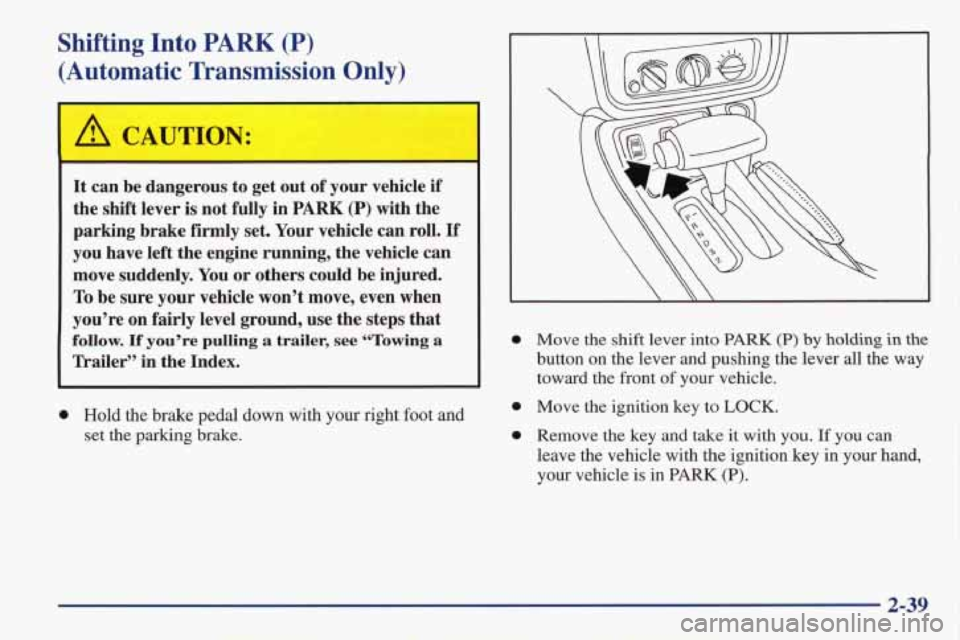
0 Move the shift lever into PARK (P) by holding in the
button on the lever and pushing the lever all the way
toward the front of your vehicle.
0 Move the ignition key to LOCK.
0 Remove the key and take it with you. If you can
leave the vehicle with the ignition key in your hand,
your vehicle
is in PARK (P).
2-39
Page 97 of 406

Parking Over Things That Burn Engine Exhaust
’ 1 CAUTION:
Things that can burn could touch hot exhaust
parts under your vehicle and ignite. Don’t park
over papers, leaves,
dry grass or other things that
can burn.
/d CAUTION:
Engine exhaust can kill. It contains the gas
carbon monoxide
(CO), which you can’t see or
smell.
It can cause unconsciousness and death.
You might have exhaust coming in if:
Your exhaust system sounds strange
0 Your vehicle gets rusty underneath.
0 Your vehicle was damaged in a collision.
0 Your vehicle was damaged when driving over
high points on the road or over road debris.
0 Repairs weren’t done correctly.
0 Your vehicle or exhaust system had been
If you ever suspect exhaust is coming into
your vehicle:
0 Drive it only with all the windows down to
Have your vehicle fixed immediately.
or
different.
modified improperly.
blow out any
CO; and
2-42
Page 98 of 406
Running Your Engine While You’re
Parked (Automatic Transmission)
It’s better not to park with the engine running. But if you
ever have to, here are some things to know.
A CAUTION: I
Idling the engine with the climate control
system
off could allow dangerous exhaust into
your vehicle (see the earlier Caution under
“Engine Exhaust”).
Also, idling in a closed-in place can let deadly
carbon monoxide
(CO) into your vehicle even if
the fan switch is at the highest setting. One place
this can happen is
a garage. Exhaust -- with
CO
-- can come in easily. NEVER park in a
garage with the engine running.
Another closed-in place can be a blizzard.
(See “Blizzard” in the Index.)
A CAUTION:
It can be dangerous to get out of your vehicle if
the shift lever is not fully in PARK
(P) with the
parking brake firmly set. Your vehicle can roll.
Don’t leave your vehicle when the engine
is
running unless you have to. If you’ve left the
engine running, the vehicle can move suddenly.
You
or others could be injured. To be sure your
vehicle won’t move, even when you’re on fairly
level ground, always set your parking brake and
move the shift lever to PARK
(P).
Follow the proper steps to be sure your vehicle won’t
move. See “Shifting Into
PARK (P)” in the Index.
If you are parking on a hill and if you’re pulling a
trailer, also see “Towing a Trailer” in the Index.
2-43