tow PONTIAC G3 2010 User Guide
[x] Cancel search | Manufacturer: PONTIAC, Model Year: 2010, Model line: G3, Model: PONTIAC G3 2010Pages: 368, PDF Size: 3.94 MB
Page 100 of 368
Additional Factors Affecting System
Operation
Safety belts help keep the passenger in position on the
seat during vehicle maneuvers and braking, which helps
the passenger sensing system maintain the passenger
airbag status. See“Safety Belts”and“Child Restraints”
in the Index for additional information about the
importance of proper restraint use.
A thick layer of additional material, such as a blanket
or cushion, or aftermarket equipment such as seat
covers, seat heaters, and seat massagers can affect
how well the passenger sensing system operates.
We recommend that you not use seat covers or other
aftermarket equipment other than any that GM has
approved for your specific vehicle. See Adding
Equipment to Your Airbag-Equipped Vehicle
on
page 2‑71for more information about modifications
that can affect how the system operates.
{WARNING:
Stowing of articles under the passenger seat or
between the passenger seat cushion and
seatback may interfere with the proper operation
of the passenger sensing system.
Servicing Your Airbag-Equipped
Vehicle
Airbags affect how the vehicle should be serviced.
There are parts of the airbag system in several places
around the vehicle. Your dealer/retailer and the service
manual have information about servicing the vehicle
and the airbag system. To purchase a service manual,
see Service Publications Ordering Information
on
page 8‑15.
{WARNING:
For up to 10 seconds after the ignition is turned off
and the battery is disconnected, an airbag can still
inflate during improper service. You can be injured
if you are close to an airbag when it inflates. Avoid
yellow connectors. They are probably part of the
airbag system. Be sure to follow proper service
procedures, and make sure the person performing
work for you is qualified to do so.
2-70
Page 109 of 368
Programming Transmitters to the
Vehicle
Only RKE transmitters programmed to the vehicle will
work. If a transmitter is lost or stolen, a replacement
can be purchased and programmed through your
dealer/retailer. When the replacement transmitter
is programmed to the vehicle, all remaining
transmitters must also be programmed. Any lost or
stolen transmitters no longer work once the new
transmitter is programmed. Each vehicle can have
up to five transmitters programmed to it.
Battery Replacement
Replace the battery if the LED on the transmitter does
not flash when you press the buttons.
Notice:When replacing the battery, do not touch
any of the circuitry on the transmitter. Static from
your body could damage the transmitter. To replace the battery:
1. Remove the screw from the back of the cover and open the cover of the transmitter.
2. Pull the transmitter out of the cover and carefully turn the circle cover of the transmitter unit
toward open.
3. Remove the battery.
4. Insert the new battery, positive side facing up. Use one three-volt, CR1620, or equivalent,
type battery.
5. Turn the circle cover of the transmitter unit toward close and put the transmitter unit in the cover.
6. Put the two halves back together and replace the screw. Make sure the cover is on tightly, so water
will not get in.
7. Test the transmitter operation.
3-5
Page 115 of 368

Liftgate (Hatchback)
{WARNING:
Exhaust gases can enter the vehicle if it is driven
with the liftgate, trunk/hatch open, or with any
objects that pass through the seal between the
body and the trunk/hatch or liftgate. Engine
exhaust contains Carbon Monoxide (CO) which
cannot be seen or smelled. It can cause
unconsciousness and even death.
If the vehicle must be driven with the liftgate,
or trunk/hatch open:
.Close all of the windows.
.Fully open the air outlets on or under the
instrument panel.
.Adjust the Climate Control system to a setting
that brings in only outside air and set the fan
speed to the highest setting. See Climate
Control System in the Index.
.If the vehicle is equipped with a power liftgate,
disable the power liftgate function.
For more information about carbon monoxide, see
Engine Exhaust on page 3‑32. To unlock the liftgate on a hatchback from outside of the
vehicle, insert the key in the lock cylinder and turn it
counterclockwise or use the RKE transmitter,
if equipped.
The handle is located above the right side of the license
plate. Pull the handle toward you and raise the liftgate.
When closing the liftgate, close from the center to
ensure it fully latches.
To lock the liftgate, insert the key into the lock cylinder
and turn it clockwise or use the RKE transmitter,
if equipped.
3-11
Page 127 of 368

{WARNING:
It is dangerous to get out of the vehicle if the shift
lever is not fully in P (Park) with the parking brake
firmly set. The vehicle can roll.
Do not leave the vehicle when the engine is
running unless you have to. If you have left the
engine running, the vehicle can move suddenly.
You or others could be injured. To be sure the
vehicle will not move, even when you are on fairly
level ground, always set the parking brake and
move the shift lever to P (Park). SeeShifting Into
Park (Automatic Transmission) on page 3‑29.
Ensure that the shift lever is fully in P (Park) before
starting the engine. The vehicle has an automatic
transmission shift lock control system. You have to
apply the brake pedal before you can shift from P (Park)
when the key is in ON/RUN. If you cannot shift out of
P (Park) while holding the brake pedal down, see
Shifting Out of Park on page 3‑30.
R (Reverse) : Use this gear to back up.
When shifting from N (Neutral) to R (Reverse), you need
to apply the brake pedal and push the release button on
the front of the shifter. Notice:
Shifting to R (Reverse) while the vehicle is
moving forward could damage the transmission.
The repairs would not be covered by the vehicle
warranty. Shift to R (Reverse) only after the vehicle
is stopped.
To rock the vehicle back and forth to get out of snow,
ice or sand without damaging the transmission, see If
Your Vehicle is Stuck in Sand, Mud, Ice, or Snow
on
page 5‑13.
N (Neutral) : In this position, the engine does not
connect with the wheels. To restart the engine while the
vehicle is already moving, use N (Neutral) only. Also,
use N (Neutral) when the vehicle is being towed.
{WARNING:
Shifting into a drive gear while the engine is
running at high speed is dangerous. Unless your
foot is firmly on the brake pedal, the vehicle could
move very rapidly. You could lose control and hit
people or objects. Do not shift into a drive gear
while the engine is running at high speed.
3-23
Page 133 of 368

Shifting Into Park
(Automatic Transmission)
{WARNING:
It can be dangerous to get out of the vehicle if the
shift lever is not fully in P (Park) with the parking
brake firmly set. The vehicle can roll. If you have
left the engine running, the vehicle can move
suddenly. You or others could be injured. To be
sure the vehicle will not move, even when you are
on fairly level ground, use the steps that follow.
1. Hold the brake pedal down and set the parking brake. See Parking Brake
on page 3‑28for more
information.
2. Move the shift lever into P (Park) by pressing the button on the shift lever and pushing the lever all
the way toward the front of the vehicle.
3. Turn the ignition key to LOCK/OFF.
4. Remove the key and take it with you. If you can leave the vehicle with the ignition key in your hand,
the vehicle is in P (Park).
Leaving the Vehicle With the Engine
Running (Automatic Transmission)
{WARNING:
It can be dangerous to leave the vehicle with the
engine running. The vehicle could move suddenly
if the shift lever is not fully in P (Park) with the
parking brake firmly set. And, if you leave the
vehicle with the engine running, it could overheat
and even catch fire. You or others could be
injured. Do not leave the vehicle with the engine
running.
If you have to leave the vehicle with the engine running,
be sure the vehicle is in P (Park) and the parking brake
is firmly set before you leave it. After you have moved
the shift lever into P (Park), hold the brake pedal down.
Then see if you can move the shift lever away from
P (Park) without first pushing the shift lock release
button. If you can, it means that the shift lever was not
fully locked into P (Park).
3-29
Page 138 of 368

Mirrors
Manual Rearview Mirror
Hold the inside rearview mirror in the center to move it
for a clearer view behind your vehicle. Adjust the mirror
to avoid glare from the headlamps behind you. Push the
tab forward for daytime use and pull it for nighttime use.
Outside Manual Mirrors
Adjust the mirrors to see a little of the side of your
vehicle.
Controls for the outside manual mirrors are located next
to each mirror.
Manually fold the mirrors inward to prevent damage
when going through an automatic car wash. To fold,
push the mirror toward the vehicle. Push the mirror
outward, to return it to the original position.
3-34
Page 139 of 368
Outside Power Mirrors
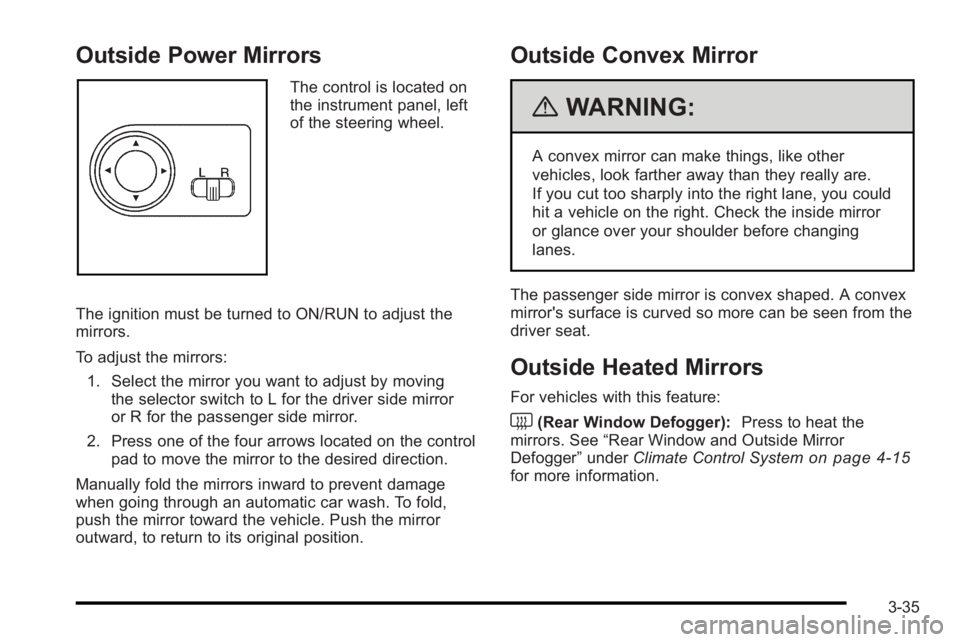
The control is located on
the instrument panel, left
of the steering wheel.
The ignition must be turned to ON/RUN to adjust the
mirrors.
To adjust the mirrors: 1. Select the mirror you want to adjust by moving the selector switch to L for the driver side mirror
or R for the passenger side mirror.
2. Press one of the four arrows located on the control pad to move the mirror to the desired direction.
Manually fold the mirrors inward to prevent damage
when going through an automatic car wash. To fold,
push the mirror toward the vehicle. Push the mirror
outward, to return to its original position.
Outside Convex Mirror
{WARNING:
A convex mirror can make things, like other
vehicles, look farther away than they really are.
If you cut too sharply into the right lane, you could
hit a vehicle on the right. Check the inside mirror
or glance over your shoulder before changing
lanes.
The passenger side mirror is convex shaped. A convex
mirror's surface is curved so more can be seen from the
driver seat.
Outside Heated Mirrors
For vehicles with this feature:
<(Rear Window Defogger): Press to heat the
mirrors. See “Rear Window and Outside Mirror
Defogger” underClimate Control System
on page 4‑15for more information.
3-35
Page 147 of 368
As you signal a turn or a lane change, if the arrows
flash rapidly, a signal bulb may be burned out and other
drivers will not see your turn signal.
If a bulb is burned out, replace it to help avoid an
accident. If the arrows do not go on at all when you
signal a turn, check for burned-out bulbs and then
check the fuse. SeeFuses and Circuit Breakers
on
page 6‑87.
Headlamp High/Low-Beam Changer
The headlamps must be on for this feature to work.
Push the turn signal lever away from you to turn the
high beams on. This instrument panel cluster light
3comes on while
the high beams are on and the ignition is turned to
ON/RUN.
Pull the lever towards you to return to low beams.
Flash-to-Pass
This feature is used to signal to the vehicle ahead that
you want to pass.
Pull the turn signal/multifunction lever towards you until
the high-beam headlamps come on, then release the
lever to turn them off.
4-5
Page 148 of 368

Windshield Wipers
Sedan shown
Hatchback shownThe lever is located on the right side of the steering
column. The ignition must be turned to ON/RUN to
operate the windshield wipers.
Move the lever to one of the following positions:
HI (High Speed) :
Fast wipes.
LO (Low Speed) : Slow wipes.
INT (Intermittent) : Move to this position for a delayed
wiping cycle. Turn the band on the windshield wiper
toward FAST or SLOW for a shorter or longer delay
between wipes. The wiper speed can only be adjusted
when the lever is in the INT position.
OFF : Turns the windshield wipers off.
Misting Function
Move the lever toward INT for a single wiping cycle.
Hold it there until the windshield wipers start; then let
go. The windshield wipers will stop after one wipe.
If more wipes are needed, hold the band toward INT
longer.
Clear ice and snow from the wiper blades before using
them. If frozen to the windshield, carefully loosen or
thaw them. Damaged wiper blades should be replaced.
SeeWindshield Wiper Blade Replacement
on
page 6‑49.
Heavy snow or ice can overload the wipers. A circuit
breaker stops them until the motor cools.
4-6
Page 149 of 368
Windshield Washer
To use this feature, the ignition must be turned to
ON/RUN. Pull the windshield washer/wiper lever
toward you to spray washer fluid on the windshield.
The spray continues until the lever is released.
The wipers will run a few times and either stop or
will resume at the speed being used previously.
SeeWindshield Washer Fluid
on page 6‑33for
information on filling the windshield washer fluid.
{WARNING:
In freezing weather, do not use your washer until
the windshield is warmed. Otherwise the washer
fluid can form ice on the windshield, blocking your
vision.
Rear Window Wiper/Washer
{WARNING:
In freezing weather, do not use your washer until
the windshield is warmed. Otherwise the washer
fluid can form ice on the windshield, blocking your
vision.
The vehicle may have a rear window wiper/washer.
Turn the rear wiper/washer band to operate the rear
window wiper/washer.
OFF : Turns the rear window wiper/washer off.
Z:Turns the rear wiper on for intermittent wipes.
Y: Sprays washer fluid onto the rear window and the
wiper operates continuously.
The windshield washer reservoir is used for the
windshield and rear window. Check the fluid level if
either washer is not working. See Windshield Washer
Fluid on page 6‑33.
4-7