instrument panel PONTIAC G6 2005 Owner's Guide
[x] Cancel search | Manufacturer: PONTIAC, Model Year: 2005, Model line: G6, Model: PONTIAC G6 2005Pages: 354, PDF Size: 2.27 MB
Page 194 of 354

Avoid needless heavy braking. Some people drive
in spurts — heavy acceleration followed by heavy
braking — rather than keeping pace with traffic. This is
a mistake. Your brakes may not have time to cool
between hard stops. Your brakes will wear out much
faster if you do a lot of heavy braking. If you keep pace
with the traffic and allow realistic following distances,
you will eliminate a lot of unnecessary braking.
That means better braking and longer brake life.
If your engine ever stops while you are driving, brake
normally but do not pump your brakes. If you do,
the pedal may get harder to push down. If your engine
stops, you will still have some power brake assist.
But you will use it when you brake. Once the power
assist is used up, it may take longer to stop and
the brake pedal will be harder to push.Anti-Lock Brake System (ABS)
Your vehicle may have anti-lock brakes. ABS is an
advanced electronic braking system that will help
prevent a braking skid.
If your vehicle has anti-lock
brakes, this warning light
on the instrument panel will
come on briey when
you start your vehicle.
When you start your engine, or when you begin to drive
away, your anti-lock brake system will check itself.
You may hear a momentary motor or clicking noise while
this test is going on, and you may even notice that
your brake pedal moves or pulses a little. This is normal.
4-6
Page 197 of 354

This light, located on the
instrument panel, will come
on when your Traction
Control System is limiting
wheel spin.
You may feel or hear the system working, but this
is normal.
If your vehicle is in cruise control when the traction
control system begins to limit wheel spin, the cruise
control will automatically disengage. When road
conditions allow you to safely use it again, you may
re-engage the cruise control. SeeCruise Control
on page 3-10.
The Traction Control System operates in all transaxle
shift lever positions. But the system can upshift the
transaxle only as high as the shift lever position you’ve
chosen, so you should use the lower gears only
when necessary. SeeAutomatic Transaxle Operation on
page 2-24.When the system is on,
this warning light, located
on the instrument panel
cluster, will come on to
let you know if there’s
a problem.
When this warning light is on, the system will not limit
wheel spin. Adjust your driving accordingly.
To limit wheel spin, especially in slippery road conditions,
you should always leave the Traction Control System on.
But you can turn the system off if you prefer.
To turn the system on or off, press the traction control
button located under the climate controls.
When you turn the system off, the Traction Control
System warning light will come on and stay on. If the
Traction Control System is limiting wheel spin when you
press the button to turn the system off, the warning
light will come on – but the system won’t turn off right
away. It will wait until there’s no longer a current need to
limit wheel spin.
You can turn the system back on at any time by
pressing the button again. The Traction Control System
warning light should go off.
4-9
Page 198 of 354

Enhanced Traction System (ETS)
Your vehicle may have an Enhanced Traction System
(ETS) that limits wheel spin. This is especially useful in
slippery road conditions. The system operates only if it
senses that one or both of the front wheels are spinning
or beginning to lose traction. When this happens, the
system reduces engine power and may also upshift the
transaxle to limit wheel spin. Also, the traction control
system activates the appropriate corner brakes to gain
even quicker control to limit wheel spin.
This light, located on the
instrument panel, will come
on when your Enhanced
Traction System is
limiting wheel spin.
You may feel or hear the system working, but this
is normal.
If your vehicle is in cruise control when the enhanced
traction system begins to limit wheel spin, the cruise
control will automatically disengage. When road
conditions allow you to safely use it again, you may
re-engage the cruise control. SeeCruise Control
on page 3-10.The Enhanced Traction System operates in all transaxle
shift lever positions. But the system can upshift the
transaxle only as high as the shift lever position you’ve
chosen, so you should use the lower gears only
when necessary. SeeAutomatic Transaxle Operation on
page 2-24.
When the system is on,
this warning light, located
on the instrument panel
cluster, will come on to let
you know if there’s a
problem.
When this warning light is on, the system will not limit
wheel spin. Adjust your driving accordingly.
To limit wheel spin, especially in slippery road
conditions, you should always leave the Enhanced
Traction System on. But you can turn the system off if
you prefer.
To turn the system on or off, press the ETS button
located on the instrument panel. In order to effectively
“rock” the vehicle, you will need to turn off ETS.
4-10
Page 231 of 354

Turn Signals When Towing a Trailer
When you tow a trailer, your vehicle may need a
different turn signal asher and/or extra wiring. Check
with your dealer. The arrows on your instrument
panel will ash whenever you signal a turn or lane
change. Properly hooked up, the trailer lamps will also
ash, telling other drivers you are about to turn,
change lanes or stop.
When towing a trailer, the arrows on your instrument
panel will ash for turns even if the bulbs on the trailer
are burned out. Thus, you may think drivers behind
you are seeing your signal when they are not. It
is important to check occasionally to be sure the trailer
bulbs are still working.
Driving On Grades
When towing a trailer on long uphill grades and the
outside temperature is above 85°F (29°C), reduce your
vehicle speed to 45 mph (72 km/h) to avoid overheating
the engine cooling system.
Reduce speed and shift to a lower gearbeforeyou start
down a long or steep downgrade. If you do not shift
down, you might have to use your brakes so much that
they would get hot and no longer work well.
Parking on Hills
{CAUTION:
You really should not park your vehicle, with a
trailer attached, on a hill. If something goes
wrong, your rig could start to move. People
can be injured, and both your vehicle and the
trailer can be damaged.
But if you ever have to park your rig on a hill, here is
how to do it:
1. Apply your regular brakes, but do not shift into
PARK (P), yet. When parking uphill, turn your
wheels away from the curb. When parking downhill,
turn your wheels into the curb.
2. Have someone place chocks under the trailer
wheels.
3. When the chocks are in place, release the regular
brakes until the chocks absorb the load.
4. Reapply the regular brakes. Then apply your
parking brake and shift into PARK (P).
5. Release the regular brakes.
4-43
Page 234 of 354

If a Tire Goes Flat........................................5-55
Changing a Flat Tire.....................................5-56
Removing the Spare Tire and Tools................5-57
Removing the Flat Tire and Installing the
Spare Tire................................................5-59
Storing a Flat or Spare Tire and Tools............5-64
Compact Spare Tire......................................5-65
Appearance Care............................................5-66
Fabric/Carpet...............................................5-66
Vinyl...........................................................5-68
Leather.......................................................5-68
Instrument Panel..........................................5-68
Interior Plastic Components............................5-68
Glass Surfaces.............................................5-68
Care of Safety Belts......................................5-69
Weatherstrips...............................................5-69
Washing Your Vehicle...................................5-69
Cleaning Exterior Lamps/Lenses.....................5-69
Finish Care..................................................5-70
Windshield and Wiper Blades.........................5-70Aluminum Wheels.........................................5-71
Tires...........................................................5-71
Sheet Metal Damage.....................................5-72
Finish Damage.............................................5-72
Underbody Maintenance................................5-72
Chemical Paint Spotting.................................5-72
Vehicle Care/Appearance Materials..................5-73
Vehicle Identication......................................5-74
Vehicle Identication Number (VIN).................5-74
Service Parts Identication Label.....................5-74
Electrical System............................................5-75
Add-On Electrical Equipment..........................5-75
Windshield Wiper Fuses................................5-75
Power Windows and Other Power Options.......5-75
Fuses and Circuit Breakers............................5-75
Instrument Panel Fuse Block..........................5-76
Engine Compartment Fuse Block....................5-78
Rear Compartment Fuse Block.......................5-79
Capacities and Specications..........................5-82
Section 5 Service and Appearance Care
5-2
Page 243 of 354
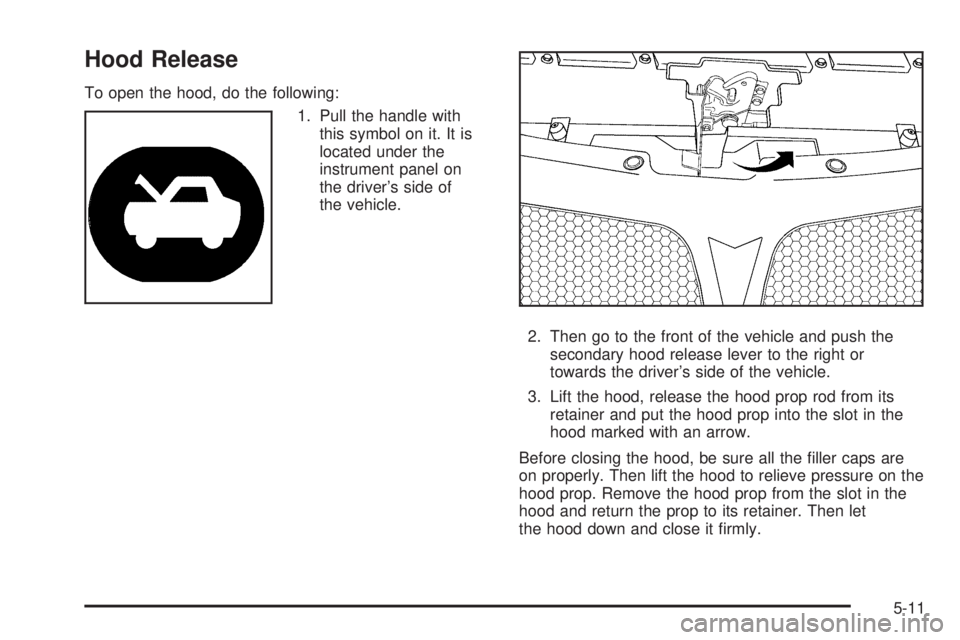
Hood Release
To open the hood, do the following:
1. Pull the handle with
this symbol on it. It is
located under the
instrument panel on
the driver’s side of
the vehicle.
2. Then go to the front of the vehicle and push the
secondary hood release lever to the right or
towards the driver’s side of the vehicle.
3. Lift the hood, release the hood prop rod from its
retainer and put the hood prop into the slot in the
hood marked with an arrow.
Before closing the hood, be sure all the ller caps are
on properly. Then lift the hood to relieve pressure on the
hood prop. Remove the hood prop from the slot in the
hood and return the prop to its retainer. Then let
the hood down and close it rmly.
5-11
Page 254 of 354

Adding Coolant
If you need more coolant, add the proper DEX-COOL®
coolant mixtureat the surge tank,but only when the
engine is cool. If the surge tank is empty, a special ll
procedure is necessary. SeeEngine Overheating
on page 5-22andCooling System on page 5-24.
{CAUTION:
You can be burned if you spill coolant on hot
engine parts. Coolant contains ethylene glycol,
and it will burn if the engine parts are hot
enough. Do not spill coolant on a hot engine.
When replacing the pressure cap, make sure it is
hand-tight.
Coolant Surge Tank Pressure Cap
Notice:If the pressure cap is not tightly installed,
coolant loss and possible engine damage may
occur. Be sure the cap is properly and tightly
secured.
Engine Overheating
You will nd an engine coolant temperature gage on
your vehicle’s instrument panel. SeeEngine Coolant
Temperature Gage on page 3-30.
If Steam Is Coming From Your Engine
{CAUTION:
Steam from an overheated engine can burn
you badly, even if you just open the hood. Stay
away from the engine if you see or hear steam
coming from it. Just turn it off and get
everyone away from the vehicle until it cools
down. Wait until there is no sign of steam or
coolant before you open the hood.
If you keep driving when your engine is
overheated, the liquids in it can catch re. You
or others could be badly burned. Stop your
engine if it overheats, and get out of the
vehicle until the engine is cool.
Notice:If your engine catches re because you
keep driving with no coolant, your vehicle can
be badly damaged. The costly repairs would not be
covered by your warranty.
5-22
Page 300 of 354
Vinyl
Use warm water and a clean cloth.
Rub with a clean, damp cloth to remove dirt. This
may have to be done more than once.
Things like tar, asphalt, and shoe polish will stain if
they are not removed quickly. Use a clean cloth
and vinyl cleaner. See your dealer for this product.
Leather
Use a soft cloth with lukewarm water and a mild soap or
saddle soap and wipe dry with a soft cloth. Then, let
the leather dry naturally. Do not use heat to dry.
For stubborn stains, use a leather cleaner.
Never use oils, varnishes, solvent-based or abrasive
cleaners, furniture polish, or shoe polish on leather.
Soiled or stained leather should be cleaned
immediately. If dirt is allowed to work into the nish,
it can harm the leather.
Instrument Panel
Use only mild soap and water to clean the top surfaces
of the instrument panel. Sprays containing silicones
or waxes may cause annoying reections in the
windshield and even make it difficult to see through the
windshield under certain conditions.
Interior Plastic Components
Use only a mild soap and water solution on a soft cloth
or sponge. Commercial cleaners may affect the
surface nish.
Glass Surfaces
Notice:If you use abrasive cleaners when cleaning
glass surfaces on your vehicle, you could scratch
the glass. When cleaning the glass on your vehicle,
use only a soft cloth and glass cleaner.
Glass should be cleaned often. GM Glass Cleaner or a
liquid household glass cleaner will remove normal
tobacco smoke and dust lms on interior glass. See
Vehicle Care/Appearance Materials on page 5-73.
5-68
Page 306 of 354

Vehicle Identication
Vehicle Identication Number (VIN)
This is the legal identier for your vehicle. It appears on
a plate in the front corner of the instrument panel, on
the driver’s side. You can see it if you look through the
windshield from outside your vehicle. The VIN also
appears on the Vehicle Certication and Service Parts
labels and the certicates of title and registration.
Engine Identication
The eighth character in your VIN is the engine code.
This code will help you identify your engine,
specications and replacement parts.
Service Parts Identication Label
You will nd this label on the inside of the glove box. It
is very helpful if you ever need to order parts. On
this label, you will nd the following:
VIN
Model designation
Paint information
Production options and special equipment
Be sure that this label is not removed from the vehicle.
5-74
Page 307 of 354
Electrical System
Add-On Electrical Equipment
Notice:Don’t add anything electrical to your vehicle
unless you check with your dealer rst. Some
electrical equipment can damage your vehicle and
the damage wouldn’t be covered by your warranty.
Some add-on electrical equipment can keep other
components from working as they should.
Your vehicle has an airbag system. Before attempting to
add anything electrical to your vehicle, seeServicing
Your Airbag-Equipped Vehicle on page 1-57.
Windshield Wiper Fuses
The windshield wiper motor is protected by a circuit
breaker and a fuse. If the motor overheats due to heavy
snow, etc., the wiper will stop until the motor cools. If
the overload is caused by some electrical problem,
have it xed.
Power Windows and Other
Power Options
A circuit breaker in the fuse panel protects the power
windows. When the current load is too heavy, the circuit
breaker opens and closes, protecting the circuit until
the problem is xed.
Fuses and Circuit Breakers
The wiring circuits in your vehicle are protected from
short circuits by a combination of fuses, circuit breakers
and fusible links. This greatly reduces the chance of
damage caused by electrical problems.
Look at the silver-colored band inside the fuse. If the
band is broken or melted, replace the fuse. Be sure to
replace a bad fuse with a new one of the identical
size and rating.
There are three fuse blocks in your vehicle: one in the
center of the instrument panel, one in the engine
compartment and one in the trunk.
There is a fuse puller located on the instrument panel
fuse block. It can be used to easily remove fuses
from the fuse block.
5-75