warning PONTIAC G6 2007 Owner's Guide
[x] Cancel search | Manufacturer: PONTIAC, Model Year: 2007, Model line: G6, Model: PONTIAC G6 2007Pages: 486, PDF Size: 2.78 MB
Page 259 of 486
Avoid needless heavy braking. Some people drive
in spurts — heavy acceleration followed by heavy
braking — rather than keeping pace with traffic.
This is a mistake. The brakes may not have time to
cool between hard stops. The brakes will wear out
much faster if you do a lot of heavy braking. If you
keep pace with the traffic and allow realistic
following distances, you will eliminate a lot of
unnecessary braking. That means better braking
and longer brake life.
If your vehicle’s engine ever stops while you are
driving, brake normally but do not pump the
brakes. If you do, the pedal may get harder to
push down. If the engine stops, you will still have
some power brake assist. But you will use it
when you brake. Once the power assist is used
up, it may take longer to stop and the brake pedal
will be harder to push.
Adding non-GM accessories can affect your
vehicle’s performance. SeeAccessories and
Modications on page 308.Anti-Lock Brake System (ABS)
Your vehicle may have the Anti-Lock Brake
System (ABS), an advanced electronic braking
system that will help prevent a braking skid.
If your vehicle has ABS,
this warning light on the
instrument panel will
come on briey when
you start your vehicle.
When you start your engine, or when you begin to
drive away, ABS will check itself. You may hear a
momentary motor or clicking noise while this test is
going on, and you may even notice that your brake
pedal moves or pulses a little. This is normal.
259
Page 262 of 486

Traction Control System (TCS)
Your vehicle may have a Traction Control System
(TCS) that limits wheel spin. This is especially
useful in slippery road conditions. The system
operates only if it senses that one or both of the
front wheels are spinning or beginning to lose
traction. When this happens, the system reduces
engine power and may also upshift the transaxle
to limit wheel spin. Also, the traction control system
activates the appropriate corner brakes to gain
even quicker control to limit wheel spin.
This light, located on the
instrument panel, will
come on when your
Traction Control System
is limiting wheel spin.
You may feel or hear the system working, but this
is normal.
If your vehicle is in cruise control when the
traction control system begins to limit wheel spin,
the cruise control will automatically disengage.When road conditions allow you to safely use it
again, you may re-engage the cruise control. See
Cruise Control on page 171.
The Traction Control System operates in all
transaxle shift lever positions except park or
neutral. But the system can upshift the transaxle
only as high as the shift lever position you’ve
chosen, so you should use the lower gears only
when necessary. SeeAutomatic Transaxle
Operation on page 129.
This light is located on
the instrument panel
cluster.
When the system is on, this light will come on to let
you know if there’s a problem, or if the system has
been turned off.
When this warning light is on, the system will not
limit wheel spin. Adjust your driving accordingly.
262
Page 263 of 486

To limit wheel spin, especially in slippery road
conditions, you should always leave the Traction
Control System on. But you can turn the system off
if you prefer.
To turn the system on or off, press the traction
control button (TC) located under the climate
controls. In order to effectively “rock” the vehicle,
you will need to turn off TCS.
If you press the TC button once, the traction control
system will turn off and the traction control system
warning light will come on. The StabiliTrak
®system
will stay on. Press the TC button again to turn the
system back on. The traction control system
warning light will go off. If you press and hold the
TC button, the StabiliTrak
®system and the traction
control system will turn off. Press the TC button
again to turn StabiliTrak
®and the traction control
system back on. For more information, see
StabiliTrak
®System on page 265.
When you turn the system off, the Traction Control
System warning light will come on and stay on.
If the Traction Control System is limiting wheel spin
when you press the button to turn the system
off, the warning light will come on – but the system
won’t turn off right away. It will wait until there’s
no longer a current need to limit wheel spin.Adding non-GM accessories can affect your
vehicle’s performance. SeeAccessories and
Modications on page 308for more information.
Enhanced Traction System (ETS)
Your vehicle may have an Enhanced Traction
System (ETS) that limits wheel spin. This is
especially useful in slippery road conditions. The
system operates only if it senses that one or
both of the front wheels are spinning or beginning
to lose traction. When this happens, the system
reduces engine power and may also upshift
the transaxle to limit wheel spin.
This light, located on
the instrument panel,
will come on when your
Enhanced Traction
System is limiting
wheel spin.
You may feel or hear the system working, but this
is normal.
263
Page 264 of 486
If your vehicle is in cruise control when the
enhanced traction system begins to limit wheel
spin, the cruise control will automatically
disengage. When road conditions allow you to
safely use it again, you may re-engage the cruise
control. SeeCruise Control on page 171.
The Enhanced Traction System operates in all
transaxle shift lever positions except park, neutral
or reverse. But the system can upshift the
transaxle only as high as the shift lever position
you’ve chosen, so you should use the lower gears
only when necessary. SeeAutomatic Transaxle
Operation on page 129.
This light is located on
the instrument panel
cluster.
When the system is on, this light will come on to
let you know if there’s a problem, or if the
system has been turned off.When this warning light is on, the system will not
limit wheel spin. Adjust your driving accordingly.
To limit wheel spin, especially in slippery road
conditions, you should always leave the Enhanced
Traction System on. But you can turn the system
off if you prefer.
To turn the system on or off, press the traction
control button located on the instrument panel. In
order to effectively “rock” the vehicle, you will
need to turn off the traction control system.
When you turn the system off, the Enhanced
Traction System warning light will come on and
stay on. If the Enhanced Traction System is
limiting wheel spin when you press the button to
turn the system off, the warning light will come
on – but the system won’t turn off right away. It will
wait until there’s no longer a current need to
limit wheel spin.
You can turn the system back on at any time by
pressing the button again. The Enhanced Traction
System warning light should go off.
264
Page 266 of 486

Steering
Electric Power Steering
If your vehicle has the electric power steering
system and the engine stalls while you are driving,
the power steering assist system will continue to
operate until you are able to stop your vehicle. If
you lose power steering assist because the electric
power steering system is not functioning, you can
steer, but it will take more effort.
If you turn the steering wheel in either direction
several times until it stops, or hold the steering
wheel in the stopped position for an extended
amount of time, you may notice a reduced amount
of power steering assist. The normal amount of
power steering assist should return shortly after a
few normal steering movements.
The electric power steering system does not
require regular maintenance. If you suspect
steering system problems, contact your dealer for
service repairs. SeeDIC Warnings and Messages
on page 212.
Hydraulic Power Steering
If your vehicle has the hydraulic power steering
system and you lose power steering assist
because the engine stops or the power steering
system is not functioning, you can steer, but it will
take much more effort.
Steering Tips
It is important to take curves at a reasonable
speed.
A lot of the “driver lost control” accidents
mentioned on the news happen on curves.
Here is why:
Experienced driver or beginner, each of us is
subject to the same laws of physics when driving on
curves. The traction of the tires against the road
surface makes it possible for the vehicle to change
its path when you turn the front wheels. If there is
no traction, inertia will keep the vehicle going in the
same direction. If you have ever tried to steer a
vehicle on wet ice, you will understand this.
266
Page 272 of 486
If your vehicle starts to slide, ease your foot off
the accelerator pedal and quickly steer the
way you want the vehicle to go. If you start
steering quickly enough, your vehicle may
straighten out. Always be ready for a second skid
if it occurs.
Of course, traction is reduced when water, snow,
ice, gravel, or other material is on the road.
For safety, you will want to slow down and adjust
your driving to these conditions. It is important
to slow down on slippery surfaces because
stopping distance will be longer and vehicle control
more limited.
While driving on a surface with reduced traction, try
your best to avoid sudden steering, acceleration, or
braking, including reducing vehicle speed by
shifting to a lower gear. Any sudden changes could
cause the tires to slide. You may not realize the
surface is slippery until your vehicle is skidding.
Learn to recognize warning clues — such as
enough water, ice, or packed snow on the road to
make a mirrored surface — and slow down when
you have any doubt.If you have the Anti-Lock Brake System (ABS),
remember: It helps avoid only the braking skid. If
you do not have ABS, then in a braking skid,
where the wheels are no longer rolling, release
enough pressure on the brakes to get the wheels
rolling again. This restores steering control.
Push the brake pedal down steadily when you
have to stop suddenly. As long as the wheels are
rolling, you will have steering control.
Driving at Night
Night driving is more dangerous than day driving.
One reason is that some drivers are likely to
be impaired — by alcohol or drugs, with night
vision problems, or by fatigue.
Here are some tips on night driving.
Drive defensively.
Do not drink and drive.
Adjust the inside rearview mirror to reduce the
glare from headlamps behind you.
Since you cannot see as well, you may need
to slow down and keep more space between
you and other vehicles.
272
Page 276 of 486

Driving Through Deep Standing Water
Notice:If you drive too quickly through
deep puddles or standing water, water can
come in through your engine’s air intake and
badly damage your engine. Never drive through
water that is slightly lower than the underbody
of your vehicle. If you cannot avoid deep
puddles or standing water, drive through them
very slowly.
Driving Through Flowing Water
{CAUTION:
Flowing or rushing water creates strong
forces. If you try to drive through owing
water, as you might at a low water
crossing, your vehicle can be carried away.
CAUTION: (Continued)
CAUTION: (Continued)
As little as six inches of owing water can
carry away a smaller vehicle. If this
happens, you and other vehicle occupants
could drown. Do not ignore police
warning signs, and otherwise be very
cautious about trying to drive through
owing water.
Some Other Rainy Weather Tips
Besides slowing down, allow some extra
following distance. And be especially careful
when you pass another vehicle. Allow yourself
more clear room ahead, and be prepared to
have your view restricted by road spray.
Have good tires with proper tread depth. See
Tires on page 370.
276
Page 277 of 486
City Driving
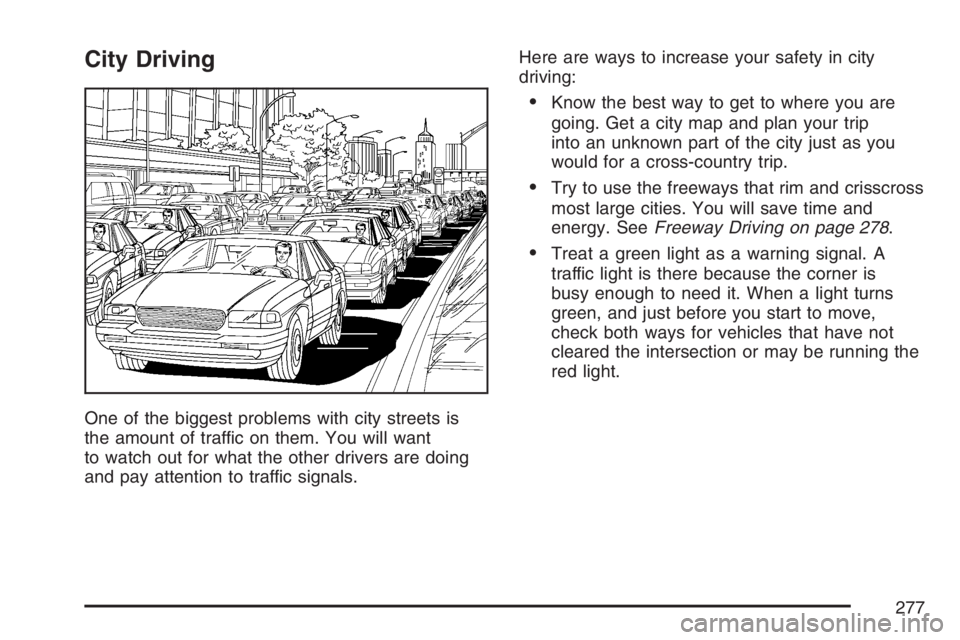
One of the biggest problems with city streets is
the amount of traffic on them. You will want
to watch out for what the other drivers are doing
and pay attention to traffic signals.Here are ways to increase your safety in city
driving:
Know the best way to get to where you are
going. Get a city map and plan your trip
into an unknown part of the city just as you
would for a cross-country trip.
Try to use the freeways that rim and crisscross
most large cities. You will save time and
energy. SeeFreeway Driving on page 278.
Treat a green light as a warning signal. A
traffic light is there because the corner is
busy enough to need it. When a light turns
green, and just before you start to move,
check both ways for vehicles that have not
cleared the intersection or may be running the
red light.
277
Page 283 of 486
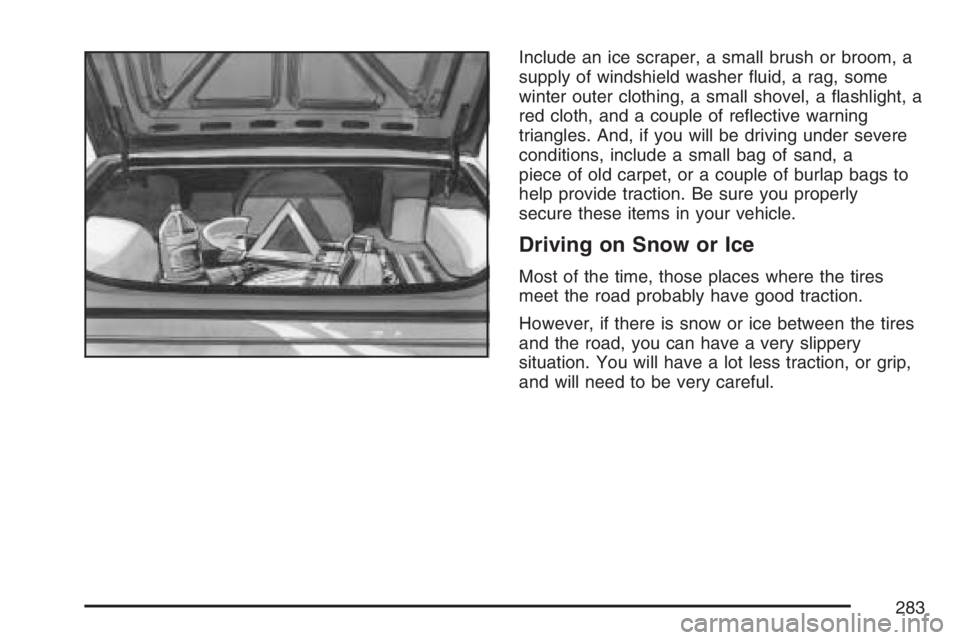
Include an ice scraper, a small brush or broom, a
supply of windshield washer uid, a rag, some
winter outer clothing, a small shovel, a ashlight, a
red cloth, and a couple of reective warning
triangles. And, if you will be driving under severe
conditions, include a small bag of sand, a
piece of old carpet, or a couple of burlap bags to
help provide traction. Be sure you properly
secure these items in your vehicle.
Driving on Snow or Ice
Most of the time, those places where the tires
meet the road probably have good traction.
However, if there is snow or ice between the tires
and the road, you can have a very slippery
situation. You will have a lot less traction, or grip,
and will need to be very careful.
283
Page 305 of 486
Service........................................................ 308
Accessories and Modications................... 308
California Proposition 65 Warning.............. 309
Doing Your Own Service Work.................. 309
Adding Equipment to the Outside of
Your Vehicle.......................................... 310
Fuel............................................................. 310
Gasoline Octane........................................ 310
Gasoline Specications.............................. 310
California Fuel........................................... 311
Additives................................................... 311
Fuels in Foreign Countries........................ 312
Filling the Tank......................................... 313
Filling a Portable Fuel Container............... 315
Checking Things Under
the Hood.................................................. 316
Hood Release........................................... 317
Engine Compartment Overview.................. 318
Engine Oil................................................. 325
Engine Oil Life System.............................. 328
Engine Air Cleaner/Filter............................ 330
Automatic Transaxle Fluid
(2.4L L4 and 3.5L V6 Engines).............. 332Automatic Transaxle Fluid
(3.6L Engine)......................................... 332
Automatic Transaxle Fluid
(3.9L V6 Engine).................................... 335
Manual Transaxle Fluid............................. 338
Hydraulic Clutch........................................ 338
Engine Coolant.......................................... 339
Pressure Cap............................................ 342
Engine Overheating................................... 342
Overheated Engine Protection
Operating Mode..................................... 344
Cooling System......................................... 345
Power Steering Fluid ................................. 349
Windshield Washer Fluid........................... 350
Brakes...................................................... 352
Battery...................................................... 355
Jump Starting............................................ 356
Bulb Replacement....................................... 361
Halogen Bulbs........................................... 361
Headlamps, Front Turn Signal,
Sidemarker, and Parking Lamps............. 362
Center High-Mounted
Stoplamp (CHMSL) (Sedan)................... 363
Section 5 Service and Appearance Care
305