transmission PONTIAC G6 2010 User Guide
[x] Cancel search | Manufacturer: PONTIAC, Model Year: 2010, Model line: G6, Model: PONTIAC G6 2010Pages: 448, PDF Size: 2.5 MB
Page 137 of 448

Torque Lock
If you are parking on a hill and you do not shift the
automatic transmission into P (Park) properly, the weight
of the vehicle may put too much force on the parking
pawl in the transmission. You may find it difficult to pull
the shift lever out of P (Park). This is called torque
lock. To prevent torque lock, set the parking brake and
then shift into P (Park) properly before you leave the
driver seat. To find out how, see “Shifting Into Park”
previously in the section.
When you are ready to drive, move the shift lever out of
P (Park) before you release the parking brake.
If torque lock does occur, you may need to have another
vehicle push yours a little uphill to take some of the
pressure from the parking pawl in the transmission, so
you can pull the shift lever out of P (Park).
Shifting Out of Park
The vehicle is equipped with an electronic shift lock
release system. The shift lock release is designed to:
•Prevent ignition key removal unless the shift
lever is in P (Park) with the shift lever button fully
released, and
•Prevent movement of the shift lever out of P (Park),
unless the ignition is in ON/RUN or ACC/
ACCESSORY and the regular brake pedal is applied.The shift lock release is always functional except
in the case of an uncharged or low voltage (less than
9 volt) battery.
If the vehicle has an uncharged battery or a battery with
low voltage, try charging or jump starting the battery.
SeeJump Starting on page 6-43for more information.
To shift out of P (Park):
1. Apply the brake pedal.
2. Press the shift lever button.
3. Move the shift lever to the desired position.
If you still are unable to shift out of P (Park):
1. Fully release the shift lever button.
2. While holding down the brake pedal, press the shift
lever button again.
3. Move the shift lever to the desired position.
If you still cannot move the shift lever from P (Park), see
your dealer/retailer.
3-31
Page 139 of 448

Running the Vehicle While Parked
It is better not to park with the engine running. But if you
ever have to, here are some things to know.
{WARNING:
Idling a vehicle in an enclosed area with poor
ventilation is dangerous. Engine exhaust may
enter the vehicle. Engine exhaust contains Carbon
Monoxide (CO) which cannot be seen or smelled.
It can cause unconsciousness and even death.
Never run the engine in an enclosed area that has
no fresh air ventilation. For more information, see
Engine Exhaust on page 3-32.
{WARNING:
It can be dangerous to get out of the vehicle if the
automatic transmission shift lever is not fully in
P (Park) with the parking brake firmly set. The
vehicle can roll. Do not leave the vehicle when the
engine is running unless you have to. If you have
left the engine running, the vehicle can move
suddenly. You or others could be injured. To be
sure the vehicle will not move, even when you are
on fairly level ground, always set the parking
brake and move the shift lever to P (Park).
Follow the proper steps to be sure the vehicle will not
move. SeeShifting Into Park (Automatic Transmission)
on page 3-30.
If parking on a hill and pulling a trailer, seeTowing a
Trailer on page 5-27.
3-33
Page 144 of 448
Notice:Forcing the sunshade forward of the
sliding glass panel may cause damage and the
sunroof may not operate properly. Always close the
glass panel before closing the sunshade.
Do not leave the sunroof open for long periods of time.
Debris can collect in the tracks and possibly damage
the sunroof operation and plug the water draining
system.
Retractable Hardtop
The following procedures explain the proper operation
of the retractable hardtop. The retractable hardtop
will not operate if the trunk cargo cover is not in place.
If the retractable hardtop is lowered or raised multiple
times, the engine should be running while doing
so to prevent drain on the vehicle’s battery.
Lowering the Retractable Hardtop
Notice:Leaving the retractable hardtop down and
exposing the interior of the vehicle to outdoor
conditions may cause damage. Always close the
retractable hardtop if leaving the vehicle outdoors.
Notice:Lowering the top if it is damp, wet, or
dirty can cause stains, mildew, and damage to the
inside of your vehicle. Dry off the top before
lowering it.Notice:If you lower the retractable hardtop in cold
weather (32°F/0°C or lower), you may damage
top components. Do not lower the retractable
hardtop in cold weather.
1. Park on a level surface, and shift the transmission
into P (Park). The vehicle must be in P (Park), and
the engine must be running, or the ignition
turned to the ON/RUN position, to operate the
retractable hardtop.
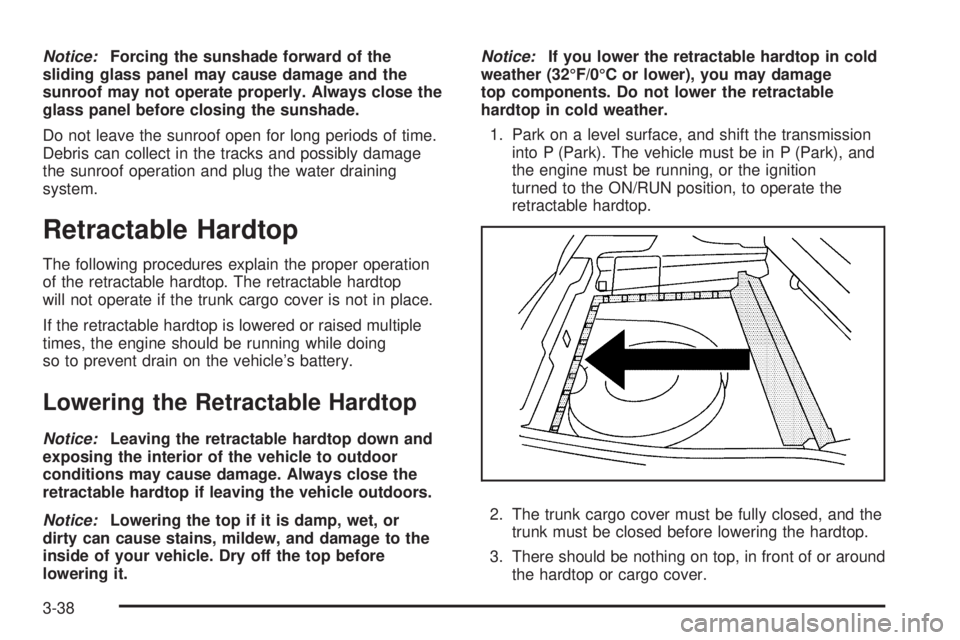
2. The trunk cargo cover must be fully closed, and the
trunk must be closed before lowering the hardtop.
3. There should be nothing on top, in front of or around
the hardtop or cargo cover.
3-38
Page 147 of 448
Raising the Retractable Hardtop
1. Park on a level surface, and shift the transmission
into P (Park). The vehicle must be in P (Park), and
the engine must be running, or the ignition
turned to the ON/RUN position, to operate the
retractable hardtop.
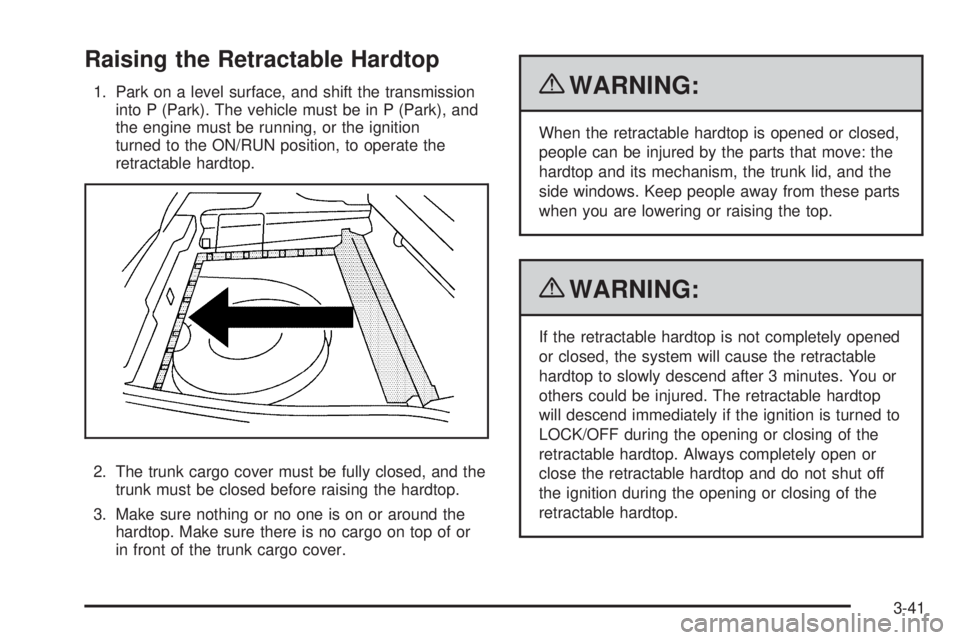
2. The trunk cargo cover must be fully closed, and the
trunk must be closed before raising the hardtop.
3. Make sure nothing or no one is on or around the
hardtop. Make sure there is no cargo on top of or
in front of the trunk cargo cover.{WARNING:
When the retractable hardtop is opened or closed,
people can be injured by the parts that move: the
hardtop and its mechanism, the trunk lid, and the
side windows. Keep people away from these parts
when you are lowering or raising the top.
{WARNING:
If the retractable hardtop is not completely opened
or closed, the system will cause the retractable
hardtop to slowly descend after 3 minutes. You or
others could be injured. The retractable hardtop
will descend immediately if the ignition is turned to
LOCK/OFF during the opening or closing of the
retractable hardtop. Always completely open or
close the retractable hardtop and do not shut off
the ignition during the opening or closing of the
retractable hardtop.
3-41
Page 162 of 448

Automatic Headlamp System
When it is dark enough outside, the automatic headlamp
system turns on the headlamps at the normal brightness
along with other lamps such as the taillamps,
sidemarker, parking lamps, and the instrument panel
lights. The radio lights will also be dim.
The vehicle has a light sensor on top of the instrument
panel that controls the automatic headlamp system.
Do not cover the sensor or the automatic headlamp
system will turn on when it is not needed.
There is a delay in the transition between the daytime
and nighttime operation of the DRL and the automatic
headlamp systems so that driving under bridges or
bright overhead street lights does not affect the system.
The DRL and automatic headlamp systems will only
be affected when the light sensor sees a change
in lighting lasting longer than this delay.
If vehicle is started in a dark garage, the automatic
headlamp system comes on immediately. Once
the vehicle leaves the garage, it takes about one minute
for the automatic headlamp system to change to DRL
if it is light outside. During that delay, the instrument
panel cluster may not be as bright as usual. Make sure
the instrument panel brightness control is in the full
bright position. SeeInstrument Panel Brightness
on page 4-13.To idle the vehicle with the automatic headlamp system
off, turn the ignition on and set the exterior light
switch to the off/on position. For vehicles first sold in
Canada, the transmission must stay in P (Park) for this
function.
The regular headlamps should be used when needed.
Fog Lamps
For vehicles with fog lamps, the button for this feature is
located on the instrument panel, to the left of the
steering wheel.
The ignition must be on for the fog lamps to work.
#:Press to turn the fog lamps on or off. An indicator
light comes on when the fog lamps are on.
The parking lamps automatically turn on and off when
the fog lamps are turned on and off.
The fog lamps turn off while the high-beam headlamps
are turned on.
Some localities have laws that require the headlamps to
be on along with the fog lamps.
4-12
Page 176 of 448

Speedometer and Odometer
The speedometer shows the vehicle speed in both miles
per hour (mph) and kilometers per hour (km/h).
The odometer shows how far the vehicle has been
driven, in either miles (used in the United States)
or kilometers (used in Canada).
When in manual shift mode, the odometer will change
from the vehicle’s mileage to the letter M, for manual
mode, and a number indicating the requested gear
range when moving the shift lever forward or rearward.
For more information seeAutomatic Transmission
Operation on page 3-24.
This vehicle has a tamper resistant odometer.
Repair or replacement of the instrument panel cluster
should only be performed by your dealer/retailer.
Trip Odometer
The trip odometer can display how far the vehicle has
been driven since it was last reset.
For more information seeDIC Operation and Displays
on page 4-40.
Tachometer
The tachometer shows the
engine speed in
revolutions per minute
(rpm).
Notice:If the engine is operated with the
tachometer in the shaded warning area, the vehicle
could be damaged, and the damages would not
be covered by the vehicle warranty. Do not operate
the engine with the tachometer in the shaded
warning area.2.4L and 3.6L Engine
shown, 3.5L and
3.9L Engine similar
4-26
Page 185 of 448
Notice:If the vehicle is continually driven with this
light on, after a while, the emission controls
might not work as well, the vehicle’s fuel economy
might not be as good, and the engine might not
run as smoothly. This could lead to costly repairs
that might not be covered by the vehicle warranty.
Notice:Modications made to the engine,
transmission, exhaust, intake, or fuel system of the
vehicle or the replacement of the original tires
with other than those of the same Tire Performance
Criteria (TPC) can affect the vehicle’s emission
controls and can cause this light to come on.
Modications to these systems could lead to costly
repairs not covered by the vehicle warranty. This
could also result in a failure to pass a required
Emission Inspection/Maintenance test. See
Accessories and Modifications on page 6-4.
This light comes on during a malfunction in one of
two ways:
Light Flashing:A misfire condition has been detected.
A misfire increases vehicle emissions and could
damage the emission control system on the vehicle.
Diagnosis and service might be required.To prevent more serious damage to the vehicle:
•Reduce vehicle speed.
•Avoid hard accelerations.
•Avoid steep uphill grades.
•If towing a trailer, reduce the amount of cargo being
hauled as soon as it is possible.
If the light continues to flash, when it is safe to do so,
stop the vehicle. Find a safe place to park the vehicle.
Turn the key off, wait at least 10 seconds, and restart
the engine. If the light is still flashing, follow the previous
steps and see your dealer/retailer for service as soon
as possible.
Light On Steady:An emission control system
malfunction has been detected on the vehicle. Diagnosis
and service might be required.
An emission system malfunction might be corrected by
doing the following:
•Make sure the fuel cap is fully installed. SeeFilling
the Tank on page 6-11. The diagnostic system can
determine if the fuel cap has been left off or
improperly installed. A loose or missing fuel cap
allows fuel to evaporate into the atmosphere. A few
driving trips with the cap properly installed should
turn the light off.
4-35
Page 240 of 448

This light comes on if there
is a problem with the
system or the system
has been turned off.
StabiliTrak comes on automatically whenever the
vehicle is started. To help assist with directional control
of the vehicle, the system should always be left on.
The Traction Control System (TCS) and StabiliTrak
can be turned off if needed by pressing and holding
the TCS/ESC button until the StabiliTrak/TCS Off light
comes on. Press the button again to turn StabiliTrak and
Traction Control back on. See Traction Control System
(TCS) following for more information.
If cruise control is being used when the system
activates, cruise control will automatically disengage.
Press the cruise control button to reengage when road
conditions allow. SeeCruise Control on page 4-7for
more information.Traction Control System (TCS)
The vehicle has a Traction Control System (TCS) that
limits wheel spin. This is especially useful in slippery road
conditions. The system operates only if it senses that one
or both of the front wheels are spinning or beginning to
lose traction. When this happens, the system reduces
engine power and may also upshift the transmission
to limit wheel spin. Also, the traction control system
activates the appropriate corner brakes to gain even
quicker control to limit wheel spin.
The system may be heard or felt while it is working, but
this is normal.
If cruise control is being used when TCS begins to
limit wheel spin, the cruise control will automatically
disengage. Press the cruise control button to reengage
when road conditions allow. SeeCruise Control on
page 4-7for more information.
TCS operates in all transmission shift lever positions
except park or neutral. But the system can upshift the
transmission only as high as the shift lever position that
is chosen, so use the lower gears only when necessary.
SeeAutomatic Transmission Operation on page 3-24.
5-6
Page 248 of 448

Hill and Mountain Roads
Driving on steep hills or through mountains is different
than driving on flat or rolling terrain. Tips for driving
in these conditions include:
•Keep the vehicle serviced and in good shape.
•Check all fluid levels and brakes, tires, cooling
system, and transmission.
•Going down steep or long hills, shift to a
lower gear.
{WARNING:
If you do not shift down, the brakes could get so
hot that they would not work well. You would then
have poor braking or even none going down a hill.
You could crash. Shift down to let the engine
assist the brakes on a steep downhill slope.
{WARNING:
Coasting downhill in N (Neutral) or with the ignition
off is dangerous. The brakes will have to do all the
work of slowing down and they could get so hot
that they would not work well. You would then
have poor braking or even none going down a hill.
You could crash. Always have the engine running
and the vehicle in gear when going downhill.
•Stay in your own lane. Do not swing wide or cut
across the center of the road. Drive at speeds
that let you stay in your own lane.
•Top of hills: Be alert — something could be in your
lane (stalled car, accident).
•Pay attention to special road signs (falling rocks
area, winding roads, long grades, passing or
no-passing zones) and take appropriate action.
5-14
Page 252 of 448
Rocking Your Vehicle to Get It Out
Turn the steering wheel left and right to clear the area
around the front wheels. Turn off any traction or stability
system. Shift back and forth between R (Reverse) and a
forward gear, spinning the wheels as little as possible.
To prevent transmission wear, wait until the wheels stop
spinning before shifting gears. Release the accelerator
pedal while shifting, and press lightly on the accelerator
pedal when the transmission is in gear. Slowly spinning
the wheels in the forward and reverse directions causes a
rocking motion that could free the vehicle. If that does not
get the vehicle out after a few tries, it might need to be
towed out. If the vehicle does need to be towed out, see
Towing Your Vehicle on page 5-23.
Loading the Vehicle
It is very important to know how much weight your
vehicle can carry. This weight is called the vehicle
capacity weight and includes the weight of all
occupants, cargo, and all nonfactory-installed
options. Two labels on the vehicle show how much
weight it may properly carry, the Tire and Loading
Information label and the Vehicle Certification label.
{WARNING:
Do not load the vehicle any heavier than the
Gross Vehicle Weight Rating (GVWR), or
either the maximum front or rear Gross Axle
Weight Rating (GAWR). If you do, parts on the
vehicle can break, and it can change the way
your vehicle handles. These could cause you
to lose control and crash. Also, overloading
can shorten the life of the vehicle.
5-18