transmission PONTIAC G6 2010 Owner's Guide
[x] Cancel search | Manufacturer: PONTIAC, Model Year: 2010, Model line: G6, Model: PONTIAC G6 2010Pages: 448, PDF Size: 2.5 MB
Page 296 of 448

Automatic Transmission Fluid
(3.9L V6 Engine)
When to Check and Change Automatic
Transmission Fluid
A good time to check the automatic transmission fluid
level is when the engine oil is changed.
Change the fluid and filter at the intervals listed in
Scheduled Maintenance on page 7-3and be sure to
use the transmission fluid listed inRecommended
Fluids and Lubricants on page 7-10.
How to Check Automatic Transmission
Fluid
Because this operation can be a little difficult, you may
choose to have this done at the dealer/retailer service
department.
If you do it yourself, be sure to follow all the instructions
here or you could get a false reading on the dipstick.Notice:Too much or too little uid can damage your
transmission. Too much can mean that some of the
uid could come out and fall on hot engine parts or
exhaust system parts, starting a re. Too little uid
could cause the transmission to overheat. Be sure
to get an accurate reading if you check your
transmission uid.
Wait at least 30 minutes before checking the
transmission fluid level if you have been driving:
•When outside temperatures are above 32°C (90°F).
•At high speed for quite a while.
•In heavy traffic — especially in hot weather.
•While pulling a trailer.
To get the right reading, the fluid should be at
normal operating temperature, which is 82°C to 93°C
(180°F to 200°F).
Get the vehicle warmed up by driving about
24 km (15 miles) when outside temperatures are
above 10°C (50°F). If it is colder than 10°C (50°F),
you may have to drive longer.
6-28
Page 297 of 448

Checking the Fluid Level
Prepare the vehicle as follows:
1. Park the vehicle on a level place. Keep the engine
running.
2. With the parking brake applied, place the shift lever
in P (Park).
3. With your foot on the brake pedal, move the
shift lever through each gear, pausing for about
three seconds in each one. Then, position the
shift lever in P (Park).
4. Let the engine run at idle for three to five minutes.
Then, without shutting off the engine, follow these
steps:
1. The transmission
fluid dipstick handle
has this symbol on it,
and is located near
the rear of the engine
compartment.
SeeEngine Compartment Overview on page 6-16
for more information on location.
2. Remove the dipstick and wipe it with a clean rag or
paper towel.3. Reinstall it back in all the way, wait three seconds,
and then pull it back out again.
4. Check both sides of the dipstick and read the
lower level. The fluid level must be within the
crosshatched area.
5. If the fluid level is in the acceptable range, reinstall
the dipstick back in all the way.
6-29
Page 298 of 448

How to Add Automatic Transmission
Fluid
Refer to the Maintenance Schedule to determine what
kind of transmission fluid to use. SeeRecommended
Fluids and Lubricants on page 7-10.
If the fluid level is low, add only enough of the proper
fluid to bring the level into the crosshatched area on
the dipstick.
1. Remove the dipstick.
2. Using a long-neck funnel, add enough fluid at the
dipstick hole to bring it to the proper level.
It does not take much fluid, generally less than a
half pint (0.24 L). Do not overfill.
Notice:Use of the incorrect automatic transmission
uid may damage the vehicle, and the damages
may not be covered by the vehicle’s warranty.
Always use the automatic transmission uid listed
inRecommended Fluids and Lubricants on
page 7-10.
3. After adding fluid, recheck the fluid level as
described under “How to Check Automatic
Transmission Fluid” earlier in this section.
4. When the correct fluid level is obtained, reinstall the
dipstick back in all the way.
Cooling System
The cooling system allows the engine to maintain the
correct working temperature.
A. Engine Cooling Fans
B. Engine Coolant Surge Tank
C. Pressure Cap3.6L V6 Engine shown, 2.4L L4, 3.5L,
3.9L Engines similar
6-30
Page 311 of 448

Jump Starting
If the vehicle’s battery has run down, you may want to
use another vehicle and some jumper cables to start
your vehicle. Be sure to use the following steps to do
it safely.
{WARNING:
Batteries can hurt you. They can be dangerous
because:
•They contain acid that can burn you.
•They contain gas that can explode or ignite.
•They contain enough electricity to burn you.
If you do not follow these steps exactly, some or
all of these things can hurt you.Notice:Ignoring these steps could result in costly
damage to the vehicle that would not be covered
by the warranty.
Trying to start the vehicle by pushing or pulling it
will not work, and it could damage the vehicle.
1. Check the other vehicle. It must have a 12-volt
battery with a negative ground system.
Notice:If the other vehicle’s system is not a 12-volt
system with a negative ground, both vehicles can
be damaged. Only use vehicles with 12-volt systems
with negative grounds to jump start your vehicle.
2. Get the vehicles close enough so the jumper cables
can reach, but be sure the vehicles are not touching
each other. If they are, it could cause a ground
connection you do not want. You would not be
able to start your vehicle, and the bad grounding
could damage the electrical systems.
To avoid the possibility of the vehicles rolling, set the
parking brake firmly on both vehicles involved in the
jump start procedure. Put an automatic transmission
in P (PARK) or a manual transmission in NEUTRAL
before setting the parking brake.
6-43
Page 329 of 448
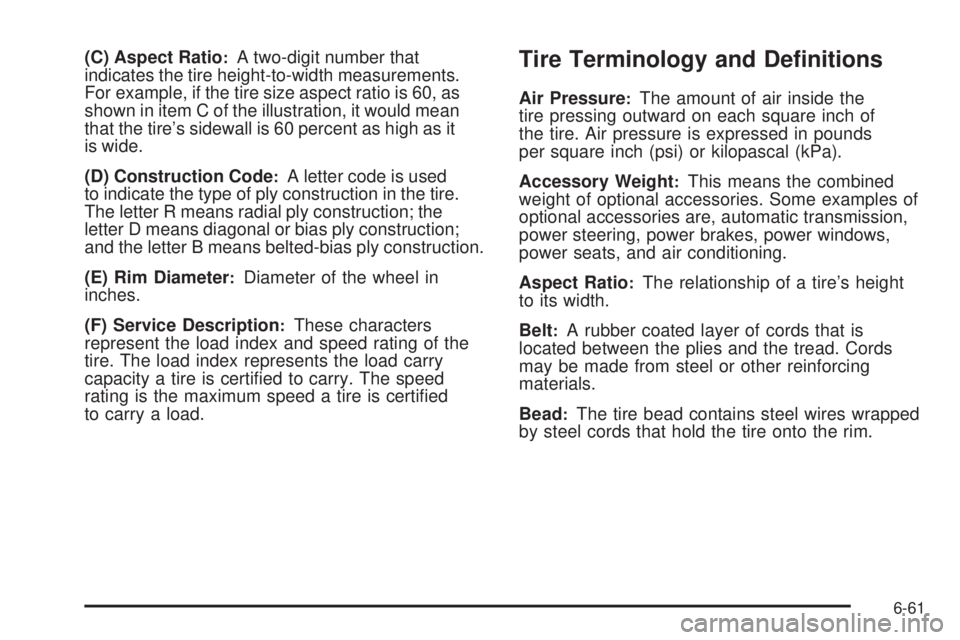
(C) Aspect Ratio:A two-digit number that
indicates the tire height-to-width measurements.
For example, if the tire size aspect ratio is 60, as
shown in item C of the illustration, it would mean
that the tire’s sidewall is 60 percent as high as it
is wide.
(D) Construction Code
:A letter code is used
to indicate the type of ply construction in the tire.
The letter R means radial ply construction; the
letter D means diagonal or bias ply construction;
and the letter B means belted-bias ply construction.
(E) Rim Diameter
:Diameter of the wheel in
inches.
(F) Service Description
:These characters
represent the load index and speed rating of the
tire. The load index represents the load carry
capacity a tire is certified to carry. The speed
rating is the maximum speed a tire is certified
to carry a load.
Tire Terminology and Denitions
Air Pressure:The amount of air inside the
tire pressing outward on each square inch of
the tire. Air pressure is expressed in pounds
per square inch (psi) or kilopascal (kPa).
Accessory Weight
:This means the combined
weight of optional accessories. Some examples of
optional accessories are, automatic transmission,
power steering, power brakes, power windows,
power seats, and air conditioning.
Aspect Ratio
:The relationship of a tire’s height
to its width.
Belt
:A rubber coated layer of cords that is
located between the plies and the tread. Cords
may be made from steel or other reinforcing
materials.
Bead
:The tire bead contains steel wires wrapped
by steel cords that hold the tire onto the rim.
6-61
Page 388 of 448

Fuses Usage
1 Air Conditioner Clutch
2 Electronic Throttle Control
3 Not UsedFuses Usage
4Transmission Control Module
Ignition 1
5 Mass Airflow Sensor (LY7)
6 Emission
6-120
Page 389 of 448

Fuses Usage
7 Left Headlamp Low Beam
8 Horn
9 Right Headlamp Low Beam
10 Front Fog Lamps
11 Left Headlamp High Beam
12 Right Headlamp High Beam
13 Engine Control Module (Battery)
14 Windshield Wiper
15 Antilock Brake System (IGN 1)
16 Engine Control Module (IGN 1)
17 Cooling Fan 1
18 Cooling Fan 2
19Run Relay, Heating, Ventilation,
Air Conditioning Blower
20 Body Control Module 1
21 Body Control Module Run/Crank
22 Rear Electrical Center 1
23 Rear Electrical Center 2
24 Antilock Brake System
25 Body Control Module 2Fuses Usage
26 Starter
41 Electric Power Steering
42Transmission Control Module
Battery
43Ignition Module (LE5, LE9, LZ4,
LZE, LZ9), Odd Cylinder
Injectors/Ignition Coils (LY7)
44Injectors (LE5, LE9, LZ4, LZE, LZ9),
Even Cylinder Injectors/Ignition
Coils (LY7)
45Rear Oxygen Sensors
(LZ4, LZE, LZ9, LY7)
46 Daytime Running Lamps
47 Center High-Mounted Stoplamp
50Front Power Windows Coupe/
Retractable Hardtop
51 Not Used
52 AIR Solenoid
54 Regulated Voltage Control
55 Antilock Brake System (Battery)
6-121
Page 393 of 448

Capacities and Specications
The following approximate capacities are given in English and metric conversions. SeeRecommended Fluids and
Lubricants on page 7-10for more information.
ApplicationCapacities
Metric English
Air Conditioning Refrigerant R134aFor the air conditioning system refrigerant charge
amount, see the refrigerant caution label located
under the hood. See your dealer/retailer for more
information.
Automatic Transmission*
Automatic 4-Speed 4T65 Transmission
(Bottom Pan Removal)7.0 L 7.4 qt
Automatic 4-Speed 4T45 Transmission
(Bottom Pan Removal)6.6 L 7.0 qt
Automatic 6-Speed 6T40 Transmission (Drain and Refill) 6.0 L 6.3 qt
Automatic 6-Speed 6T70 Transmission (Drain and Refill) 9.0 L 9.5 qt
6-125
Page 394 of 448

ApplicationCapacities
Metric English
Cooling System
2.4L L4 Engine 7.1 L 7.5 qt
3.5L, 3.6L, 3.9L V6 Engines 9.2 L 9.7 qt
Engine Oil with Filter
2.4L L4 Engine 4.7 L 5.0 qt
3.5L and 3.9L V6 Engines 3.8 L 4.0 qt
3.6L V6 Engine 5.2 L 5.5 qt
Fuel Tank 61.7 L 16.3 gal
Wheel Nut Torque 140Y100 lb ft
*Transmission fluid capacity is approximate. SeeAutomatic Transmission Fluid (2.4L L4, 3.5L V6 and
3.6L V6 Engines) on page 6-27orAutomatic Transmission Fluid (3.9L V6 Engine) on page 6-28for
information on checking fluid level.
All capacities are approximate. When adding, be sure to fill to the approximate level, as recommended in this
manual.
6-126
Page 395 of 448
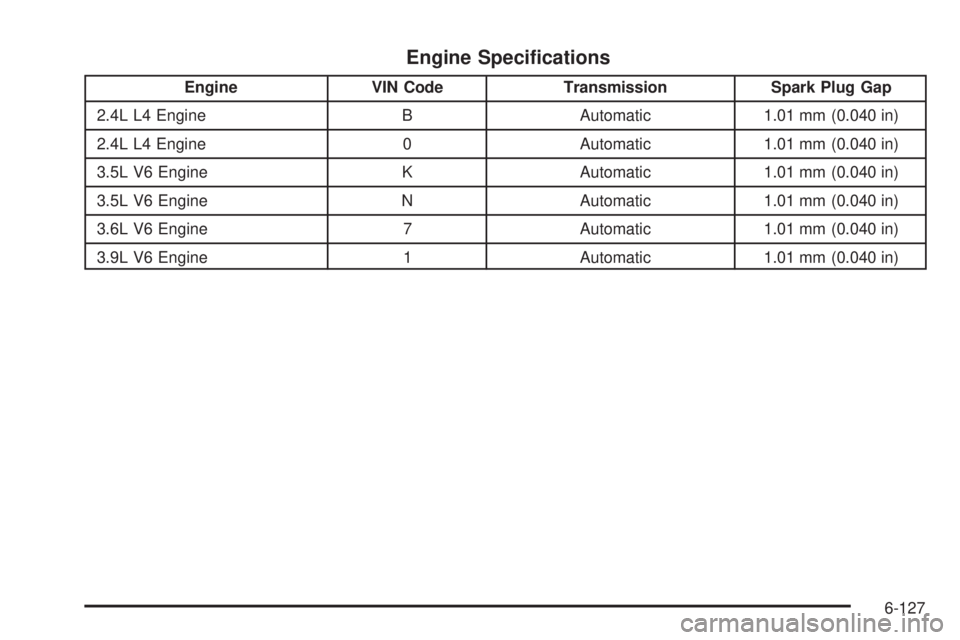
Engine Specications
Engine VIN Code Transmission Spark Plug Gap
2.4L L4 Engine B Automatic 1.01 mm (0.040 in)
2.4L L4 Engine 0 Automatic 1.01 mm (0.040 in)
3.5L V6 Engine K Automatic 1.01 mm (0.040 in)
3.5L V6 Engine N Automatic 1.01 mm (0.040 in)
3.6L V6 Engine 7 Automatic 1.01 mm (0.040 in)
3.9L V6 Engine 1 Automatic 1.01 mm (0.040 in)
6-127