cooling PONTIAC G8 2009 User Guide
[x] Cancel search | Manufacturer: PONTIAC, Model Year: 2009, Model line: G8, Model: PONTIAC G8 2009Pages: 356, PDF Size: 1.83 MB
Page 219 of 356
{CAUTION
Heater and radiator hoses, and
other engine parts, can be very
hot. Do not touch them. If you do,
you can be burned.
Do not run the engine if there is
a leak. If you run the engine, it
could lose all coolant. That could
cause an engine re, and you
could be burned. Get any leak
xed before you drive the vehicle.Notice:Using coolant other
than DEX-COOL
®can cause
premature engine, heater core, or
radiator corrosion. In addition,
the engine coolant could require
changing sooner, at 30,000 miles
(50 000 km) or 24 months,
whichever occurs rst. Any
repairs would not be covered by
the vehicle warranty. Always
use DEX-COOL
®(silicate-free)
coolant in the vehicle.
Engine Coolant
The cooling system in the vehicle is
lled with DEX-COOL®engine
coolant. This coolant is designed to
remain in the vehicle for ve years
or 150,000 miles (240 000 km),
whichever occurs rst.
The following explains the cooling
system and how to check and add
coolant when it is low. If there is a
problem with engine overheating,
seeEngine Overheating on
page 9-20.
Vehicle Service and Care 9-15
Page 220 of 356
What to Use
{CAUTION
Adding only plain water to the
cooling system can be dangerous.
Plain water, or some other liquid
such as alcohol, can boil before
the proper coolant mixture will.
The vehicle’s coolant warning
system is set for the proper
coolant mixture. With plain water
or the wrong mixture, the engine
could get too hot but you would
not get the overheat warning. The
engine could catch re and you or
others could be burned. Use a
50/50 mixture of clean, drinkable
water and DEX-COOL
®coolant.Use a 50/50 mixture of clean,
drinkable water and DEX-COOL
®
coolant. If using this mixture,
nothing else needs to be added.
This mixture:
Gives freezing protection down
to−34°F (−37°C), outside
temperature.
Gives boiling protection up to
265°F (129°C), engine
temperature.
Protects against rust and
corrosion.
Will not damage aluminum parts.
Helps keep the proper engine
temperature.Notice:If an improper coolant
mixture is used, the engine could
overheat and be badly damaged.
The repair cost would not be
covered by the vehicle warranty.
Too much water in the mixture
can freeze and crack the engine,
radiator, heater core, and
other parts.
Notice:If extra inhibitors and/or
additives are used in the vehicle’s
cooling system, the vehicle
could be damaged. Use only the
proper mixture of the engine
coolant listed in this manual
for the cooling system. See
Recommended Fluids and
Lubricants on page 11-12for
more information.
9-16 Vehicle Service and Care
Page 221 of 356
Checking Coolant
The vehicle must be on a level
surface when checking the
coolant level.
Check to see if coolant is visible in
the coolant recovery tank. If the
coolant inside the coolant recovery
tank is boiling, do not do anything
else until it cools down. If coolant is
visible but the coolant level is not
at or above the COLD mark,
add a 50/50 mixture of clean,
drinkable water and DEX-COOL
®
coolant at the coolant recovery tank,
but be sure the cooling system is
cool before this is done. See Engine
Coolant Engine Coolant for more
information.The coolant reservoir is located in
the engine compartment on the
passenger side of the vehicle.
SeeEngine Compartment Overview
on page 9-6for more information
on location.
The coolant level should be at or
above the top mark on the coolant
reservoir dipstick. If it is not,
you may have a leak in the cooling
system.
How to Add Coolant to the
Recovery Tank
{CAUTION
You can be burned if you spill
coolant on hot engine parts.
Coolant contains ethylene glycol
and it will burn if the engine parts
are hot enough. Do not spill
coolant on a hot engine.
Notice:This vehicle has a
specic coolant ll procedure.
Failure to follow this procedure
could cause the engine to
overheat and be severely
damaged.
If coolant is needed, add the proper
DEX-COOL
®coolant mixture at
the coolant recovery tank.
Vehicle Service and Care 9-17
Page 222 of 356
How to Add Coolant to the
Radiator
{CAUTION
You can be burned if you spill
coolant on hot engine parts.
Coolant contains ethylene glycol
and it will burn if the engine parts
are hot enough. Do not spill
coolant on a hot engine.
Notice:This vehicle has a
specic coolant ll procedure.
Failure to follow this procedure
could cause the engine to
overheat and be severely
damaged.
{CAUTION
An electric engine cooling fan
under the hood can start up even
when the engine is not running and
can cause injury. Keep hands,
clothing, and tools away from any
underhood electric fan.
{CAUTION
Steam and scalding liquids from a
hot cooling system can blow out
and burn you badly. They are
under pressure, and if you turn
the radiator pressure cap — even
a little — they can come out at
high speed. Never turn the cap
(Continued)
CAUTION (Continued)
when the cooling system,
including the radiator pressure
cap, is hot. Wait for the cooling
system and radiator pressure cap
to cool if you ever have to turn
the pressure cap.
If coolant is needed, add the proper
mixture directly to the radiator,
but be sure the cooling system is
cool before this is done.
9-18 Vehicle Service and Care
Page 224 of 356
Engine Overheating
The vehicle has an indicator to
warn of engine overheating.
There is an engine coolant
temperature warning light on
your vehicle’s instrument panel.
SeeEngine Coolant Temperature
Gage on page 4-17.
You may decide not to lift the hood
when this warning appears, but
instead get service help right away.
SeeRoadside Assistance Program
on page 12-6.
If you do decide to lift the hood,
make sure the vehicle is parked on
a level surface.Then check to see if the engine
cooling fans are running. If the
engine is overheating, both fans
should be running. If they are
not, do not continue to run the
engine and have the vehicle
serviced.
Notice:Engine damage from
running the engine without
coolant is not covered by the
warranty.
Notice:If the engine catches re
because of being driven with
no coolant, your vehicle can be
badly damaged. The costly
repairs would not be covered by
the vehicle warranty.
If Steam Is Coming From The
Engine Compartment
{CAUTION
Steam from an overheated engine
can burn you badly, even if you
just open the hood. Stay away
from the engine if you see or hear
steam coming from it. Just turn it
off and get everyone away from
the vehicle until it cools down.
Wait until there is no sign of
steam or coolant before you
open the hood.
If you keep driving when your
engine is overheated, the liquids
in it can catch re. You or others
could be badly burned. Stop your
engine if it overheats, and get out
of the vehicle until the engine
is cool.
9-20 Vehicle Service and Care
Page 243 of 356
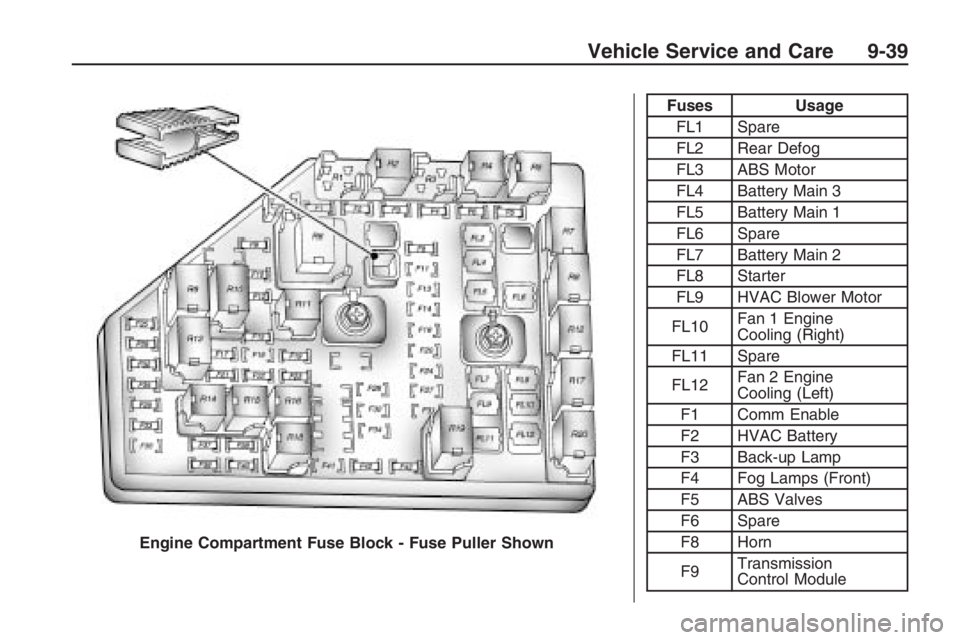
Fuses UsageFL1 Spare
FL2 Rear Defog
FL3 ABS Motor
FL4 Battery Main 3
FL5 Battery Main 1
FL6 Spare
FL7 Battery Main 2
FL8 Starter
FL9 HVAC Blower Motor
FL10 Fan 1 Engine
Cooling (Right)
FL11 Spare
FL12 Fan 2 Engine
Cooling (Left)
F1 Comm Enable
F2 HVAC Battery
F3 Back-up Lamp
F4 Fog Lamps (Front)
F5 ABS Valves
F6 Spare
F8 Horn
F9 Transmission
Control Module
Engine Compartment Fuse Block - Fuse Puller Shown
Vehicle Service and Care 9-39
Page 244 of 356
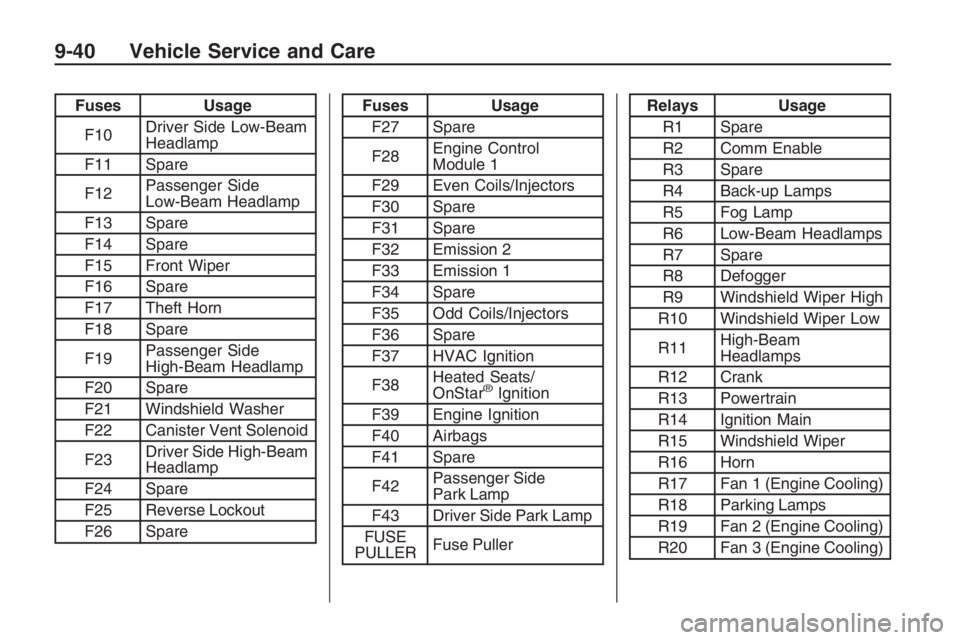
Fuses Usage
F10Driver Side Low-Beam
Headlamp
F11 Spare
F12Passenger Side
Low-Beam Headlamp
F13 Spare
F14 Spare
F15 Front Wiper
F16 Spare
F17 Theft Horn
F18 Spare
F19Passenger Side
High-Beam Headlamp
F20 Spare
F21 Windshield Washer
F22 Canister Vent Solenoid
F23Driver Side High-Beam
Headlamp
F24 Spare
F25 Reverse Lockout
F26 SpareFuses Usage
F27 Spare
F28Engine Control
Module 1
F29 Even Coils/Injectors
F30 Spare
F31 Spare
F32 Emission 2
F33 Emission 1
F34 Spare
F35 Odd Coils/Injectors
F36 Spare
F37 HVAC Ignition
F38Heated Seats/
OnStar
®Ignition
F39 Engine Ignition
F40 Airbags
F41 Spare
F42Passenger Side
Park Lamp
F43 Driver Side Park Lamp
FUSE
PULLERFuse Puller
Relays Usage
R1 Spare
R2 Comm Enable
R3 Spare
R4 Back-up Lamps
R5 Fog Lamp
R6 Low-Beam Headlamps
R7 Spare
R8 Defogger
R9 Windshield Wiper High
R10 Windshield Wiper Low
R11High-Beam
Headlamps
R12 Crank
R13 Powertrain
R14 Ignition Main
R15 Windshield Wiper
R16 Horn
R17 Fan 1 (Engine Cooling)
R18 Parking Lamps
R19 Fan 2 (Engine Cooling)
R20 Fan 3 (Engine Cooling)
9-40 Vehicle Service and Care
Page 268 of 356
Wheel Alignment and
Tire Balance
The tires and wheels on your vehicle
were aligned and balanced carefully
at the factory to give you the longest
tire life and best overall performance.
Adjustments to wheel alignment and
tire balancing will not be necessary
on a regular basis. However, if you
notice unusual tire wear or your
vehicle pulling to one side or the
other, the alignment might need to be
checked. If you notice your vehicle
vibrating when driving on a smooth
road, the tires and wheels might
need to be rebalanced. See your
dealer/retailer for proper diagnosis.
Wheel Replacement
Replace any wheel that is bent,
cracked or badly rusted or corroded.
If wheel nuts keep coming loose, the
wheel, wheel bolts and wheel nuts
should be replaced. If the wheel
leaks air, replace it (except some
aluminum wheels, which can
sometimes be repaired). See your
dealer/retailer if any of these
conditions exist.
Your dealer/retailer will know the
kind of wheel you need.
Each new wheel should have
the same load-carrying capacity,
diameter, width, offset and be
mounted the same way as the
one it replaces.
If you need to replace any of the
wheels, wheel bolts or wheel
nuts, replace them only with new
GM original equipment parts.
This way, you will be sure to have
the right wheel, wheel bolts and
wheel nuts for the vehicle.{CAUTION
Using the wrong replacement
wheels, wheel bolts, or wheel nuts
on your vehicle can be dangerous.
It could affect the braking and
handling of your vehicle, make
your tires lose air and make you
lose control. You could have a
collision in which you or others
could be injured. Always use the
correct wheel, wheel bolts, and
wheel nuts for replacement.
Notice:The wrong wheel can
also cause problems with bearing
life, brake cooling, speedometer
or odometer calibration, headlamp
aim, bumper height, vehicle
ground clearance, and tire or tire
chain clearance to the body and
chassis.
SeeChanging a Flat Tire on
page 9-75for more information.
9-64 Vehicle Service and Care
Page 299 of 356
When You Are Ready to Leave
After Parking on a Hill
1. Apply your regular brakes and
hold the pedal down while you:
Start your engine.
Shift into a gear.
Release the parking brake.
2. Let up on the brake pedal.
3. Drive slowly until the trailer is
clear of the chocks.
4. Stop and have someone pick up
and store the chocks.
Maintenance When Trailer
Towing
Your vehicle will need service more
often when you’re pulling a trailer.
See the Maintenance Schedule for
more on this. Things that are
especially important in trailer
operation are automatic transmission
uid (don’t overll), engine oil, drivebelt, cooling system and brake
system. Each of these is covered in
this manual, and the Index will help
you nd them quickly. If you’re
trailering, it’s a good idea to review
this information before you start
your trip.
Check periodically to see that all
hitch nuts and bolts are tight.
Engine Cooling When Trailer
Towing
Your cooling system may
temporarily overheat during severe
operating conditions. SeeEngine
Overheating on page 9-20.
Appearance Care
Interior Cleaning
Your vehicle’s interior will continue to
look its best if it is cleaned often.
Although not always visible, dust and
dirt can accumulate on your
upholstery. Dirt can damage carpet,
fabric, leather, and plastic surfaces.
Regular vacuuming is recommended
to remove particles from the
upholstery. It is important to keep
your upholstery from becoming and
remaining heavily soiled. Soils
should be removed as quickly as
possible. Your vehicle’s interior may
experience extremes of heat that
could cause stains to set rapidly.
Lighter colored interiors may require
more frequent cleaning. Use care
because newspapers and garments
that transfer color to your home
furnishings may also transfer color
to your vehicle’s interior.
Vehicle Service and Care 9-95
Page 308 of 356
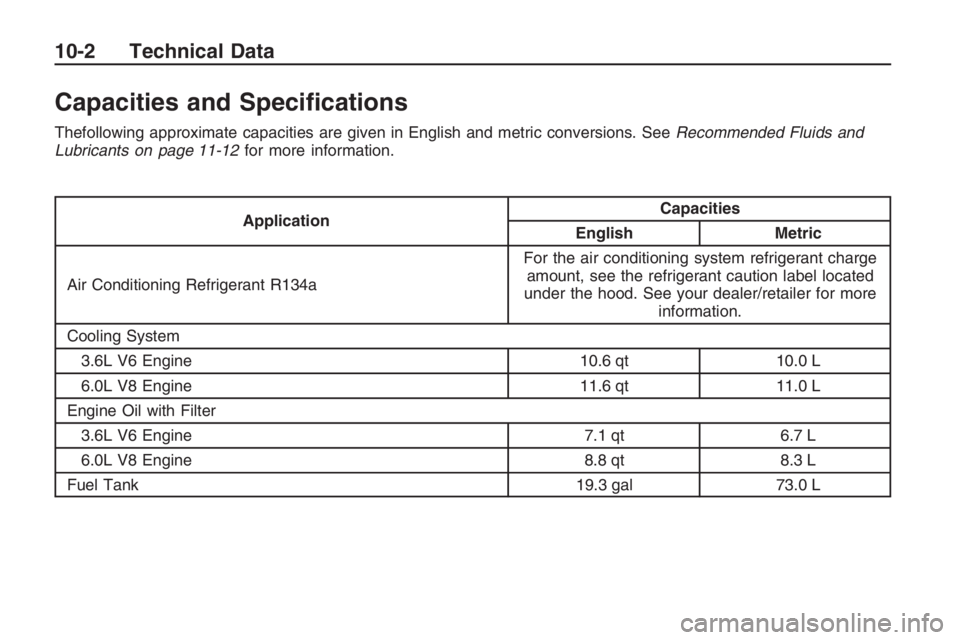
Capacities and Specications
Thefollowing approximate capacities are given in English and metric conversions. SeeRecommended Fluids and
Lubricants on page 11-12 for more information.
Application Capacities
English Metric
Air Conditioning Refrigerant R134a For the air conditioning system refrigerant charge
amount, see the refrigerant caution label located
under the hood. See your dealer/retailer for more information.
Cooling System 3.6L V6 Engine 10.6 qt 10.0 L
6.0L V8 Engine 11.6 qt 11.0 L
Engine Oil with Filter 3.6L V6 Engine 7.1 qt 6.7 L
6.0L V8 Engine 8.8 qt 8.3 L
Fuel Tank 19.3 gal 73.0 L
10-2 Technical Data