radiator PONTIAC G8 2009 User Guide
[x] Cancel search | Manufacturer: PONTIAC, Model Year: 2009, Model line: G8, Model: PONTIAC G8 2009Pages: 356, PDF Size: 1.83 MB
Page 237 of 356
10. Reconnect the wiring harness
to the bulb socket.
11. Push the bulb socket into the
lamp assembly and turn it
clockwise to lock it into place.
12. Turn the dust cap clockwise to
lock it into place.
13. For the driver side reinstall the
air cleaner/lter cover.
14. For the passenger side reinstall
the coolant bottle ller neck.
15. Reinstall the radiator support
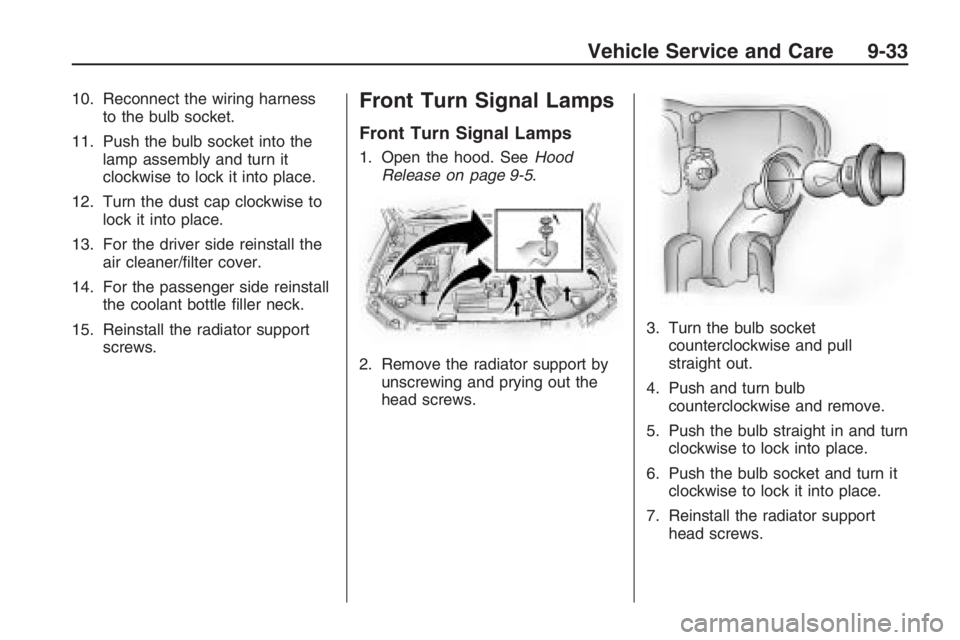
screws.Front Turn Signal Lamps
Front Turn Signal Lamps
1. Open the hood. SeeHood
Release on page 9-5.
2. Remove the radiator support by
unscrewing and prying out the
head screws.3. Turn the bulb socket
counterclockwise and pull
straight out.
4. Push and turn bulb
counterclockwise and remove.
5. Push the bulb straight in and turn
clockwise to lock into place.
6. Push the bulb socket and turn it
clockwise to lock it into place.
7. Reinstall the radiator support
head screws.
Vehicle Service and Care 9-33
Page 317 of 356
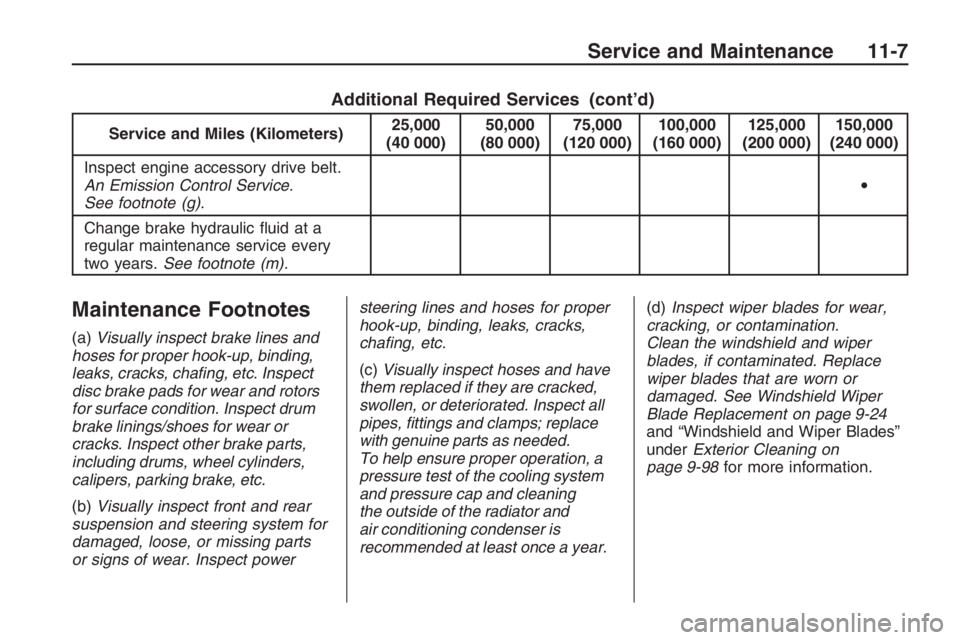
Additional Required Services (cont’d)
Service and Miles (Kilometers)25,000
(40 000) 50,000
(80 000) 75,000
(120 000) 100,000
(160 000) 125,000
(200 000) 150,000
(240 000)
Inspect engine accessory drive belt.
An Emission Control Service.
See footnote (g). •
Change brake hydraulic uid at a
regular maintenance service every
two years. See footnote (m).
Maintenance Footnotes
(a)Visually inspect brake lines and
hoses for proper hook-up, binding,
leaks, cracks, chafing, etc. Inspect
disc brake pads for wear and rotors
for surface condition. Inspect drum
brake linings/shoes for wear or
cracks. Inspect other brake parts,
including drums, wheel cylinders,
calipers, parking brake, etc.
(b) Visually inspect front and rear
suspension and steering system for
damaged, loose, or missing parts
or signs of wear. Inspect power steering lines and hoses for proper
hook-up, binding, leaks, cracks,
chafing, etc.
(c)
Visually inspect hoses and have
them replaced if they are cracked,
swollen, or deteriorated. Inspect all
pipes, fittings and clamps; replace
with genuine parts as needed.
To help ensure proper operation, a
pressure test of the cooling system
and pressure cap and cleaning
the outside of the radiator and
air conditioning condenser is
recommended at least once a year. (d)
Inspect wiper blades for wear,
cracking, or contamination.
Clean the windshield and wiper
blades, if contaminated. Replace
wiper blades that are worn or
damaged. See Windshield Wiper
Blade Replacement on page 9-24
and “Windshield and Wiper Blades”
under Exterior Cleaning on
page 9-98 for more information.
Service and Maintenance 11-7
Page 318 of 356
(e)Make sure the safety belt
reminder light and safety belt
assemblies are working properly.
Look for any other loose or damaged
safety belt system parts. If you see
anything that might keep a safety belt
system from doing its job, have it
repaired. Have any torn or frayed
safety belts replaced. Also see
Airbag System Check on page 1-33.
(f)Lubricate all key lock cylinders,
door hinges and latches, hood
hinges and latches and trunk lid
hinges and latches. More frequent
lubrication may be required when
exposed to a corrosive environment.
Applying silicone grease on
weatherstrips with a clean cloth will
make them last longer, seal
better, and not stick or squeak.
(g)Visually inspect belt for fraying,
excessive cracks, or obvious
damage. Replace belt if necessary.(h)Change automatic transmission
fluid and filter if the vehicle is
mainly driven under one or more of
these conditions:
In heavy city traffic where the
outside temperature regularly
reaches 90°F (32°C) or higher.
In hilly or mountainous terrain.
When doing frequent trailer
towing.
Uses such as found in taxi,
police, or delivery service.
(i)Drain, flush, and refill cooling
system. This service can be
complex; you should have your
dealer/retailer perform this service.
See Engine Coolant on page 9-15
for what to use. Inspect hoses.
Clean radiator, condenser, pressure
cap, and filler neck. Pressure test the
cooling system and pressure cap.(j)A fluid loss in any vehicle system
could indicate a problem. Have the
system inspected and repaired and
the fluid level checked. Add fluid
if needed.
(k)If you drive regularly under dusty
conditions, inspect the filter at
each engine oil change.
(l)If you drive regularly under dusty
conditions, the filter may require
replacement more often.
(m)Drain, flush, and refill brake
hydraulic system at a regular service
interval (IorII) every two years.
This service can be complex;
you should have your dealer/retailer
perform this service. See Brakes
on page 9-25.
11-8 Service and Maintenance